Скачать презентацию Time Value of Money Presenters Khairulla Aigul Zhumatayev
Time Value of Money.pptx
- Количество слайдов: 13
 Time Value of Money Presenters: Khairulla Aigul Zhumatayev Olzhas
 Time Value of Money • Time Value of Money (TVM) can be used to compare investment alternatives and to solve problems involving loans, mortgages, leases, savings, and annuities.
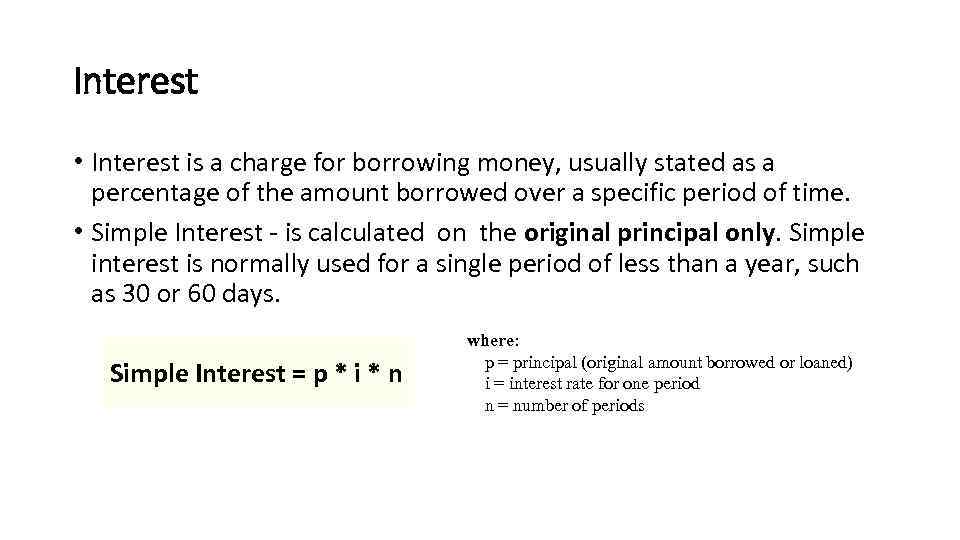 Interest • Interest is a charge for borrowing money, usually stated as a percentage of the amount borrowed over a specific period of time. • Simple Interest - is calculated on the original principal only. Simple interest is normally used for a single period of less than a year, such as 30 or 60 days. Simple Interest = p * i * n where: p = principal (original amount borrowed or loaned) i = interest rate for one period n = number of periods
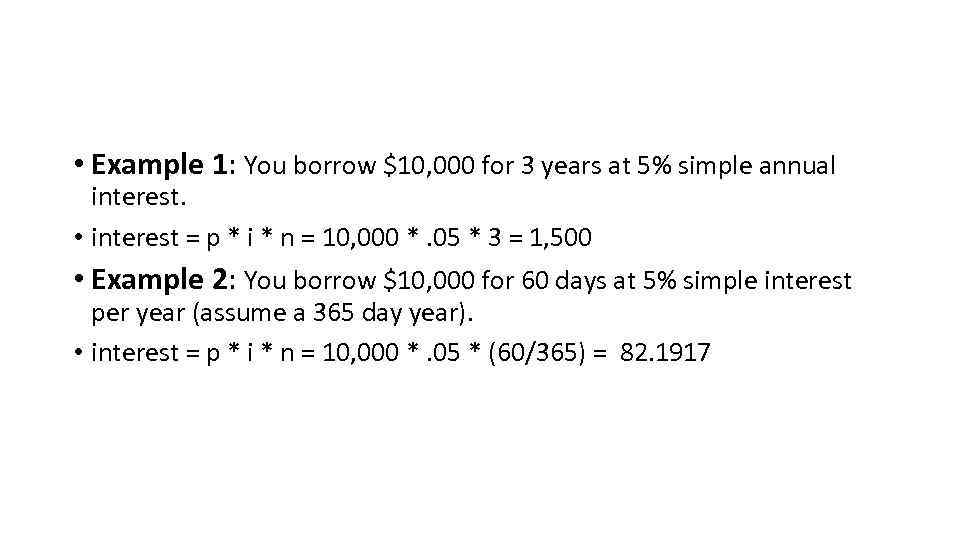 • Example 1: You borrow $10, 000 for 3 years at 5% simple annual interest. • interest = p * i * n = 10, 000 *. 05 * 3 = 1, 500 • Example 2: You borrow $10, 000 for 60 days at 5% simple interest per year (assume a 365 day year). • interest = p * i * n = 10, 000 *. 05 * (60/365) = 82. 1917
 Compound Interest • Compound interest is calculated each period on the original principal and all interest accumulated during past periods. Although the interest may be stated as a yearly rate, the compounding periods can be yearly, semiannually, quarterly, or even continuously.
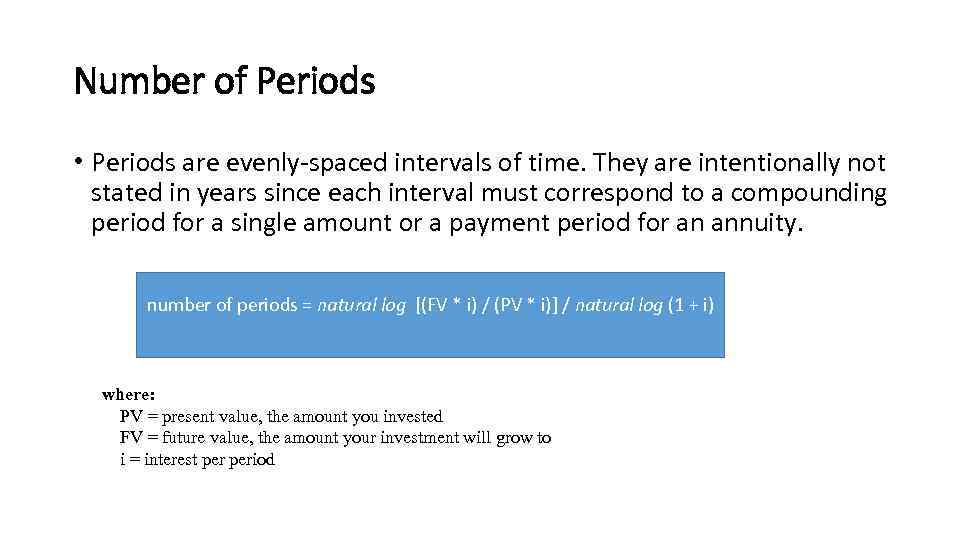 Number of Periods • Periods are evenly-spaced intervals of time. They are intentionally not stated in years since each interval must correspond to a compounding period for a single amount or a payment period for an annuity. number of periods = natural log [(FV * i) / (PV * i)] / natural log (1 + i) where: PV = present value, the amount you invested FV = future value, the amount your investment will grow to i = interest period
 Payments are a series of equal, evenly-spaced cash flows. In TVM applications, payments must represent all outflows (negative amount) or all inflows (positive amount). Payments must: • be the same amount each period • occur at evenly spaced intervals • occur exactly at the beginning or end of each period • be all inflows or all outflows (payments or receipts) • represent the payment during one compounding (or discount) period
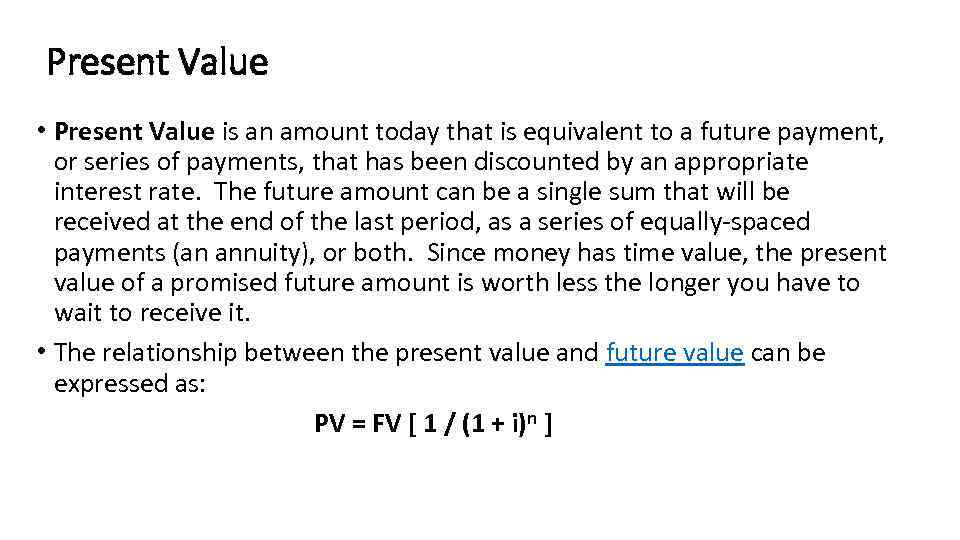 Present Value • Present Value is an amount today that is equivalent to a future payment, or series of payments, that has been discounted by an appropriate interest rate. The future amount can be a single sum that will be received at the end of the last period, as a series of equally-spaced payments (an annuity), or both. Since money has time value, the present value of a promised future amount is worth less the longer you have to wait to receive it. • The relationship between the present value and future value can be expressed as: PV = FV [ 1 / (1 + i)n ]
 Future Value • Future Value is the amount of money that an investment with a fixed, compounded interest rate will grow to by some future date. The investment can be a single sum deposited at the beginning of the first period, a series of equally-spaced payments (an annuity), or both. Since money has time value, we naturally expect the future value to be greater than the present value. The difference between the two depends on the number of compounding periods involved and the going interest rate.
 Loan Amortization • Amortization is a method for repaying a loan in equal installments. • Part of each payment goes toward interest and any remainder is used to reduce the principal. • As the balance of the loan is gradually reduced, a progressively larger portion of each payment goes toward reducing principal.
 Amortization Schedule • An amortization schedule is a table with a row for each payment period of an amortized loan. Each row shows the amount of the payment that is needed to pay interest, the amount that is used to reduce principal, and the balance of the loan remaining at the end of the period. Negative Amortization • Negative amortization occurs when the payment is not large enough to cover the interest due for a period. This will cause the loan balance to increase after each payment - a situation that should certainly be avoided. This might occur, for instance, if the rate of an adjustable-rate loan increases, but the payment does not.
 Cash Flow Diagram • A cash flow diagram is a picture of a financial problem that shows all cash inflows and outflows along a time line. It can help you to visualize a problem and to determine if it can be solved by TVM methods.