


 Скачать презентацию Time Value of Money P V Viswanath
17e8c4f33b79339174ecb1675873529c.ppt
- Количество слайдов: 53
 Time Value of Money P. V. Viswanath
 Key Concepts w Be able to compute the future value of an investment made today w Be able to compute the present value of cash to be received at some future date w Be able to compute the return on an investment P. V. Viswanath 2
 Chapter Outline w Future Value and Compounding w Present Value and Discounting w More on Present and Future Values P. V. Viswanath 3
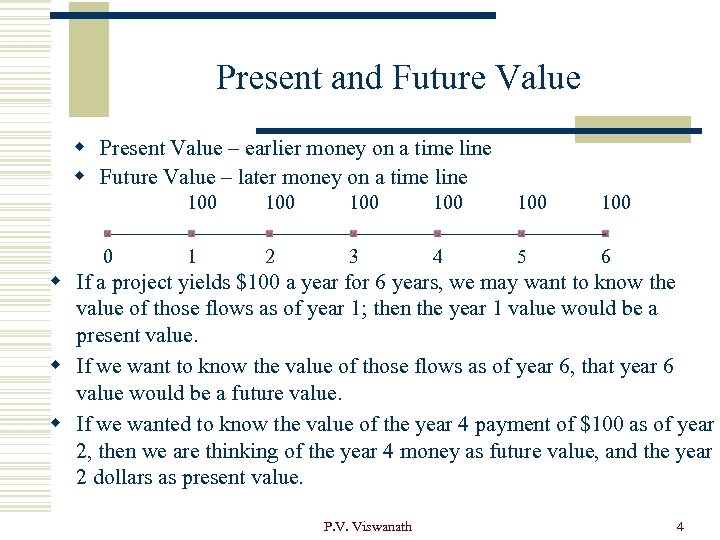 Present and Future Value w Present Value – earlier money on a time line w Future Value – later money on a time line 100 0 100 100 100 1 2 3 4 5 6 w If a project yields $100 a year for 6 years, we may want to know the value of those flows as of year 1; then the year 1 value would be a present value. w If we want to know the value of those flows as of year 6, that year 6 value would be a future value. w If we wanted to know the value of the year 4 payment of $100 as of year 2, then we are thinking of the year 4 money as future value, and the year 2 dollars as present value. P. V. Viswanath 4
 Rates and Prices w A rate is a “price” used to convert earlier money into later money, and vice-versa. w If $1 of today’s money is equal in value to $1. 05 of next period’s money, then the conversion rate is 0. 05 or 5%. w Equivalently, the price of today’s dollar in terms of next period money is 1. 05. The excess of next period’s monetary value over this period’s value (1. 05 – 1. 00 or 0. 05) is often referred to, as interest. w The price of next period’s money in terms of today’s money would be 1/1. 05 or 95. 24 cents. P. V. Viswanath 5
 Rate Terminology w Interest rate – “exchange rate” between earlier money and later money (normally the later money is certain). w Discount Rate – rate used to convert future value to present value. w Compounding rate – rate used to convert present value to future value. w Cost of capital – the rate at which the firm obtains funds for investment. w Opportunity cost of capital – the rate that the firm has to pay investors in order to obtain an additional $ of funds. w Required rate of return – the rate of return that investors demand for providing the firm with funds for investment. P. V. Viswanath 6
 Relation between rates w If capital markets are in equilibrium, the rate that the firm has to pay to obtain additional funds will be equal to the rate that investors will demand for providing those funds. This will be “the” market rate. w Hence this is the rate that should be used to convert future values to present values and vice-versa. w Hence this should be the discount rate used to convert future project (or security) cashflows into present values. P. V. Viswanath 7
 Discount Rates and Risk w In reality there is no single discount rate that can be used to evaluate all future cashflows. w The reason is that future cashflows differ not only in terms of when they occur, but also in terms of riskiness. w Hence, one needs to either convert future risky cashflows into certainty-equivalent cashflows, or, as is more commonly done, add a risk premium to the “certain-future-cashflows” discount rate to get the discount rate appropriate for risky-future-cashflows. P. V. Viswanath 8
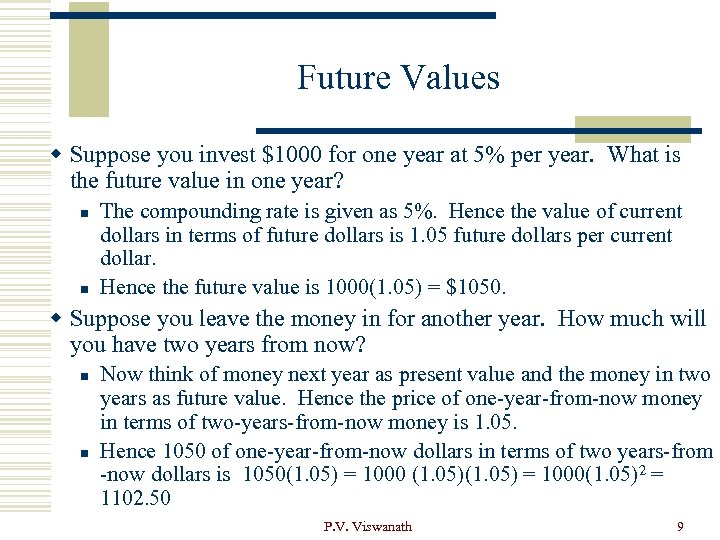 Future Values w Suppose you invest $1000 for one year at 5% per year. What is the future value in one year? n n The compounding rate is given as 5%. Hence the value of current dollars in terms of future dollars is 1. 05 future dollars per current dollar. Hence the future value is 1000(1. 05) = $1050. w Suppose you leave the money in for another year. How much will you have two years from now? n n Now think of money next year as present value and the money in two years as future value. Hence the price of one-year-from-now money in terms of two-years-from-now money is 1. 05. Hence 1050 of one-year-from-now dollars in terms of two years-from -now dollars is 1050(1. 05) = 1000(1. 05)2 = 1102. 50 P. V. Viswanath 9
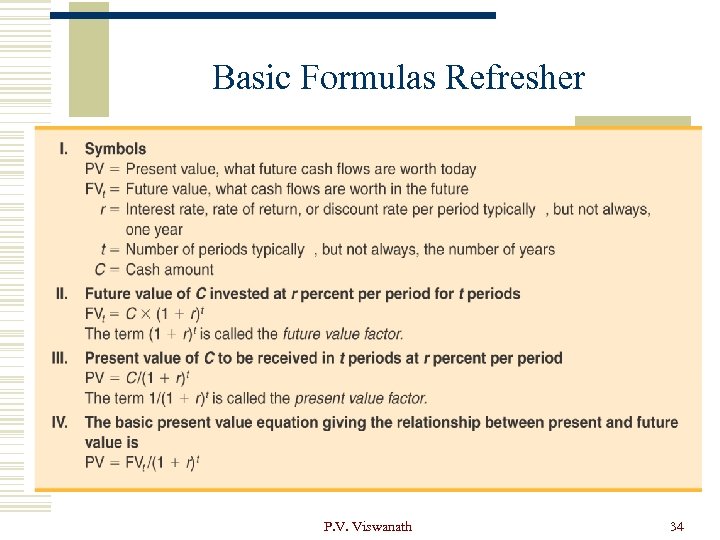
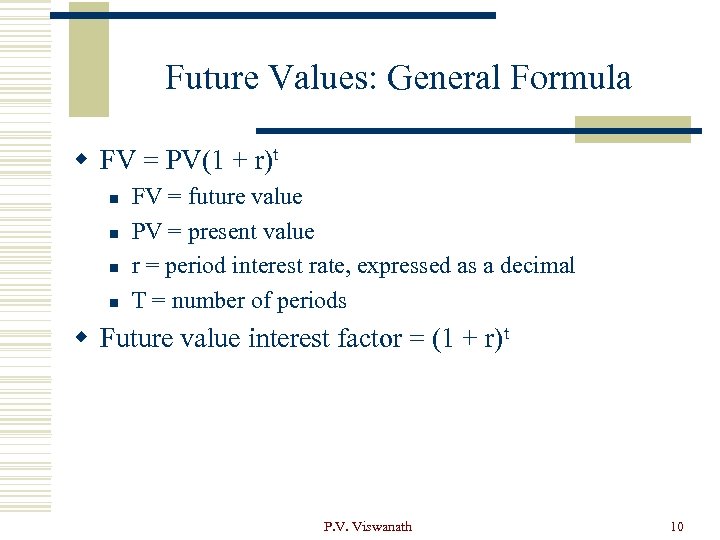 Future Values: General Formula w FV = PV(1 + r)t n n FV = future value PV = present value r = period interest rate, expressed as a decimal T = number of periods w Future value interest factor = (1 + r)t P. V. Viswanath 10
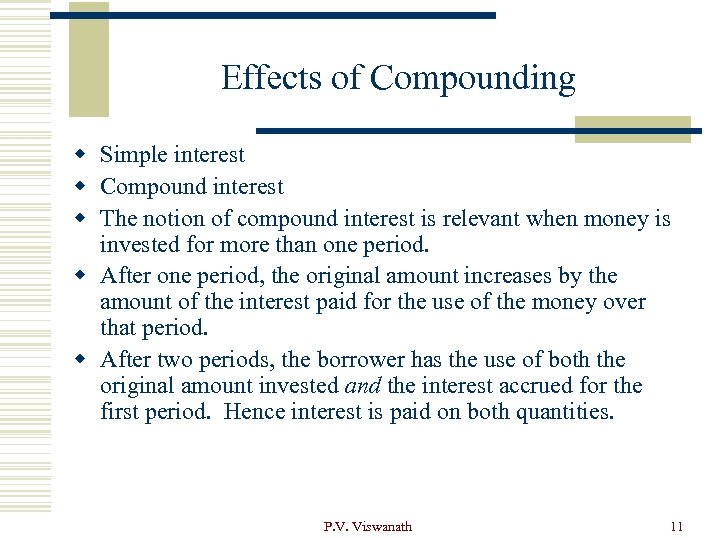 Effects of Compounding w Simple interest w Compound interest w The notion of compound interest is relevant when money is invested for more than one period. w After one period, the original amount increases by the amount of the interest paid for the use of the money over that period. w After two periods, the borrower has the use of both the original amount invested and the interest accrued for the first period. Hence interest is paid on both quantities. P. V. Viswanath 11
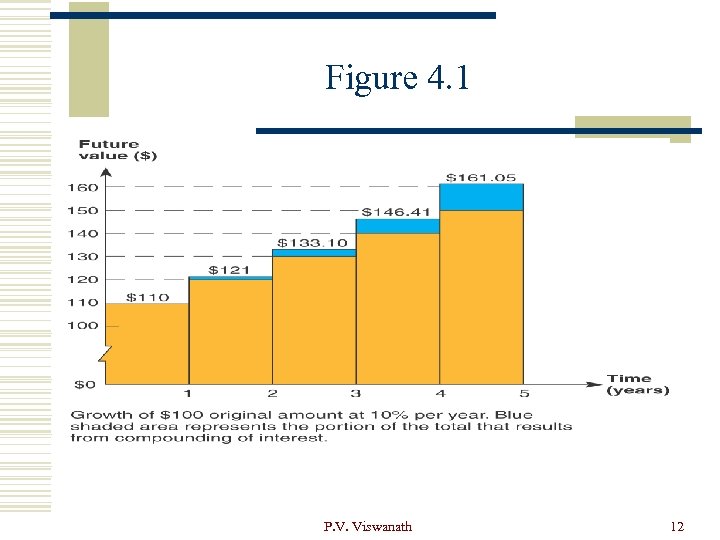 Figure 4. 1 P. V. Viswanath 12
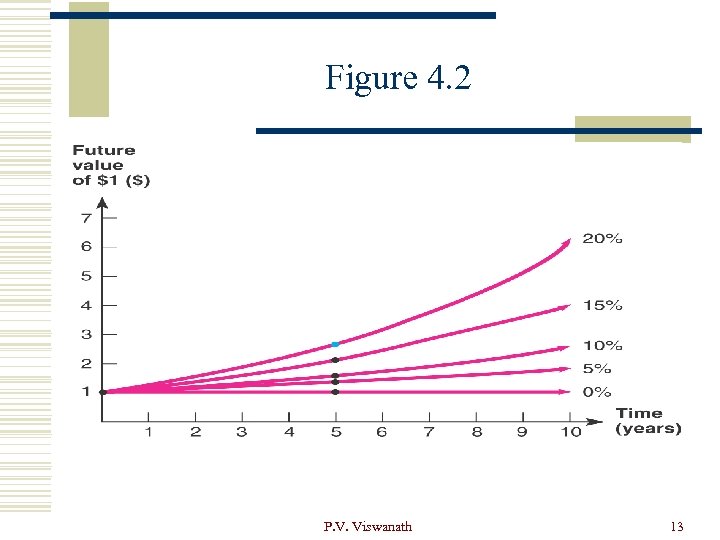 Figure 4. 2 P. V. Viswanath 13
 Future Values – Example 2 w Suppose you invest the $1000 from the previous example for 5 years. How much would you have? n FV = 1000(1. 05)5 = 1276. 28 w The effect of compounding is small for a small number of periods, but increases as the number of periods increases. (Simple interest would have a future value of $1250, for a difference of $26. 28. ) P. V. Viswanath 14
 Future Values – Example 3 w Suppose you had a relative deposit $10 at 5. 5% interest 200 years ago. How much would the investment be worth today? n FV = 10(1. 055)200 = 447, 189. 84 w What is the effect of compounding? n n Without compounding the future value would have been the original $10 plus the accrued interest of 10(0. 055)(200), or 10 + 110 = $120. Compounding caused the future value to be higher by an amount of $447, 069. 84! P. V. Viswanath 15
 Future Value as a General Growth Formula w Suppose your company expects to increase unit sales of books by 15% per year for the next 5 years. If you currently sell 3 million books in one year, how many books do you expect to sell in 5 years? n FV = 3, 000(1. 15)5 = 6, 034, 072 P. V. Viswanath 16
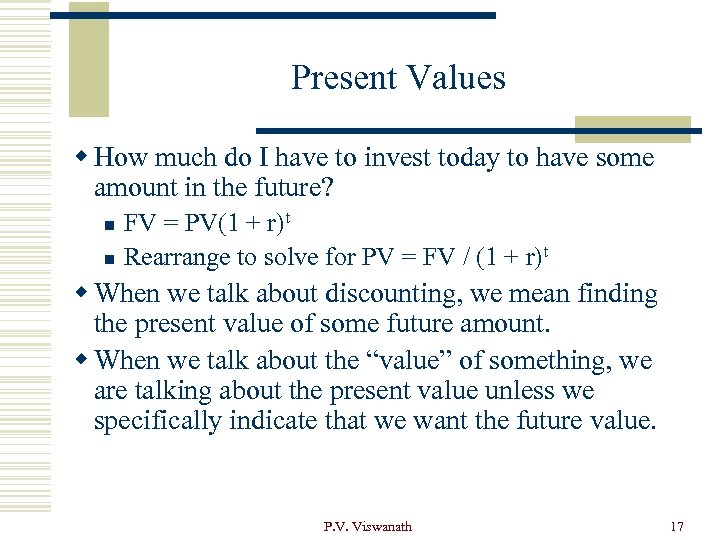 Present Values w How much do I have to invest today to have some amount in the future? n n FV = PV(1 + r)t Rearrange to solve for PV = FV / (1 + r)t w When we talk about discounting, we mean finding the present value of some future amount. w When we talk about the “value” of something, we are talking about the present value unless we specifically indicate that we want the future value. P. V. Viswanath 17
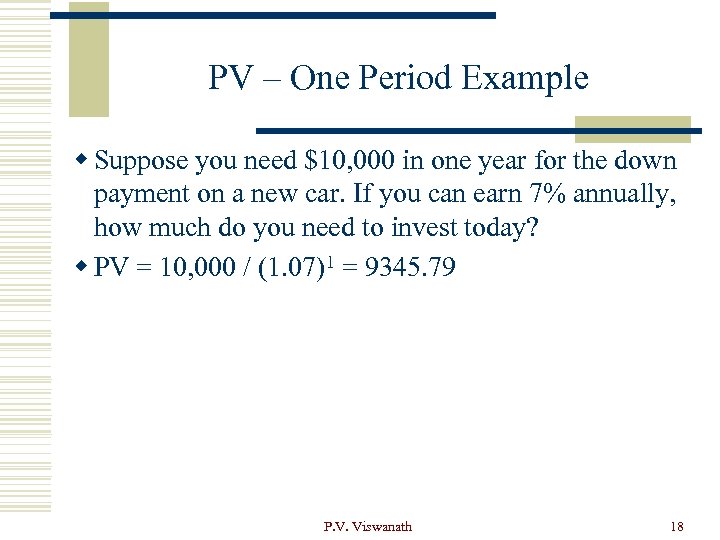 PV – One Period Example w Suppose you need $10, 000 in one year for the down payment on a new car. If you can earn 7% annually, how much do you need to invest today? w PV = 10, 000 / (1. 07)1 = 9345. 79 P. V. Viswanath 18
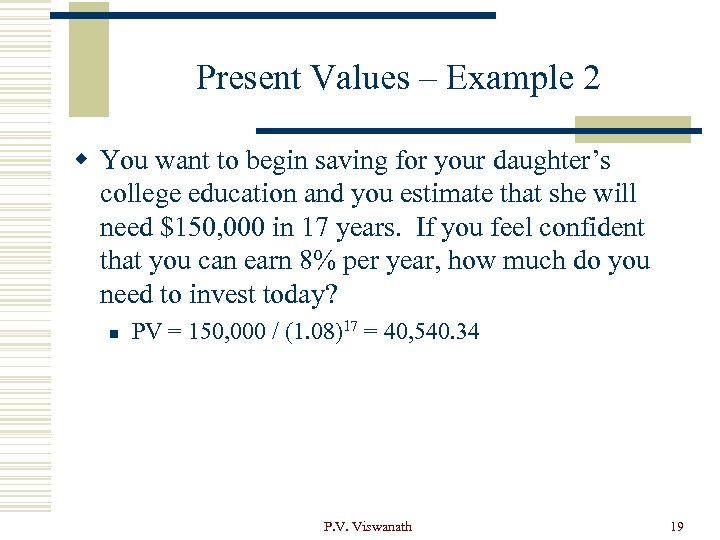 Present Values – Example 2 w You want to begin saving for your daughter’s college education and you estimate that she will need $150, 000 in 17 years. If you feel confident that you can earn 8% per year, how much do you need to invest today? n PV = 150, 000 / (1. 08)17 = 40, 540. 34 P. V. Viswanath 19
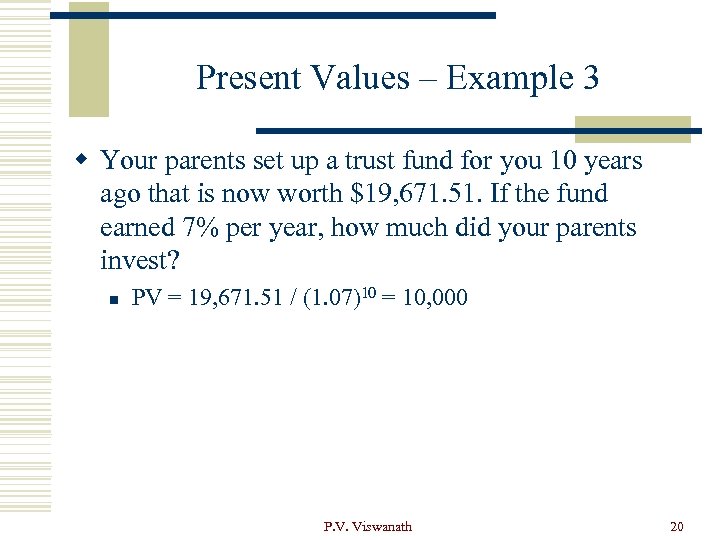 Present Values – Example 3 w Your parents set up a trust fund for you 10 years ago that is now worth $19, 671. 51. If the fund earned 7% per year, how much did your parents invest? n PV = 19, 671. 51 / (1. 07)10 = 10, 000 P. V. Viswanath 20
 PV – Important Relationship I w For a given interest rate – the longer the time period, the lower the present value n n n What is the present value of $500 to be received in 5 years? 10 years? The discount rate is 10% 5 years: PV = 500 / (1. 1)5 = 310. 46 10 years: PV = 500 / (1. 1)10 = 192. 77 P. V. Viswanath 21
 PV – Important Relationship II w For a given time period – the higher the interest rate, the smaller the present value n What is the present value of $500 received in 5 years if the interest rate is 10%? 15%? l l Rate = 10%: PV = 500 / (1. 1)5 = 310. 46 Rate = 15%; PV = 500 / (1. 15)5 = 248. 58 P. V. Viswanath 22
 Quick Quiz w What is the relationship between present value and future value? w Suppose you need $15, 000 in 3 years. If you can earn 6% annually, how much do you need to invest today? w If you could invest the money at 8%, would you have to invest more or less than at 6%? How much? P. V. Viswanath 23
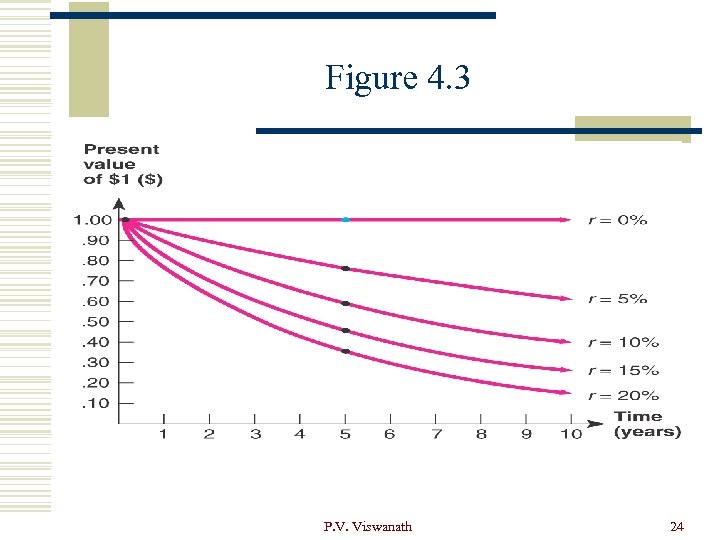 Figure 4. 3 P. V. Viswanath 24
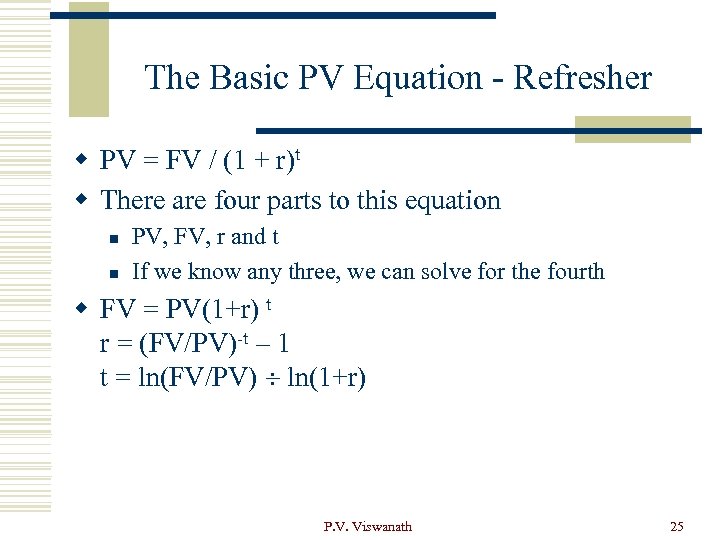 The Basic PV Equation - Refresher w PV = FV / (1 + r)t w There are four parts to this equation n n PV, FV, r and t If we know any three, we can solve for the fourth w FV = PV(1+r) t r = (FV/PV)-t – 1 t = ln(FV/PV) ln(1+r) P. V. Viswanath 25
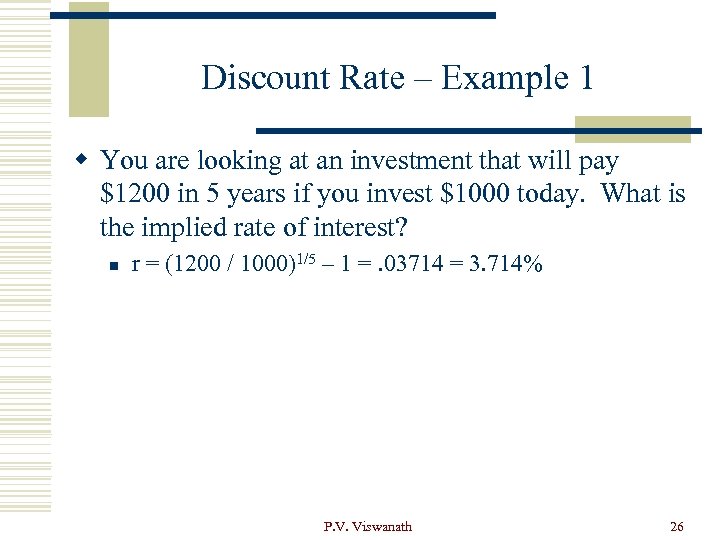 Discount Rate – Example 1 w You are looking at an investment that will pay $1200 in 5 years if you invest $1000 today. What is the implied rate of interest? n r = (1200 / 1000)1/5 – 1 =. 03714 = 3. 714% P. V. Viswanath 26
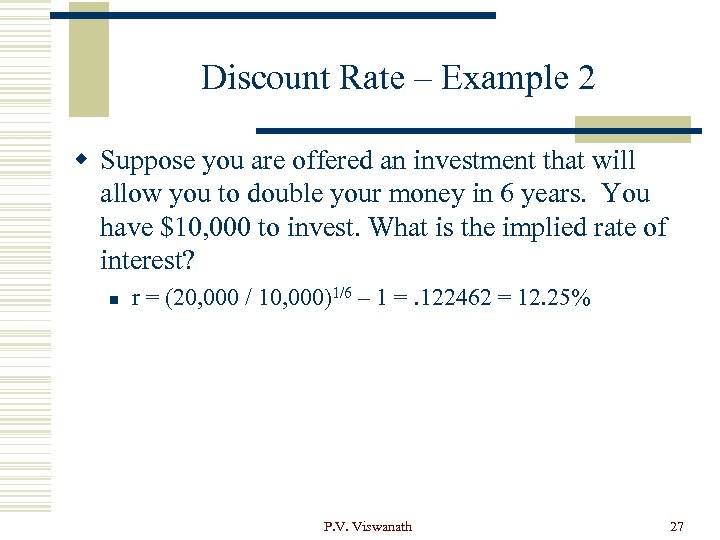 Discount Rate – Example 2 w Suppose you are offered an investment that will allow you to double your money in 6 years. You have $10, 000 to invest. What is the implied rate of interest? n r = (20, 000 / 10, 000)1/6 – 1 =. 122462 = 12. 25% P. V. Viswanath 27
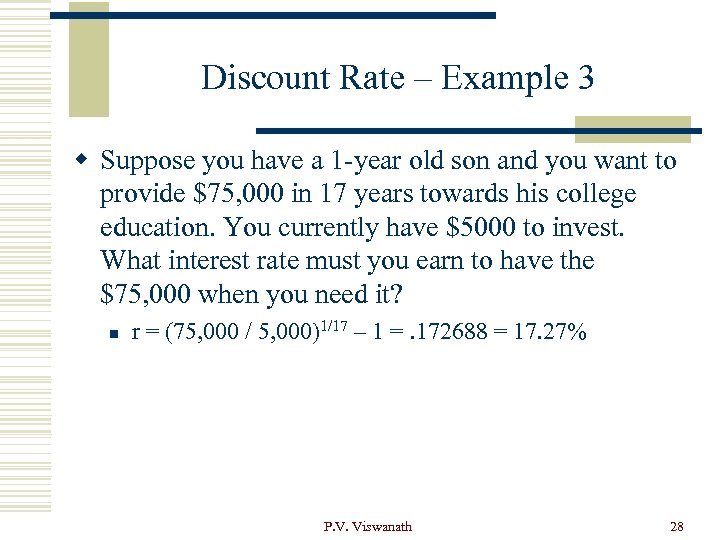 Discount Rate – Example 3 w Suppose you have a 1 -year old son and you want to provide $75, 000 in 17 years towards his college education. You currently have $5000 to invest. What interest rate must you earn to have the $75, 000 when you need it? n r = (75, 000 / 5, 000)1/17 – 1 =. 172688 = 17. 27% P. V. Viswanath 28
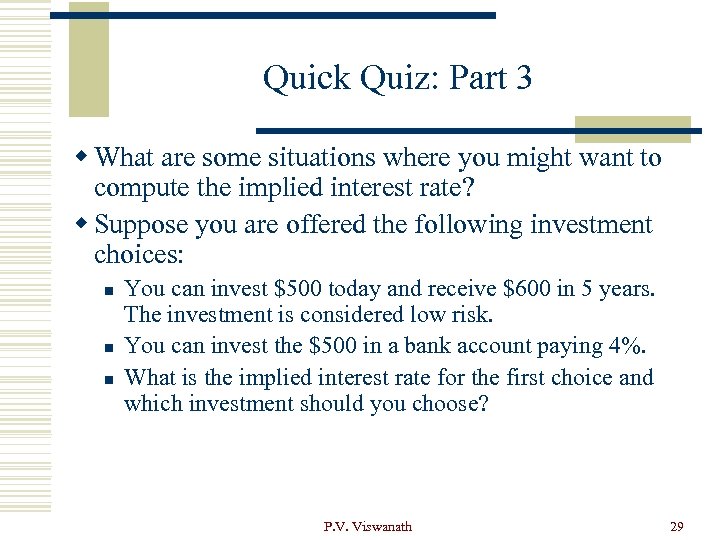 Quick Quiz: Part 3 w What are some situations where you might want to compute the implied interest rate? w Suppose you are offered the following investment choices: n n n You can invest $500 today and receive $600 in 5 years. The investment is considered low risk. You can invest the $500 in a bank account paying 4%. What is the implied interest rate for the first choice and which investment should you choose? P. V. Viswanath 29
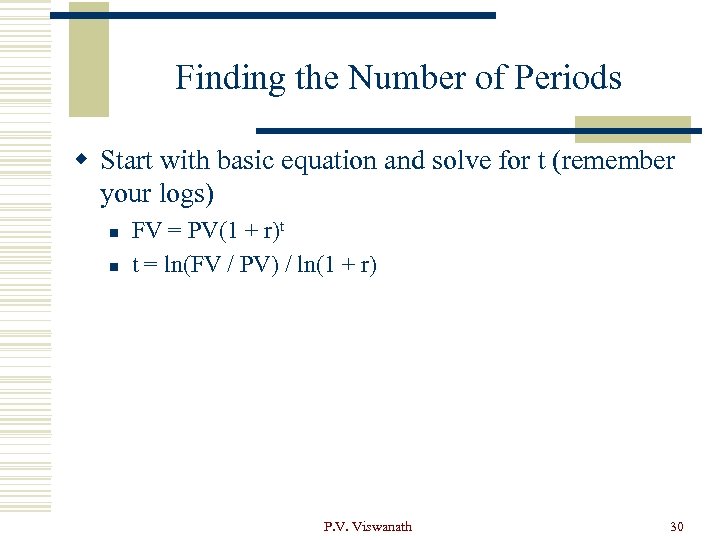 Finding the Number of Periods w Start with basic equation and solve for t (remember your logs) n n FV = PV(1 + r)t t = ln(FV / PV) / ln(1 + r) P. V. Viswanath 30
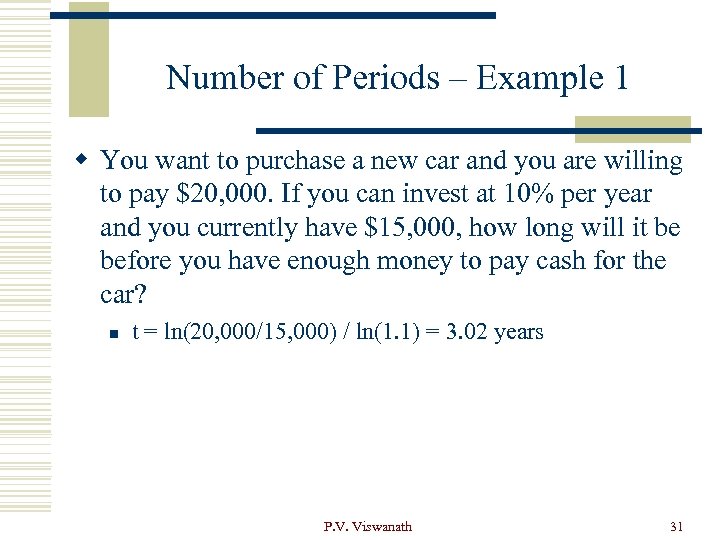 Number of Periods – Example 1 w You want to purchase a new car and you are willing to pay $20, 000. If you can invest at 10% per year and you currently have $15, 000, how long will it be before you have enough money to pay cash for the car? n t = ln(20, 000/15, 000) / ln(1. 1) = 3. 02 years P. V. Viswanath 31
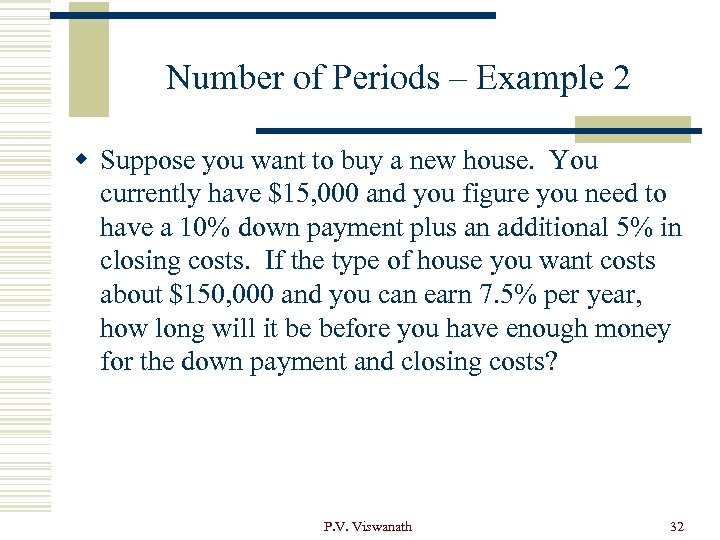 Number of Periods – Example 2 w Suppose you want to buy a new house. You currently have $15, 000 and you figure you need to have a 10% down payment plus an additional 5% in closing costs. If the type of house you want costs about $150, 000 and you can earn 7. 5% per year, how long will it be before you have enough money for the down payment and closing costs? P. V. Viswanath 32
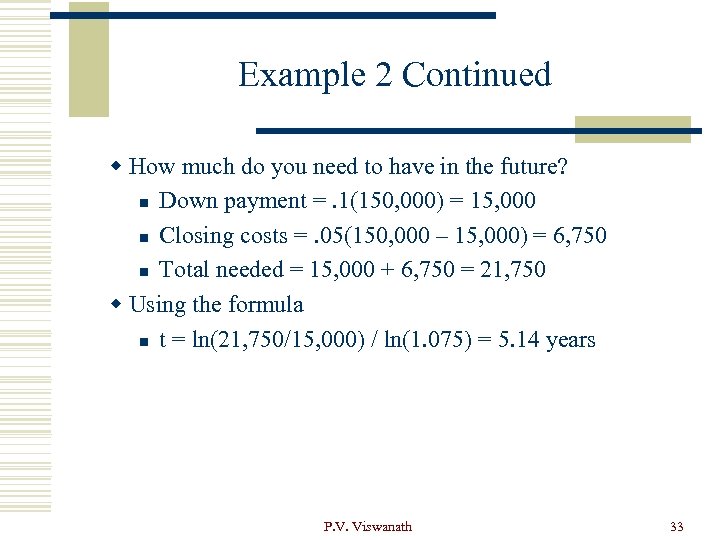 Example 2 Continued w How much do you need to have in the future? n Down payment =. 1(150, 000) = 15, 000 n Closing costs =. 05(150, 000 – 15, 000) = 6, 750 n Total needed = 15, 000 + 6, 750 = 21, 750 w Using the formula n t = ln(21, 750/15, 000) / ln(1. 075) = 5. 14 years P. V. Viswanath 33
 Basic Formulas Refresher P. V. Viswanath 34
 Quick Quiz: Part 4 w When might you want to compute the number of periods? w Suppose you want to buy some new furniture for your family room. You currently have $500 and the furniture you want costs $600. If you can earn 6%, how long will you have to wait if you don’t add any additional money? P. V. Viswanath 35
 The Frequency of Compounding w Banks frequently refer to interest rates on loans and deposits in the form of an annual percentage rate (APR) with a certain frequency of compounding. w For example, a loan might carry an APR of 18% per annum with monthly compounding. w This actually means that the loan will carry a monthly rate of interest of 18/12 = 1. 5% per month. w The APR is also called the stated rate of interest in contrast to the Effective Rate of Interest, which is effectively the additional dollars the borrower will have to pay if the loan is repaid at the end of a year, over and above the initial principal, assuming no interim repayments. P. V. Viswanath 36
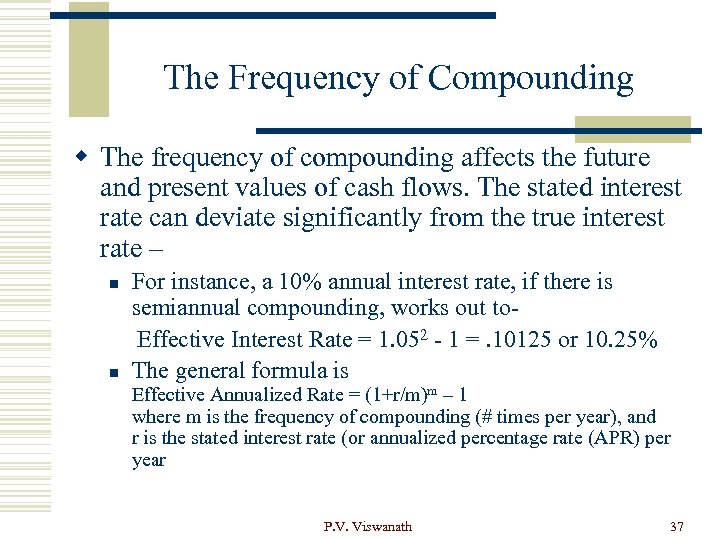 The Frequency of Compounding w The frequency of compounding affects the future and present values of cash flows. The stated interest rate can deviate significantly from the true interest rate – n n For instance, a 10% annual interest rate, if there is semiannual compounding, works out to. Effective Interest Rate = 1. 052 - 1 =. 10125 or 10. 25% The general formula is Effective Annualized Rate = (1+r/m)m – 1 where m is the frequency of compounding (# times per year), and r is the stated interest rate (or annualized percentage rate (APR) per year P. V. Viswanath 37
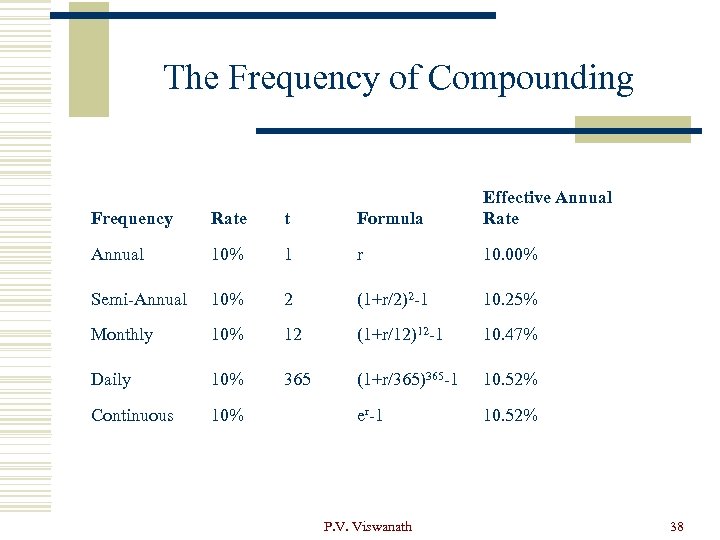 The Frequency of Compounding Frequency Rate t Formula Effective Annual Rate Annual 10% 1 r 10. 00% Semi-Annual 10% 2 (1+r/2)2 -1 10. 25% Monthly 10% 12 (1+r/12)12 -1 10. 47% Daily 10% 365 (1+r/365)365 -1 10. 52% Continuous 10% er-1 10. 52% P. V. Viswanath 38
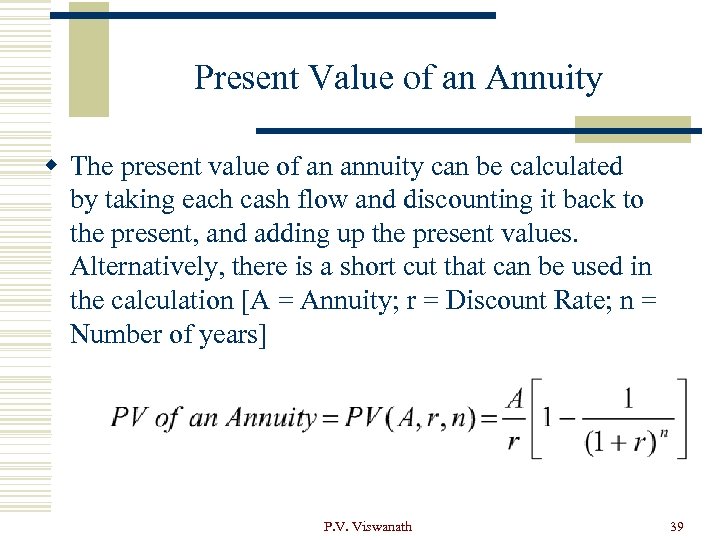 Present Value of an Annuity w The present value of an annuity can be calculated by taking each cash flow and discounting it back to the present, and adding up the present values. Alternatively, there is a short cut that can be used in the calculation [A = Annuity; r = Discount Rate; n = Number of years] P. V. Viswanath 39
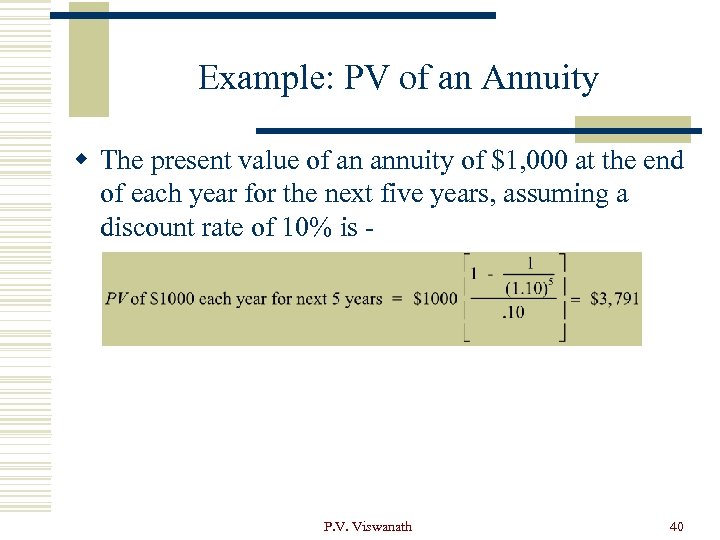 Example: PV of an Annuity w The present value of an annuity of $1, 000 at the end of each year for the next five years, assuming a discount rate of 10% is - P. V. Viswanath 40
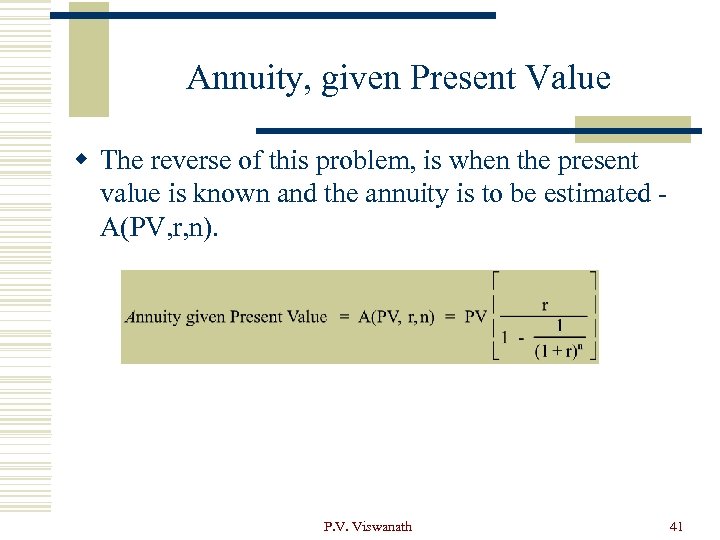 Annuity, given Present Value w The reverse of this problem, is when the present value is known and the annuity is to be estimated - A(PV, r, n). P. V. Viswanath 41
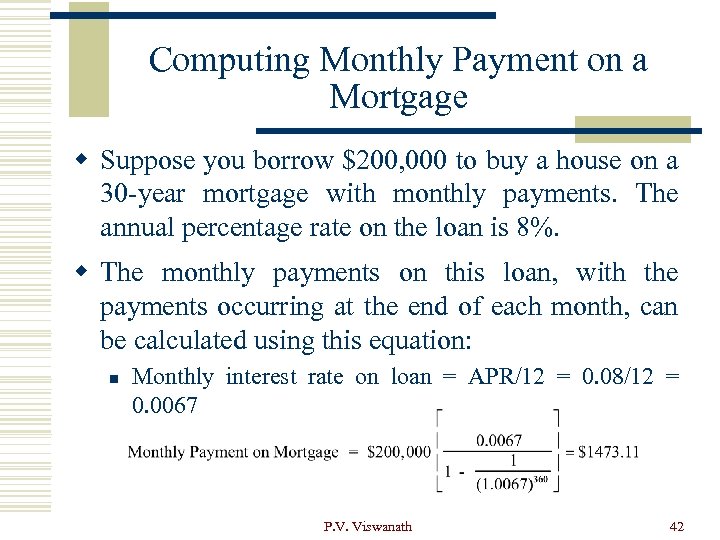 Computing Monthly Payment on a Mortgage w Suppose you borrow $200, 000 to buy a house on a 30 -year mortgage with monthly payments. The annual percentage rate on the loan is 8%. w The monthly payments on this loan, with the payments occurring at the end of each month, can be calculated using this equation: n Monthly interest rate on loan = APR/12 = 0. 08/12 = 0. 0067 P. V. Viswanath 42
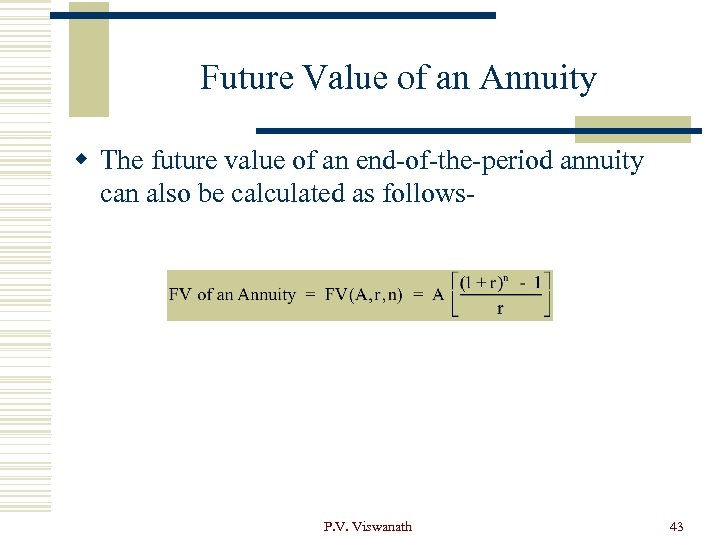 Future Value of an Annuity w The future value of an end-of-the-period annuity can also be calculated as follows- P. V. Viswanath 43
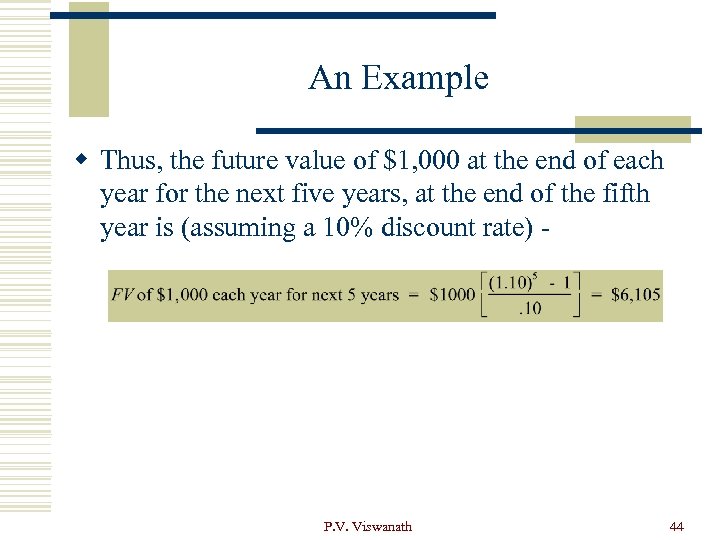 An Example w Thus, the future value of $1, 000 at the end of each year for the next five years, at the end of the fifth year is (assuming a 10% discount rate) - P. V. Viswanath 44
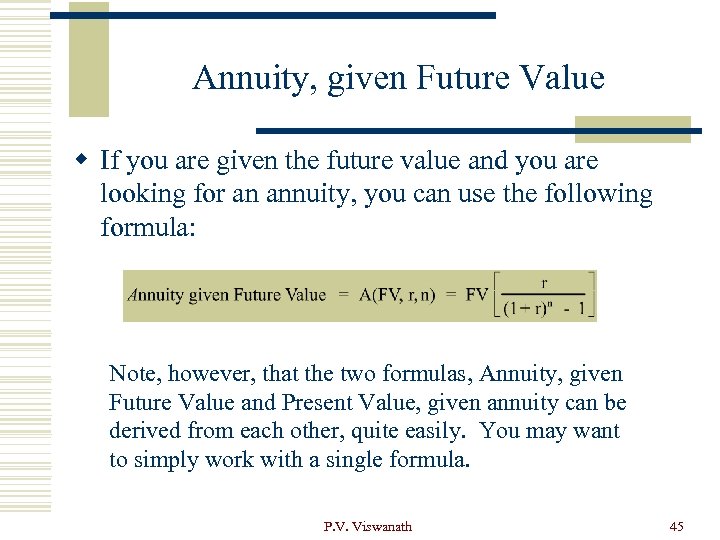 Annuity, given Future Value w If you are given the future value and you are looking for an annuity, you can use the following formula: Note, however, that the two formulas, Annuity, given Future Value and Present Value, given annuity can be derived from each other, quite easily. You may want to simply work with a single formula. P. V. Viswanath 45
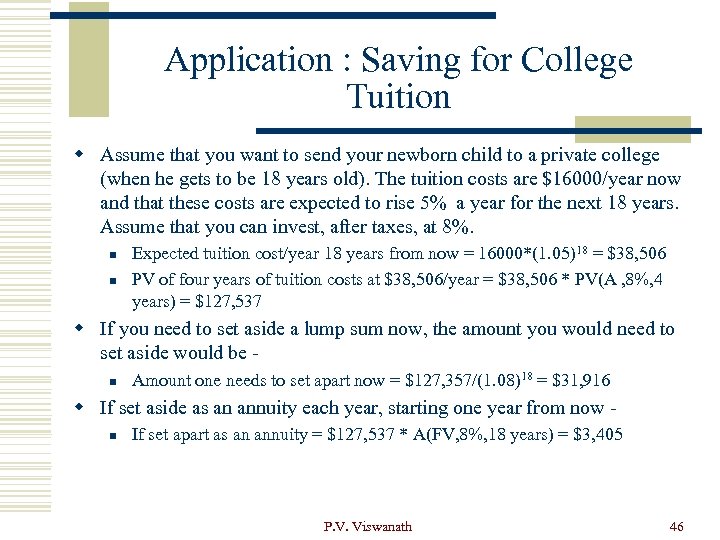 Application : Saving for College Tuition w Assume that you want to send your newborn child to a private college (when he gets to be 18 years old). The tuition costs are $16000/year now and that these costs are expected to rise 5% a year for the next 18 years. Assume that you can invest, after taxes, at 8%. n n Expected tuition cost/year 18 years from now = 16000*(1. 05)18 = $38, 506 PV of four years of tuition costs at $38, 506/year = $38, 506 * PV(A , 8%, 4 years) = $127, 537 w If you need to set aside a lump sum now, the amount you would need to set aside would be n Amount one needs to set apart now = $127, 357/(1. 08)18 = $31, 916 w If set aside as an annuity each year, starting one year from now n If set apart as an annuity = $127, 537 * A(FV, 8%, 18 years) = $3, 405 P. V. Viswanath 46
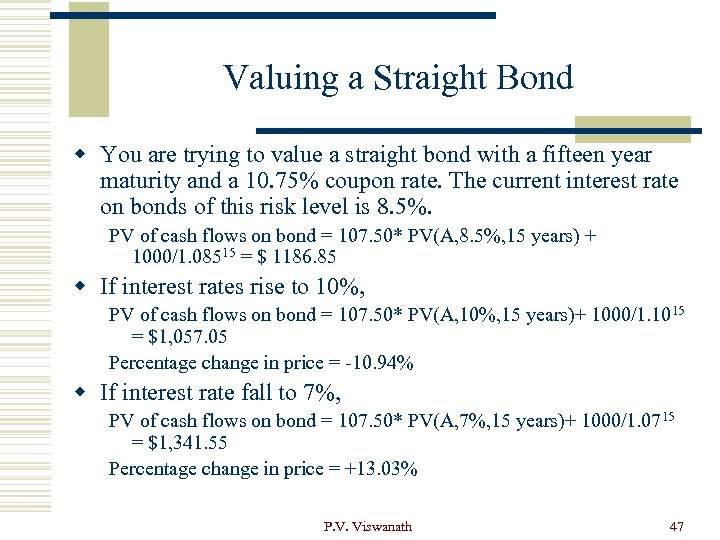 Valuing a Straight Bond w You are trying to value a straight bond with a fifteen year maturity and a 10. 75% coupon rate. The current interest rate on bonds of this risk level is 8. 5%. PV of cash flows on bond = 107. 50* PV(A, 8. 5%, 15 years) + 1000/1. 08515 = $ 1186. 85 w If interest rates rise to 10%, PV of cash flows on bond = 107. 50* PV(A, 10%, 15 years)+ 1000/1. 1015 = $1, 057. 05 Percentage change in price = -10. 94% w If interest rate fall to 7%, PV of cash flows on bond = 107. 50* PV(A, 7%, 15 years)+ 1000/1. 0715 = $1, 341. 55 Percentage change in price = +13. 03% P. V. Viswanath 47
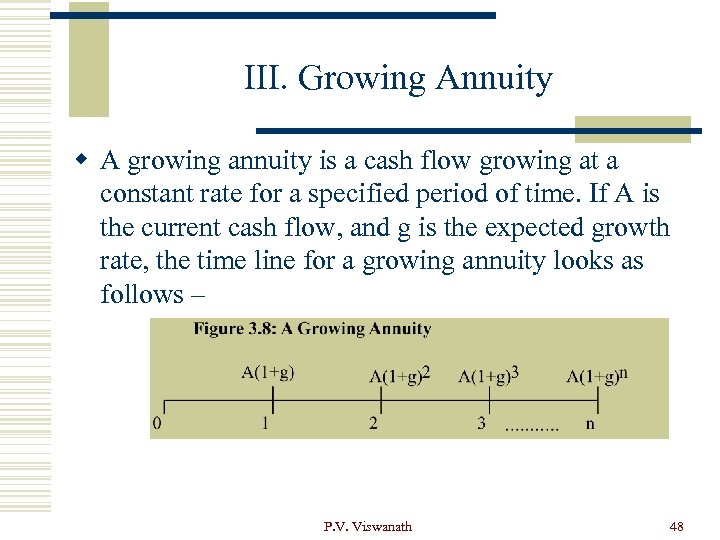 III. Growing Annuity w A growing annuity is a cash flow growing at a constant rate for a specified period of time. If A is the current cash flow, and g is the expected growth rate, the time line for a growing annuity looks as follows – P. V. Viswanath 48
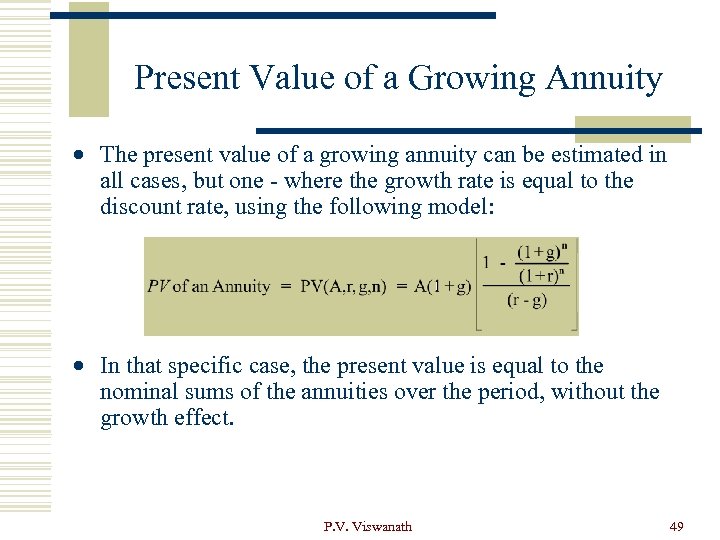 Present Value of a Growing Annuity · The present value of a growing annuity can be estimated in all cases, but one - where the growth rate is equal to the discount rate, using the following model: · In that specific case, the present value is equal to the nominal sums of the annuities over the period, without the growth effect. P. V. Viswanath 49
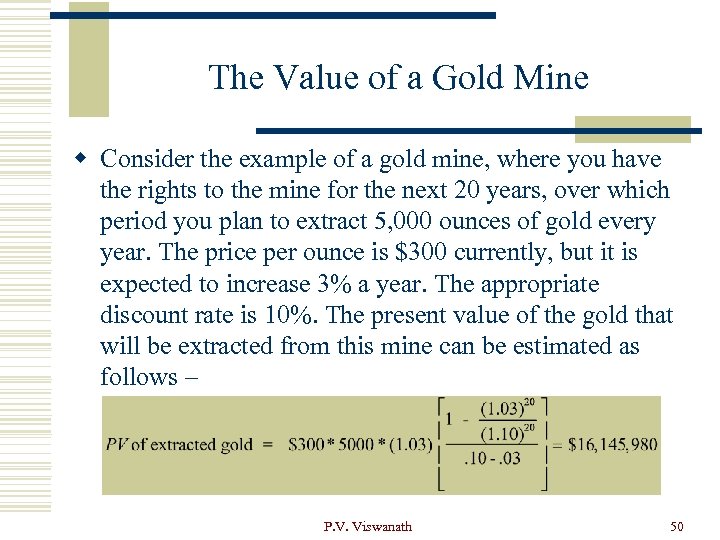 The Value of a Gold Mine w Consider the example of a gold mine, where you have the rights to the mine for the next 20 years, over which period you plan to extract 5, 000 ounces of gold every year. The price per ounce is $300 currently, but it is expected to increase 3% a year. The appropriate discount rate is 10%. The present value of the gold that will be extracted from this mine can be estimated as follows – P. V. Viswanath 50
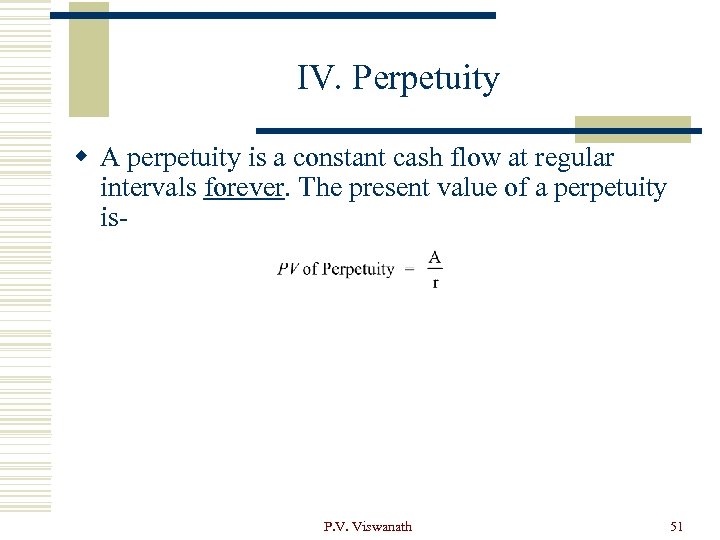 IV. Perpetuity w A perpetuity is a constant cash flow at regular intervals forever. The present value of a perpetuity is- P. V. Viswanath 51
 Valuing a Consol Bond w A consol bond is a bond that has no maturity and pays a fixed coupon. Assume that you have a 6% coupon console bond. The value of this bond, if the interest rate is 9%, is as follows Value of Consol Bond = $60 /. 09 = $667 P. V. Viswanath 52
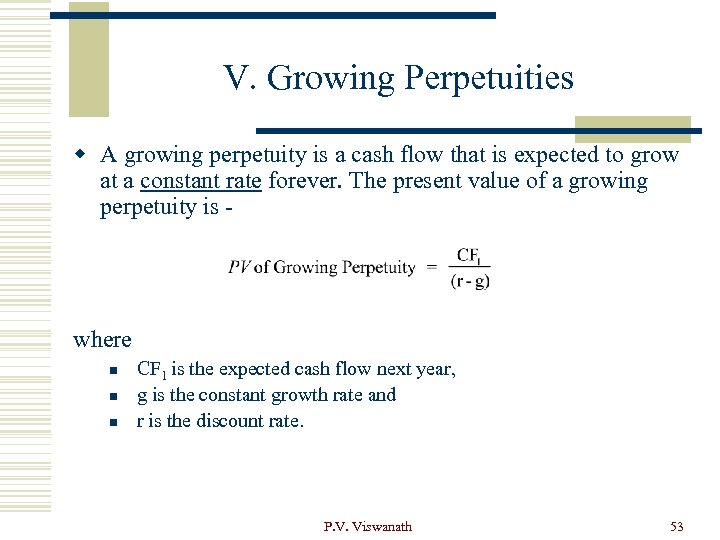 V. Growing Perpetuities w A growing perpetuity is a cash flow that is expected to grow at a constant rate forever. The present value of a growing perpetuity is - where n n n CF 1 is the expected cash flow next year, g is the constant growth rate and r is the discount rate. P. V. Viswanath 53