


 Скачать презентацию Time Value of Money FIN 461 Financial Cases
d1f7684ec25a3149dcc45dcbc28a31e6.ppt
- Количество слайдов: 109
 Time Value of Money FIN 461: Financial Cases & Modeling George W. Gallinger Associate Professor of Finance W. P. Carey School of Business Arizona State University
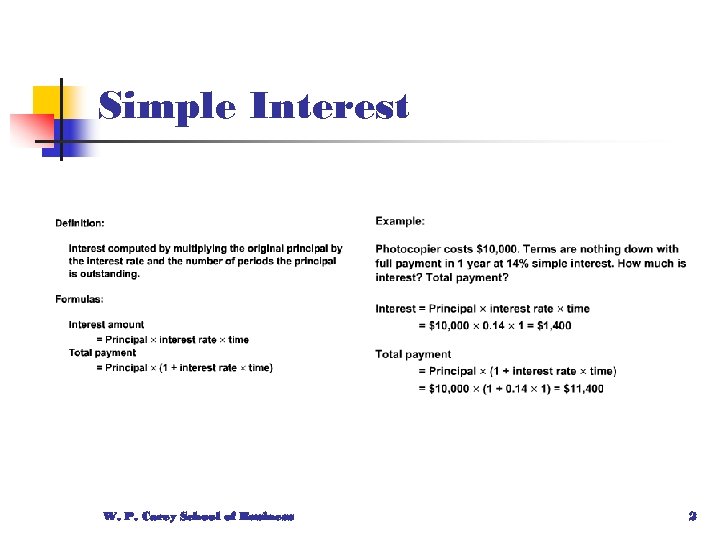 Simple Interest W. P. Carey School of Business 2
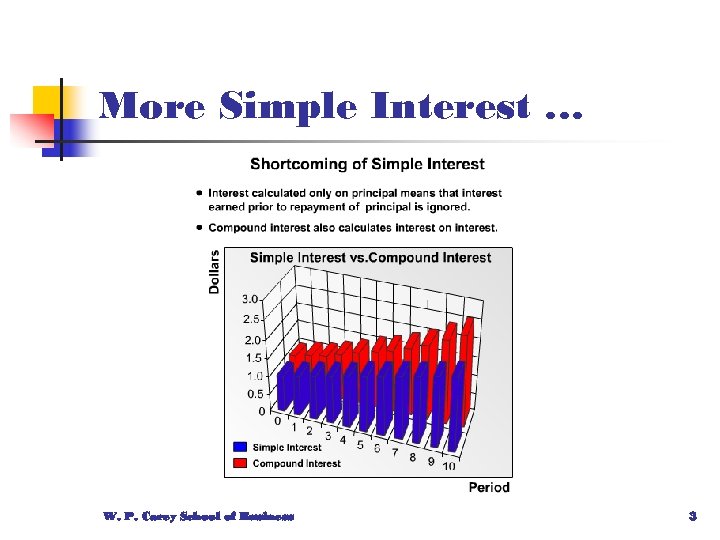 More Simple Interest … W. P. Carey School of Business 3
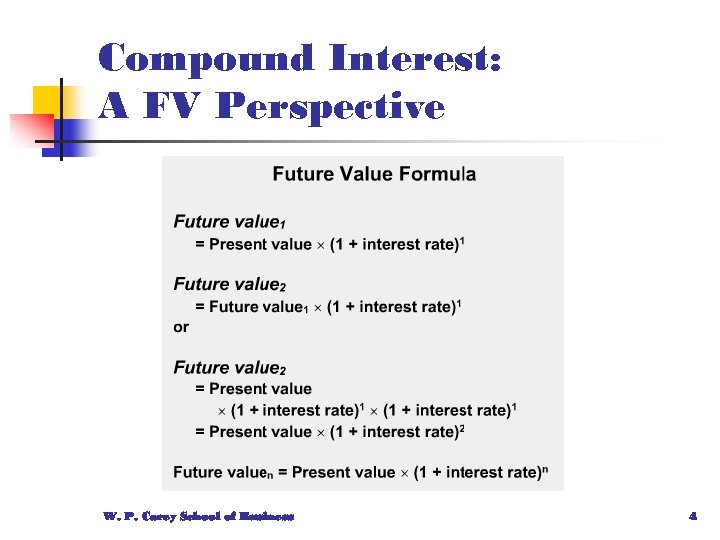 Compound Interest: A FV Perspective W. P. Carey School of Business 4
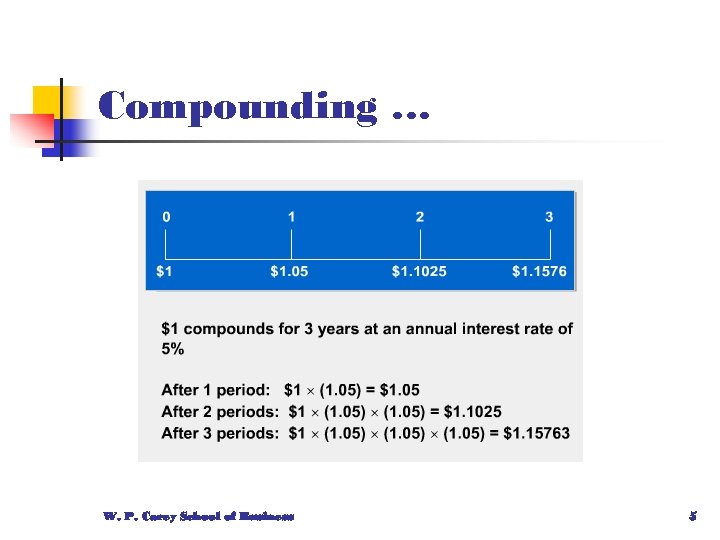 Compounding … W. P. Carey School of Business 5
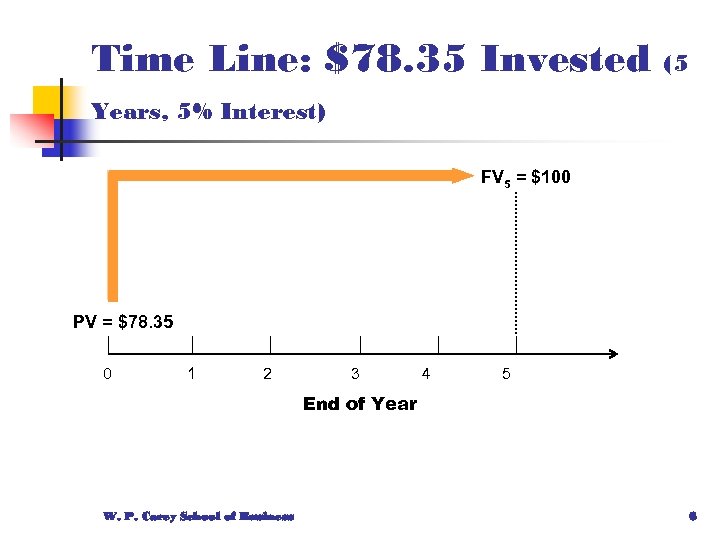 Time Line: $78. 35 Invested (5 Years, 5% Interest) FV 5 = $100 PV = $78. 35 0 1 2 3 4 5 End of Year W. P. Carey School of Business 6
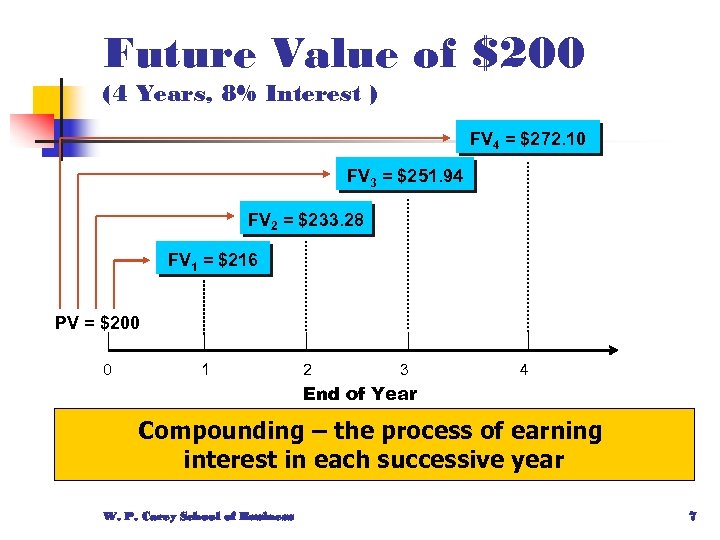 Future Value of $200 (4 Years, 8% Interest ) FV 4 = $272. 10 FV 3 = $251. 94 FV 2 = $233. 28 FV 1 = $216 PV = $200 0 1 2 3 4 End of Year Compounding – the process of earning interest in each successive year W. P. Carey School of Business 7
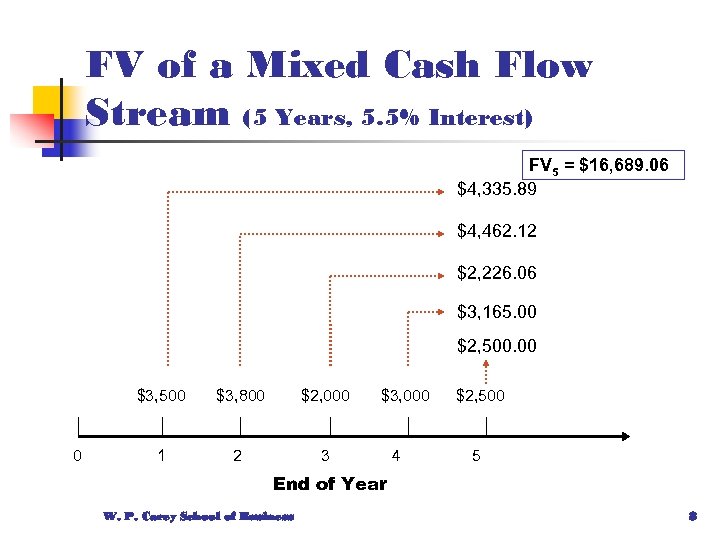 FV of a Mixed Cash Flow Stream (5 Years, 5. 5% Interest) FV 5 = $16, 689. 06 $4, 335. 89 $4, 462. 12 $2, 226. 06 $3, 165. 00 $2, 500. 00 $3, 500 0 $3, 800 $2, 000 1 2 $3, 000 3 4 $2, 500 5 End of Year W. P. Carey School of Business 8
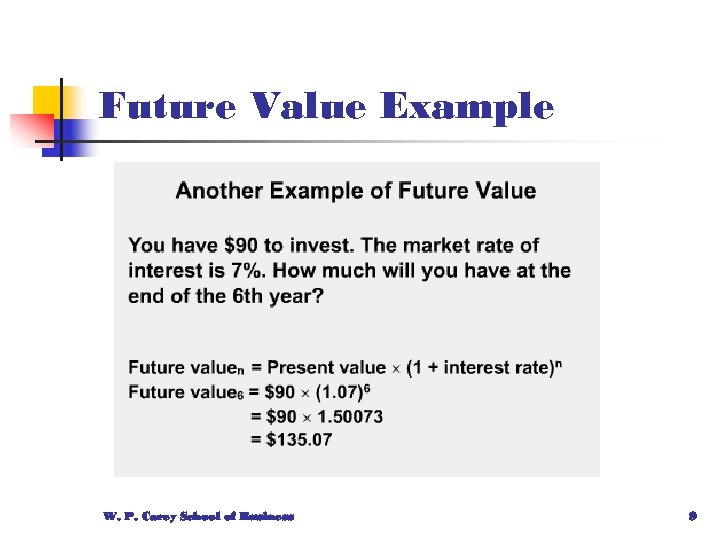 Future Value Example W. P. Carey School of Business 9
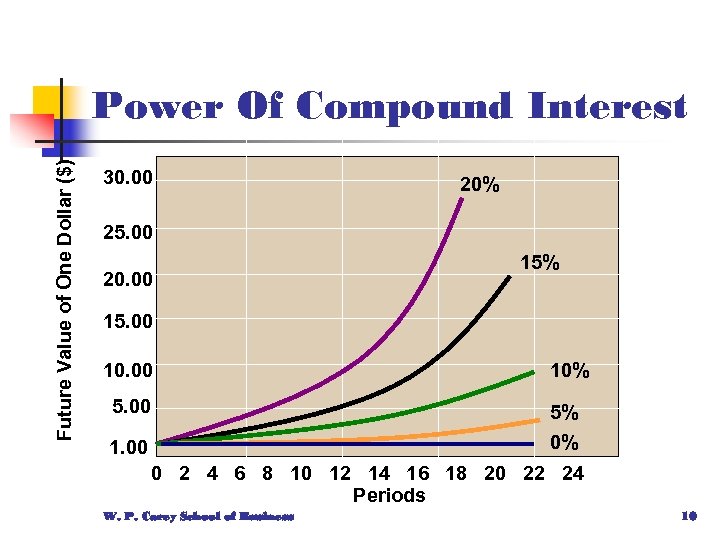 Future Value of One Dollar ($) Power Of Compound Interest 30. 00 20% 25. 00 20. 00 15% 15. 00 10% 5. 00 5% 0% 1. 00 0 2 4 6 8 10 12 14 16 18 20 22 24 Periods W. P. Carey School of Business 10
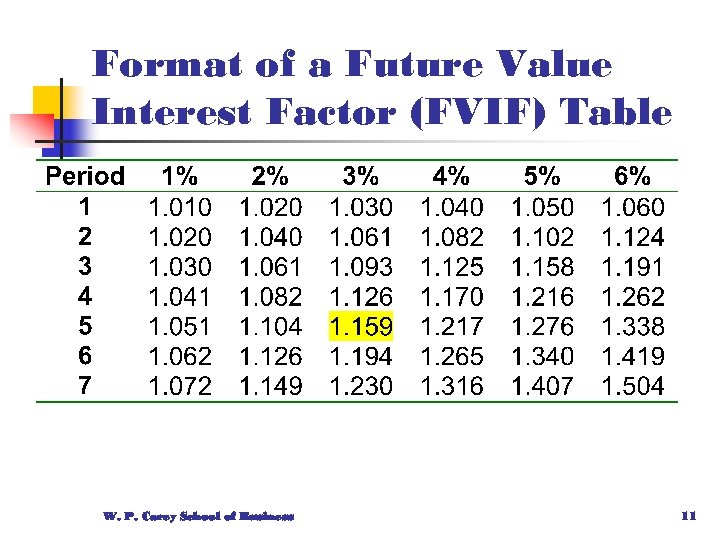 Format of a Future Value Interest Factor (FVIF) Table W. P. Carey School of Business 11
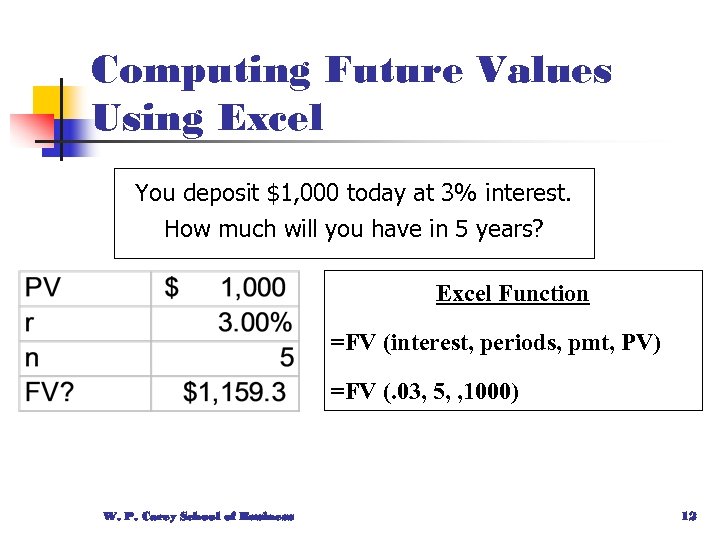 Computing Future Values Using Excel You deposit $1, 000 today at 3% interest. How much will you have in 5 years? Excel Function =FV (interest, periods, pmt, PV) =FV (. 03, 5, , 1000) W. P. Carey School of Business 12
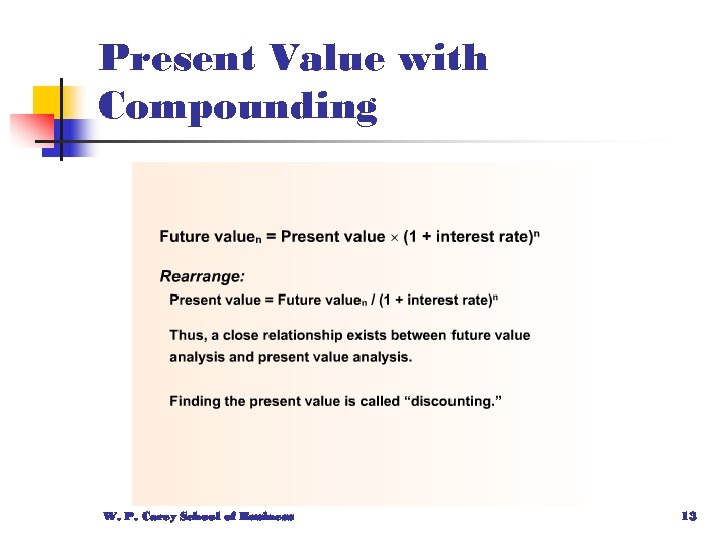 Present Value with Compounding W. P. Carey School of Business 13
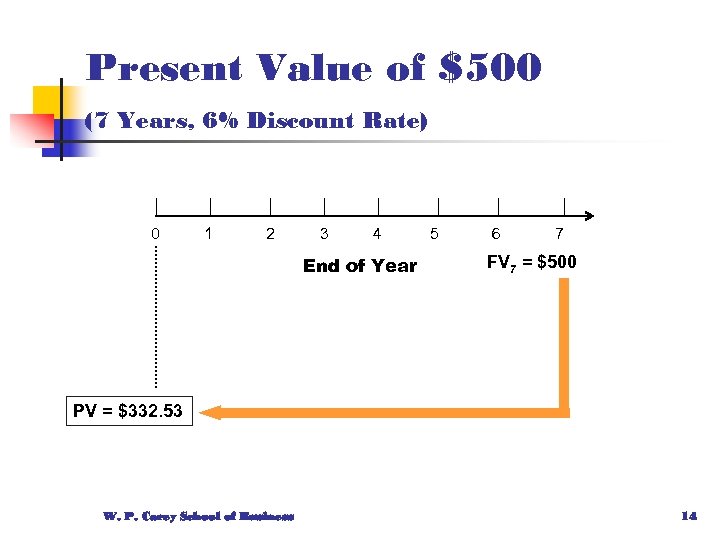 Present Value of $500 (7 Years, 6% Discount Rate) 0 1 2 3 4 End of Year 5 6 7 FV 7 = $500 PV = $332. 53 W. P. Carey School of Business 14
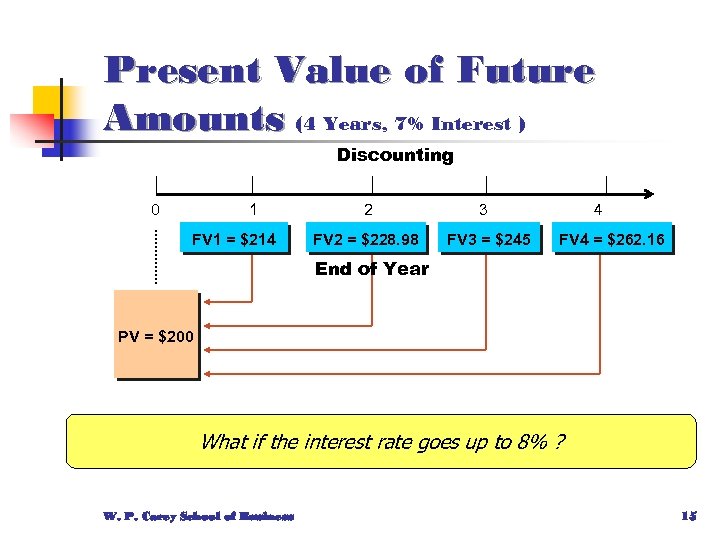 Present Value of Future Amounts (4 Years, 7% Interest ) Discounting 0 1 FV 1 = $214 2 FV 2 = $228. 98 3 FV 3 = $245 4 FV 4 = $262. 16 End of Year PV = $200 What if the interest rate goes up to 8% ? W. P. Carey School of Business 15
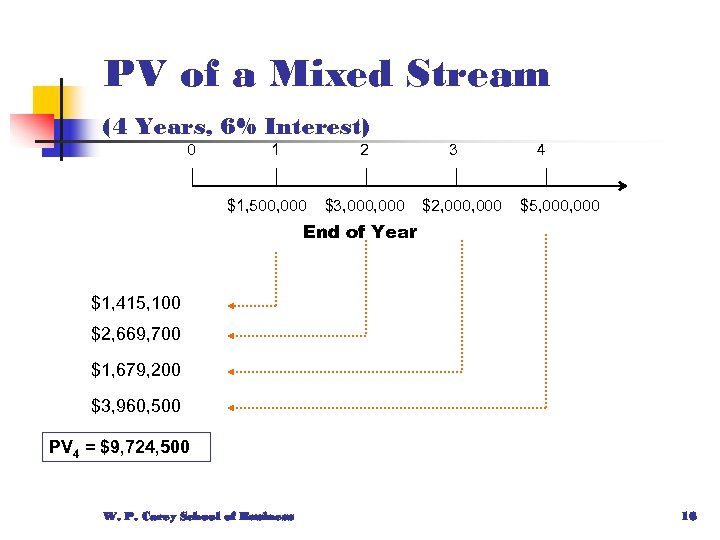 PV of a Mixed Stream (4 Years, 6% Interest) 0 1 2 $1, 500, 000 $3, 000 3 $2, 000 4 $5, 000 End of Year $1, 415, 100 $2, 669, 700 $1, 679, 200 $3, 960, 500 PV 4 = $9, 724, 500 W. P. Carey School of Business 16
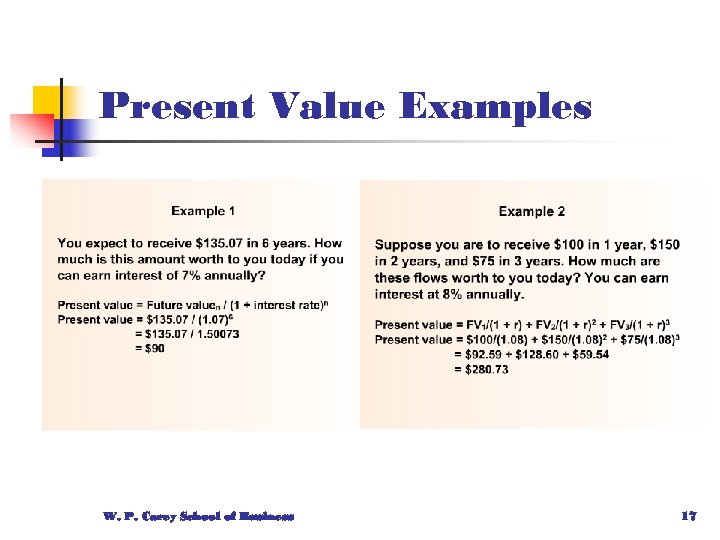 Present Value Examples W. P. Carey School of Business 17
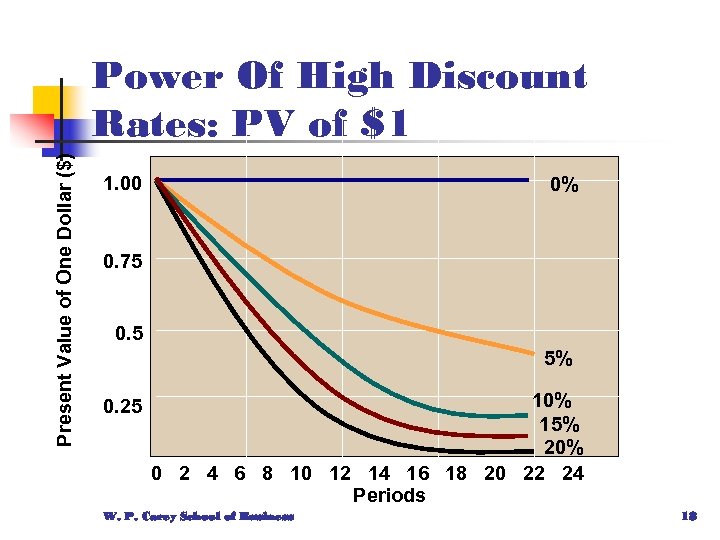 Present Value of One Dollar ($) Power Of High Discount Rates: PV of $1 1. 00 0% 0. 75 0. 5 5% 0. 25 10% 15% 20% 0 2 4 6 8 10 12 14 16 18 20 22 24 Periods W. P. Carey School of Business 18
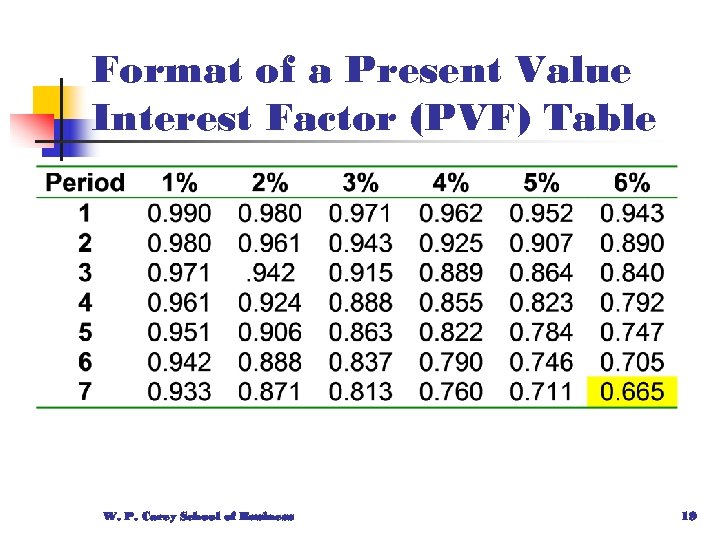 Format of a Present Value Interest Factor (PVF) Table W. P. Carey School of Business 19
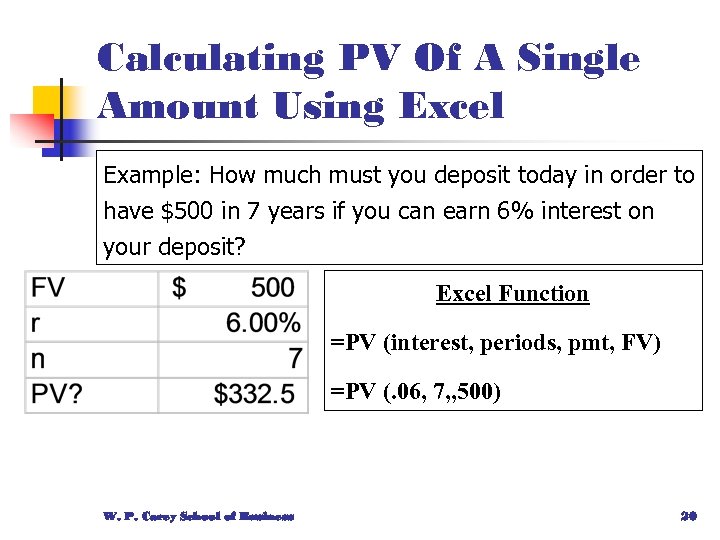 Calculating PV Of A Single Amount Using Excel Example: How much must you deposit today in order to have $500 in 7 years if you can earn 6% interest on your deposit? Excel Function =PV (interest, periods, pmt, FV) =PV (. 06, 7, , 500) W. P. Carey School of Business 20
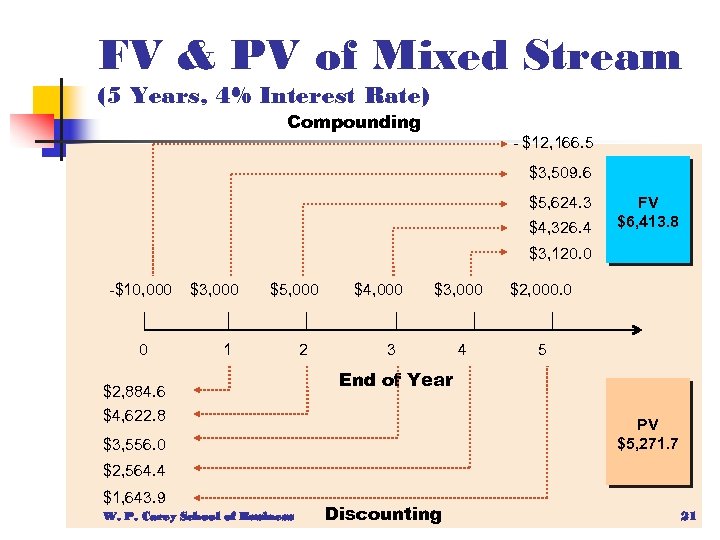 FV & PV of Mixed Stream (5 Years, 4% Interest Rate) Compounding - $12, 166. 5 $3, 509. 6 $5, 624. 3 $4, 326. 4 FV $6, 413. 8 $3, 120. 0 -$10, 000 0 $3, 000 $5, 000 1 $2, 884. 6 $4, 622. 8 2 $4, 000 $3, 000 $2, 000. 0 4 5 3 End of Year PV $5, 271. 7 $3, 556. 0 $2, 564. 4 $1, 643. 9 W. P. Carey School of Business Discounting 21
 Change the Flows n Assume constant flows n n Over an explicit period Forever called perpetuity. W. P. Carey School of Business 22
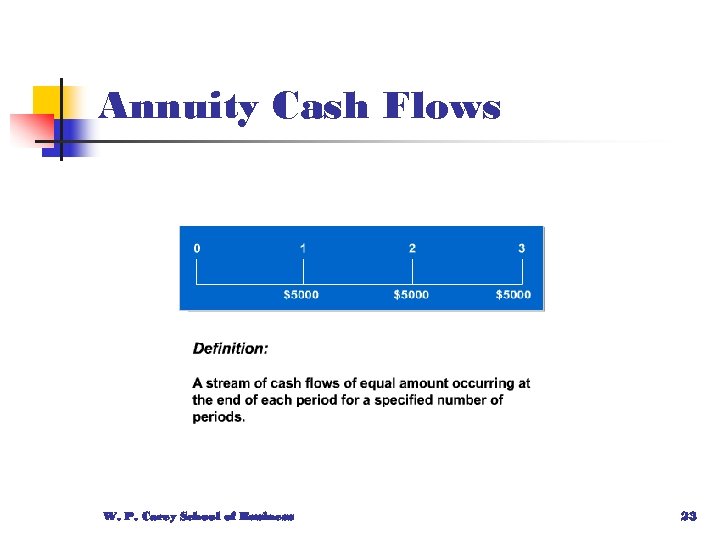 Annuity Cash Flows W. P. Carey School of Business 23
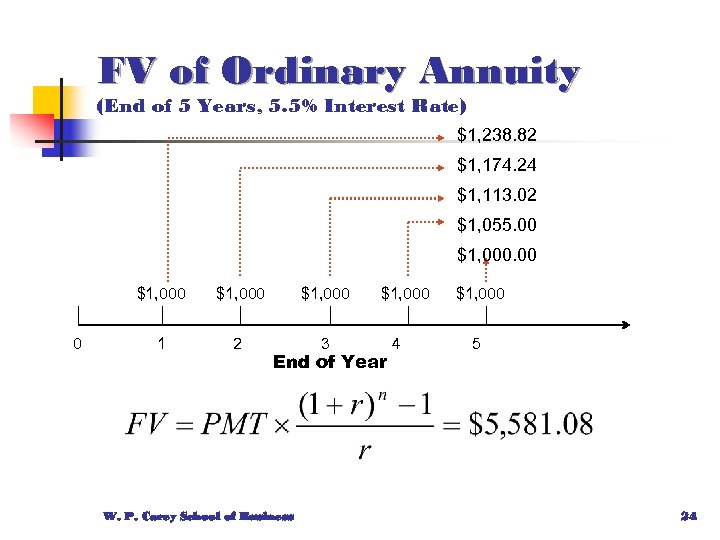 FV of Ordinary Annuity (End of 5 Years, 5. 5% Interest Rate) $1, 238. 82 $1, 174. 24 $1, 113. 02 $1, 055. 00 $1, 000 1 2 3 $1, 000 End of Year W. P. Carey School of Business 4 $1, 000 5 24
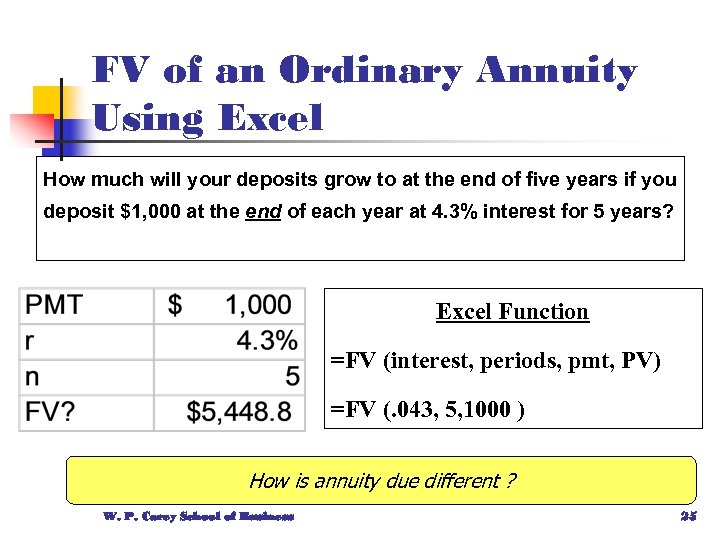 FV of an Ordinary Annuity Using Excel How much will your deposits grow to at the end of five years if you deposit $1, 000 at the end of each year at 4. 3% interest for 5 years? Excel Function =FV (interest, periods, pmt, PV) =FV (. 043, 5, 1000 ) How is annuity due different ? W. P. Carey School of Business 25
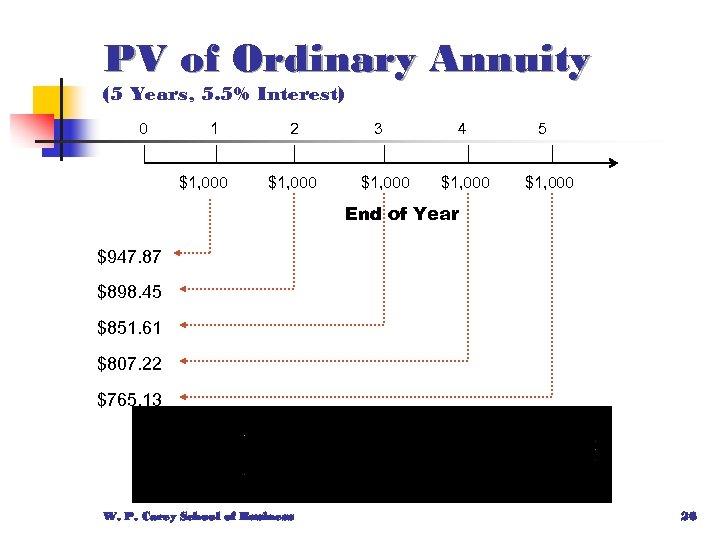 PV of Ordinary Annuity (5 Years, 5. 5% Interest) 0 1 $1, 000 2 $1, 000 3 $1, 000 4 $1, 000 5 $1, 000 End of Year $947. 87 $898. 45 $851. 61 $807. 22 $765. 13 W. P. Carey School of Business 26
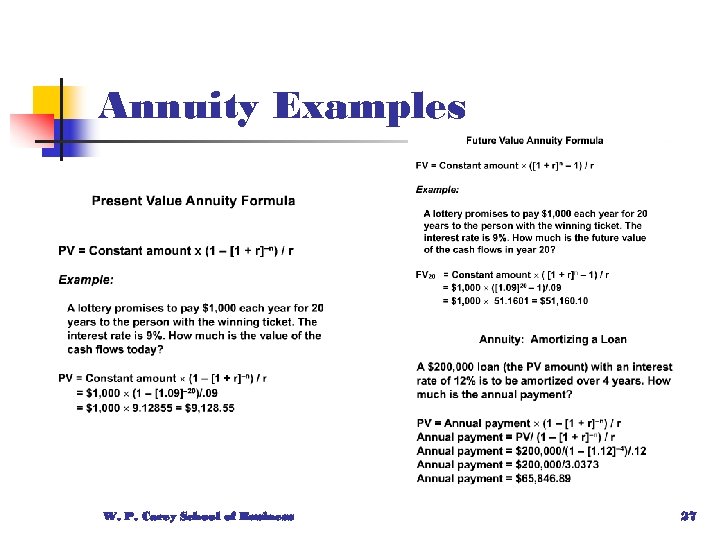 Annuity Examples W. P. Carey School of Business 27
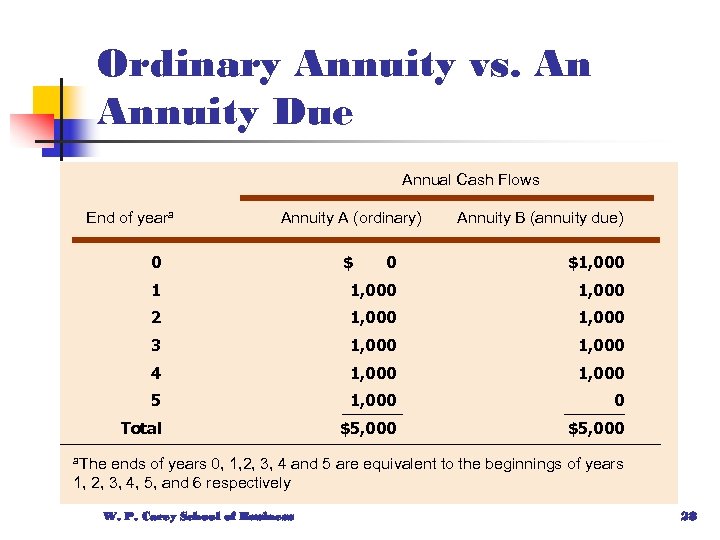 Ordinary Annuity vs. An Annuity Due Annual Cash Flows End of yeara Annuity A (ordinary) 0 $ Annuity B (annuity due) 0 $1, 000 1 1, 000 2 1, 000 3 1, 000 4 1, 000 5 1, 000 0 Total $5, 000 a. The ends of years 0, 1, 2, 3, 4 and 5 are equivalent to the beginnings of years 1, 2, 3, 4, 5, and 6 respectively W. P. Carey School of Business 28
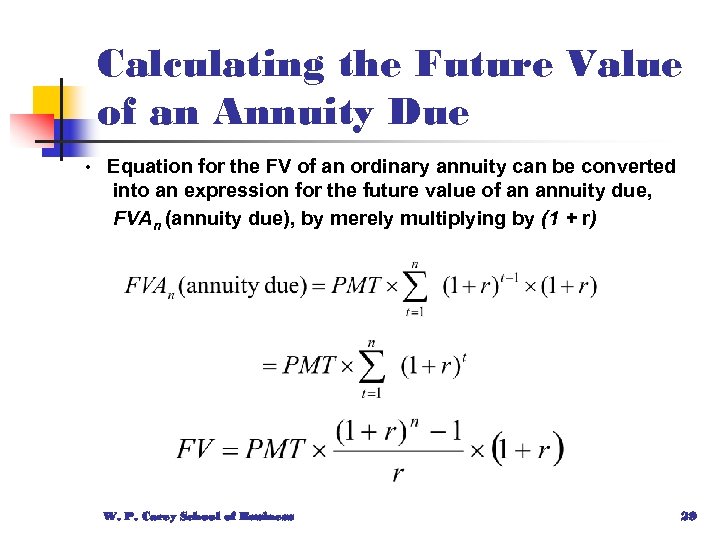 Calculating the Future Value of an Annuity Due • Equation for the FV of an ordinary annuity can be converted into an expression for the future value of an annuity due, FVAn (annuity due), by merely multiplying by (1 + r) W. P. Carey School of Business 29
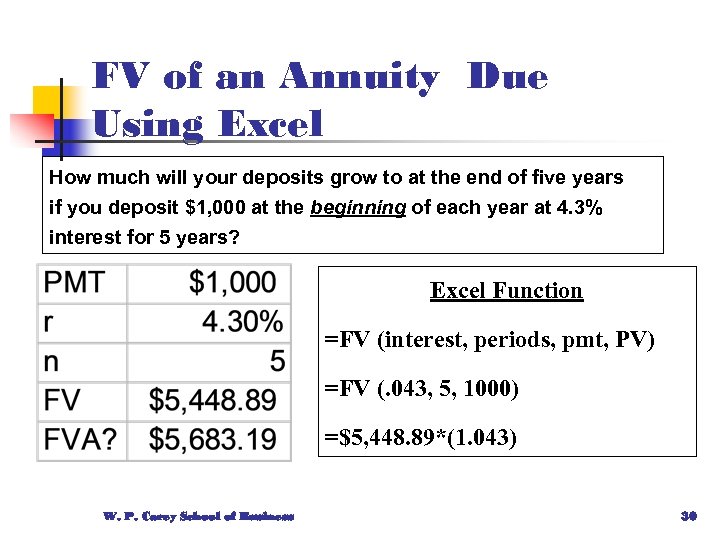 FV of an Annuity Due Using Excel How much will your deposits grow to at the end of five years if you deposit $1, 000 at the beginning of each year at 4. 3% interest for 5 years? Excel Function =FV (interest, periods, pmt, PV) =FV (. 043, 5, 1000) =$5, 448. 89*(1. 043) W. P. Carey School of Business 30
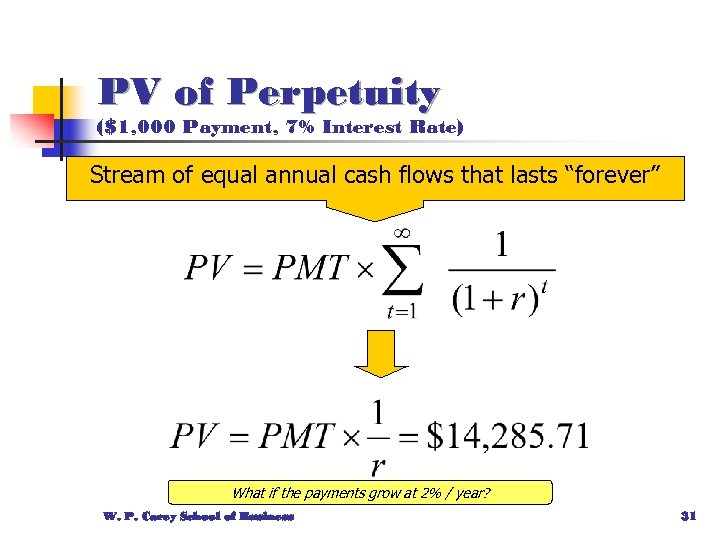 PV of Perpetuity ($1, 000 Payment, 7% Interest Rate) Stream of equal annual cash flows that lasts “forever” What if the payments grow at 2% / year? W. P. Carey School of Business 31
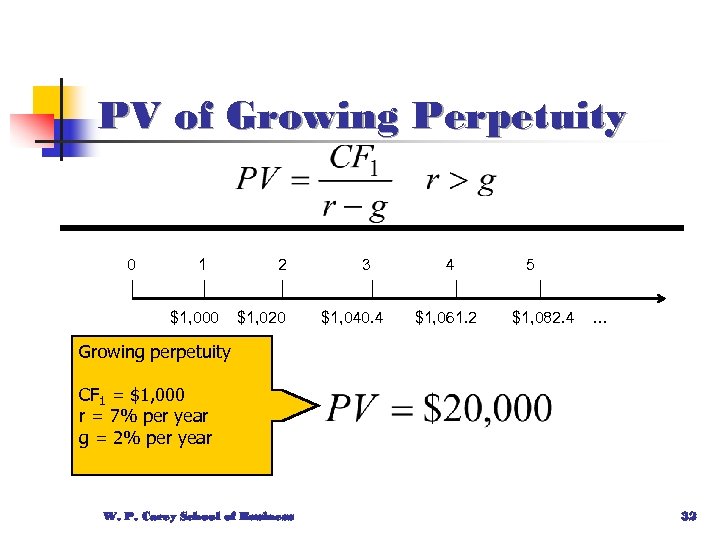 PV of Growing Perpetuity 0 1 $1, 000 2 $1, 020 3 $1, 040. 4 4 $1, 061. 2 5 $1, 082. 4 … Growing perpetuity CF 1 = $1, 000 r = 7% per year g = 2% per year W. P. Carey School of Business 32
 Frequency of Compounding n Discussion so far n n Assumed annual flows No need to be the case. W. P. Carey School of Business 33
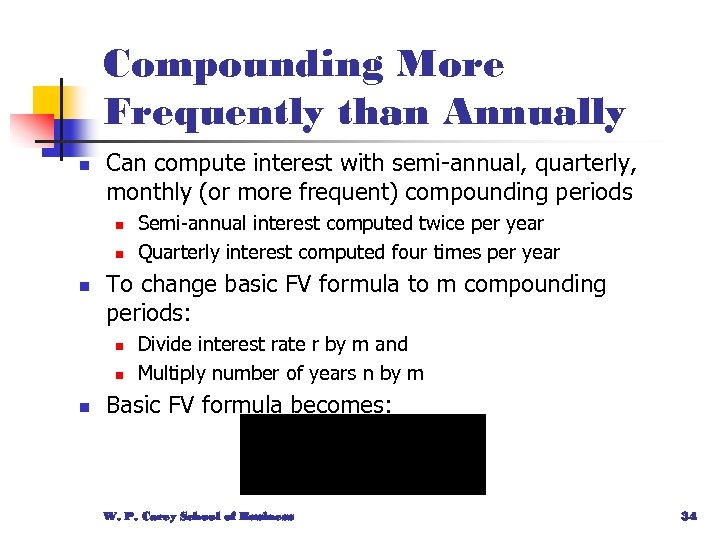 Compounding More Frequently than Annually n Can compute interest with semi-annual, quarterly, monthly (or more frequent) compounding periods n n n To change basic FV formula to m compounding periods: n n n Semi-annual interest computed twice per year Quarterly interest computed four times per year Divide interest rate r by m and Multiply number of years n by m Basic FV formula becomes: W. P. Carey School of Business 34
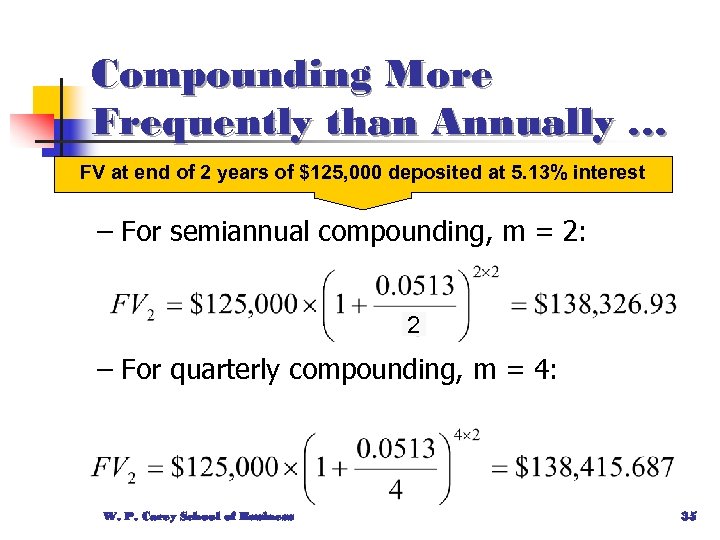 Compounding More Frequently than Annually … FV at end of 2 years of $125, 000 deposited at 5. 13% interest – For semiannual compounding, m = 2: 2 – For quarterly compounding, m = 4: W. P. Carey School of Business 35
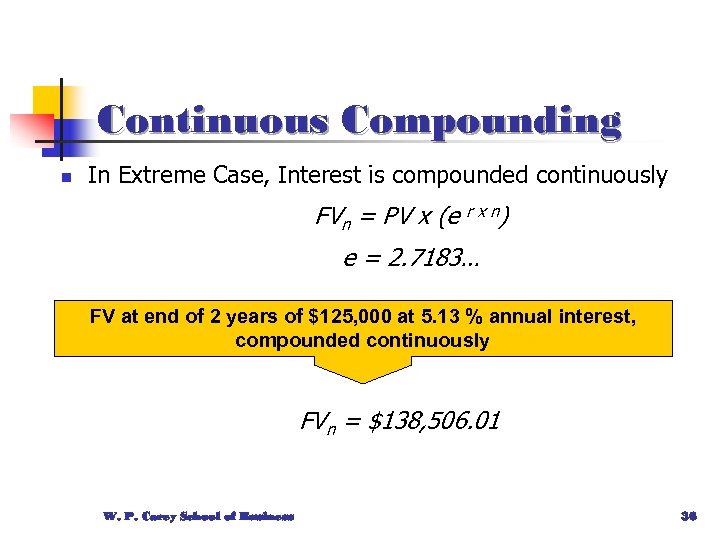 Continuous Compounding n In Extreme Case, Interest is compounded continuously FVn = PV x (e r x n) e = 2. 7183… FV at end of 2 years of $125, 000 at 5. 13 % annual interest, compounded continuously FVn = $138, 506. 01 W. P. Carey School of Business 36
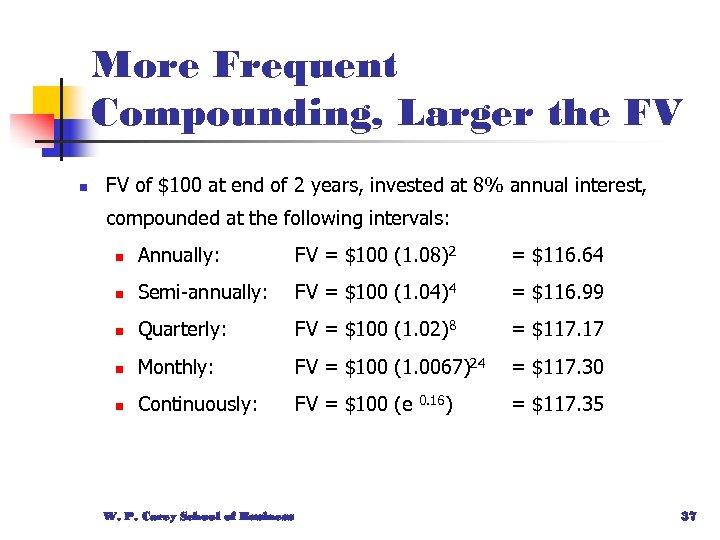 More Frequent Compounding, Larger the FV n FV of $100 at end of 2 years, invested at 8% annual interest, compounded at the following intervals: n Annually: FV = $100 (1. 08)2 = $116. 64 n Semi-annually: FV = $100 (1. 04)4 = $116. 99 n Quarterly: FV = $100 (1. 02)8 = $117. 17 n Monthly: FV = $100 (1. 0067)24 = $117. 30 n Continuously: FV = $100 (e = $117. 35 W. P. Carey School of Business 0. 16) 37
 What’s the True Interest Rate? n Quoted or otherwise? n Otherwise! W. P. Carey School of Business 38
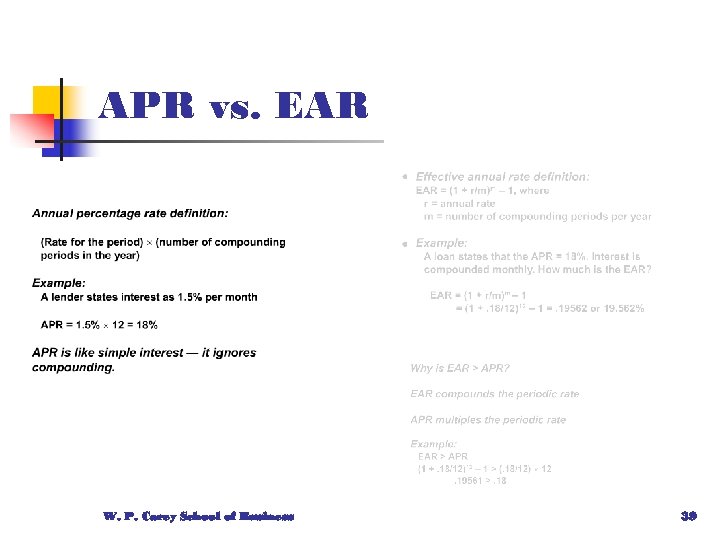 APR vs. EAR W. P. Carey School of Business 39
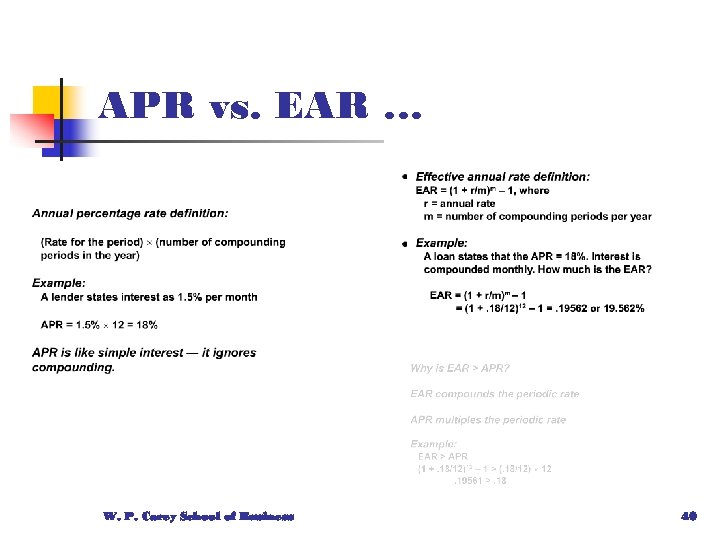 APR vs. EAR … W. P. Carey School of Business 40
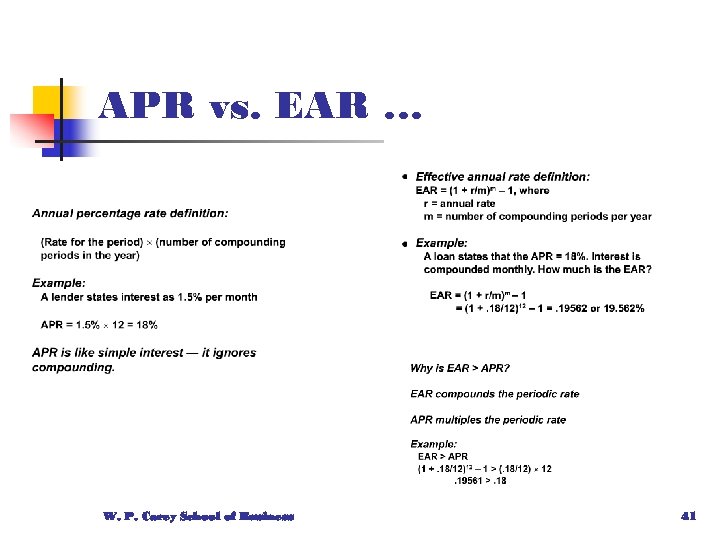 APR vs. EAR … W. P. Carey School of Business 41
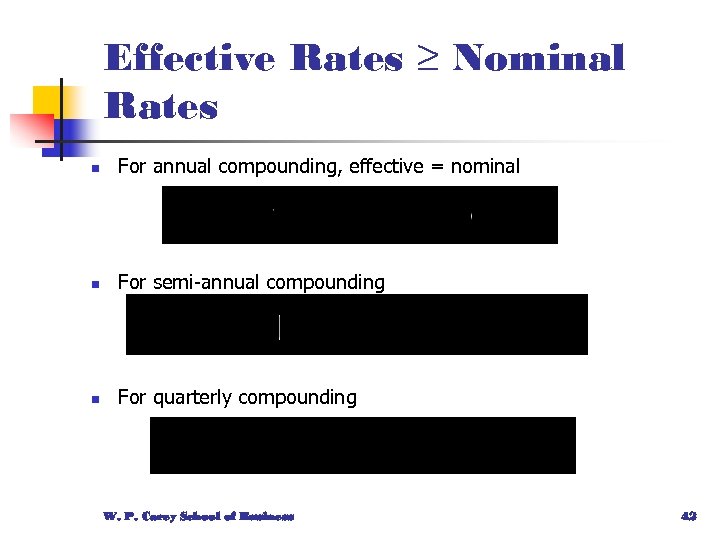 Effective Rates ≥ Nominal Rates n For annual compounding, effective = nominal n For semi-annual compounding n For quarterly compounding W. P. Carey School of Business 42
 Applications of TVM W. P. Carey School of Business 43
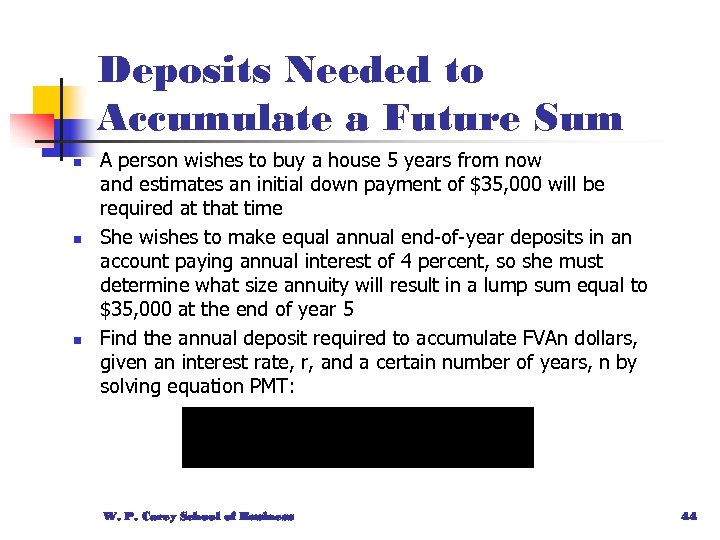 Deposits Needed to Accumulate a Future Sum n n n A person wishes to buy a house 5 years from now and estimates an initial down payment of $35, 000 will be required at that time She wishes to make equal annual end-of-year deposits in an account paying annual interest of 4 percent, so she must determine what size annuity will result in a lump sum equal to $35, 000 at the end of year 5 Find the annual deposit required to accumulate FVAn dollars, given an interest rate, r, and a certain number of years, n by solving equation PMT: W. P. Carey School of Business 44
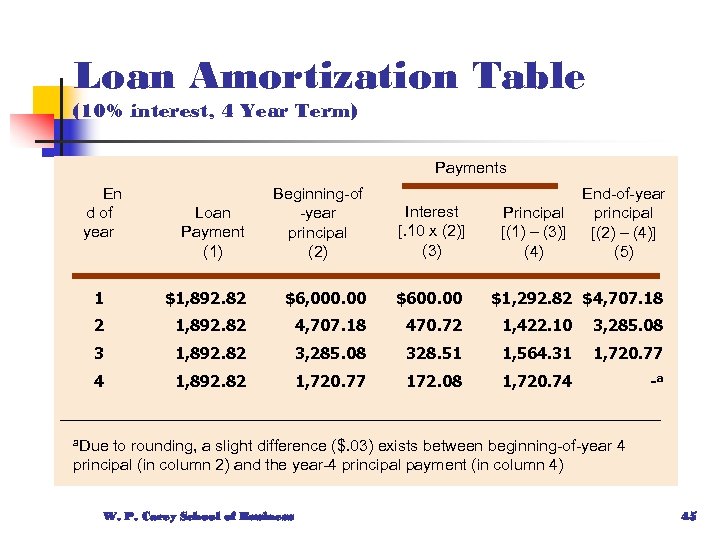 Loan Amortization Table (10% interest, 4 Year Term) Payments En d of year Loan Payment (1) Beginning-of -year principal (2) Interest [. 10 x (2)] (3) End-of-year Principal principal [(1) – (3)] [(2) – (4)] (4) (5) 1 $1, 892. 82 $6, 000. 00 $600. 00 $1, 292. 82 $4, 707. 18 2 1, 892. 82 4, 707. 18 470. 72 1, 422. 10 3, 285. 08 3 1, 892. 82 3, 285. 08 328. 51 1, 564. 31 1, 720. 77 4 1, 892. 82 1, 720. 77 172. 08 1, 720. 74 -a a. Due to rounding, a slight difference ($. 03) exists between beginning-of-year 4 principal (in column 2) and the year-4 principal payment (in column 4) W. P. Carey School of Business 45
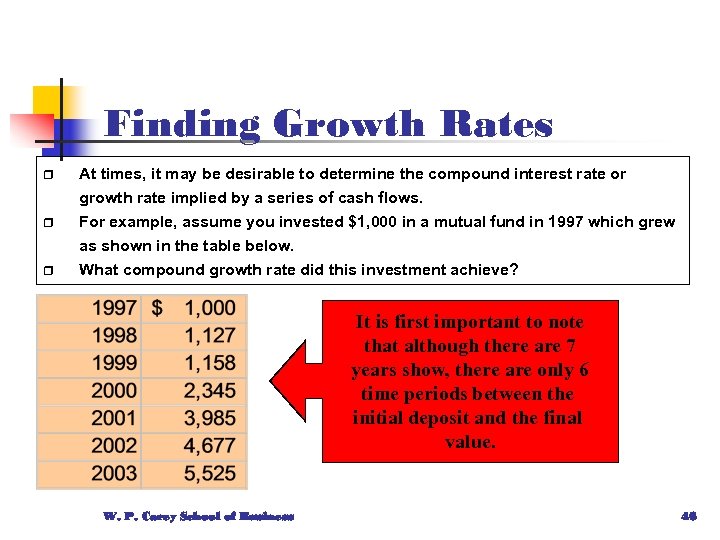 Finding Growth Rates r At times, it may be desirable to determine the compound interest rate or growth rate implied by a series of cash flows. r For example, assume you invested $1, 000 in a mutual fund in 1997 which grew as shown in the table below. What compound growth rate did this investment achieve? r It is first important to note that although there are 7 years show, there are only 6 time periods between the initial deposit and the final value. W. P. Carey School of Business 46
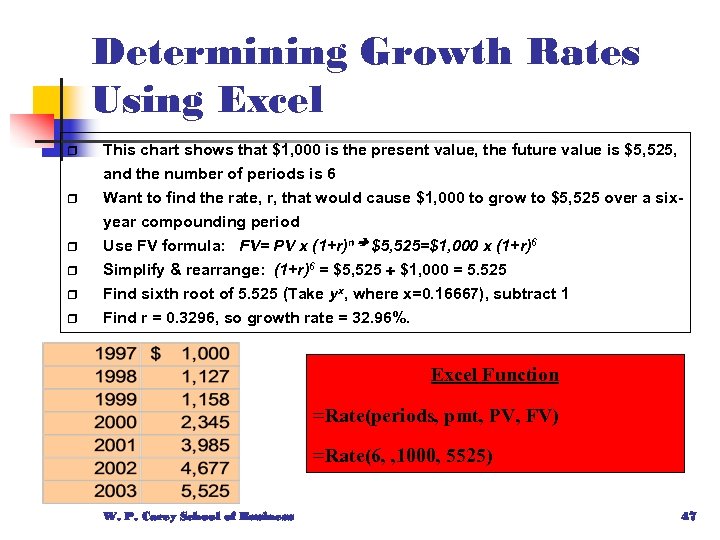 Determining Growth Rates Using Excel r This chart shows that $1, 000 is the present value, the future value is $5, 525, and the number of periods is 6 r Want to find the rate, r, that would cause $1, 000 to grow to $5, 525 over a sixyear compounding period Use FV formula: FV= PV x (1+r)n $5, 525=$1, 000 x (1+r)6 Simplify & rearrange: (1+r)6 = $5, 525 $1, 000 = 5. 525 Find sixth root of 5. 525 (Take yx, where x=0. 16667), subtract 1 Find r = 0. 3296, so growth rate = 32. 96%. r r Excel Function =Rate(periods, pmt, PV, FV) =Rate(6, , 1000, 5525) W. P. Carey School of Business 47
 The End of TVM Discussion W. P. Carey School of Business 48
 Risk & Return Concepts FIN 461: Financial Cases & Modeling George W. Gallinger Associate Professor of Finance W. P. Carey School of Business Arizona State University
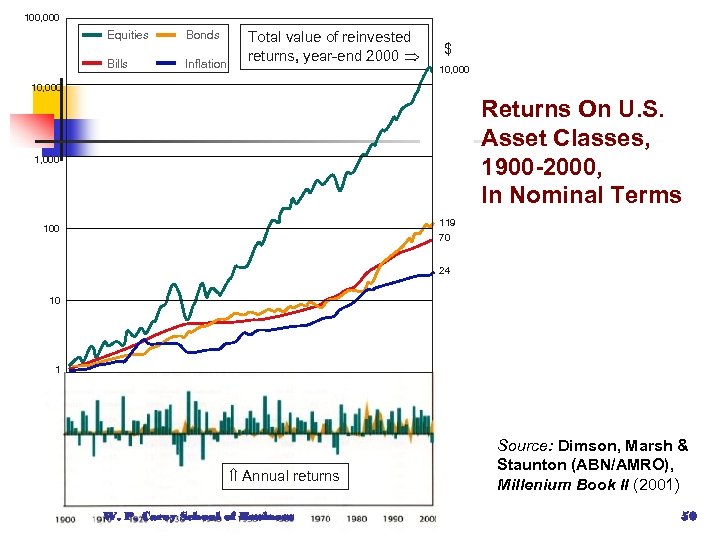 100, 000 Equities Bonds Bills Inflation Total value of reinvested returns, year-end 2000 $ 10, 000 Returns On U. S. Asset Classes, 1900 -2000, In Nominal Terms 1, 000 119 100 70 24 10 1 Annual returns W. P. Carey School of Business Source: Dimson, Marsh & Staunton (ABN/AMRO), Millenium Book II (2001) 50
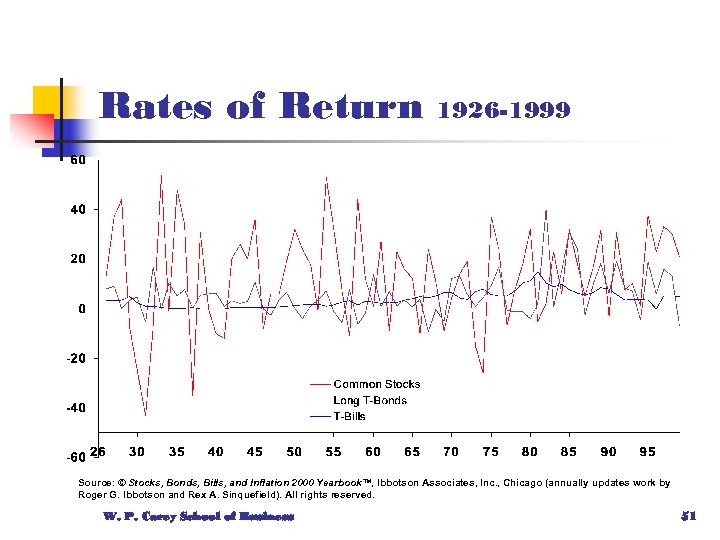 Rates of Return 1926 -1999 Source: © Stocks, Bonds, Bills, and Inflation 2000 Yearbook™, Ibbotson Associates, Inc. , Chicago (annually updates work by Roger G. Ibbotson and Rex A. Sinquefield). All rights reserved. W. P. Carey School of Business 51
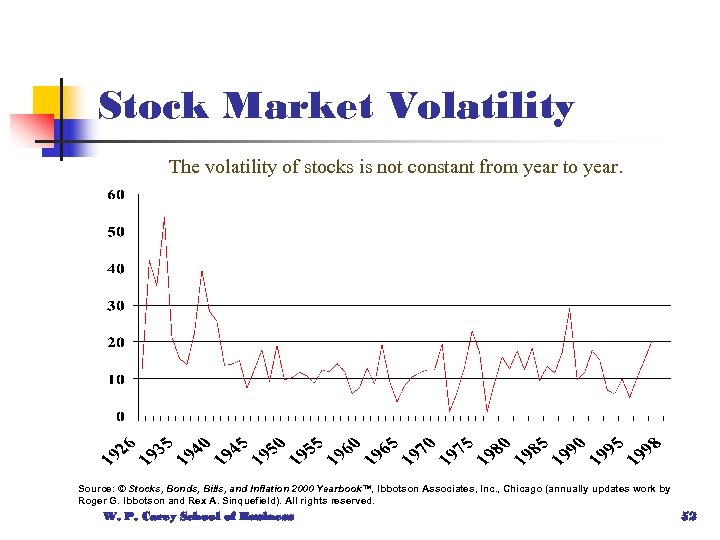 Stock Market Volatility The volatility of stocks is not constant from year to year. Source: © Stocks, Bonds, Bills, and Inflation 2000 Yearbook™, Ibbotson Associates, Inc. , Chicago (annually updates work by Roger G. Ibbotson and Rex A. Sinquefield). All rights reserved. W. P. Carey School of Business 52
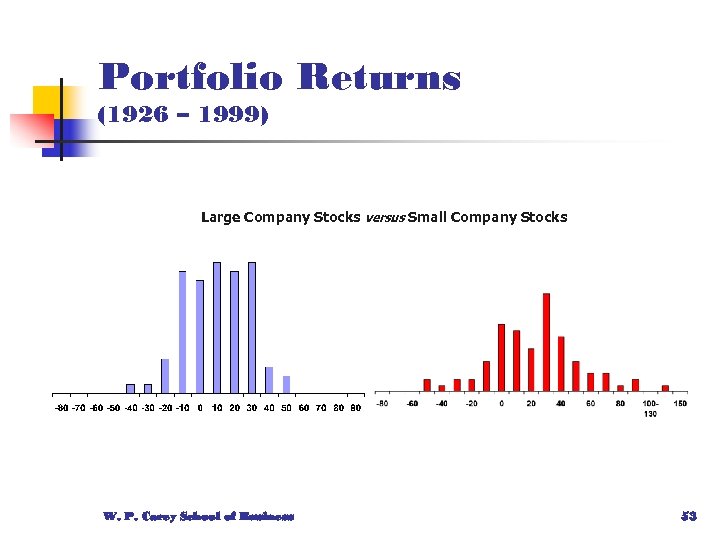 Portfolio Returns (1926 – 1999) Large Company Stocks versus Small Company Stocks W. P. Carey School of Business 53
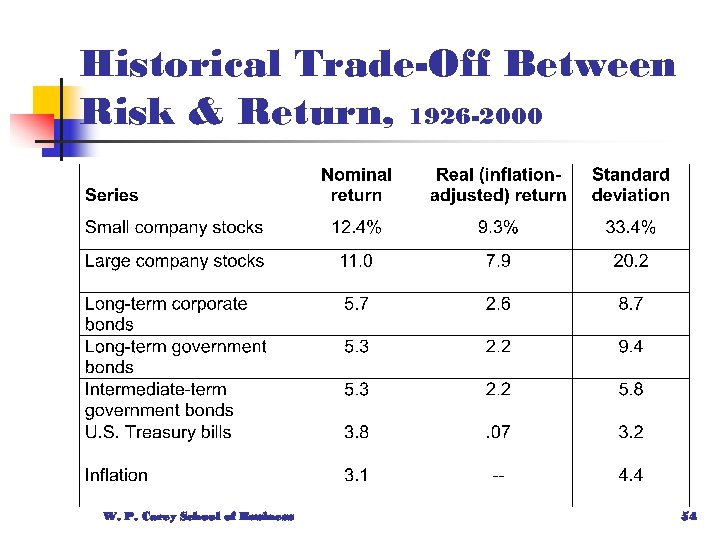 Historical Trade-Off Between Risk & Return, 1926 -2000 W. P. Carey School of Business 54
 Risk Premiums n n Rate of return on T-bills is essentially risk-free Investing in stocks is risky, but there are compensations Difference between the return on T-bills and stocks is the risk premium for investing in stocks An old saying on Wall Street is “You can either sleep well or eat well. ” W. P. Carey School of Business 55
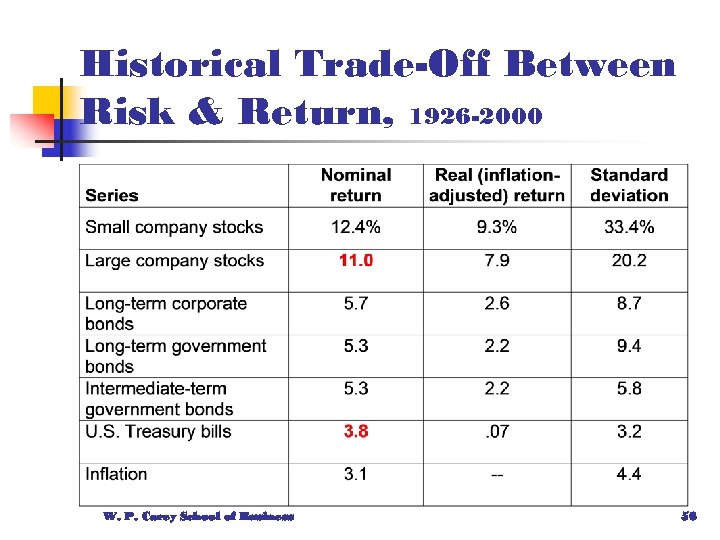 Historical Trade-Off Between Risk & Return, 1926 -2000 W. P. Carey School of Business 56
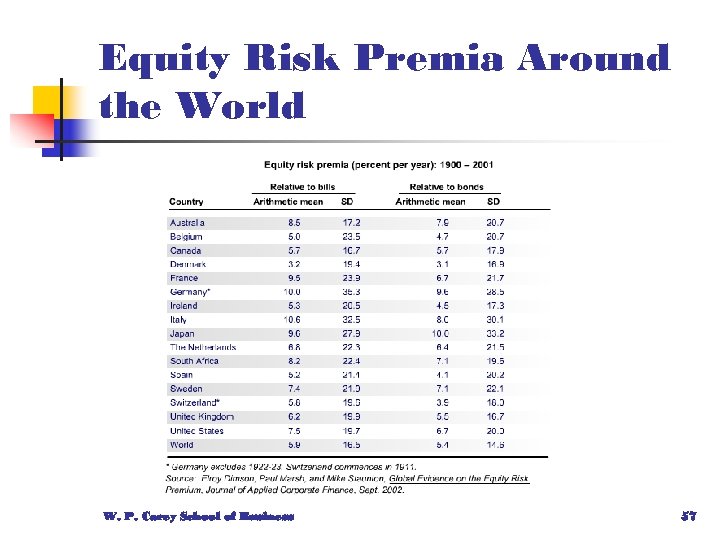 Equity Risk Premia Around the World W. P. Carey School of Business 57
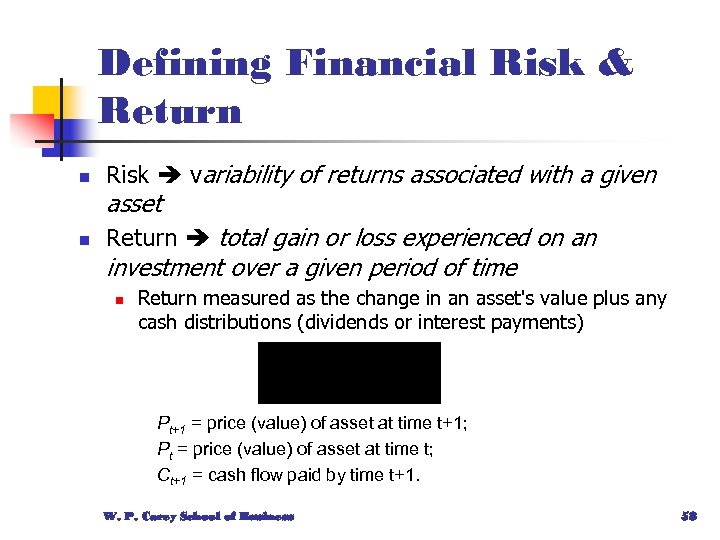 Defining Financial Risk & Return n Risk variability of returns associated with a given asset n Return total gain or loss experienced on an investment over a given period of time n Return measured as the change in an asset's value plus any cash distributions (dividends or interest payments) Pt+1 = price (value) of asset at time t+1; Pt = price (value) of asset at time t; Ct+1 = cash flow paid by time t+1. W. P. Carey School of Business 58
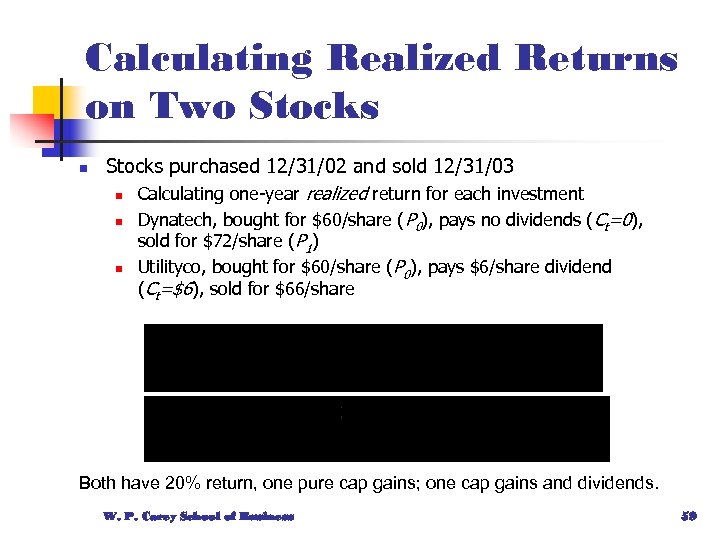 Calculating Realized Returns on Two Stocks n Stocks purchased 12/31/02 and sold 12/31/03 n Calculating one-year realized return for each investment n Dynatech, bought for $60/share (P ), pays no dividends (C =0), 0 t sold for $72/share (P 1) n Utilityco, bought for $60/share (P ), pays $6/share dividend 0 (Ct=$6), sold for $66/share Both have 20% return, one pure cap gains; one cap gains and dividends. W. P. Carey School of Business 59
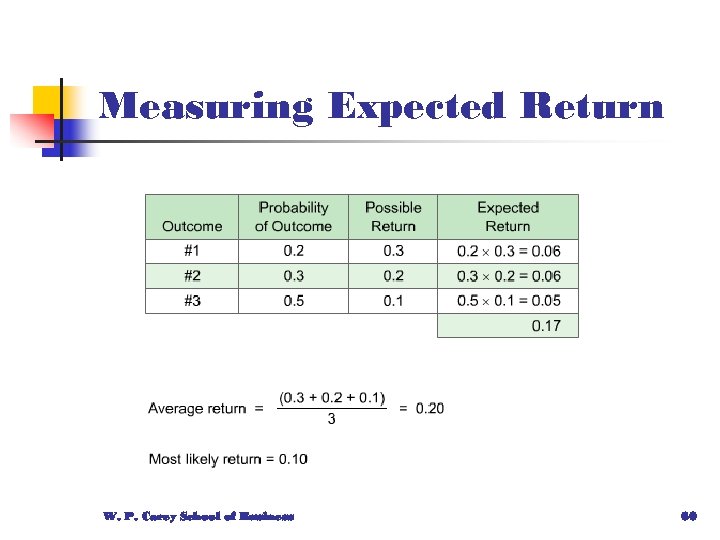 Measuring Expected Return W. P. Carey School of Business 60
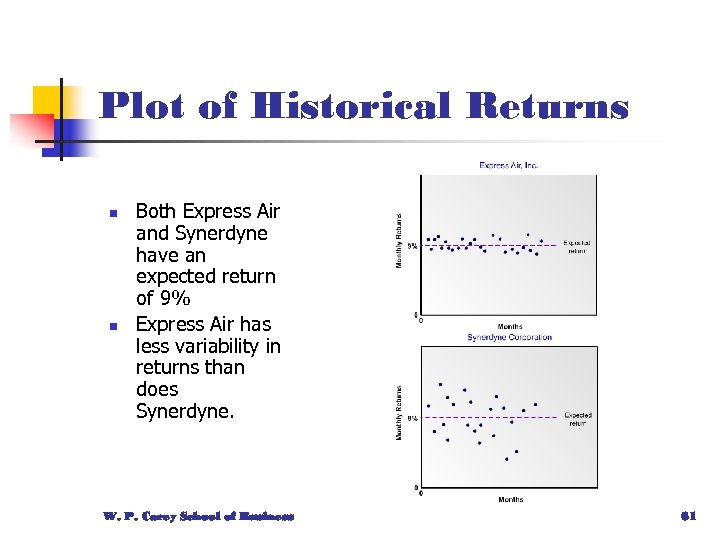 Plot of Historical Returns n n Both Express Air and Synerdyne have an expected return of 9% Express Air has less variability in returns than does Synerdyne. W. P. Carey School of Business 61
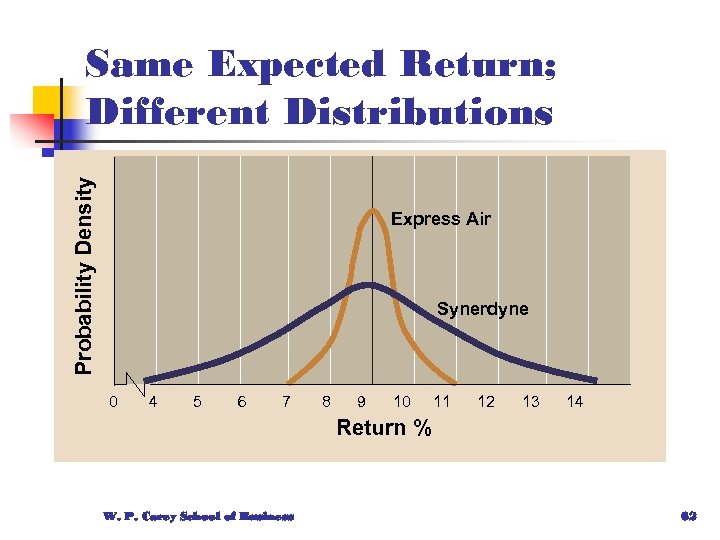 Probability Density Same Expected Return; Different Distributions Express Air Synerdyne 0 4 5 6 7 8 9 10 11 12 13 14 Return % W. P. Carey School of Business 62
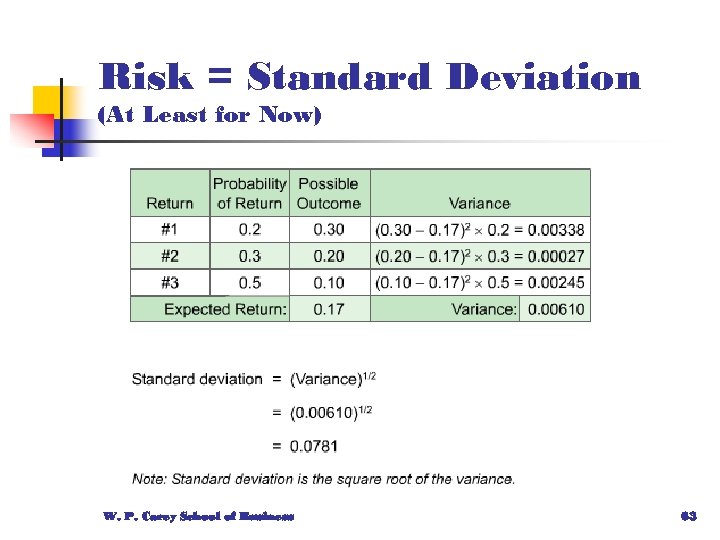 Risk = Standard Deviation (At Least for Now) W. P. Carey School of Business 63
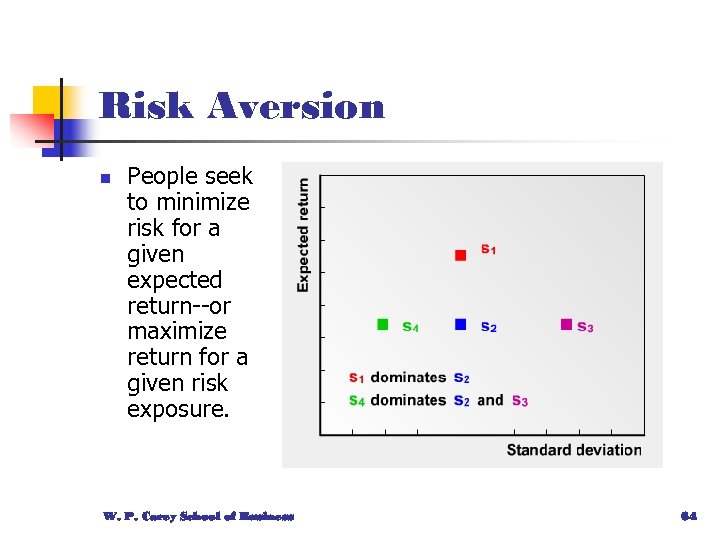 Risk Aversion n People seek to minimize risk for a given expected return--or maximize return for a given risk exposure. W. P. Carey School of Business 64
 Let’s Form a Portfolio n Assume two assets included. W. P. Carey School of Business 65
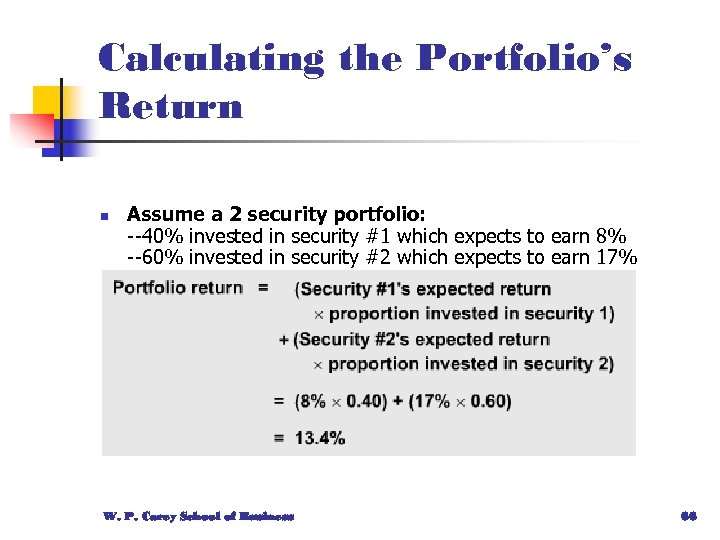 Calculating the Portfolio’s Return n Assume a 2 security portfolio: --40% invested in security #1 which expects to earn 8% --60% invested in security #2 which expects to earn 17% W. P. Carey School of Business 66
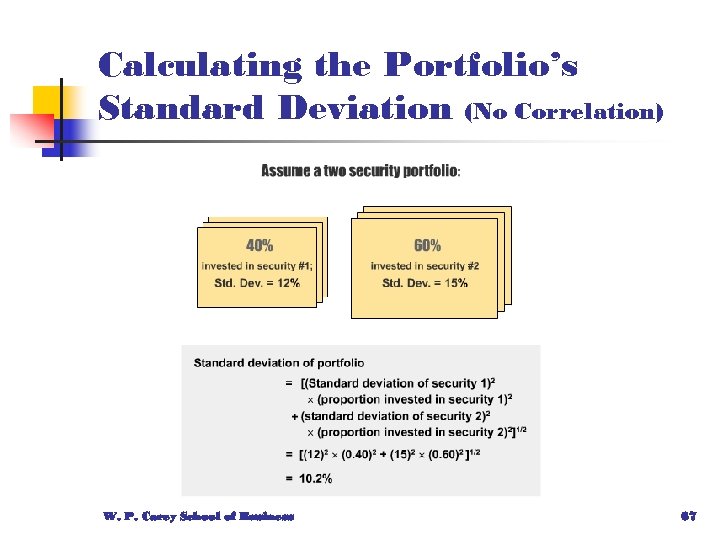 Calculating the Portfolio’s Standard Deviation (No Correlation) W. P. Carey School of Business 67
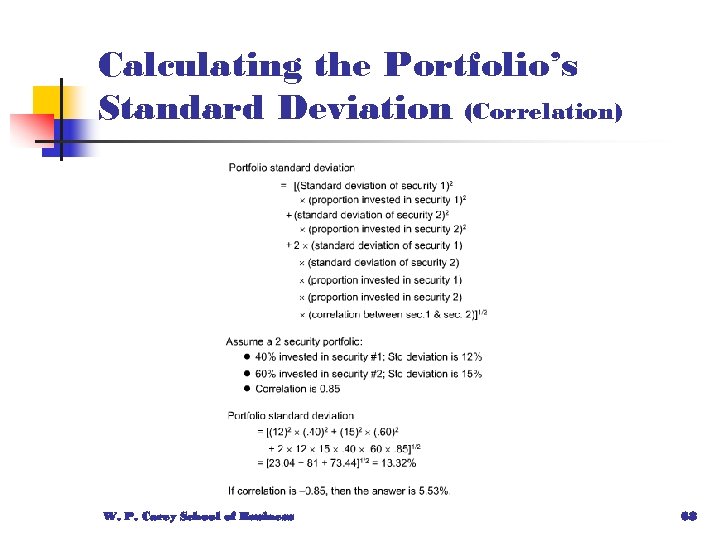 Calculating the Portfolio’s Standard Deviation (Correlation) W. P. Carey School of Business 68
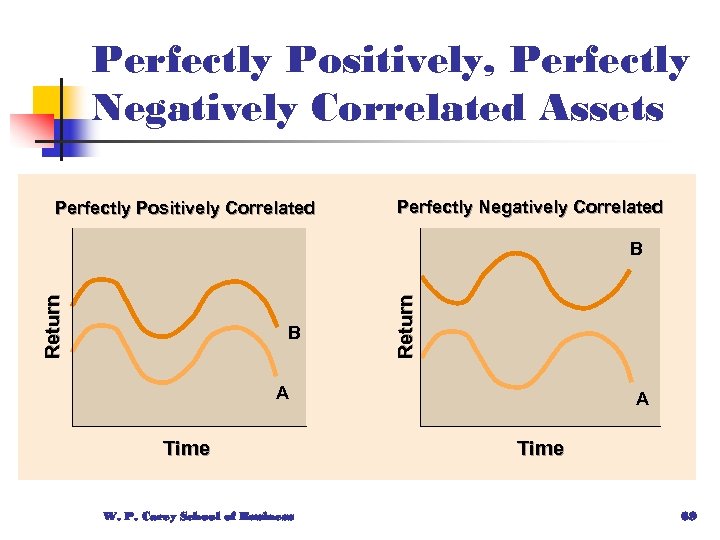 Perfectly Positively, Perfectly Negatively Correlated Assets Perfectly Positively Correlated Perfectly Negatively Correlated B Return B A Time W. P. Carey School of Business A Time 69
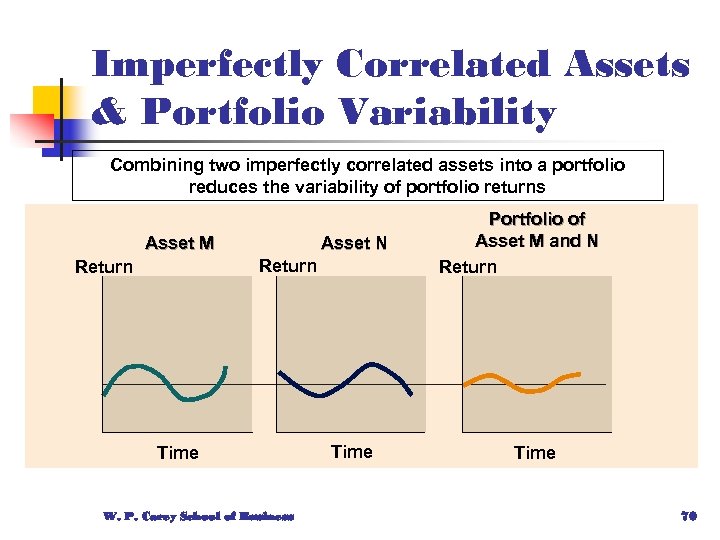 Imperfectly Correlated Assets & Portfolio Variability Combining two imperfectly correlated assets into a portfolio reduces the variability of portfolio returns Asset M Asset N Return Time W. P. Carey School of Business Time Portfolio of Asset M and N Return Time 70
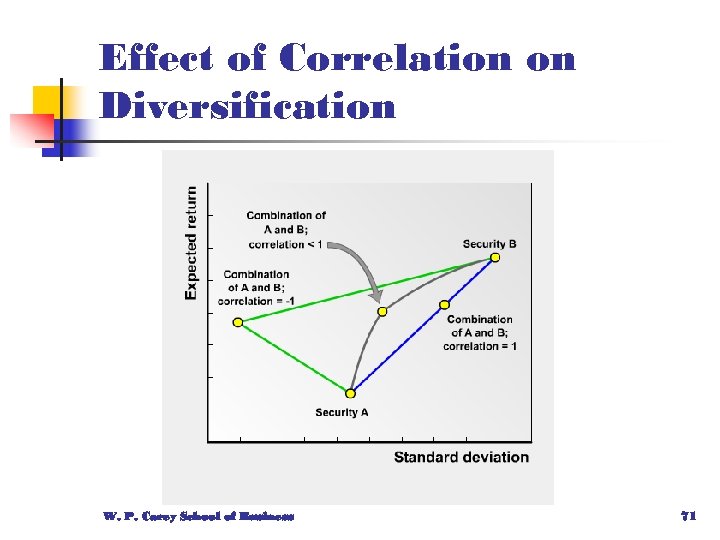 Effect of Correlation on Diversification W. P. Carey School of Business 71
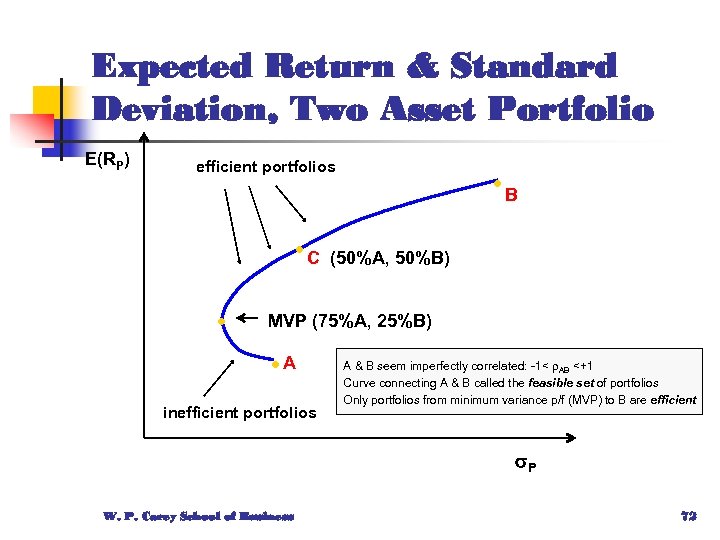 Expected Return & Standard Deviation, Two Asset Portfolio E(RP) efficient portfolios • C • • B (50%A, 50%B) MVP (75%A, 25%B) • A inefficient portfolios A & B seem imperfectly correlated: -1< AB <+1 Curve connecting A & B called the feasible set of portfolios Only portfolios from minimum variance p/f (MVP) to B are efficient P W. P. Carey School of Business 72
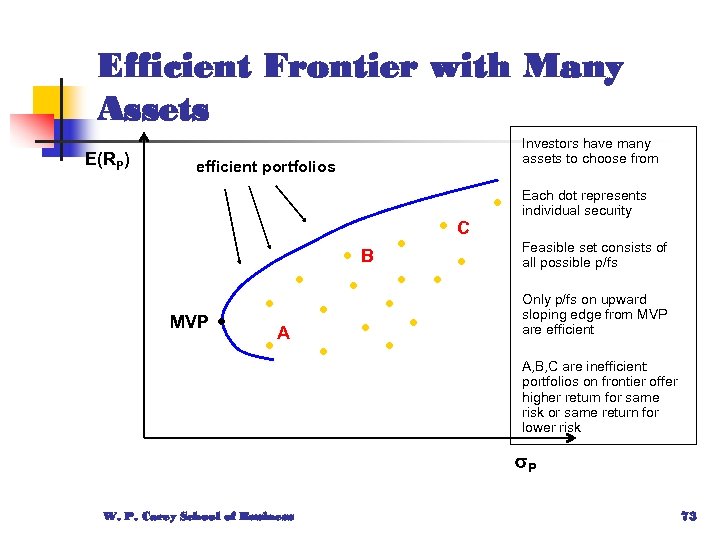 Efficient Frontier with Many Assets E(RP) Investors have many assets to choose from efficient portfolios • C • • MVP • • B • • A • • Each dot represents individual security Feasible set consists of all possible p/fs Only p/fs on upward sloping edge from MVP are efficient A, B, C are inefficient: portfolios on frontier offer higher return for same risk or same return for lower risk P W. P. Carey School of Business 73
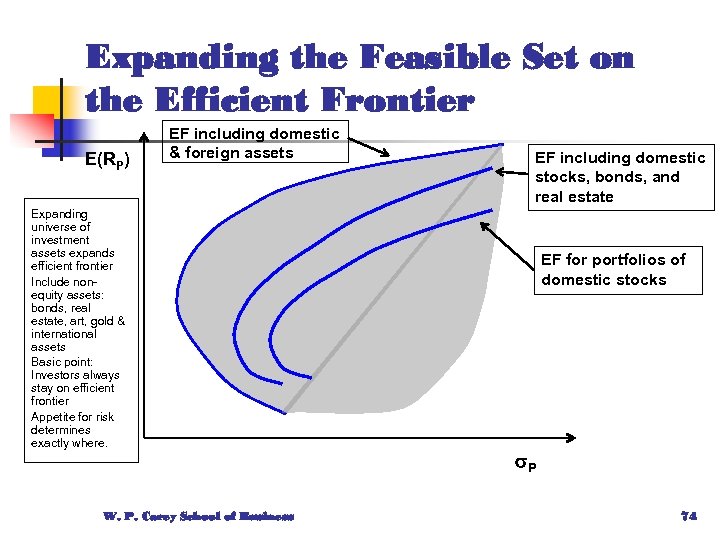 Expanding the Feasible Set on the Efficient Frontier E(RP) EF including domestic & foreign assets Expanding universe of investment assets expands efficient frontier Include nonequity assets: bonds, real estate, art, gold & international assets Basic point: Investors always stay on efficient frontier Appetite for risk determines exactly where. W. P. Carey School of Business EF including domestic stocks, bonds, and real estate EF for portfolios of domestic stocks P 74
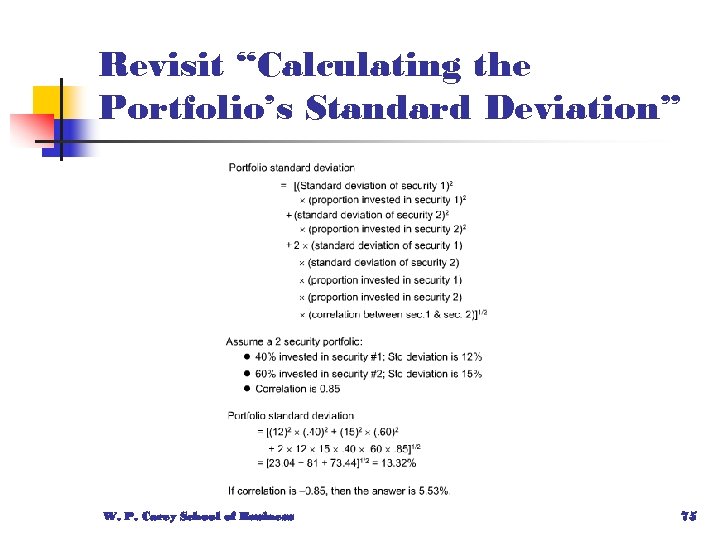 Revisit “Calculating the Portfolio’s Standard Deviation” W. P. Carey School of Business 75
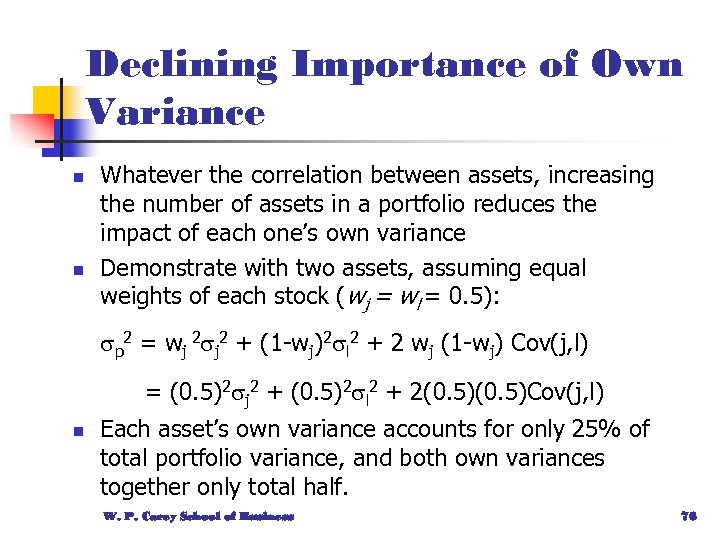 Declining Importance of Own Variance n n Whatever the correlation between assets, increasing the number of assets in a portfolio reduces the impact of each one’s own variance Demonstrate with two assets, assuming equal weights of each stock (wj = wl = 0. 5): p 2 = wj 2 + (1 -wj)2 l 2 + 2 wj (1 -wj) Cov(j, l) = (0. 5)2 j 2 + (0. 5)2 l 2 + 2(0. 5)Cov(j, l) n Each asset’s own variance accounts for only 25% of total portfolio variance, and both own variances together only total half. W. P. Carey School of Business 76
 Add More Assets n n Addition of more assets causes individual variances to decline in importance Covariance amounts are important. W. P. Carey School of Business 77
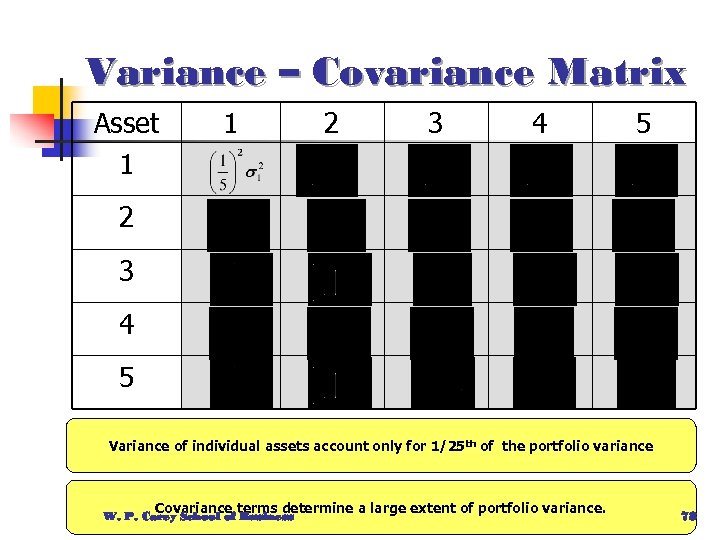 Variance – Covariance Matrix Asset 1 1 2 3 4 5 Variance of individual assets account only for 1/25 th of the portfolio variance Covariance terms determine a large extent of portfolio variance. W. P. Carey School of Business 78
 Important Discovery Emerges n Treat as two asset portfolio n n Asset #1 Risk-free Treasury security Asset #2 Market portfolio. W. P. Carey School of Business 79
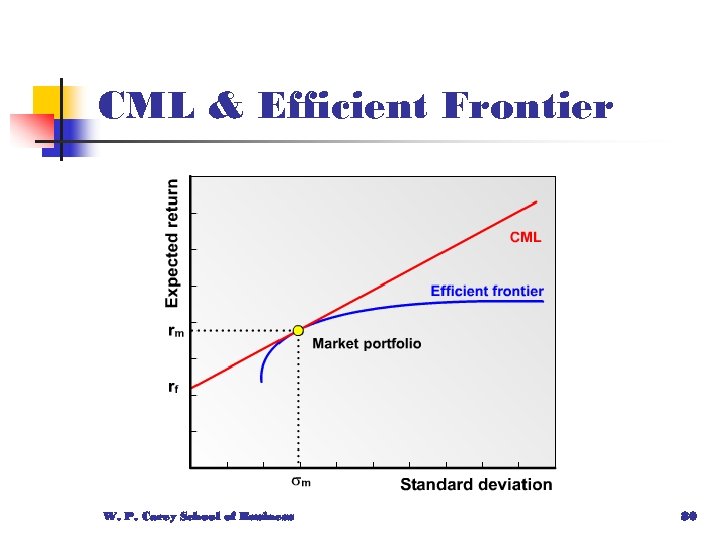 CML & Efficient Frontier W. P. Carey School of Business 80
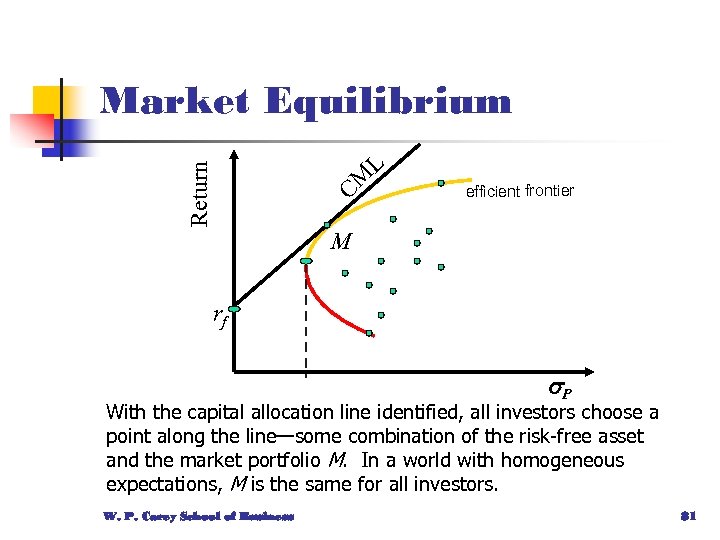 Market Equilibrium Return L CM efficient frontier M rf P With the capital allocation line identified, all investors choose a point along the line—some combination of the risk-free asset and the market portfolio M. In a world with homogeneous expectations, M is the same for all investors. W. P. Carey School of Business 81
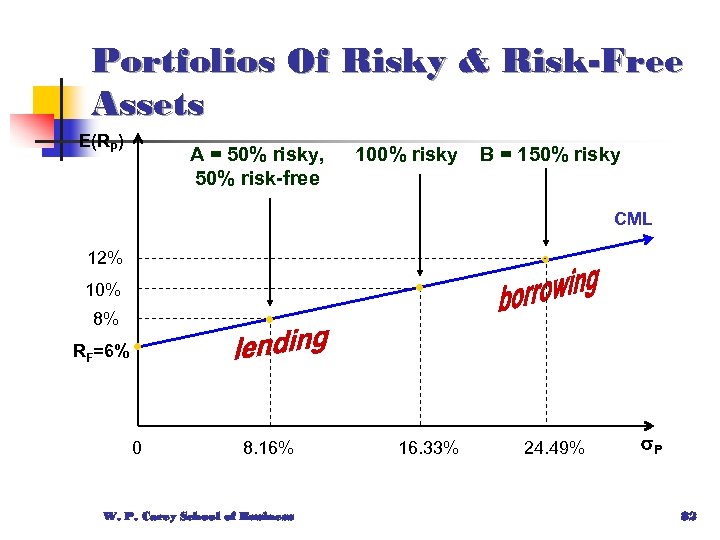 Portfolios Of Risky & Risk-Free Assets E(RP) A = 50% risky, 50% risk-free 100% risky B = 150% risky CML 12% • 10% 8% RF=6% • 0 • • 8. 16% W. P. Carey School of Business 16. 33% 24. 49% P 82
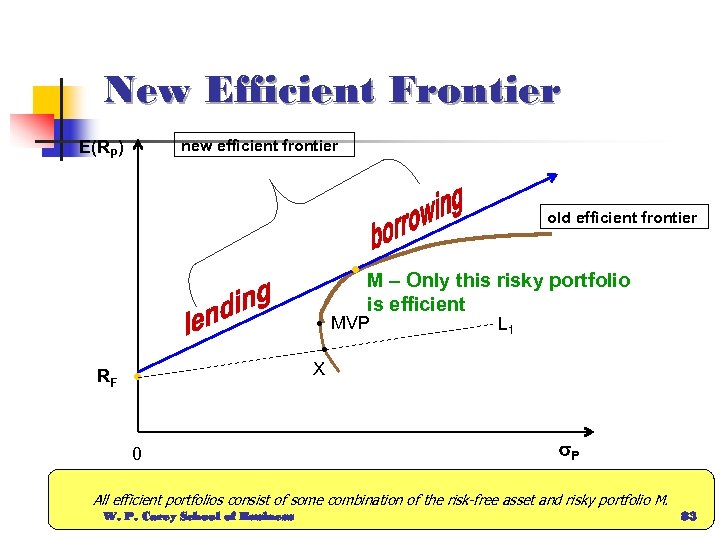 New Efficient Frontier new efficient frontier E(RP) old efficient frontier • M – Only this risky portfolio is efficient RF • 0 • MVP • L 1 X P All efficient portfolios consist of some combination of the risk-free asset and risky portfolio M. W. P. Carey School of Business 83
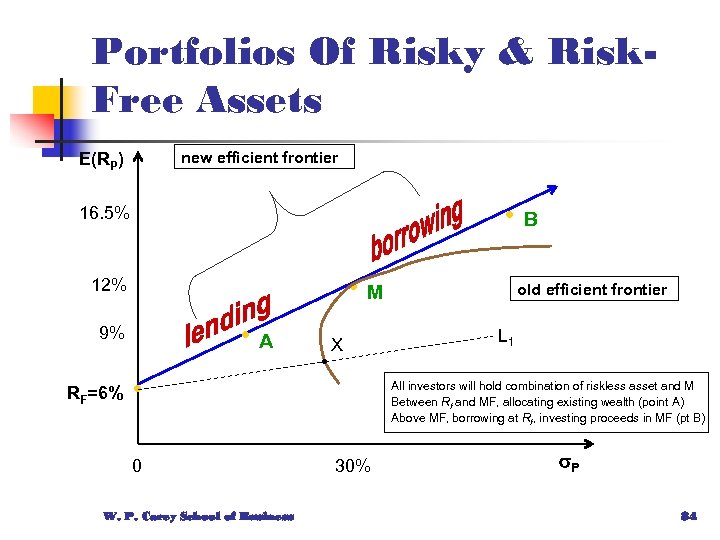 Portfolios Of Risky & Risk. Free Assets new efficient frontier E(RP) • 16. 5% • M 12% • A 9% RF=6% • 0 W. P. Carey School of Business • X B old efficient frontier L 1 All investors will hold combination of riskless asset and M Between Rf and MF, allocating existing wealth (point A) Above MF, borrowing at Rf, investing proceeds in MF (pt B) 30% P 84
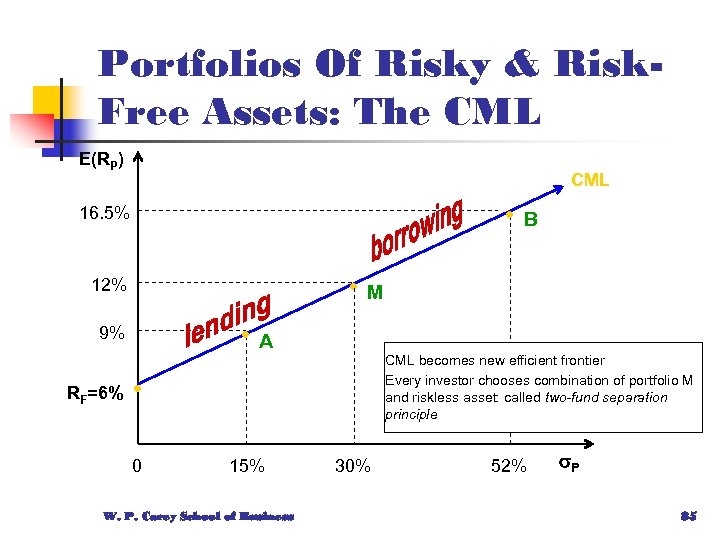 Portfolios Of Risky & Risk. Free Assets: The CML E(RP) CML • 16. 5% • M 12% • A 9% RF=6% B CML becomes new efficient frontier Every investor chooses combination of portfolio M and riskless asset: called two-fund separation principle • 0 15% W. P. Carey School of Business 30% 52% P 85
 Risk Contribution of a Security to a Diversified Portfolio n Ask: n n How does the security change as the market portfolio changes? Is the asset n n More risky? Less risky? As risky? What’s the diversifiable risk? W. P. Carey School of Business 86
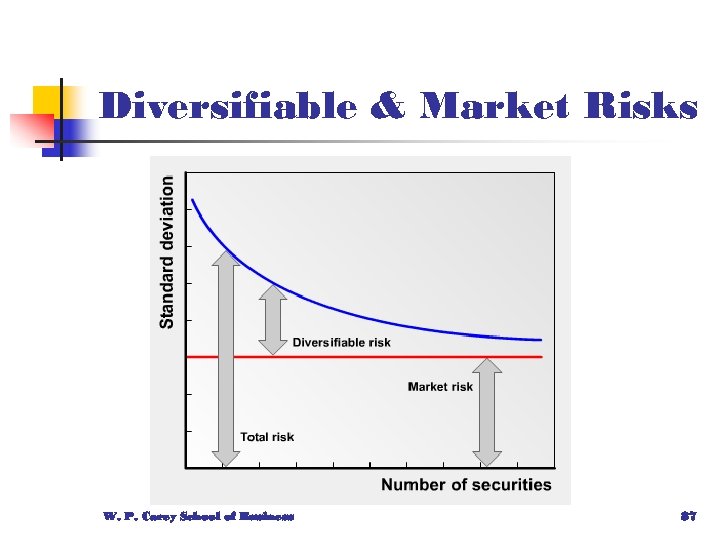 Diversifiable & Market Risks W. P. Carey School of Business 87
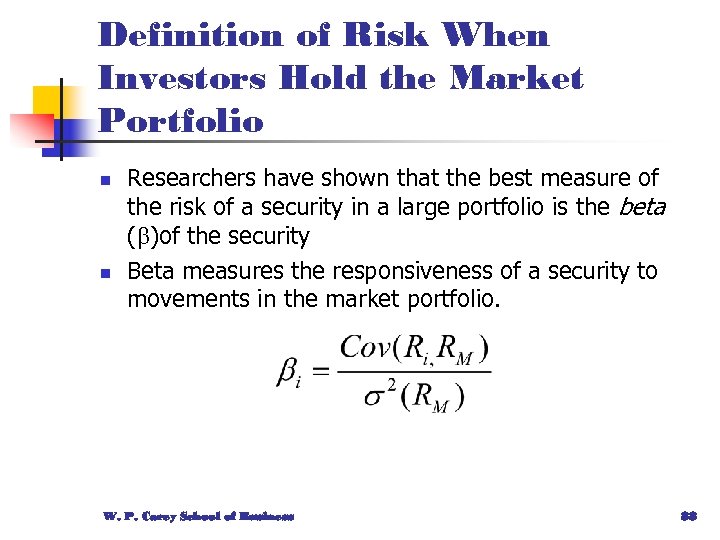 Definition of Risk When Investors Hold the Market Portfolio n n Researchers have shown that the best measure of the risk of a security in a large portfolio is the beta (b)of the security Beta measures the responsiveness of a security to movements in the market portfolio. W. P. Carey School of Business 88
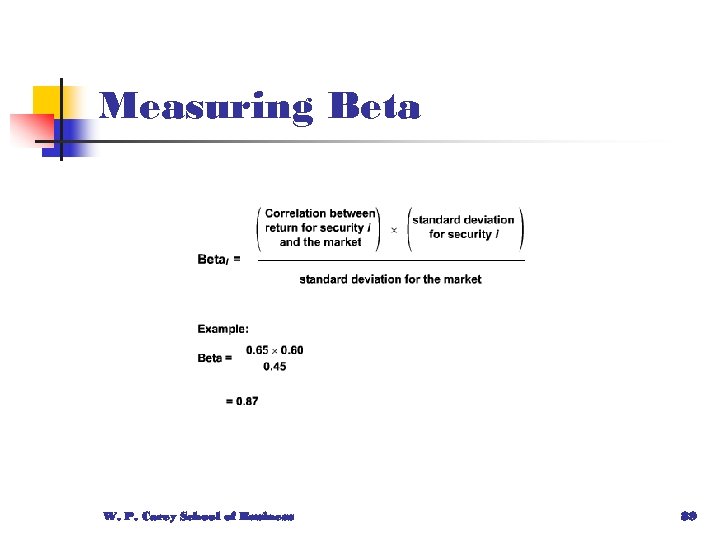 Measuring Beta W. P. Carey School of Business 89
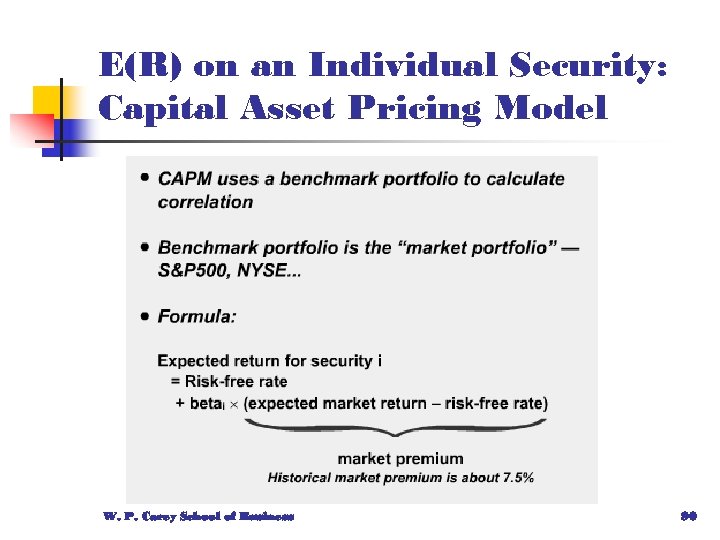 E(R) on an Individual Security: Capital Asset Pricing Model W. P. Carey School of Business 90
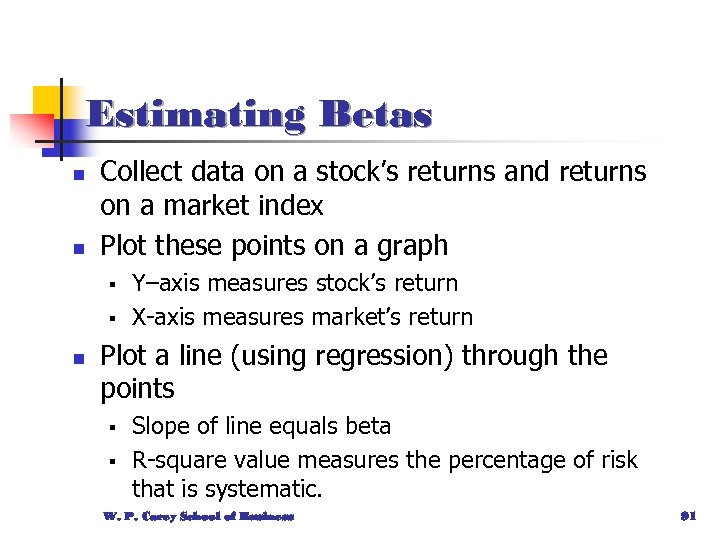 Estimating Betas n n Collect data on a stock’s returns and returns on a market index Plot these points on a graph § § n Y–axis measures stock’s return X-axis measures market’s return Plot a line (using regression) through the points § § Slope of line equals beta R-square value measures the percentage of risk that is systematic. W. P. Carey School of Business 91
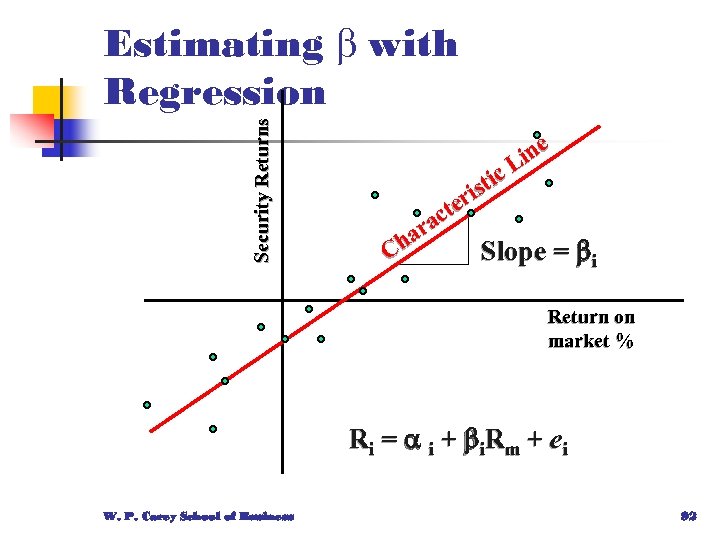 Security Returns Estimating b with Regression ine L ic ist ter c ra ha Slope = C i Return on market % Ri = a i + i. Rm + ei W. P. Carey School of Business 92
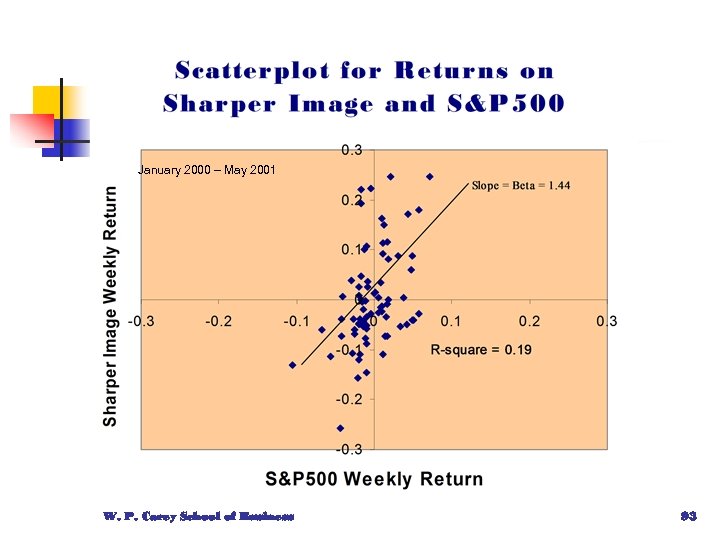 January 2000 – May 2001 W. P. Carey School of Business 93
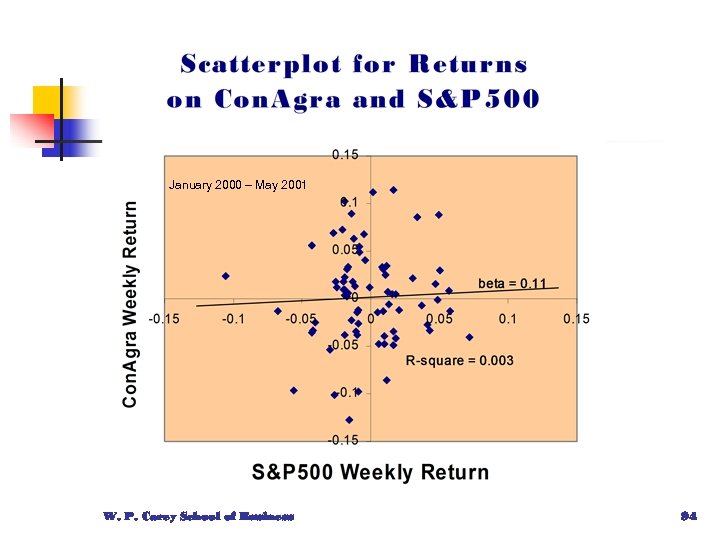 January 2000 – May 2001 W. P. Carey School of Business 94
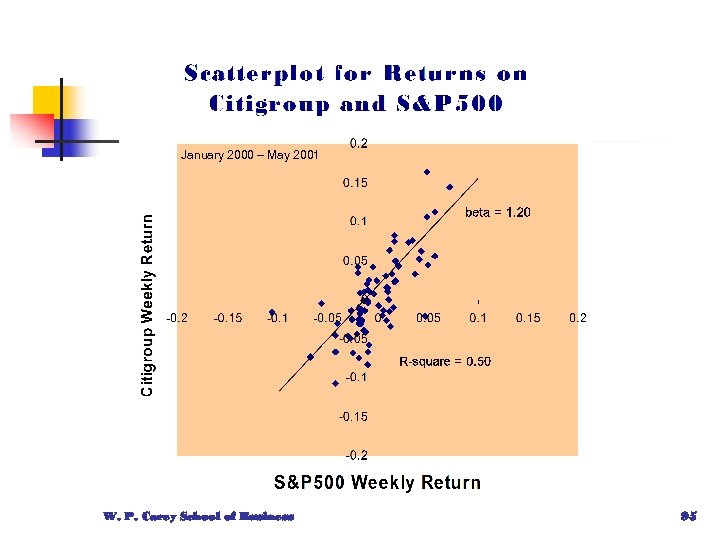 January 2000 – May 2001 W. P. Carey School of Business 95
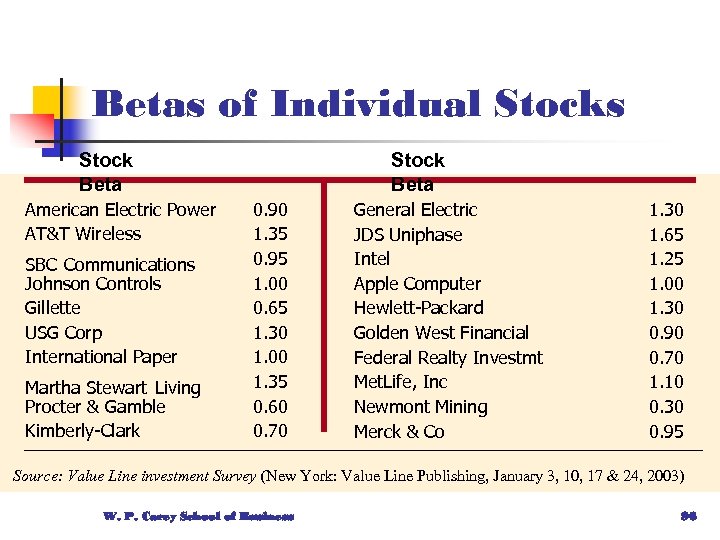 Betas of Individual Stocks Stock Beta American Electric Power AT&T Wireless SBC Communications Johnson Controls Gillette USG Corp International Paper Martha Stewart Living Procter & Gamble Kimberly-Clark Stock Beta 0. 90 1. 35 0. 95 1. 00 0. 65 1. 30 1. 00 1. 35 0. 60 0. 70 General Electric JDS Uniphase Intel Apple Computer Hewlett-Packard Golden West Financial Federal Realty Investmt Met. Life, Inc Newmont Mining Merck & Co 1. 30 1. 65 1. 25 1. 00 1. 30 0. 90 0. 70 1. 10 0. 30 0. 95 Source: Value Line investment Survey (New York: Value Line Publishing, January 3, 10, 17 & 24, 2003) W. P. Carey School of Business 96
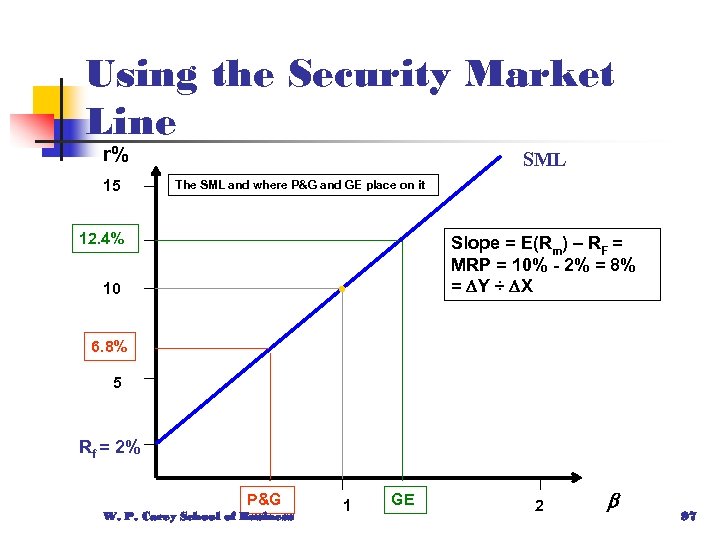 Using the Security Market Line r% 15 SML The SML and where P&G and GE place on it 12. 4% Slope = E(Rm) – RF = MRP = 10% - 2% = 8% = Y ÷ X • 10 6. 8% 5 Rf = 2% P&G W. P. Carey School of Business 1 GE 2 97
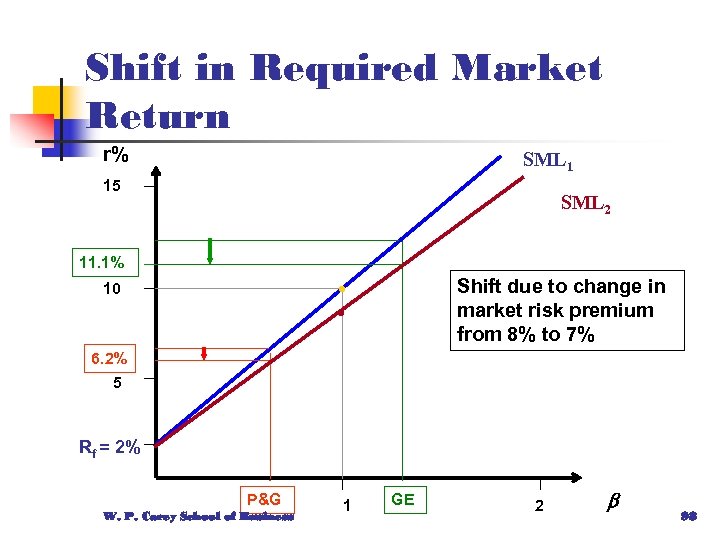 Shift in Required Market Return r% SML 1 15 SML 2 11. 1% Shift due to change in market risk premium from 8% to 7% • • 10 6. 2% 5 Rf = 2% P&G W. P. Carey School of Business 1 GE 2 98
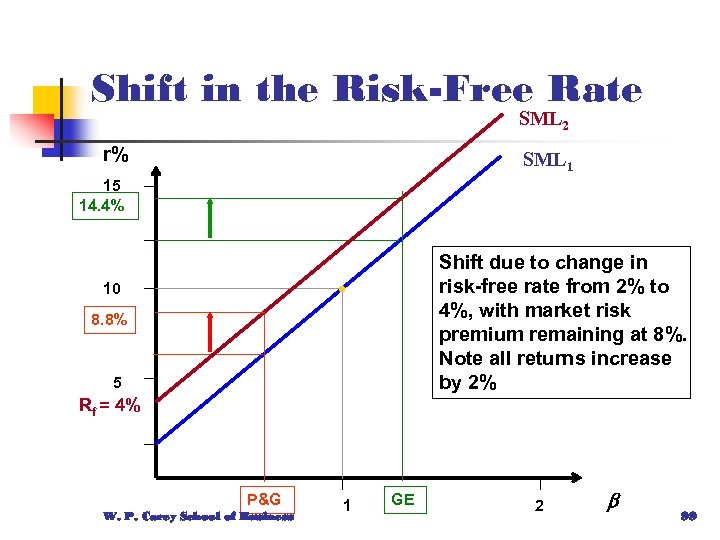 Shift in the Risk-Free Rate SML 2 r% SML 1 15 14. 4% Shift due to change in risk-free rate from 2% to 4%, with market risk premium remaining at 8%. Note all returns increase by 2% • 10 8. 8% 5 Rf = 4% P&G W. P. Carey School of Business 1 GE 2 99
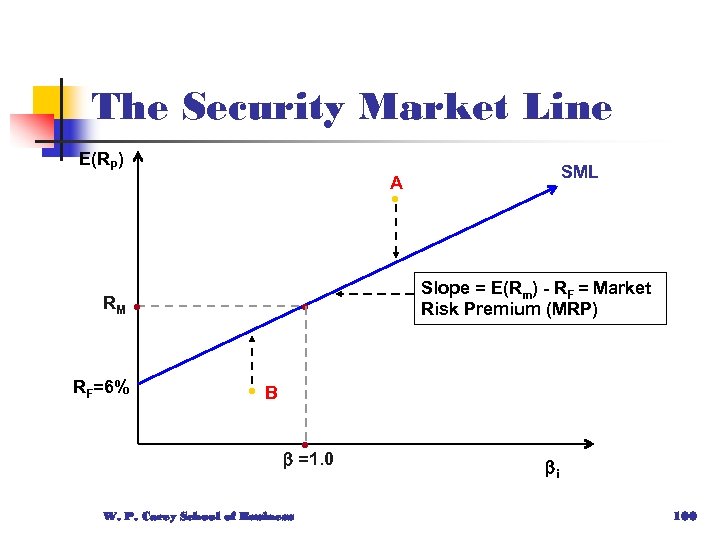 The Security Market Line E(RP) SML A • RM RF=6% • • • Slope = E(Rm) - RF = Market Risk Premium (MRP) B • =1. 0 W. P. Carey School of Business i 100
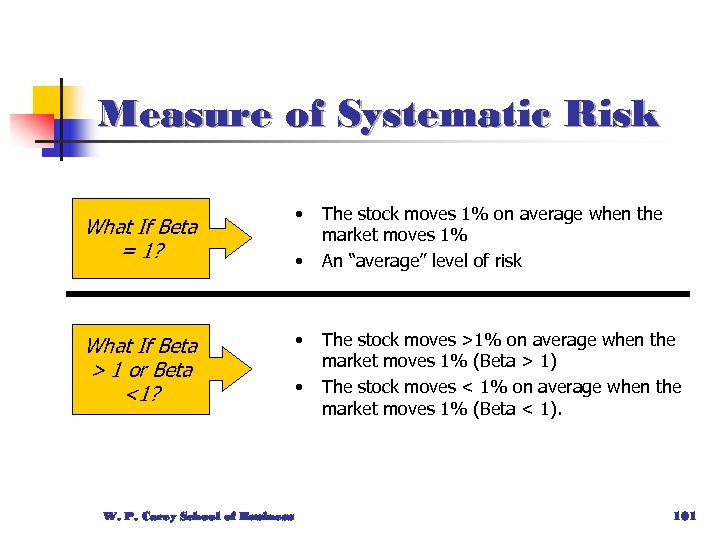 Measure of Systematic Risk What If Beta = 1? What If Beta > 1 or Beta <1? W. P. Carey School of Business • • The stock moves 1% on average when the market moves 1% An “average” level of risk The stock moves >1% on average when the market moves 1% (Beta > 1) The stock moves < 1% on average when the market moves 1% (Beta < 1). 101
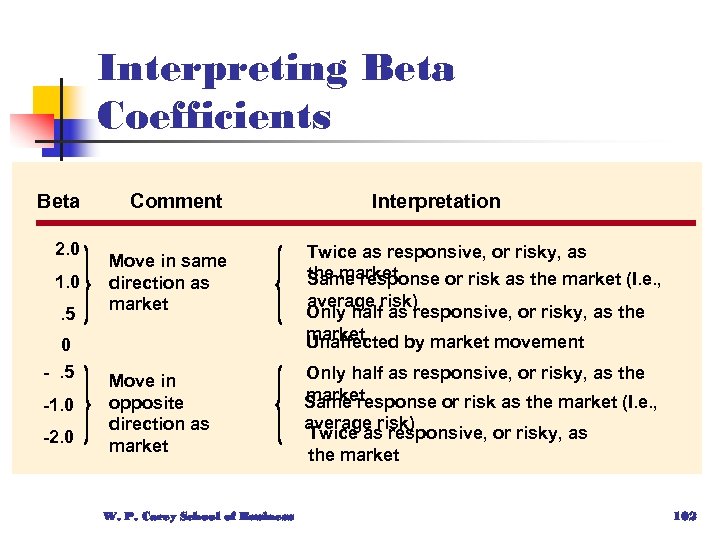 Interpreting Beta Coefficients Beta 2. 0 1. 0. 5 Comment Move in same direction as market 0 -. 5 -1. 0 -2. 0 Move in opposite direction as market W. P. Carey School of Business Interpretation Twice as responsive, or risky, as the market Same response or risk as the market (I. e. , average risk) Only half as responsive, or risky, as the market Unaffected by market movement Only half as responsive, or risky, as the market Same response or risk as the market (I. e. , average risk) Twice as responsive, or risky, as the market 102
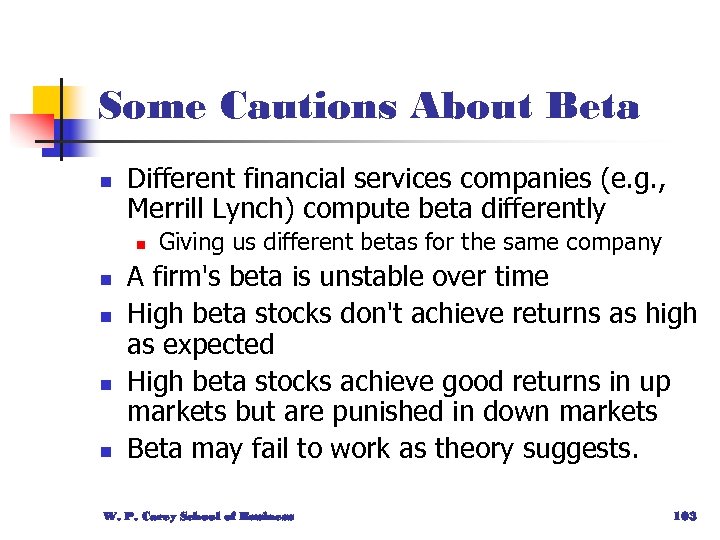 Some Cautions About Beta n Different financial services companies (e. g. , Merrill Lynch) compute beta differently n n n Giving us different betas for the same company A firm's beta is unstable over time High beta stocks don't achieve returns as high as expected High beta stocks achieve good returns in up markets but are punished in down markets Beta may fail to work as theory suggests. W. P. Carey School of Business 103
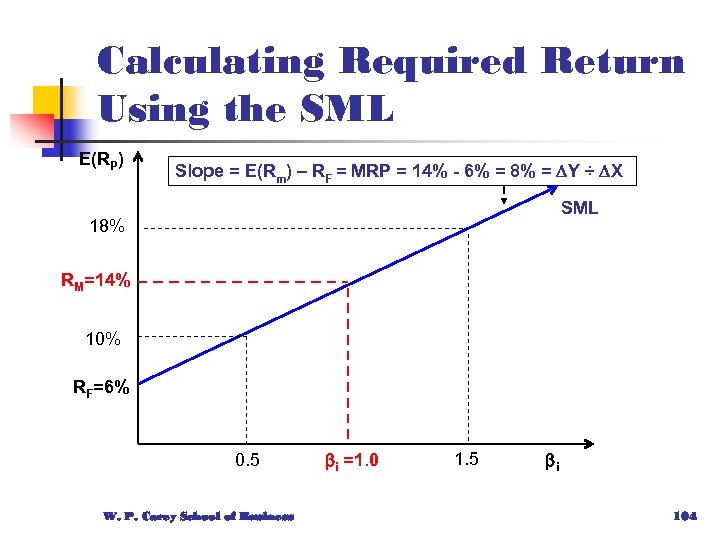 Calculating Required Return Using the SML E(RP) Slope = E(Rm) – RF = MRP = 14% - 6% = 8% = Y ÷ X SML 18% RM=14% 10% RF=6% 0. 5 W. P. Carey School of Business i =1. 0 1. 5 i 104
![Example: Calculating Expected Returns E(Ri) = Rf + ß [E(Rm) – Rf] • Assume](https://present5.com/presentation/d1f7684ec25a3149dcc45dcbc28a31e6/image-105.jpg "Example: Calculating Expected Returns E(Ri) = Rf + ß [E(Rm) – Rf] • Assume") Example: Calculating Expected Returns E(Ri) = Rf + ß [E(Rm) – Rf] • Assume • Risk–free rate = 2% • Expected risk premium = 6% If Stock’s Beta Is Then Expected Return Is 0 2% 0. 5 5% 1 8% 2 14% When beta = 0, the return equals the risk-free return When beta = 1, the W. P. Carey School of Business return equals the expected market return. 105
Example: Calculating Expected Returns E(Ri) = Rf + ß [E(Rm) – Rf] • Assume • Risk–free rate = 2% • Expected risk premium = 6% If Stock’s Beta Is Then Expected Return Is 0 2% 0. 5 5% 1 8% 2 14% When beta = 0, the return equals the risk-free return When beta = 1, the W. P. Carey School of Business return equals the expected market return. 105
 Portfolio Betas? n n Betas calculated for stocks Thus, can calculate portfolio betas. W. P. Carey School of Business 106
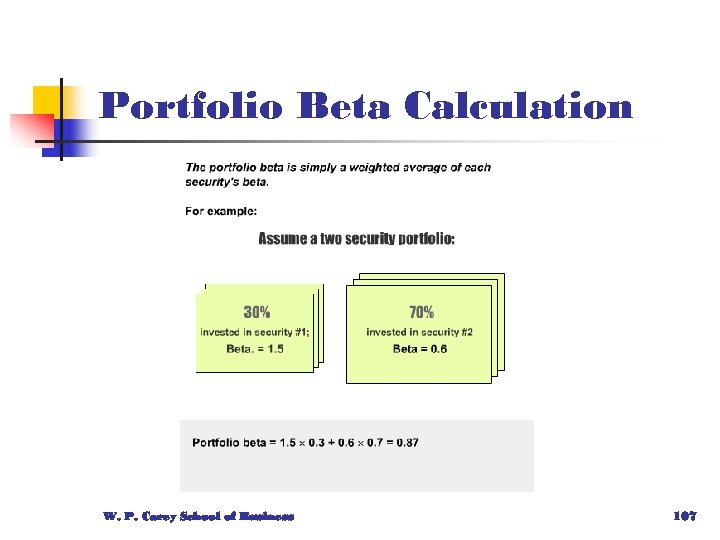 Portfolio Beta Calculation W. P. Carey School of Business 107
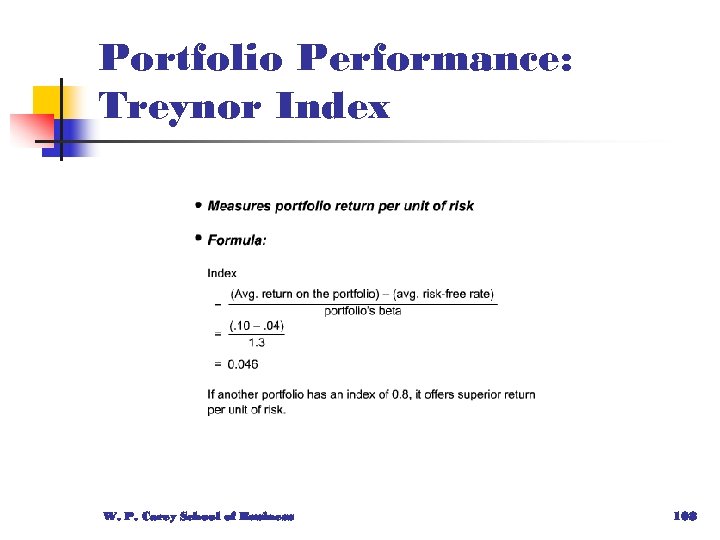 Portfolio Performance: Treynor Index W. P. Carey School of Business 108
 The End W. P. Carey School of Business 109