 Скачать презентацию Time to Market -Solving the Problem of Viable
848d65efdb861009ad13f0d56fd7a3a9.ppt
- Количество слайдов: 40



Time to Market -Solving the Problem of Viable Processes Through Research by Assoc. Prof. Karl Reed, FACS, FIE-Aust. , MSc, ARMIT Director, Computer Sys. & Software Engineering Board, ACS, Governor, IEEE-Computer Society(1997 -1999, 2000 -2002), Member of the Board, SEA-Vic. , Member, IEEE-CS/ACM Software Engineering Coordinating Committee, Department of Computer Science and Computer Engineering, La Trobe University Hon. Visiting Professor, Middlesex University “time to market is shorter than time to design… and time to evaluate ROI” reed Karl Reed sea 2000 Time To Market 1
This Presentation will cover. . 1. The Problem and Its Business Implications, 2. Standard Software Processes, Their Limitations and Advantages 3. Time-to-Market (TTM) as a truncated schedule. . the impact 4. Business Characteristics needed from TTM 5. Current State of Knowledge and Practice-MS vs the Rest 6. A Research Program for Practical TTM Processes 7. Conclusions Karl Reed sea 2000 Time To Market 2
Objectives of this Presentation. . Analyse the Problem, Demonstrate that Researchers can Assist the Software Industry Propose a credible work-plan, Form a working Party. . . Karl Reed sea 2000 Time To Market 3
1. TTM- The Problem and Its Business Implications “TTM-the ability to project software into a market in abnormally short time-scales. . ” The Problem… How to do this and make a profit. . How to apply to non-shrink-wrap, multi-sale environments Karl Reed sea 2000 Time To Market 4
1. TTM- The Problem and Its Business Implications(cont’d. . ) The Business Implications. . TTM allows. . Market pre-emption… product to market ahead of competitors (cf Microsoft and Netscape), Rapid response to evolving customer need, in rapidly evolving domains Customer “lock-in” through pre-mature release. . Virgin markets to be “captured” Fixed, immediate deadlines to be met. . Karl Reed sea 2000 Time To Market 5
1. TTM-The Problem and Its Business Implications(cont’d. . ) TTM is not new. . Or unique to s/w. . The IBM OS/360 … (~1963 -66). . (. . . productivity may be 7 times better for a small team, and personal productivity may be 7 times better, so a 5000 person year project might be completed in 10 years by 10 people. . “. . But would anyone be interested…”) Brooks 1975 The auto industry operates in a TTM environment Karl Reed sea 2000 Time To Market 6
2. Standard Processes-their limitations and advantages Limitations… relatively slow delay functional demonstrations schedule not an independent variable Karl Reed sea 2000 Time To Market 7
2. Standard Processes-limitations and advantages Advantages schedule and effort determined by task in hand resources quality outcomes controlled functional coherence on complex projects possible(? ) excellent for “custom builds” and “inhouse”projects. . “oncers” productivity “high” Karl Reed sea 2000 Time To Market 8
3. Time to Market as a “truncated schedule”, uses and impact Delivery schedules severely truncated. . (< than 50% of normal) Schedule fixed by external factors. . Used where there is. . Ultra-high volumes of sales Need for market capture (see earlier) Impact Productivity reduced (? ) Quality reduced(? ) Functional Coherence reduced Slow, unreliable, incomplete Karl Reed sea 2000 Time To Market 9
3. Time to Market as a “truncated schedule”…… (cont’d) The productivity problem for a given project a minimum feasible delivery time tdmin cost = k t-4 (Putnam’s SLIM)… cost increases dramatically with reduced schedule cost increases with project staff-size Karl Reed sea 2000 Time To Market 10
3. Time to Market as a “truncated schedule”…… (cont’d) The Quality Problem Thorough design of high-functionality systems takes time, especially if there are complex HCI interactions, Complete testing of high-functionality systems takes time Error-free code takes time… Efficient code takes time… (re-useable code/design takes time. . ) Karl Reed sea 2000 Time To Market 11
4. Business Characteristics of TTM Projects. . . Hard delivery dates year Finite 2000, GST cut-over windows of opportunity Web-development Pre-emptive beating products Microsoft to the market Leveraging net-centric Karl Reed sea 2000 Time To Market technology new technology products (net assembled and delivered) 12
4. Business Characteristics of TTM Projects…(cont’d) Projects where initial sales provide future market dominance Ultra high volume products sale price almost independent of development cost Time-critical request for proposals providing a bidder with a competitive edge Karl Reed sea 2000 Time To Market 13
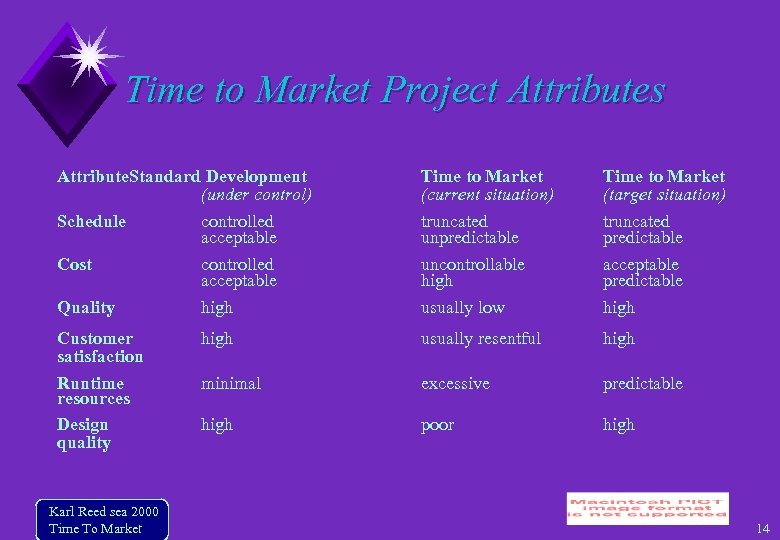
Time to Market Project Attributes Attribute. Standard Development (under control) Time to Market (current situation) Time to Market (target situation) Schedule controlled acceptable high truncated unpredictable uncontrollable high usually low truncated predictable acceptable predictable high Customer satisfaction high usually resentful high Runtime resources Design quality minimal excessive predictable high poor high Cost Quality Karl Reed sea 2000 Time To Market 14
5. Current State of Knowledge and Practice-MS vs the Rest. . Clearly there are “processes” that work. . Microsoft has made the TTM concept famous, seems a little like the old “Mongolian Hords”, adhoc approach Major telco’s claim success based on COTS approaches. . MCI claimed it was shooting for about 10 weeks for major product deployment Karl Reed sea 2000 Time To Market 15
5. Current State of Knowledge and Practice. MS vs the Rest. . (cont’d) history Dijkstra and THE OS in the 70’s (the lesson? ). . . “Five people as smart as Edgar Dijkstra can do anything” Reed, 1981 The first Unix effort…(but what did it take for product versions) OS/360, PL/I (the lesson? ) (60’s). . Very large teams can build large systems very quickly. . ~ x 1000 person years Total volumes of functionality (e. g. OS/360) may allow partitioning. . TTM issue obscured. . Karl Reed sea 2000 Time To Market 16
5. Current State of Knowledge of TTM. . . The $64, 000? …How does MS do it? “synchronise and stabilise” Netscape ? modified “synchronise and stabilise” OSA ? Pretty much the same… Issue. . What is really new? Karl Reed sea 2000 Time To Market 17
Microsoft’s “Synchronise & Stabilise” Karl Reed sea 2000 Time To Market [Cusumano & Yoffle 1999] fig 1 ieee-cs computer v 38 n 10 Oct. 1999
Microsoft’s “Synchronise & Stabilise” (cf waterfall) Karl Reed sea 2000 Time To Market
Netscape Staff Allocations for TTM Projects Karl Reed sea 2000 Time To Market 20
5. Microsoft’s/Netscape “Synchronise & Stabilise”. . Non-standard features. . “Daily” build and testing, High-leverage tool usage NOT reported Development technology not useful or irrelevant Feature instability. . Features responsibility of teams, which may change them. . (? ) Mid project major enhancement (NS, MS) Automated reporting and testing Build-cycle Karl Reed sea 2000 Time To Market times ~ a few hours 21
5. Microsoft’s/Netscape “Synchronise & Stabilise”. . Non-standard features. . (cont’d) Pre-emptive QA seems “light” (not clean-room) Code reviews not intensive or mandated NS-change control and altered-code reviews, sign-off and recording High reliance on developer motivation and progressive testing feature-complete testing precedes controlled during . . fix acceptance Macro-process independent. . Individuals do whatever Karl Reed sea 2000 Time To Market 22
We identify five issues…The technology : a. embodied by the complete product, Its capabilities, in function, performance etc. b. of its components, the parts, materials, sub-systems c. used in its production, tools, design techniques d. in terms of human skills used in production, e. used in the process of production organisation of production, process Karl Reed sea 2000 Time To Market 23
5. Microsoft’s/Netscape “Synchronise & Stabilise”. . Non-standard features. . (cont’d) Bug tracing during stabilization extensive… NOT REPORTED BY OBSERVERS. . formal documentation requirements… conventional phase-completion checks feature conformance requirements for OS api’s feature coherence testing and checking Compatibility control. . Karl Reed sea 2000 Time To Market 24
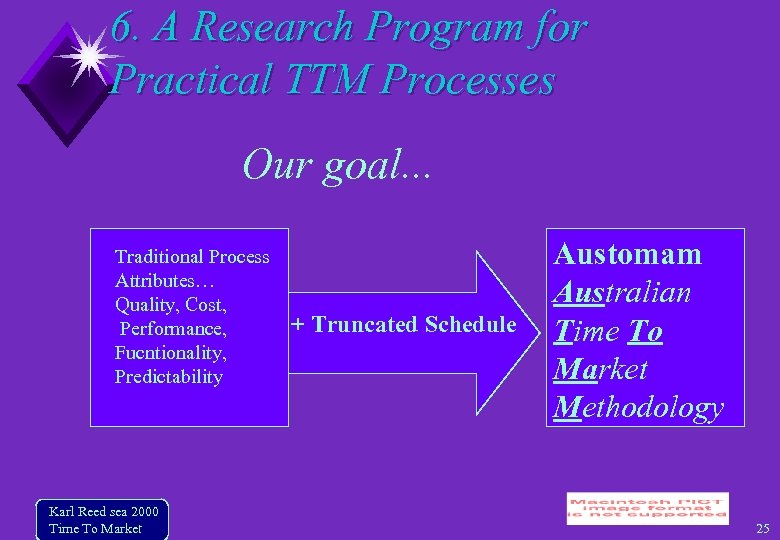
6. A Research Program for Practical TTM Processes Our goal. . . Traditional Process Attributes… Quality, Cost, Performance, Fucntionality, Predictability Karl Reed sea 2000 Time To Market + Truncated Schedule Austomam Australian Time To Market Methodology 25
Research Questions Schedule What is an optimal/reasonable project schedule? Is it feasible to attempt a project within a specific timeframe? Resources How can available human resources best be allocated to ensure projects succeed? Karl Reed sea 2000 Time To Market 26
Research Questions Factors determining schedules estimating staff quality and experience methodology re-use tools Karl Reed sea 2000 Time To Market 27
Research Questions Determining candidate markets Product opportunities what else is a candidate? identification of opportunities and time frames assessed what project aspects should be emphasised to gain maximum marketing leverage? technology and market prediction what technology will be market ready when needed? Karl Reed sea 2000 Time To Market 28
Research Outcomes. . What do we already know? Prototyping has several elements…. eliminating non-coding activities relaxing performance constraints simplifying error recovery controlling UI complexity using highly leveraged development domains emphasis on interfaces and skeletons Incremental Karl Reed sea 2000 Time To Market enhancement of the above 29
Research Outcomes. . What do we already know? Impact of experience and team cohesion Continuity 76) Repeated of Experience Syndrome (Reed experience gives massive gains in productivity Team consistancy and coherence Experienced teams share corporate knowledge Domain and Platform experience… IBM study showed these more important than technology Specialists in narrow fields are very highly productive Moving to a new domain/platform could incur learning curve losses Karl Reed sea 2000 Time To Market 30
Research Outcomes. . What do we already know? Impact of experience and team cohesion The above leads to formal and informal “patterns” Methodology Myths… Detailed methodologies are best. . But we know they are not followed. . Rigid frame-works will be best. . See above, what is the cognitive model valid? Documentation aids design… If so, why is it hard to have it happen? Karl Reed sea 2000 Time To Market 31
Research Outcomes. . What do we already know? Methodology Myths…(cont’d) Specialists at each phase of (Waterfall) process is best, with work product handover. . But we know (~60’s) that allocating vertical slices of design, coding, testing yields better code faster. . Part of the Problem. . What do we really know about successful s/w development? Not enough! Karl Reed sea 2000 Time To Market 32
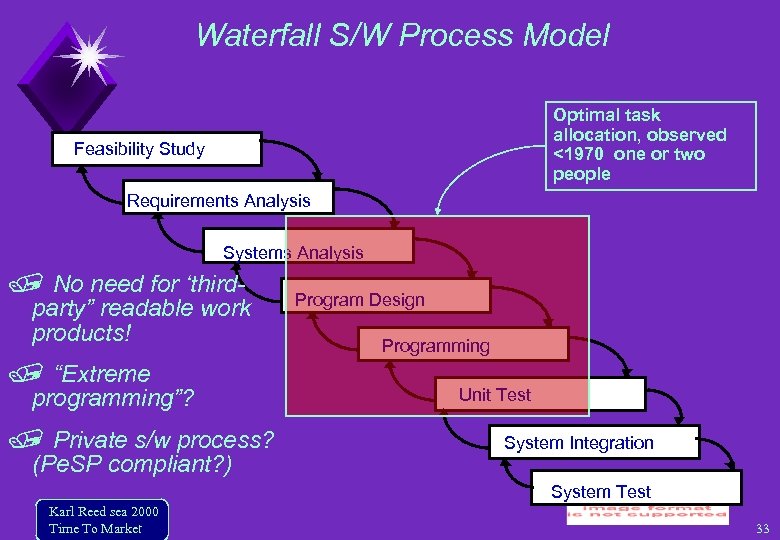
Waterfall S/W Process Model Optimal task allocation, observed <1970 one or two people Feasibility Study Requirements Analysis Systems Analysis / No need for ‘third- party” readable work products! / “Extreme programming”? / Private s/w process? (Pe. SP compliant? ) Program Design Programming Unit Test System Integration System Test Karl Reed sea 2000 Time To Market 33
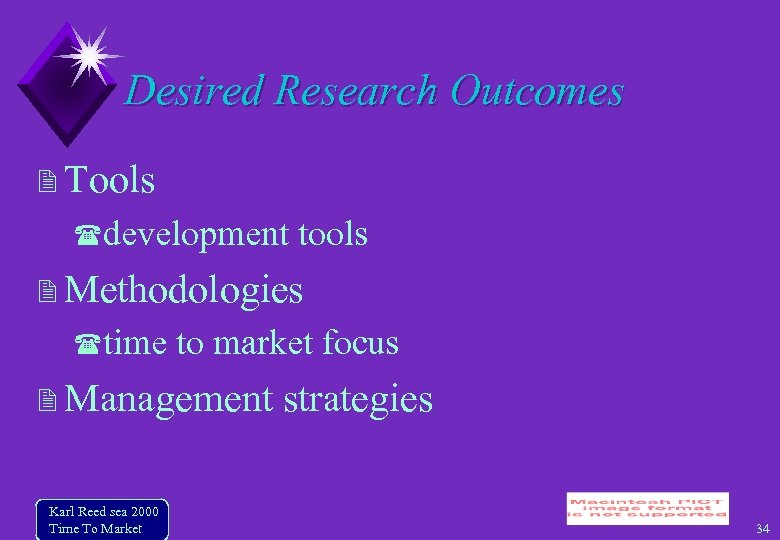
Desired Research Outcomes Tools development tools Methodologies time to market focus Management Karl Reed sea 2000 Time To Market strategies 34
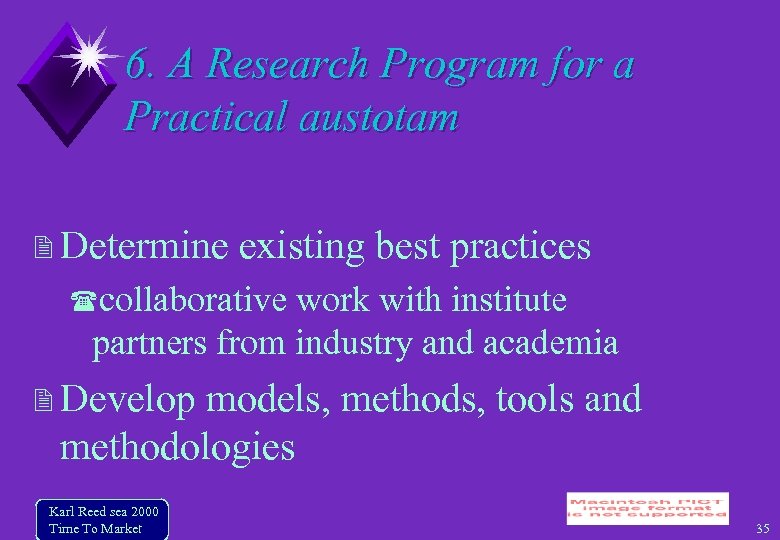
6. A Research Program for a Practical austotam Determine existing best practices collaborative work with institute partners from industry and academia Develop models, methods, tools and methodologies Karl Reed sea 2000 Time To Market 35
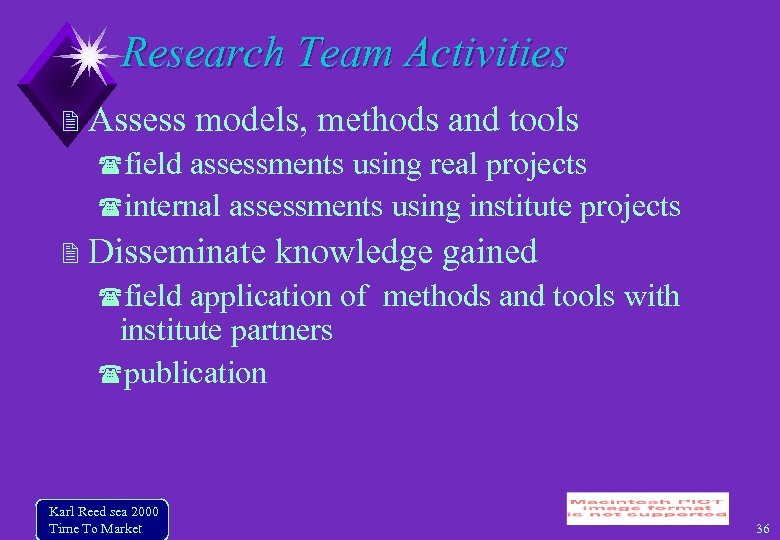
Research Team Activities Assess models, methods and tools field assessments using real projects internal assessments using institute projects Disseminate knowledge gained field application of methods and tools with institute partners publication Karl Reed sea 2000 Time To Market 36
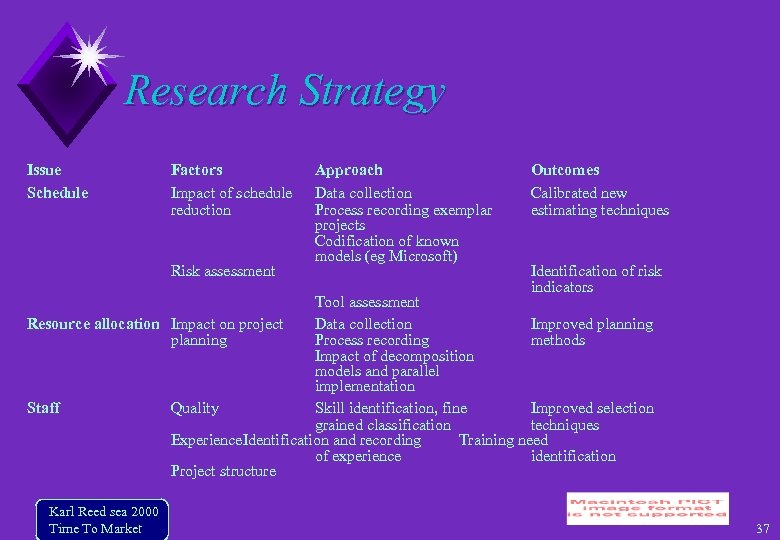
Research Strategy Issue Schedule Factors Impact of schedule reduction Risk assessment Approach Data collection Process recording exemplar projects Codification of known models (eg Microsoft) Outcomes Calibrated new estimating techniques Identification of risk indicators Tool assessment Resource allocation Impact on project Data collection Improved planning Process recording methods Impact of decomposition models and parallel implementation Staff Quality Skill identification, fine Improved selection grained classification techniques Experience. Identification and recording Training need of experience identification Project structure Karl Reed sea 2000 Time To Market 37
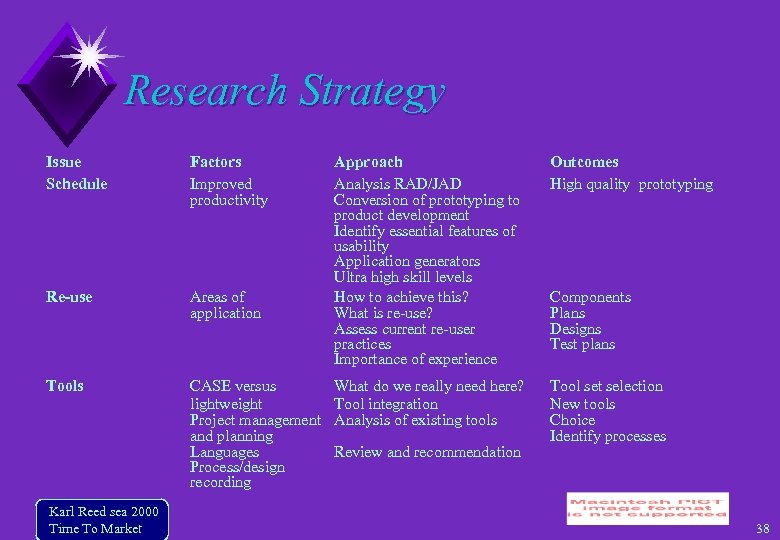
Research Strategy Issue Schedule Factors Improved productivity Re-use Areas of application Tools CASE versus lightweight Project management and planning Languages Process/design recording Karl Reed sea 2000 Time To Market Approach Analysis RAD/JAD Conversion of prototyping to product development Identify essential features of usability Application generators Ultra high skill levels How to achieve this? What is re-use? Assess current re-user practices Importance of experience Outcomes High quality prototyping What do we really need here? Tool integration Analysis of existing tools Tool set selection New tools Choice Identify processes Review and recommendation Components Plans Designs Test plans 38
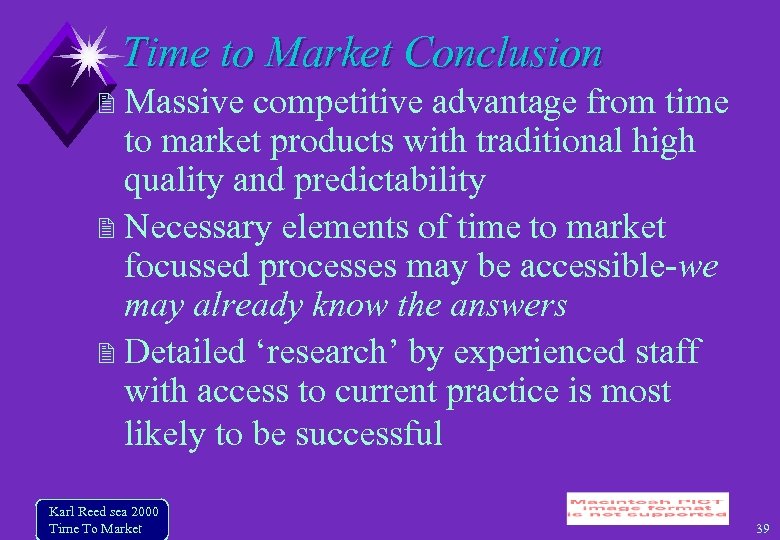
Time to Market Conclusion Massive competitive advantage from time to market products with traditional high quality and predictability Necessary elements of time to market focussed processes may be accessible-we may already know the answers Detailed ‘research’ by experienced staff with access to current practice is most likely to be successful Karl Reed sea 2000 Time To Market 39
Time to Market Conclusion Thank You… Acknowledge input from. . david cleary, paul radford (chrismatek), dan marantz, jason baragry Sea workimg group on TTM A working party to be formed. . . Karl Reed sea 2000 Time To Market 40
Скачать презентацию Time to Market -Solving the Problem of Viable
848d65efdb861009ad13f0d56fd7a3a9.ppt