 Скачать презентацию Time-series Break-out I Future biogeochemical time-series needs and
1d9652d58b9a818a80b71c699e316a9b.ppt
- Количество слайдов: 13



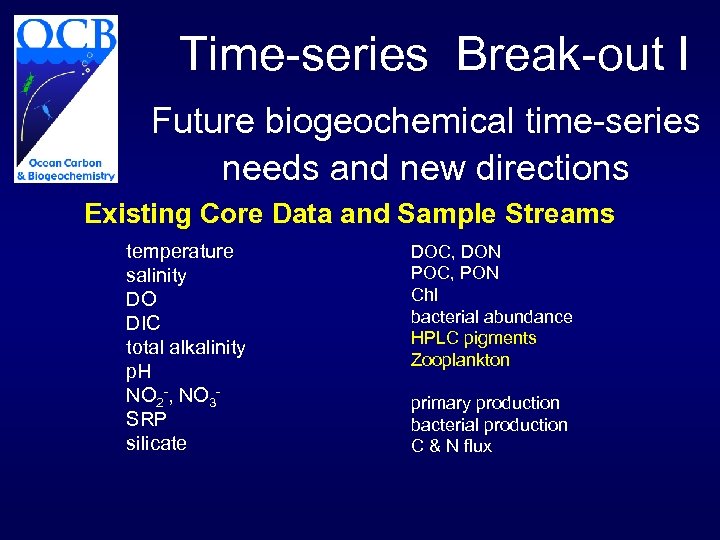
Time-series Break-out I Future biogeochemical time-series needs and new directions Existing Core Data and Sample Streams temperature salinity DO DIC total alkalinity p. H NO 2 -, NO 3 SRP silicate DOC, DON POC, PON Chl bacterial abundance HPLC pigments Zooplankton primary production bacterial production C & N flux
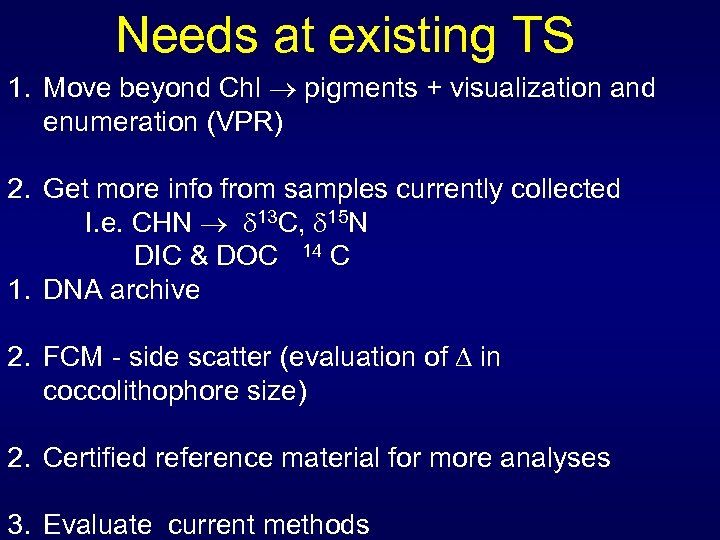
Needs at existing TS 1. Move beyond Chl pigments + visualization and enumeration (VPR) 2. Get more info from samples currently collected I. e. CHN 13 C, 15 N DIC & DOC 14 C 1. DNA archive 2. FCM - side scatter (evaluation of ∆ in coccolithophore size) 2. Certified reference material for more analyses 3. Evaluate current methods
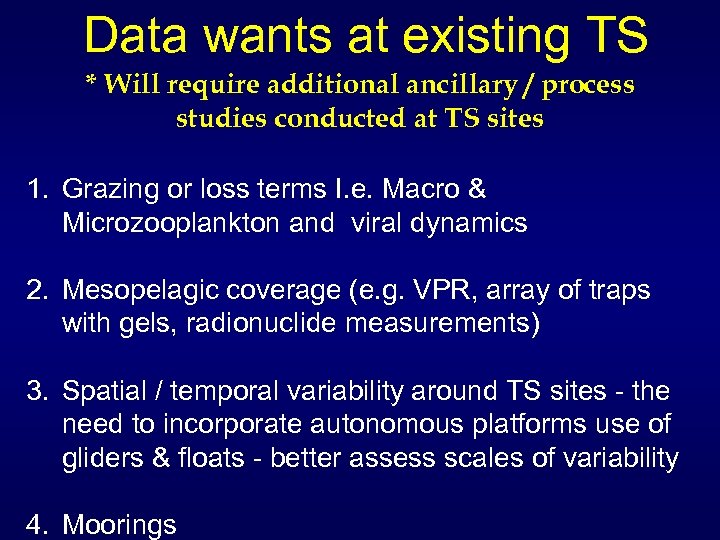
Data wants at existing TS * Will require additional ancillary / process studies conducted at TS sites 1. Grazing or loss terms I. e. Macro & Microzooplankton and viral dynamics 2. Mesopelagic coverage (e. g. VPR, array of traps with gels, radionuclide measurements) 3. Spatial / temporal variability around TS sites - the need to incorporate autonomous platforms use of gliders & floats - better assess scales of variability 4. Moorings
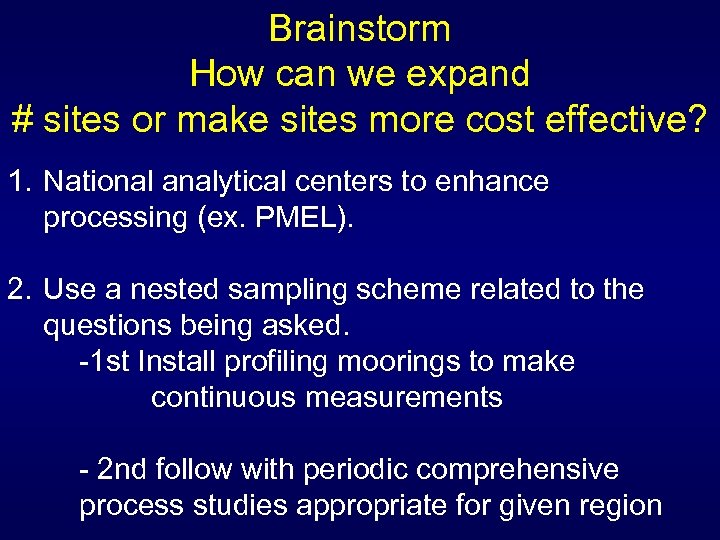
Brainstorm How can we expand # sites or make sites more cost effective? 1. National analytical centers to enhance processing (ex. PMEL). 2. Use a nested sampling scheme related to the questions being asked. -1 st Install profiling moorings to make continuous measurements - 2 nd follow with periodic comprehensive process studies appropriate for given region
3. Integrate better with other International Time-Series *focus of an upcoming TS workshop • Data coordination / repository • Training (POGO) / coordinate best practice manual • Intercalibration / technician exchange • Technology and instrumentation • Development / distribution of CRMs
Pressing science issues that could use TS as test beds: 1. The mesopelagic 2. What are the regeneration length scales? Role of chemoautotrophy? 2. Linking dust/Fe deposition with surface production and flux. 3. How do we define the right timescales to assess the natural versus anthropogenic signal? 4. How is community structure changing and how do these community shifts affect flux?
Misc. thoughts…… How should future TS be reviewed? Hypothesis driven science or monitoring? Importance of having a team leader (a. k. a. special sauce!). Data management timely delivery of data into public domain Fund data mining

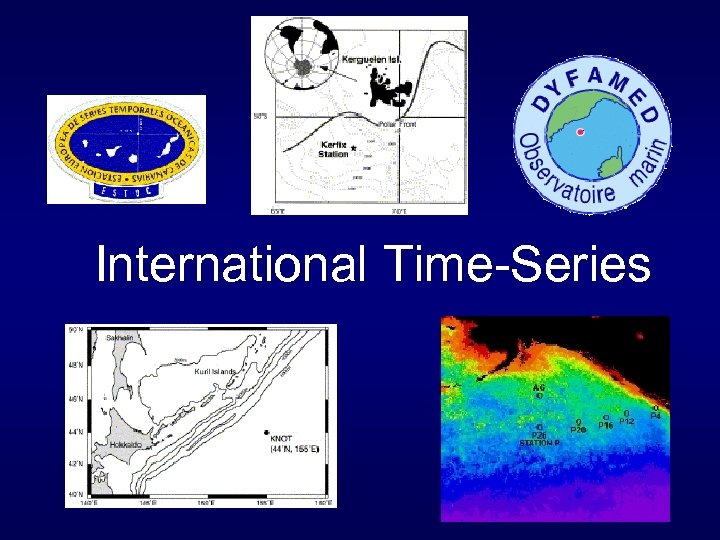
International Time-Series
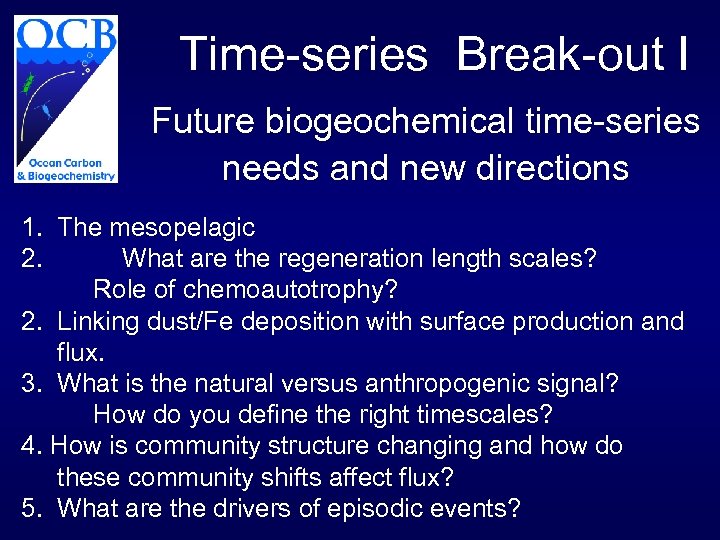
Time-series Break-out I Future biogeochemical time-series needs and new directions 1. The mesopelagic 2. What are the regeneration length scales? Role of chemoautotrophy? 2. Linking dust/Fe deposition with surface production and flux. 3. What is the natural versus anthropogenic signal? How do you define the right timescales? 4. How is community structure changing and how do these community shifts affect flux? 5. What are the drivers of episodic events?
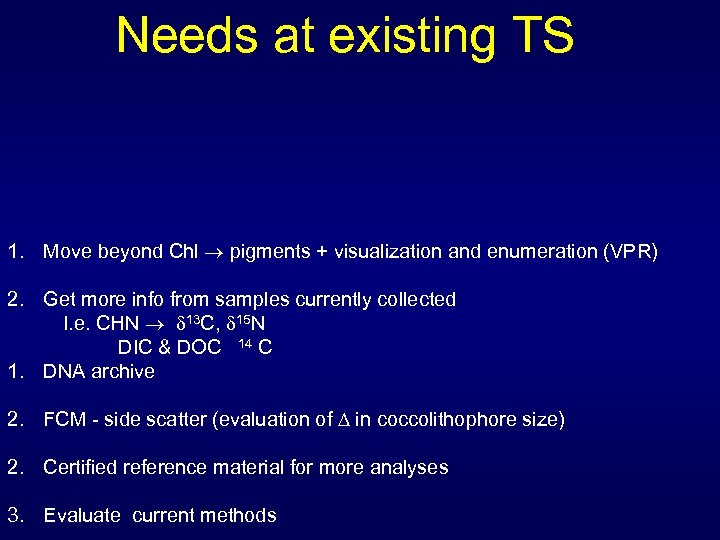
Needs at existing TS 1. Move beyond Chl pigments + visualization and enumeration (VPR) 2. Get more info from samples currently collected I. e. CHN 13 C, 15 N DIC & DOC 14 C 1. DNA archive 2. FCM - side scatter (evaluation of ∆ in coccolithophore size) 2. Certified reference material for more analyses 3. Evaluate current methods
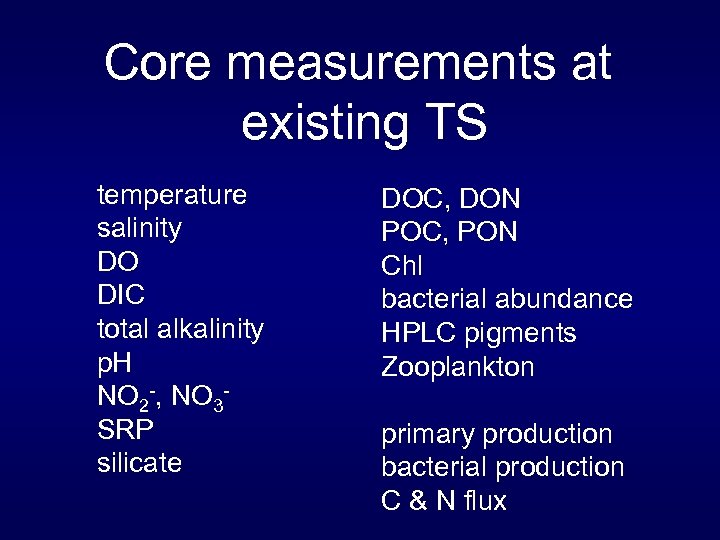
Core measurements at existing TS temperature salinity DO DIC total alkalinity p. H NO 2 -, NO 3 SRP silicate DOC, DON POC, PON Chl bacterial abundance HPLC pigments Zooplankton primary production bacterial production C & N flux
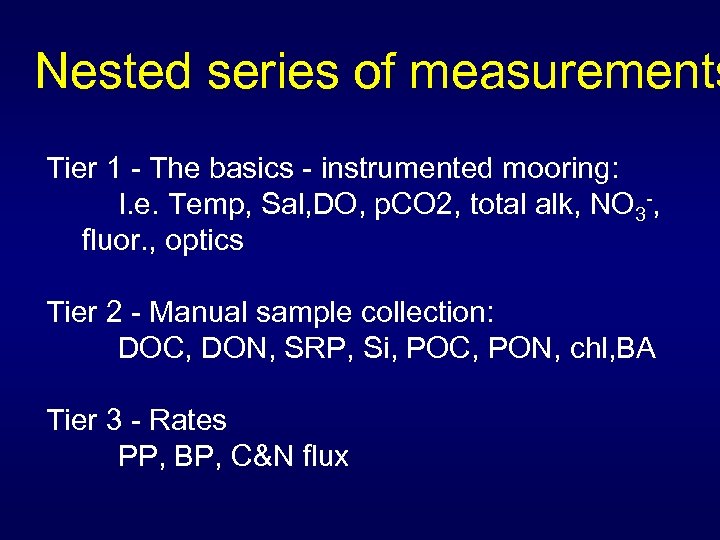
Nested series of measurements Tier 1 - The basics - instrumented mooring: I. e. Temp, Sal, DO, p. CO 2, total alk, NO 3 -, fluor. , optics Tier 2 - Manual sample collection: DOC, DON, SRP, Si, POC, PON, chl, BA Tier 3 - Rates PP, BP, C&N flux
Скачать презентацию Time-series Break-out I Future biogeochemical time-series needs and
1d9652d58b9a818a80b71c699e316a9b.ppt