


 Скачать презентацию Time-of-Use and Critical Peak Pricing Considerations for Program
0900f5c8caee852970fd64dc5ee3df6e.ppt
- Количество слайдов: 17
 Time-of-Use and Critical Peak Pricing Considerations for Program Design and the Role of Enabling Technologies
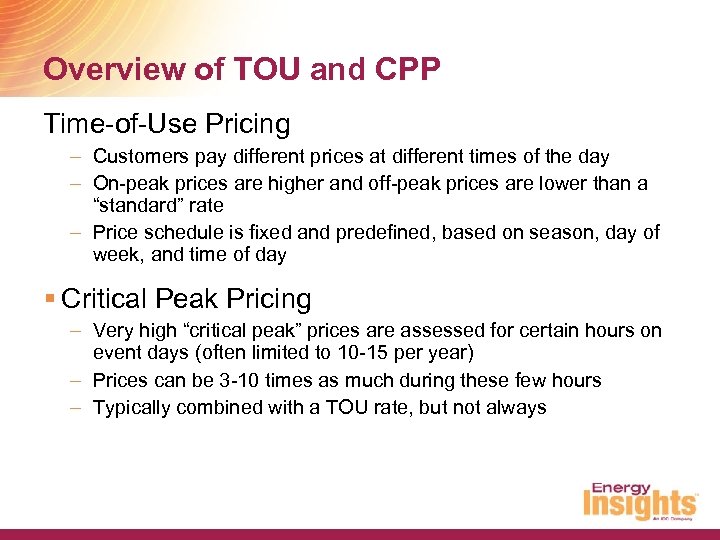 Overview of TOU and CPP Time-of-Use Pricing – Customers pay different prices at different times of the day – On-peak prices are higher and off-peak prices are lower than a “standard” rate – Price schedule is fixed and predefined, based on season, day of week, and time of day § Critical Peak Pricing – Very high “critical peak” prices are assessed for certain hours on event days (often limited to 10 -15 per year) – Prices can be 3 -10 times as much during these few hours – Typically combined with a TOU rate, but not always
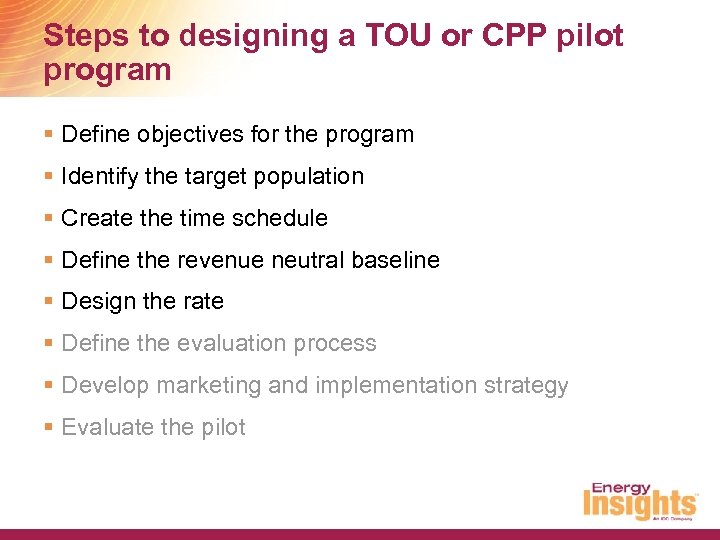 Steps to designing a TOU or CPP pilot program § Define objectives for the program § Identify the target population § Create the time schedule § Define the revenue neutral baseline § Design the rate § Define the evaluation process § Develop marketing and implementation strategy § Evaluate the pilot
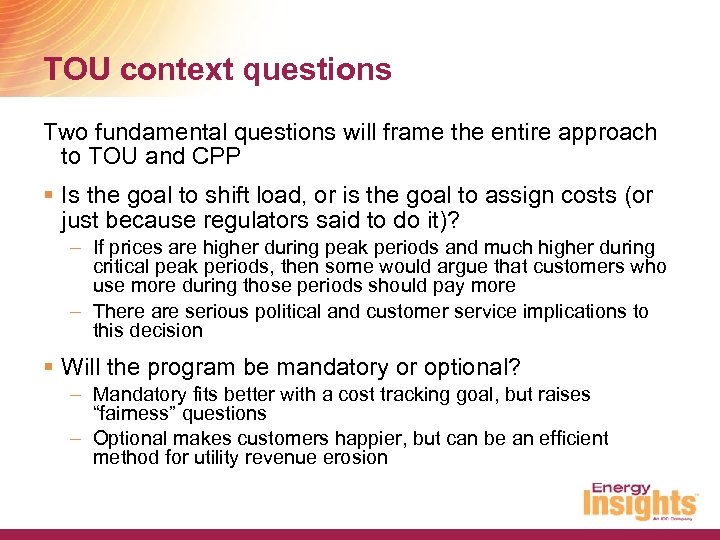 TOU context questions Two fundamental questions will frame the entire approach to TOU and CPP § Is the goal to shift load, or is the goal to assign costs (or just because regulators said to do it)? – If prices are higher during peak periods and much higher during critical peak periods, then some would argue that customers who use more during those periods should pay more – There are serious political and customer service implications to this decision § Will the program be mandatory or optional? – Mandatory fits better with a cost tracking goal, but raises “fairness” questions – Optional makes customers happier, but can be an efficient method for utility revenue erosion
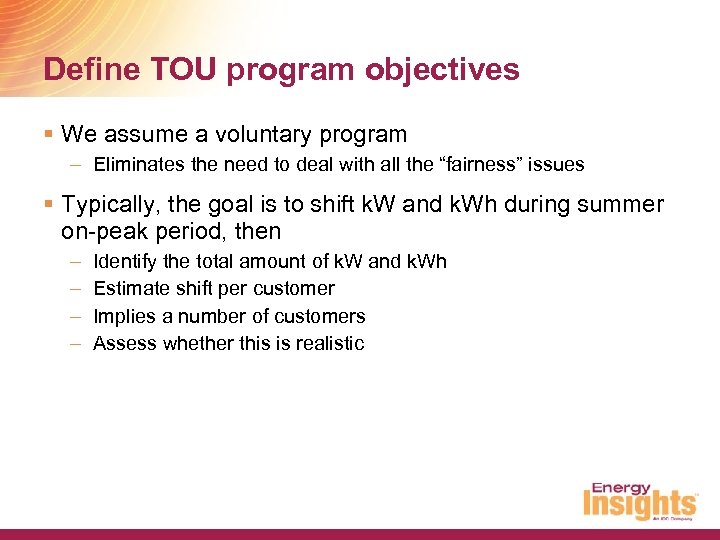 Define TOU program objectives § We assume a voluntary program – Eliminates the need to deal with all the “fairness” issues § Typically, the goal is to shift k. W and k. Wh during summer on-peak period, then – – Identify the total amount of k. W and k. Wh Estimate shift per customer Implies a number of customers Assess whether this is realistic
 Identify and analyze the target population § Target people who either have or can have the ability to respond § If reducing summer peak use is goal, then focus on customers with central air – SRP program is for single-family homes that consume 1, 300 or more k. Wh per month § If reducing winter peak is the goal, then focus on electric heating or electric water heating customers
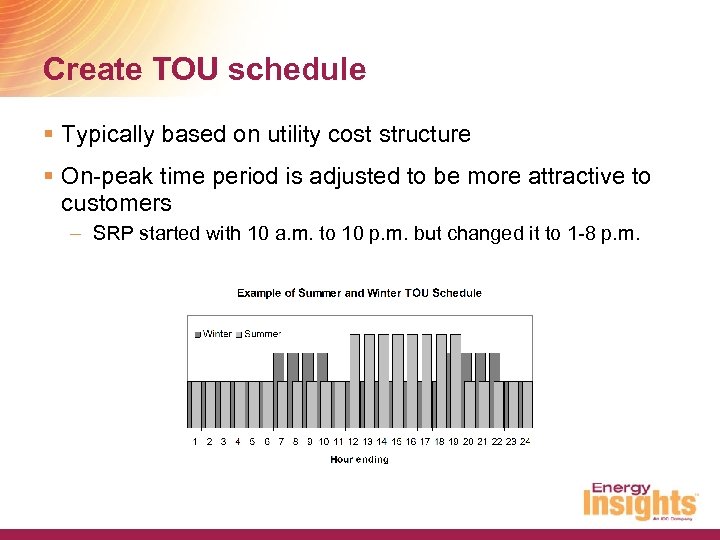 Create TOU schedule § Typically based on utility cost structure § On-peak time period is adjusted to be more attractive to customers – SRP started with 10 a. m. to 10 p. m. but changed it to 1 -8 p. m.
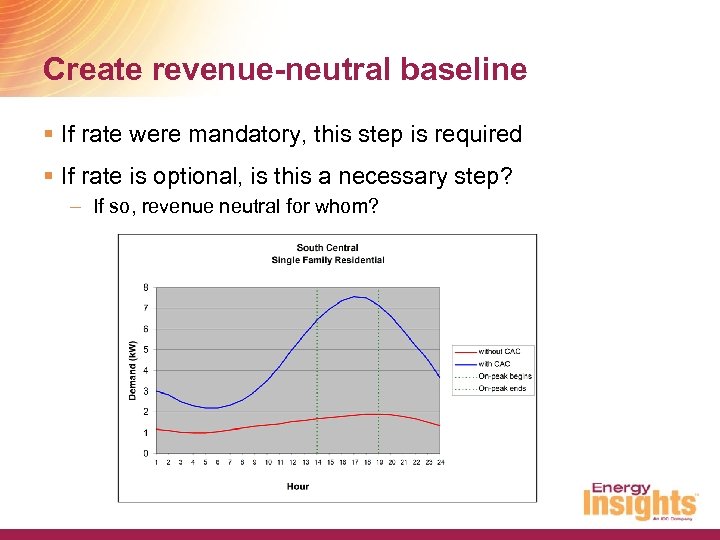 Create revenue-neutral baseline § If rate were mandatory, this step is required § If rate is optional, is this a necessary step? – If so, revenue neutral for whom?
 Design the rate § Create a revenue neutral rate – Start with relevant class shape – For a two-tier rate, set one price and then compute the other – On peak rate should be based on actual utility costs § Assess this rate—do we believe it will achieve what we want to achieve? For example, – Differential could be higher than cost to create a bigger incentive to reduce and/or shift load – Differential could be lower for political considerations – WPS had company buy-in for a higher differential to get a response, but the commission wouldn’t approve it
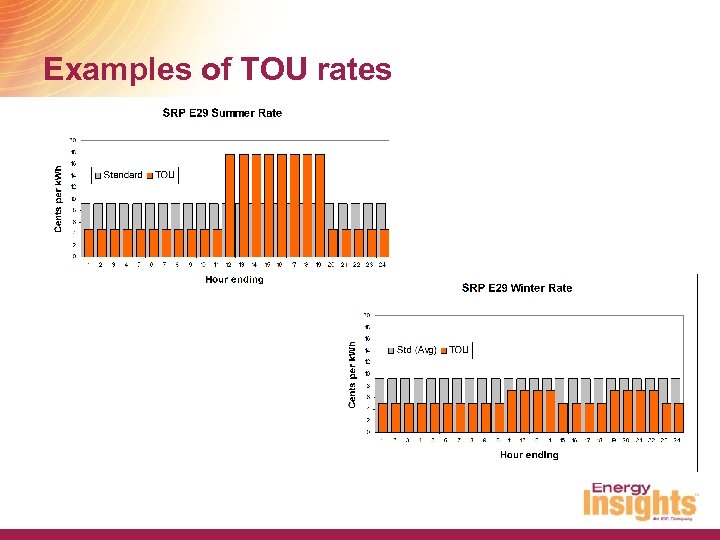 Examples of TOU rates
 Critical peak pricing (CPP) § Typical goal of CPP is to more dramatically reduce load during the relatively few, very expensive hours § Process is similar to TOU rate and program design with some considerations § Typically, a CPP is added to a TOU rate – People are in a TOU mindset – Get more TOU shift when there is a CPP component
 Considerations § Target people who can or can develop the ability to respond dynamically § Need to define the CPP time period (typically within or overlapping the on-peak period) § Event days – Need to define the number of event days in a season – Challenge is to pick the days § Revenue neutral takes into account the CPP events and hours – Not a trivial exercise with CPP
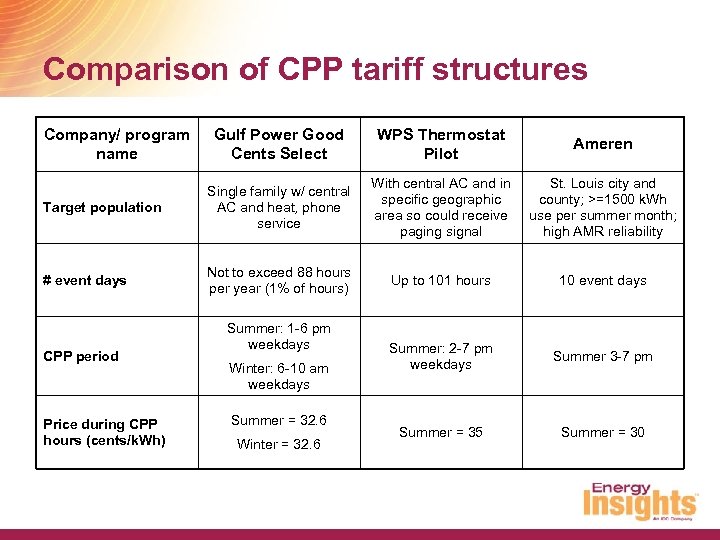 Comparison of CPP tariff structures Company/ program name Gulf Power Good Cents Select WPS Thermostat Pilot Ameren Target population Single family w/ central AC and heat, phone service With central AC and in specific geographic area so could receive paging signal St. Louis city and county; >=1500 k. Wh use per summer month; high AMR reliability # event days Not to exceed 88 hours per year (1% of hours) Up to 101 hours 10 event days Summer: 2 -7 pm weekdays Summer 3 -7 pm Summer = 35 Summer = 30 CPP period Price during CPP hours (cents/k. Wh) Summer: 1 -6 pm weekdays Winter: 6 -10 am weekdays Summer = 32. 6 Winter = 32. 6
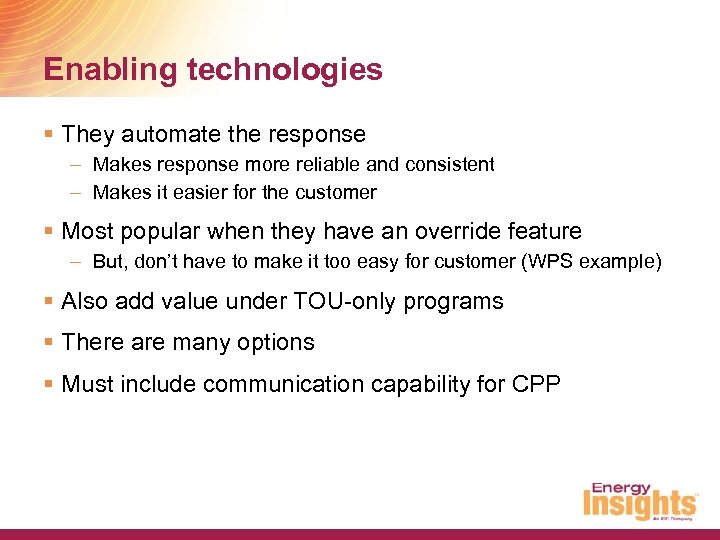 Enabling technologies § They automate the response – Makes response more reliable and consistent – Makes it easier for the customer § Most popular when they have an override feature – But, don’t have to make it too easy for customer (WPS example) § Also add value under TOU-only programs § There are many options § Must include communication capability for CPP
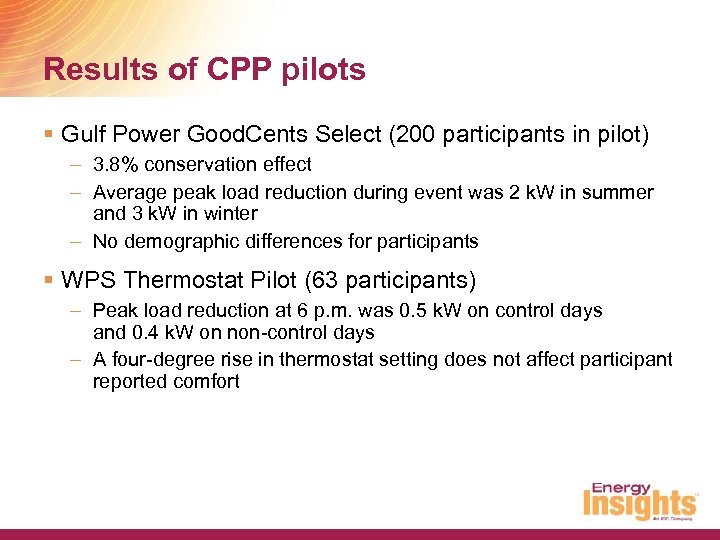 Results of CPP pilots § Gulf Power Good. Cents Select (200 participants in pilot) – 3. 8% conservation effect – Average peak load reduction during event was 2 k. W in summer and 3 k. W in winter – No demographic differences for participants § WPS Thermostat Pilot (63 participants) – Peak load reduction at 6 p. m. was 0. 5 k. W on control days and 0. 4 k. W on non-control days – A four-degree rise in thermostat setting does not affect participant reported comfort
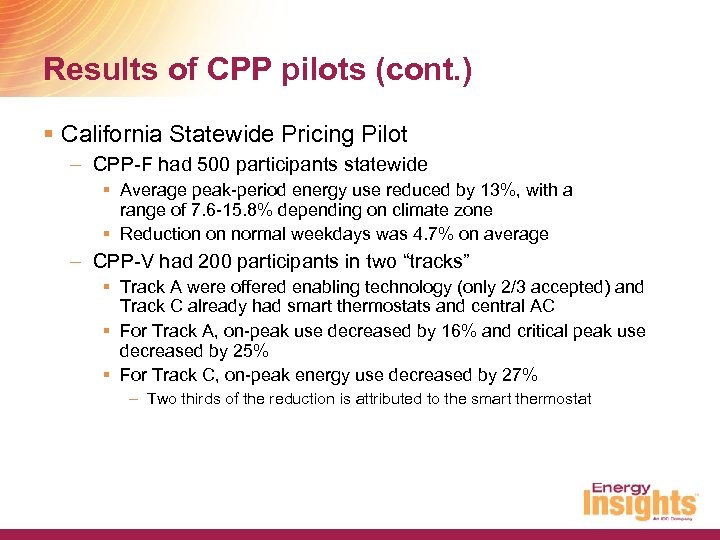 Results of CPP pilots (cont. ) § California Statewide Pricing Pilot – CPP-F had 500 participants statewide § Average peak-period energy use reduced by 13%, with a range of 7. 6 -15. 8% depending on climate zone § Reduction on normal weekdays was 4. 7% on average – CPP-V had 200 participants in two “tracks” § Track A were offered enabling technology (only 2/3 accepted) and Track C already had smart thermostats and central AC § For Track A, on-peak use decreased by 16% and critical peak use decreased by 25% § For Track C, on-peak energy use decreased by 27% – Two thirds of the reduction is attributed to the smart thermostat
 Contact information Craig Williamson Program Director, Energy End Use Research cwilliamson@energy-insights. com tel 303 -385 -0342