

Time Management Jennifer Peel, PhD Director of Education,


 Скачать презентацию Time Management Jennifer Peel, PhD Director of Education,
13834-roman_time_management4.ppt
- Количество слайдов: 29
Time Management Jennifer Peel, PhD Director of Education, Graduate Medical Education (How much can you cram into your life and how much more can you handle?)
First things first… You can’t manage time!
Time Management Self
Purpose of Time (Self) Management Stress=Managing time well can prevent much of the stress we are subject to. Balance=Good time habits can enable us to achieve a more balanced life, with adequate time and energy for work, home, family, self. Mackenzie, 1997
Purpose of Time (Self) Management Productivity=If you can become more effective with your time, you automatically increase your productivity. Goals=To make progress toward achieving your personal and professional goals, you need available time. Nothing can be done when you’re out of time. Mackenzie, 1997
Misconceptions about Time Management “Time management is nothing but common sense.” “I work best under pressure.” “I use an appointment calendar and a to-do list. Isn’t that good enough?” “I’m a spontaneous person. Time management will take all of the fun out of life.” “I don’t have time to learn how to do all of this.”
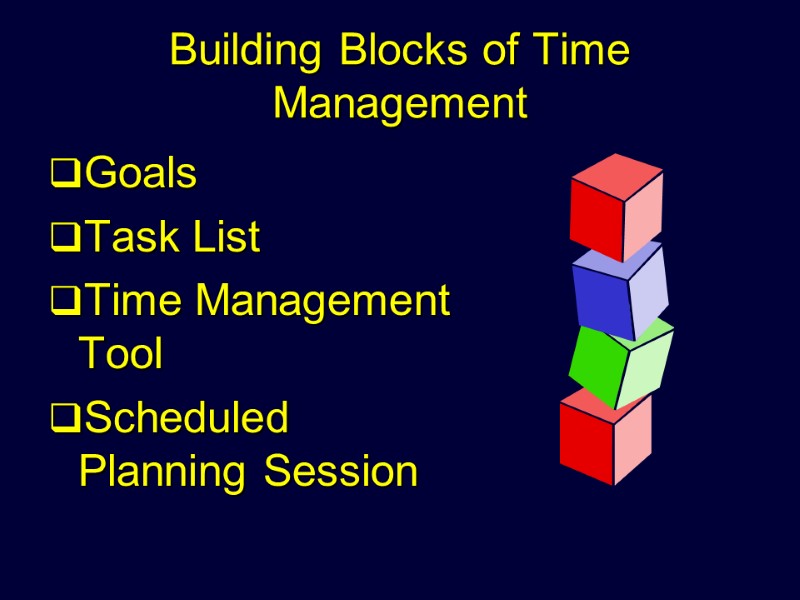
Building Blocks of Time Management Goals Task List Time Management Tool Scheduled Planning Session
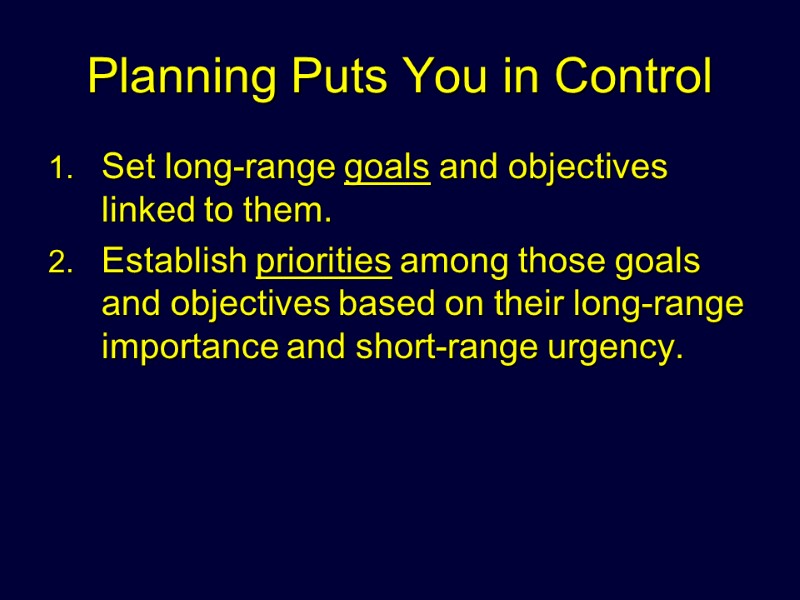
Planning Puts You in Control Set long-range goals and objectives linked to them.
Effective Goals Specific Measurable Achievable Realistic Timed SMART
Planning Puts You in Control Set long-range goals and objectives linked to them. Establish priorities among those goals and objectives based on their long-range importance and short-range urgency.
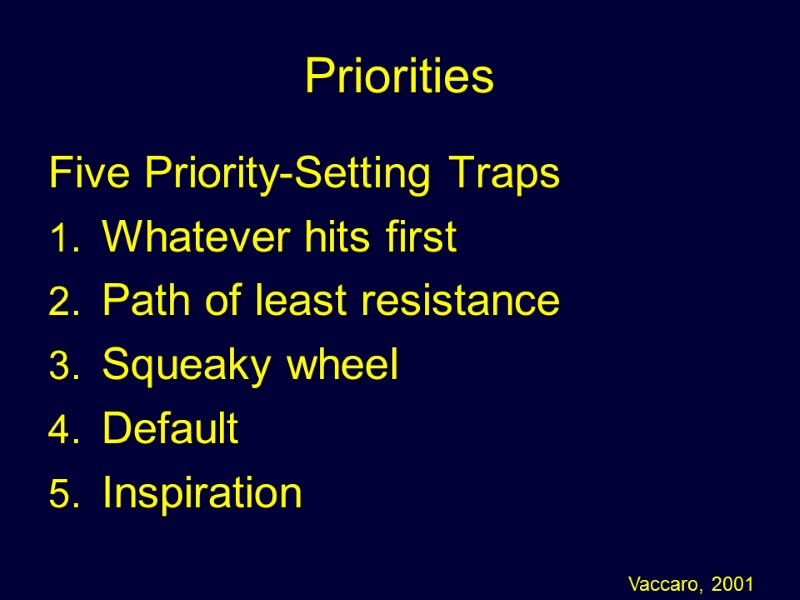
Priorities Five Priority-Setting Traps Whatever hits first Path of least resistance Squeaky wheel Default Inspiration Vaccaro, 2001
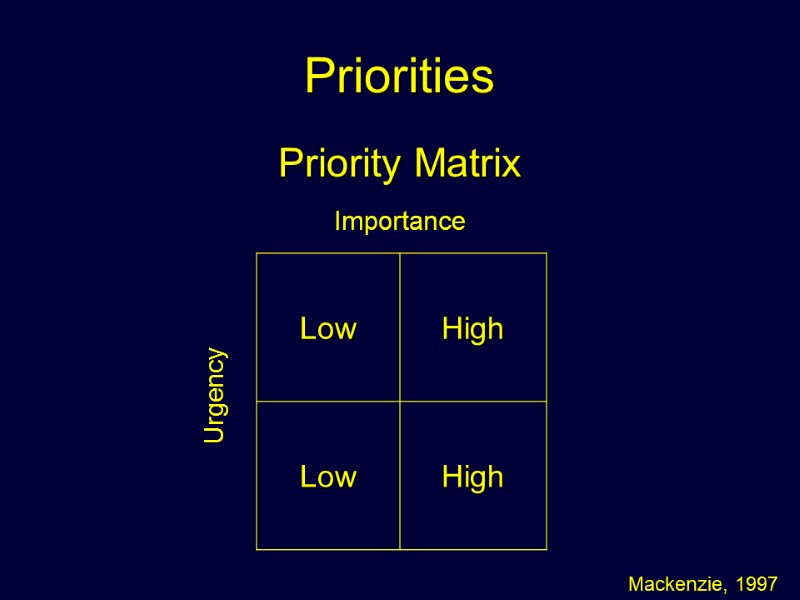
Priorities Priority Matrix Mackenzie, 1997 Importance Urgency
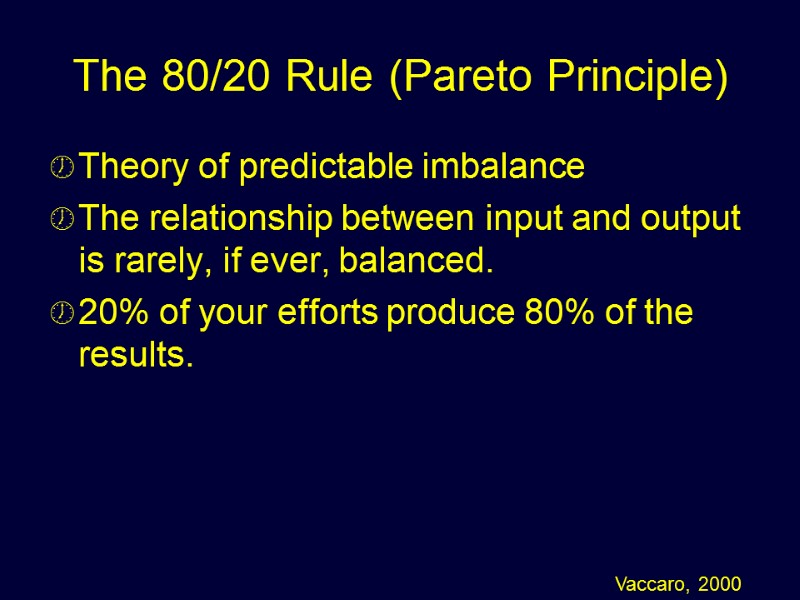
The 80/20 Rule (Pareto Principle) Theory of predictable imbalance The relationship between input and output is rarely, if ever, balanced. 20% of your efforts produce 80% of the results. Vaccaro, 2000
The 80/20 Rule Where are you? You’re in your 80% if you’re: Working on tasks other people want you to, but have no investment in them Frequently working on tasks labeled “urgent” Spending time on tasks you’re not good at Complaining all of the time
The 80/20 Rule Where are you? You’re in your 20% if you’re: Engaged in activities that advance your overall purpose in life Doing things you have always wanted to do or that make you feel good about yourself Working on tasks you don’t like, but you’re doing them know they related to the bigger picture Smiling
Implementing the 80/20 Rule Read less. Identify the 20% of the journals you get that are most valuable. Keep current. Make yourself aware of new technological innovations. Remember the basics. Let your ethics and values guide your decision making, and you’re bound to end up focusing on your 20%.
Planning Puts You in Control Set long-range goals and objectives linked to them. Establish priorities among those goals and objectives based on their long-range importance and short-range urgency. Learn your personal energy cycle and sketch out an “ideal day” based on your best working times.
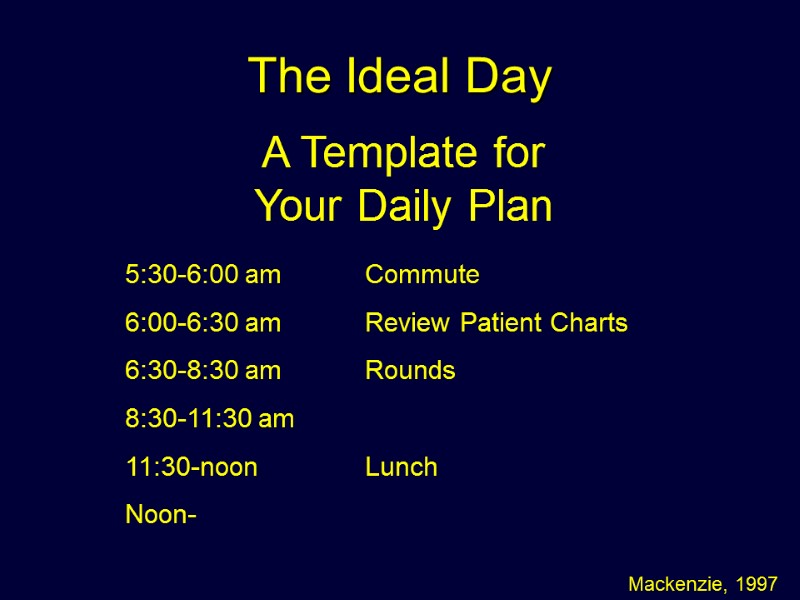
The Ideal Day Mackenzie, 1997 A Template for Your Daily Plan 5:30-6:00 am Commute 6:00-6:30 am Review Patient Charts 6:30-8:30 am Rounds 8:30-11:30 am 11:30-noon Lunch Noon-
Planning Puts You in Control Set long-range goals and objectives linked to them. Establish priorities among those goals and objectives based on their long-range importance and short-range urgency. Learn your personal energy cycle and sketch out an “ideal day” based on your best working times. Use the above three to create a plan for the day and write it down!
Putting it All Together Mackenzie, 1997 Start with long-range goals and objectives. Relate the day’s activities to those goals. Assign priorities to the day’s tasks according to their contribution to your overall goals. Schedule tasks according to priority and to the degree of concentration required. Stay on track, using the plan to guide you through crises and interruptions.
Time Wasters Leaving tasks unfinished Inadequate staff Socializing Confused responsibility or authority Poor communication Inadequate controls and progress reports Incomplete information Travel
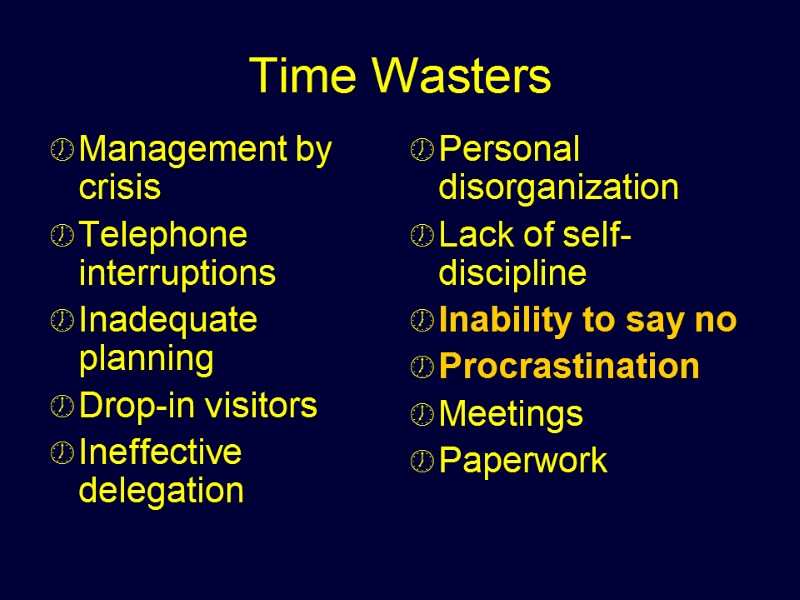
Time Wasters Management by crisis Telephone interruptions Inadequate planning Drop-in visitors Ineffective delegation Personal disorganization Lack of self-discipline Inability to say no Procrastination Meetings Paperwork
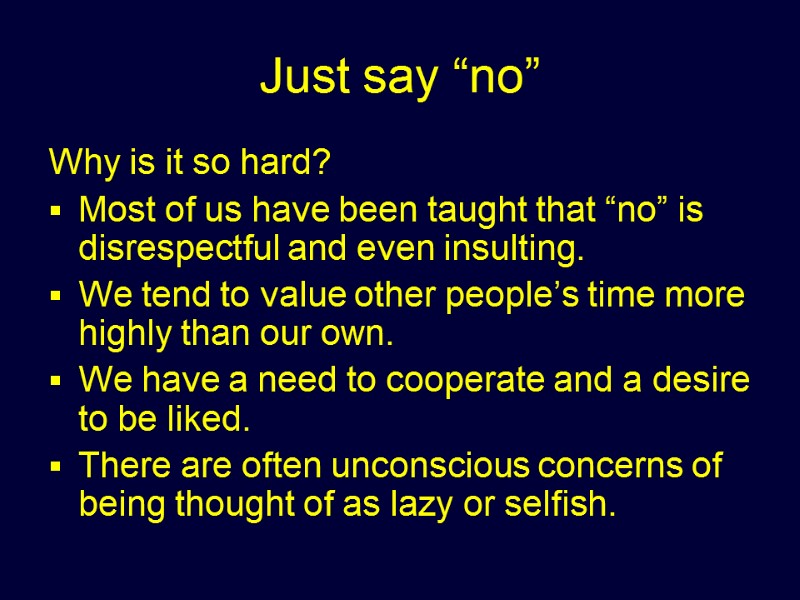
Just say “no” Why is it so hard? Most of us have been taught that “no” is disrespectful and even insulting. We tend to value other people’s time more highly than our own. We have a need to cooperate and a desire to be liked. There are often unconscious concerns of being thought of as lazy or selfish.
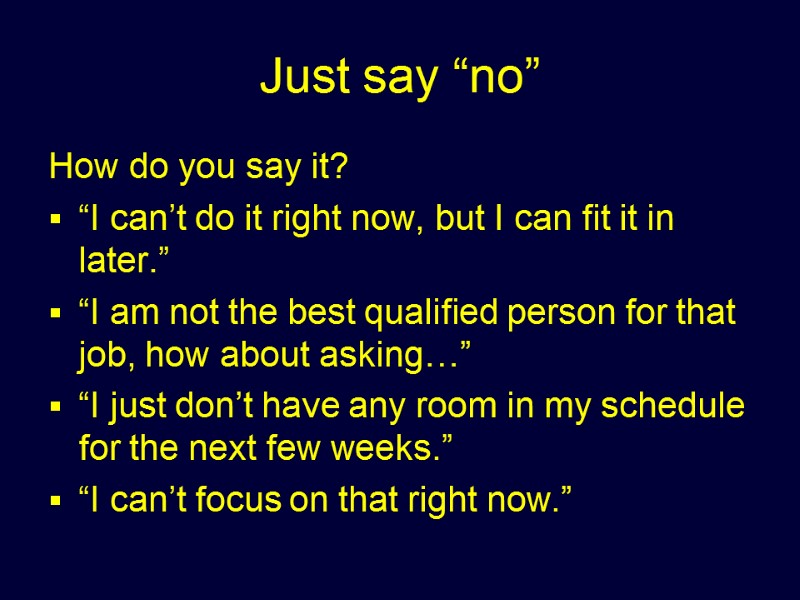
Just say “no” How do you say it? “I can’t do it right now, but I can fit it in later.” “I am not the best qualified person for that job, how about asking…” “I just don’t have any room in my schedule for the next few weeks.” “I can’t focus on that right now.”
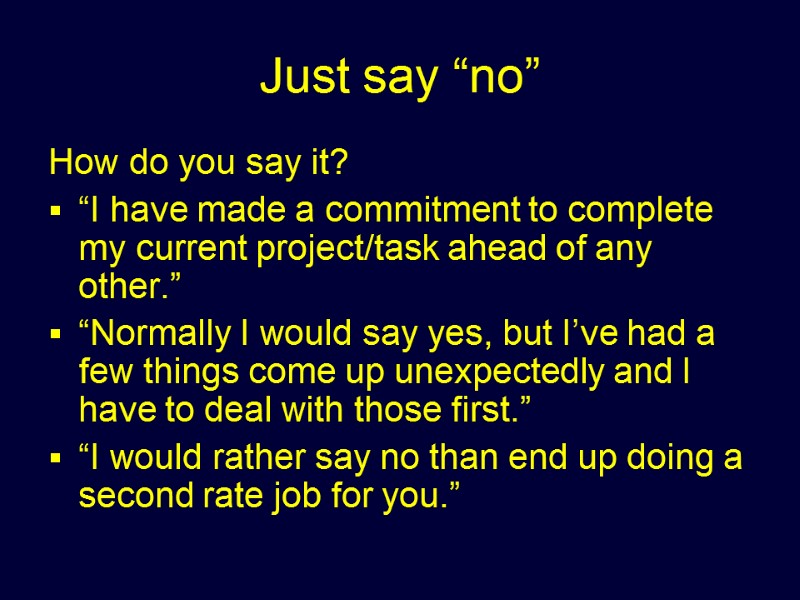
Just say “no” How do you say it? “I have made a commitment to complete my current project/task ahead of any other.” “Normally I would say yes, but I’ve had a few things come up unexpectedly and I have to deal with those first.” “I would rather say no than end up doing a second rate job for you.”
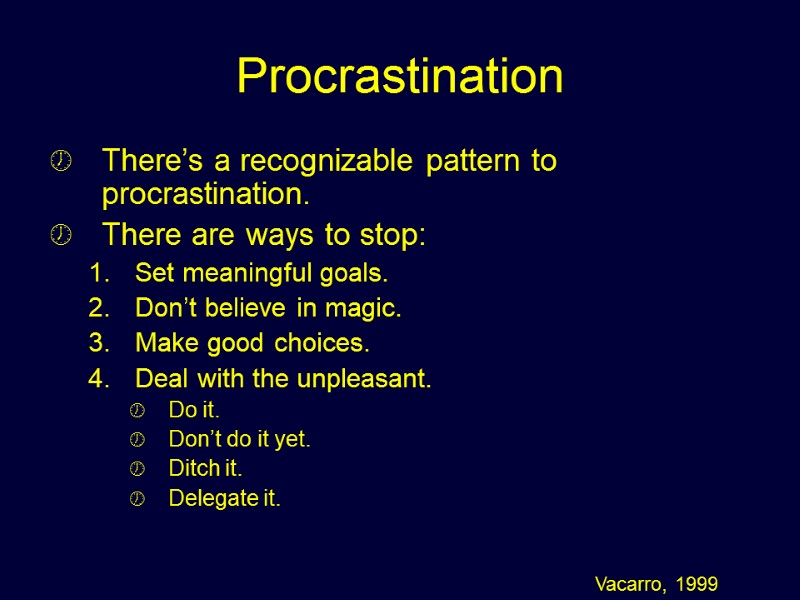
Procrastination There’s a recognizable pattern to procrastination. There are ways to stop: Set meaningful goals. Don’t believe in magic. Make good choices. Deal with the unpleasant. Do it. Don’t do it yet. Ditch it. Delegate it. Vacarro, 1999
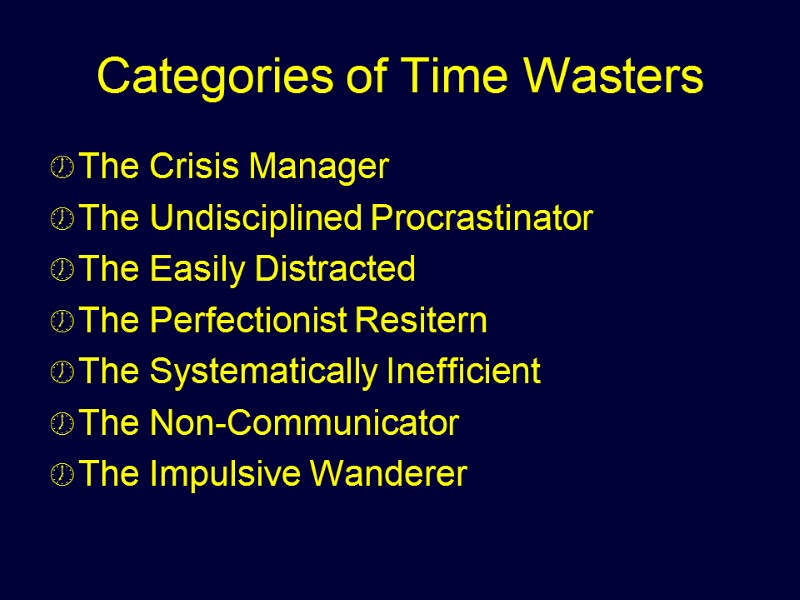
Categories of Time Wasters The Crisis Manager The Undisciplined Procrastinator The Easily Distracted The Perfectionist Resitern The Systematically Inefficient The Non-Communicator The Impulsive Wanderer
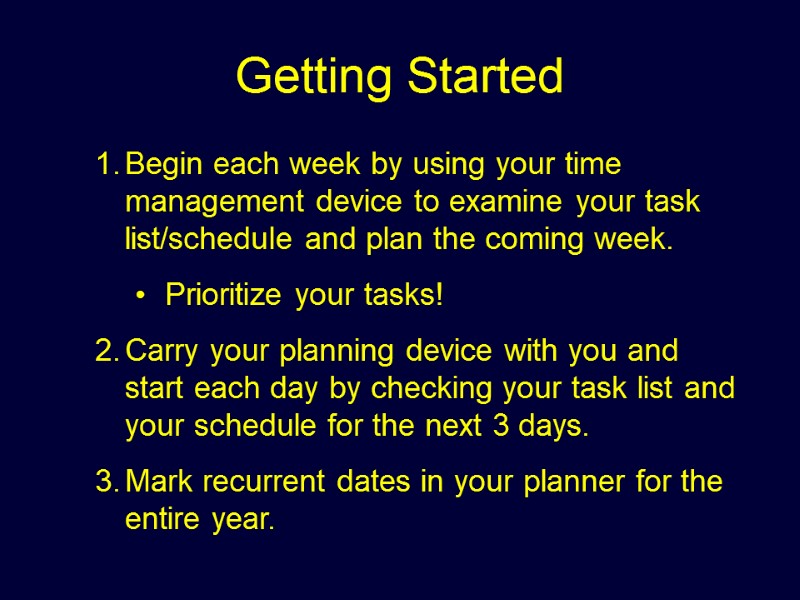
Getting Started Begin each week by using your time management device to examine your task list/schedule and plan the coming week. Prioritize your tasks! Carry your planning device with you and start each day by checking your task list and your schedule for the next 3 days. Mark recurrent dates in your planner for the entire year.
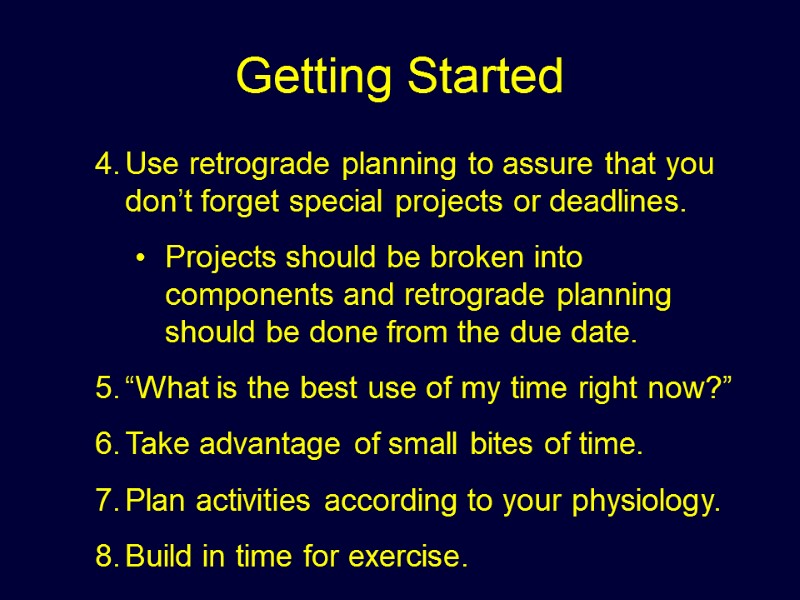
Getting Started Use retrograde planning to assure that you don’t forget special projects or deadlines. Projects should be broken into components and retrograde planning should be done from the due date. “What is the best use of my time right now?” Take advantage of small bites of time. Plan activities according to your physiology. Build in time for exercise.