


 Скачать презентацию Time Management Janie Irwin Computer Science and Engineering
c8544ecdeb072214465b471d99d3a2a7.ppt
- Количество слайдов: 20
 Time Management Janie Irwin Computer Science and Engineering Electrical Engineering
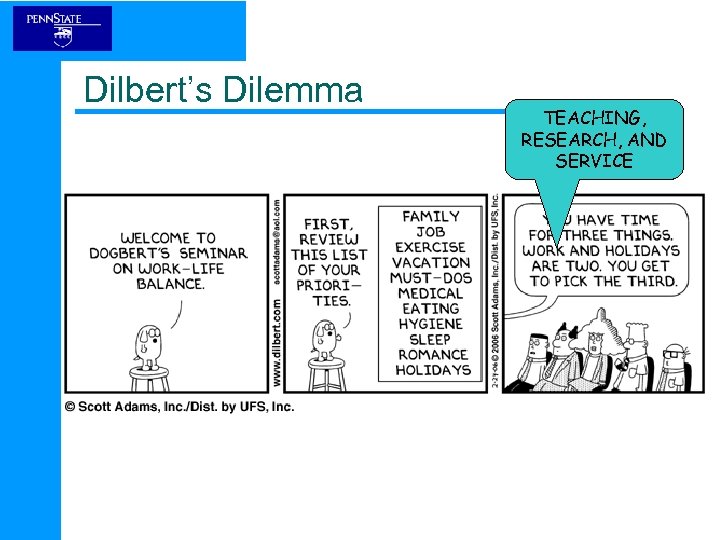 Dilbert’s Dilemma TEACHING, RESEARCH, AND SERVICE
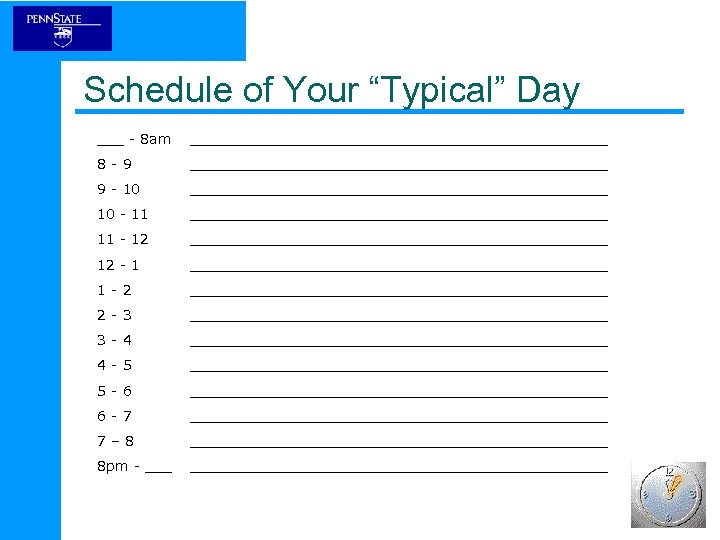 Schedule of Your “Typical” Day ___ - 8 am ________________________ 8 -9 ________________________ 9 - 10 ________________________ 10 - 11 ________________________ 11 - 12 ________________________ 12 - 1 ________________________ 1 -2 ________________________ 2 -3 ________________________ 3 -4 ________________________ 4 -5 ________________________ 5 -6 ________________________ 6 -7 ________________________ 7– 8 ________________________ 8 pm - _________________________
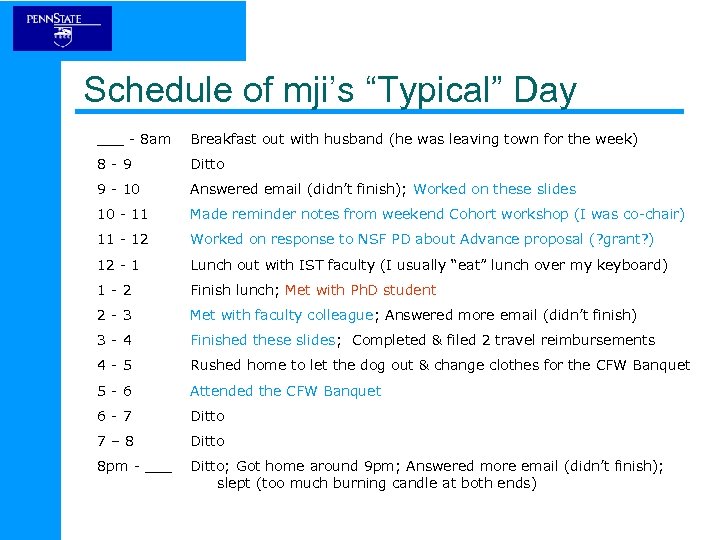 Schedule of mji’s “Typical” Day ___ - 8 am Breakfast out with husband (he was leaving town for the week) 8 -9 Ditto 9 - 10 Answered email (didn’t finish); Worked on these slides 10 - 11 Made reminder notes from weekend Cohort workshop (I was co-chair) 11 - 12 Worked on response to NSF PD about Advance proposal (? grant? ) 12 - 1 Lunch out with IST faculty (I usually “eat” lunch over my keyboard) 1 -2 Finish lunch; Met with Ph. D student 2 -3 Met with faculty colleague; Answered more email (didn’t finish) 3 -4 Finished these slides; Completed & filed 2 travel reimbursements 4 -5 Rushed home to let the dog out & change clothes for the CFW Banquet 5 -6 Attended the CFW Banquet 6 -7 Ditto 7– 8 Ditto 8 pm - ___ Ditto; Got home around 9 pm; Answered more email (didn’t finish); slept (too much burning candle at both ends)
 10 Tips for Time Management in an Academic Setting
 #1: Long/Short Term Goals ¡ Have clear, articulate long-term (year(s)) and short-term (semester) goals l ¡ Spend some time at the beginning of each semester evaluating and revising your long term and short term goals Make informed decisions based on your goals
 My Goals ¡ Long term l l l How many items on l your schedule Short term aligned with your l goals? l l ¡ l l l
 #2: Have a Schedule (Week, Day) ¡ Make it realistic l ¡ Avoid fragmented time l l l ¡ Back appointments up to one another Schedule big blocks of "thinking time” Schedule "synergistic" tasks together Know when something is good enough l l ¡ Learn how long things take Keep track of deadlines Know if demand driven (crisis mode, just-in-time engineering) works for you Put your life in there somewhere l l l Family Professional development Exercise
 #3: Prioritize (from Goals/Schedule) ¡ Make a to-do list with deadlines and prioritize from it l l ¡ Must do, should do, not that important Block of time required to complete Every morning write down the five most important things to accomplish that day. Whatever else you do, get those five things done.
 #4: Stay Focused ¡ Know when you work most efficiently – don't squander that time, don’t get distracted l l ¡ ¡ When "on a roll", keep the momentum going even at the expense of other things Conversely, when a task seems like a grind, push a little, but then switch to something more productive Learn to context switch fast Don’t thrash Schedule “low skill” tasks (like reading email) at less productive times (evenings? ) Don’t confuse hard work with hard thinking l In the end people care about quality
 #5: Find a Place to Hide ¡ You need a place where you can work undisturbed and it may not be your office l l ¡ Home office, cubby hole in the library In real crisis mode and in hiding place intentionally ignore everything else (including email) Office door open or closed?
 #6: Learn to Say “No” ¡ ¡ Be selective! Evaluate each request in terms of your goals and your schedule What you decide to do, do really well l ¡ ¡ Learn how to say “no” nicely Don’t say “yes” when you mean “no” l ¡ Be clear up front about the scope of the job and the level of commitment you can bring Use the opportunity as a chance to let go of something else Work with people who are good at getting things done, it does rub off Avoid saying “yes” on the spot. Say "let me think about it”, then assess and consult Resist the urge to volunteer just because no one else does (unless its your high priority)
 #7: Be Organized ¡ Disorganization wastes time – but its not genetic! l l ¡ ¡ Practice good calendar management Simplify tracking travel arrangements l ¡ Have a travel folder for each trip Run productive meetings l ¡ Find your worst time sinks and fix them (looking for your keys? cell phone? car? ) Have a spot (or stack) in your office for each major “item” on your schedule and file promptly Be prepared. Have an agenda and specific goals. Walk out with action items. Don’t think you have to reinvent the wheel all the time – reuse/borrow, just give credit
 #8: Delegate ¡ You don’t have to do everything yourself (in your professional life or in your personal life) l l Students Staff Colleagues (but don’t be a user) Partner/Kids Use other people's time efficiently ¡ Rewards (public thanks, chocolate, flowers) pay back in the long run ¡
 #9: Trade Time for Money ¡ Hire someone to do the things you don’t like to do (and don’t have to personally do) l ¡ Another form of delegating Value your time, avoid letting yourself be exploited l Up to $x an hour buy time, over $x an hour sell time
 #10: Beware of email ¡ Email can be a huge time sink l l ¡ Turn off the audio notification Restrict your reading to certain (less productive? ) times of the day Be organized in email – keep folders Respond immediately, if possible, and file – don’t keep rereading the same email Don’t conduct confrontational discussions over email if possible. If not, craft email and let it age 24 hours before sending it out.
 Making it Work with Family ¡ ¡ Accept that parenting takes time Figure out which things can "give" - no need for perfection! l ¡ ¡ Get great daycare Share responsibility around the house l ¡ ¡ Focus on the important things Foster partner’s and kids' independence in daily tasks Maintain a sense of humor Remember your time becomes yours again as your kids get older – balance is regained!
 Wrap Up It’s not simply a matter of hanging in there until you have tenure … Time management is a skill that you’ll need to cultivate throughout your entire career Try to maintain some balance and to love your job
 Credits ¡ CRA-Women (especially Jan Cuny, Fran Berman, Leah Jamieson) http: //cra. org/Activities/craw/ l Career Mentoring Workshops
 Schwarzkopf’s Principles ¡ ¡ Have clear goals that you can articulate clearly Have an agenda l ¡ Let people know where they stand l ¡ ¡ ¡ Don’t put off decisions indefinitely; may have to make decisions without adequate information. Decide, monitor results, change course if necessary. Set high standards – expect a lot (from yourself and others) Lay the concept out, but let your people execute it l ¡ Problems that aren’t dealt with lead to other problems. Besides, something else will break and need fixing tomorrow. When in charge, take command l ¡ The grades you give people must reflect reality What’s broken, fix now. Don’t put it off. l ¡ Every morning write down the five most important things to accomplish that day. Whatever else you do, get those five things done. Insist that people who report to you operate the same way. Have the right people in place and allow them to own their work People come to work to succeed. Remember that. Never lie, ever