 Скачать презентацию Tim Berners-Lee was born on the 8 th
20020918internethistoryandgrowth-090323064232-phpapp01.ppt
- Количество слайдов: 19



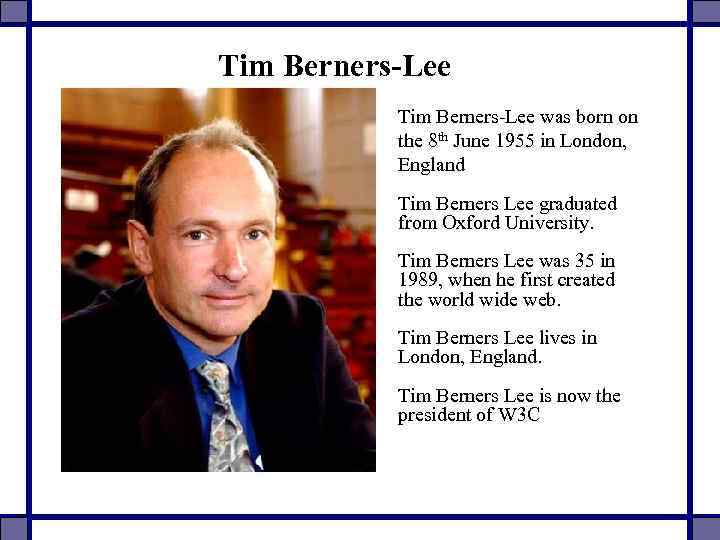
Tim Berners-Lee was born on the 8 th June 1955 in London, England Tim Berners Lee graduated from Oxford University. Tim Berners Lee was 35 in 1989, when he first created the world wide web. Tim Berners Lee lives in London, England. Tim Berners Lee is now the president of W 3 C
World Wide Web “WWW”, "Web" or "W 3"
WHAT IS WORLD WIDE WEB? • The World Wide Web is a way of exchanging information between computers on the Internet. • The World Wide Web is the network of pages of images, texts and sounds on the Internet which can be viewed using browser software.
WWW …. BACKGROUND? v 1989 -1990 – Tim Berners-Lee invents the World Wide Web at CERN v Means for transferring text and graphics simultaneously v Lots of previous attempts (Gopher, WAIS, Archie, Xanadu, etc. ) v Client/Server data transfer protocol v Established a common language for sharing information on computers
STRUCTURE § Clients use browser application to send URIs via HTTP to servers requesting a Web page § Web pages constructed using HTML (or other markup language) and consist of text, graphics, sounds plus embedded files § Servers (or caches) respond with requested Web page ◙ Or with error message § Client’s browser renders Web page returned by server ◙ Page is written using Hyper Text Markup Language (HTML) ◙ Displaying text, graphics and sound in browser ◙ Writing data as well § The entire system runs over standard networking protocols (TCP/IP, DNS, …)
WWW COMPONENTS • Structural Components: q Clients/browsers – to dominant implementations q. Servers – run on sophisticated hardware q. Caches – many interesting implementations q. Internet – the global infrastructure which facilitates data transfer • Semantic Components: q. Hyper Text Transfer Protocol (HTTP) q. Hyper Text Markup Language (HTML) – extensible Markup Language (XML) q. Uniform Resource Identifiers (URIs)
The Fundamental concept the World Wide Web Ø of The Hypertext concept • Hypertext is text which contains links to other texts. The term was coined by Ted Nelson around 1965. Ø The Hypermedia concept • Hypermedia is a term used for hypertext which is not constrained to be text: it can include graphics, video and sound.
ØWEB Browser • A web browser displays a web document and enables users to access web documents. ØWEB Server • This is a program that waits patiently for the browser to request a web page. The servers looks for the requested information, retrieves it and send it to the browser or sends an error message if the file is not found. ØUniform Resource Locator (URL) • These are the web addresses. The resource locator is an addressing system.
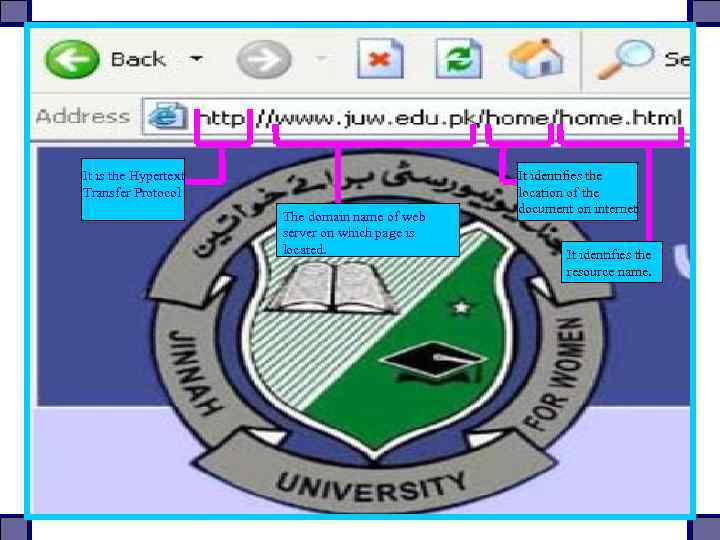
It is the Hypertext Transfer Protocol The domain name of web server on which page is located. It identifies the location of the document on internet It identifies the resource name.
Working Fields • In 1980 he worked at CERN as a consultant software engineer, where he built his unpublished first prototype system “Enquire”. • Also in 1980 he created his own langauage called Hypertext Mark-up Language (HTML) for the Internet. • In 1984, he took up a fellowship at CERN, to work on distributed realtime systems for scientific data acquisition and system control. • In 1989 he made history by creating global hypertext project aka World Wide Web. • He wrote the first World Wide Web server, "httpd", and the first client, "World. Wide. Web” which ran through nextstep environment. • 1991 in the summer time his invention “World Wide Web” got extremely popular .
Creating a WEB PAGE ! Web pages are generally sets of text files coded with special notation called Hypertext Markup Language (HTML) that is interpreted by a web browser program reading the file.
THE DIFFERENCE BETWEEN WORLD WIDE WEB AND INTERNET…? • Many people use the terms Internet and World Wide Web, but in fact the two terms are not synonymous. The Internet and the Web are two separate but related things. • The Internet is a massive network of networks. It connects millions of computers together globally, forming a network in which any computer can communicate with any other computer as long as they are both connected to the Internet. • The World Wide Web, or simply Web, is a way of accessing information over the medium of the Internet. • So the Web is just a portion of the Internet, albeit a large portion, but the two terms are not synonymous and should not be confused.
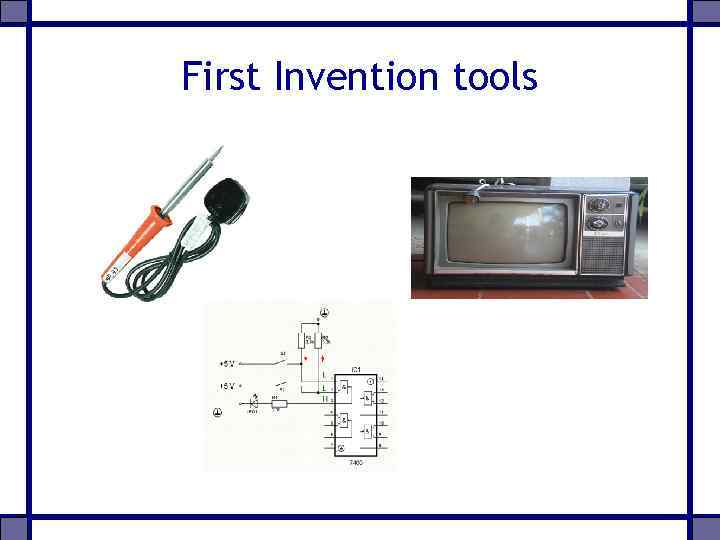
First Invention tools
WORLD WIDE WEB success!! • World Wide Web succeeded because it was simple! ØDidn’t attempt to maintain links, just a common way to name things
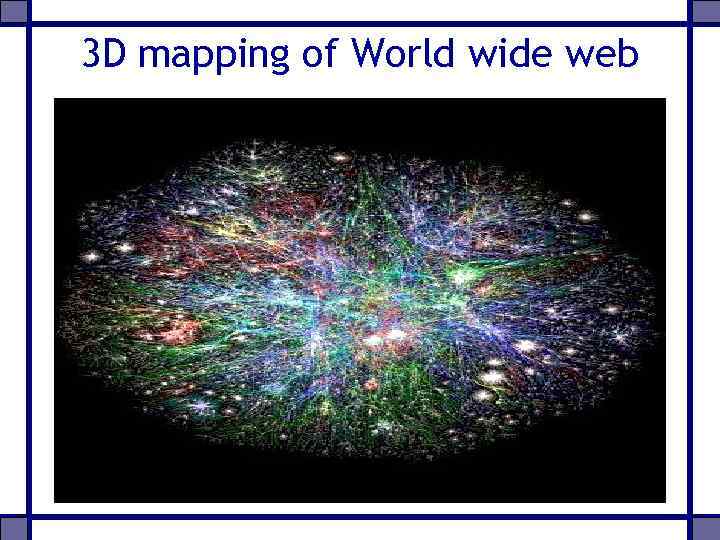
3 D mapping of World wide web
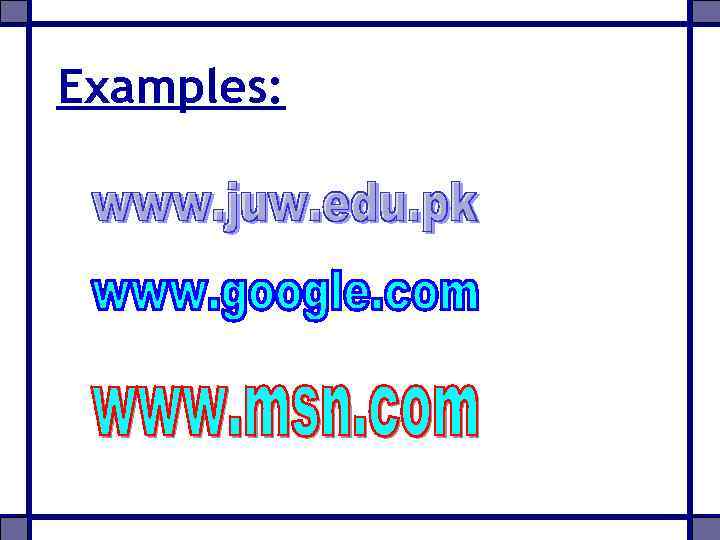
Examples:
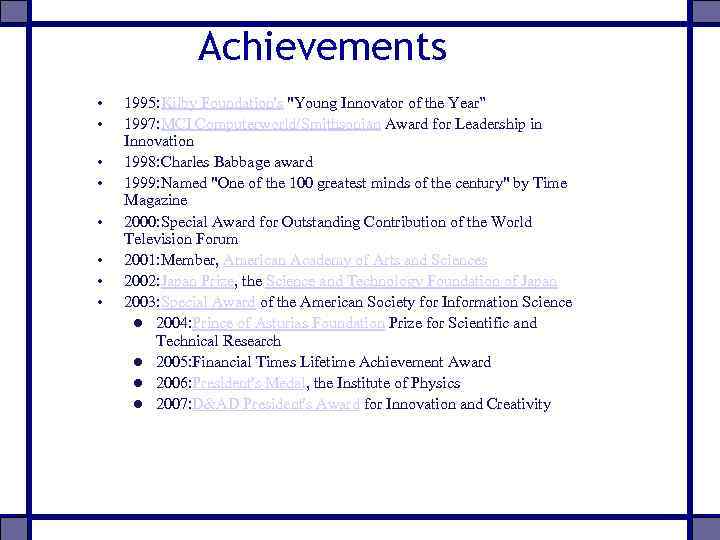
Achievements • • 1995: Kilby Foundation's "Young Innovator of the Year” 1997: MCI Computerworld/Smithsonian Award for Leadership in Innovation 1998: Charles Babbage award 1999: Named "One of the 100 greatest minds of the century" by Time Magazine 2000: Special Award for Outstanding Contribution of the World Television Forum 2001: Member, American Academy of Arts and Sciences 2002: Japan Prize, the Science and Technology Foundation of Japan 2003: Special Award of the American Society for Information Science l 2004: Prince of Asturias Foundation Prize for Scientific and Technical Research l 2005: Financial Times Lifetime Achievement Award l 2006: President's Medal, the Institute of Physics l 2007: D&AD President's Award for Innovation and Creativity
Questions?
Thank you!
Скачать презентацию Tim Berners-Lee was born on the 8 th
20020918internethistoryandgrowth-090323064232-phpapp01.ppt