 Скачать презентацию Tile HCAL plans for testbeams and beyond ECAL
f14ce14fc33ffea453c41ddd1b9370b8.ppt
- Количество слайдов: 32



Tile HCAL plans for testbeams and beyond ECAL Tile HCAL Tail Catcher Common DAQ Recons/Analysis Simulation Optimal calo concept ? ? 2007/8 ? V. Korbel, DESY 1. 2. 3. 4. Outline Why testbeam studies? Preparations for the testbeam Test beam plans Some ideas for further R&D 3. ILC workshop, Vienna, 2005 1
I. Why do we need testbeam studies Physics arguments, for a pre-prototype HCAL: Energy resolution to achieve Compensation by sw-weighting (e/h) a la H 1? Topological shower reconstruction of measured shower trees: -Find best cell granularity, staggering of layers? -Comparison with shower simulation models, --find the best one --optimize by tuning -identification and 3 -D separation of real particle showers in “jets” --with measured particle overlays, collect particle libraries, --with use of optimized/tuned simulation models Find the best calorimeter type for “imaging calorimetry” Analogue Scint. Calo? Semi-analogue or digital Scint. Calo, granularity needed? Digital Gas Calos? Our plans are described in 2004/2005 in documents: --Memorandum to the DESY-PRC, May 2004 --Report on Worldwide Linear Collider Test Beam Effort, July 2004 --International Linear Collider Calorimeter Test Beam Program, Oct. 2004 --Memorandum to the DESY-PRC, Nov. 2005 V. Korbel, DESY 3. ILC workshop, Vienna, 2005 2
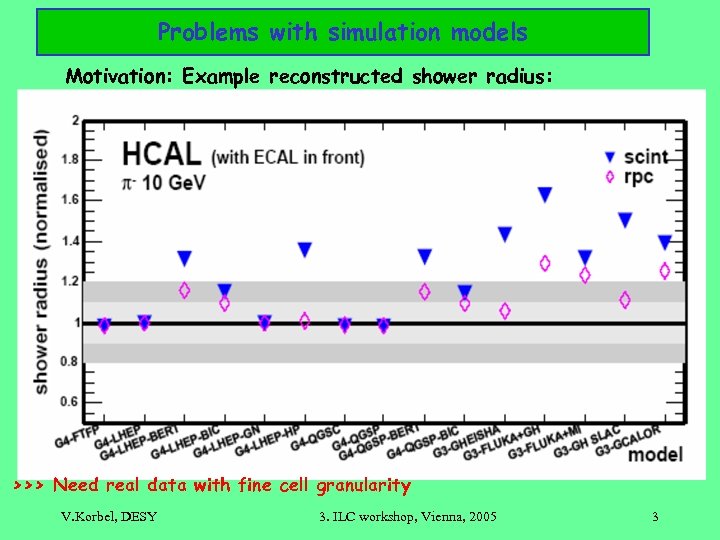
Problems with simulation models Motivation: Example reconstructed shower radius: >>> Need real data with fine cell granularity V. Korbel, DESY 3. ILC workshop, Vienna, 2005 3
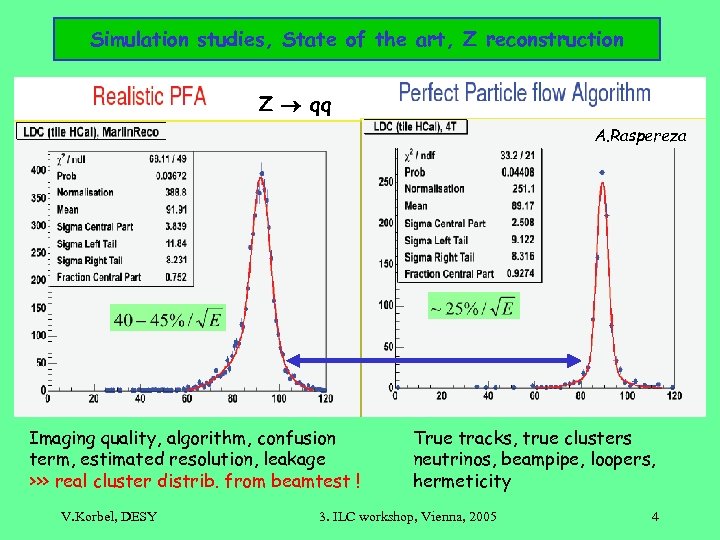
Simulation studies, State of the art, Z reconstruction Z qq A. Raspereza Imaging quality, algorithm, confusion term, estimated resolution, leakage >>> real cluster distrib. from beamtest ! V. Korbel, DESY True tracks, true clusters neutrinos, beampipe, loopers, hermeticity 3. ILC workshop, Vienna, 2005 4
Why do we need also testbeam studies The Tile. HCAL is again a “Pre-prototype” calorimeter! First Pre-prototyp was Minical (DESY) Technical arguments: Test all concepts/components of the calorimeter Nice results presented yesterday by: --Marius Groll, Commissioning of HCAL modules in the DESY testbeam --Erika Garutti, Tile. HCAL Calibration Next: Show to run a larger detector with ~8 K cells, Manage: • Gain monitoring, • Energy calibration, • Stability in time, • Live time of components, • Systematic errors, to minimize • ……. Cooperation/Integration with other calorimeter modules as ECAL, TC, Muon system… >>> Get new Ideas for the technical prototype and the future large detector V. Korbel, DESY 3. ILC workshop, Vienna, 2005 5
2. The testbeam measurement plans • HCAL stand alone (no beam) Set-up, commissioning LED/PIN photodiode calibration and gain monitoring MIP calibration, from Halo • HCAL stand alone (with beam) Electrons, Mips (beam ms or Mips from triggered showers) TC as Veto for hadron leakage? Collection of various particles, energies and angles Staggered calo planes • HCAL + TC Collect hadrons with larger energies Measure leakage, are corrections possible? • ECAL+ HCAL + TC The ultimate test V. Korbel, DESY 3. ILC workshop, Vienna, 2005 6
Test Beams for Calorimeters in 2006 Need: events, time --muons for calibration (halo, cosmics), 8 K cells to calibrate --large number of events of different particle types, typically 10**8 hadrons (with minimum leakage? ) -- >> long ( ~months) running time Test beams: 1. DESY, Strahl 21, electrons, 1 -6, 5 Ge. V, 2. CERN: large priority for LHC experiments PS, low energy hadrons, mid May-beginning Nov. , serious space limits ? SPS, North hall, mid June-beginning Nov. 3. FNAL, available in summer 2006? 4. Protvino, see my talk at LCWS Paris 2004, still an option ! V. Korbel, DESY 3. ILC workshop, Vienna, 2005 7
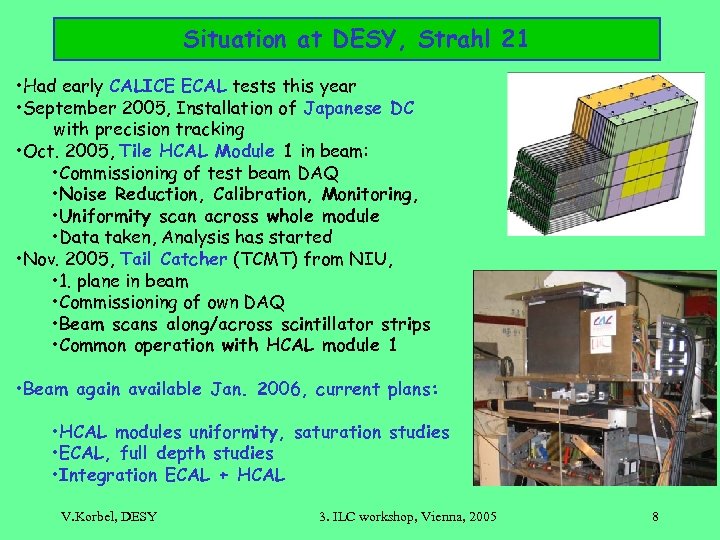
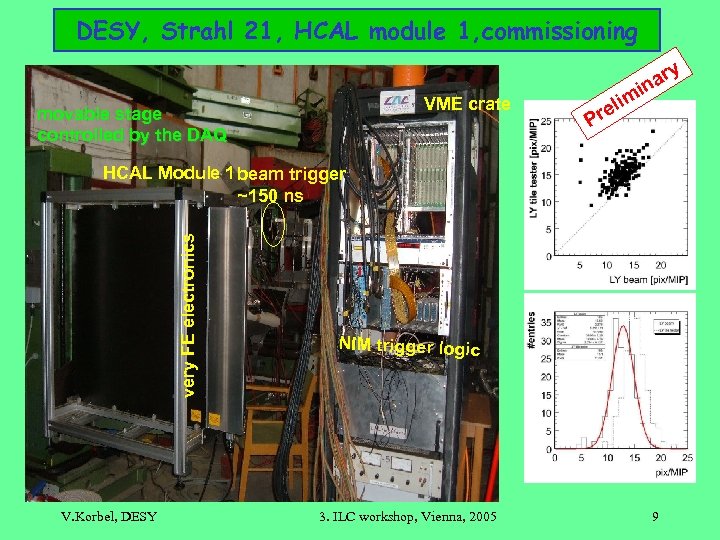
Situation at DESY, Strahl 21 • Had early CALICE ECAL tests this year • September 2005, Installation of Japanese DC with precision tracking • Oct. 2005, Tile HCAL Module 1 in beam: • Commissioning of test beam DAQ • Noise Reduction, Calibration, Monitoring, • Uniformity scan across whole module • Data taken, Analysis has started • Nov. 2005, Tail Catcher (TCMT) from NIU, • 1. plane in beam • Commissioning of own DAQ • Beam scans along/across scintillator strips • Common operation with HCAL module 1 • Beam again available Jan. 2006, current plans: • HCAL modules uniformity, saturation studies • ECAL, full depth studies • Integration ECAL + HCAL V. Korbel, DESY 3. ILC workshop, Vienna, 2005 8
DESY, Strahl 21, HCAL module 1, commissioning VME crate movable stage controlled by the DAQ y ar n mi li re P very FE electronics HCAL Module 1 beam trigger ~150 ns V. Korbel, DESY i NIM trigger logic 3. ILC workshop, Vienna, 2005 9
CALICE e-Logbook Calice wide common documentation ? Dates Detectors Production status Author Sven Karstensen Based on TTF-Logbook >>> http: //ttfinfo. desy. de/CALICEelog/ V. Korbel, DESY 3. ILC workshop, Vienna, 2005 10
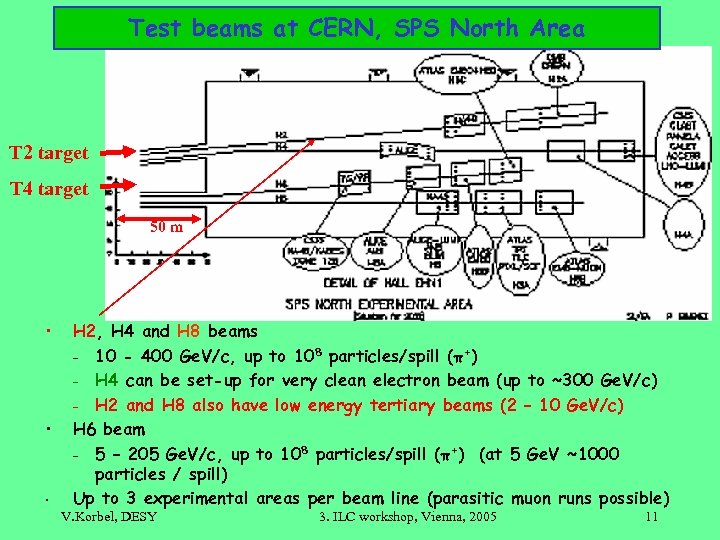
Test beams at CERN, SPS North Area T 2 target T 4 target 50 m • • • H 2, H 4 and H 8 beams – 10 - 400 Ge. V/c, up to 108 particles/spill (π+) – H 4 can be set-up for very clean electron beam (up to ~300 Ge. V/c) – H 2 and H 8 also have low energy tertiary beams (2 – 10 Ge. V/c) H 6 beam – 5 – 205 Ge. V/c, up to 108 particles/spill (π+) (at 5 Ge. V ~1000 particles / spill) Up to 3 experimental areas per beam line (parasitic muon runs possible) V. Korbel, DESY 3. ILC workshop, Vienna, 2005 11
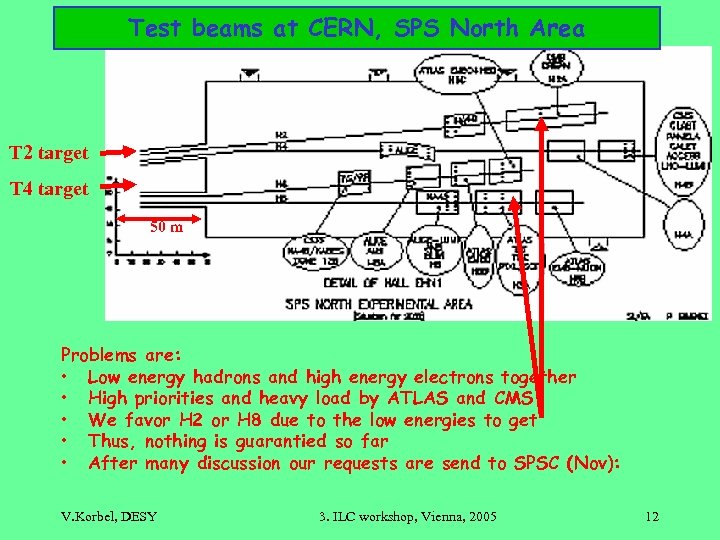
Test beams at CERN, SPS North Area T 2 target T 4 target 50 m Problems are: • Low energy hadrons and high energy electrons together • High priorities and heavy load by ATLAS and CMS • We favor H 2 or H 8 due to the low energies to get • Thus, nothing is guarantied so far • After many discussion our requests are send to SPSC (Nov): V. Korbel, DESY 3. ILC workshop, Vienna, 2005 12
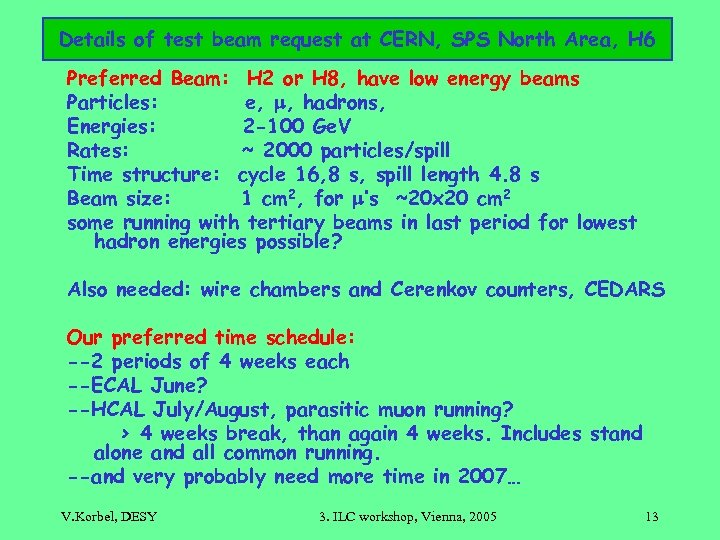
Details of test beam request at CERN, SPS North Area, H 6 Preferred Beam: H 2 or H 8, have low energy beams Particles: e, m, hadrons, Energies: 2 -100 Ge. V Rates: ~ 2000 particles/spill Time structure: cycle 16, 8 s, spill length 4. 8 s Beam size: 1 cm 2, for m’s ~20 x 20 cm 2 some running with tertiary beams in last period for lowest hadron energies possible? Also needed: wire chambers and Cerenkov counters, CEDARS Our preferred time schedule: --2 periods of 4 weeks each --ECAL June? --HCAL July/August, parasitic muon running? > 4 weeks break, than again 4 weeks. Includes stand alone and all common running. --and very probably need more time in 2007… V. Korbel, DESY 3. ILC workshop, Vienna, 2005 13
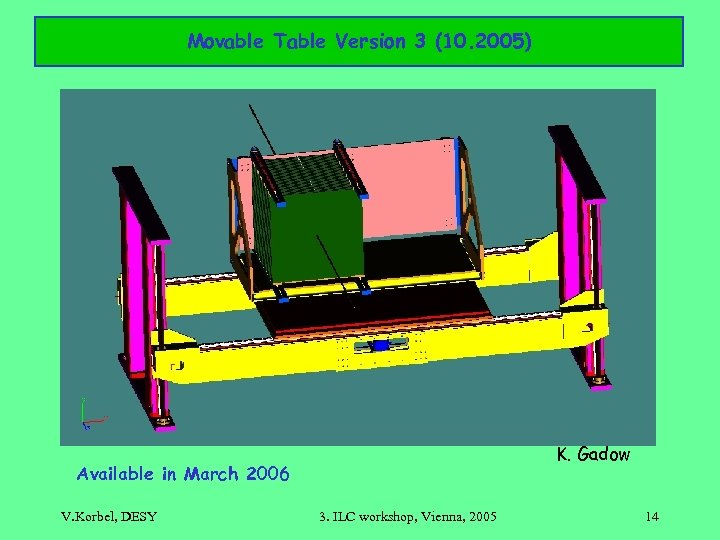
Movable Table Version 3 (10. 2005) K. Gadow Available in March 2006 V. Korbel, DESY 3. ILC workshop, Vienna, 2005 14
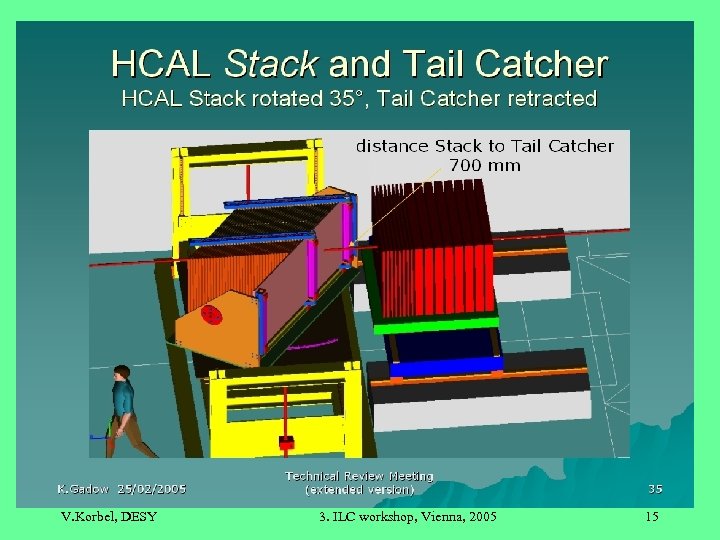
Movable Table modification impact for the close up of the Tail-Catcher The distance between the HCAL Stack and the Tail-Catcher should be also during a 35° scan as close as possible. V. Korbel, DESY 3. ILC workshop, Vienna, 2005 15
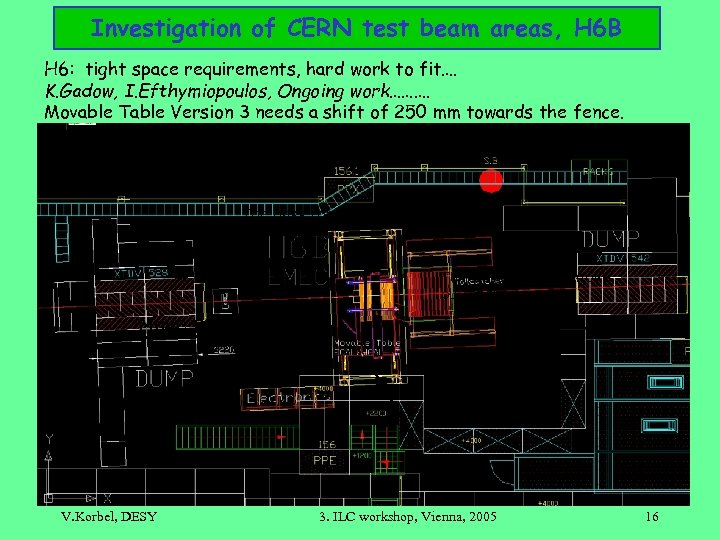
Investigation of CERN test beam areas, H 6 B H 6: tight space requirements, hard work to fit…. K. Gadow, I. Efthymiopoulos, Ongoing work………. Movable Table Version 3 needs a shift of 250 mm towards the fence. The pass-through will be blocked! Tail-Catcher must move out of the beam Move downstream ? V. Korbel, DESY 3. ILC workshop, Vienna, 2005 16
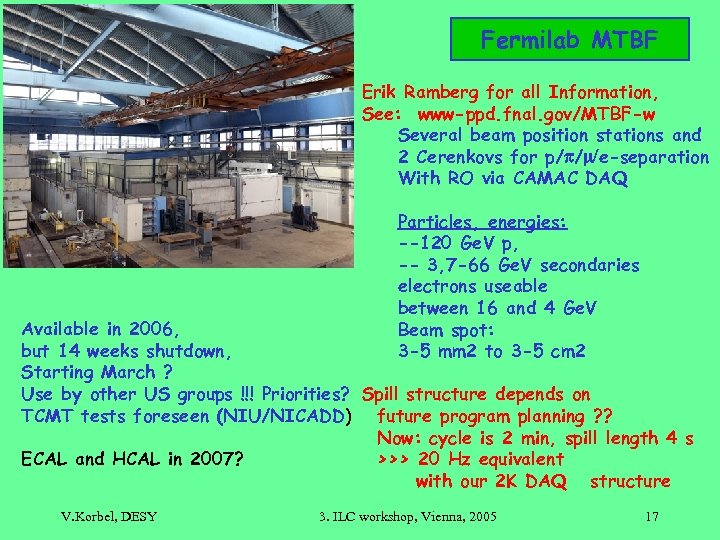
TC Fermilab MTBF Erik Ramberg for all Information, See: www-ppd. fnal. gov/MTBF-w Several beam position stations and 2 Cerenkovs for p/p/m/e-separation With RO via CAMAC DAQ Particles, energies: --120 Ge. V p, -- 3, 7 -66 Ge. V secondaries electrons useable between 16 and 4 Ge. V Beam spot: 3 -5 mm 2 to 3 -5 cm 2 Available in 2006, but 14 weeks shutdown, Starting March ? Use by other US groups !!! Priorities? Spill structure depends on TCMT tests foreseen (NIU/NICADD) future program planning ? ? Now: cycle is 2 min, spill length 4 s ECAL and HCAL in 2007? >>> 20 Hz equivalent with our 2 K DAQ structure V. Korbel, DESY 3. ILC workshop, Vienna, 2005 17
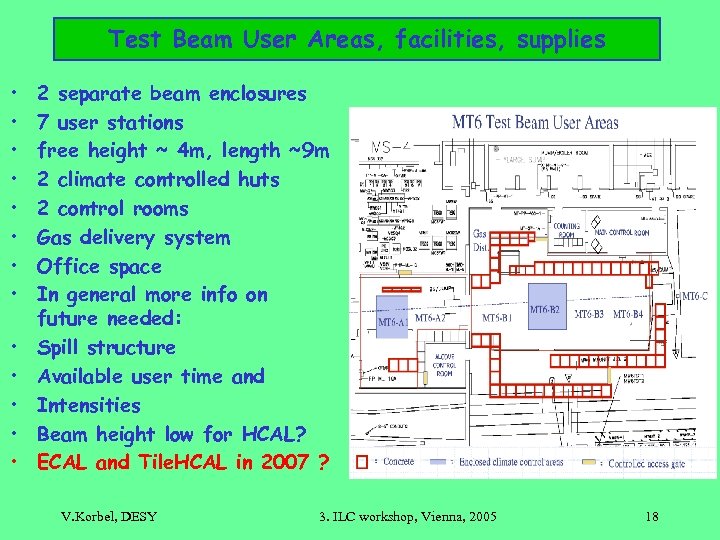
Test Beam User Areas, facilities, supplies • • • • 2 separate beam enclosures 7 user stations free height ~ 4 m, length ~9 m 2 climate controlled huts 2 control rooms Gas delivery system Office space In general more info on future needed: Spill structure Available user time and Intensities Beam height low for HCAL? ECAL and Tile. HCAL in 2007 ? V. Korbel, DESY 3. ILC workshop, Vienna, 2005 18
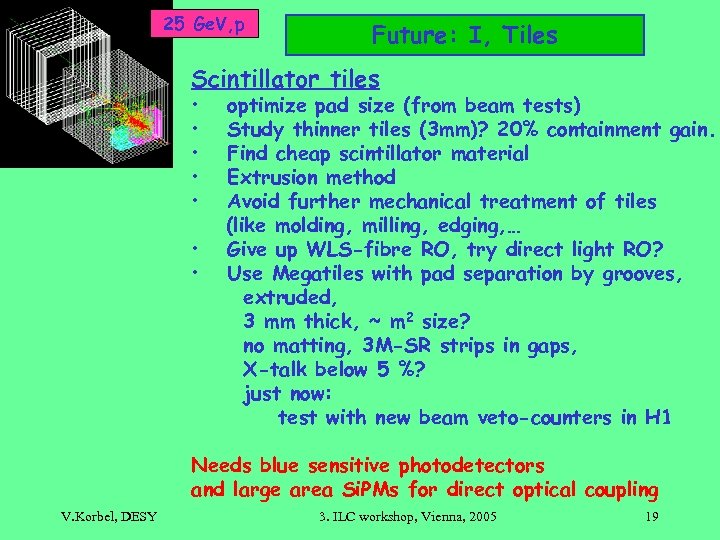
25 Ge. V, p Future: I, Tiles Scintillator tiles • • optimize pad size (from beam tests) Study thinner tiles (3 mm)? 20% containment gain. Find cheap scintillator material Extrusion method Avoid further mechanical treatment of tiles (like molding, milling, edging, … Give up WLS-fibre RO, try direct light RO? Use Megatiles with pad separation by grooves, extruded, 3 mm thick, ~ m 2 size? no matting, 3 M-SR strips in gaps, X-talk below 5 %? just now: test with new beam veto-counters in H 1 Needs blue sensitive photodetectors and large area Si. PMs for direct optical coupling V. Korbel, DESY 3. ILC workshop, Vienna, 2005 19
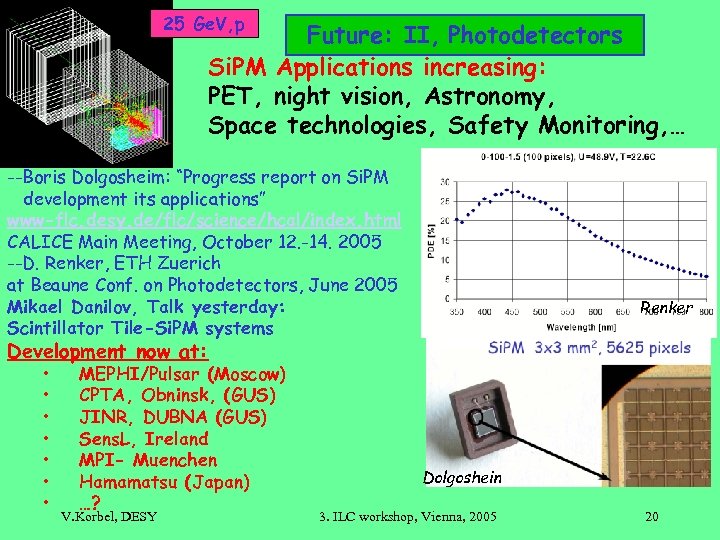
25 Ge. V, p Future: II, Photodetectors Si. PM Applications increasing: PET, night vision, Astronomy, Space technologies, Safety Monitoring, … --Boris Dolgosheim: “Progress report on Si. PM development its applications” www-flc. desy. de/flc/science/hcal/index. html CALICE Main Meeting, October 12. -14. 2005 --D. Renker, ETH Zuerich at Beaune Conf. on Photodetectors, June 2005 Mikael Danilov, Talk yesterday: Scintillator Tile-Si. PM systems Renker Development now at: • • MEPHI/Pulsar (Moscow) CPTA, Obninsk, (GUS) JINR, DUBNA (GUS) Sens. L, Ireland MPI- Muenchen Hamamatsu (Japan) …? V. Korbel, DESY Dolgoshein 3. ILC workshop, Vienna, 2005 20
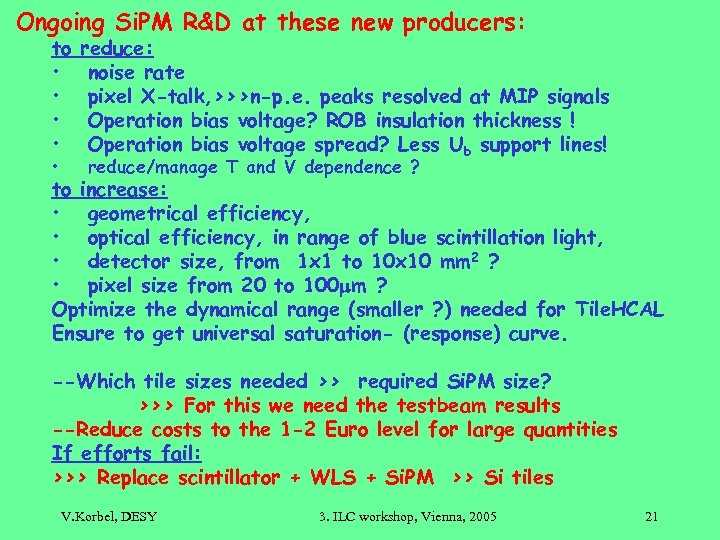
Ongoing Si. PM R&D at these new producers: to • • • reduce: noise rate pixel X-talk, >>>n-p. e. peaks resolved at MIP signals Operation bias voltage? ROB insulation thickness ! Operation bias voltage spread? Less Ub support lines! reduce/manage T and V dependence ? to increase: • geometrical efficiency, • optical efficiency, in range of blue scintillation light, • detector size, from 1 x 1 to 10 x 10 mm 2 ? • pixel size from 20 to 100 mm ? Optimize the dynamical range (smaller ? ) needed for Tile. HCAL Ensure to get universal saturation- (response) curve. --Which tile sizes needed >> required Si. PM size? >>> For this we need the testbeam results --Reduce costs to the 1 -2 Euro level for large quantities If efforts fail: >>> Replace scintillator + WLS + Si. PM >> Si tiles V. Korbel, DESY 3. ILC workshop, Vienna, 2005 21
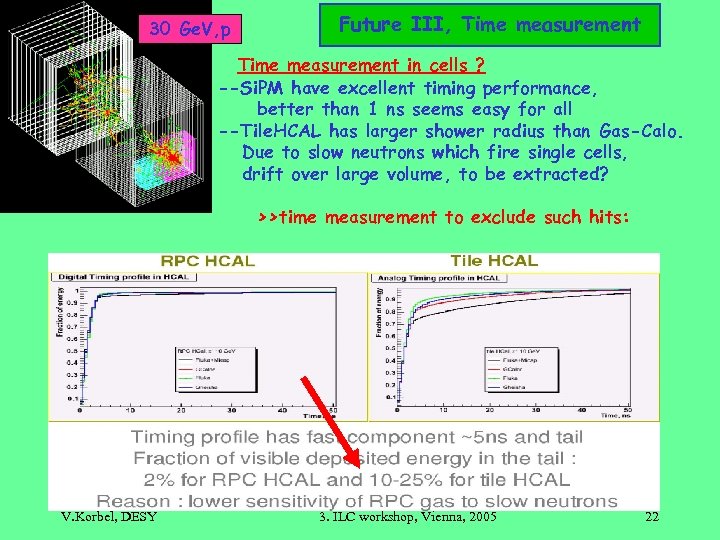
30 Ge. V, p Future III, Time measurement in cells ? --Si. PM have excellent timing performance, better than 1 ns seems easy for all --Tile. HCAL has larger shower radius than Gas-Calo. Due to slow neutrons which fire single cells, drift over large volume, to be extracted? >>time measurement to exclude such hits: V. Korbel, DESY 3. ILC workshop, Vienna, 2005 22
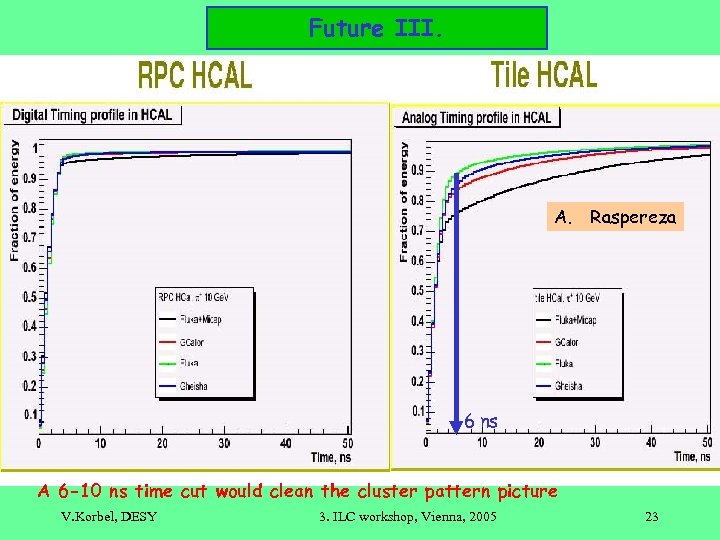
Future III. A. Raspereza 6 ns A 6 -10 ns time cut would clean the cluster pattern picture V. Korbel, DESY 3. ILC workshop, Vienna, 2005 23
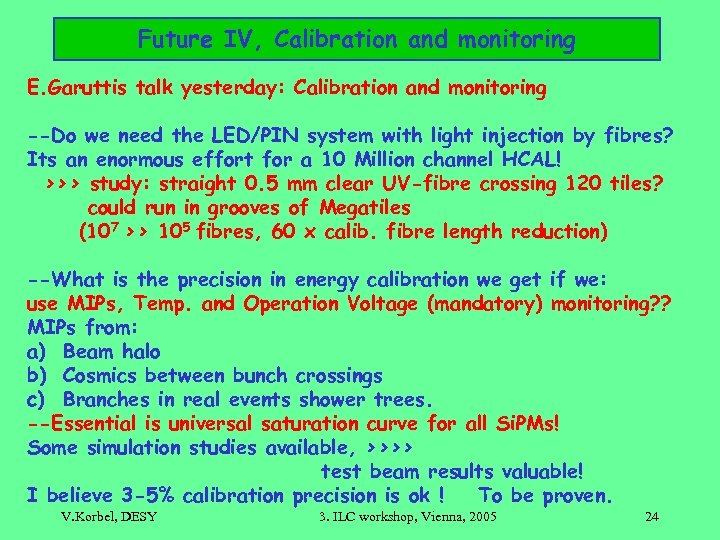
Future IV, Calibration and monitoring E. Garuttis talk yesterday: Calibration and monitoring --Do we need the LED/PIN system with light injection by fibres? Its an enormous effort for a 10 Million channel HCAL! >>> study: straight 0. 5 mm clear UV-fibre crossing 120 tiles? could run in grooves of Megatiles (107 >> 105 fibres, 60 x calib. fibre length reduction) --What is the precision in energy calibration we get if we: use MIPs, Temp. and Operation Voltage (mandatory) monitoring? ? MIPs from: a) Beam halo b) Cosmics between bunch crossings c) Branches in real events shower trees. --Essential is universal saturation curve for all Si. PMs! Some simulation studies available, >>>> test beam results valuable! I believe 3 -5% calibration precision is ok ! To be proven. V. Korbel, DESY 3. ILC workshop, Vienna, 2005 24
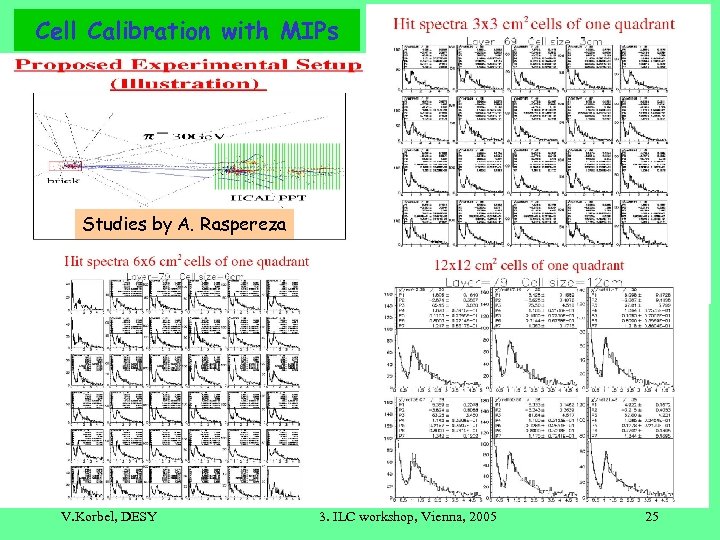
Cell Calibration with MIPs Studies by A. Raspereza V. Korbel, DESY 3. ILC workshop, Vienna, 2005 25
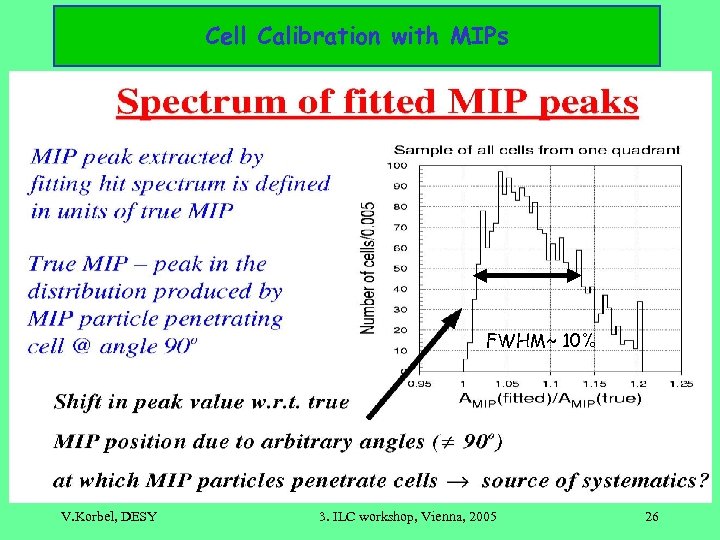
Cell Calibration with MIPs FWHM~ 10% V. Korbel, DESY 3. ILC workshop, Vienna, 2005 26
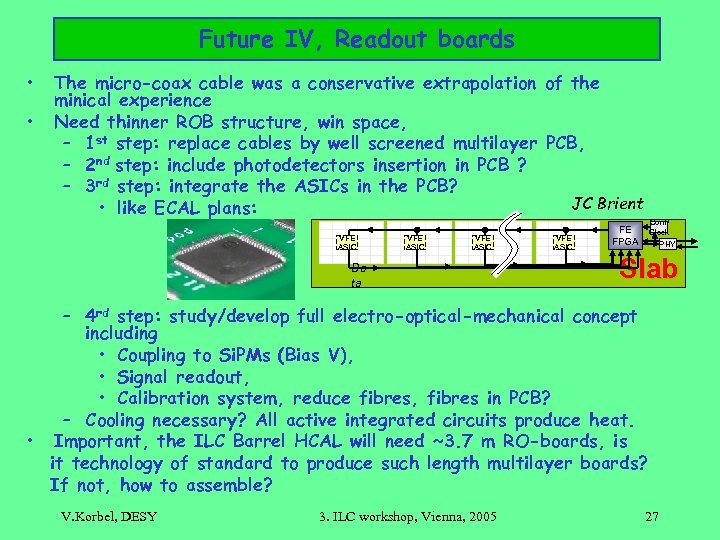
Future IV, Readout boards • • The micro-coax cable was a conservative extrapolation of the minical experience Need thinner ROB structure, win space, – 1 st step: replace cables by well screened multilayer PCB, – 2 nd step: include photodetectors insertion in PCB ? – 3 rd step: integrate the ASICs in the PCB? JC Brient • like ECAL plans: VFE ASIC Da ta VFE ASIC Conf/ Clock FE FPGA PHY Slab – 4 rd step: study/develop full electro-optical-mechanical concept including • Coupling to Si. PMs (Bias V), • Signal readout, • Calibration system, reduce fibres, fibres in PCB? – Cooling necessary? All active integrated circuits produce heat. • Important, the ILC Barrel HCAL will need ~3. 7 m RO-boards, is it technology of standard to produce such length multilayer boards? If not, how to assemble? V. Korbel, DESY 3. ILC workshop, Vienna, 2005 27
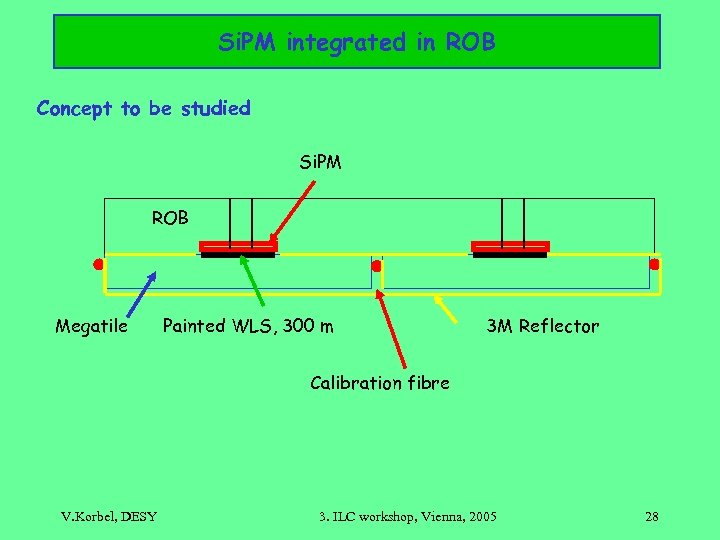
Si. PM integrated in ROB Concept to be studied Si. PM ROB Megatile Painted WLS, 300 m 3 M Reflector Calibration fibre V. Korbel, DESY 3. ILC workshop, Vienna, 2005 28
ROB, cooling Manage cooling problem inside modules: ---All active electronic front end electronics outside STAC, only Si. PM inside, ~50 V, ~ 1 m. A, >> power dissipation ~ 50 m. W/m 2, >> no active module cooling needed ---Or follow the ECAL trail: VFE electronic integrated in ROB Pulsed power, but allows no cosmics between BC’s for cell calibration V. Korbel, DESY 3. ILC workshop, Vienna, 2005 29
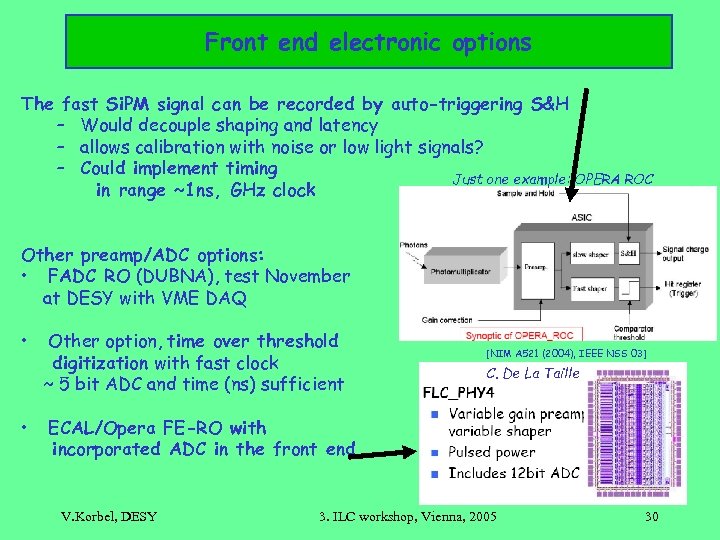
Front end electronic options The fast Si. PM signal can be recorded by auto-triggering S&H – Would decouple shaping and latency – allows calibration with noise or low light signals? – Could implement timing Just one example: OPERA ROC in range ~1 ns, GHz clock Other preamp/ADC options: • FADC RO (DUBNA), test November at DESY with VME DAQ • • Other option, time over threshold digitization with fast clock ~ 5 bit ADC and time (ns) sufficient [NIM A 521 (2004), IEEE NSS 03] C. De La Taille ECAL/Opera FE-RO with incorporated ADC in the front end V. Korbel, DESY 3. ILC workshop, Vienna, 2005 30
European network for detector R&D • Monday, 14. 11. Joachim Mnich: Plans for EURODET • Integrated Infrastructure Initiative within European Union Framework Program 6, R&D for larger prototypes, • 3 domains for funding: • Calo, Tracker, Test beam infrastructure • Successfully evaluated, negotiations invited • Starts presumably in 2006 • Funding volume: 7 M€ for 4 years • Coordinating Inst. DESY, • Coordinator J. Mnich • JRA 3 (Calo) management: – Christophe De La Taille, – Felix Sefkow • HCAL brainstorming at 8. /9. 12. DESY • EUDET Kick-off meeting spring 2006 V. Korbel, DESY 3. ILC workshop, Vienna, 2005 31
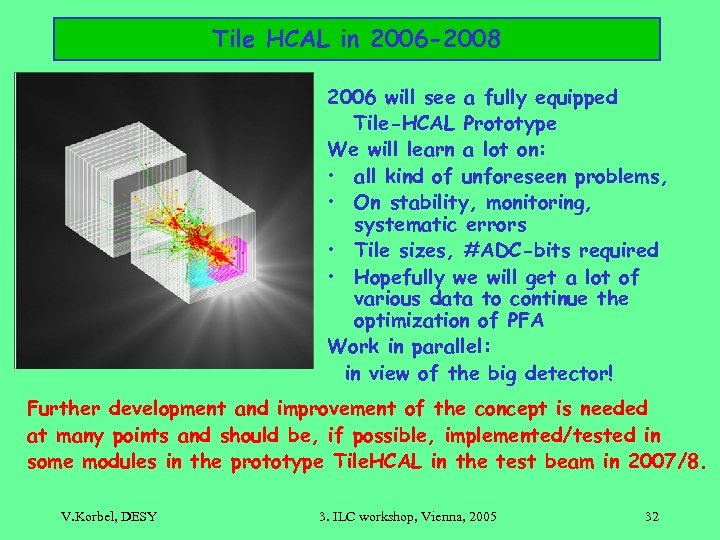
Tile HCAL in 2006 -2008 2006 will see a fully equipped Tile-HCAL Prototype We will learn a lot on: • all kind of unforeseen problems, • On stability, monitoring, systematic errors • Tile sizes, #ADC-bits required • Hopefully we will get a lot of various data to continue the optimization of PFA Work in parallel: in view of the big detector! Further development and improvement of the concept is needed at many points and should be, if possible, implemented/tested in some modules in the prototype Tile. HCAL in the test beam in 2007/8. V. Korbel, DESY 3. ILC workshop, Vienna, 2005 32
Скачать презентацию Tile HCAL plans for testbeams and beyond ECAL
f14ce14fc33ffea453c41ddd1b9370b8.ppt