


 Скачать презентацию TILDA The Irish Longitudinal Study on
00da3de80f4b88b45f334d0a12532d9f.ppt
- Количество слайдов: 28
 TILDA – The Irish Longitudinal Study on Ageing Trinity College Dublin
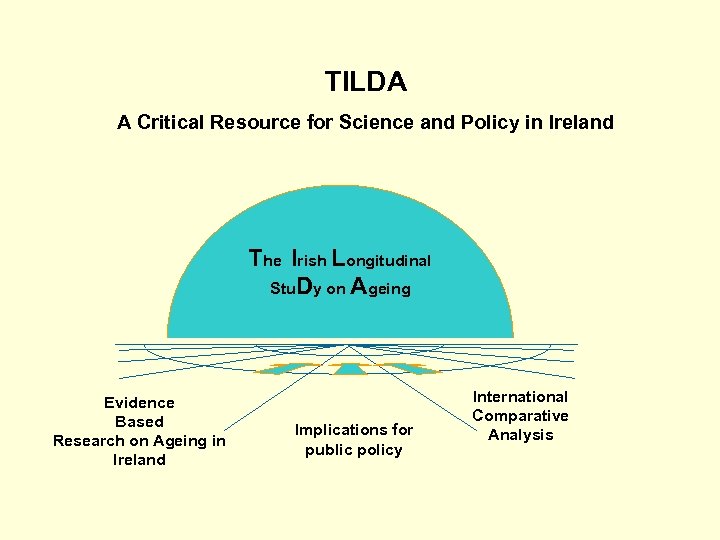 TILDA A Critical Resource for Science and Policy in Ireland The Irish Longitudinal Stu. Dy on Ageing Evidence Based Research on Ageing in Ireland Implications for public policy International Comparative Analysis
 Funding • Preliminary and Pilot (2 years) • 10 year study • Irish Life • Atlantic Philanthropies • Government (Health/Office Older People)
 Ageing in Ireland • Proportion of population ≥ 65 has remained steady at about 11% for the past 40 years • It is projected that this proportion will rise to 20 -25% by 2036 (CSO 2006) • The greatest increase will be in the oldest old
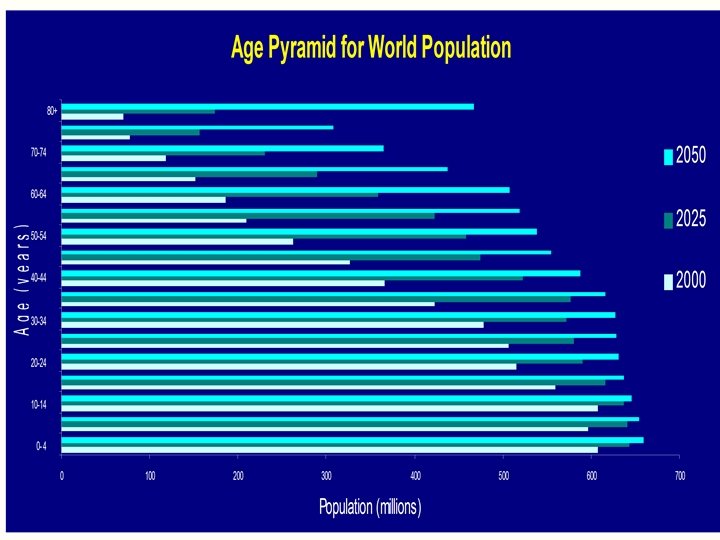
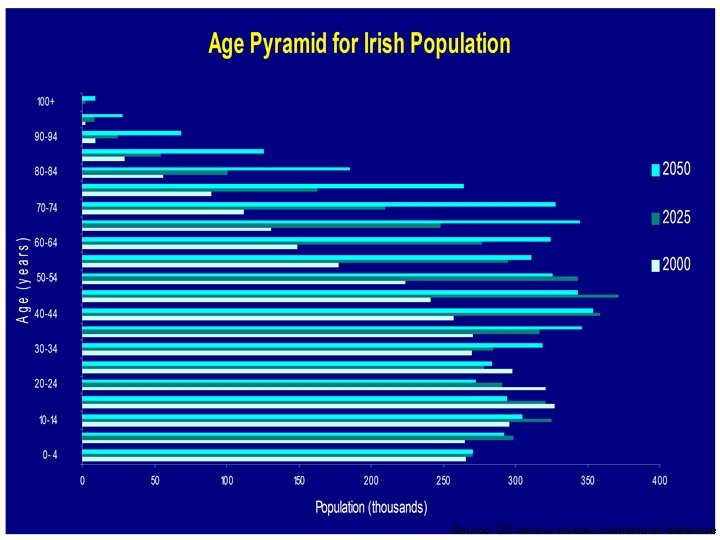 Source: US census bureau International database
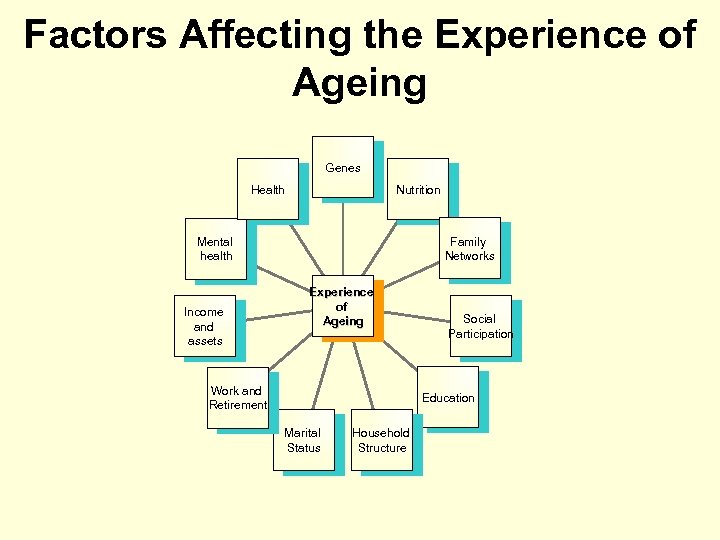 Factors Affecting the Experience of Ageing Genes Health Nutrition Family Networks Mental health Income and assets Experience of Ageing Work and Retirement Social Participation Education Marital Status Household Structure
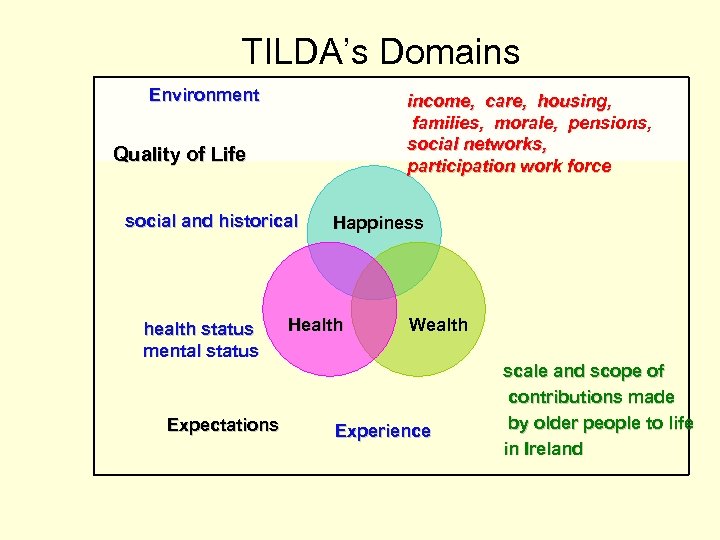 TILDA’s Domains Environment income, care, housing, families, morale, pensions, Factors Influencing the Experience of Ageing social networks, Quality of Life participation work force social and historical health status mental status Expectations Happiness Health Wealth Experience scale and scope of contributions made by older people to life in Ireland
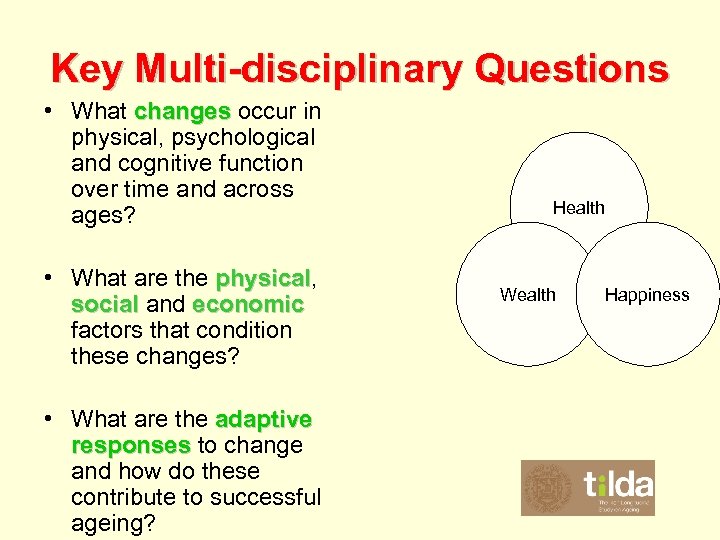 Key Multi-disciplinary Questions • What changes occur in physical, psychological and cognitive function over time and across ages? • What are the physical, physical social and economic factors that condition these changes? • What are the adaptive responses to change and how do these contribute to successful ageing? Health Wealth Happiness
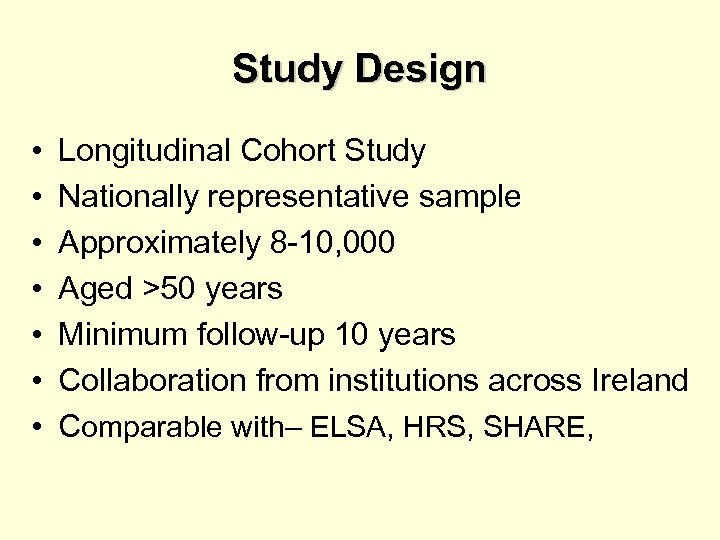 Study Design • • Longitudinal Cohort Study Nationally representative sample Approximately 8 -10, 000 Aged >50 years Minimum follow-up 10 years Collaboration from institutions across Ireland Comparable with– ELSA, HRS, SHARE,
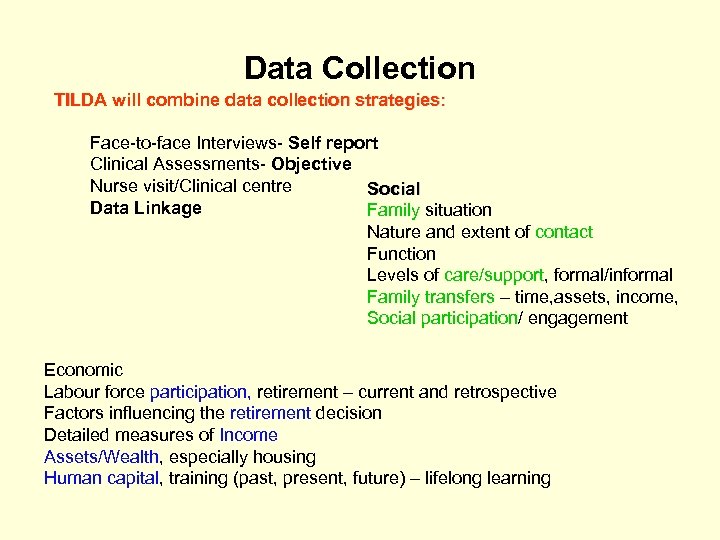 Data Collection TILDA will combine data collection strategies: Face-to-face Interviews- Self report Clinical Assessments- Objective Nurse visit/Clinical centre Social Data Linkage Family situation Nature and extent of contact Function Levels of care/support, formal/informal Family transfers – time, assets, income, Social participation/ engagement Economic Labour force participation, retirement – current and retrospective Factors influencing the retirement decision Detailed measures of Income Assets/Wealth, especially housing Human capital, training (past, present, future) – lifelong learning
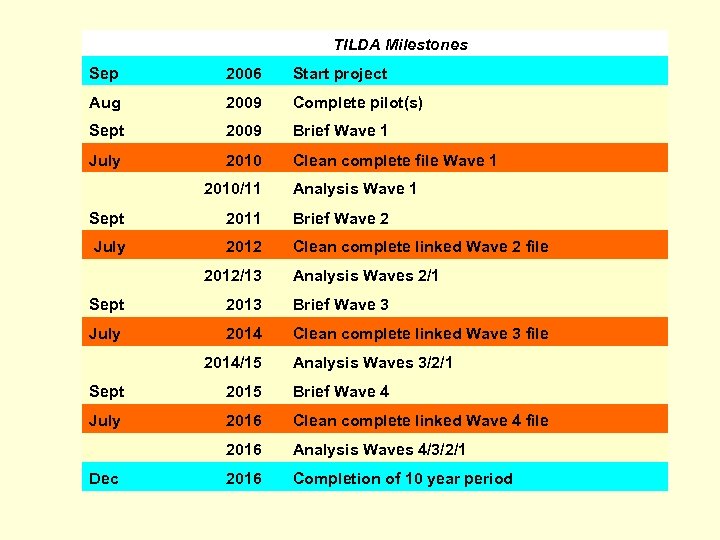 TILDA Milestones Sep 2006 Start project Aug 2009 Complete pilot(s) Sept 2009 Brief Wave 1 July 2010 Clean complete file Wave 1 2010/11 Analysis Wave 1 Sept 2011 Brief Wave 2 July 2012 Clean complete linked Wave 2 file 2012/13 Analysis Waves 2/1 Sept 2013 Brief Wave 3 July 2014 Clean complete linked Wave 3 file 2014/15 Analysis Waves 3/2/1 Sept 2015 Brief Wave 4 July 2016 Clean complete linked Wave 4 file 2016 Analysis Waves 4/3/2/1 Dec 2016 Completion of 10 year period
 Home-Self Report, Objective
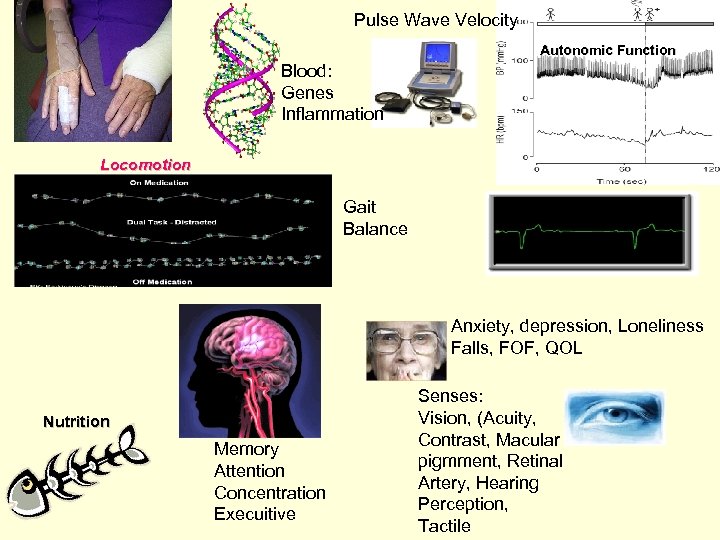 Pulse Wave Velocity Autonomic Function Blood: Genes Inflammation Locomotion Gait Balance Anxiety, depression, Loneliness Falls, FOF, QOL HRV Nutrition Memory Attention Concentration R Execuitive Senses: Vision, (Acuity, Contrast, Macular pigmment, Retinal Artery, Hearing Perception, Tactile
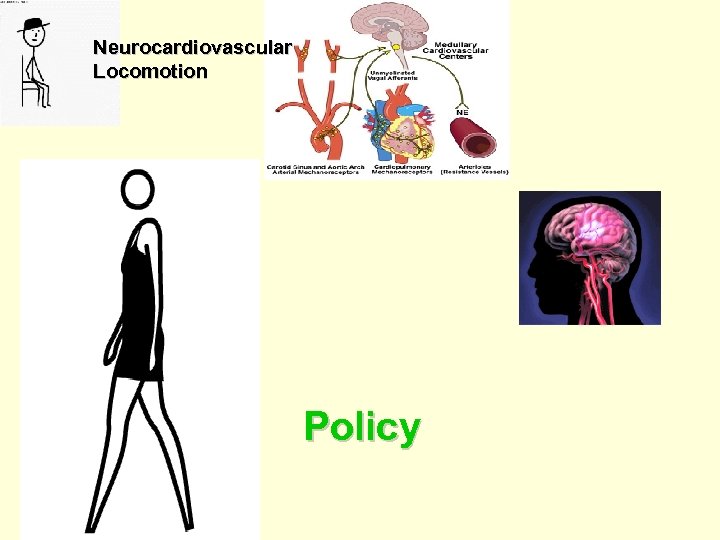 Neurocardiovascular Locomotion Policy
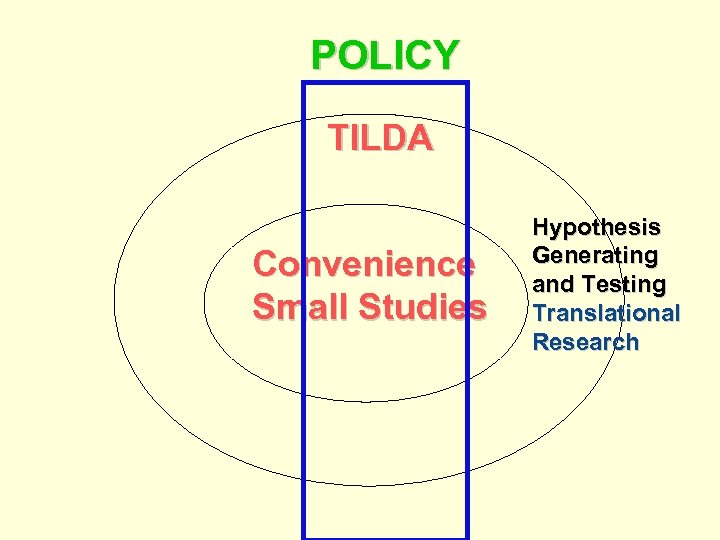 POLICY TILDA Convenience Small Studies Hypothesis Generating and Testing Translational Research
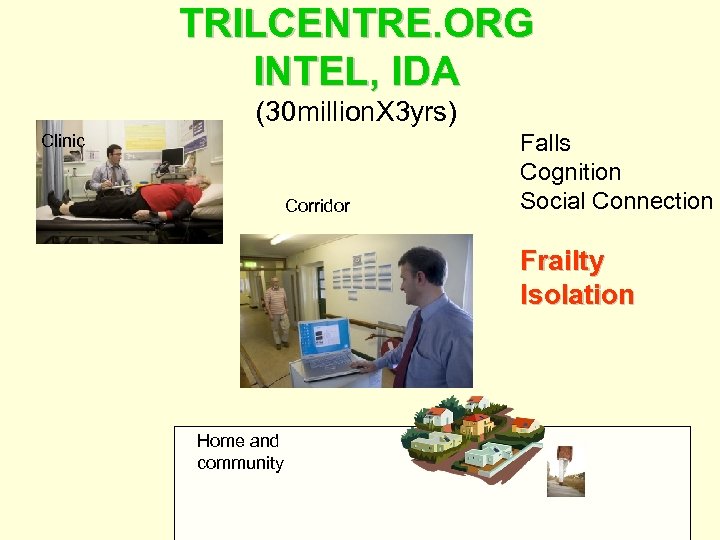 TRILCENTRE. ORG INTEL, IDA (30 million. X 3 yrs) Clinic Corridor Falls Cognition Social Connection Frailty Isolation Home and community
 TILDA Outcomes TILDA will enable us to… – Raise and heighten awareness ageing issues; – Identify and understand trends in ageing; – generalizability of findings from smaller studies; – Develop informed policies ; improved advocacy – Make Ireland a hotbed for ageing research and innovation in technology, services, & other domains; – Validate measures used globally around ageing; Validate – Inform an emerging market of care services; care services – Potentially lead to start-ups and spin-off ventures, spin-off ventures e. g. in pharma, biotech, assistive tech, service delivery, etc.
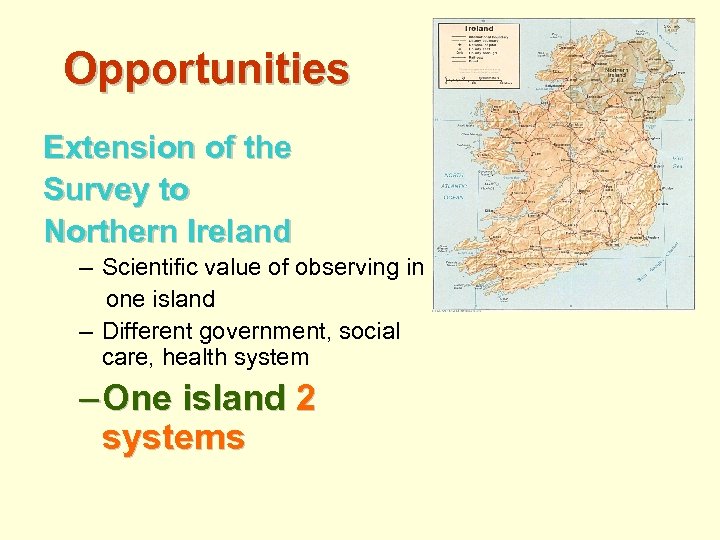 Opportunities Extension of the Survey to Northern Ireland – Scientific value of observing in one island – Different government, social care, health system – One island 2 systems
 Policy Context - Ireland’s unique features Demography • Population is young – ageing will occur later than in the rest of Europe • Ireland has one of the lowest old-age dependency rates in the OECD • Will still be one of the lowest in 2025 • But by 2050 will rise to the EU-15 average • Relatively high age of retirement for men
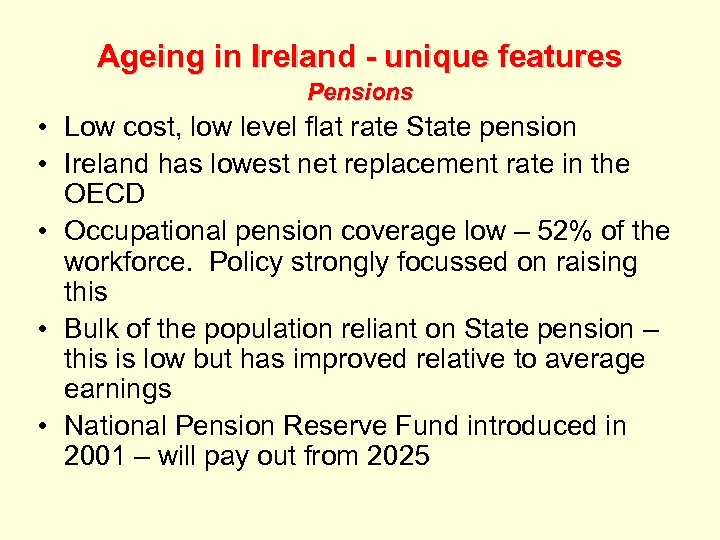 Ageing in Ireland - unique features Pensions • Low cost, low level flat rate State pension • Ireland has lowest net replacement rate in the OECD • Occupational pension coverage low – 52% of the workforce. Policy strongly focussed on raising this • Bulk of the population reliant on State pension – this is low but has improved relative to average earnings • National Pension Reserve Fund introduced in 2001 – will pay out from 2025
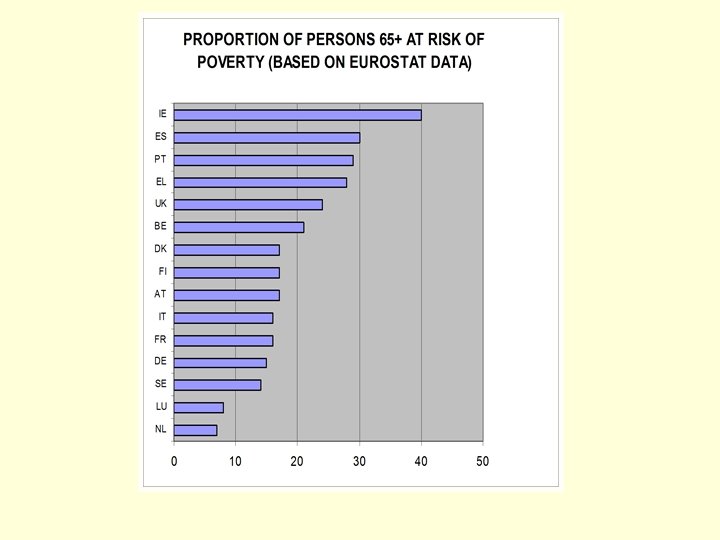
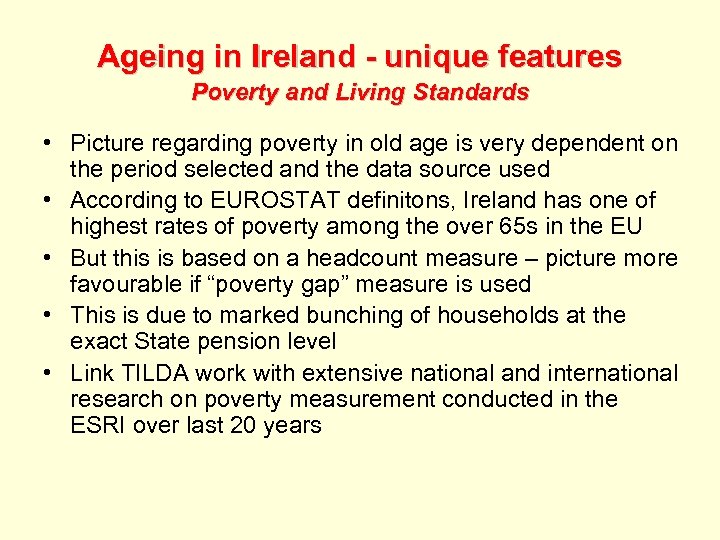 Ageing in Ireland - unique features Poverty and Living Standards • Picture regarding poverty in old age is very dependent on the period selected and the data source used • According to EUROSTAT definitons, Ireland has one of highest rates of poverty among the over 65 s in the EU • But this is based on a headcount measure – picture more favourable if “poverty gap” measure is used • This is due to marked bunching of households at the exact State pension level • Link TILDA work with extensive national and international research on poverty measurement conducted in the ESRI over last 20 years
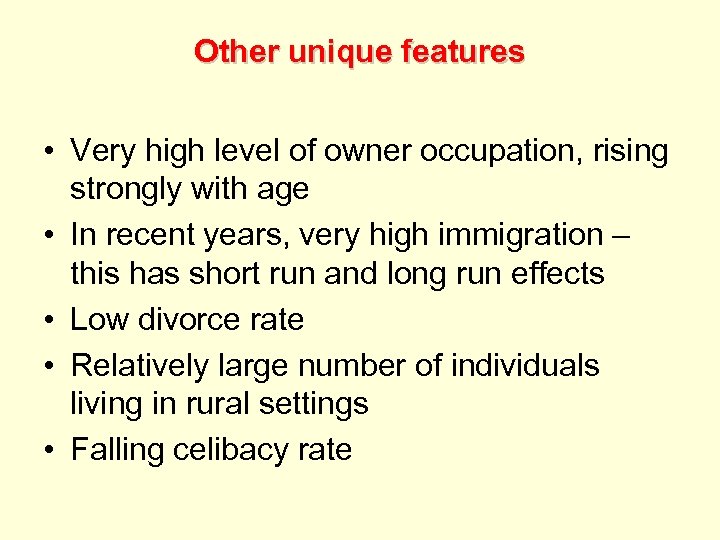 Other unique features • Very high level of owner occupation, rising strongly with age • In recent years, very high immigration – this has short run and long run effects • Low divorce rate • Relatively large number of individuals living in rural settings • Falling celibacy rate
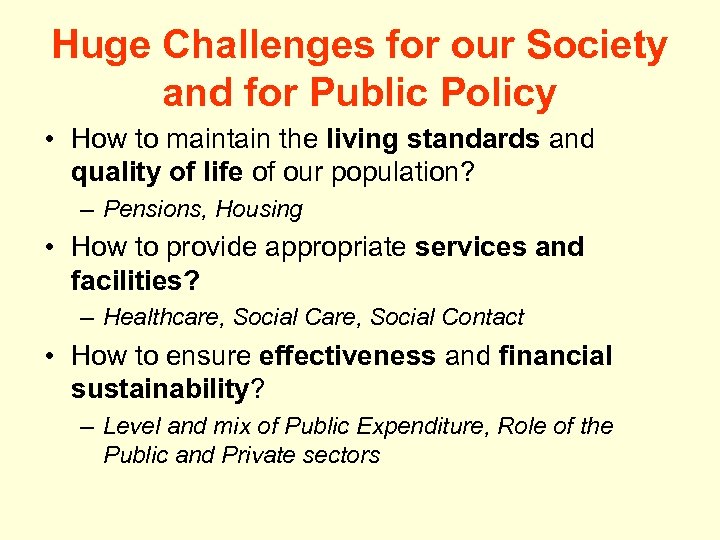 Huge Challenges for our Society and for Public Policy • How to maintain the living standards and quality of life of our population? – Pensions, Housing • How to provide appropriate services and facilities? – Healthcare, Social Contact • How to ensure effectiveness and financial sustainability? – Level and mix of Public Expenditure, Role of the Public and Private sectors
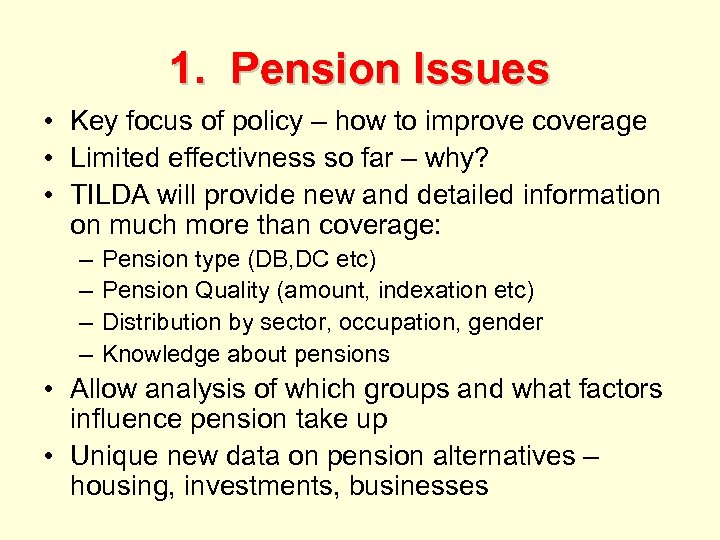 1. Pension Issues • Key focus of policy – how to improve coverage • Limited effectivness so far – why? • TILDA will provide new and detailed information on much more than coverage: – – Pension type (DB, DC etc) Pension Quality (amount, indexation etc) Distribution by sector, occupation, gender Knowledge about pensions • Allow analysis of which groups and what factors influence pension take up • Unique new data on pension alternatives – housing, investments, businesses
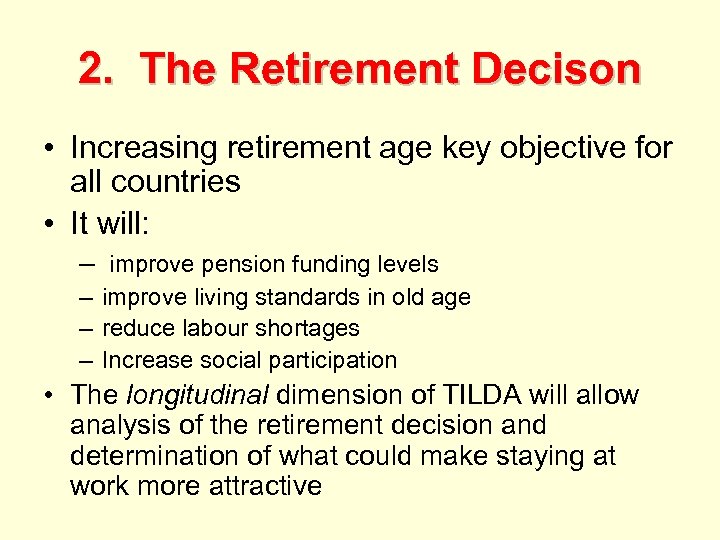 2. The Retirement Decison • Increasing retirement age key objective for all countries • It will: – improve pension funding levels – improve living standards in old age – reduce labour shortages – Increase social participation • The longitudinal dimension of TILDA will allow analysis of the retirement decision and determination of what could make staying at work more attractive
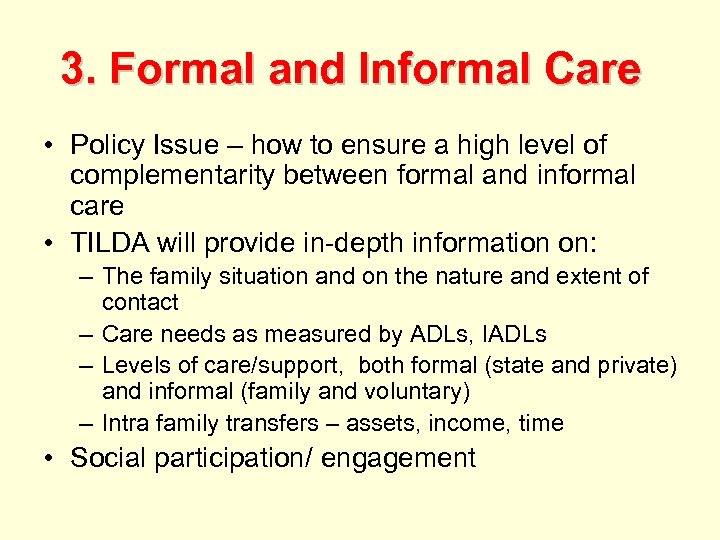 3. Formal and Informal Care • Policy Issue – how to ensure a high level of complementarity between formal and informal care • TILDA will provide in-depth information on: – The family situation and on the nature and extent of contact – Care needs as measured by ADLs, IADLs – Levels of care/support, both formal (state and private) and informal (family and voluntary) – Intra family transfers – assets, income, time • Social participation/ engagement