


 Скачать презентацию Tilapia Marketing in the Americas Kevin Fitzsimmons Ph
079c9b6bb38e5f22b82a6ac875279cb1.ppt
- Количество слайдов: 40
 Tilapia Marketing in the Americas Kevin Fitzsimmons, Ph. D. Professor - University of Arizona Sec. / Tres. - American Tilapia Association President - US. Aquaculture Soc. Chapter of WAS August 2001
 Tilapia introductions to the Americas F Oreochromis mossambicus first in the Caribbean in 1949 by C. F. Hickling F To United States in 1954 F Oreochromis aureus introduced in 1957 F Throughout the Americas by 1970 F Oreochromis niloticus into Brazil 1971 F Red strains developed in 1970’s and 80’s F Oreochromis niloticus spreads in 1990’s F Total production of 257, 000 mt in 2000
 Production widely distributed around the Americas. FTilapia introduced to every country FTilapia, mojarra, St. Peters fish, Jamaican freshwater snapper, Cherry Snapper FUsed in hundreds of recipes FLive, Whole, fillets, fresh and frozen, smoked
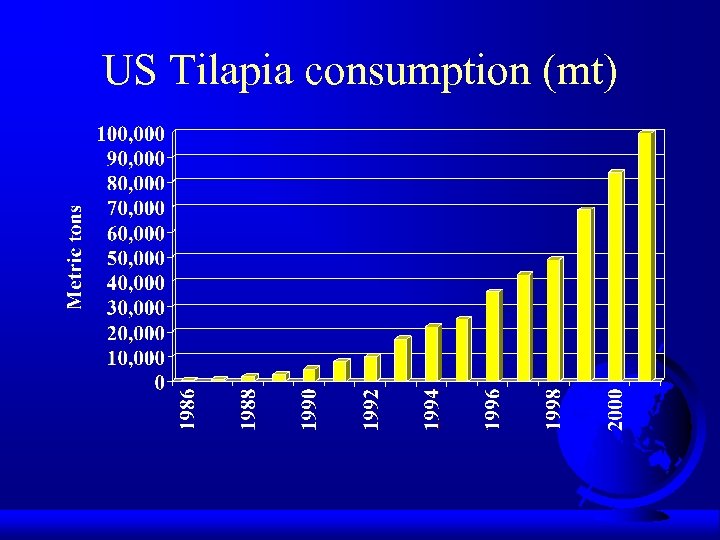
 Supply and Demand FSupply primarily from tropical countries FDemand is in producer countries and US FWith rapid increases in supply, demand must increase at least as fast to support price.
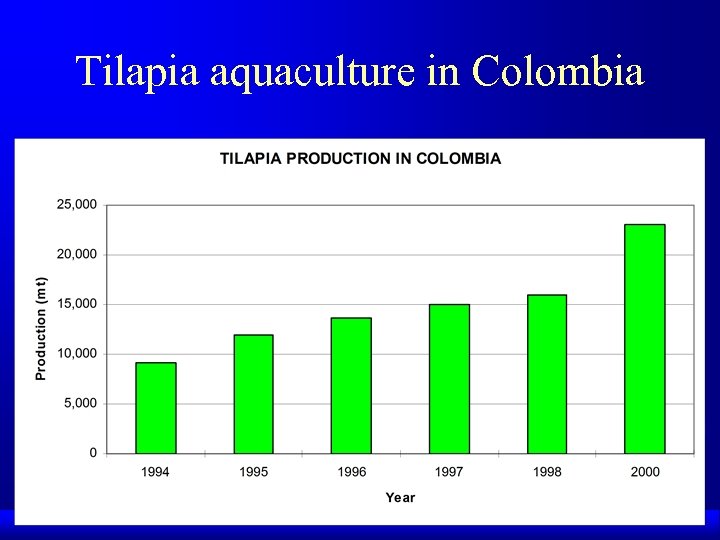
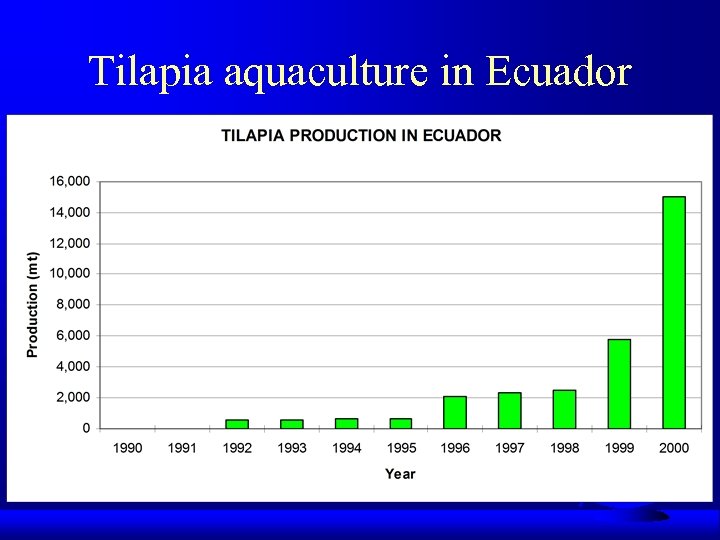
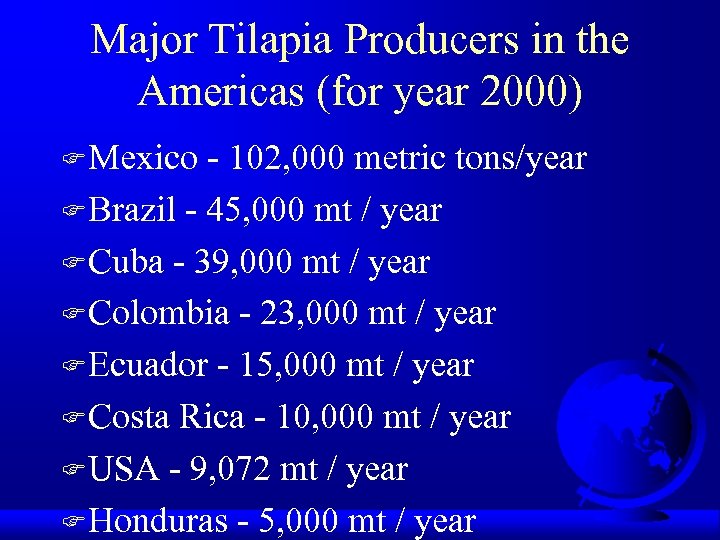 Major Tilapia Producers in the Americas (for year 2000) F Mexico - 102, 000 metric tons/year F Brazil - 45, 000 mt / year F Cuba - 39, 000 mt / year F Colombia - 23, 000 mt / year F Ecuador - 15, 000 mt / year F Costa Rica - 10, 000 mt / year F USA - 9, 072 mt / year F Honduras - 5, 000 mt / year
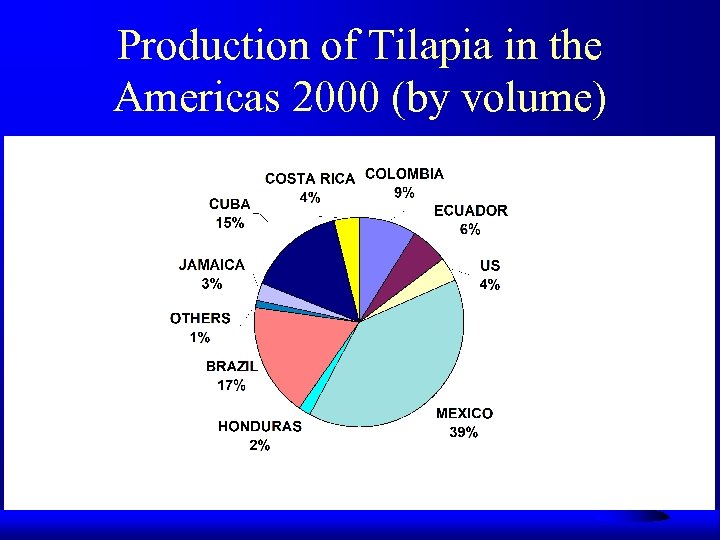 Production of Tilapia in the Americas 2000 (by volume)
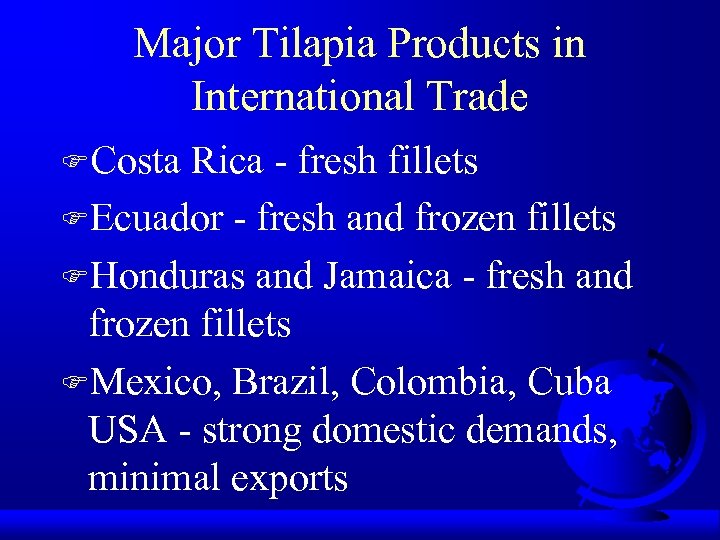 Major Tilapia Products in International Trade FCosta Rica - fresh fillets FEcuador - fresh and frozen fillets FHonduras and Jamaica - fresh and frozen fillets FMexico, Brazil, Colombia, Cuba USA - strong domestic demands, minimal exports
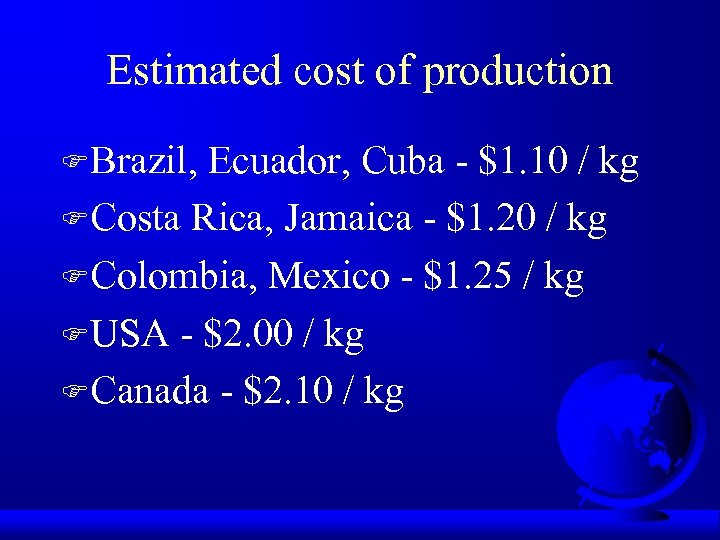 Estimated cost of production FBrazil, Ecuador, Cuba - $1. 10 / kg FCosta Rica, Jamaica - $1. 20 / kg FColombia, Mexico - $1. 25 / kg FUSA - $2. 00 / kg FCanada - $2. 10 / kg
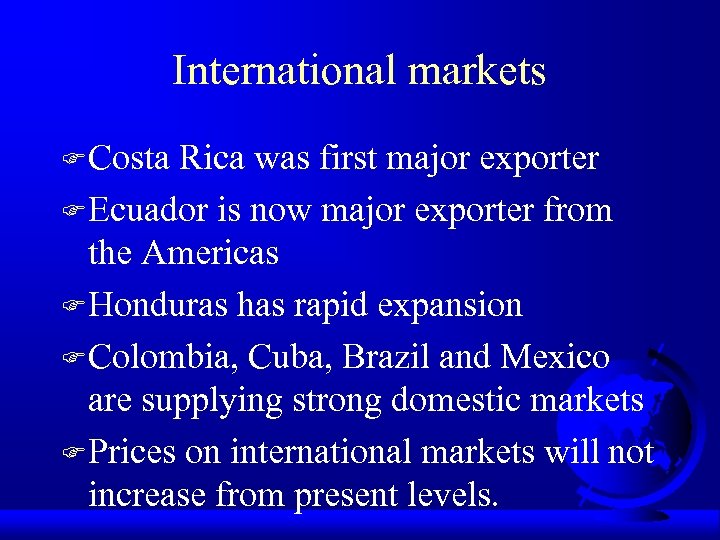 International markets F Costa Rica was first major exporter F Ecuador is now major exporter from the Americas F Honduras has rapid expansion F Colombia, Cuba, Brazil and Mexico are supplying strong domestic markets F Prices on international markets will not increase from present levels.
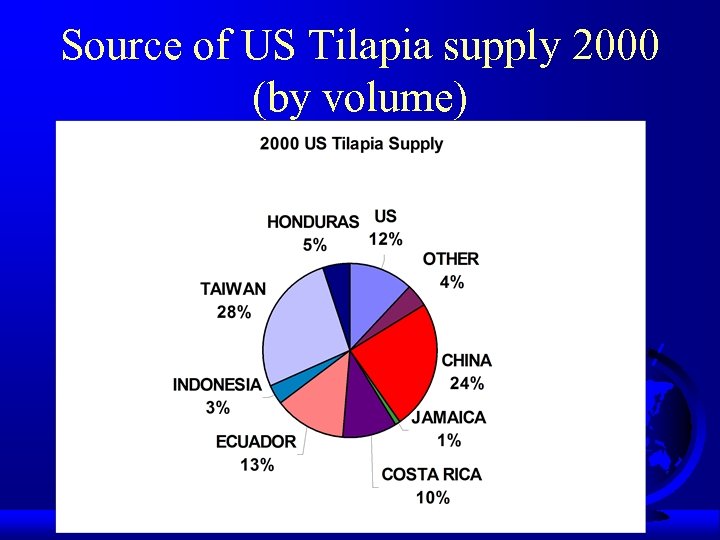
 International markets F Ecuador has passed Costa Rica as supplier of fillets to US F Ecuador integrating with shrimp production F Colombia and Mexico were exporters to US, but exports levels decreased while production increased
 Tilapia production and Markets in Mexico FProduction in most states of Mexico FIntensive in north, lake ranching in south FStrong domestic markets; on ice, fillets in grocery stores FWill eventually develop export markets.
 Tilapia production & Markets in Brasil FProduction in Southeast and Northeast FRed tilapia in Southeast for fee-fishing and food FCage farms allowed in NE reservoirs. FTilapia leather industry FJump in interest with ISTA 5 in Rio. FWill eventually develop export markets.
 Tilapia in Colombia FBefore 1980, Colombia had strong domestic market FDeveloped export trade to US FDomestic market has grown so strong that exports were suspended FColombia imports tilapia from Venezuela and Ecuador
 Tilapia aquaculture in Colombia
 Tilapia production in Ecuador FReplacing shrimp because of white spot disease FUsing shrimp infrastructure FExporting to US and EU FWill they revert to shrimp if disease is controlled?
 Tilapia aquaculture in Ecuador
 US Tilapia consumption (mt)
 Source of US Tilapia supply 2000 (by volume)
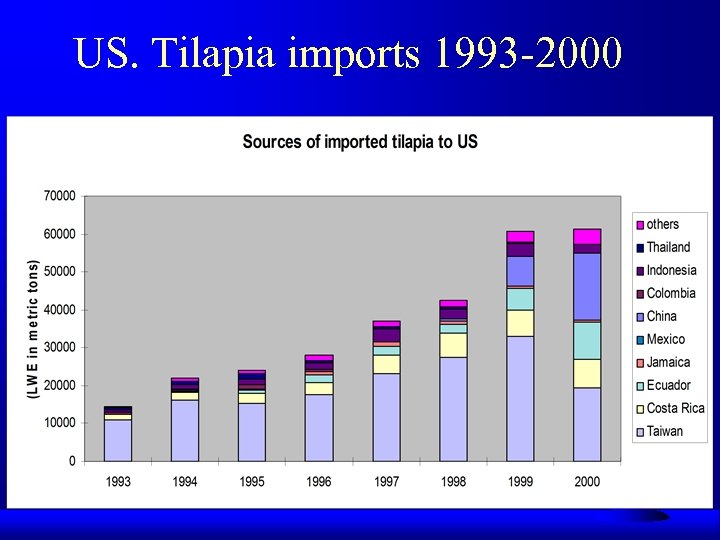 US. Tilapia imports 1993 -2000
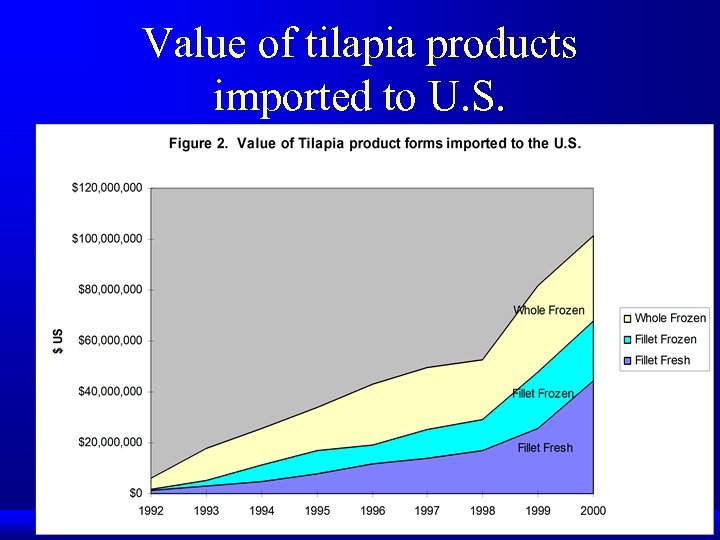 Value of tilapia products imported to U. S.
 Tilapia Production in the US = Live Sales
 International market changes FIncreasing domestic consumption in producing countries especially Colombia, Brazil, Mexico, Costa Rica FColombia starting to export again, Mexico and Brazil will follow
 Current International Market Trends FIncrease in demand for all forms of tilapia FDemand increase will be greatest for fresh fillets FPrices have been constant for several years and will remain stable, will not increase with inflation.
 Current International Market Trends FUS and EU growers will concentrate on live sales and highly processed forms FLatin America and Southeast Asia will be primary US suppliers F Latin America, Caribbean and Africa will supply EU
 Marketing - Push vs. Pull FPush = get distributors to take more product FPull = get consumers to demand more product F Push = often more expenses with product, prices and profits lower FPull = advertising, higher prices and profits
 Marketing - Push FLower prices FAdvertise in business magazines FAdd value to product -processing FBetter bulk packaging FOther sales incentives
 Marketing - Pull FAdvertise to consumer FAdvertise in general interest magazines FProduct placement - movies, TV, books FValue adding to product FBetter retail packaging FPoint of sale recipe cards & promotions FTestimonials
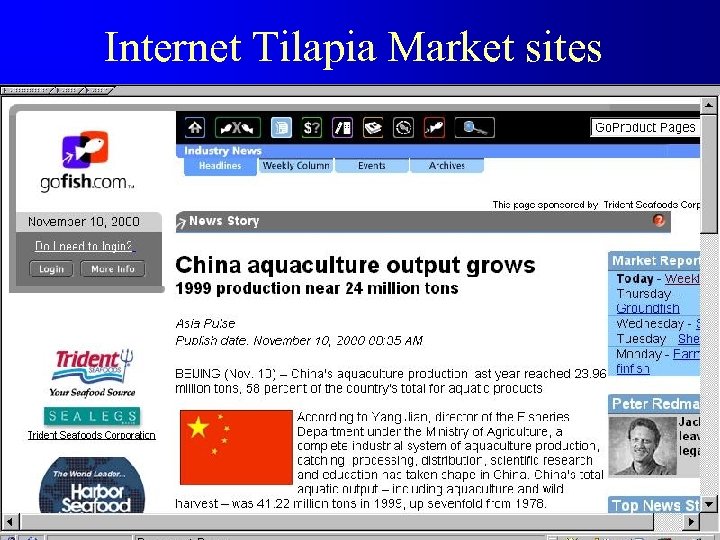 Internet Tilapia Market sites
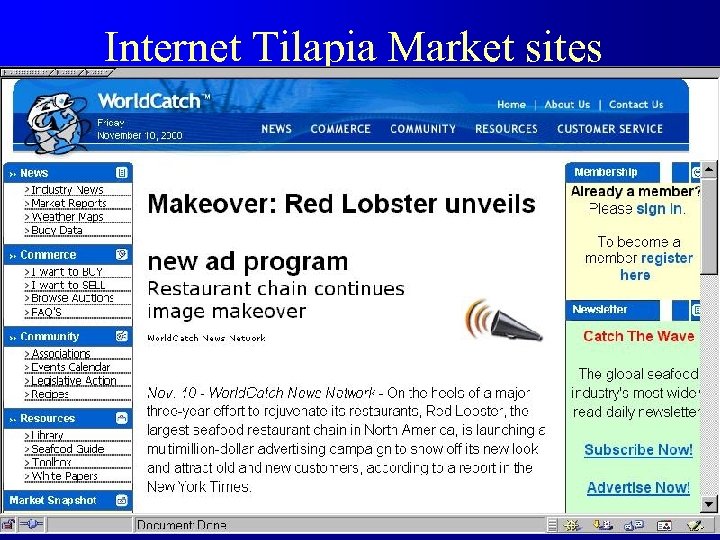 Internet Tilapia Market sites
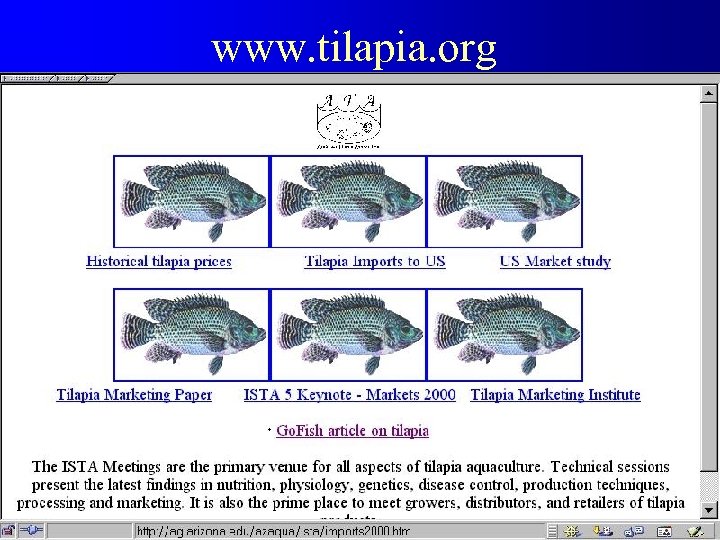 www. tilapia. org
 Dear Kevin, F I recently began using Tilapia fillets farm raised by Sea Best and distributed by Beaver Street Fisheries, Inc. I buy these in individual vacuum sealed packages in one pound bags at Wal-Mart in San Marcos, Texas. My husband has diabetes and we both are very weight conscious. This fish is the perfect food item for us, I love the way it is packaged, just use what I need for one meal, it is reasonably priced, always available in the market and consistently high quality. I trust you will forward these comments to the producer. F FI F LOVE THE PRODUCT!!!! Marian Birnie Aug. 12, 2001
 Packaging and Delivery
 New product forms Push and Pull Smoked tilapia Sashimi grade tilapia
 Changes and Predictions FFurther intensification in virtually every country F F Production will be 75% Oreochromis niloticus, 20% Red strains, O. aureus and O. mossambicus mostly for hybridization Production will be 50% intensive ponds, 25% cages, 10% intensive recirculating systems
 Changes and Predictions F Further intensification in virtually every country FProduction will be 75% Oreochromis niloticus, 20% Red strains, O. aureus and O. mossambicus mostly for hybridization F Production will be 50% intensive ponds, 25% cages, 10% intensive recirculating systems
 Changes and Predictions F F Further intensification in virtually every country Production will be 75% Oreochromis niloticus, 20% Red strains, O. aureus and O. mossambicus mostly for hybridization FProduction will be 50% intensive ponds, 25% cages, 10% intensive recirculating systems
 Changes and Predictions FLeather goods from skin will become a significant contributor to profitability F Processing and "value-adding" will intensify in producing countries F Polyculture with shrimp will become common in most shrimp farming areas
 Changes and Predictions FProcessing and "value-adding" will intensify in producing countries
 Changes and Predictions F US production will increase slowly, intensifying current production methods FProduction in the Americas will reach 500, 000 mt by 2010 and 1, 000 mt by 2020
 Marketing tilapia F Increasing demand / markets should begin in producing country F Opening new markets will be required in US F Plenty of techniques can be used to build markets F Many are free or low cost (placement, samples, live tanks, Web sites) F Most effective forms require investment