 Скачать презентацию Tier 3 Computing Doug Benjamin Duke University
0d19654694a81fddbcda7a531c781216.ppt
- Количество слайдов: 19



Tier 3 Computing Doug Benjamin Duke University
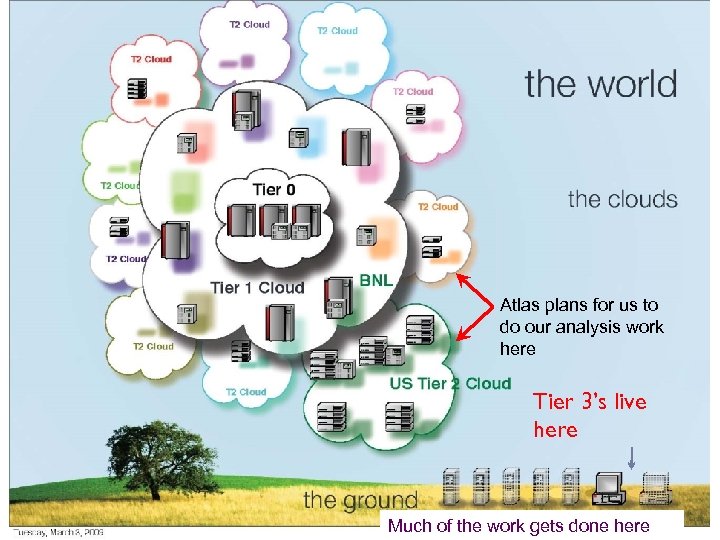
Atlas plans for us to do our analysis work here Tier 3’s live here Much of the work gets done here
![Skeleton physics analysis model 09/10 Athena [main selection & reco work] Data super-set of](https://present5.com/presentation/0d19654694a81fddbcda7a531c781216/image-3.jpg "Skeleton physics analysis model 09/10 Athena [main selection & reco work] Data super-set of")
Skeleton physics analysis model 09/10 Athena [main selection & reco work] Data super-set of good runs for this period 2 -3 times reprocessing from RAW in 2009/10 AODfix Direct or Frontier/Squid DB access Pool files Use of TAG User format d. AOD Port developed analysis algorithms back to Athena as much as possible “Analysis Model for the First Year” - Thorsten Wengler Analysis group driven definitions coordinated by PC, May have added meta data to allow ARA-only analysis from here PAT ntuple dumper keep track of tag versions of meta-data, lumi-info etc User file [final complex analysis steps] With release/cache results Re-produce for reprocessed data and significant meta-data updates May have several forms (left to the user): • Pool file (ARA analysis) • Root Tree • Histograms • …
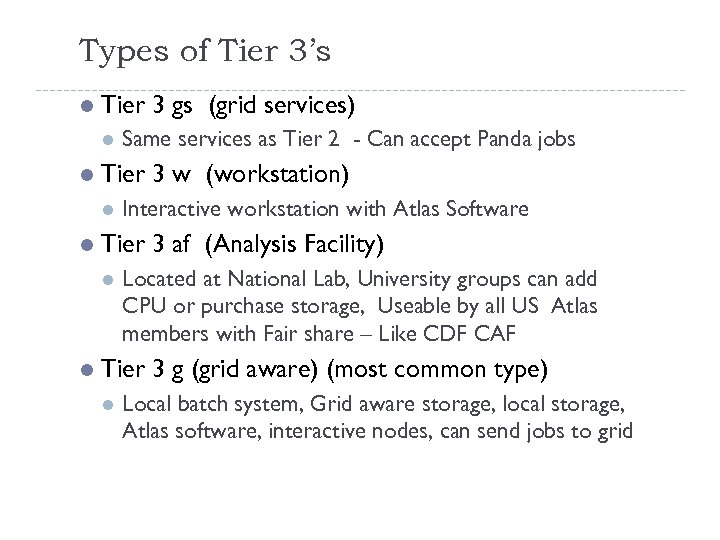
Types of Tier 3’s l Tier 3 gs (grid services) l l Tier 3 w (workstation) l l Interactive workstation with Atlas Software Tier 3 af (Analysis Facility) l l Same services as Tier 2 - Can accept Panda jobs Located at National Lab, University groups can add CPU or purchase storage, Useable by all US Atlas members with Fair share – Like CDF CAF Tier 3 g (grid aware) (most common type) l Local batch system, Grid aware storage, local storage, Atlas software, interactive nodes, can send jobs to grid
Some goals of this talk: All US ATLAS Institutes thinking about what to do next about the computing resources under their control (Tier 3 resources) to maximize their usefulness. You may: have some computing infrastructure but not set up for ATLAS analysis. have no Tier 3, but applied for and/or received funding for one. already have a working ATLAS Tier 3. Thinking about expansion. be thinking about investing in an Analysis Facility at BNL or SLAC. A year ago, there was little planning or organization in the use of T 3 resources. DB (plus some volunteers) has began to set the direction for the T 3 resources since last year. A lot of work has already been done. Rik Yoshida has officially jointed the effort (he was working on Tier 3 issues for some time already). He and I are working closely together. Our aim is to organize the T 3 efforts for the maximum benefit to all US ATLAS institutes.
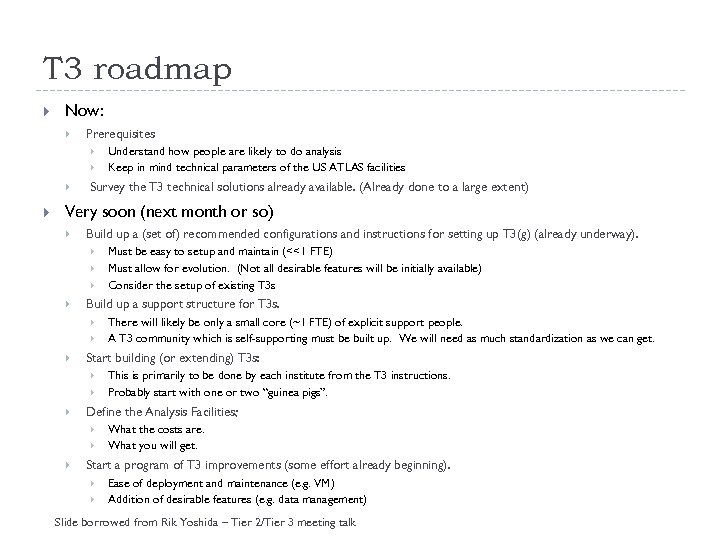
T 3 roadmap Now: Prerequisites Understand how people are likely to do analysis Keep in mind technical parameters of the US ATLAS facilities Survey the T 3 technical solutions already available. (Already done to a large extent) Very soon (next month or so) Build up a (set of) recommended configurations and instructions for setting up T 3(g) (already underway). Build up a support structure for T 3 s. This is primarily to be done by each institute from the T 3 instructions. Probably start with one or two “guinea pigs”. Define the Analysis Facilities; There will likely be only a small core (~1 FTE) of explicit support people. A T 3 community which is self-supporting must be built up. We will need as much standardization as we can get. Start building (or extending) T 3 s: Must be easy to setup and maintain (<<1 FTE) Must allow for evolution. (Not all desirable features will be initially available) Consider the setup of existing T 3 s What the costs are. What you will get. Start a program of T 3 improvements (some effort already beginning). Ease of deployment and maintenance (e. g. VM) Addition of desirable features (e. g. data management) Slide borrowed from Rik Yoshida – Tier 2/Tier 3 meeting talk
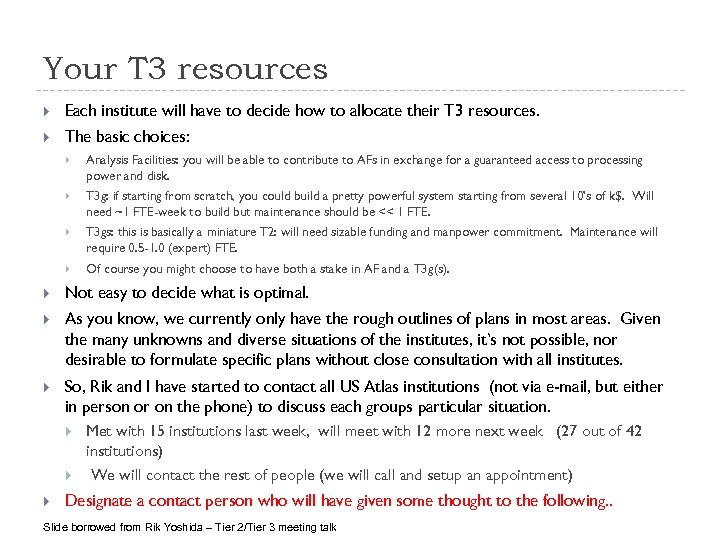
Your T 3 resources Each institute will have to decide how to allocate their T 3 resources. The basic choices: Analysis Facilities: you will be able to contribute to AFs in exchange for a guaranteed access to processing power and disk. T 3 g: if starting from scratch, you could build a pretty powerful system starting from several 10’s of k$. Will need ~1 FTE-week to build but maintenance should be << 1 FTE. T 3 gs: this is basically a miniature T 2: will need sizable funding and manpower commitment. Maintenance will require 0. 5 -1. 0 (expert) FTE. Of course you might choose to have both a stake in AF and a T 3 g(s). Not easy to decide what is optimal. As you know, we currently only have the rough outlines of plans in most areas. Given the many unknowns and diverse situations of the institutes, it’s not possible, nor desirable to formulate specific plans without close consultation with all institutes. So, Rik and I have started to contact all US Atlas institutions (not via e-mail, but either in person or on the phone) to discuss each groups particular situation. Met with 15 institutions last week, will meet with 12 more next week (27 out of 42 institutions) We will contact the rest of people (we will call and setup an appointment) Designate a contact person who will have given some thought to the following. . Slide borrowed from Rik Yoshida – Tier 2/Tier 3 meeting talk
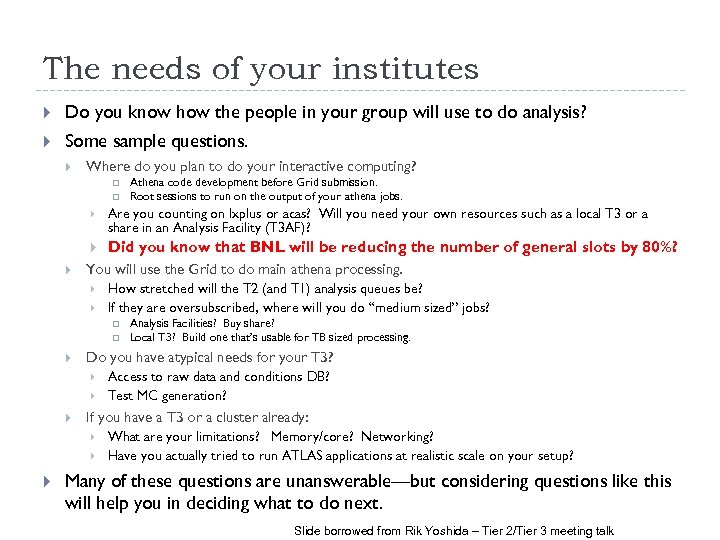
The needs of your institutes Do you know how the people in your group will use to do analysis? Some sample questions. Where do you plan to do your interactive computing? Athena code development before Grid submission. Root sessions to run on the output of your athena jobs. Are you counting on lxplus or acas? Will you need your own resources such as a local T 3 or a share in an Analysis Facility (T 3 AF)? Did you know that BNL will be reducing the number of general slots by 80%? You will use the Grid to do main athena processing. How stretched will the T 2 (and T 1) analysis queues be? If they are oversubscribed, where will you do “medium sized” jobs? Do you have atypical needs for your T 3? Access to raw data and conditions DB? Test MC generation? If you have a T 3 or a cluster already: Analysis Facilities? Buy share? Local T 3? Build one that’s usable for TB sized processing. What are your limitations? Memory/core? Networking? Have you actually tried to run ATLAS applications at realistic scale on your setup? Many of these questions are unanswerable—but considering questions like this will help you in deciding what to do next. Slide borrowed from Rik Yoshida – Tier 2/Tier 3 meeting talk
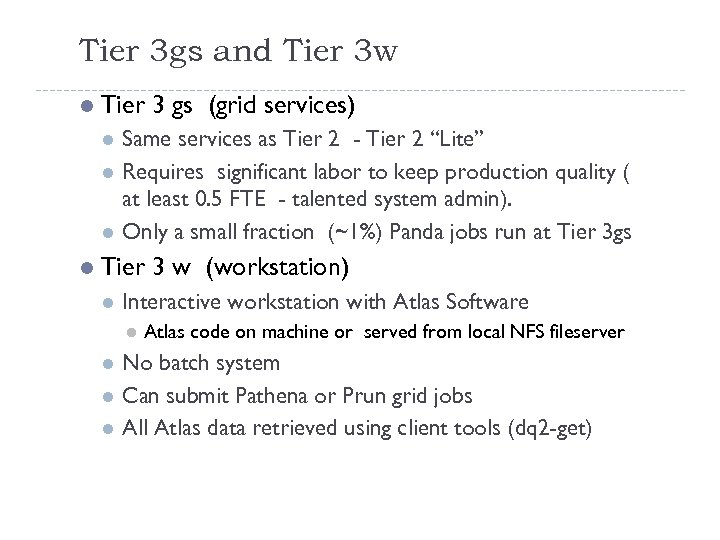
Tier 3 gs and Tier 3 w l Tier 3 gs (grid services) l l Same services as Tier 2 - Tier 2 “Lite” Requires significant labor to keep production quality ( at least 0. 5 FTE - talented system admin). Only a small fraction (~1%) Panda jobs run at Tier 3 gs Tier 3 w (workstation) l Interactive workstation with Atlas Software l l Atlas code on machine or served from local NFS fileserver No batch system Can submit Pathena or Prun grid jobs All Atlas data retrieved using client tools (dq 2 -get)
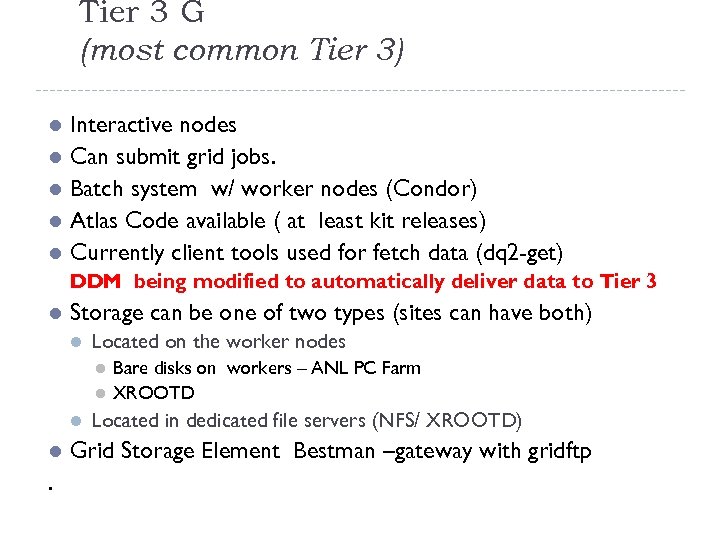
Tier 3 G (most common Tier 3) l l l Interactive nodes Can submit grid jobs. Batch system w/ worker nodes (Condor) Atlas Code available ( at least kit releases) Currently client tools used for fetch data (dq 2 -get) DDM being modified to automatically deliver data to Tier 3 l Storage can be one of two types (sites can have both) l Located on the worker nodes l l . Bare disks on workers – ANL PC Farm XROOTD Located in dedicated file servers (NFS/ XROOTD) Grid Storage Element Bestman –gateway with gridftp
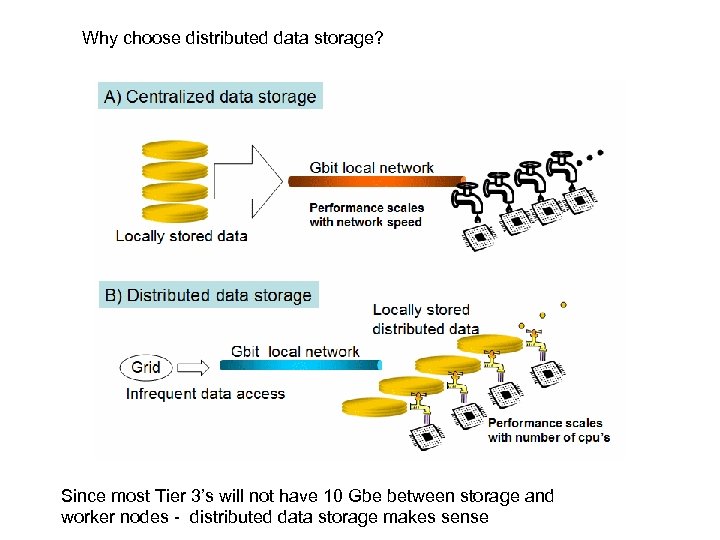
Why choose distributed data storage? Since most Tier 3’s will not have 10 Gbe between storage and worker nodes - distributed data storage makes sense
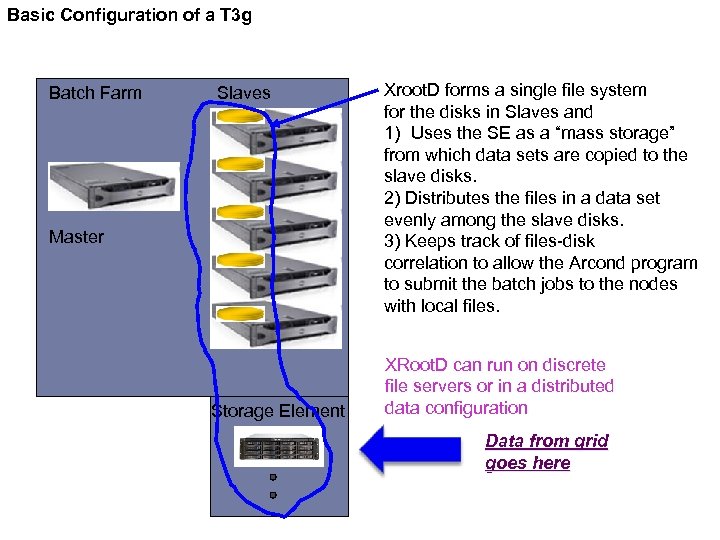
Basic Configuration of a T 3 g Batch Farm Slaves Master Storage Element Xroot. D forms a single file system for the disks in Slaves and 1) Uses the SE as a “mass storage” from which data sets are copied to the slave disks. 2) Distributes the files in a data set evenly among the slave disks. 3) Keeps track of files-disk correlation to allow the Arcond program to submit the batch jobs to the nodes with local files. XRoot. D can run on discrete file servers or in a distributed data configuration Data from grid goes here
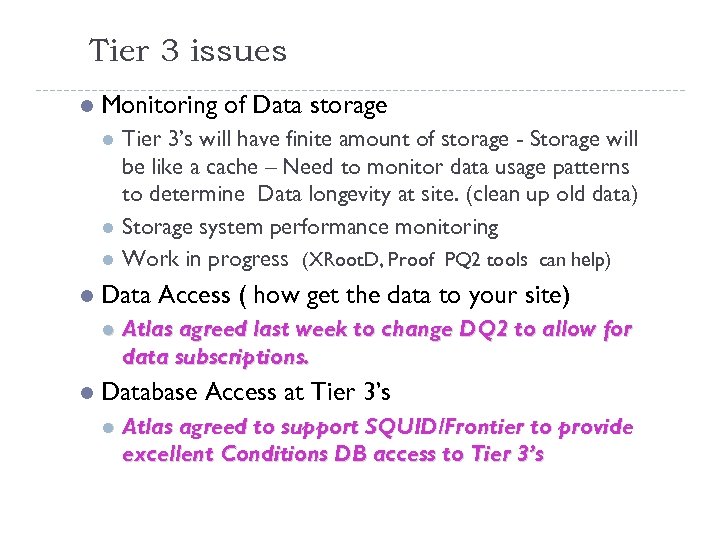
Tier 3 issues l Monitoring of Data storage l l Data Access ( how get the data to your site) l l Tier 3’s will have finite amount of storage - Storage will be like a cache – Need to monitor data usage patterns to determine Data longevity at site. (clean up old data) Storage system performance monitoring Work in progress (XRoot. D, Proof PQ 2 tools can help) Atlas agreed last week to change DQ 2 to allow for data subscriptions. Database Access at Tier 3’s l Atlas agreed to support SQUID/Frontier to provide excellent Conditions DB access to Tier 3’s
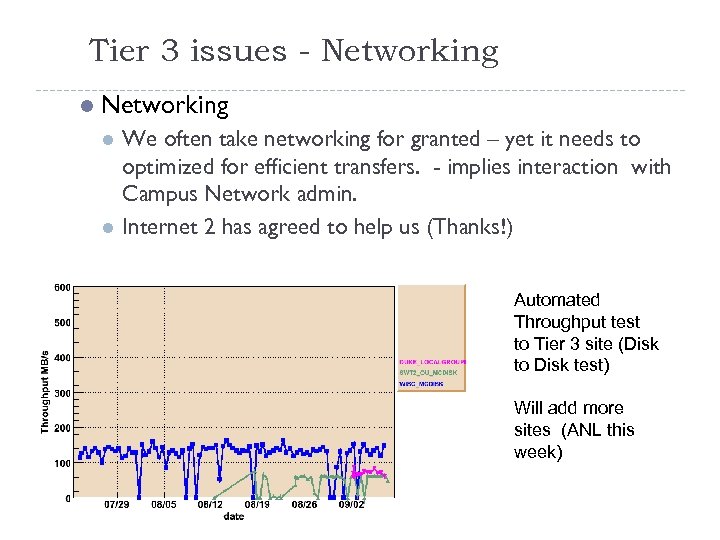
Tier 3 issues - Networking l l We often take networking for granted – yet it needs to optimized for efficient transfers. - implies interaction with Campus Network admin. Internet 2 has agreed to help us (Thanks!) Automated Throughput test to Tier 3 site (Disk to Disk test) Will add more sites (ANL this week)
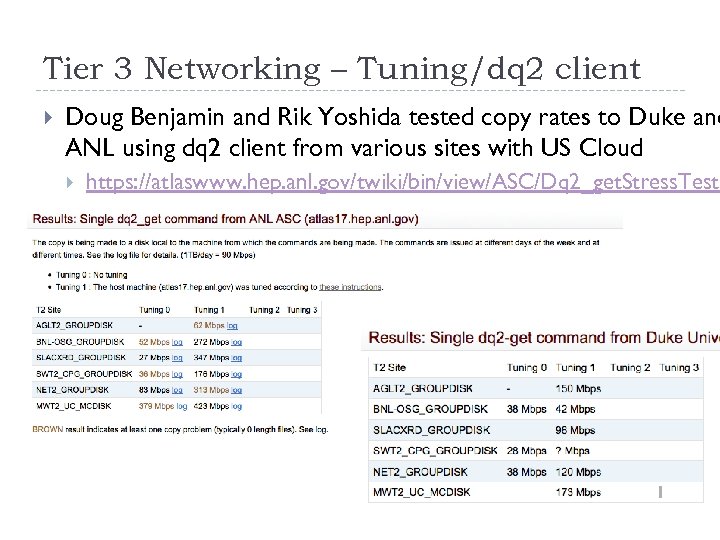
Tier 3 Networking – Tuning/dq 2 client Doug Benjamin and Rik Yoshida tested copy rates to Duke and ANL using dq 2 client from various sites with US Cloud https: //atlaswww. hep. anl. gov/twiki/bin/view/ASC/Dq 2_get. Stress. Test
Tier 3 issues - Support l Support (goal – maintain a Teir 3 g w/ < 0. 25 FTE Postdoc/grad stud. ) (less than 1 week Full time to setup a Tier 3) l Likely less than ~ 1 FTE assigned to support Tier 3’s. l OSG would like to help l Atlas Canada - they support 1 configuration – have good tool kit. l Standardization should help here. l Since there will be only a small amount of formal support for T 3 s for the foreseeable future, the T 3 community must become self-sustaining.
Tier 3 g configuration instructions and getting help l Tier 3 g configuration details and instructions in Tier 3 wiki at ANL and BNL: l l https: //atlaswww. hep. anl. gov/twiki/bin/view/Tier 3 Setup/Web. Home https: //www. usatlas. bnl. gov/twiki/bin/view/Admins/Tier 3 Setup US Atlas Hypernews - HN-Tier 3 Support@bnl. gov l US Atlas Tier 3 trouble ticket at BNL USAtlas. Tier 3 l RT-RACF-USAtlas. Tier 3@bnl. gov l If all else fails contact us: l l Doug Benjamin - US Atlas Tier 3 technical support lead (benjamin@phy. duke. edu) Rik Yoshida – US Atlas Tier 3 coordinator (Rik. Yoshida@anl. gov)
Future Tier 3 improvements l Tier 3 Virtualization “Tier 3 in Box” l l l BNL has provided a test cluster for Virtualization studies and development (Xen based) Using CERNVM and Xen build VM for worker node Some Tier 3’s already using VM’s ( OSG, Duke). reduce support load globally and locally Provide better security for Tier 3’s Will look at other technologies to make Tier 3 as effective as possible.
Conclusions Data is coming. So is some money --- We need to start setting up our Tier 3’s sooner than later. We should configure the Tier 3’s in a manner to be the most effective. Tier 3’s are a collaborative effort. We will need your help. Since the Atlas Analysis model is evolving – Tier 3’s must be adaptable and nibble
Скачать презентацию Tier 3 Computing Doug Benjamin Duke University
0d19654694a81fddbcda7a531c781216.ppt