


 Скачать презентацию TIED A Cluster of One TIED Trial
0156c59808b977e3c61f3dc2bcf2dca7.ppt
- Количество слайдов: 17
 TIED: A Cluster of One
 TIED: Trial Integration built Environment on DETER The DETER folks: Terry Benzel, Bob Braden, Ted Faber, John Hickey, Alefiya Hussain, Anthony Joseph, Calvin Ko, Kevin Lahey, Jelena Mirkovic, Steve Schwab, Keith Sklower, Arun Viswanathan, John Wroclawski, …
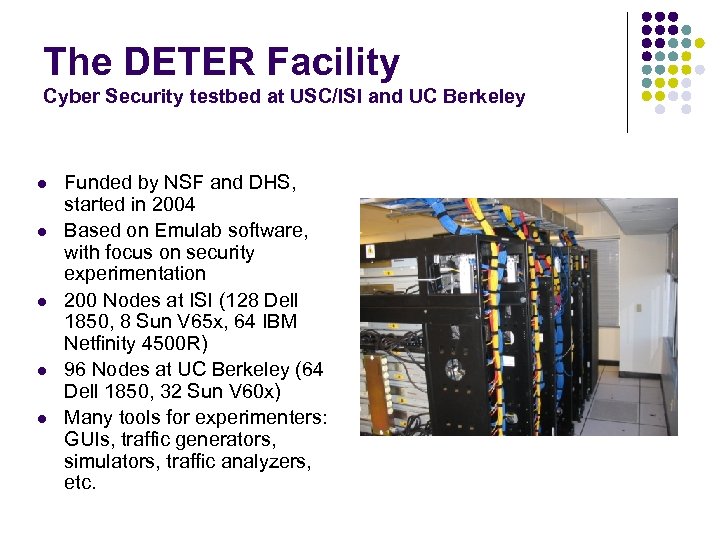 The DETER Facility Cyber Security testbed at USC/ISI and UC Berkeley l l l Funded by NSF and DHS, started in 2004 Based on Emulab software, with focus on security experimentation 200 Nodes at ISI (128 Dell 1850, 8 Sun V 65 x, 64 IBM Netfinity 4500 R) 96 Nodes at UC Berkeley (64 Dell 1850, 32 Sun V 60 x) Many tools for experimenters: GUIs, traffic generators, simulators, traffic analyzers, etc.
 DETER Project Goals l l l Scientific methods and infrastructure for advancing security in identified hard problems Enhanced availability of validated information about security protection technology Enduring realistic testbed for security research Advances in testing methods and methodology for network security devices Suite of reusable network security tests including traffic data sets
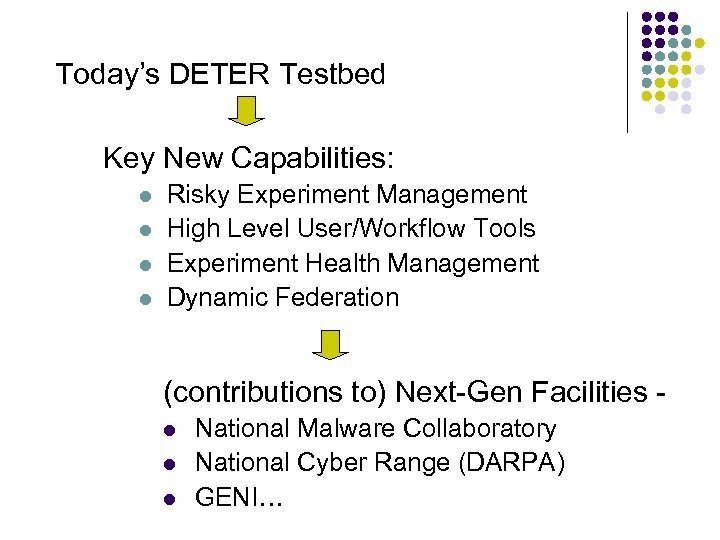 Today’s DETER Testbed Key New Capabilities: l l Risky Experiment Management High Level User/Workflow Tools Experiment Health Management Dynamic Federation (contributions to) Next-Gen Facilities l l l National Malware Collaboratory National Cyber Range (DARPA) GENI…
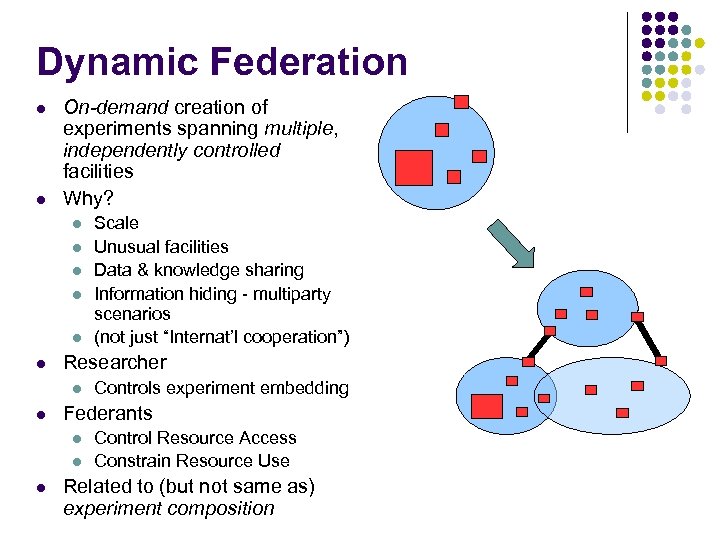 Dynamic Federation l l On-demand creation of experiments spanning multiple, independently controlled facilities Why? l l l Researcher l l Controls experiment embedding Federants l l l Scale Unusual facilities Data & knowledge sharing Information hiding - multiparty scenarios (not just “Internat’l cooperation”) Control Resource Access Constrain Resource Use Related to (but not same as) experiment composition
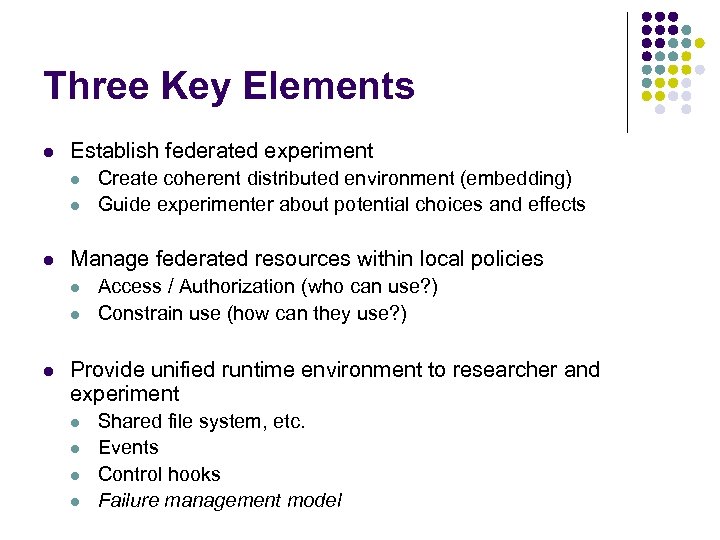 Three Key Elements l Establish federated experiment l l l Manage federated resources within local policies l l l Create coherent distributed environment (embedding) Guide experimenter about potential choices and effects Access / Authorization (who can use? ) Constrain use (how can they use? ) Provide unified runtime environment to researcher and experiment l l Shared file system, etc. Events Control hooks Failure management model
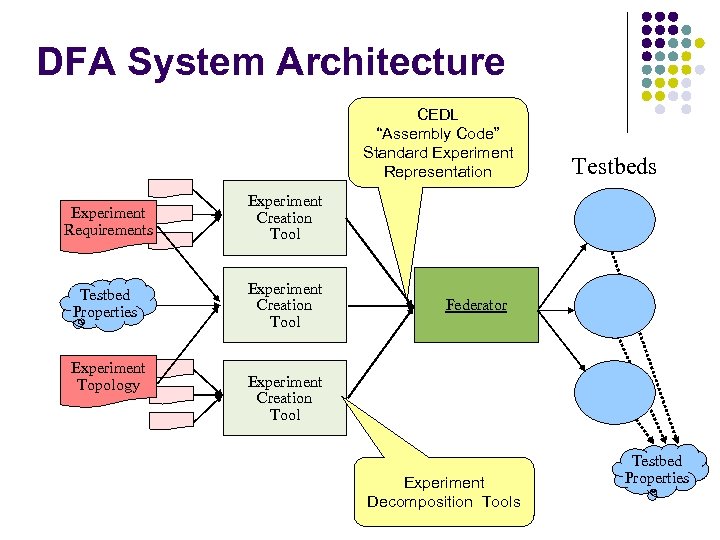 DFA System Architecture CEDL “Assembly Code” Standard Experiment Representation Experiment Requirements Experiment Creation Tool Testbed Properties Experiment Creation Tool Testbeds Experiment Topology Federator Experiment Creation Tool Experiment Decomposition Tools Testbed Properties
 CEDL Canonical Experiment Description Language l Standard Experiment Representation - “Assembly Code” Output of all tools / input to Federator l Expressiveness (today): l l Core semantics: Logical {nodes, links, elements} topology (Emulab/ns 2) Annotations: Logical attributes - eg, node type l l l Physical attributes l l Type information: router, switch, etc. Physical selection: map to specific instance “Escapes” to allow physical configuration of hardware CEDL is related to one form/use of “RSpecs”
 DFA Access Control Architecture (Today) l Based on single-Emulab model: l l l Projects control resource access User's project membership determines access DETER federation architecture - three level model: l l l Users, projects, testbeds have global names Federants honor accesses based on: l Proof of name l Attested facts (evaluated wrt name) l Local information bound to name Once accepted, federants assign accepted sub-experiments to local projects for resource control
 TIED
TIED
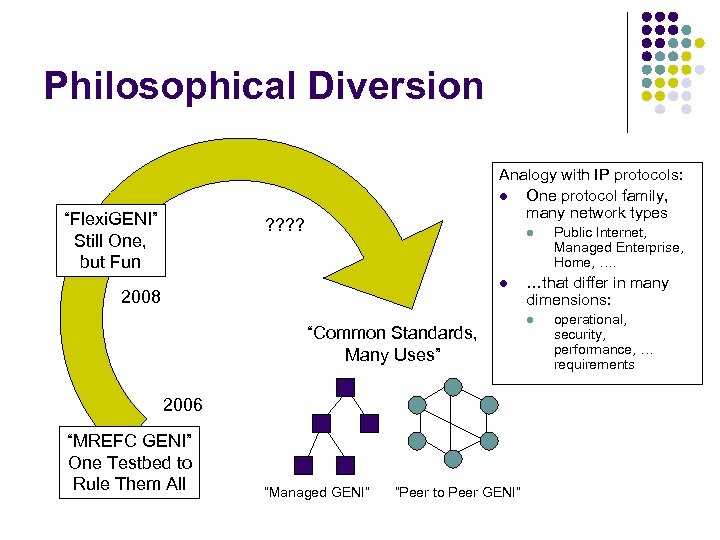 Philosophical Diversion “Flexi. GENI” Still One, but Fun Analogy with IP protocols: l One protocol family, many network types ? ? l l 2008 “Common Standards, Many Uses” 2006 “MREFC GENI” One Testbed to Rule Them All “Managed GENI” “Peer to Peer GENI” Public Internet, Managed Enterprise, Home, …. …that differ in many dimensions: l operational, security, performance, … requirements
 Authorization for Dynamic Federated Testbed Environments (With Steve Schwab, SPARTA) l Decentralized, collaborative/competitive environment. Alliances form/break frequently l l Explicit, visible decision making l l Examples: Hierarchical PKI, PGP web of trust, etc. Minimize unnecessary communication l l Corollary: clear auditing and understanding Multiple trust models, independent of mechanism l l Semantics appropriate for testbed federation For disconnected operation Control and limit revelation of info (credentials, etc. ) l Corollary: potential multi-step negotiation
 Attribute Based AC l We build on Attribute-Based Access Control l l Work by Winsborough, Li, Mitchell, others in turn Basic model: l Principals l l Principals have attributes l l l In our work, user’s identity established by local authority’s local means - Kerberos, certs, passwords, … Established by digitally signed credentials… … through which credential issuers assert judgments about the attributes of principals Expressed in a formal language Attributes and Rules drive a reasoning engine l Authorization decisions are based on applying rules to attributes of the requestor
 Expressivity l Decentralized attributes: l l Delegation of attribute authority l l “University delegates to its Registrar the determination of who is a full time student” Inference of attributes l l “University Registrar says Dan is a full time student” “University considers a student to be full time if s/he is [has the attribute of] a Ph. D candidate” Attribute-based delegation of attribute authority l l Delegate to strangers who’s trustworthiness is determined based on their own attributes. Key to scalability. “University delegates to the graduate officers of all departments the authority to determine who is Ph. D candidate” Words from “Toward Practical Automated Trust Negotiation”, W. Winsborough and N. Li, IEEE 3 rd Int’l. Workshop on Policies for Distributed Systems and Networks
 Details. . l Today l l l 6 months l l l DETER accessible as an Emulab Federation (DFA) in use across DETER, demo’d with Emulab and WAIL SEER in use as a low-level user interface GUI Basic DFA authorization is not ABACbased DFA available for Emulab/GENI slice based experiments Internal ABAC prototype 1 Year l l Control system based on DFA and ABAC available Federation with DETER facility available through GENI interfaces SEER available as experiment management tool Interconnect with national DCNs
 Technical Elements