


 Скачать презентацию Tidworth Taekwon-Do Revision Aid 1 st Kup
fdf45a264838096ec7d7c3a96efcf1f8.ppt
- Количество слайдов: 22
 Tidworth Taekwon-Do Revision Aid – 1 st Kup Black Tags Grading to Black Belt Copyright - Mr Barry Storton (IV Dan) Tidworth Taekwondo )
 What does black belt signify? Black; the opposite of white, therefore signifying maturity and proficiency in Taekwon Do. It also indicates the holder’s imperviousness to darkness and fear. Copyright - Mr Barry Storton (IV Dan) Tidworth Taekwondo
 What ‘Levels’ are there ? High Level (nopunde) your own eye level. Middle Level (kaunde) your own shoulder level. Low Level (najunde) your own lower abdomen. Define Middle? Any Technique performed at shoulder level. What ‘Sections’ are there ? High Section (nopun bubun) from your opponents shoulders and above. Middle Section (kaun bubun) from your opponents waist to their shoulders. Low Section (najun bubun) from your opponents waist and below. Copyright - Mr Barry Storton (IV Dan) Tidworth Taekwondo
 Body Facings What body Facings are there? Full Facing (Ohmn Mom) Half Facing (Ban Mom) Side Facing (Yop Mom) Copyright - Mr Barry Storton (IV Dan) Tidworth Taekwondo
 What is the acronym for the ‘Theory of Power (Him ui wolli) C. R. E. M. B. S. Concentration (Jip joong) Reaction (Bandong ryok) Equilibrium (Kyun hyung) Mass (Zilyang) Breath Control (Hohup jojul) Speed (Sokdo) Copyright - Mr Barry Storton (IV Dan) Tidworth Taekwondo
 Concentration What is concentration in terminology? Jip joong There are two types of concentration, what are they? 1) Concentrating all your energy / power in to the smallest point on the target. 2). Concentrating / tensing all your muscles at the moment of impact. Copyright - Mr Barry Storton (IV Dan) Tidworth Taekwondo
 Reaction What is Reaction in terminology? Bandong ryok There are two types of Reaction, what are they? 1). Your own - one hand is aided by pulling back the other. 2). Your Opponents. Copyright - Mr Barry Storton (IV Dan) Tidworth Taekwondo
 Equilibrium What is Equilibrium in terminology? Kyun hyung What is another word for Equilibrium? Balance How many types of Equilibrium / Balance? TWO, Static & Dynamic What do we mean by Static ? Our ability to keep still & not fall over, our body is balancing whilst remaining still. What do we mean by Dynamic ? Our ability to be moving & not fall over, e. g. while performing a spinning back kick Copyright - Mr Barry Storton (IV Dan) Tidworth Taekwondo
 Mass What is Mass in terminology? Zilyang How can you maximise your body’s Mass ? By using the following; Sine Wave Knee Spring Hip Twist Heel Spring Copyright - Mr Barry Storton (IV Dan) Tidworth Taekwondo
 Breath Control What is Breath Control in terminology? Hohup jojul Why do we use Breath control ? When we exhale fast (force the air out) we tense our stomach muscles, since this is done at the moment of impact of our technique it gives our stomach more strength in absorbing a possible simultaneous counter attack. It also concentrates our stomach muscles. Copyright - Mr Barry Storton (IV Dan) Tidworth Taekwondo
 Speed What is Speed in terminology ? Sokdo What’s so important about speed? The faster an object such as your fist is moving the more Kinetic energy it possesses, therefore the more damage it will do. W=1/2 mv² W = Kinetic Energy m = Mass v = Velocity Double the speed, square the kinetic energy Copyright - Mr Barry Storton (IV Dan) Tidworth Taekwondo
 Types of Motion Consecutive Motion Two or more moves performed by the same tool. Connecting Motion – Ierjin Donjak Two or more moves performed in one breath and/or one in preparation for the next. Fast Motion - Barun Don. Jak Two or more (normal speed) moves with the least amount of time in between them. Continuous Motion - Gaesok Don. Jak Two or more moves performed without stopping (pausing) in between, using the bodies motion to carry you into the next move & usually continued until told to stop. Slow Motion – Neurin Donjak Any number of moves performed at a slowed down speed. The students actions should be the same as a normal speed movement, only slower. Ensure the movement is co-ordinated with respect to the reaction movement & the stance. Copyright - Mr Barry Storton (IV Dan) Tidworth Taekwondo
 New Techniques What new kicks do you perform in Chong Moo? Flying side piercing kick- twimyo yopcha jirugi Back piercing kick – dwitcha jirugi Which new blocks do you perform? Middle front block– kaunde ap makgi X knifehand checking block– kyocha sonkal momchau makgi Twin palm upward block – sang sonbadak ollyo makgi Which new strikes do you perform? Knifehand high inward strike– sonkal napunde anuro taerigi Reverse knifehand high inward front strike – sonkal dung nopunde anuro taerigi Copyright - Mr Barry Storton (IV Dan) Tidworth Taekwondo
 Name all the blocks you know Outer forearm low Block - bakat Palmok najun de makgi Inner forearm middle block - an palmok kaun de makgi Knife hand middle Guarding Block - sonkal kaun de daebi makgi Outer forearm twin block - bakat palmok sang makgi Outer forearm Rising Block - bakat palmok chookyo makgi Outer forearm high block - bakat Palmok napun de makgi Palm downward block - son badak naeryo makgi (Part of sun sonkut tulgi) Outer forearm high wedging block - bakat Palmok napun de hechyo makgi Inner forearm circular block - an palmok dollimyo makgi Forearm middle Guarding Block - palmok kaun de daebi makgi Palm hooking block - son badak golcho makgi Knife hand twin block - sonkal sang makgi Double forearm high block - doo palmok makgi Reverse knife hand middle block - sonkal dung kaun de makgi Palm upward block - son badak ollyo makgi ‘X’ Fist rising Block - kyocha joomuk chookyo makgi Palm pressing block - son badak noollo makgi ‘U’ shaped block - bandal son digutja makgi ‘X’ Fist pressing block – kyocha joomuk noollo makgi Outer forearm ‘w’ shaped block – bakat palmok san makgi Double forearm low pushing block – doo palmok miro makgi Palm pushing block – sonbadak miro makgi Inner formarm side front block – an palmok yop-ap makgi Middle front block – kaunde ap makgi X knifehand checking block - kyocha sonkal momchau makgi Twin palm upward block – sang sonbadak ollyo makgi Copyright - Mr Barry Storton (IV Dan) Tidworth Taekwondo
 Hand techniques you know Forefist middle punch - ap joomuk kaunde jirugi Knifehand outward strike – sonkal bakurotaerigi Straight fingertip thrust – sun sonkut tulgi Back fist high side strike – dung joomuk nopunde yop taerigi Knifehand outward side strike – sonkal bakuro yop taerigi Knifehand inward strike - sonkal annuro taerigi Front elbow strike - ap palkup taerigi Upper elbow strike – wi palkup taerigi Twin vertical punch – sang sewo jirugi Twin upset punch – sang dwijibo jirugi Angle punch – giokja jirugi Upset fingertip thrust - dwijibun tulgi Back fist side back strike – dung joomuk yopdwi taerigi Twin side elbow thrust – sang yop palkup taerigi Flat fingertip thrust – opun sonkut tulgi Forefist upward punch - ap joomuk ollyo jirugi Knifehand downward strike – sonkal naeryo makgi Obverse punch in ‘L’ stance – niunja sogi baro jirugi Side elbow thrust - yop palkup tulgi Knifehand high inward strike – sonkal nopunde anuro taerigi Reverse knifehand high inward side strike - sonkal dung nopunde anuro taerigi Copyright - Mr Barry Storton (IV Dan) Tidworth Taekwondo
 Stances Attention Stance - charyot sogi Parallel Stance - narani sogi( Full or Side Facing) Sitting Stance - annun sogi (Full or Side Facing) Walking Stance - gunnun sogi (Full or Side Facing) ‘L’ Stance - niunja sogi (Always Half Facing) Fixed Stance - gojung sogi (Always Half Facing) Bending Stance - guburyo sogi (Full or Half Facing) Close Stance - moa sogi Close ready Stance ‘A’ - moa junbi sogi ‘A’ Close ready Stance ‘B’ - moa junbi sogi ‘B’ Close ready Stance ‘C’ - moa junbi sogi ‘C’ ‘X’ Stance - kyocha sogi (Full or Half Facing) Rear Foot Stance - dwitbal sogi (Always Half Facing) Low Stance - nachuo sogi (Full or Half Facing) Vertical Stance - soojik sogi (Always Half Facing) Copyright - Mr Barry Storton (IV Dan) Tidworth Taekwondo
 Parts of the body you know Fore fist - ap joomuk Outer forearm - bakat palmok Knife hand - sonkal Inner forearm - an palmok Palm - sonbadak Fingers – sonkuts Toes - balkuts Back fist - dung joomuk Front sole - ap kumchi Foot sword – balkal Back heel – dwitchook Front elbow - ap palkup Reverse knifehand – sonkal dung Upper elbow - wi palkup Arc hand – bandal son Side elbow - yop palkup Knee - moorup Copyright - Mr Barry Storton (IV Dan) Tidworth Taekwondo
 Choong Moo How many movements are there in Choong Moo? 30 (sorun) Who is Choong Moo? Choong Moo was the name given to the great Admiral Yi Soon-Sin of the Yi dynasty. He was reported to have invented the first armoured battleship (Kobukson) in 1592, which is said to be the precursor of the present day submarine. This pattern ends with a left hand attack symbolising his regrettable death. He was never allowed to reach his full potential as he was forced to be loyal with the king. Copyright - Mr Barry Storton (IV Dan) Tidworth Taekwondo
 Colourbelt Patterns What is the terminology for Pattern ? Tul Name all the Tuls you have learnt & the number of movements for each one 1). Chon Ji - 19 (yol ahop) 2). Dan Gun - 21 (samul hana) 3). Do san - 24 (samul net) 4). Won Hyo – 28 (samul yodol) 5). Yul Gok – 38 (sorun yodol) 6). Joong Gun – 32 (sorun dool) 7). Toi Gye - 37 (sorun ilgop) 8). Hwa Rang – 29 (samul ahop) 9). Choong Moo – 30 (sorun) Copyright - Mr Barry Storton (IV Dan) Tidworth Taekwondo
 Performing a Pattern These points should be considered when performing a pattern: The pattern should begin and end on the same spot, indicating the performers’ accuracy Correct posture and facing must be maintained at all times Muscles should be tensed and relaxed at the correct moments during the exercise The pattern should be performed with smooth and rhythmic movements with an absence of stiffness Techniques should be fast or slow according to the instructions The technique should be finished on completion of the stance (not before or after) Each pattern should be perfected before moving on The purpose of each technique should be fully understood The techniques should be performed with realism Copyright - Mr Barry Storton (IV Dan) Tidworth Taekwondo
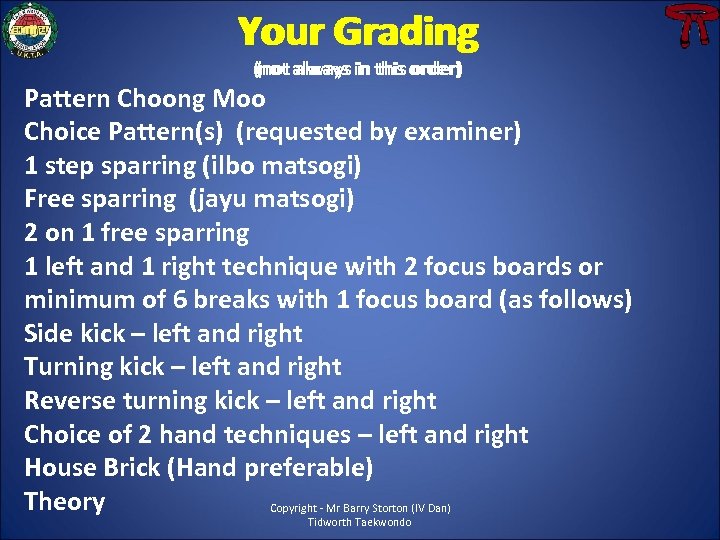 Your Grading (not always in this order) Pattern Choong Moo Choice Pattern(s) (requested by examiner) 1 step sparring (ilbo matsogi) Free sparring (jayu matsogi) 2 on 1 free sparring 1 left and 1 right technique with 2 focus boards or minimum of 6 breaks with 1 focus board (as follows) Side kick – left and right Turning kick – left and right Reverse turning kick – left and right Choice of 2 hand techniques – left and right House Brick (Hand preferable) Theory Copyright - Mr Barry Storton (IV Dan) Tidworth Taekwondo
 Good Luck! Please refer to your students hand book for further information All information reproduced for Tidworth Taekwon-Do school with kind permission of Mr Andy Proverbs (Kimpton TKD) Copyright - Mr Barry Storton (IV Dan) Tidworth Taekwondo