


 Скачать презентацию Thy NVM Software-Transparent Crash Consistency for Persistent Memory
387213957f3dc735dacac531c807be3a.ppt
- Количество слайдов: 99
 Thy. NVM Software-Transparent Crash Consistency for Persistent Memory Onur Mutlu omutlu@ethz. ch (joint work with Jinglei Ren, Jishen Zhao, Samira Khan, Jongmoo Choi, Yongwei Wu) August 8, 2016 Flash Memory Summit 2016, Santa Clara, CA
 Original Paper (I) 2
 Original Paper (II) n Presented at ACM/IEEE MICRO Conference in Dec 2015. n Full paper for details: q Jinglei Ren, Jishen Zhao, Samira Khan, Jongmoo Choi, Yongwei Wu, and Onur Mutlu, "Thy. NVM: Enabling Software-Transparent Crash Consistency in Persistent Memory Systems" Proceedings of the 48 th International Symposium on Microarchitecture (MICRO), Waikiki, Hawaii, USA, December 2015. [Slides (pptx) (pdf)] [Lightning Session Slides (pptx) (pdf)] [Poster (pptx) (pdf)] [Source Code] q https: //users. ece. cmu. edu/~omutlu/pub/Thy. NVM-transparentcrash-consistency-for-persistent-memory_micro 15. pdf 3
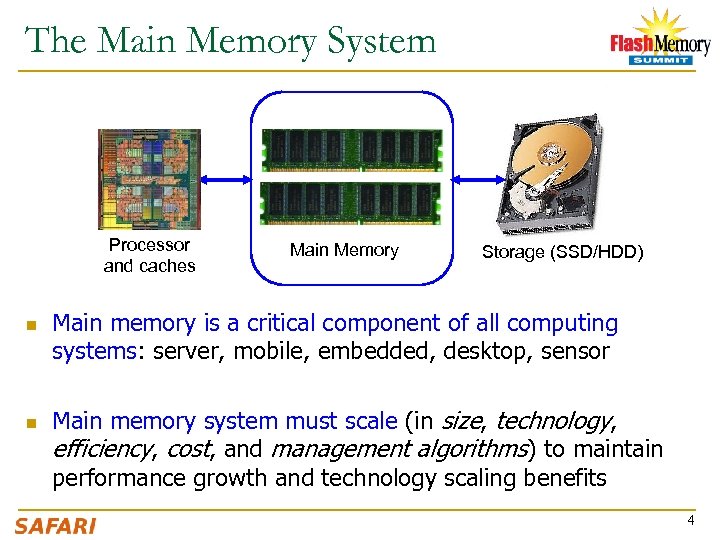 The Main Memory System Processor and caches n n Main Memory Storage (SSD/HDD) Main memory is a critical component of all computing systems: server, mobile, embedded, desktop, sensor Main memory system must scale (in size, technology, efficiency, cost, and management algorithms) to maintain performance growth and technology scaling benefits 4
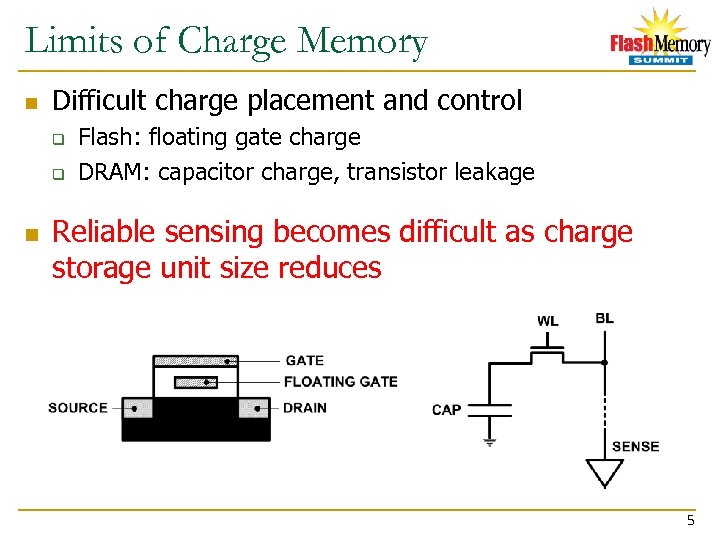 Limits of Charge Memory n Difficult charge placement and control q q n Flash: floating gate charge DRAM: capacitor charge, transistor leakage Reliable sensing becomes difficult as charge storage unit size reduces 5
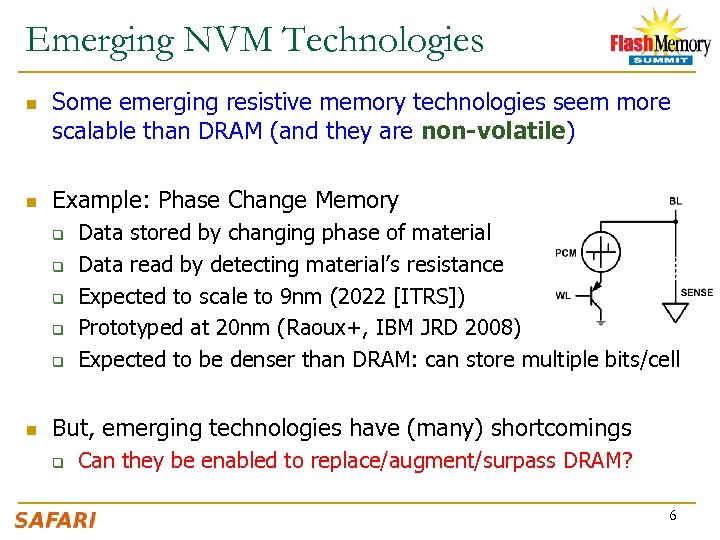 Emerging NVM Technologies n n Some emerging resistive memory technologies seem more scalable than DRAM (and they are non-volatile) Example: Phase Change Memory q q q n Data stored by changing phase of material Data read by detecting material’s resistance Expected to scale to 9 nm (2022 [ITRS]) Prototyped at 20 nm (Raoux+, IBM JRD 2008) Expected to be denser than DRAM: can store multiple bits/cell But, emerging technologies have (many) shortcomings q Can they be enabled to replace/augment/surpass DRAM? 6
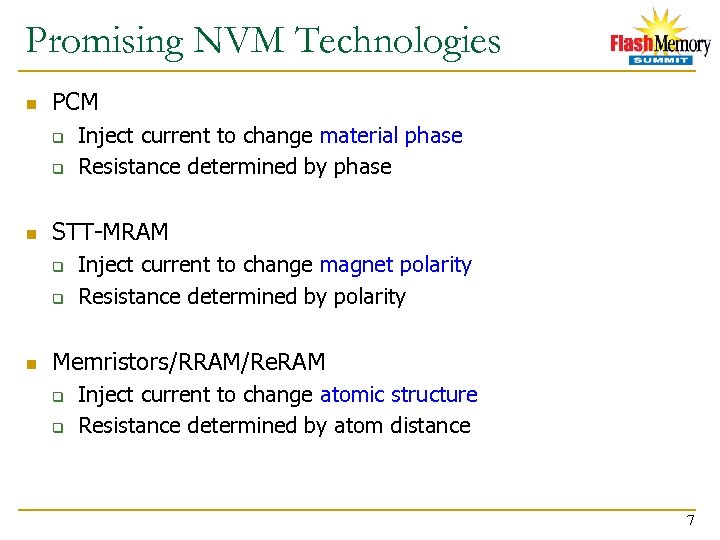 Promising NVM Technologies n PCM q q n STT-MRAM q q n Inject current to change material phase Resistance determined by phase Inject current to change magnet polarity Resistance determined by polarity Memristors/RRAM/Re. RAM q q Inject current to change atomic structure Resistance determined by atom distance 7
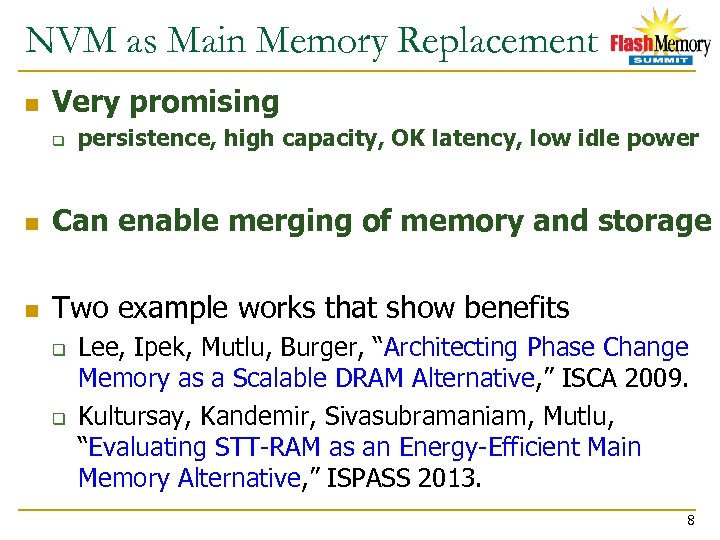 NVM as Main Memory Replacement n Very promising q persistence, high capacity, OK latency, low idle power n Can enable merging of memory and storage n Two example works that show benefits q q Lee, Ipek, Mutlu, Burger, “Architecting Phase Change Memory as a Scalable DRAM Alternative, ” ISCA 2009. Kultursay, Kandemir, Sivasubramaniam, Mutlu, “Evaluating STT-RAM as an Energy-Efficient Main Memory Alternative, ” ISPASS 2013. 8
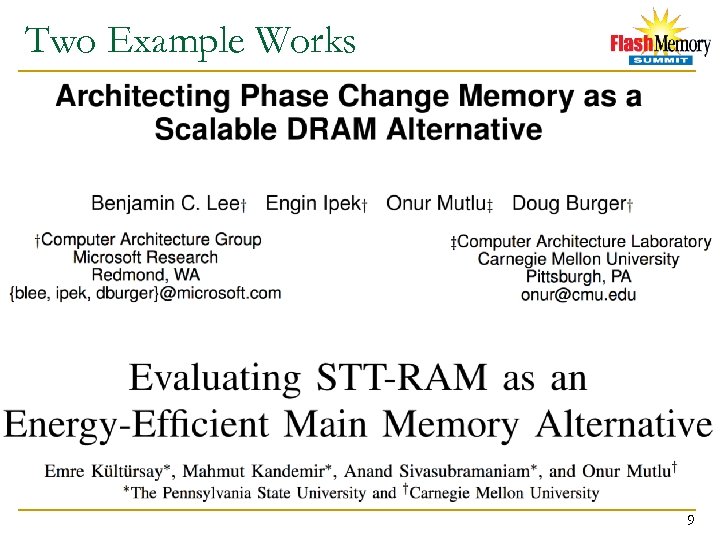 Two Example Works 9
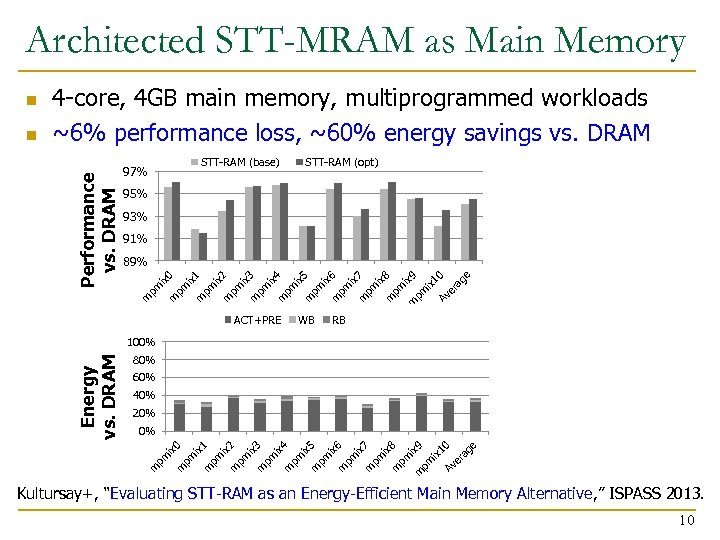 Architected STT-MRAM as Main Memory STT-RAM (base) 97% STT-RAM (opt) 95% 93% 91% 2 pm ix m 3 pm ix m 4 pm ix m 5 pm ix m 6 pm ix m 7 pm ix m 8 pm m ix 9 pm ix 1 Av 0 er ag e m ix 1 pm ix m pm m ix 0 89% m Performance vs. DRAM n 4 -core, 4 GB main memory, multiprogrammed workloads ~6% performance loss, ~60% energy savings vs. DRAM pm n ACT+PRE WB RB 80% 60% 40% 20% 1 Av 0 er ag e ix 9 ix m pm 8 ix m pm pm 7 ix m 6 pm ix m 5 pm ix m 4 ix m pm pm 3 ix m pm 2 m m pm ix ix pm m 1 0% 0 Energy vs. DRAM 100% Kultursay+, “Evaluating STT-RAM as an Energy-Efficient Main Memory Alternative, ” ISPASS 2013. 10
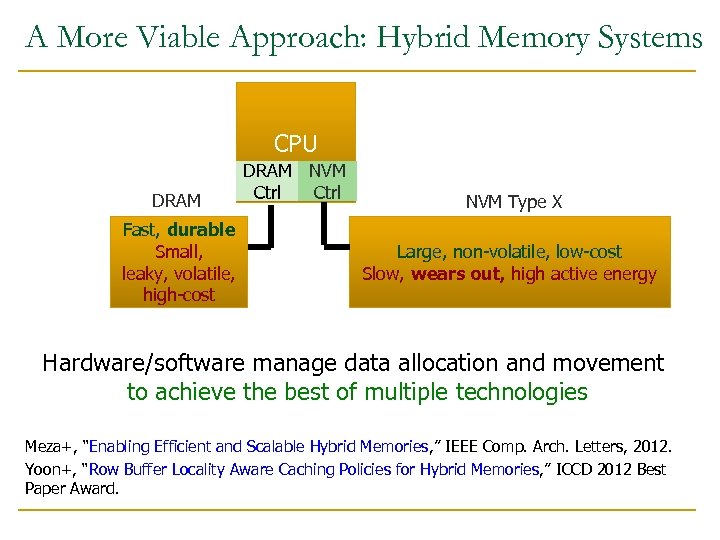 A More Viable Approach: Hybrid Memory Systems CPU DRAM Fast, durable Small, leaky, volatile, high-cost DRAM NVM Ctrl NVM Type X Large, non-volatile, low-cost Slow, wears out, high active energy Hardware/software manage data allocation and movement to achieve the best of multiple technologies Meza+, “Enabling Efficient and Scalable Hybrid Memories, ” IEEE Comp. Arch. Letters, 2012. Yoon+, “Row Buffer Locality Aware Caching Policies for Hybrid Memories, ” ICCD 2012 Best Paper Award.
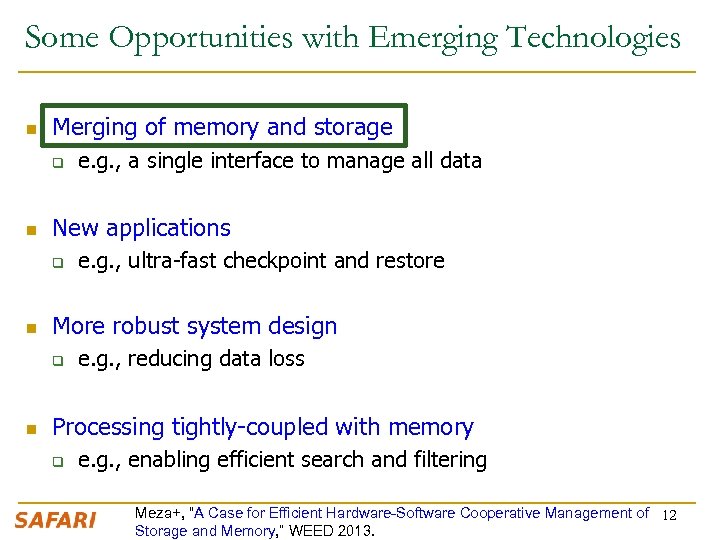 Some Opportunities with Emerging Technologies n Merging of memory and storage q n New applications q n e. g. , ultra-fast checkpoint and restore More robust system design q n e. g. , a single interface to manage all data e. g. , reducing data loss Processing tightly-coupled with memory q e. g. , enabling efficient search and filtering Meza+, “A Case for Efficient Hardware-Software Cooperative Management of 12 Storage and Memory, ” WEED 2013.
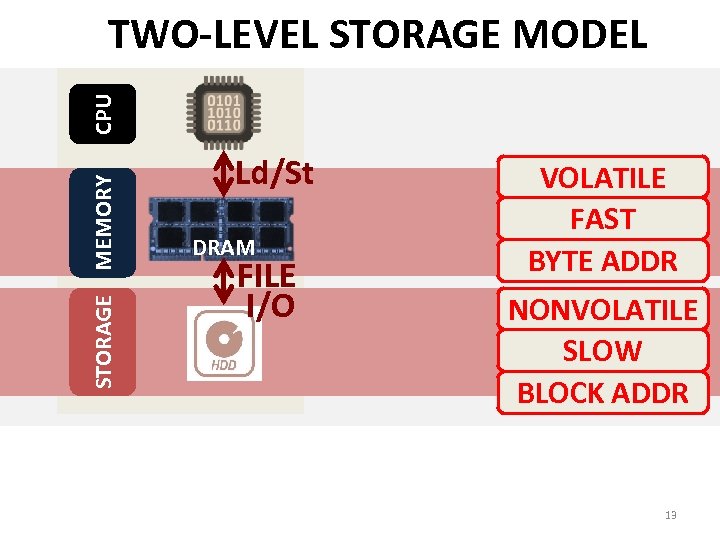 STORAGE MEMORY CPU TWO-LEVEL STORAGE MODEL Ld/St DRAM FILE I/O VOLATILE FAST BYTE ADDR NONVOLATILE SLOW BLOCK ADDR 13
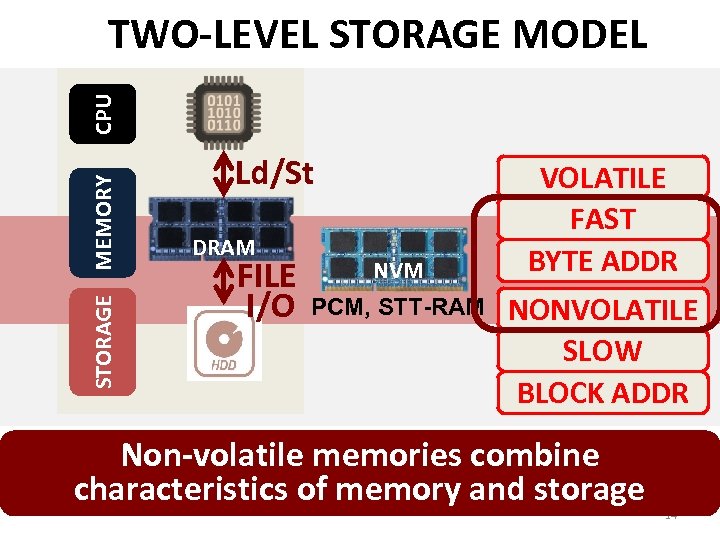 STORAGE MEMORY CPU TWO-LEVEL STORAGE MODEL Ld/St DRAM FILE I/O NVM PCM, STT-RAM VOLATILE FAST BYTE ADDR NONVOLATILE SLOW BLOCK ADDR Non-volatile memories combine characteristics of memory and storage 14
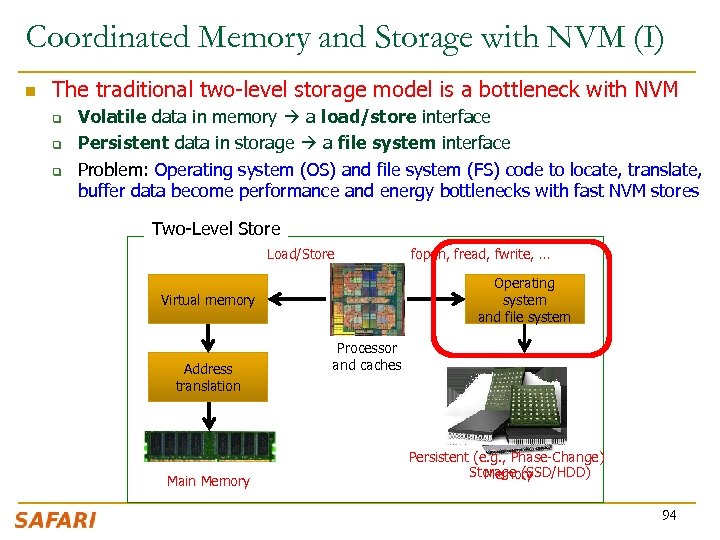
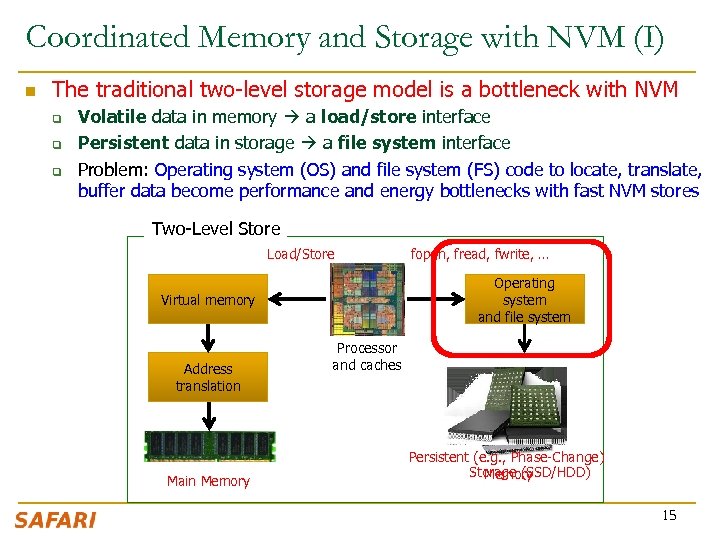 Coordinated Memory and Storage with NVM (I) n The traditional two-level storage model is a bottleneck with NVM q q q Volatile data in memory a load/store interface Persistent data in storage a file system interface Problem: Operating system (OS) and file system (FS) code to locate, translate, buffer data become performance and energy bottlenecks with fast NVM stores Two-Level Store Load/Store Operating system and file system Virtual memory Address translation Main Memory fopen, fread, fwrite, … Processor and caches Persistent (e. g. , Phase-Change) Storage (SSD/HDD) Memory 15
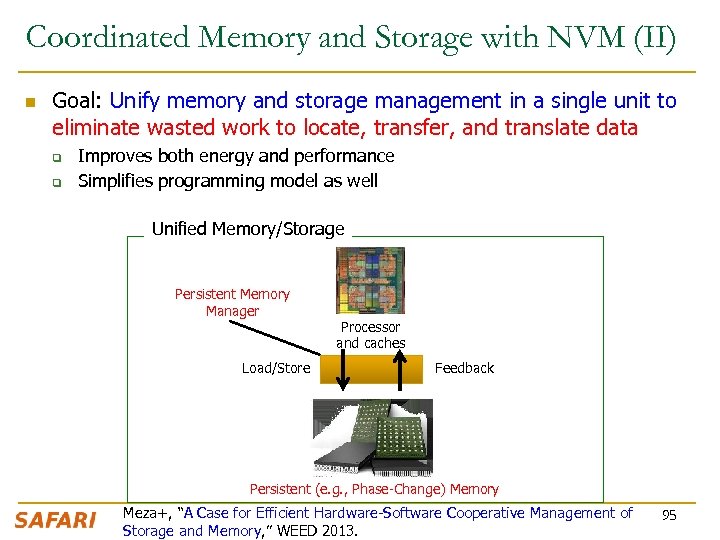
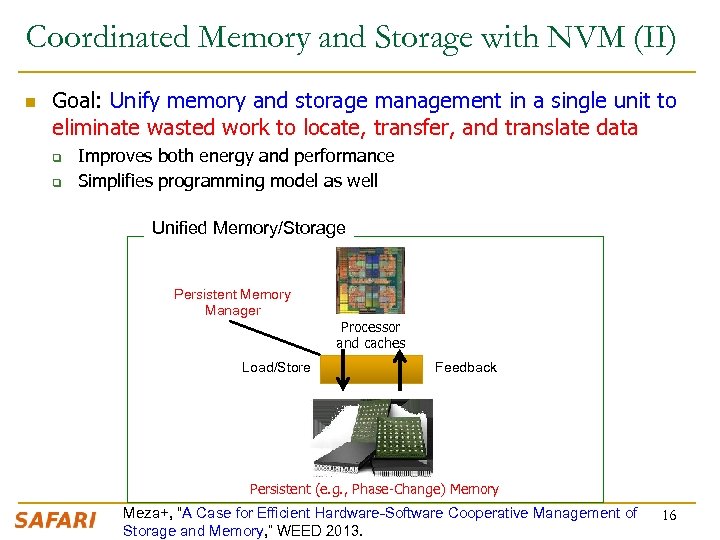 Coordinated Memory and Storage with NVM (II) n Goal: Unify memory and storage management in a single unit to eliminate wasted work to locate, transfer, and translate data q q Improves both energy and performance Simplifies programming model as well Unified Memory/Storage Persistent Memory Manager Load/Store Processor and caches Feedback Persistent (e. g. , Phase-Change) Memory Meza+, “A Case for Efficient Hardware-Software Cooperative Management of Storage and Memory, ” WEED 2013. 16
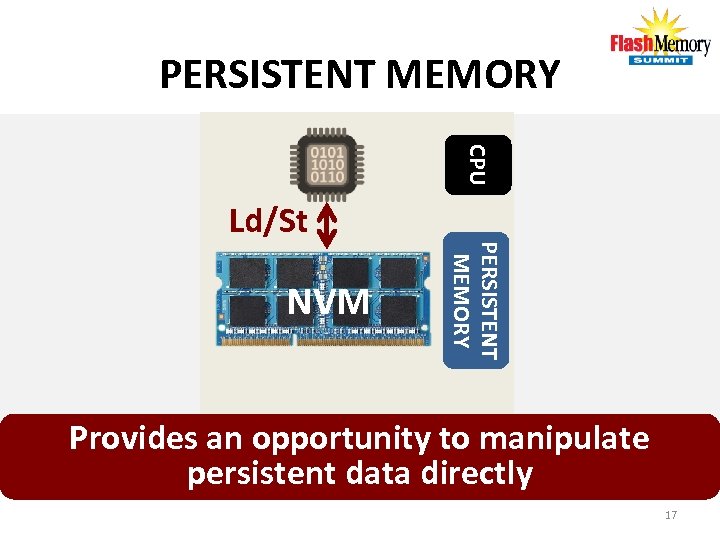 PERSISTENT MEMORY CPU NVM PERSISTENT MEMORY Ld/St Provides an opportunity to manipulate persistent data directly 17
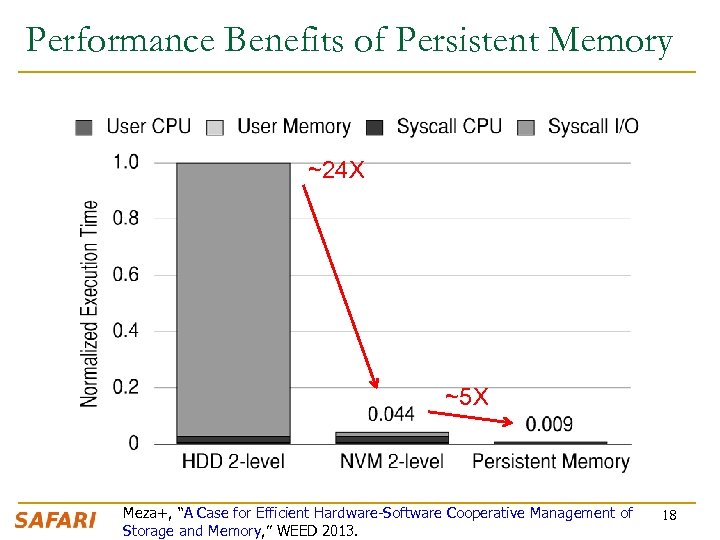 Performance Benefits of Persistent Memory ~24 X ~5 X Meza+, “A Case for Efficient Hardware-Software Cooperative Management of Storage and Memory, ” WEED 2013. 18
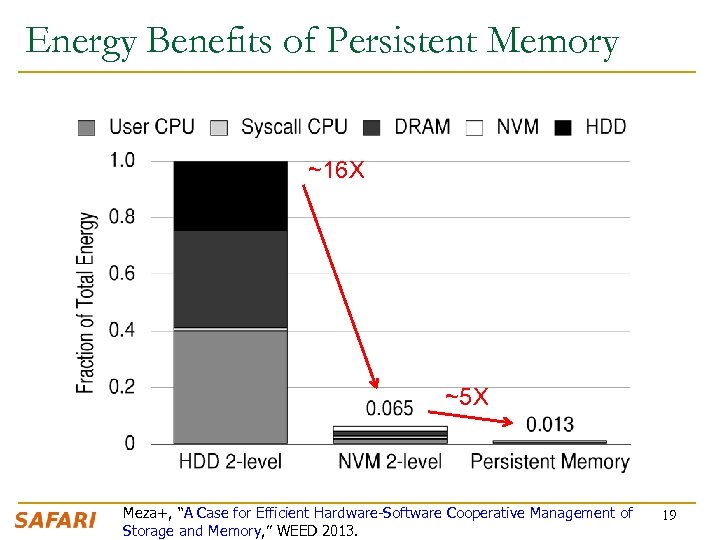 Energy Benefits of Persistent Memory ~16 X ~5 X Meza+, “A Case for Efficient Hardware-Software Cooperative Management of Storage and Memory, ” WEED 2013. 19
 On Persistent Memory Benefits & Challenges n Justin Meza, Yixin Luo, Samira Khan, Jishen Zhao, Yuan Xie, and Onur Mutlu, "A Case for Efficient Hardware-Software Cooperative Management of Storage and Memory" Proceedings of the 5 th Workshop on Energy-Efficient Design (WEED), Tel-Aviv, Israel, June 2013. Slides (pptx) Slides (pdf) 20
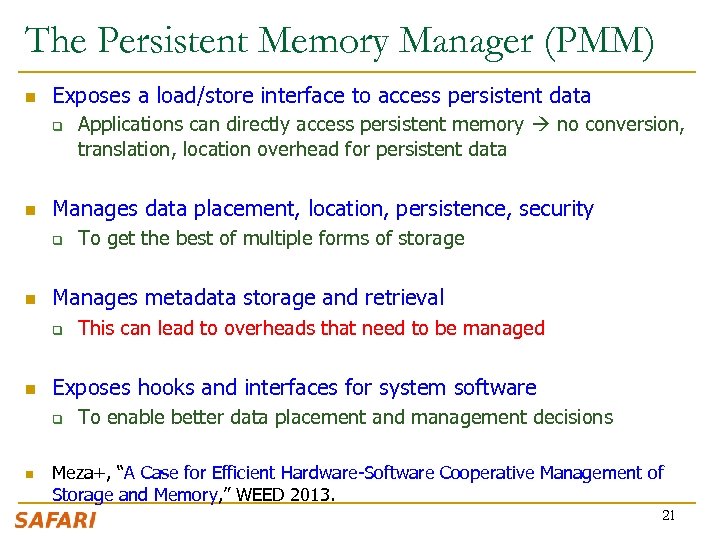 The Persistent Memory Manager (PMM) n Exposes a load/store interface to access persistent data q n Manages data placement, location, persistence, security q n This can lead to overheads that need to be managed Exposes hooks and interfaces for system software q n To get the best of multiple forms of storage Manages metadata storage and retrieval q n Applications can directly access persistent memory no conversion, translation, location overhead for persistent data To enable better data placement and management decisions Meza+, “A Case for Efficient Hardware-Software Cooperative Management of Storage and Memory, ” WEED 2013. 21
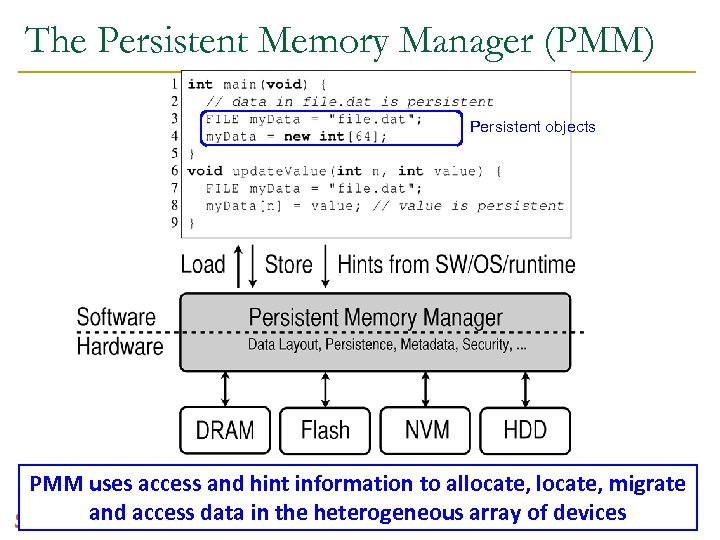 The Persistent Memory Manager (PMM) Persistent objects PMM uses access and hint information to allocate, migrate and access data in the heterogeneous array of devices 22
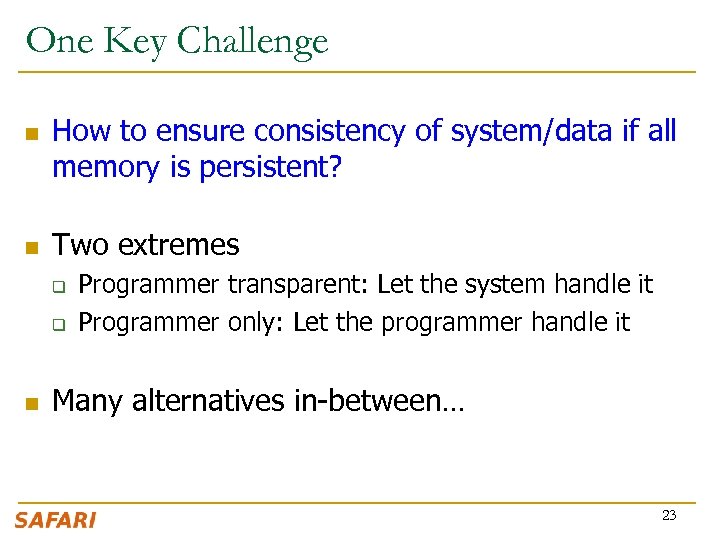 One Key Challenge n n How to ensure consistency of system/data if all memory is persistent? Two extremes q q n Programmer transparent: Let the system handle it Programmer only: Let the programmer handle it Many alternatives in-between… 23
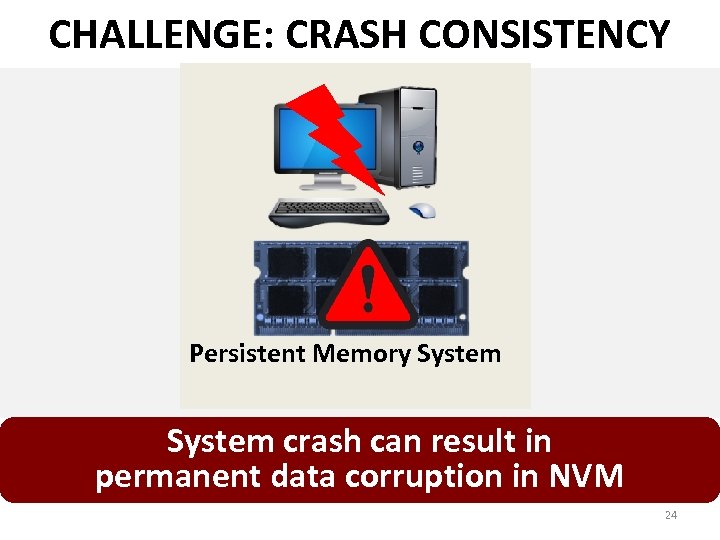 CHALLENGE: CRASH CONSISTENCY Persistent Memory System crash can result in permanent data corruption in NVM 24
![CURRENT SOLUTIONS Explicit interfaces to manage consistency – NV-Heaps [ASPLOS’ 11], BPFS [SOSP’ 09],](https://present5.com/presentation/387213957f3dc735dacac531c807be3a/image-25.jpg "CURRENT SOLUTIONS Explicit interfaces to manage consistency – NV-Heaps [ASPLOS’ 11], BPFS [SOSP’ 09],") CURRENT SOLUTIONS Explicit interfaces to manage consistency – NV-Heaps [ASPLOS’ 11], BPFS [SOSP’ 09], Mnemosyne [ASPLOS’ 11] Atomic. Begin { Insert a new node; } Atomic. End; Limits adoption of NVM Have to rewrite code with clear partition between volatile and non-volatile data Burden on the programmers 25
CURRENT SOLUTIONS Explicit interfaces to manage consistency – NV-Heaps [ASPLOS’ 11], BPFS [SOSP’ 09], Mnemosyne [ASPLOS’ 11] Atomic. Begin { Insert a new node; } Atomic. End; Limits adoption of NVM Have to rewrite code with clear partition between volatile and non-volatile data Burden on the programmers 25
 OUR APPROACH: Thy. NVM Goal: Software-transparent crash consistency in persistent memory systems 26
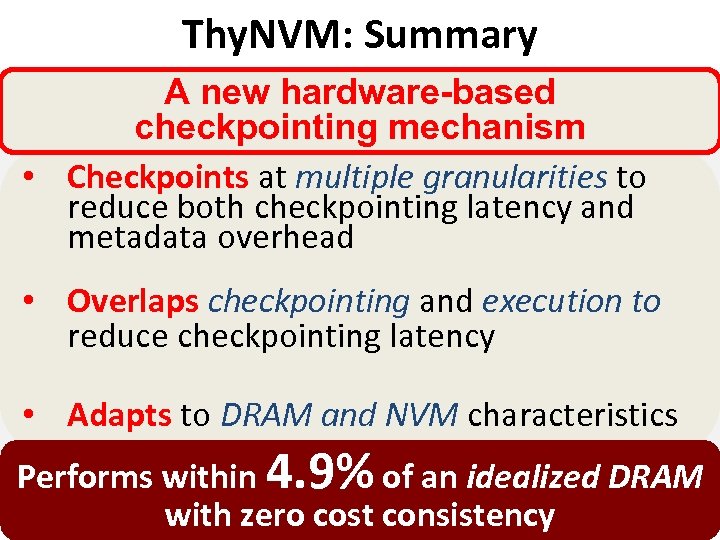 Thy. NVM: Summary A new hardware-based checkpointing mechanism • Checkpoints at multiple granularities to reduce both checkpointing latency and metadata overhead • Overlaps checkpointing and execution to reduce checkpointing latency • Adapts to DRAM and NVM characteristics Performs within 4. 9% of an idealized DRAM with zero cost consistency 27
 OUTLINE Crash Consistency Problem Current Solutions Thy. NVM Evaluation Conclusion 28
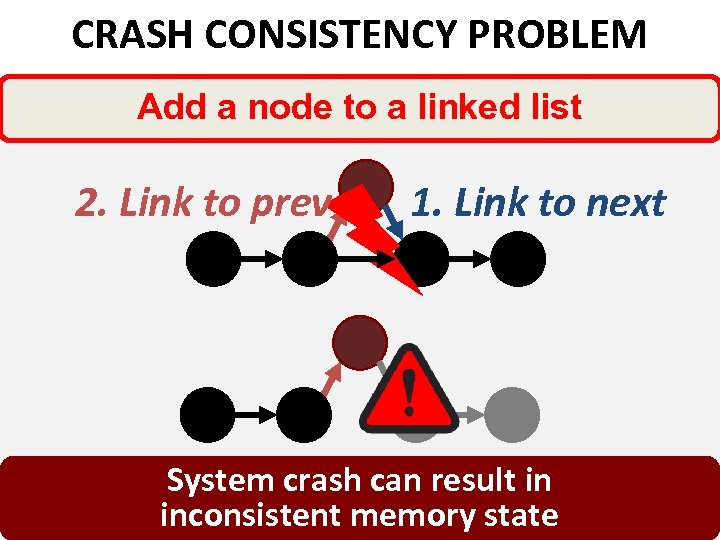 CRASH CONSISTENCY PROBLEM Add a node to a linked list 2. Link to prev 1. Link to next System crash can result in inconsistent memory state 29
 OUTLINE Crash Consistency Problem Current Solutions Thy. NVM Evaluation Conclusion 30
![CURRENT SOLUTIONS Explicit interfaces to manage consistency – NV-Heaps [ASPLOS’ 11], BPFS [SOSP’ 09],](https://present5.com/presentation/387213957f3dc735dacac531c807be3a/image-31.jpg "CURRENT SOLUTIONS Explicit interfaces to manage consistency – NV-Heaps [ASPLOS’ 11], BPFS [SOSP’ 09],") CURRENT SOLUTIONS Explicit interfaces to manage consistency – NV-Heaps [ASPLOS’ 11], BPFS [SOSP’ 09], Mnemosyne [ASPLOS’ 11] Example Code update a node in a persistent hash table void hashtable_update(hashtable_t* ht, void *key, void *data) { list_t* chain = get_chain(ht, key); pair_t* pair; pair_t update. Pair; update. Pair. first = key; pair = (pair_t*) list_find(chain, &update. Pair); pair->second = data; } 31
CURRENT SOLUTIONS Explicit interfaces to manage consistency – NV-Heaps [ASPLOS’ 11], BPFS [SOSP’ 09], Mnemosyne [ASPLOS’ 11] Example Code update a node in a persistent hash table void hashtable_update(hashtable_t* ht, void *key, void *data) { list_t* chain = get_chain(ht, key); pair_t* pair; pair_t update. Pair; update. Pair. first = key; pair = (pair_t*) list_find(chain, &update. Pair); pair->second = data; } 31
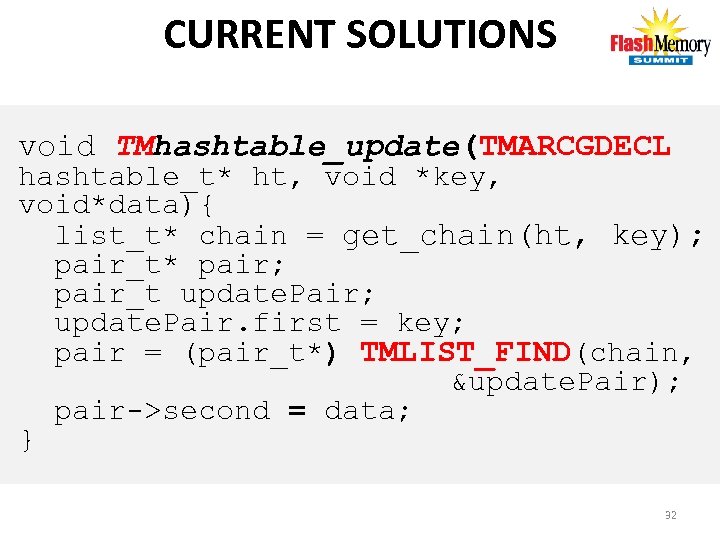 CURRENT SOLUTIONS void TMhashtable_update(TMARCGDECL hashtable_t* ht, void *key, void*data){ list_t* chain = get_chain(ht, key); pair_t* pair; pair_t update. Pair; update. Pair. first = key; pair = (pair_t*) TMLIST_FIND(chain, &update. Pair); pair->second = data; } 32
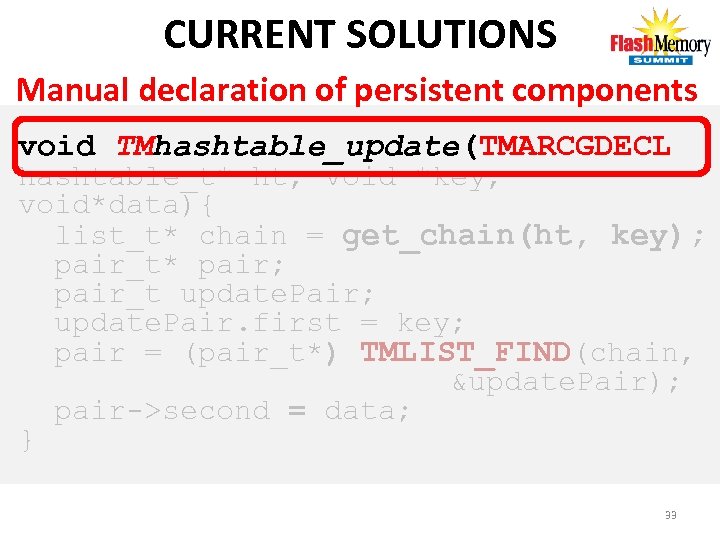 CURRENT SOLUTIONS Manual declaration of persistent components void TMhashtable_update(TMARCGDECL hashtable_t* ht, void *key, void*data){ list_t* chain = get_chain(ht, key); pair_t* pair; pair_t update. Pair; update. Pair. first = key; pair = (pair_t*) TMLIST_FIND(chain, &update. Pair); pair->second = data; } 33
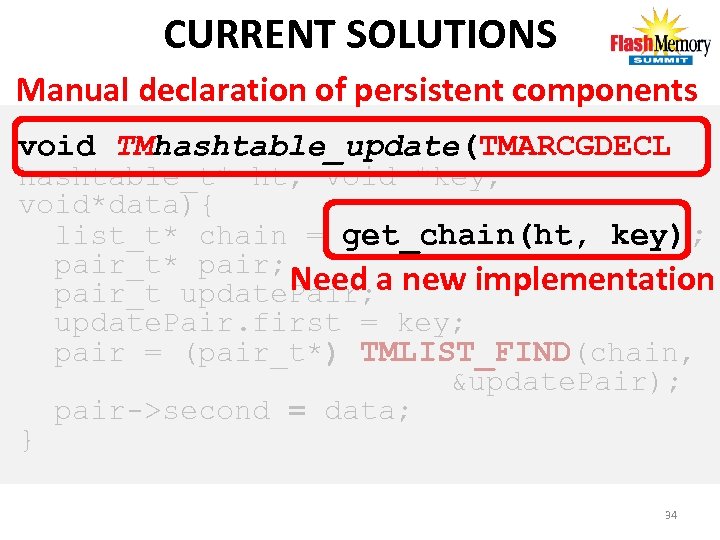 CURRENT SOLUTIONS Manual declaration of persistent components void TMhashtable_update(TMARCGDECL hashtable_t* ht, void *key, void*data){ list_t* chain = get_chain(ht, key); pair_t* pair; Need pair_t update. Pair; a new implementation update. Pair. first = key; pair = (pair_t*) TMLIST_FIND(chain, &update. Pair); pair->second = data; } 34
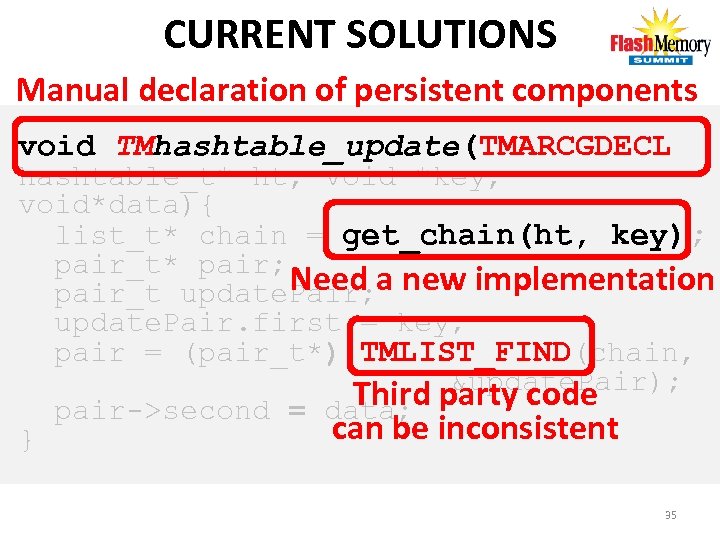 CURRENT SOLUTIONS Manual declaration of persistent components void TMhashtable_update(TMARCGDECL hashtable_t* ht, void *key, void*data){ list_t* chain = get_chain(ht, key); pair_t* pair; Need pair_t update. Pair; a new implementation update. Pair. first = key; pair = (pair_t*) TMLIST_FIND(chain, &update. Pair); Third pair->second = data; party code can be inconsistent } 35
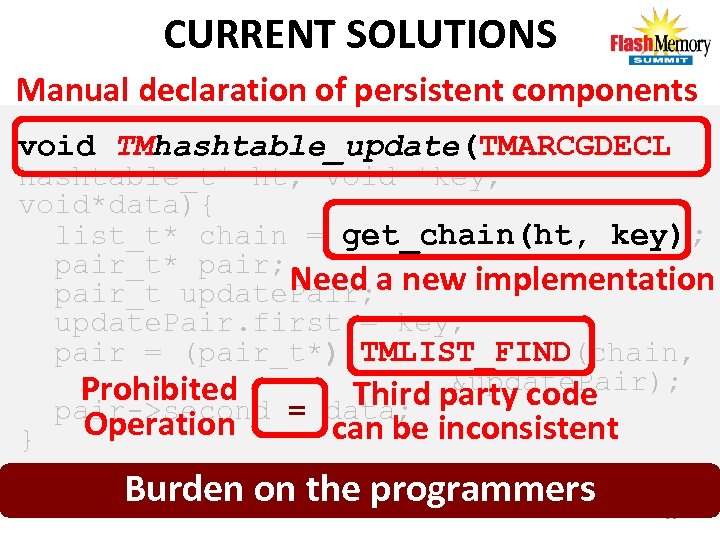 CURRENT SOLUTIONS Manual declaration of persistent components void TMhashtable_update(TMARCGDECL hashtable_t* ht, void *key, void*data){ list_t* chain = get_chain(ht, key); pair_t* pair; Need pair_t update. Pair; a new implementation update. Pair. first = key; pair = (pair_t*) TMLIST_FIND(chain, &update. Pair); Prohibited Third pair->second = data; party code Operation can be inconsistent } Burden on the programmers 36
 OUTLINE Crash Consistency Problem Current Solutions Thy. NVM Evaluation Conclusion 37
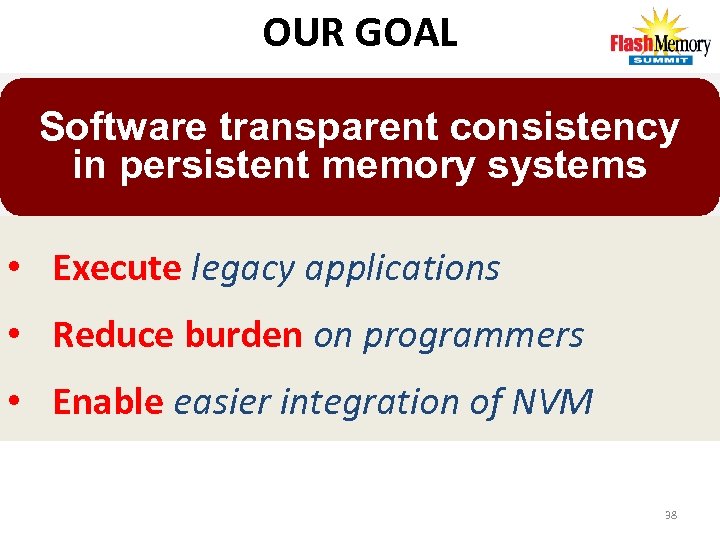 OUR GOAL Software transparent consistency in persistent memory systems • Execute legacy applications • Reduce burden on programmers • Enable easier integration of NVM 38
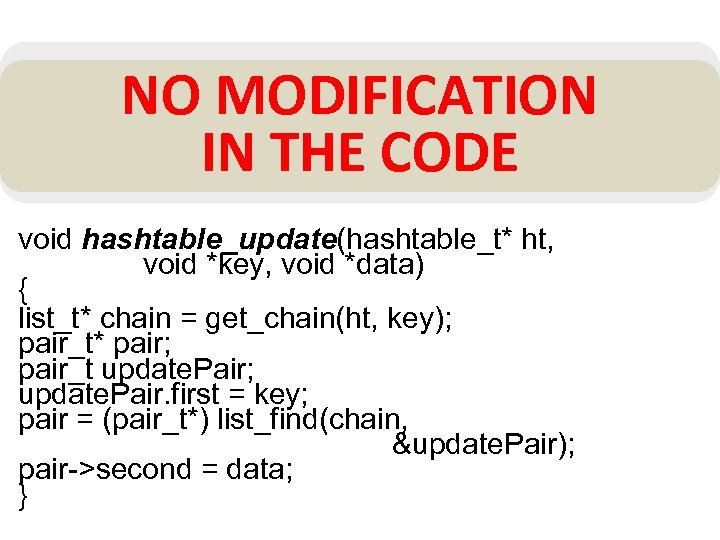 NO MODIFICATION IN THE CODE void hashtable_update(hashtable_t* ht, void *key, void *data) { list_t* chain = get_chain(ht, key); pair_t* pair; pair_t update. Pair; update. Pair. first = key; pair = (pair_t*) list_find(chain, &update. Pair); pair->second = data; }
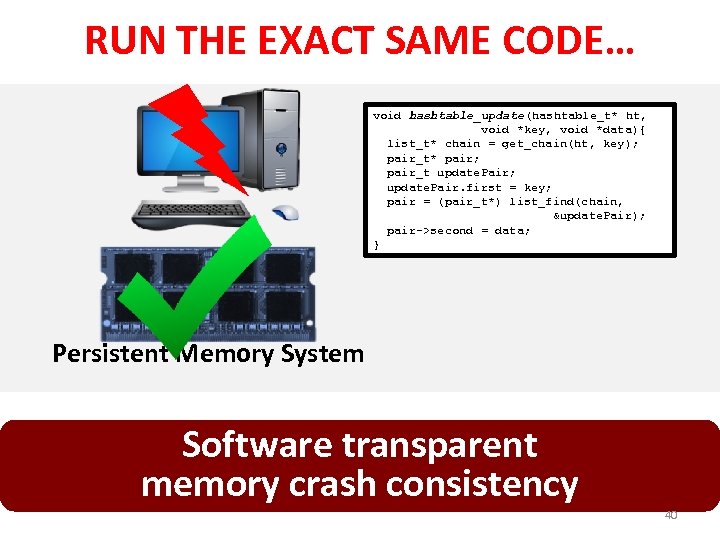 RUN THE EXACT SAME CODE… void hashtable_update(hashtable_t* ht, void *key, void *data){ list_t* chain = get_chain(ht, key); pair_t* pair; pair_t update. Pair; update. Pair. first = key; pair = (pair_t*) list_find(chain, &update. Pair); pair->second = data; } Persistent Memory System Software transparent memory crash consistency 40
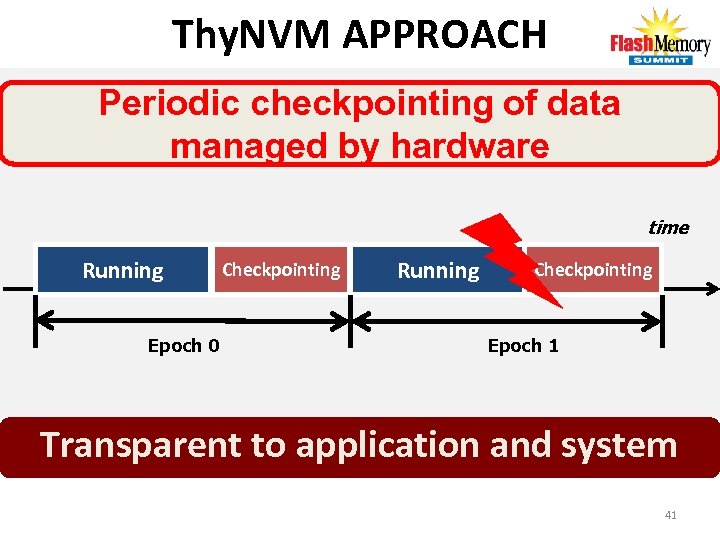 Thy. NVM APPROACH Periodic checkpointing of data managed by hardware time Running Epoch 0 Checkpointing Running Checkpointing Epoch 1 Transparent to application and system 41
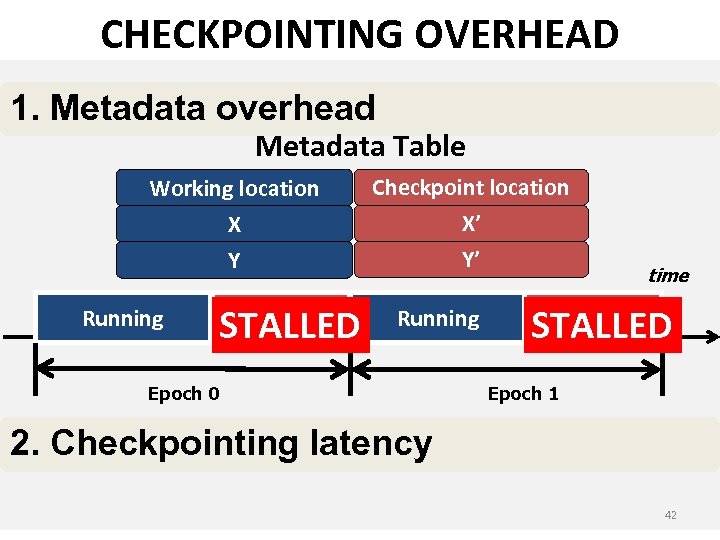 CHECKPOINTING OVERHEAD 1. Metadata overhead Metadata Table Working location X Checkpoint location X’ Y Y’ Running Checkpointing STALLED Running Epoch 0 time Checkpointing STALLED Epoch 1 2. Checkpointing latency 42
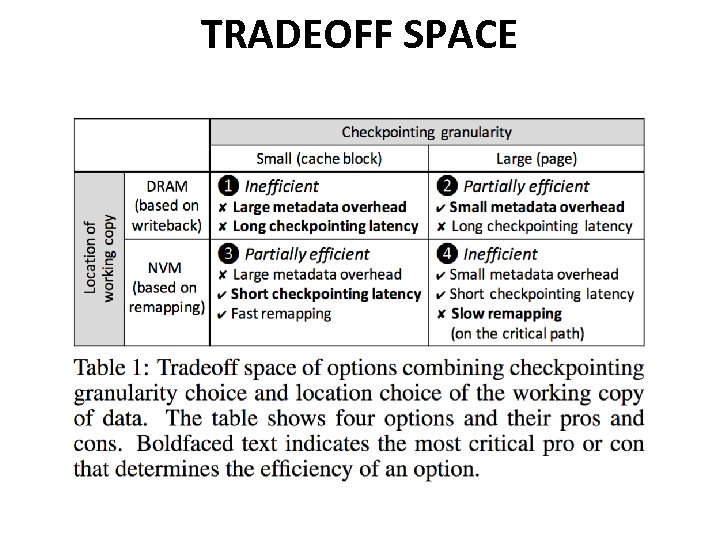
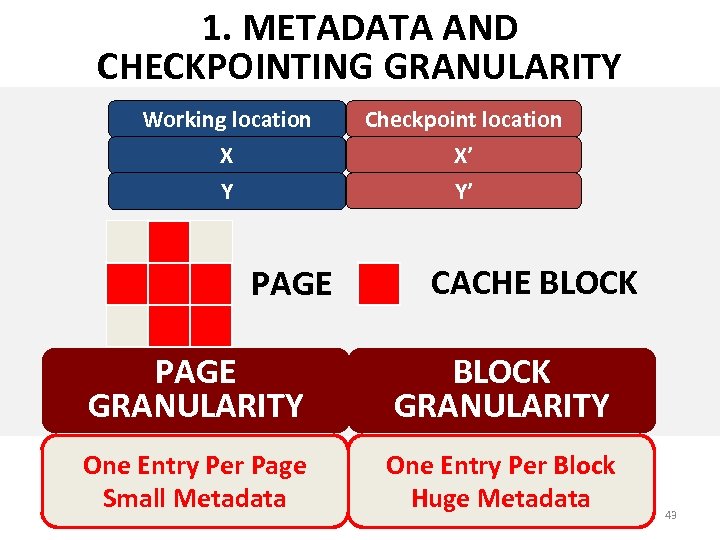 1. METADATA AND CHECKPOINTING GRANULARITY Working location Checkpoint location X Y X’ Y’ PAGE CACHE BLOCK PAGE GRANULARITY BLOCK GRANULARITY One Entry Per Page Small Metadata One Entry Per Block Huge Metadata 43
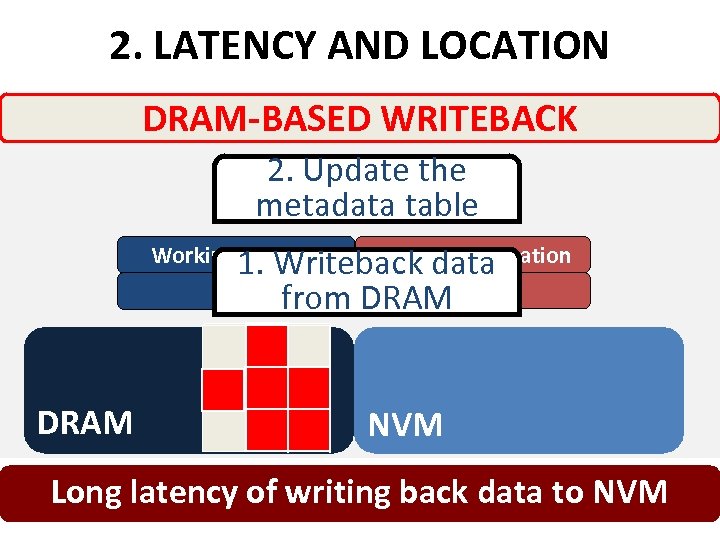 2. LATENCY AND LOCATION DRAM-BASED WRITEBACK 2. Update the metadata table Checkpoint location Working 1. Writeback data location X from DRAM X’ W DRAM NVM Long latency of writing back data to NVM 44
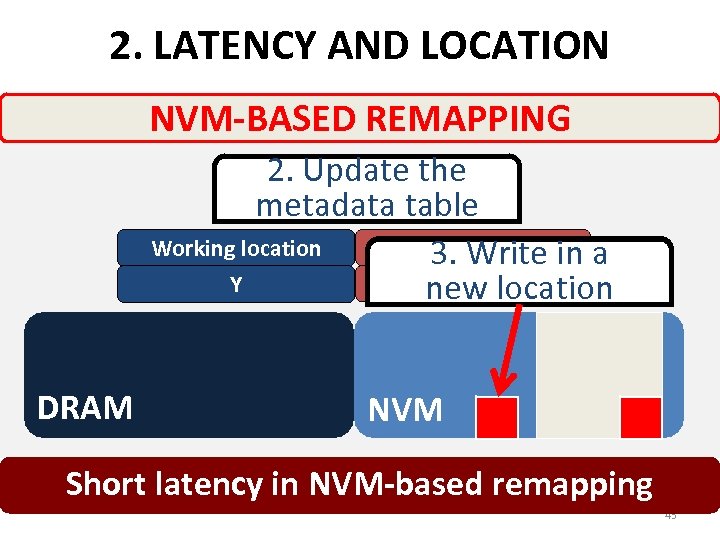 2. LATENCY AND LOCATION NVM-BASED REMAPPING 2. Update the metadata table Checkpoint location Working location 1. 3. Write in a No copying X Y of data new location DRAM NVM Short latency in NVM-based remapping 45
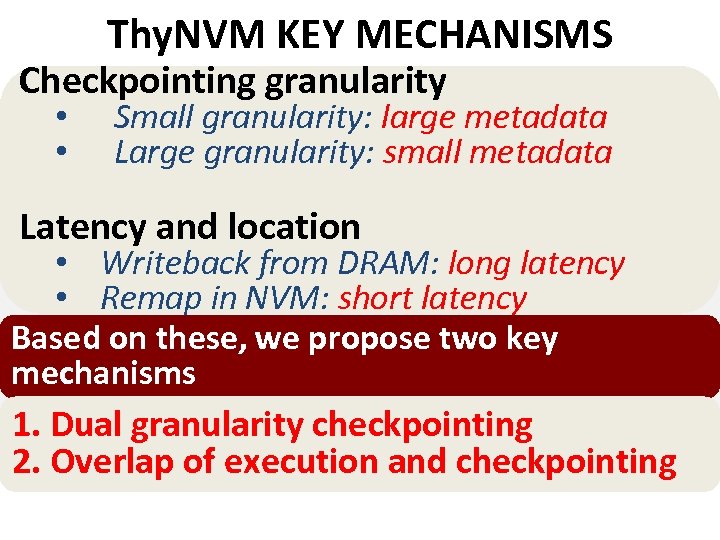 Thy. NVM KEY MECHANISMS Checkpointing granularity • • Small granularity: large metadata Large granularity: small metadata Latency and location • Writeback from DRAM: long latency • Remap in NVM: short latency Based on these, we propose two key mechanisms 1. Dual granularity checkpointing 2. Overlap of execution and checkpointing
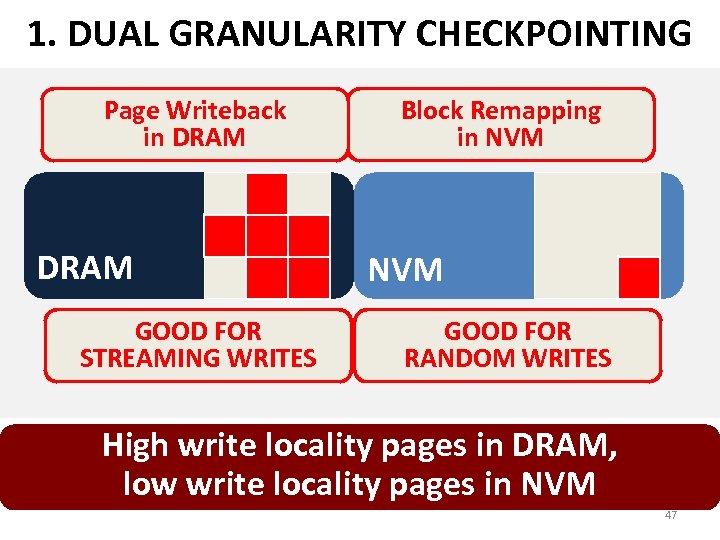 1. DUAL GRANULARITY CHECKPOINTING Page Writeback in DRAM GOOD FOR STREAMING WRITES Block Remapping in NVM GOOD FOR RANDOM WRITES High write locality pages in DRAM, low write locality pages in NVM 47
 TRADEOFF SPACE
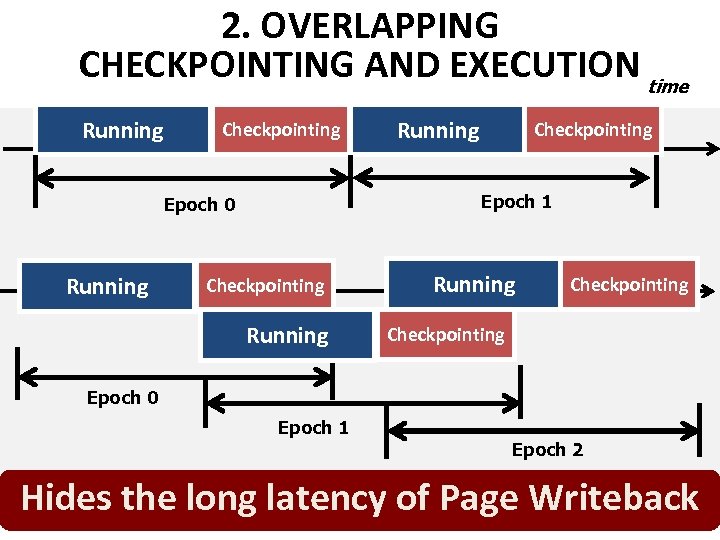 2. OVERLAPPING CHECKPOINTING AND EXECUTION time Running Checkpointing Epoch 1 Epoch 0 Running Epoch 0 Checkpointing Running Epoch 1 Running time Checkpointing Epoch 0 Epoch 1 Epoch 2 Hides the long latency of Page Writeback
 OUTLINE Crash Consistency Problem Current Solutions Thy. NVM Evaluation Conclusion 50
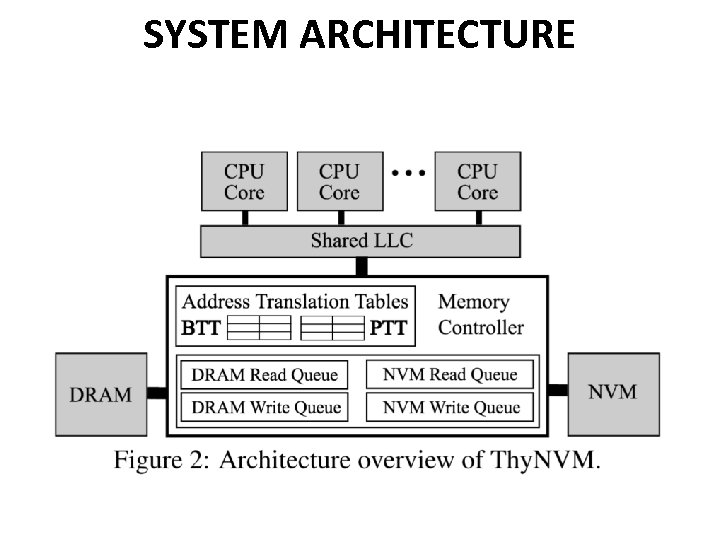 SYSTEM ARCHITECTURE
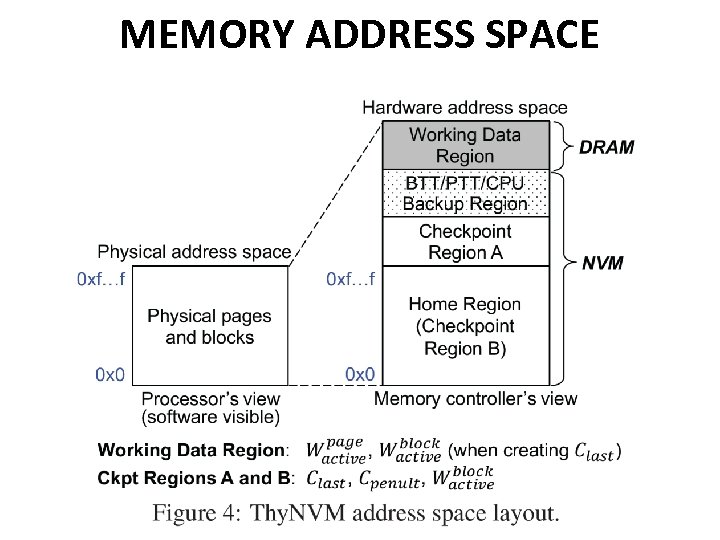 MEMORY ADDRESS SPACE
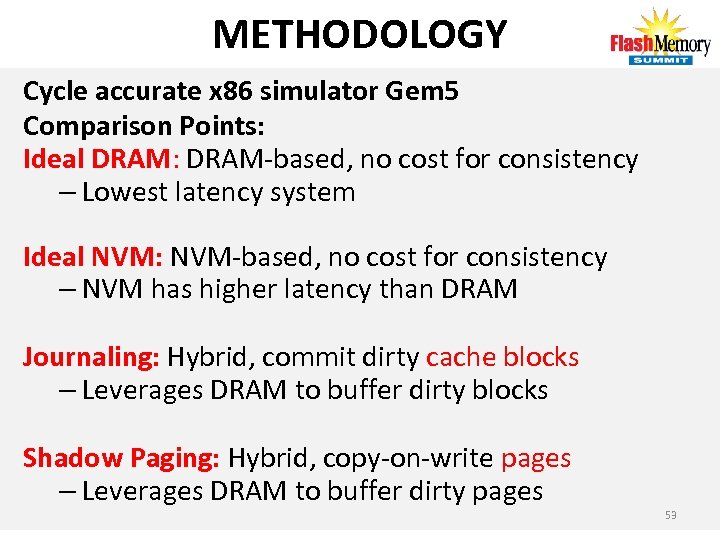 METHODOLOGY Cycle accurate x 86 simulator Gem 5 Comparison Points: Ideal DRAM: DRAM‐based, no cost for consistency – Lowest latency system Ideal NVM: NVM‐based, no cost for consistency – NVM has higher latency than DRAM Journaling: Hybrid, commit dirty cache blocks – Leverages DRAM to buffer dirty blocks Shadow Paging: Hybrid, copy‐on‐write pages – Leverages DRAM to buffer dirty pages 53
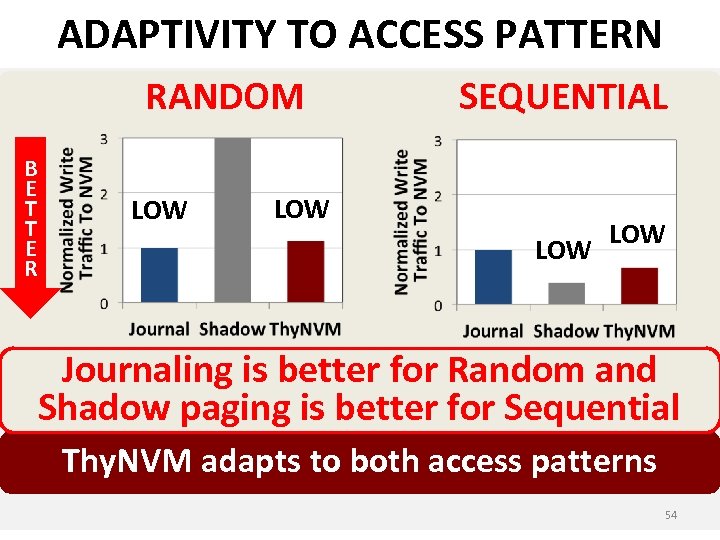 ADAPTIVITY TO ACCESS PATTERN RANDOM B E T T E R LOW SEQUENTIAL LOW LOW Journaling is better for Random and Shadow paging is better for Sequential Thy. NVM adapts to both access patterns 54
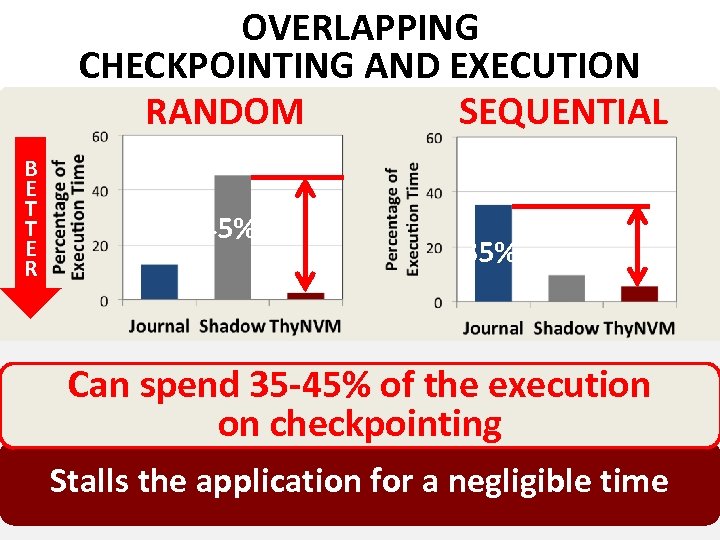 OVERLAPPING CHECKPOINTING AND EXECUTION RANDOM SEQUENTIAL B E T T E R 45% 35% Thy. NVM spends onlyof the execution Can spend 35 -45% 2. 4%/5. 5% of the execution time on checkpointing Stalls the application for a negligible time 55
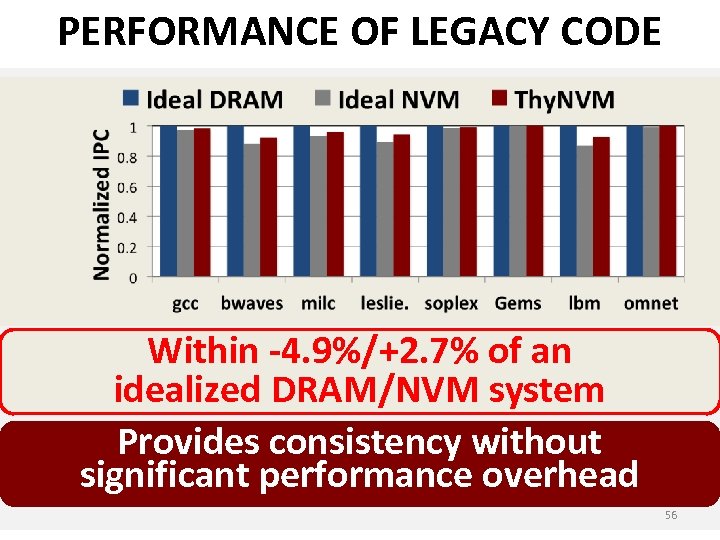 PERFORMANCE OF LEGACY CODE Within -4. 9%/+2. 7% of an idealized DRAM/NVM system Provides consistency without significant performance overhead 56
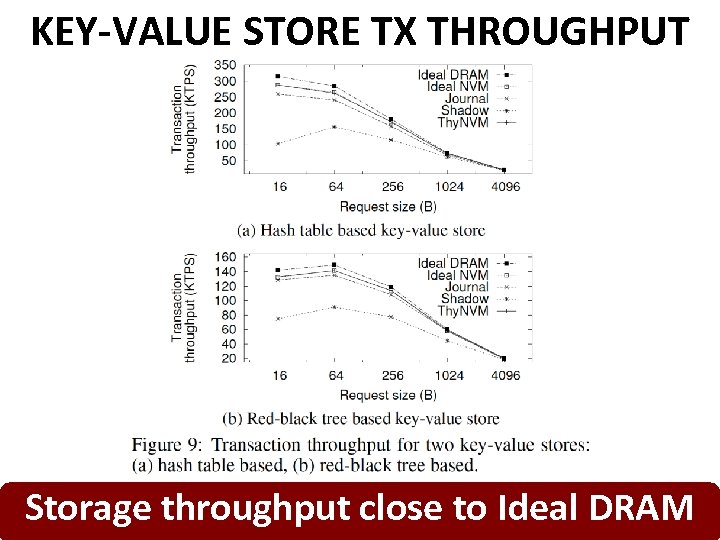 KEY-VALUE STORE TX THROUGHPUT Storage throughput close to Ideal DRAM
 OUTLINE Crash Consistency Problem Current Solutions Thy. NVM Evaluation Conclusion 58
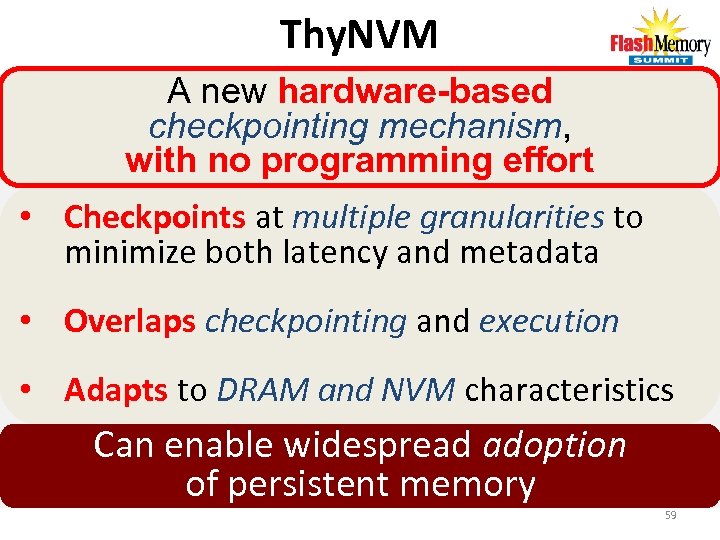 Thy. NVM A new hardware-based checkpointing mechanism, with no programming effort • Checkpoints at multiple granularities to minimize both latency and metadata • Overlaps checkpointing and execution • Adapts to DRAM and NVM characteristics Can enable widespread adoption of persistent memory 59
 Source Code and More Available at http: //persper. com/thynvm Thy. NVM Enabling Software-transparent Crash Consistency In Persistent Memory Systems
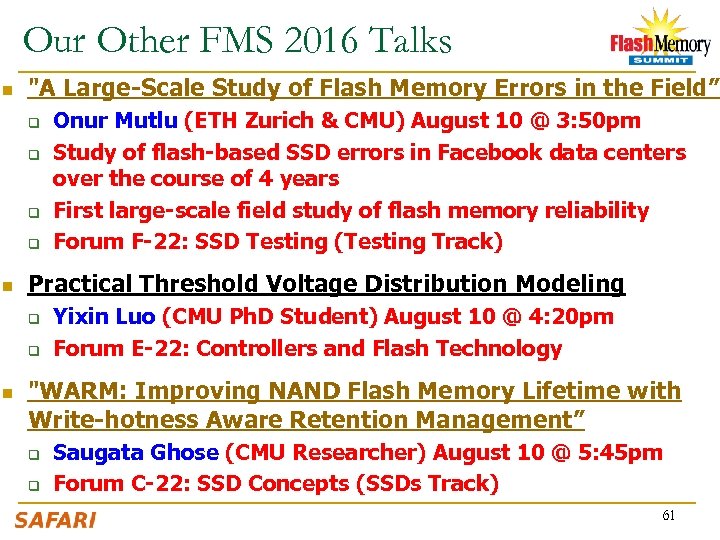 Our Other FMS 2016 Talks n "A Large-Scale Study of Flash Memory Errors in the Field” q q n Practical Threshold Voltage Distribution Modeling q q n Onur Mutlu (ETH Zurich & CMU) August 10 @ 3: 50 pm Study of flash-based SSD errors in Facebook data centers over the course of 4 years First large-scale field study of flash memory reliability Forum F-22: SSD Testing (Testing Track) Yixin Luo (CMU Ph. D Student) August 10 @ 4: 20 pm Forum E-22: Controllers and Flash Technology "WARM: Improving NAND Flash Memory Lifetime with Write-hotness Aware Retention Management” q q Saugata Ghose (CMU Researcher) August 10 @ 5: 45 pm Forum C-22: SSD Concepts (SSDs Track) 61
 Referenced Papers and Talks n All are available at http: //users. ece. cmu. edu/~omutlu/projects. htm http: //users. ece. cmu. edu/~omutlu/talks. htm n And, many other previous works on q q NVM & Persistent Memory DRAM Hybrid memories NAND flash memory 62
 Thank you. Feel free to email me with any questions & feedback omutlu@ethz. ch http: //users. ece. cmu. edu/~omutlu/
 Thy. NVM Software-Transparent Crash Consistency for Persistent Memory Onur Mutlu omutlu@ethz. ch (joint work with Jinglei Ren, Jishen Zhao, Samira Khan, Jongmoo Choi, Yongwei Wu) August 8, 2016 Flash Memory Summit 2016, Santa Clara, CA
 References to Papers and Talks
 Challenges and Opportunities in Memory n n Onur Mutlu, "Rethinking Memory System Design" Keynote talk at 2016 ACM SIGPLAN International Symposium on Memory Management (ISMM), Santa Barbara, CA, USA, June 2016. [Slides (pptx) (pdf)] [Abstract] Onur Mutlu and Lavanya Subramanian, "Research Problems and Opportunities in Memory Systems" Invited Article in Supercomputing Frontiers and Innovations (SUPERFRI), 2015. 66
 Phase Change Memory As DRAM Replacement n Benjamin C. Lee, Engin Ipek, Onur Mutlu, and Doug Burger, "Architecting Phase Change Memory as a Scalable DRAM Alternative" Proceedings of the 36 th International Symposium on Computer Architecture (ISCA), pages 2 -13, Austin, TX, June 2009. Slides (pdf) n Benjamin C. Lee, Ping Zhou, Jun Yang, Youtao Zhang, Bo Zhao, Engin Ipek, Onur Mutlu, and Doug Burger, "Phase Change Technology and the Future of Main Memory" IEEE Micro, Special Issue: Micro's Top Picks from 2009 Computer Architecture Conferences (MICRO TOP PICKS), Vol. 30, No. 1, pages 60 -70, January/February 2010. 67
 STT-MRAM As DRAM Replacement n Emre Kultursay, Mahmut Kandemir, Anand Sivasubramaniam, and Onur Mutlu, "Evaluating STT-RAM as an Energy-Efficient Main Memory Alternative" Proceedings of the 2013 IEEE International Symposium on Performance Analysis of Systems and Software (ISPASS), Austin, TX, April 2013. Slides (pptx) (pdf) 68
 Taking Advantage of Persistence in Memory n Justin Meza, Yixin Luo, Samira Khan, Jishen Zhao, Yuan Xie, and Onur Mutlu, "A Case for Efficient Hardware-Software Cooperative Management of Storage and Memory" Proceedings of the 5 th Workshop on Energy-Efficient Design (WEED), Tel-Aviv, Israel, June 2013. Slides (pptx) Slides (pdf) n Jinglei Ren, Jishen Zhao, Samira Khan, Jongmoo Choi, Yongwei Wu, and Onur Mutlu, "Thy. NVM: Enabling Software-Transparent Crash Consistency in Persistent Memory Systems" Proceedings of the 48 th International Symposium on Microarchitecture (MICRO), Waikiki, Hawaii, USA, December 2015. [Slides (pptx) (pdf)] [Lightning Session Slides (pptx) (pdf)] [Poster (pptx) (pdf)] [Source Code] 69
 Hybrid DRAM + NVM Systems (I) n Han. Bin Yoon, Justin Meza, Rachata Ausavarungnirun, Rachael Harding, and Onur Mutlu, "Row Buffer Locality Aware Caching Policies for Hybrid Memories" Proceedings of the 30 th IEEE International Conference on Computer Design (ICCD), Montreal, Quebec, Canada, September 2012. Slides (pptx) (pdf) Best paper award (in Computer Systems and Applications track). n Justin Meza, Jichuan Chang, Han. Bin Yoon, Onur Mutlu, and Parthasarathy Ranganathan, "Enabling Efficient and Scalable Hybrid Memories Using Fine-Granularity DRAM Cache Management" IEEE Computer Architecture Letters (CAL), February 2012. 70
 Hybrid DRAM + NVM Systems (II) n Dongwoo Kang, Seungjae Baek, Jongmoo Choi, Donghee Lee, Sam H. Noh, and Onur Mutlu, "Amnesic Cache Management for Non-Volatile Memory" Proceedings of the 31 st International Conference on Massive Storage Systems and Technologies (MSST), Santa Clara, CA, June 2015. [Slides (pdf)] 71
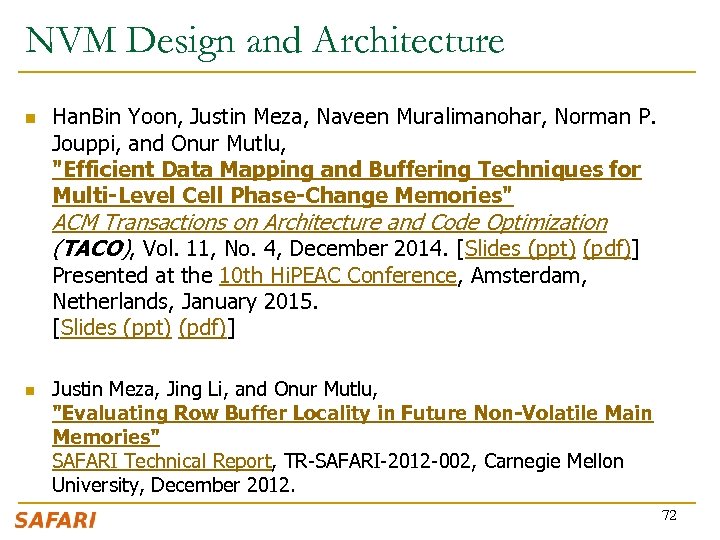 NVM Design and Architecture n Han. Bin Yoon, Justin Meza, Naveen Muralimanohar, Norman P. Jouppi, and Onur Mutlu, "Efficient Data Mapping and Buffering Techniques for Multi-Level Cell Phase-Change Memories" ACM Transactions on Architecture and Code Optimization (TACO), Vol. 11, No. 4, December 2014. [Slides (ppt) (pdf)] Presented at the 10 th Hi. PEAC Conference, Amsterdam, Netherlands, January 2015. [Slides (ppt) (pdf)] n Justin Meza, Jing Li, and Onur Mutlu, "Evaluating Row Buffer Locality in Future Non-Volatile Main Memories" SAFARI Technical Report, TR-SAFARI-2012 -002, Carnegie Mellon University, December 2012. 72
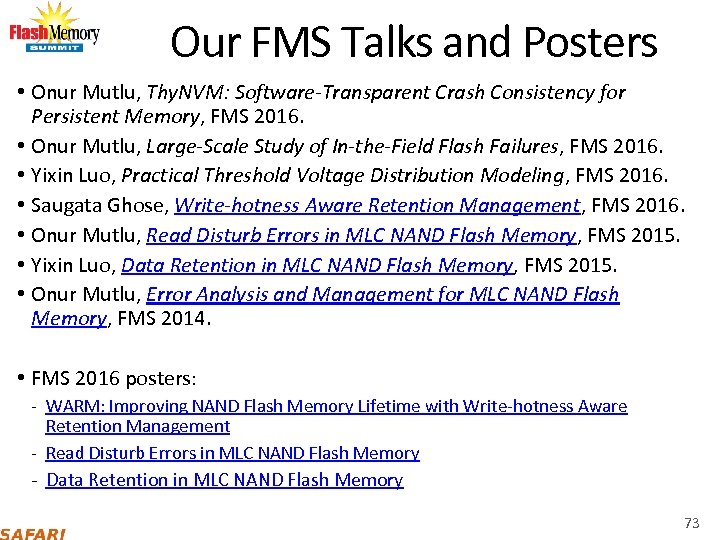 Our FMS Talks and Posters • Onur Mutlu, Thy. NVM: Software-Transparent Crash Consistency for Persistent Memory, FMS 2016. • Onur Mutlu, Large-Scale Study of In-the-Field Flash Failures, FMS 2016. • Yixin Luo, Practical Threshold Voltage Distribution Modeling, FMS 2016. • Saugata Ghose, Write-hotness Aware Retention Management, FMS 2016. • Onur Mutlu, Read Disturb Errors in MLC NAND Flash Memory, FMS 2015. • Yixin Luo, Data Retention in MLC NAND Flash Memory, FMS 2015. • Onur Mutlu, Error Analysis and Management for MLC NAND Flash Memory, FMS 2014. • FMS 2016 posters: ‐ WARM: Improving NAND Flash Memory Lifetime with Write‐hotness Aware Retention Management ‐ Read Disturb Errors in MLC NAND Flash Memory ‐ Data Retention in MLC NAND Flash Memory 73
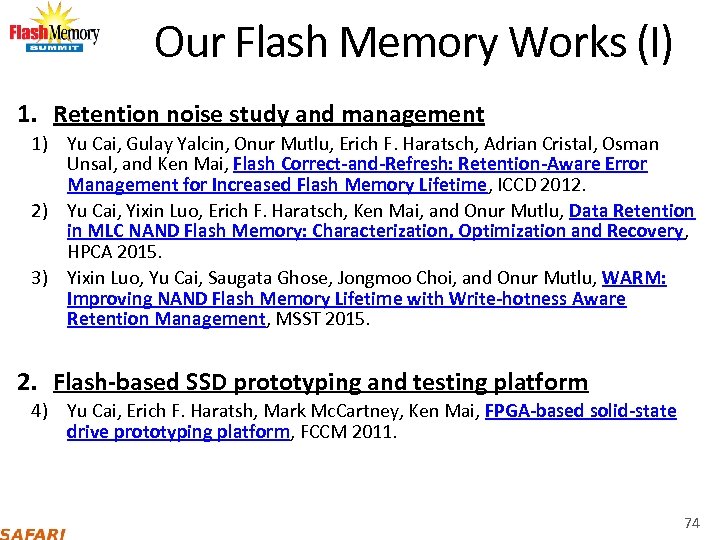 Our Flash Memory Works (I) 1. Retention noise study and management 1) Yu Cai, Gulay Yalcin, Onur Mutlu, Erich F. Haratsch, Adrian Cristal, Osman Unsal, and Ken Mai, Flash Correct-and-Refresh: Retention-Aware Error Management for Increased Flash Memory Lifetime, ICCD 2012. 2) Yu Cai, Yixin Luo, Erich F. Haratsch, Ken Mai, and Onur Mutlu, Data Retention in MLC NAND Flash Memory: Characterization, Optimization and Recovery, HPCA 2015. 3) Yixin Luo, Yu Cai, Saugata Ghose, Jongmoo Choi, and Onur Mutlu, WARM: Improving NAND Flash Memory Lifetime with Write-hotness Aware Retention Management, MSST 2015. 2. Flash-based SSD prototyping and testing platform 4) Yu Cai, Erich F. Haratsh, Mark Mc. Cartney, Ken Mai, FPGA-based solid-state drive prototyping platform, FCCM 2011. 74
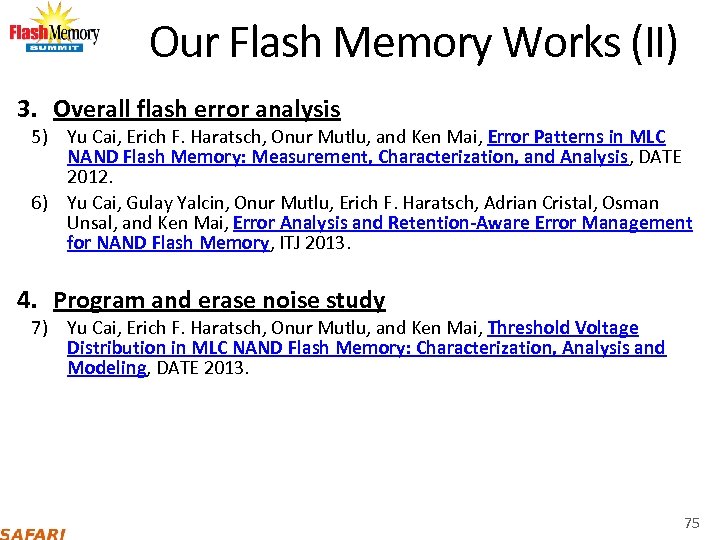 Our Flash Memory Works (II) 3. Overall flash error analysis 5) Yu Cai, Erich F. Haratsch, Onur Mutlu, and Ken Mai, Error Patterns in MLC NAND Flash Memory: Measurement, Characterization, and Analysis, DATE 2012. 6) Yu Cai, Gulay Yalcin, Onur Mutlu, Erich F. Haratsch, Adrian Cristal, Osman Unsal, and Ken Mai, Error Analysis and Retention-Aware Error Management for NAND Flash Memory, ITJ 2013. 4. Program and erase noise study 7) Yu Cai, Erich F. Haratsch, Onur Mutlu, and Ken Mai, Threshold Voltage Distribution in MLC NAND Flash Memory: Characterization, Analysis and Modeling, DATE 2013. 75
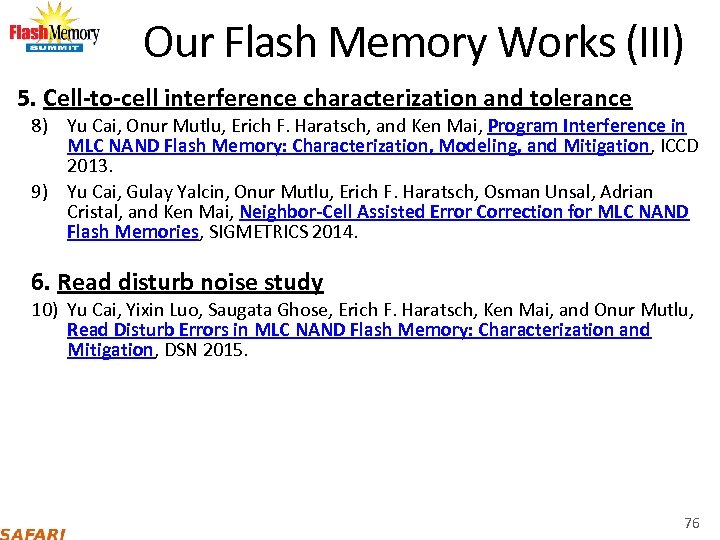 Our Flash Memory Works (III) 5. Cell-to-cell interference characterization and tolerance 8) Yu Cai, Onur Mutlu, Erich F. Haratsch, and Ken Mai, Program Interference in MLC NAND Flash Memory: Characterization, Modeling, and Mitigation, ICCD 2013. 9) Yu Cai, Gulay Yalcin, Onur Mutlu, Erich F. Haratsch, Osman Unsal, Adrian Cristal, and Ken Mai, Neighbor-Cell Assisted Error Correction for MLC NAND Flash Memories, SIGMETRICS 2014. 6. Read disturb noise study 10) Yu Cai, Yixin Luo, Saugata Ghose, Erich F. Haratsch, Ken Mai, and Onur Mutlu, Read Disturb Errors in MLC NAND Flash Memory: Characterization and Mitigation, DSN 2015. 76
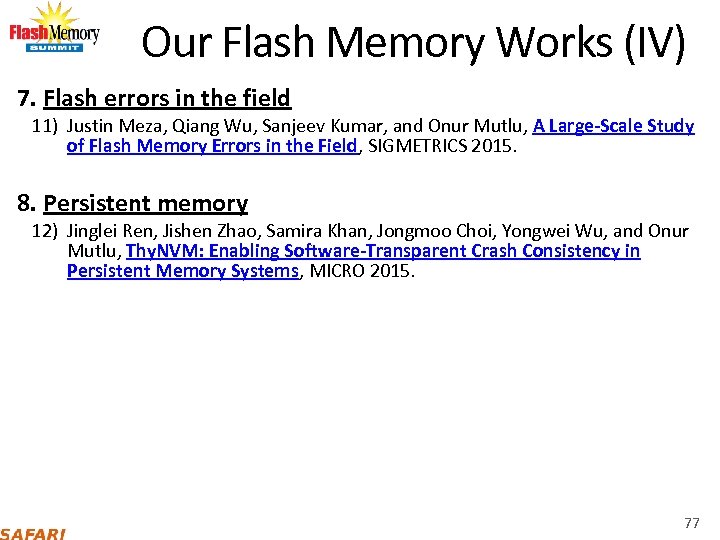 Our Flash Memory Works (IV) 7. Flash errors in the field 11) Justin Meza, Qiang Wu, Sanjeev Kumar, and Onur Mutlu, A Large-Scale Study of Flash Memory Errors in the Field, SIGMETRICS 2015. 8. Persistent memory 12) Jinglei Ren, Jishen Zhao, Samira Khan, Jongmoo Choi, Yongwei Wu, and Onur Mutlu, Thy. NVM: Enabling Software-Transparent Crash Consistency in Persistent Memory Systems, MICRO 2015. 77
 Referenced Papers and Talks n All are available at http: //users. ece. cmu. edu/~omutlu/projects. htm http: //users. ece. cmu. edu/~omutlu/talks. htm n And, many other previous works on NAND flash memory errors and management 78
 Related Videos and Course Materials n n n Undergraduate Computer Architecture Course Lecture Videos (2013, 2014, 2015) Undergraduate Computer Architecture Course Materials (2013, 2014, 2015) Graduate Computer Architecture Lecture Videos (2013, 2015) Parallel Computer Architecture Course Materials (Lecture Videos) Memory Systems Short Course Materials (Lecture Video on Main Memory and DRAM Basics) 79
 Additional Slides on Persistent Memory and NVM
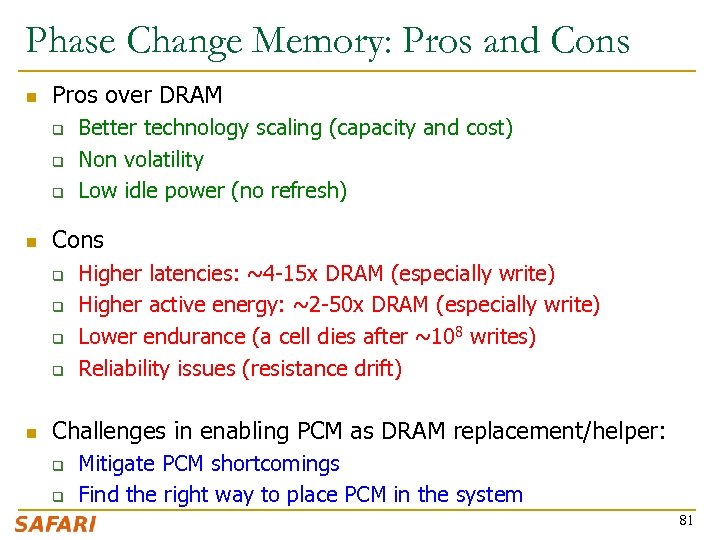 Phase Change Memory: Pros and Cons n Pros over DRAM q q q n Cons q q n Better technology scaling (capacity and cost) Non volatility Low idle power (no refresh) Higher latencies: ~4 -15 x DRAM (especially write) Higher active energy: ~2 -50 x DRAM (especially write) Lower endurance (a cell dies after ~108 writes) Reliability issues (resistance drift) Challenges in enabling PCM as DRAM replacement/helper: q q Mitigate PCM shortcomings Find the right way to place PCM in the system 81
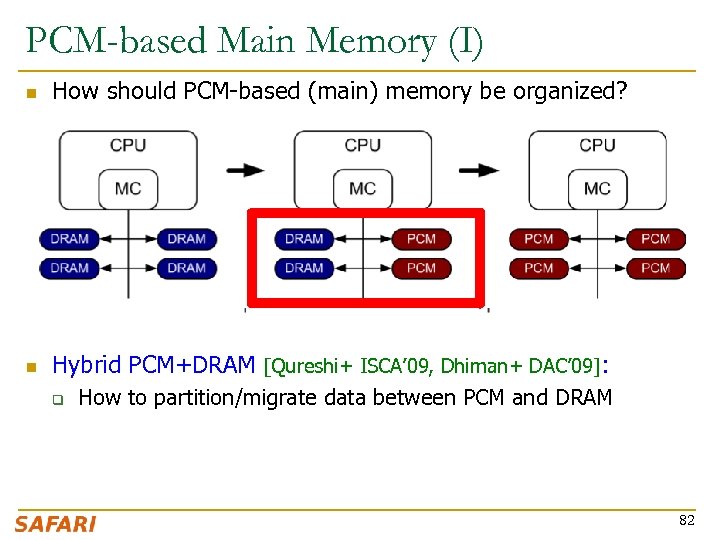 PCM-based Main Memory (I) n How should PCM-based (main) memory be organized? n Hybrid PCM+DRAM [Qureshi+ ISCA’ 09, Dhiman+ DAC’ 09]: q How to partition/migrate data between PCM and DRAM 82
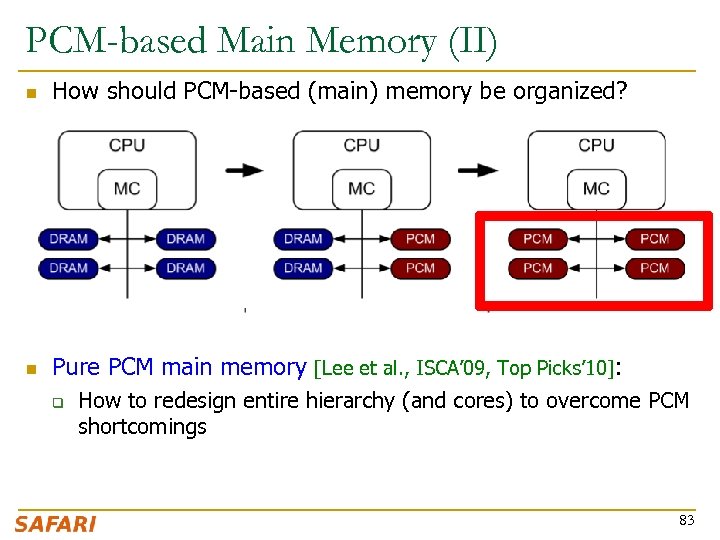 PCM-based Main Memory (II) n How should PCM-based (main) memory be organized? n Pure PCM main memory [Lee et al. , ISCA’ 09, Top Picks’ 10]: q How to redesign entire hierarchy (and cores) to overcome PCM shortcomings 83
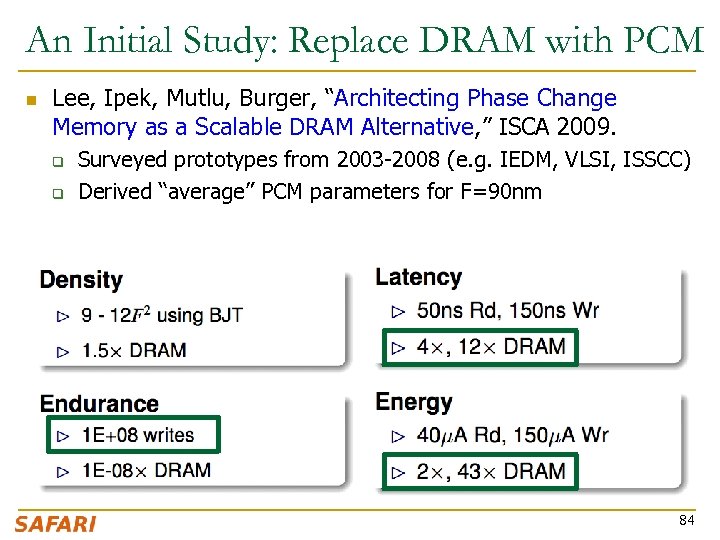 An Initial Study: Replace DRAM with PCM n Lee, Ipek, Mutlu, Burger, “Architecting Phase Change Memory as a Scalable DRAM Alternative, ” ISCA 2009. q q Surveyed prototypes from 2003 -2008 (e. g. IEDM, VLSI, ISSCC) Derived “average” PCM parameters for F=90 nm 84
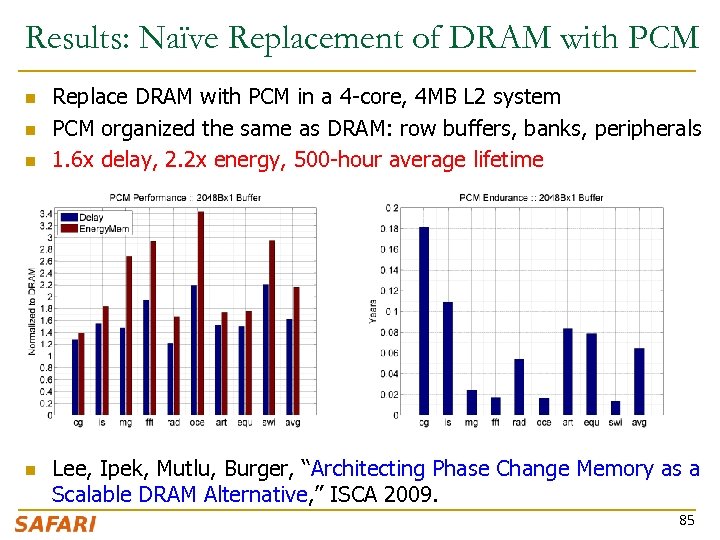 Results: Naïve Replacement of DRAM with PCM n n Replace DRAM with PCM in a 4 -core, 4 MB L 2 system PCM organized the same as DRAM: row buffers, banks, peripherals 1. 6 x delay, 2. 2 x energy, 500 -hour average lifetime Lee, Ipek, Mutlu, Burger, “Architecting Phase Change Memory as a Scalable DRAM Alternative, ” ISCA 2009. 85
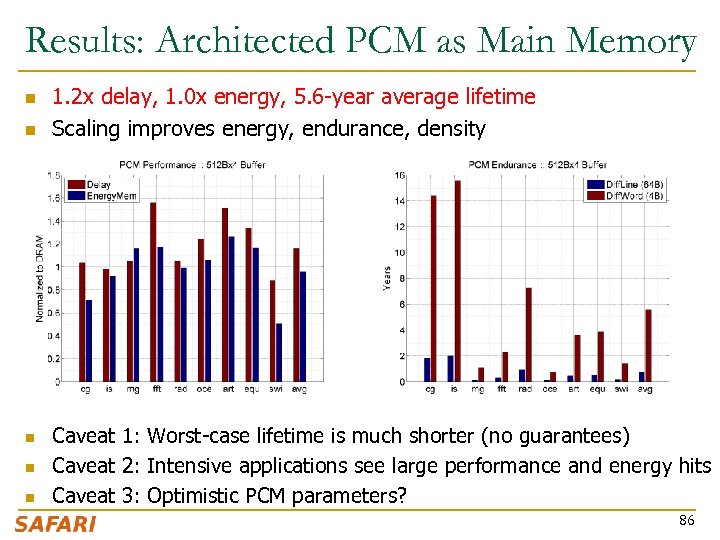 Results: Architected PCM as Main Memory n n n 1. 2 x delay, 1. 0 x energy, 5. 6 -year average lifetime Scaling improves energy, endurance, density Caveat 1: Worst-case lifetime is much shorter (no guarantees) Caveat 2: Intensive applications see large performance and energy hits Caveat 3: Optimistic PCM parameters? 86
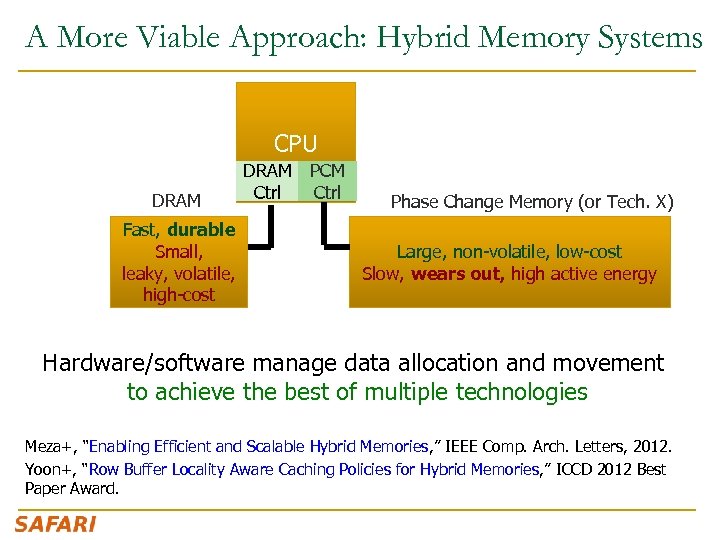 A More Viable Approach: Hybrid Memory Systems CPU DRAM Fast, durable Small, leaky, volatile, high-cost DRAM Ctrl PCM Ctrl Phase Change Memory (or Tech. X) Large, non-volatile, low-cost Slow, wears out, high active energy Hardware/software manage data allocation and movement to achieve the best of multiple technologies Meza+, “Enabling Efficient and Scalable Hybrid Memories, ” IEEE Comp. Arch. Letters, 2012. Yoon+, “Row Buffer Locality Aware Caching Policies for Hybrid Memories, ” ICCD 2012 Best Paper Award.
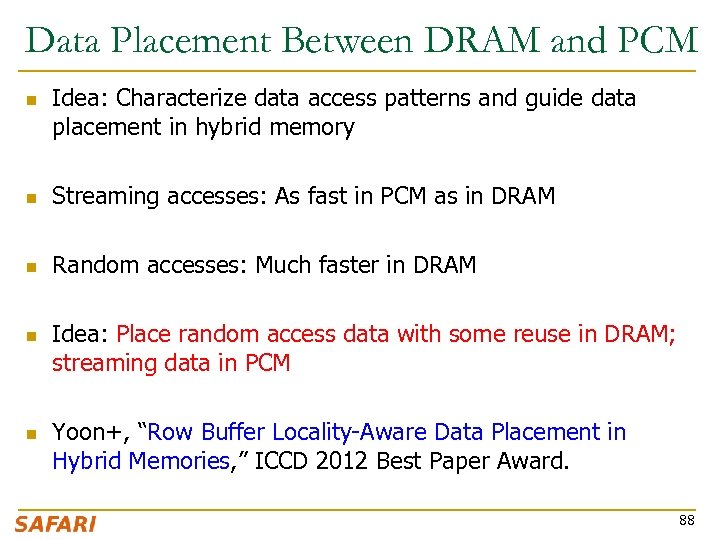 Data Placement Between DRAM and PCM n Idea: Characterize data access patterns and guide data placement in hybrid memory n Streaming accesses: As fast in PCM as in DRAM n Random accesses: Much faster in DRAM n n Idea: Place random access data with some reuse in DRAM; streaming data in PCM Yoon+, “Row Buffer Locality-Aware Data Placement in Hybrid Memories, ” ICCD 2012 Best Paper Award. 88
![Hybrid vs. All-PCM/DRAM [ICCD’ 12] 16 GB PCM 16 GB DRAM 2 1. 8](https://present5.com/presentation/387213957f3dc735dacac531c807be3a/image-89.jpg "Hybrid vs. All-PCM/DRAM [ICCD’ 12] 16 GB PCM 16 GB DRAM 2 1. 8") Hybrid vs. All-PCM/DRAM [ICCD’ 12] 16 GB PCM 16 GB DRAM 2 1. 8 1. 6 29% 1. 4 1. 2 31% 1 0. 8 0. 6 0. 4 31% better performance than all PCM, within 29% of all DRAM 0. 2 performance 0. 4 Weighted Speedup 0. 2 0 Normalized Max. Slowdown Normalized Weighted Speedup 2 1. 8 1. 6 1. 4 1. 2 1 0. 8 0. 6 0. 4 0. 2 0 RBLA-Dyn Max. Slowdown Normalized Metric 0 Perf. per Watt Yoon+, “Row Buffer Locality‐Aware Data Placement in Hybrid Memories, ” ICCD 2012 Best Paper Award.
Hybrid vs. All-PCM/DRAM [ICCD’ 12] 16 GB PCM 16 GB DRAM 2 1. 8 1. 6 29% 1. 4 1. 2 31% 1 0. 8 0. 6 0. 4 31% better performance than all PCM, within 29% of all DRAM 0. 2 performance 0. 4 Weighted Speedup 0. 2 0 Normalized Max. Slowdown Normalized Weighted Speedup 2 1. 8 1. 6 1. 4 1. 2 1 0. 8 0. 6 0. 4 0. 2 0 RBLA-Dyn Max. Slowdown Normalized Metric 0 Perf. per Watt Yoon+, “Row Buffer Locality‐Aware Data Placement in Hybrid Memories, ” ICCD 2012 Best Paper Award.
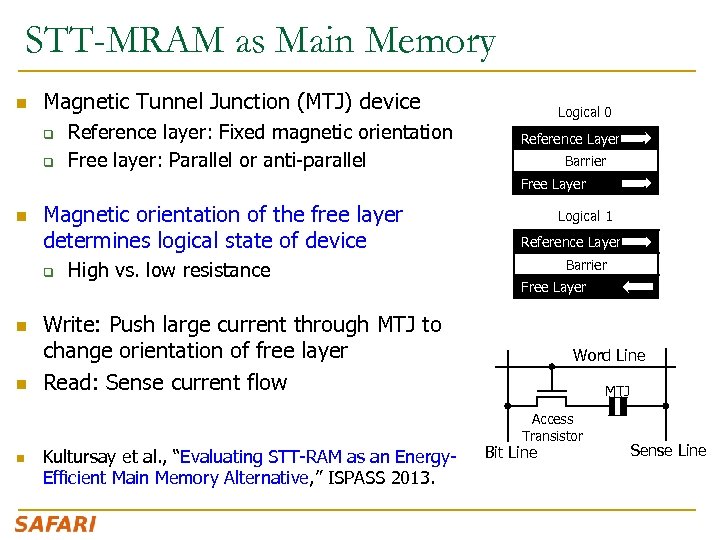 STT-MRAM as Main Memory n Magnetic Tunnel Junction (MTJ) device q q Reference layer: Fixed magnetic orientation Free layer: Parallel or anti-parallel Logical 0 Reference Layer Barrier Free Layer n Magnetic orientation of the free layer determines logical state of device q n n High vs. low resistance Logical 1 Reference Layer Barrier Free Layer Write: Push large current through MTJ to change orientation of free layer Read: Sense current flow Word Line MTJ Access Transistor n Kultursay et al. , “Evaluating STT-RAM as an Energy. Efficient Main Memory Alternative, ” ISPASS 2013. Bit Line Sense Line
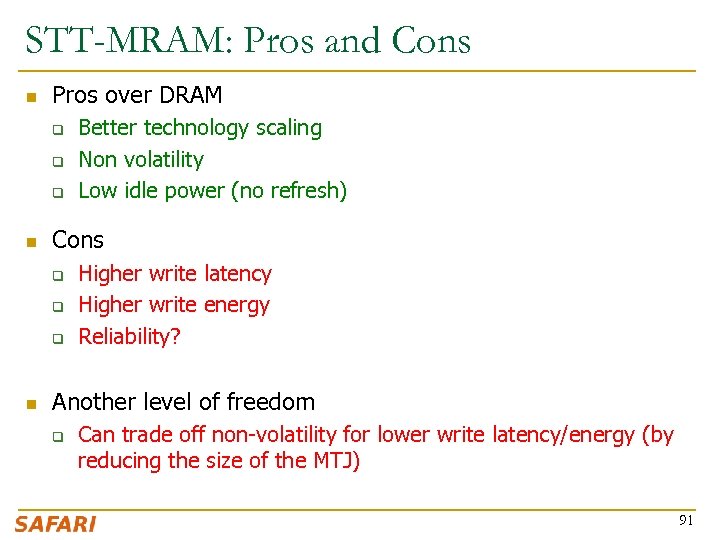 STT-MRAM: Pros and Cons n Pros over DRAM q q q n Cons q q q n Better technology scaling Non volatility Low idle power (no refresh) Higher write latency Higher write energy Reliability? Another level of freedom q Can trade off non-volatility for lower write latency/energy (by reducing the size of the MTJ) 91
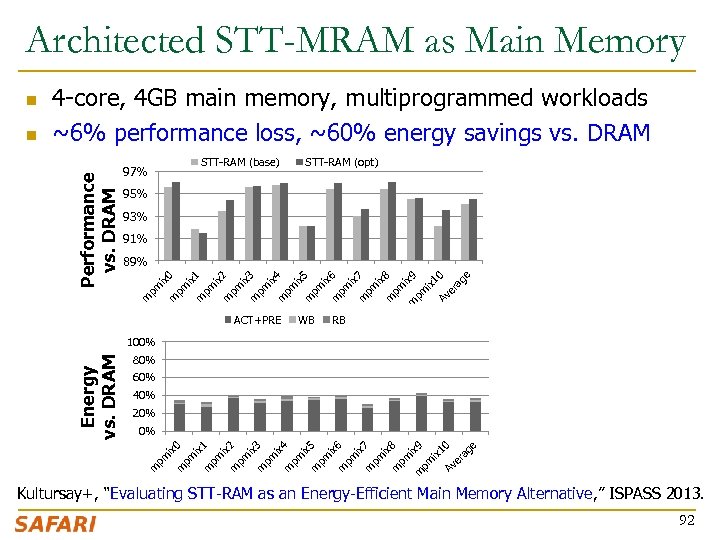 Architected STT-MRAM as Main Memory STT-RAM (base) 97% STT-RAM (opt) 95% 93% 91% 2 pm ix m 3 pm ix m 4 pm ix m 5 pm ix m 6 pm ix m 7 pm ix m 8 pm m ix 9 pm ix 1 Av 0 er ag e m ix 1 pm ix m pm m ix 0 89% m Performance vs. DRAM n 4 -core, 4 GB main memory, multiprogrammed workloads ~6% performance loss, ~60% energy savings vs. DRAM pm n ACT+PRE WB RB 80% 60% 40% 20% 1 Av 0 er ag e ix 9 ix m pm 8 ix m pm pm 7 ix m 6 pm ix m 5 pm ix m 4 ix m pm pm 3 ix m pm 2 m m pm ix ix pm m 1 0% 0 Energy vs. DRAM 100% Kultursay+, “Evaluating STT-RAM as an Energy-Efficient Main Memory Alternative, ” ISPASS 2013. 92
 Other Opportunities with Emerging Technologies n Merging of memory and storage q n New applications q n e. g. , ultra-fast checkpoint and restore More robust system design q n e. g. , a single interface to manage all data e. g. , reducing data loss Processing tightly-coupled with memory q e. g. , enabling efficient search and filtering 93
 Coordinated Memory and Storage with NVM (I) n The traditional two-level storage model is a bottleneck with NVM q q q Volatile data in memory a load/store interface Persistent data in storage a file system interface Problem: Operating system (OS) and file system (FS) code to locate, translate, buffer data become performance and energy bottlenecks with fast NVM stores Two-Level Store Load/Store Operating system and file system Virtual memory Address translation Main Memory fopen, fread, fwrite, … Processor and caches Persistent (e. g. , Phase-Change) Storage (SSD/HDD) Memory 94
 Coordinated Memory and Storage with NVM (II) n Goal: Unify memory and storage management in a single unit to eliminate wasted work to locate, transfer, and translate data q q Improves both energy and performance Simplifies programming model as well Unified Memory/Storage Persistent Memory Manager Load/Store Processor and caches Feedback Persistent (e. g. , Phase-Change) Memory Meza+, “A Case for Efficient Hardware-Software Cooperative Management of Storage and Memory, ” WEED 2013. 95
 The Persistent Memory Manager (PMM) n Exposes a load/store interface to access persistent data q n Manages data placement, location, persistence, security q n This can lead to overheads that need to be managed Exposes hooks and interfaces for system software q n To get the best of multiple forms of storage Manages metadata storage and retrieval q n Applications can directly access persistent memory no conversion, translation, location overhead for persistent data To enable better data placement and management decisions Meza+, “A Case for Efficient Hardware-Software Cooperative Management of Storage and Memory, ” WEED 2013. 96
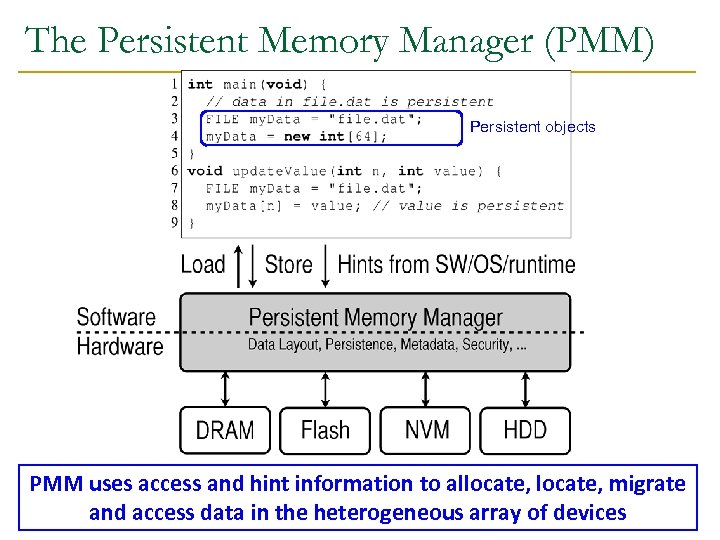 The Persistent Memory Manager (PMM) Persistent objects PMM uses access and hint information to allocate, migrate and access data in the heterogeneous array of devices 97
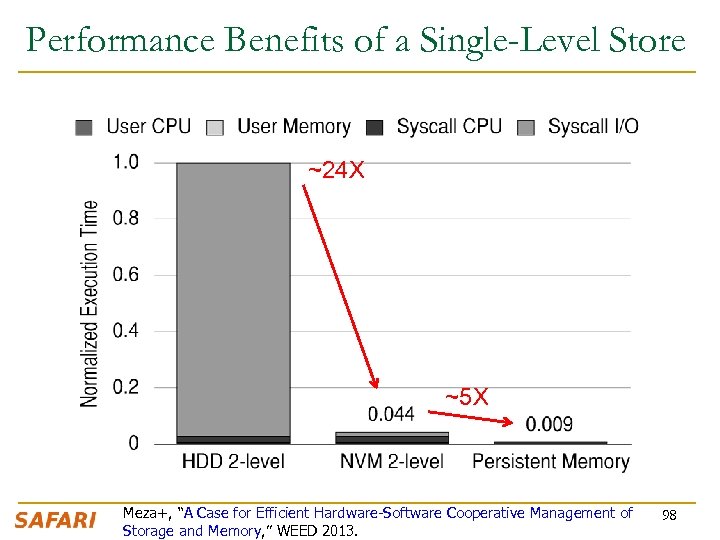 Performance Benefits of a Single-Level Store ~24 X ~5 X Meza+, “A Case for Efficient Hardware-Software Cooperative Management of Storage and Memory, ” WEED 2013. 98
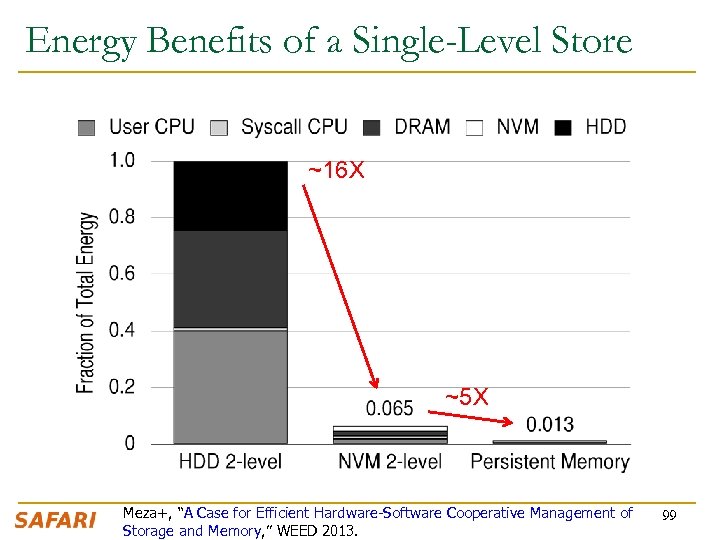 Energy Benefits of a Single-Level Store ~16 X ~5 X Meza+, “A Case for Efficient Hardware-Software Cooperative Management of Storage and Memory, ” WEED 2013. 99