 Скачать презентацию THUNDERBIRD Working in the World of Decision Support
5450efc62f4e051e821c973deb0fa154.ppt
- Количество слайдов: 40



THUNDERBIRD Working in the World of “Decision Support” Career Paths for Business Intelligence Skills Sets Professor Paul Kinsinger
Some Background… Ø 29 years of professional intelligence experience in the public and private sectors Ø First career was with the CIA’s analysis directorate Ø Eleven years consulting with private sector and teaching business intelligence at Thunderbird Ø Course is GB 5712—Business Intelligence and Corporate Security… 3 credit elective…taught every semester THUNDERBIRD
A Working Definition… Business intelligence is… a systematic, targeted and timely effort to collect, synthesize, and analyze information on the external operating environment in order to produce actionable insight. When combined with internal company information, it should give a manager as complete a picture as possible of the total decision making environment. THUNDERBIRD
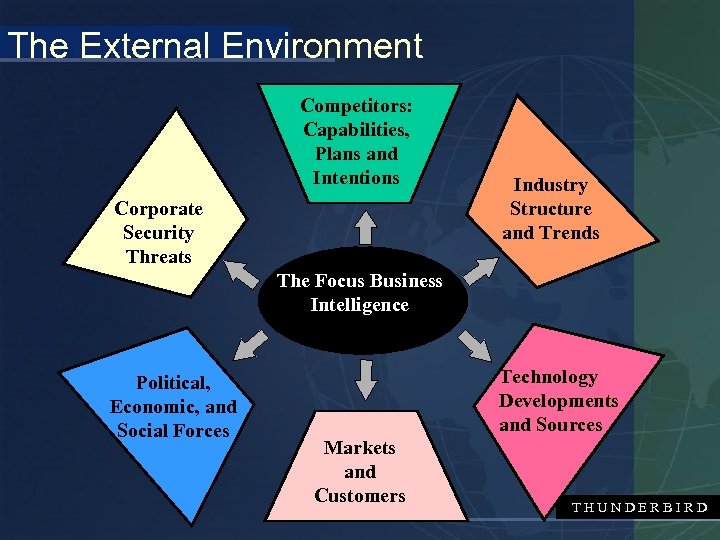
The External Environment Competitors: Capabilities, Plans and Intentions Corporate Security Threats Industry Structure and Trends The Focus Business Intelligence Political, Economic, and Social Forces Technology Developments and Sources Markets and Customers THUNDERBIRD
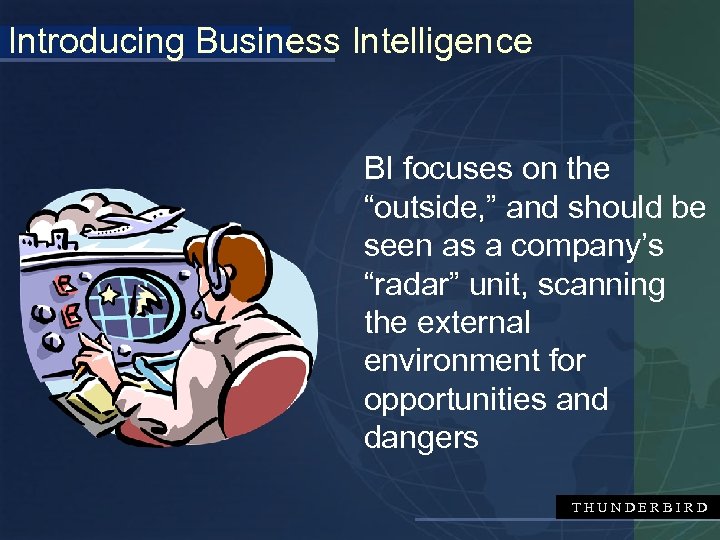
Introducing Business Intelligence BI focuses on the “outside, ” and should be seen as a company’s “radar” unit, scanning the external environment for opportunities and dangers THUNDERBIRD
It’s not just another term for Market Research…. “Good BI is broader in scope and more forward -looking than market research. ” THUNDERBIRD
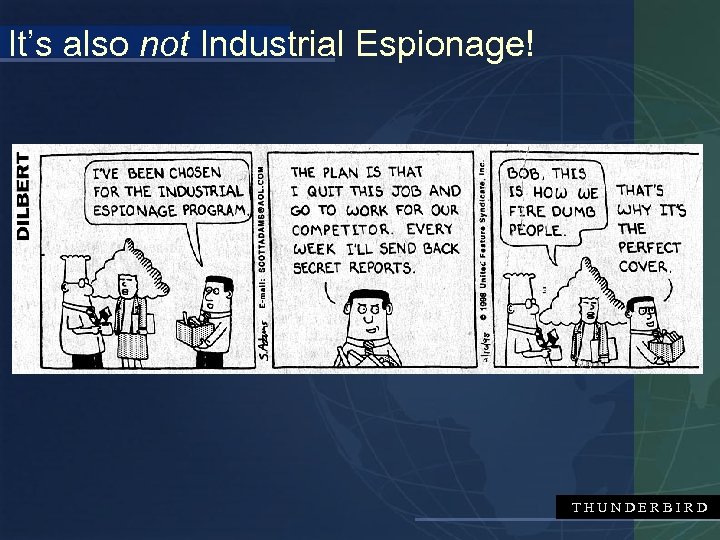
It’s also not Industrial Espionage! THUNDERBIRD
What Do Companies Use BI For? 1. Assessing Competitor(s) Strategies Øresponse to new product launch or new market entry Øbenchmarking best practices Øpredicting next moves Øevaluating a new entrant Øevaluating new leadership THUNDERBIRD
Assessing a Possible Merger for Merck • Assuming that the merger materializes, assess the potential new company formed between partner A and partner B – Profile of new company – Determine synergies – Identify and assess strengths and weaknesses • Analyze the impact of the potential new company on Merck • Recommend course of action for Merck THUNDERBIRD
What Do Companies Use BI For? 2. Defining A Competitive Landscape ØNew business doesn’t really know what it’s up against… Øothers that do exactly the same thing Østronger players thinking of entry Øthreatening new technologies THUNDERBIRD
What Do Companies Use BI For? 3. Discovering and Assessing Industry Trends ØWho Else is Doing What, and Why? ØAnything we can do, too? ØAnything we can do to leapfrog? ØAnything we can avoid? THUNDERBIRD
What Do Companies Use BI For? 4. Targeting Opportunities ØWho are the best partner prospects for us? ØWho are the best acquisition opportunities? ØWho should we be trying to sell to/merge with? THUNDERBIRD
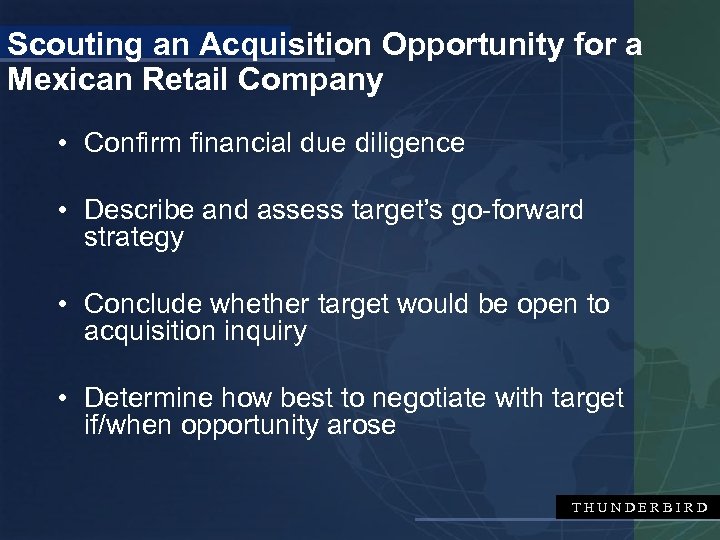
Scouting an Acquisition Opportunity for a Mexican Retail Company • Confirm financial due diligence • Describe and assess target’s go-forward strategy • Conclude whether target would be open to acquisition inquiry • Determine how best to negotiate with target if/when opportunity arose THUNDERBIRD
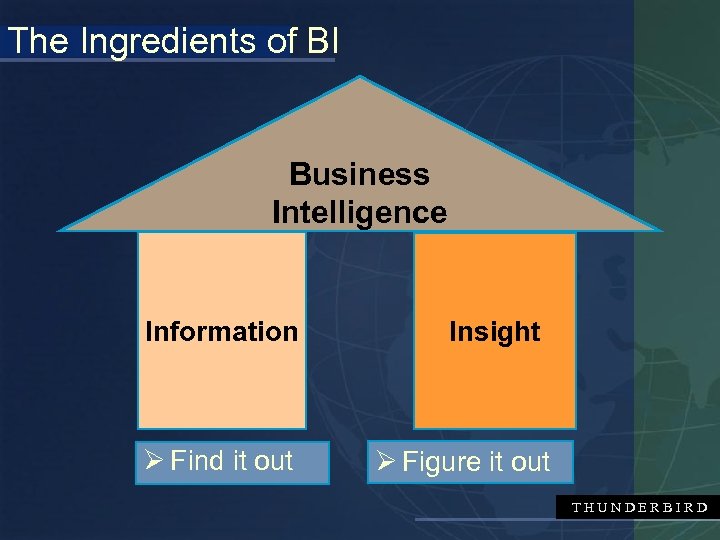
The Ingredients of BI Business Intelligence Information Ø Find it out Insight Ø Figure it out THUNDERBIRD
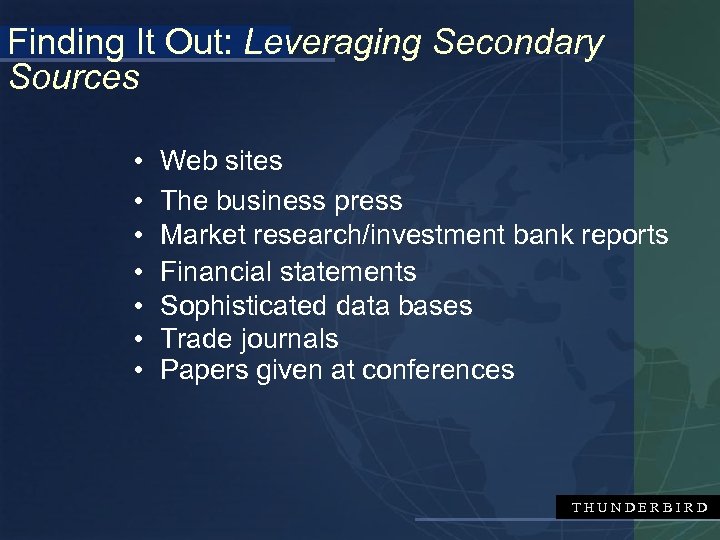
Finding It Out: Leveraging Secondary Sources • • Web sites The business press Market research/investment bank reports Financial statements Sophisticated data bases Trade journals Papers given at conferences THUNDERBIRD
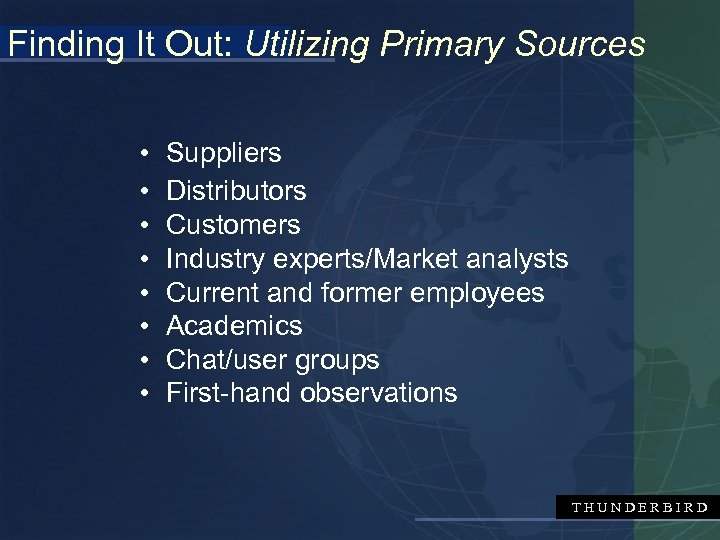
Finding It Out: Utilizing Primary Sources • • Suppliers Distributors Customers Industry experts/Market analysts Current and former employees Academics Chat/user groups First-hand observations THUNDERBIRD
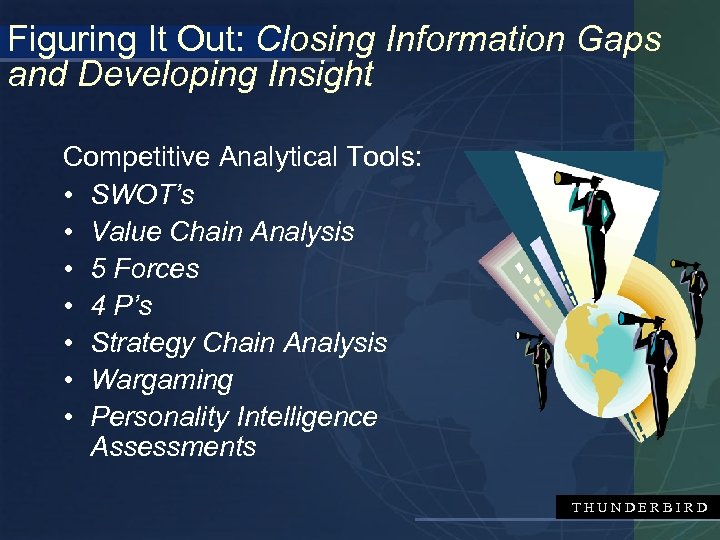
Figuring It Out: Closing Information Gaps and Developing Insight Competitive Analytical Tools: • SWOT’s • Value Chain Analysis • 5 Forces • 4 P’s • Strategy Chain Analysis • Wargaming • Personality Intelligence Assessments THUNDERBIRD
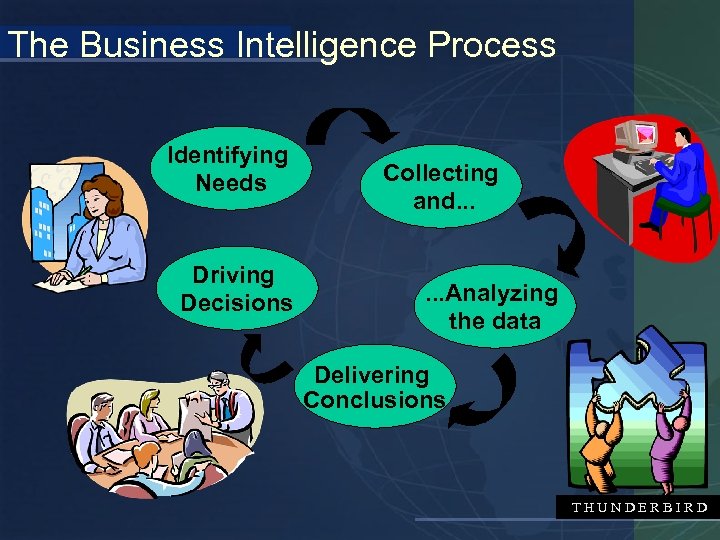
The Business Intelligence Process Identifying Needs Driving Decisions Collecting and. . . Analyzing the data Delivering Conclusions THUNDERBIRD
Careers in Business/Competitive Intelligence Key Resources: • The Society of Competitive Intelligence Professionals (SCIP)…@scip. org • 27 US chapters and 3 in Canada • 13 in Europe • 3 in Asia • 3 in Latin America • 1 in South Africa • Competitive Intelligence Magazine • SCIP. online THUNDERBIRD
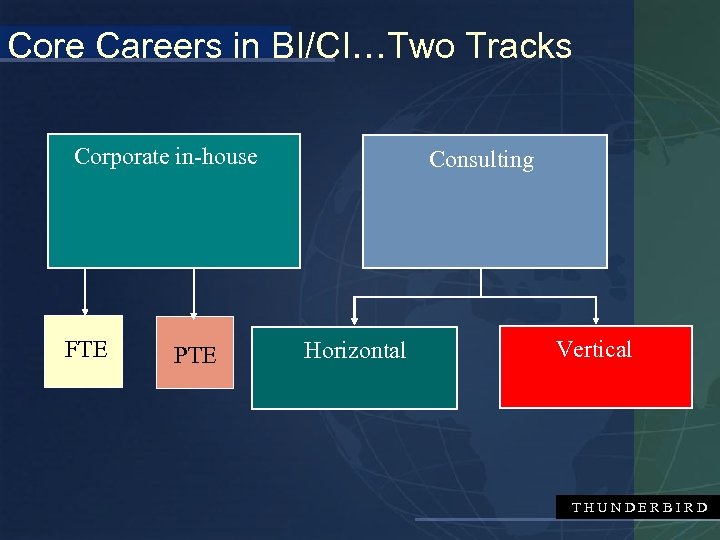
Core Careers in BI/CI…Two Tracks Corporate in-house FTE PTE Consulting Horizontal Vertical THUNDERBIRD
Companies where T-birds are doing “in-house” BI/CI • Ernst&Young • Unilever • American Express • Microsoft • Merck • ING • Flowserve THUNDERBIRD
“What do I like most about my job? ” “The best part of my job is the constant learning, the ability to stretch my brain on a regular basis…With the dynamics inside the professional services industry currently, as well as the overall business environment, there's tons of thought-provoking situations and opportunities…another aspect of my job I enjoy is access to the top layers of the organization and feeling like I can make a difference by helping our leadership think differently or more broadly about their decisions. ” Michelle Settecase, 1995, Ernst&Young THUNDERBIRD
“In reality CI is only one of many things I do” “The CEO, when I first started doing this back about three and a half years ago, implored me to give my reports some added value in the form of recommendations (“what does this all mean? ”). Since then, I always add actionable conclusions and recommendations. Ain’t always easy, but at the end of the day, I hear he loves it and that he thinks it’s some of the most important work we do. So, if for no other reason, it’s to assuage the concerns of the CEO, who worries that there could be a “ 2 X 4” coming out of nowhere to knock us on our ass. ” Chris Kenny, 2001, ING THUNDERBIRD
Consulting firms where T-birds are doing “in-house” BI/CI Proactive Worldwide Navigate International THUNDERBIRD
“What do you like most about your job? ” “I love learning about new industries, companies & countries and I love the variety. I never get bored with the research because I'm constantly learning something new. I love the fact that no two projects are ever the same, even if they are for the same client or within the same industry. ” --Ingrid Lee, 2003 Navigate Int’l “The diversity of the work; no two projects are the same. Having input on the decisions that executives make. When you’re on the phone with a division president or in the room with a client's executive committee and they begin to discuss how they are going to make changes based upon your research, it’s a thrill. ” --Chris O’Neill, 2000, Proactive Worldwide THUNDERBIRD
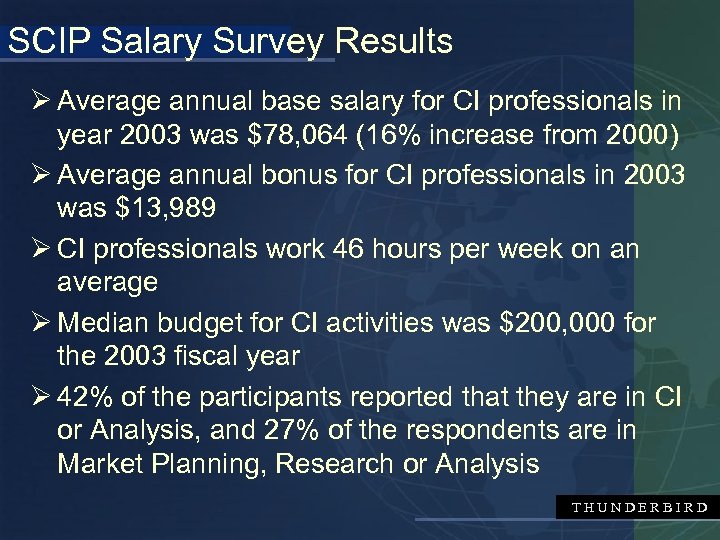
SCIP Salary Survey Results Ø Average annual base salary for CI professionals in year 2003 was $78, 064 (16% increase from 2000) Ø Average annual bonus for CI professionals in 2003 was $13, 989 Ø CI professionals work 46 hours per week on an average Ø Median budget for CI activities was $200, 000 for the 2003 fiscal year Ø 42% of the participants reported that they are in CI or Analysis, and 27% of the respondents are in Market Planning, Research or Analysis THUNDERBIRD
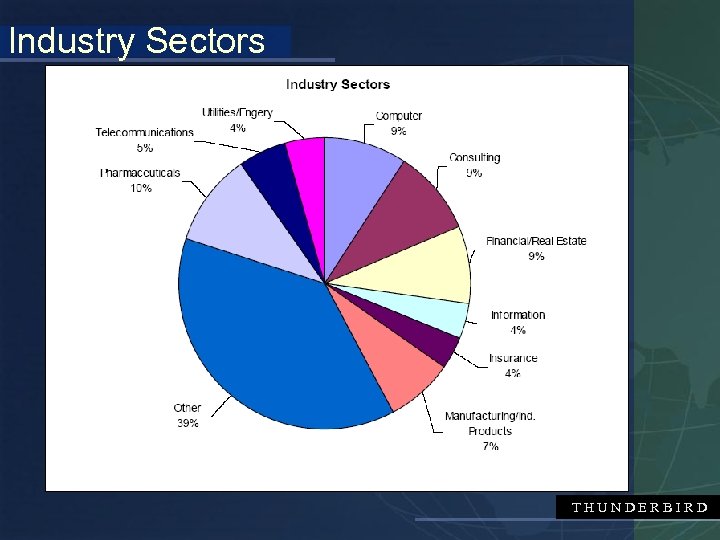
Industry Sectors THUNDERBIRD
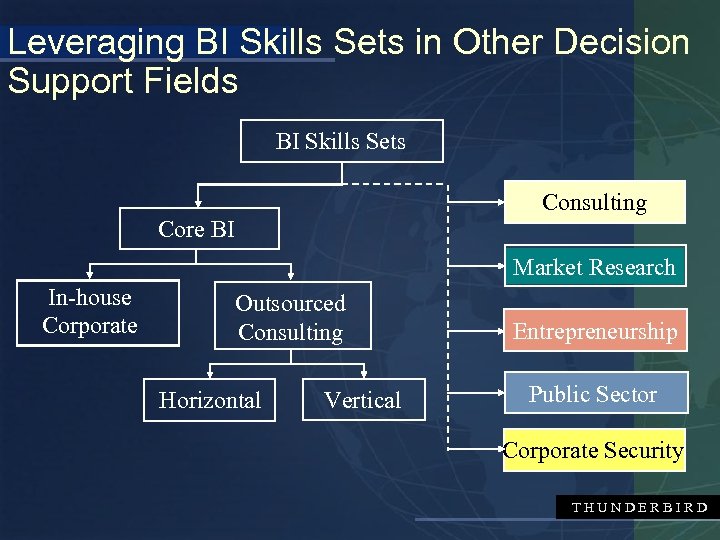
Leveraging BI Skills Sets in Other Decision Support Fields BI Skills Sets Consulting Core BI Market Research In-house Corporate Outsourced Consulting Horizontal Vertical Entrepreneurship Public Sector Corporate Security THUNDERBIRD
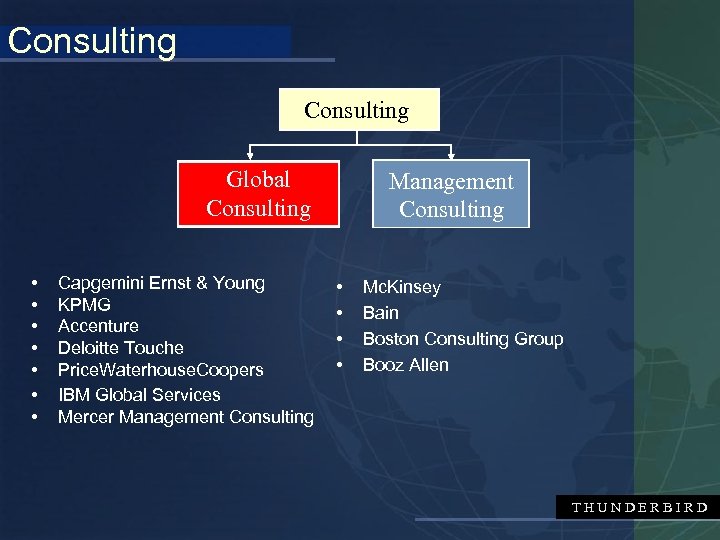
Consulting Global Consulting • • Capgemini Ernst & Young KPMG Accenture Deloitte Touche Price. Waterhouse. Coopers IBM Global Services Mercer Management Consulting • • Mc. Kinsey Bain Boston Consulting Group Booz Allen THUNDERBIRD
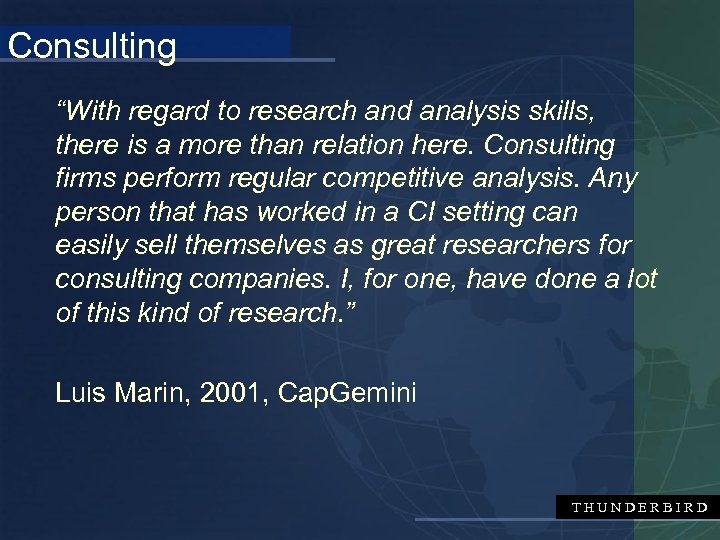
Consulting “With regard to research and analysis skills, there is a more than relation here. Consulting firms perform regular competitive analysis. Any person that has worked in a CI setting can easily sell themselves as great researchers for consulting companies. I, for one, have done a lot of this kind of research. ” Luis Marin, 2001, Cap. Gemini THUNDERBIRD
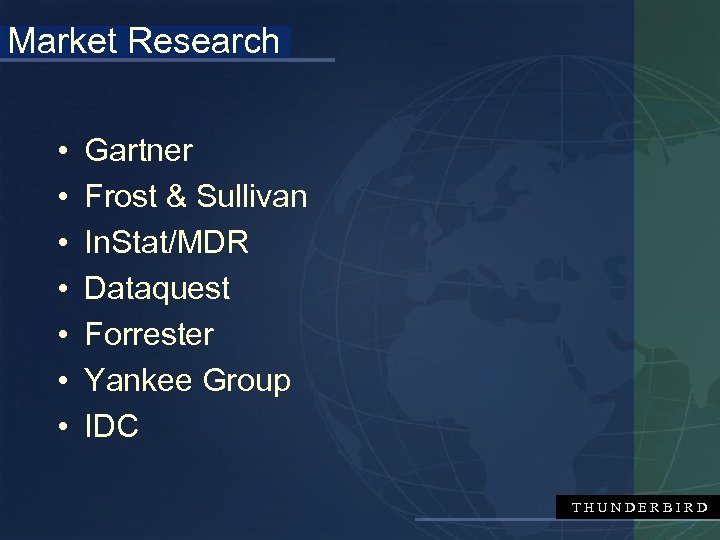
Market Research • • Gartner Frost & Sullivan In. Stat/MDR Dataquest Forrester Yankee Group IDC THUNDERBIRD
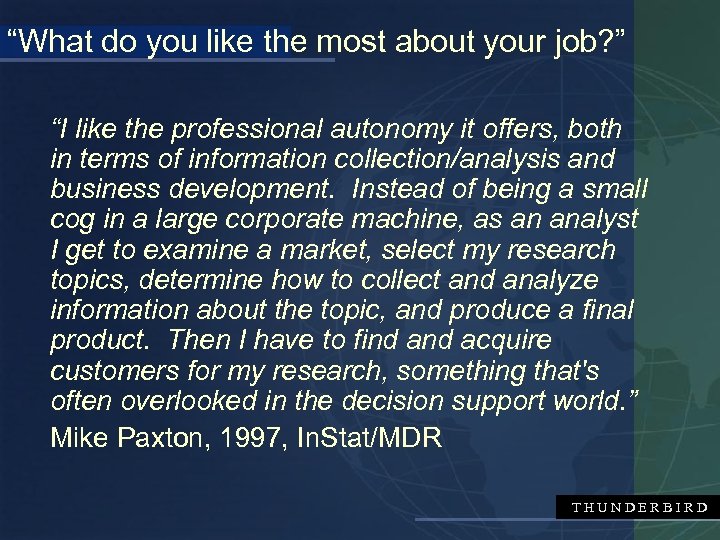
“What do you like the most about your job? ” “I like the professional autonomy it offers, both in terms of information collection/analysis and business development. Instead of being a small cog in a large corporate machine, as an analyst I get to examine a market, select my research topics, determine how to collect and analyze information about the topic, and produce a final product. Then I have to find acquire customers for my research, something that's often overlooked in the decision support world. ” Mike Paxton, 1997, In. Stat/MDR THUNDERBIRD
“What skills sets are the most important for your job? ” “Pattern recognition, highly conceptual thinking, the ability to digest large volumes of information rapidly, and the ability to project forward and extrapolate current conditions into likely future scenarios are the most important core personal characteristics needed, along with a strong sense of intellectual curiosity. Obviously, strong research skills are a must, such as being able to establish industry contacts and effectively utilize a wide range of information sources. A strong understanding of competitive strategy and how businesses and industries "work" is also a requisite skill. ” Sam Lucero, 2000, In. Stat/MDR THUNDERBIRD
“What skills sets are the most important for your job? ” “A high degree of analytical ability, a high degree of comfort with financial analysis coupled with vertical industry expertise. The "soft" skills (and I would classify them as being as important as the "hard" skills) would be presentation skills, as much of our job entails presenting to large audiences or C-level execs. Relationship building (brings in repeat business if the project is executed well) and last but not the least - diplomacy!” Arun Rao, 1996, Gartner THUNDERBIRD
“What skills sets are the most important for your job? ” • • • “Good interviewing skills and ability to "soften up" the interviewee so he/she shares more sensitive information Good writing skills and ability to write a paper of about 50150 pages that clearly defines concepts and ideas and presents a logical and coherent analysis of the current and future state of a certain market Ability to generalize and draw conclusions about market characteristics and trends based on secondary sources and facts and opinions shared by market participants Ability to extrapolate and develop unit and revenue forecast models based on current market size estimates and qualitative factors such as challenges, drivers, restraints, and market and technology trends Ability to correlate trends across various market segments” Elka Popova, 1999, Frost & Sullivan THUNDERBIRD
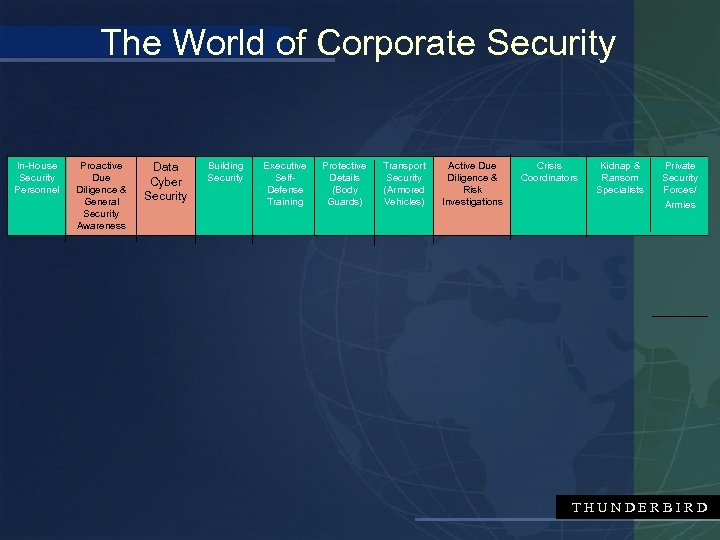
The World of Corporate Security In-House Security Personnel Proactive Due Diligence & General Security Awareness Data Cyber Security Building Security Executive Self. Defense Training Protective Details (Body Guards) Transport Security (Armored Vehicles) Active Due Diligence & Risk Investigations Crisis Coordinators Kidnap & Ransom Specialists Private Security Forces/ Armies THUNDERBIRD
Companies in this field where T-birds work: Ø Kroll Ø Control Risk Group Ø Hill & Associates Ø Spinelli Coprptation THUNDERBIRD
“What skills sets are the most important for your job? ” “What the forensics experts and investigators like most about their jobs would probably be developing investigation strategies to help resolve a client's problem or working with business people to develop solutions to their business issues. The most important skill sets in our companies are some technical expertise (e. g. . accounting, specifically a CFE designation or computer technology-an Encase certification), strong analytic skills, strong communication skills (much of the process is reiterative and the end product is either a written or oral report), and an ability to creatively approach problems. ” Helen Fenlon, 1983, Spinelli Corporation THUNDERBIRD
The Public Sector ØThe Foreign Service (Foreign Ministry) ØUS Commercial Service (Int’l Trade ministries) ØNational intelligence agencies ØMilitaries and the Department of Defense (Defense Ministry) ØDepartment of Energy ØDepartment of Homeland Security (Interior Ministry) THUNDERBIRD

Final Thoughts… “Your BI class, although one of the most challenging classes I took, turned out to be one of the most relevant to my professional experience since graduation. I have found to be very useful the basic approach to gathering relevant information, analyzing and making recommendations or decisions. As a financial professional, it may not be clear how BI interfaces with my everyday activities, but it is actually quite simplefinancial analysis is only as good as the assumptions used to arrive at the outcome; therefore, I have to constantly check the plausibility of these assumptions by engaging myself within the competitive environment, form opinions about trends, and most importantly, ask the right questions of my business partners. ” Valentine Aganbi, 2001, Unilever THUNDERBIRD
Скачать презентацию THUNDERBIRD Working in the World of Decision Support
5450efc62f4e051e821c973deb0fa154.ppt