


 Скачать презентацию Through the Lens of Cultural Awareness Planning Requirements
8774455e3431b21b13bf238ca8f62fde.ppt
- Количество слайдов: 78
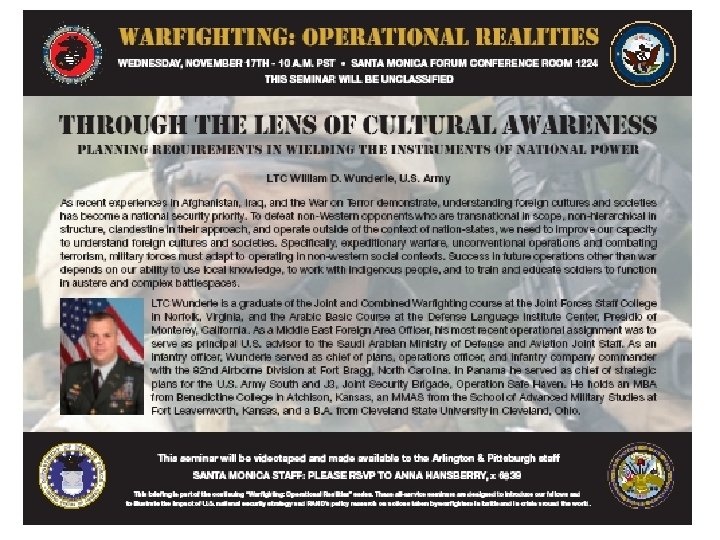
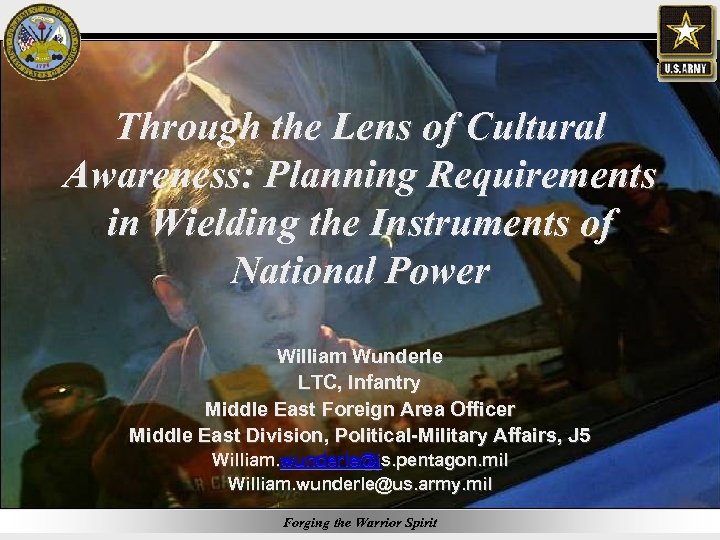 Through the Lens of Cultural Awareness: Planning Requirements in Wielding the Instruments of National Power William Wunderle LTC, Infantry Middle East Foreign Area Officer Middle East Division, Political-Military Affairs, J 5 William. wunderle@js. pentagon. mil William. wunderle@us. army. mil Forging the Warrior Spirit
 Bottom Line Up Front Ø To an American Soldier, culture can be likened to a minefield - dangerous ground that, if not breached, must be navigated with caution, understanding, and respect. Ø Cultural interpretation, competence, and adaptation are prerequisites for achieving a win-win relationship in any military operation. Ø Arabic culture in particular is very complex. Take the time to understand the intricacies of Arabic culture. “There are no true Middle East ‘experts, ’ only varying degrees of ignorance” Forging the Warrior Spirit
 Outline Ø Why understanding foreign cultures is important Ø Army cultural doctrine and training Ø Building cultural competence Ø Applying cultural competence to military operations Ø Conclusions Forging the Warrior Spirit
 The Need for Cultural Understanding Continues to Be Recognized by Our National Leaders Ø Vietnam "Our mutual ignorance was mind-boggling…we ascribed to them motives that didn't exist at all and capabilities that didn't exist at all. " Robert S. Mc. Namara Ø Operation Desert Storm “On January 9, 1991, the Foreign Minister of Iraq, Tariq Aziz, and the Secretary of State of the United States, James Baker, met in Geneva to attempt a last-minute compromise that would avoid a war…The Iraqis, however, paid less attention to what Baker said and most attention to how he said it. Hussein’s half-brother reported to Baghdad that ‘the Americans will not attack… They are weak. They are calm. They are not angry. They are only talking…’ Seven days later Operation Desert Storm began. ” H. C. Triandis Ø Somalia “… The lesson learned [in Somalia] that kept coming out was that we lacked cultural awareness. We needed cultural intelligence going in. ” Gen Anthony Zinni Forging the Warrior Spirit
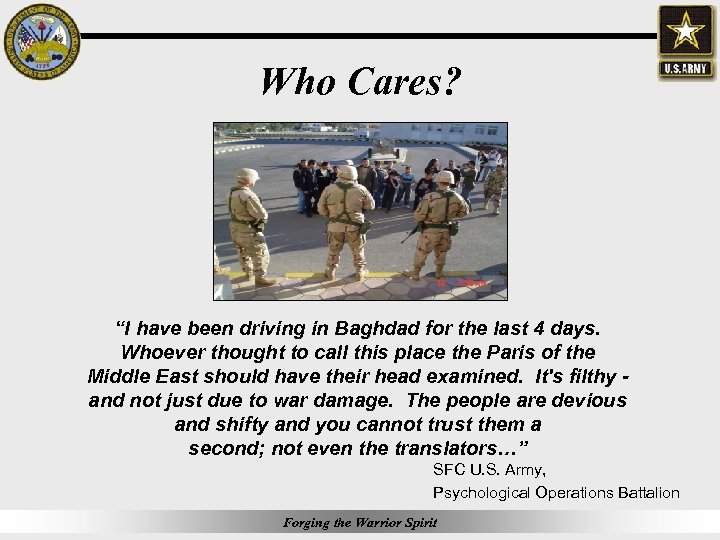 Who Cares? “I have been driving in Baghdad for the last 4 days. Whoever thought to call this place the Paris of the Middle East should have their head examined. It's filthy and not just due to war damage. The people are devious and shifty and you cannot trust them a second; not even the translators…” SFC U. S. Army, Psychological Operations Battalion Forging the Warrior Spirit
 “… if we had better understood the Iraqi culture and mindset, our war plans would have been even better than they were, [and] the plan for the post-war period and all of its challenges would have been far better…we must improve our cultural awareness…to inform the policy process. Our policies would benefit from this not only in Iraq, but…elsewhere, where we will have long-term strategic relationships and potential military challenges for many years to come. ” Ike Skelton, in a letter to Donald Rumsfeld, October 23, 2003 Forging the Warrior Spirit
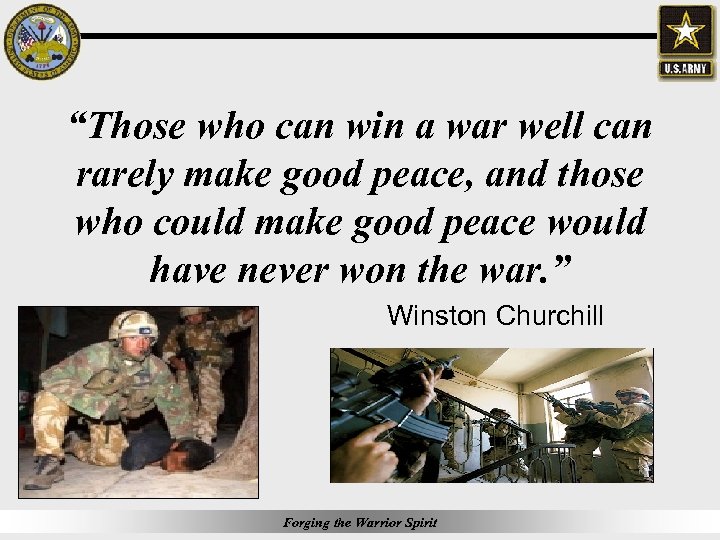 “Those who can win a war well can rarely make good peace, and those who could make good peace would have never won the war. ” Winston Churchill Forging the Warrior Spirit
 Outline Ø Why understanding foreign cultures is important Ø Army cultural doctrine and training Ø Building cultural competence Ø Applying cultural competence to military operations Ø Conclusions Forging the Warrior Spirit
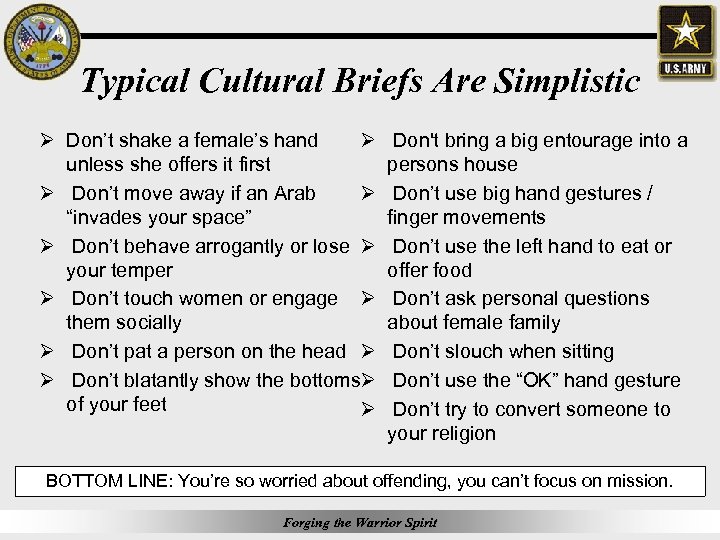 Typical Cultural Briefs Are Simplistic Ø Don’t shake a female’s hand Ø unless she offers it first Ø Don’t move away if an Arab Ø “invades your space” Ø Don’t behave arrogantly or lose Ø your temper Ø Don’t touch women or engage Ø them socially Ø Don’t pat a person on the head Ø Ø Don’t blatantly show the bottoms Ø of your feet Ø Don't bring a big entourage into a persons house Don’t use big hand gestures / finger movements Don’t use the left hand to eat or offer food Don’t ask personal questions about female family Don’t slouch when sitting Don’t use the “OK” hand gesture Don’t try to convert someone to your religion BOTTOM LINE: You’re so worried about offending, you can’t focus on mission. Forging the Warrior Spirit
 What Can We Do About This? You Won’t Find Answers In Doctrine provides guidance and methodology for completing the deliberate planning process. Ø Currently, U. S. Joint and Service doctrine does not stress the consideration of any type of cultural awareness and competence factors during the deliberate planning process. Ø When cultural factors are addressed in doctrine, it is usually in reference to working together with coalition partners and not specifically how cultural factors could affect enemy reaction and impacts on our selected COA. Forging the Warrior Spirit
 What We Really Need to Know… BOTTOM LINE: Cultural niceties are important but do not “check the box. ” Ø What is the enemy thinking and why? Ø What are my friends thinking and why? Ø What will they do if I take action X and why? Ø How are cultural issues impacting my operations? Ø How can I make them do what I want them to do? Forging the Warrior Spirit
 Outline Ø Why understanding foreign cultures is important Ø Army cultural doctrine and training Ø Building cultural competence ØWhat is culture? ØWhat is cultural competence? Ø Applying cultural competence to military operations Ø Conclusions Forging the Warrior Spirit
 What Do We Mean By Culture? The totality of socially transmitted behavior patterns, arts, beliefs, institutions, and all other products of human work and thought. The American Heritage Dictionary of the English Language, Fourth Edition Ø Culture is a shared set of traditions, belief systems, and behaviors. Culture is shaped by history, religion, ethnic identity, language and nationality, and evolves in response to various pressures and influences, and is learned through socialization…it is not inherent. “Culture is the ‘human terrain’ of warfare. Human terrain is key terrain. ” MG(Ret) Jeff Lambert Forging the Warrior Spirit
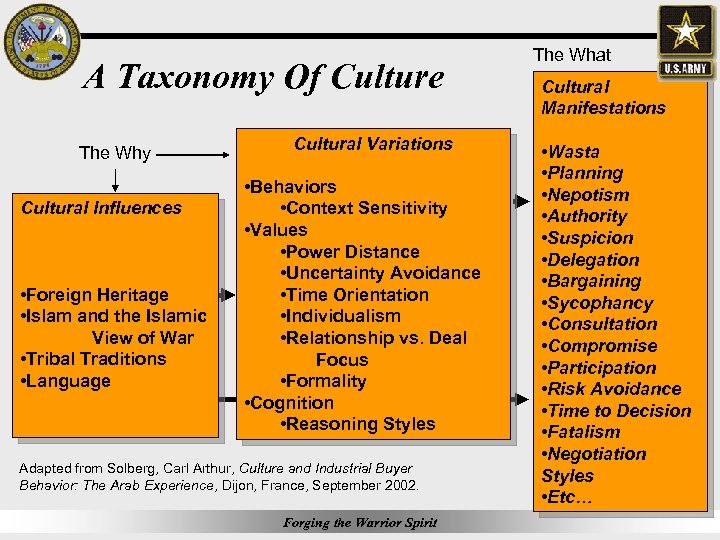 A Taxonomy Of Culture The Why Cultural Influences • Foreign Heritage • Islam and the Islamic View of War • Tribal Traditions • Language Cultural Variations • Behaviors • Context Sensitivity • Values • Power Distance • Uncertainty Avoidance • Time Orientation • Individualism • Relationship vs. Deal Focus • Formality • Cognition • Reasoning Styles Adapted from Solberg, Carl Arthur, Culture and Industrial Buyer Behavior: The Arab Experience, Dijon, France, September 2002. Forging the Warrior Spirit The What Cultural Manifestations • Wasta • Planning • Nepotism • Authority • Suspicion • Delegation • Bargaining • Sycophancy • Consultation • Compromise • Participation • Risk Avoidance • Time to Decision • Fatalism • Negotiation Styles • Etc…
 Cultural Influences Ø Influences on Arabic Culture ØForeign Heritage ØIslam, and Islamic Views of War ØTribal Traditions ØLanguage Forging the Warrior Spirit
 Views of Religion Ø The West: The basic unit of human organization is the nation. Ø In American usage, this is virtually synonymous with country. Ø This is then subdivided in various ways, one of which is by religion. Ø Muslims: Tend to see not a nation subdivided into religious groups, but a religion subdivided into nations. "Islam is not so much a religion as a form of life, not so much a theological system as a pattern for personal and social conduct based on an active consciousness of God. " Forging the Warrior Spirit
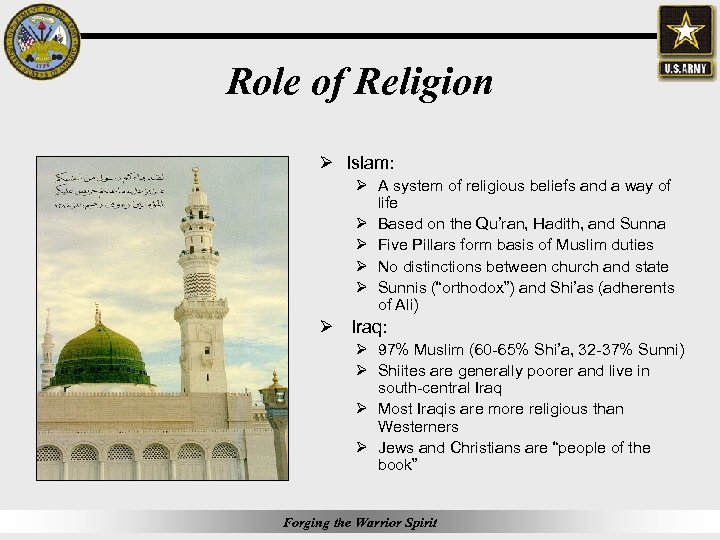 Role of Religion Ø Islam: Ø A system of religious beliefs and a way of life Ø Based on the Qu’ran, Hadith, and Sunna Ø Five Pillars form basis of Muslim duties Ø No distinctions between church and state Ø Sunnis (“orthodox”) and Shi’as (adherents of Ali) Ø Iraq: Ø 97% Muslim (60 -65% Shi’a, 32 -37% Sunni) Ø Shiites are generally poorer and live in south-central Iraq Ø Most Iraqis are more religious than Westerners Ø Jews and Christians are “people of the book” Forging the Warrior Spirit
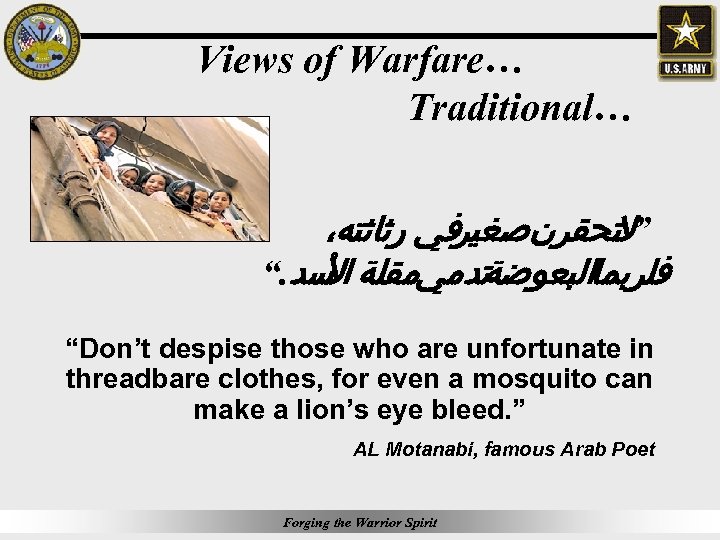 Views of Warfare… Traditional… ، ”ﻻﺗﺤﻘﺮﻥ ﺻﻐﻴﺮﻓﻲ ﺭﺛﺎﺛﺘﻪ “. ﻓﻠﺮﺑﻤﺎﺍﻟﺒﻌﻮﺿﺔﺗﺪﻣﻲﻣﻘﻠﺔ ﺴﺪ ﺍﻷ “Don’t despise those who are unfortunate in threadbare clothes, for even a mosquito can make a lion’s eye bleed. ” AL Motanabi, famous Arab Poet Forging the Warrior Spirit
 …And Islamic ﻓﺈﺫﺍﻟﻘﻴﺘﻢﺍﻟﺬﻳﻦ ﻛﻔﺮﻭﺍ ﻓﻀﺮﺏ ﺍﻟﺮﻗﺎﺏﺣﻴﻰ ﺇﺫﺍ ﻫﻢﻓﺸﺪﻭﺍﺍﻟﻮﺛﺎﻕﻓﺈﻣﺎ ﻣﻨﺎﺑﻌﺪ ﻭﺇﻣﺎﻓﺪﺍﺀ ﺃﺜﺨﻨﺘﻤﻮ ﺣﺘﻰ ﺗﻀﻊ ﺍﻟﺮﺣﺐ ﺃﻮﺯﺍﺭﻫﺎ “So when you meet in battle those who disbelieve, then smite the necks until when you have overcome them, then make prisoners, and afterwards either set them free as a favor or let them ransom themselves until the war terminates” Qur’an 47: 4 Forging the Warrior Spirit
 Leadership Sets Ø Determine leaders vs. decision-makers Ø Three sets of leaders: Ø Tribal: Sheikhs Ø Religious: Clerics Ø Civil/Administrative: Mayors, Police Chiefs, etc. Ø Sources of power and extent of authority will vary from group to group and from situation to situation. Forging the Warrior Spirit
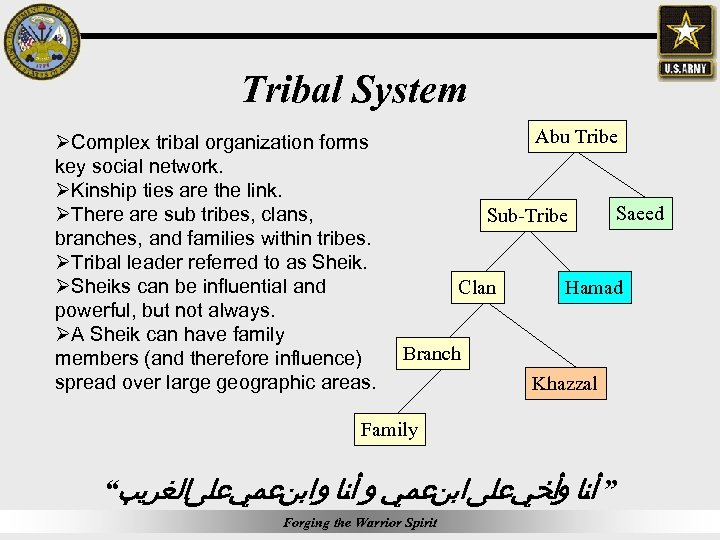 Tribal System ØComplex tribal organization forms key social network. ØKinship ties are the link. ØThere are sub tribes, clans, branches, and families within tribes. ØTribal leader referred to as Sheik. ØSheiks can be influential and powerful, but not always. ØA Sheik can have family members (and therefore influence) spread over large geographic areas. Abu Tribe Sub-Tribe Clan Saeed Hamad Branch Khazzal Family “ ” ﺃﻨﺎ ﻭﺃﺨﻲﻋﻠﻰ ﺍﺑﻦﻋﻤﻲ ﻭ ﺃﻨﺎ ﻭ ﺍﺑﻦﻋﻤﻲﻋﻠﻰﺍﻟﻐﺮﻳﺐ Forging the Warrior Spirit
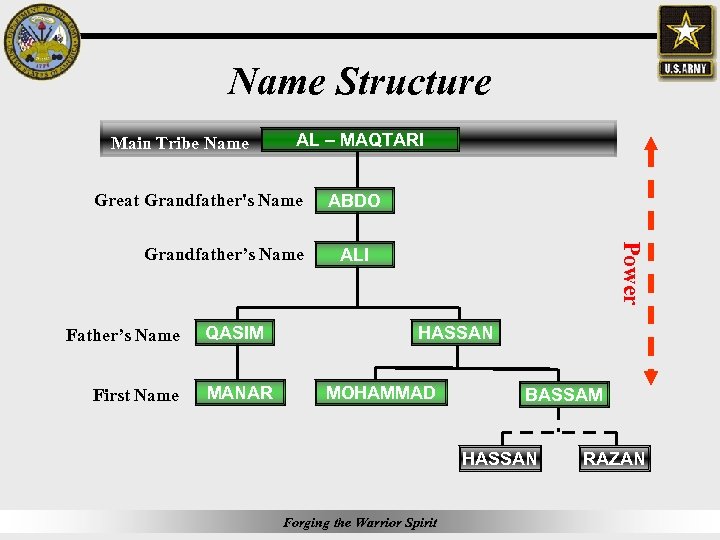 Name Structure Main Tribe Name AL – MAQTARI Great Grandfather's Name Father’s Name First Name QASIM MANAR Power Grandfather’s Name ABDO ALI HASSAN MOHAMMAD BASSAM HASSAN Forging the Warrior Spirit RAZAN
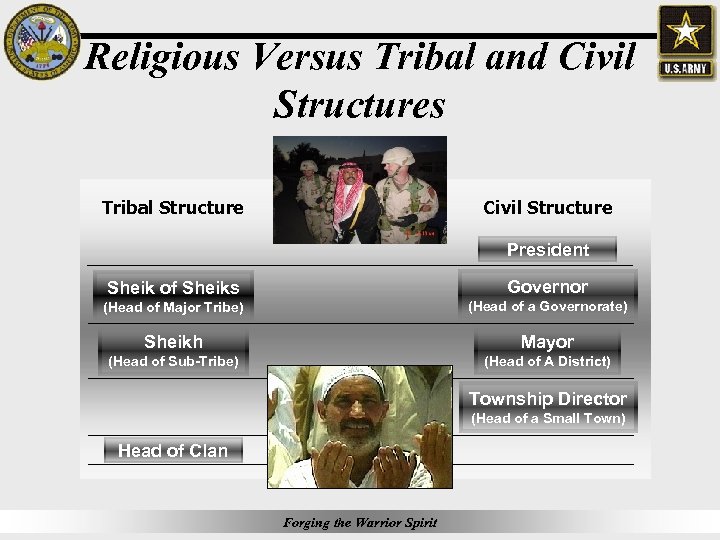 Religious Versus Tribal and Civil Structures Tribal Structure Civil Structure President Sheik of Sheiks Governor (Head of Major Tribe) (Head of a Governorate) Sheikh Mayor (Head of Sub-Tribe) (Head of A District) Township Director (Head of a Small Town) Head of Clan Forging the Warrior Spirit
 Language Ø Arabic is spoken in more than 21 countries and throughout the Arabian Peninsula. Ø It is the first language of over 208 million people, and at least another 35 million speak it as a second language. Ø Arabic is the language of Islam. It is the liturgical language of about one billion Muslims throughout the world. Ø Modern Standard Arabic (MSA) is the official language throughout the Arab world and, in its written form, is relatively consistent across national boundaries. Forging the Warrior Spirit
 Cultural Variations Forging the Warrior Spirit
 Behaviors The outward, observable artifacts (including structures and institutions of a culture) Ø Languages, Customs, Dress, Religion: The normal definition for these. Ø Language Styles -Context Sensitivity: Cultures that emphasize the surrounding circumstances (or context) make extensive use of body language and take the time to build relationships and establish trust. Ø Personal Space: The region around an individual, within which it is considered taboo (to varying degrees) for another individual to enter that space. Forging the Warrior Spirit
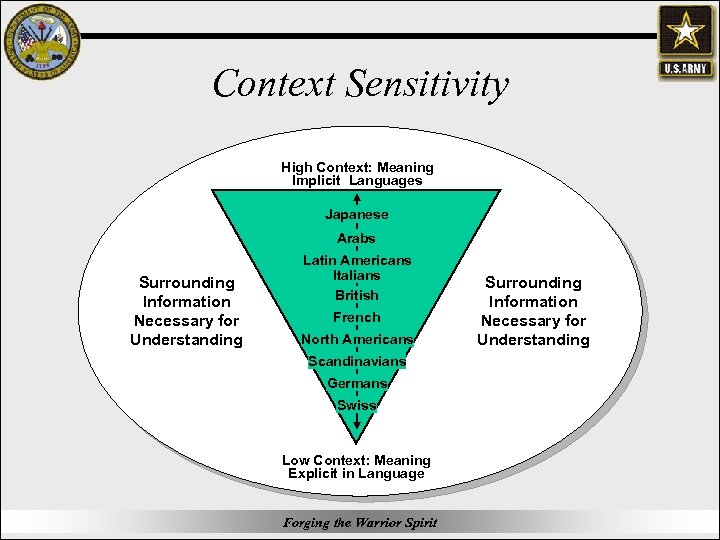 Context Sensitivity High Context: Meaning Implicit Languages Japanese Arabs Surrounding Information Necessary for Understanding Latin Americans Italians British French North Americans Scandinavians Germans Swiss Low Context: Meaning Explicit in Language Forging the Warrior Spirit Surrounding Information Necessary for Understanding
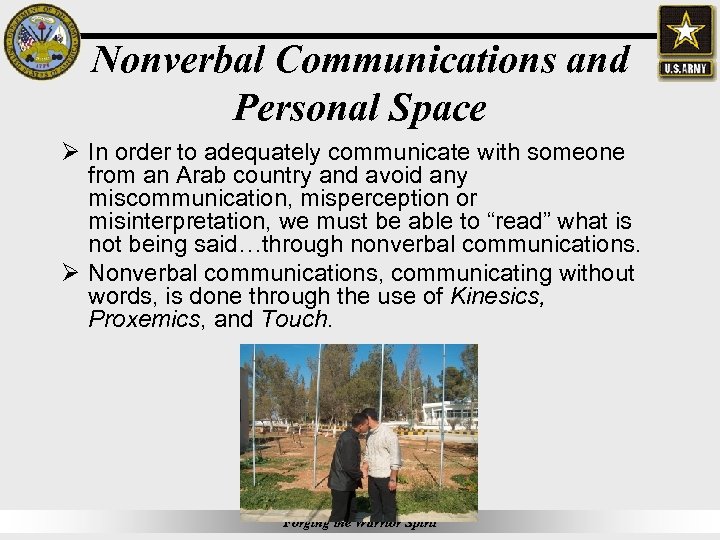 Nonverbal Communications and Personal Space Ø In order to adequately communicate with someone from an Arab country and avoid any miscommunication, misperception or misinterpretation, we must be able to “read” what is not being said…through nonverbal communications. Ø Nonverbal communications, communicating without words, is done through the use of Kinesics, Proxemics, and Touch. Forging the Warrior Spirit
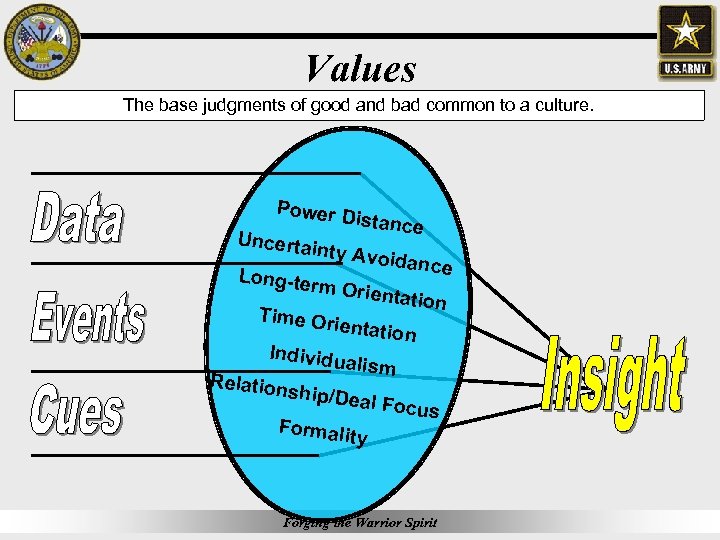 Values The base judgments of good and bad common to a culture. Power D i Uncerta Long-te stance inty Avo idance rm Orien tation Time Or ientation Individu Relation alism ship/De Formali al Focus ty Forging the Warrior Spirit
 Power Distance The acceptable difference of power between a superior and a subordinate Ø Power distance can be defined as “the extent to which the less powerful members of society accept and expect that power is distributed unequally. ” Ø In high power distance countries, the people are more concerned with status. Subordinates are perceived as afraid and they usually have to agree with their superiors’ decisions. Ø In low power distance countries, employees prefer a “consultative” manager and managers take subordinates’ suggestions into consideration when they make a decision, Forging the Warrior Spirit
 Uncertainty Avoidance The value an individual attaches to a perceived risk - how much an individual experiences uncertainty as stressful, and how much they avoid it. Ø Uncertainty avoidance deals with a society's tolerance for uncertainty and ambiguity. It indicates to what extent a culture programs its members to feel either uncomfortable or comfortable in unstructured situations. Ø Arabs tend to feel threatened by uncertainty and ambiguity, thus try to avoid these situations. Ø This is closely related to the dual concepts of “honor” and “saving face. ” Ø Simply stated, saving face means that neither party in a given interaction should suffer embarrassment. This concept often makes it difficult for an Arab to say “no” to a request because it would be impolite. They are reluctant to offend others - even if they intentionally mislead them instead. Thus, a “yes” to an Arab might mean, “Yes, I understand you” rather than “Yes, I agree. ” Ø Because of this, it is essential to be able to read between the lines because what is left unsaid or unwritten may be just as important as what is said or written. Forging the Warrior Spirit
 Long-Term Orientation Ø Long-term Orientation is defined as the fostering of virtues oriented toward future rewards - in particular, perseverance and thrift. Ø Short-Term Orientation fosters virtues related to the past and present - in particular, respect for tradition, preservation of "face", and fulfilling social obligations. Forging the Warrior Spirit
 Time Orientation Whether the individual is focused on the past, present, or future in making decisions. Ø Americans are very time-conscious and very precise about appointments, while Arab cultures tend to be more casual about time. Ø For example, if your Arab host tells you that he will meet with you at 1500 hours, he most likely means “ - ”ﺈﻥ ﺷﺎﺀ ﺍﻟﻠﻪ inshallah (Arabic for “If God wills, as God pleases”). Ø Middle Eastern cultures tend to favor long negotiations and slow deliberations. Ø They exchange pleasantries at some length before getting down to business. Ø Arabs use silent intervals for contemplation, whereas Americans seem to have little tolerance for silence during negotiations. Forging the Warrior Spirit
 Individualism vs. Collectivism Cultures in which people see themselves first as individuals and believe that their own interests take priority. Ø American culture is a typical example of individualism. Ø Once the kids grow up, they are expected to leave the parents and live on their own. Ø They typically do not assume the responsibility of taking care of their parents. Ø In collective societies, everyone belongs to a certain group. Ø This group protects its “members” and expects their loyalty in return. Ø In individualistic cultures, individuals are more taskoriented as compared to collectivism cultures. Forging the Warrior Spirit
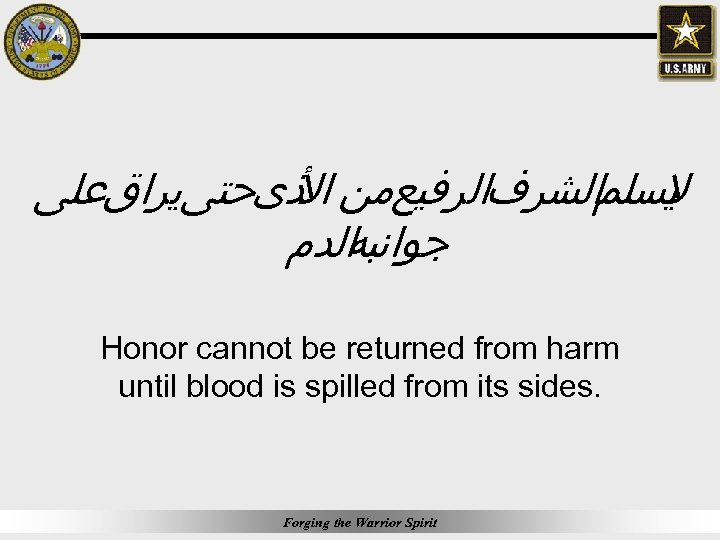 ﻳﺴﻠﻢﺍﻟﺸﺮﻑﺍﻟﺮﻓﻴﻊﻣﻦ ﺬﻯﺣﺘﻰﻳﺮﺍﻕﻋﻠﻰ ﺍﻷ ﻻ ﺍﻟﺪﻡ ﺟﻮﺍﻧﺒﻪ Honor cannot be returned from harm until blood is spilled from its sides. Forging the Warrior Spirit
 Relationship vs. Deal Focus Refers to the importance of personal relationships in conducting business and negotiations. Ø Relationship-focused people prefer to do business with friends, families, and persons well known to them. Ø They always want to know their business partners very well before talking business with them. Ø The business relationship is based on trust, and networking is very essential for doing business in these countries. Ø Deal-focused cultures are relatively open to do business with strangers. To them, business has nothing to do with their private life. Forging the Warrior Spirit
 Formality Cultures that attach considerable importance to tradition, ceremony, social rules, and rank. Ø Compared to traditional American culture, Arabs value and respect a much more formal approach to business dealings and negotiations. Ø Call your counterparts by their titles and family names unless specifically asked to do otherwise. Ø Most of the Arab world can be categorized as a formal business culture. Ø Respect is very important in a formal business culture. How you address a person is one of the important ways to show your respect. Forging the Warrior Spirit
 Cognition The preference based strategies used in decision-making, perception, and knowledge representation Ø Dialectical Reasoning: Whether options are delineated to show their differences, or whether those options are merged to maintain possibly contradictory perspectives. Ø Hypothetical Reasoning: Whether the individual uses hypothetical (imagined) circumstances to show implications of actions, or grounding analysis in context and experience. Ø Counterfactual Reasoning: Whether the individual uses counterfactual (untrue, explicitly opposite what is known to be true) circumstances to show implications of actions. Ø Perception: The tendency for people to perceive objects in a scene as relating to other objects in that scene. Ø Attribution: How people of different cultures attribute causality across cultures. Forging the Warrior Spirit
 Cultural Manifestations Ø Wasta Ø Planning Ø Nepotism Ø Authority Ø Suspicion Ø Delegation Ø Bargaining Ø Sycophancy Ø Consultation Ø Compromise Ø Participation Ø Fatalism Ø Risk Avoidance Ø Time to Decision Ø Privileged Relations Ø Negotiation Styles Ø Etc… Forging the Warrior Spirit
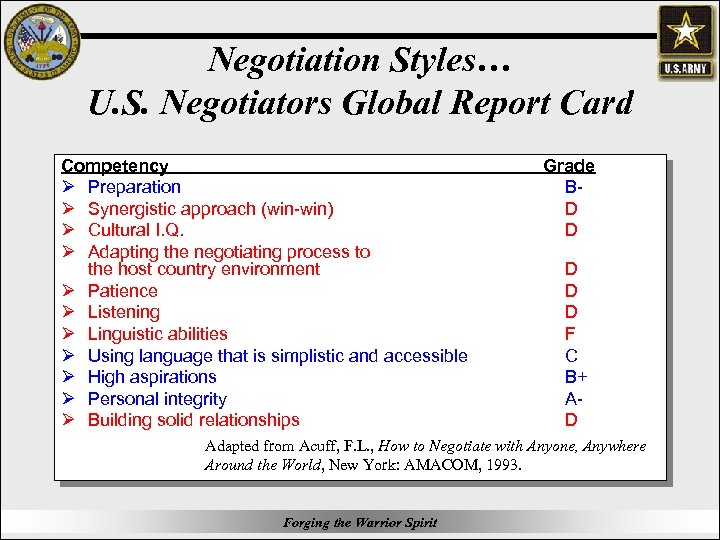 Negotiation Styles… U. S. Negotiators Global Report Card Competency Grade Ø Preparation BØ Synergistic approach (win-win) D Ø Cultural I. Q. D Ø Adapting the negotiating process to the host country environment D Ø Patience D Ø Listening D Ø Linguistic abilities F Ø Using language that is simplistic and accessible C Ø High aspirations B+ Ø Personal integrity AØ Building solid relationships D Adapted from Acuff, F. L. , How to Negotiate with Anyone, Anywhere Around the World, New York: AMACOM, 1993. Forging the Warrior Spirit
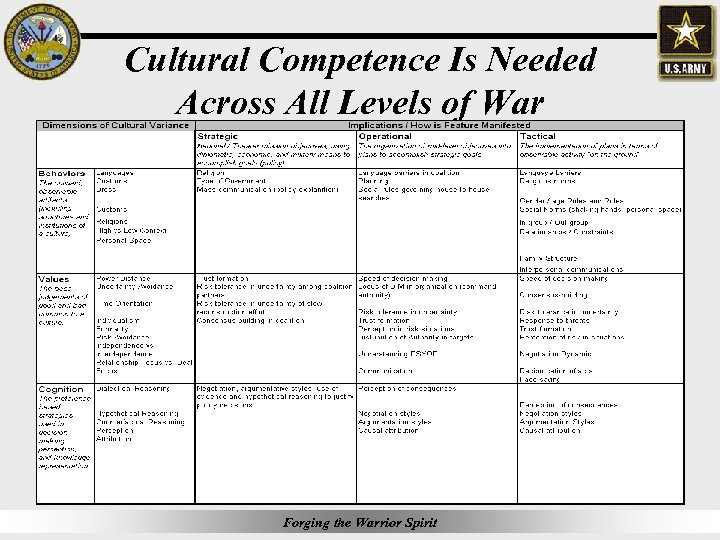 Cultural Competence Is Needed Across All Levels of War Forging the Warrior Spirit
 Outline Ø Why understanding foreign cultures is important Ø Army cultural doctrine and training Ø Building cultural competence ØWhat is culture? ØAchieving cultural competence? Ø Applying cultural competence to military operations Ø Conclusions Forging the Warrior Spirit
 Achieving Cultural Competence “Cultural and religious ignorance of allies and enemies negatively impact coalition coherence, mask enemy and expose friendly centers of gravity, delay or deter operational success, and influence conflict termination…” Calvin F. Swain Jr. Forging the Warrior Spirit
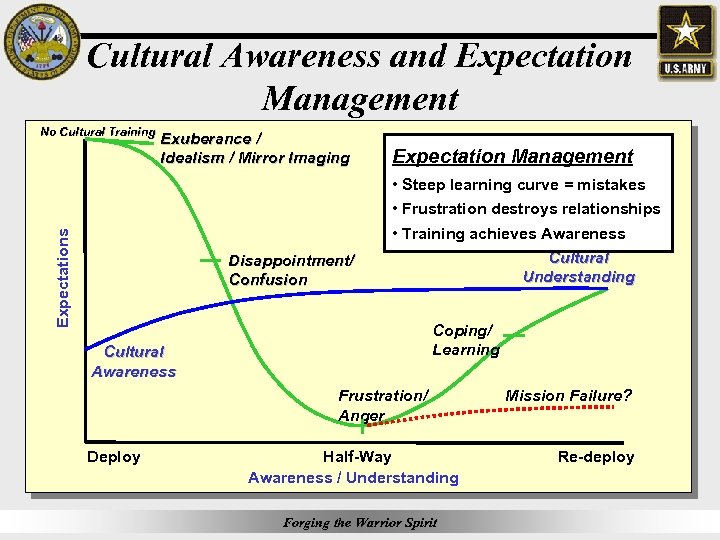 Cultural Awareness and Expectation Management No Cultural Training Exuberance / Idealism / Mirror Imaging Expectation Management • Steep learning curve = mistakes Expectations • Frustration destroys relationships Disappointment/ Confusion • Training achieves Awareness Cultural Understanding Coping/ Learning Cultural Awareness Frustration/ Anger Deploy Half-Way Awareness / Understanding Forging the Warrior Spirit Mission Failure? Re-deploy
 “An army of strangers in the midst of strangers. ” LTG David Petraeus Commander, Multinational Security Transition Command This cultural wall must be torn down. Lives depend on it. Forging the Warrior Spirit
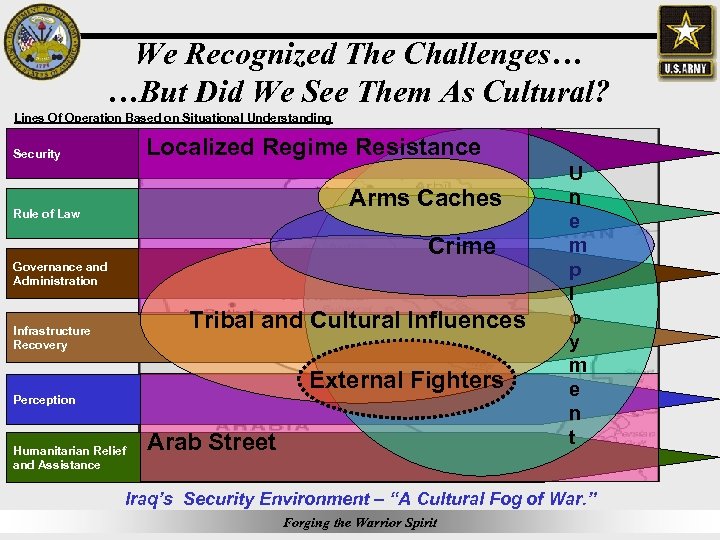 We Recognized The Challenges… …But Did We See Them As Cultural? Lines Of Operation Based on Situational Understanding Localized Regime Resistance Security Arms Caches Rule of Law Crime Governance and Administration Tribal and Cultural Influences Infrastructure Recovery External Fighters Perception Humanitarian Relief and Assistance Arab Street U n e m p l o y m e n t Iraq’s Security Environment – “A Cultural Fog of War. ” Forging the Warrior Spirit
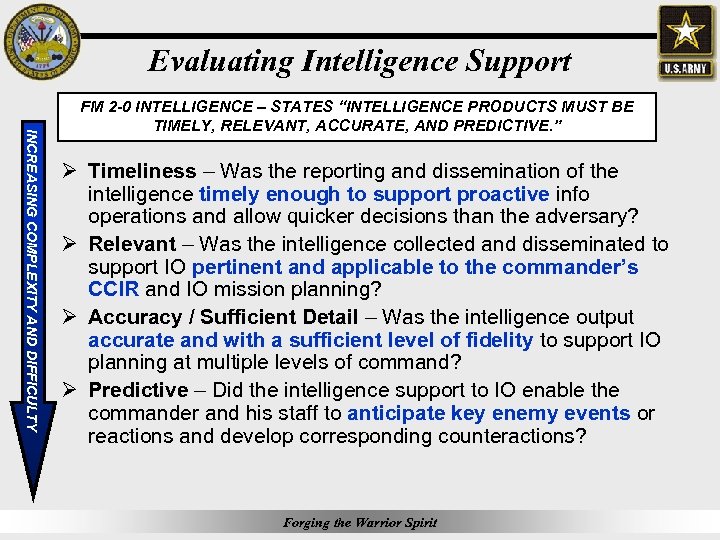 Evaluating Intelligence Support INCREASING COMPLEXITY AND DIFFICULTY FM 2 -0 INTELLIGENCE – STATES “INTELLIGENCE PRODUCTS MUST BE TIMELY, RELEVANT, ACCURATE, AND PREDICTIVE. ” Ø Timeliness – Was the reporting and dissemination of the intelligence timely enough to support proactive info operations and allow quicker decisions than the adversary? Ø Relevant – Was the intelligence collected and disseminated to support IO pertinent and applicable to the commander’s CCIR and IO mission planning? Ø Accuracy / Sufficient Detail – Was the intelligence output accurate and with a sufficient level of fidelity to support IO planning at multiple levels of command? Ø Predictive – Did the intelligence support to IO enable the commander and his staff to anticipate key enemy events or reactions and develop corresponding counteractions? Forging the Warrior Spirit
 Situational Awareness…But Of The Wrong Enemy “I knew where every enemy tank was dug in on the outskirts of [the city]…The only problem was, my soldiers had to fight fanatics charging on foot or in pick-ups and firing AK-47 s and RPGs. I had perfect situational awareness. What I lacked was cultural awareness. Great technical intelligence…Wrong enemy. ” Brigade Commander 3 rd Infantry Division Enroute to Baghdad “Intelligence Products Must Be Timely, Relevant, Accurate, And Predictive. ” Forging the Warrior Spirit
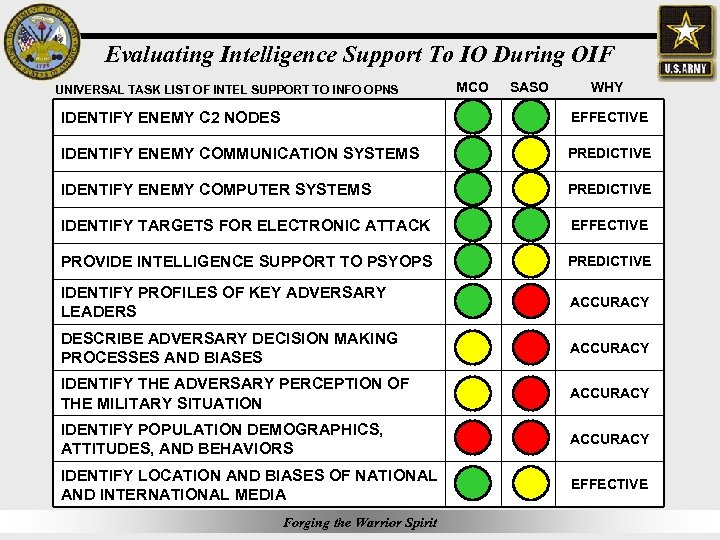 Evaluating Intelligence Support To IO During OIF UNIVERSAL TASK LIST OF INTEL SUPPORT TO INFO OPNS MCO SASO WHY IDENTIFY ENEMY C 2 NODES EFFECTIVE IDENTIFY ENEMY COMMUNICATION SYSTEMS PREDICTIVE IDENTIFY ENEMY COMPUTER SYSTEMS PREDICTIVE IDENTIFY TARGETS FOR ELECTRONIC ATTACK EFFECTIVE PROVIDE INTELLIGENCE SUPPORT TO PSYOPS PREDICTIVE IDENTIFY PROFILES OF KEY ADVERSARY LEADERS ACCURACY DESCRIBE ADVERSARY DECISION MAKING PROCESSES AND BIASES ACCURACY IDENTIFY THE ADVERSARY PERCEPTION OF THE MILITARY SITUATION ACCURACY IDENTIFY POPULATION DEMOGRAPHICS, ATTITUDES, AND BEHAVIORS ACCURACY IDENTIFY LOCATION AND BIASES OF NATIONAL AND INTERNATIONAL MEDIA EFFECTIVE Forging the Warrior Spirit
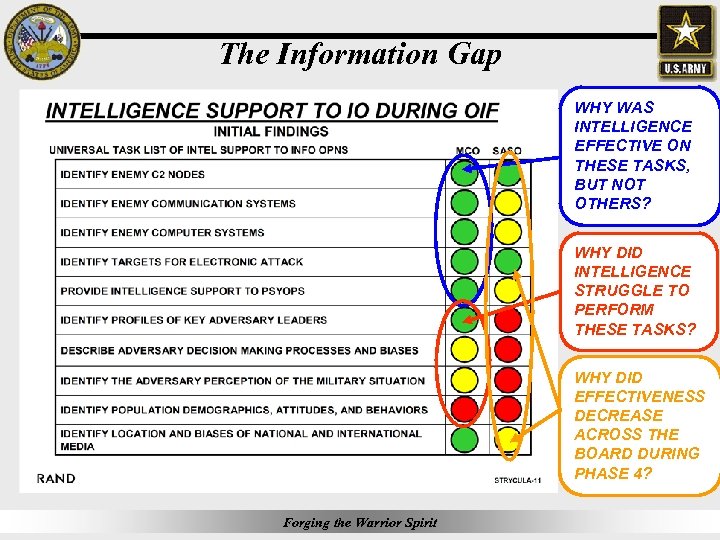 The Information Gap WHY WAS INTELLIGENCE EFFECTIVE ON THESE TASKS, BUT NOT OTHERS? WHY DID INTELLIGENCE STRUGGLE TO PERFORM THESE TASKS? WHY DID EFFECTIVENESS DECREASE ACROSS THE BOARD DURING PHASE 4? Forging the Warrior Spirit
 Information Gap Ø Computer, drones and layers of three-letter information agencies above the tactical level are no substitute for human eyes and brains. Therefore, the focus of every agency must be at the tactical level. Ø Information that does not benefit the soldier in combat is irrelevant. Ø To do this we must close the information gap. Forging the Warrior Spirit
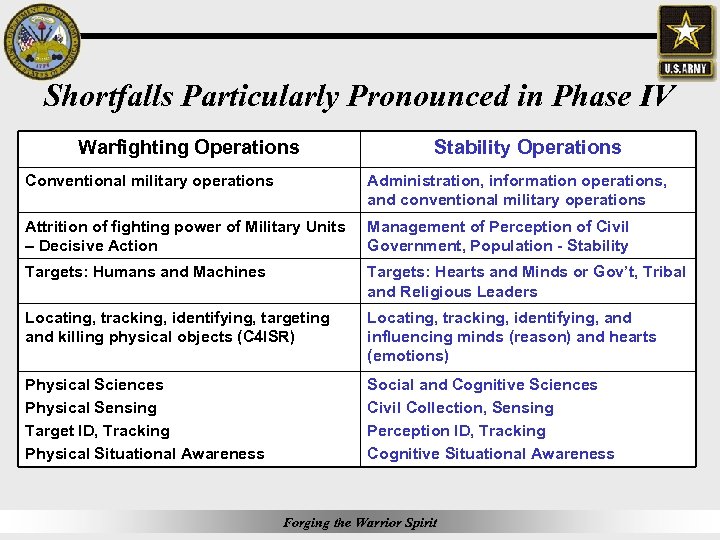 Shortfalls Particularly Pronounced in Phase IV Warfighting Operations Stability Operations Conventional military operations Administration, information operations, and conventional military operations Attrition of fighting power of Military Units – Decisive Action Management of Perception of Civil Government, Population - Stability Targets: Humans and Machines Targets: Hearts and Minds or Gov’t, Tribal and Religious Leaders Locating, tracking, identifying, targeting and killing physical objects (C 4 ISR) Locating, tracking, identifying, and influencing minds (reason) and hearts (emotions) Physical Sciences Physical Sensing Target ID, Tracking Physical Situational Awareness Social and Cognitive Sciences Civil Collection, Sensing Perception ID, Tracking Cognitive Situational Awareness Forging the Warrior Spirit
 Outline Ø Why understanding foreign cultures is important Ø Army cultural doctrine and training Ø Building cultural competence Ø Applying cultural competence to military operations Ø Effects-based operations Ø Cultural intelligence Ø Iraq done differently Ø Conclusions Forging the Warrior Spirit
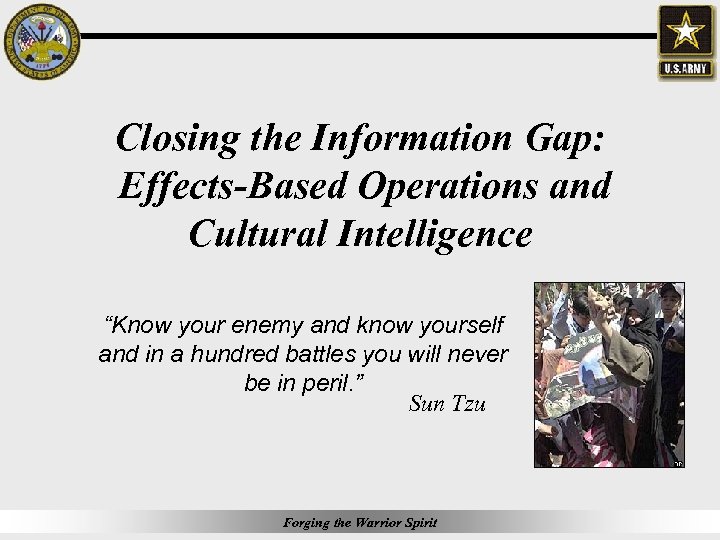 Closing the Information Gap: Effects-Based Operations and Cultural Intelligence “Know your enemy and know yourself and in a hundred battles you will never be in peril. ” Sun Tzu Forging the Warrior Spirit
 Training and Doctrinal Requirements Ø Integrate cultural considerations for military operations into training, doctrine, and decision -making Ø Training: Ø Incorporate cultural awareness training into Professional Military Education courses at every level. Ø Modify soldier/unit-level training to foster cultural awareness. Ø Doctrine: Ø Incorporate Cultural Intelligence Factors Into the IPB process. Ø Incorporate Cultural Factors into the Commander’s Estimated and the Military Decision-Making Process to facilitate Effects-Based Operations. Forging the Warrior Spirit
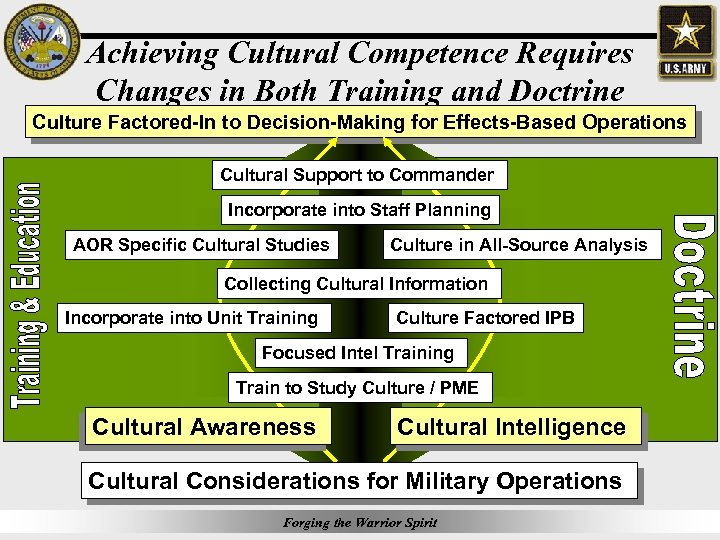 Achieving Cultural Competence Requires Changes in Both Training and Doctrine Culture Factored-In to Decision-Making for Effects-Based Operations Cultural Support to Commander Incorporate into Staff Planning AOR Specific Cultural Studies Culture in All-Source Analysis Collecting Cultural Information Incorporate into Unit Training Culture Factored IPB Focused Intel Training Train to Study Culture / PME Cultural Awareness Cultural Intelligence Cultural Considerations for Military Operations Forging the Warrior Spirit
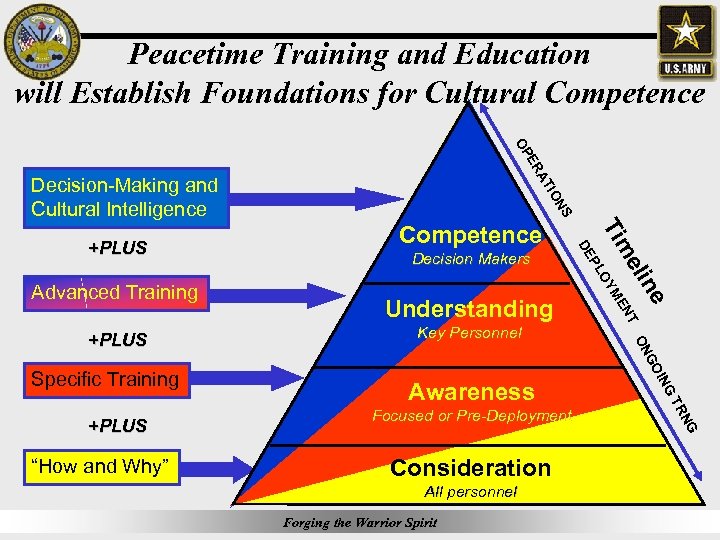 Peacetime Training and Education will Establish Foundations for Cultural Competence A ER OP Consideration All personnel Forging the Warrior Spirit NG Focused or Pre-Deployment TR Awareness ING “How and Why” Key Personnel GO +PLUS Understanding ON Specific Training Decision Makers ne eli ENT Tim LOYM +PLUS Competence P DE Advanced Training NS +PLUS TIO Decision-Making and Cultural Intelligence
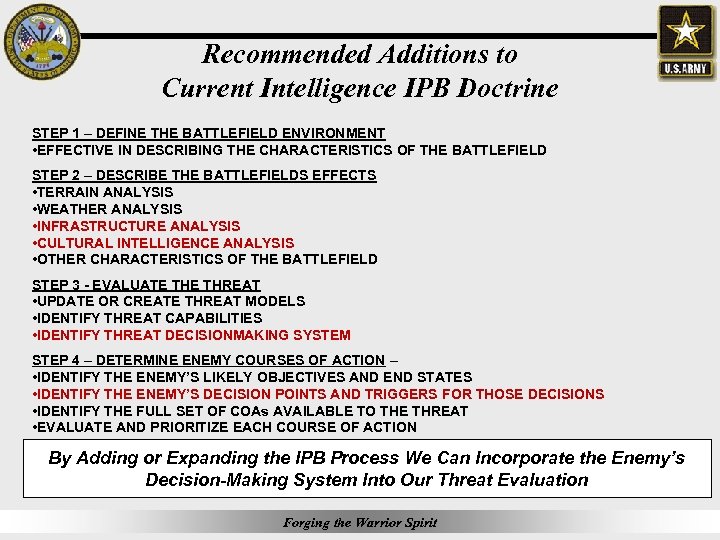 Recommended Additions to Current Intelligence IPB Doctrine STEP 1 – DEFINE THE BATTLEFIELD ENVIRONMENT • EFFECTIVE IN DESCRIBING THE CHARACTERISTICS OF THE BATTLEFIELD STEP 2 – DESCRIBE THE BATTLEFIELDS EFFECTS • TERRAIN ANALYSIS • WEATHER ANALYSIS • INFRASTRUCTURE ANALYSIS • CULTURAL INTELLIGENCE ANALYSIS • OTHER CHARACTERISTICS OF THE BATTLEFIELD STEP 3 - EVALUATE THREAT • UPDATE OR CREATE THREAT MODELS • IDENTIFY THREAT CAPABILITIES • IDENTIFY THREAT DECISIONMAKING SYSTEM STEP 4 – DETERMINE ENEMY COURSES OF ACTION – • IDENTIFY THE ENEMY’S LIKELY OBJECTIVES AND END STATES • IDENTIFY THE ENEMY’S DECISION POINTS AND TRIGGERS FOR THOSE DECISIONS • IDENTIFY THE FULL SET OF COAs AVAILABLE TO THE THREAT • EVALUATE AND PRIORITIZE EACH COURSE OF ACTION By Adding or Expanding the IPB Process We Can Incorporate the Enemy’s Decision-Making System Into Our Threat Evaluation Forging the Warrior Spirit
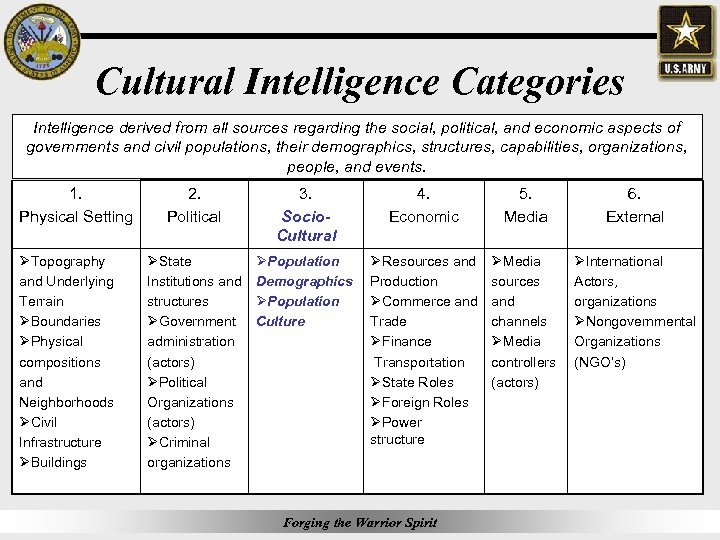 Cultural Intelligence Categories Intelligence derived from all sources regarding the social, political, and economic aspects of governments and civil populations, their demographics, structures, capabilities, organizations, people, and events. 1. Physical Setting ØTopography and Underlying Terrain ØBoundaries ØPhysical compositions and Neighborhoods ØCivil Infrastructure ØBuildings 2. Political 3. Socio. Cultural 4. Economic 5. Media 6. External ØState Institutions and structures ØGovernment administration (actors) ØPolitical Organizations (actors) ØCriminal organizations ØPopulation Demographics ØPopulation Culture ØResources and Production ØCommerce and Trade ØFinance Transportation ØState Roles ØForeign Roles ØPower structure ØMedia sources and channels ØMedia controllers (actors) ØInternational Actors, organizations ØNongovernmental Organizations (NGO’s) Forging the Warrior Spirit
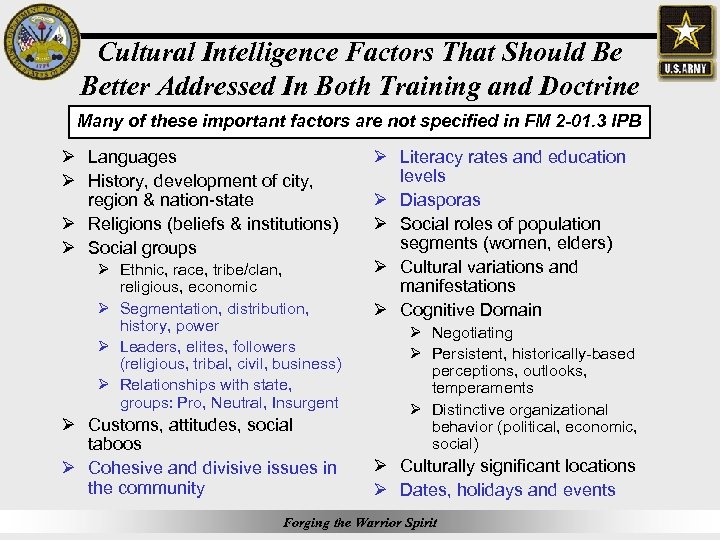 Cultural Intelligence Factors That Should Be Better Addressed In Both Training and Doctrine Many of these important factors are not specified in FM 2 -01. 3 IPB Ø Languages Ø History, development of city, region & nation-state Ø Religions (beliefs & institutions) Ø Social groups Ø Ethnic, race, tribe/clan, religious, economic Ø Segmentation, distribution, history, power Ø Leaders, elites, followers (religious, tribal, civil, business) Ø Relationships with state, groups: Pro, Neutral, Insurgent Ø Customs, attitudes, social taboos Ø Cohesive and divisive issues in the community Ø Literacy rates and education levels Ø Diasporas Ø Social roles of population segments (women, elders) Ø Cultural variations and manifestations Ø Cognitive Domain Ø Negotiating Ø Persistent, historically-based perceptions, outlooks, temperaments Ø Distinctive organizational behavior (political, economic, social) Ø Culturally significant locations Ø Dates, holidays and events Forging the Warrior Spirit
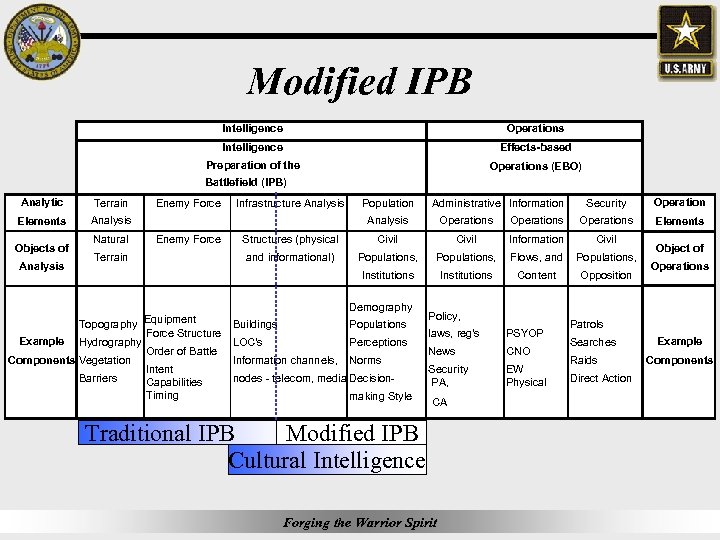 Modified IPB Intelligence Operations Intelligence Effects-based Preparation of the Operations (EBO) Battlefield (IPB) Analytic Terrain Elements Analysis Objects of Analysis Natural Enemy Force Infrastructure Analysis Population Administrative Information Security Operation Elements Analysis Enemy Force Terrain Operations Structures (physical Civil Information Civil and informational) Populations, Flows, and Populations, Institutions Equipment Topography Force Structure Example Hydrography Order of Battle Components Vegetation Intent Barriers Capabilities Timing Demography Buildings Populations LOC's Perceptions Information channels, Norms nodes - telecom, media Decisionmaking Style Institutions Content Policy, laws, reg's PSYOP News CNO Security PA, EW Physical CA Traditional IPB Modified IPB Cultural Intelligence Forging the Warrior Spirit Opposition Object of Operations Patrols Searches Example Raids Components Direct Action
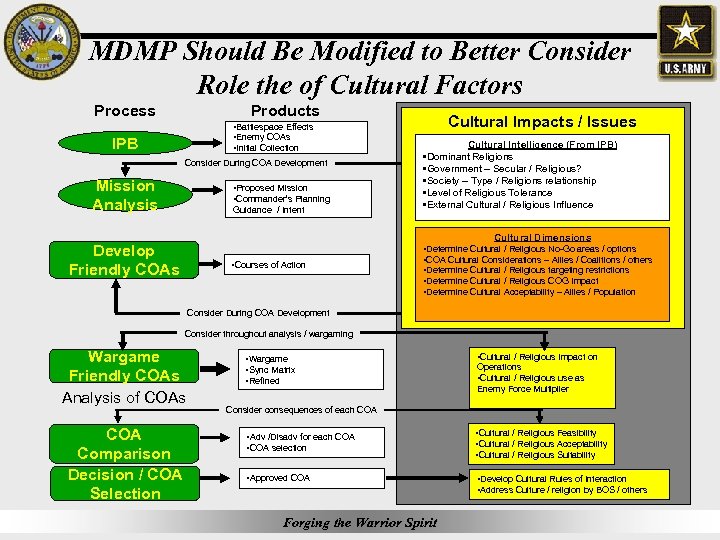 MDMP Should Be Modified to Better Consider Role the of Cultural Factors Process Products • Battlespace Effects • Enemy COAs • Initial Collection IPB Consider During COA Development Mission Analysis • Proposed Mission • Commander’s Planning Guidance / Intent Cultural Impacts / Issues Cultural Intelligence (From IPB) • Dominant Religions • Government – Secular / Religious? • Society – Type / Religions relationship • Level of Religious Tolerance • External Cultural / Religious Influence Cultural Dimensions Develop Friendly COAs • Courses of Action • Determine Cultural / Religious No-Go areas / options • COA Cultural Considerations – Allies / Coalitions / others • Determine Cultural / Religious targeting restrictions • Determine Cultural / Religious COG Impact • Determine Cultural Acceptability – Allies / Population Consider During COA Development Consider throughout analysis / wargaming Wargame Friendly COAs Analysis of COAs COA Comparison Decision / COA Selection • Wargame • Sync Matrix • Refined • Cultural / Religious Impact on Operations • Cultural / Religious use as Enemy Force Multiplier Consider consequences of each COA • Adv /Disadv for each COA • COA selection • Cultural / Religious Feasibility • Cultural / Religious Acceptability • Cultural / Religious Suitability • Approved COA • Develop Cultural Rules of Interaction • Address Culture / religion by BOS / others Forging the Warrior Spirit
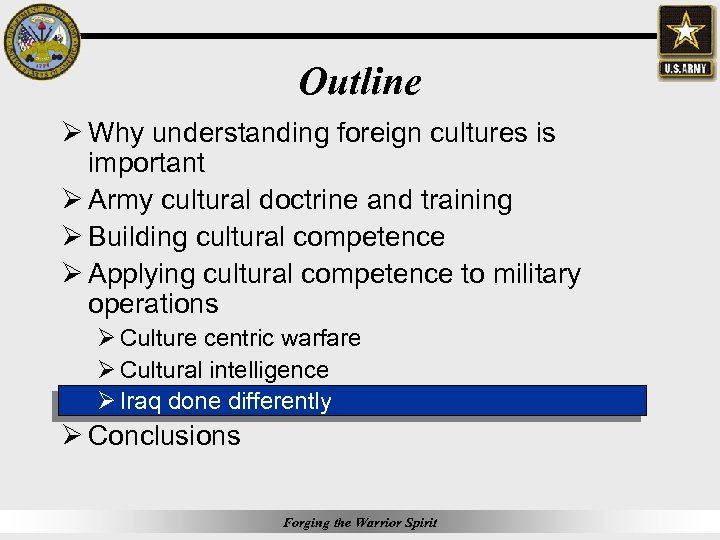 Outline Ø Why understanding foreign cultures is important Ø Army cultural doctrine and training Ø Building cultural competence Ø Applying cultural competence to military operations Ø Culture centric warfare Ø Cultural intelligence Ø Iraq done differently Ø Conclusions Forging the Warrior Spirit
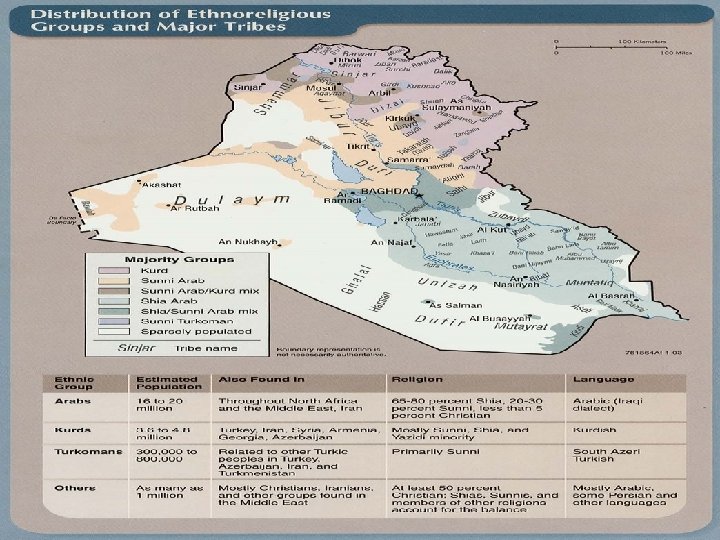
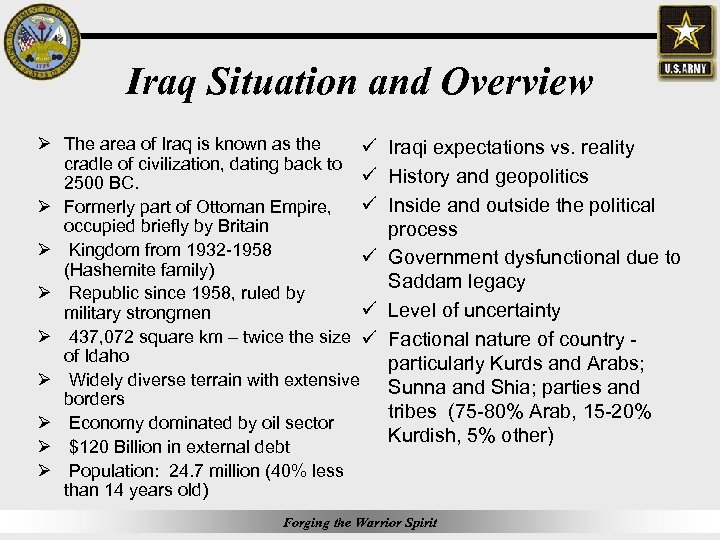 Iraq Situation and Overview Ø The area of Iraq is known as the ü cradle of civilization, dating back to ü 2500 BC. Ø Formerly part of Ottoman Empire, ü occupied briefly by Britain Ø Kingdom from 1932 -1958 ü (Hashemite family) Ø Republic since 1958, ruled by ü military strongmen Ø 437, 072 square km – twice the size ü of Idaho Ø Widely diverse terrain with extensive borders Ø Economy dominated by oil sector Ø $120 Billion in external debt Ø Population: 24. 7 million (40% less than 14 years old) Iraqi expectations vs. reality History and geopolitics Inside and outside the political process Government dysfunctional due to Saddam legacy Level of uncertainty Factional nature of country - particularly Kurds and Arabs; Sunna and Shia; parties and tribes (75 -80% Arab, 15 -20% Kurdish, 5% other) Forging the Warrior Spirit
 Forging the Warrior Spirit
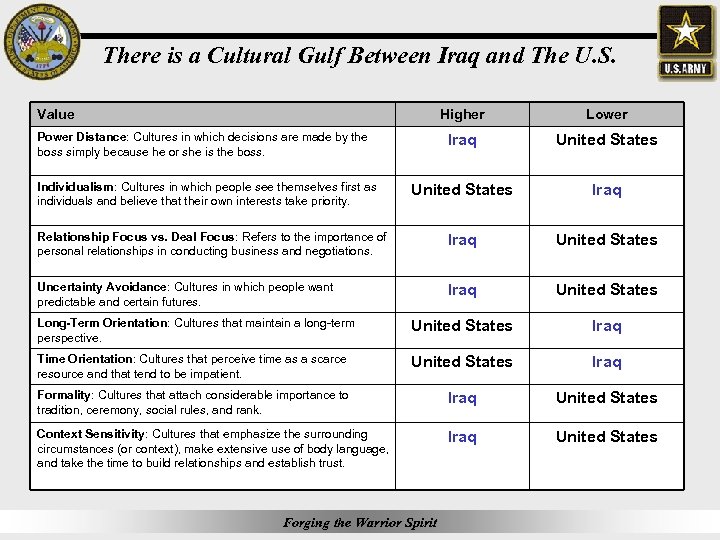 There is a Cultural Gulf Between Iraq and The U. S. Value Higher Lower Iraq United States Iraq Relationship Focus vs. Deal Focus: Refers to the importance of personal relationships in conducting business and negotiations. Iraq United States Uncertainty Avoidance: Cultures in which people want predictable and certain futures. Iraq United States Long-Term Orientation: Cultures that maintain a long-term perspective. United States Iraq Time Orientation: Cultures that perceive time as a scarce resource and that tend to be impatient. United States Iraq Formality: Cultures that attach considerable importance to tradition, ceremony, social rules, and rank. Iraq United States Context Sensitivity: Cultures that emphasize the surrounding circumstances (or context), make extensive use of body language, and take the time to build relationships and establish trust. Iraq United States Power Distance: Cultures in which decisions are made by the boss simply because he or she is the boss. Individualism: Cultures in which people see themselves first as individuals and believe that their own interests take priority. Forging the Warrior Spirit
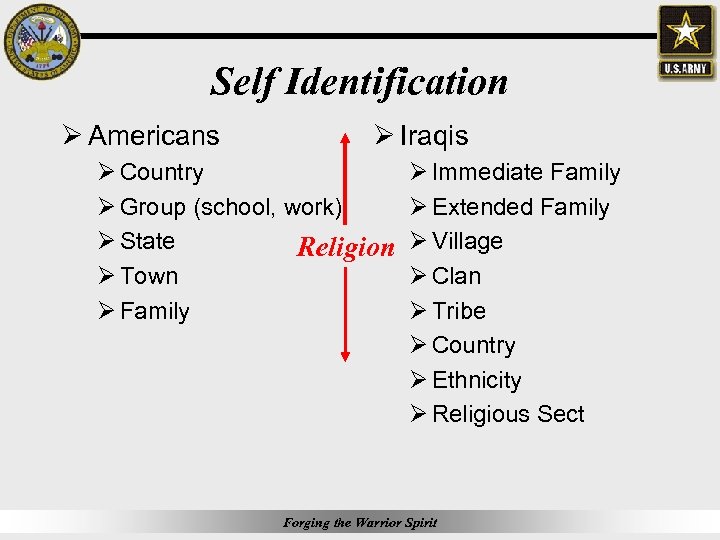 Self Identification Ø Americans Ø Iraqis Ø Country Ø Group (school, work) Ø State Religion Ø Town Ø Family Ø Immediate Family Ø Extended Family Ø Village Ø Clan Ø Tribe Ø Country Ø Ethnicity Ø Religious Sect Forging the Warrior Spirit
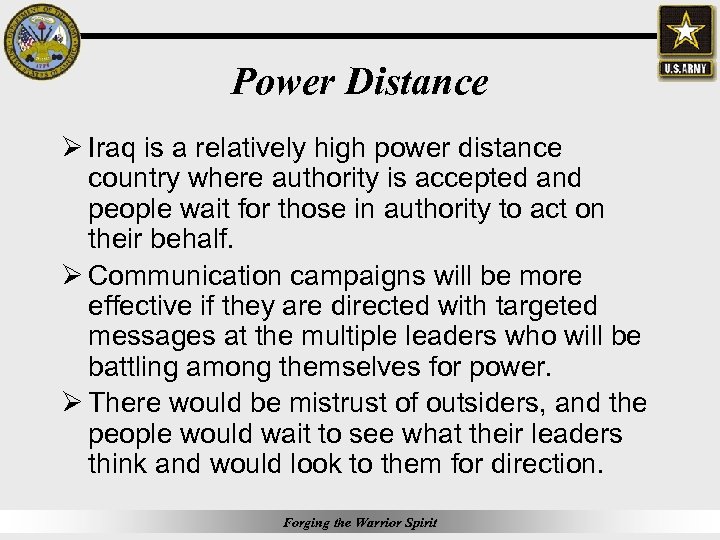 Power Distance Ø Iraq is a relatively high power distance country where authority is accepted and people wait for those in authority to act on their behalf. Ø Communication campaigns will be more effective if they are directed with targeted messages at the multiple leaders who will be battling among themselves for power. Ø There would be mistrust of outsiders, and the people would wait to see what their leaders think and would look to them for direction. Forging the Warrior Spirit
 Counterfactual Thinking Ø In Iraq, the pattern of thinking is based in the analysis of past events through the eye of experience. Given that Iraq’s history has been fraught with invasion and control by outsiders, one could predict with relative certainty that outsiders would not be trusted. Forging the Warrior Spirit
 Family-Tribe Centered Ø Trust is based in family and tribal/village ties. Outsiders are distrusted, and their motivations suspect. Ø Given the “in-group” nature of Iraq’s culture and Iraq’s porous borders and history of invasion, it would be predictable that small cells of terrorists or extremists might go undetected or be ignored because the Iraqi people are focused on their own in-groups that keep to themselves. Forging the Warrior Spirit
 Fatalism and Collectivism Ø There is a general acceptance of circumstances, a belief that people have little control over what happens to them, and that they must accept the fate handed to them by God. Fatalism leads to a tendency to accept circumstances and wait for them to change, rather than try to control them. Ø Iraq is also a collectivist, or group oriented culture. Fatalism, combined with collectivism, could be predicted to lead to a willingness to sacrifice individual life for the good of the ingroup. Forging the Warrior Spirit
 Competition Ø There is inherent competition among different subgroups in Iraq that is rooted in religious and historical roots, and in natural geographic boundaries. Ø Competition for resources and power will be predicted to continue and intensify when there is a power void. Forging the Warrior Spirit
 Religion Ø In Iraq, religion and politics cannot be separated. In Iraq, it is necessary to not only understand Islam, but the unique versions of Islam that exist in the different area of Iraq and the role that each plays Ø In the Middle East, it is difficult to differentiae between religion and politics. Consequently, in addition to being a place of worship, mosques are often used for civic and education centers, political activism and even military operations. Forging the Warrior Spirit
 Outline Ø Why understanding foreign cultures is important Ø Army cultural doctrine and training Ø Building cultural competence Ø Applying cultural competence to military operations Ø Conclusions Forging the Warrior Spirit
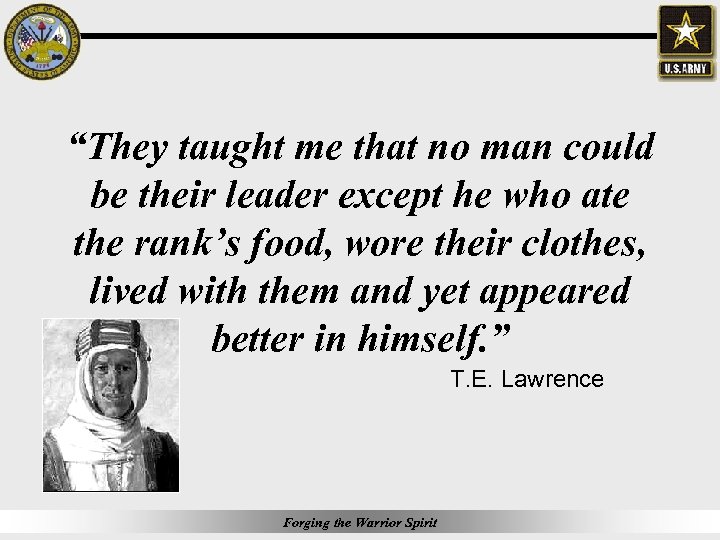 “They taught me that no man could be their leader except he who ate the rank’s food, wore their clothes, lived with them and yet appeared better in himself. ” T. E. Lawrence Forging the Warrior Spirit
 Conclusion Ø The geo-strategic landscape has shifted dramatically since the Cold War, and diplomatic and military activities increasingly take place in parts of the world that are disconnected from the global economy. Ø In expeditionary warfare, unconventional operations and combating terrorism, military forces must adapt to operating in non-western social contexts. Ø Terrorism often emerges from specific social contexts and reflects cultural values of the original group. Ø Effective PSYOP and IO depend on understanding both the mind and the culture of the adversary. Ø The new strategic environment necessitates a deeper understanding of the cultural and social systems of our present and potential adversaries. Ø Success in future operations other than war depends on our ability to use local knowledge, to work with indigenous people, and to train and educate soldiers to function in austere and complex battlespaces. Forging the Warrior Spirit
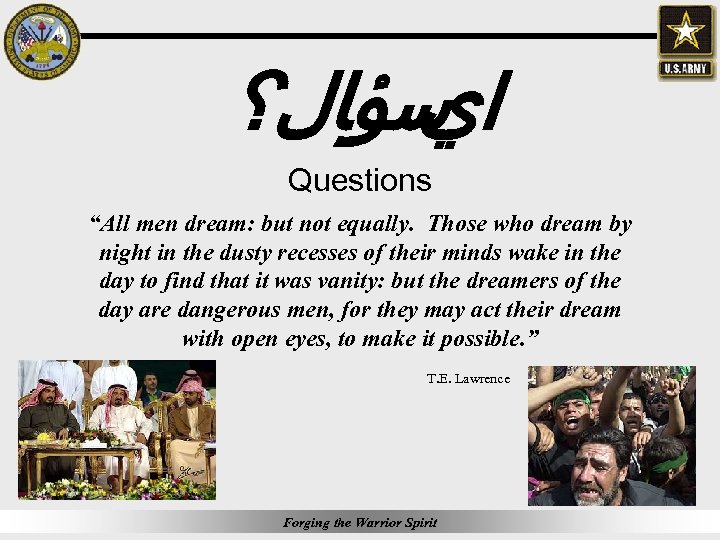 ﺳﺆﺎﻝ؟ ﺍﻱ Questions “All men dream: but not equally. Those who dream by night in the dusty recesses of their minds wake in the day to find that it was vanity: but the dreamers of the day are dangerous men, for they may act their dream with open eyes, to make it possible. ” T. E. Lawrence Forging the Warrior Spirit
 Forging the Warrior Spirit