 Скачать презентацию Through Life Capability Management Presentation to RUSI 31
789d31b08cbb770163d294ec514e58bc.ppt
- Количество слайдов: 38



Through Life Capability Management Presentation to RUSI 31 st January 2008 Defence Acquisition Change Programme
Contents § § § § Context Background Achievements A Front Line perspective The DE&S Perspective An Industry Perspective Summary and Challenges Defence Acquisition Change Programme
TLCM Overview Better Solutions for Defence By Brig Jon Brittain Defence Acquisition Change Programme
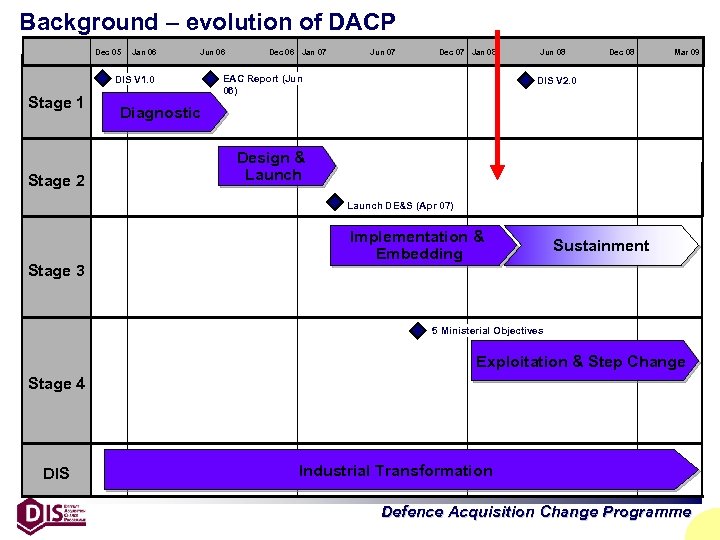
Background – evolution of DACP Dec 05 Jan 06 Jun 06 DIS V 1. 0 Stage 1 Stage 2 Dec 06 Jan 07 Jun 07 Dec 07 Jan 08 EAC Report (Jun 06) Jun 08 Dec 08 Mar 09 DIS V 2. 0 Diagnostic Design & Launch DE&S (Apr 07) Stage 3 Implementation & Embedding Sustainment 5 Ministerial Objectives Exploitation & Step Change Stage 4 DIS Industrial Transformation Defence Acquisition Change Programme
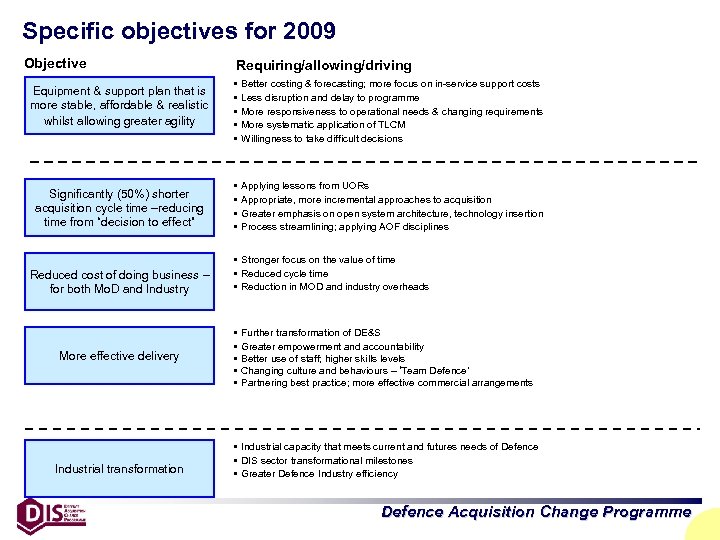
Specific objectives for 2009 Objective Requiring/allowing/driving Equipment & support plan that is more stable, affordable & realistic whilst allowing greater agility • Better costing & forecasting; more focus on in-service support costs • Less disruption and delay to programme • More responsiveness to operational needs & changing requirements • More systematic application of TLCM • Willingness to take difficult decisions Significantly (50%) shorter acquisition cycle time –reducing time from “decision to effect” • Applying lessons from UORs • Appropriate, more incremental approaches to acquisition • Greater emphasis on open system architecture, technology insertion • Process streamlining; applying AOF disciplines Reduced cost of doing business – for both Mo. D and Industry More effective delivery Industrial transformation • Stronger focus on the value of time • Reduced cycle time • Reduction in MOD and industry overheads • Further transformation of DE&S • Greater empowerment and accountability • Better use of staff; higher skills levels • Changing culture and behaviours – ‘Team Defence’ • Partnering best practice; more effective commercial arrangements • Industrial capacity that meets current and futures needs of Defence • DIS sector transformational milestones • Greater Defence Industry efficiency Defence Acquisition Change Programme
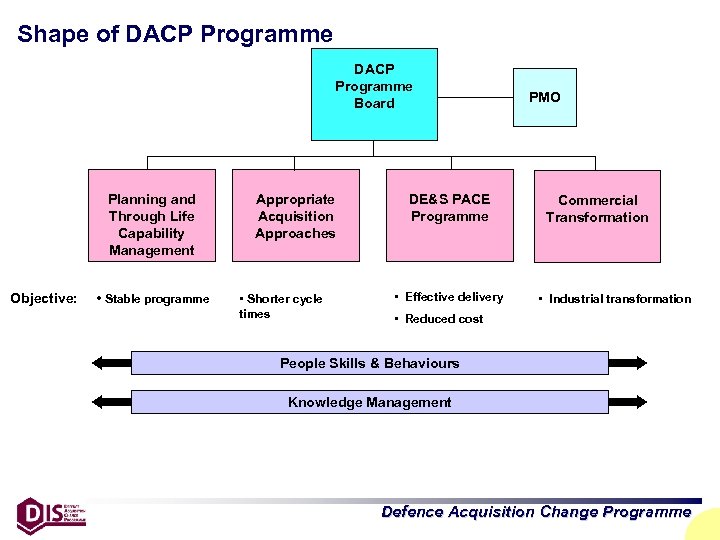
Shape of DACP Programme Board Planning and Through Life Capability Management Objective: • Stable programme Appropriate Acquisition Approaches • Shorter cycle times DE&S PACE Programme • Effective delivery PMO Commercial Transformation • Industrial transformation • Reduced cost People Skills & Behaviours Knowledge Management Defence Acquisition Change Programme
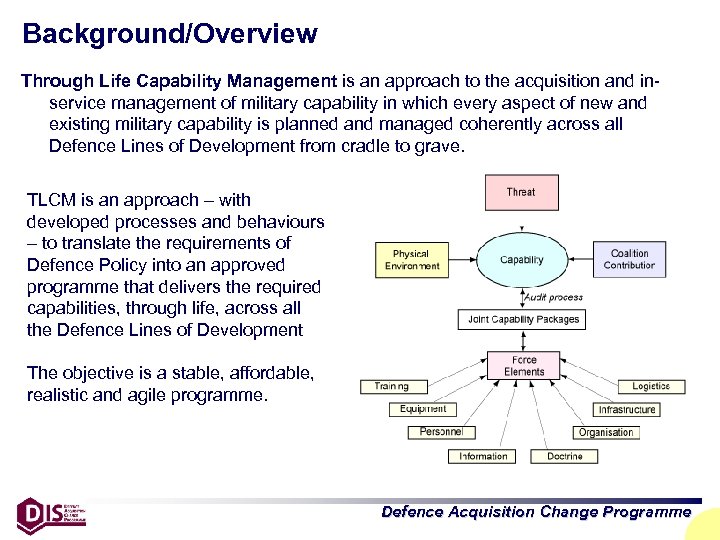
Background/Overview Through Life Capability Management is an approach to the acquisition and inservice management of military capability in which every aspect of new and existing military capability is planned and managed coherently across all Defence Lines of Development from cradle to grave. TLCM is an approach – with developed processes and behaviours – to translate the requirements of Defence Policy into an approved programme that delivers the required capabilities, through life, across all the Defence Lines of Development The objective is a stable, affordable, realistic and agile programme. Defence Acquisition Change Programme
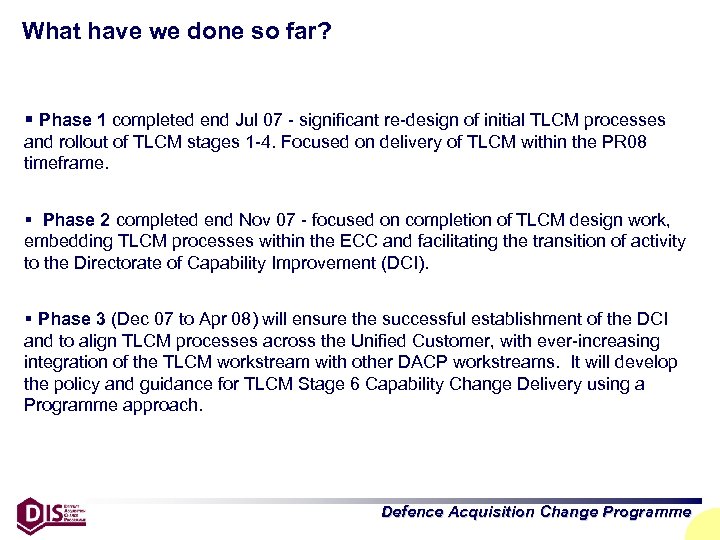
What have we done so far? § Phase 1 completed end Jul 07 - significant re-design of initial TLCM processes and rollout of TLCM stages 1 -4. Focused on delivery of TLCM within the PR 08 timeframe. § Phase 2 completed end Nov 07 - focused on completion of TLCM design work, embedding TLCM processes within the ECC and facilitating the transition of activity to the Directorate of Capability Improvement (DCI). § Phase 3 (Dec 07 to Apr 08) will ensure the successful establishment of the DCI and to align TLCM processes across the Unified Customer, with ever-increasing integration of the TLCM workstream with other DACP workstreams. It will develop the policy and guidance for TLCM Stage 6 Capability Change Delivery using a Programme approach. Defence Acquisition Change Programme
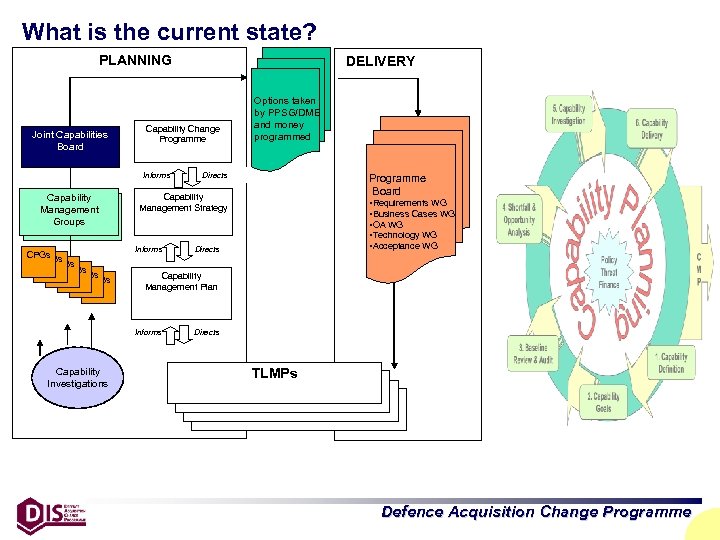
What is the current state? PLANNING Joint Capabilities Board Capability Change Programme Informs Capability Management Groups CPGs CPGs Options taken by PPSG/DMB and money programmed Directs Programme Board Capability Management Strategy Informs • Requirements WG • Business Cases WG • OA WG • Technology WG • Acceptance WG Directs Capability Management Plan Informs Capability Investigations DELIVERY Directs TLMP Defence Acquisition Change Programme
TLCM Case Studies Making a difference – what we have achieved - Better Decisions - Better Prioritisation and Coherent Planning - Innovative Thinking By Brig Jon Brittain Defence Acquisition Change Programme
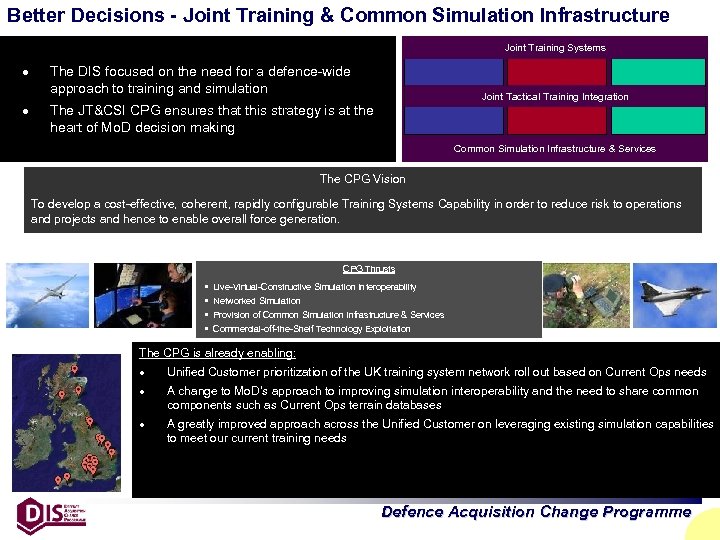
Better Decisions - Joint Training & Common Simulation Infrastructure Joint Training Systems The DIS focused on the need for a defence-wide approach to training and simulation The JT&CSI CPG ensures that this strategy is at the heart of Mo. D decision making Joint Tactical Training Integration Common Simulation Infrastructure & Services The CPG Vision To develop a cost-effective, coherent, rapidly configurable Training Systems Capability in order to reduce risk to operations and projects and hence to enable overall force generation. CPG Thrusts § Live-Virtual-Constructive Simulation Interoperability § Networked Simulation § Provision of Common Simulation Infrastructure & Services § Commercial-off-the-Shelf Technology Exploitation The CPG is already enabling: Unified Customer prioritization of the UK training system network roll out based on Current Ops needs A greatly improved approach across the Unified Customer on leveraging existing simulation capabilities to meet our current training needs A change to Mo. D’s approach to improving simulation interoperability and the need to share common components such as Current Ops terrain databases Defence Acquisition Change Programme
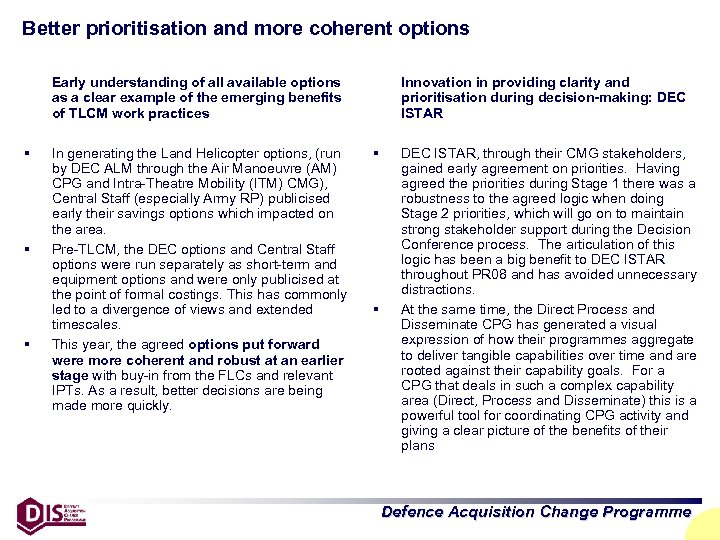
Better prioritisation and more coherent options Early understanding of all available options as a clear example of the emerging benefits of TLCM work practices § § § In generating the Land Helicopter options, (run by DEC ALM through the Air Manoeuvre (AM) CPG and Intra-Theatre Mobility (ITM) CMG), Central Staff (especially Army RP) publicised early their savings options which impacted on the area. Pre-TLCM, the DEC options and Central Staff options were run separately as short-term and equipment options and were only publicised at the point of formal costings. This has commonly led to a divergence of views and extended timescales. This year, the agreed options put forward were more coherent and robust at an earlier stage with buy-in from the FLCs and relevant IPTs. As a result, better decisions are being made more quickly. Innovation in providing clarity and prioritisation during decision-making: DEC ISTAR § § DEC ISTAR, through their CMG stakeholders, gained early agreement on priorities. Having agreed the priorities during Stage 1 there was a robustness to the agreed logic when doing Stage 2 priorities, which will go on to maintain strong stakeholder support during the Decision Conference process. The articulation of this logic has been a big benefit to DEC ISTAR throughout PR 08 and has avoided unnecessary distractions. At the same time, the Direct Process and Disseminate CPG has generated a visual expression of how their programmes aggregate to deliver tangible capabilities over time and are rooted against their capability goals. For a CPG that deals in such a complex capability area (Direct, Process and Disseminate) this is a powerful tool for coordinating CPG activity and giving a clear picture of the benefits of their plans Defence Acquisition Change Programme
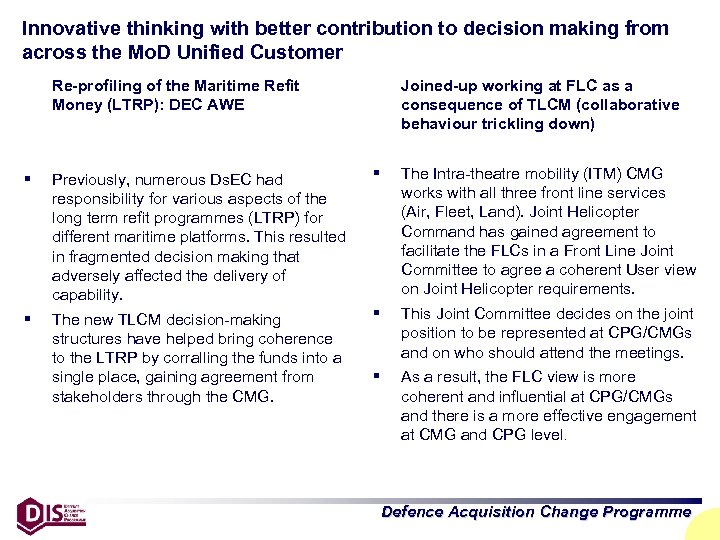
Innovative thinking with better contribution to decision making from across the Mo. D Unified Customer Re-profiling of the Maritime Refit Money (LTRP): DEC AWE Joined-up working at FLC as a consequence of TLCM (collaborative behaviour trickling down) § Previously, numerous Ds. EC had responsibility for various aspects of the long term refit programmes (LTRP) for different maritime platforms. This resulted in fragmented decision making that adversely affected the delivery of capability. § The Intra-theatre mobility (ITM) CMG works with all three front line services (Air, Fleet, Land). Joint Helicopter Command has gained agreement to facilitate the FLCs in a Front Line Joint Committee to agree a coherent User view on Joint Helicopter requirements. § The new TLCM decision-making structures have helped bring coherence to the LTRP by corralling the funds into a single place, gaining agreement from stakeholders through the CMG. § This Joint Committee decides on the joint position to be represented at CPG/CMGs and on who should attend the meetings. § As a result, the FLC view is more coherent and influential at CPG/CMGs and there is a more effective engagement at CMG and CPG level. Defence Acquisition Change Programme
Making a difference – what we have achieved § § Better Decisions § Innovative Thinking Better Prioritisation and Coherent Planning Defence Acquisition Change Programme
A Front Line Command Perspective of TLCM What are the Lessons from the Introduction of TLCM? By Gp Capt Andy Linstead Defence Acquisition Change Programme
Scope § The RAF User Concept § Lessons Identified § Developments Defence Acquisition Change Programme
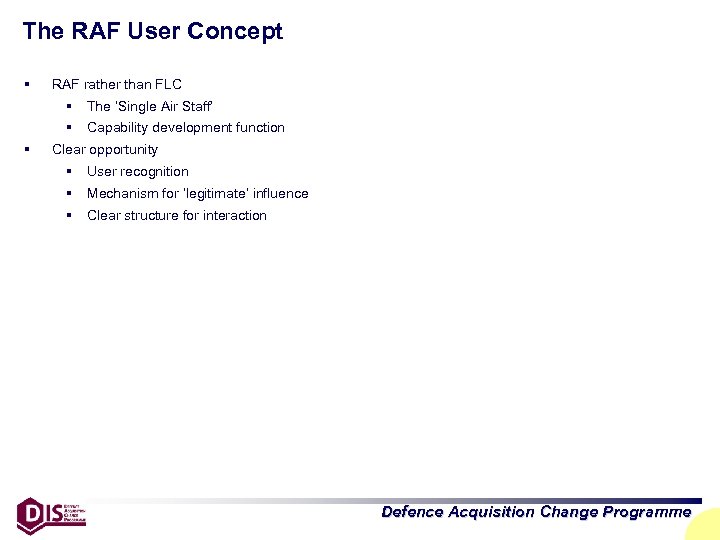
The RAF User Concept § RAF rather than FLC § The ‘Single Air Staff’ § Capability development function § Clear opportunity § User recognition § Mechanism for ‘legitimate’ influence § Clear structure for interaction Defence Acquisition Change Programme
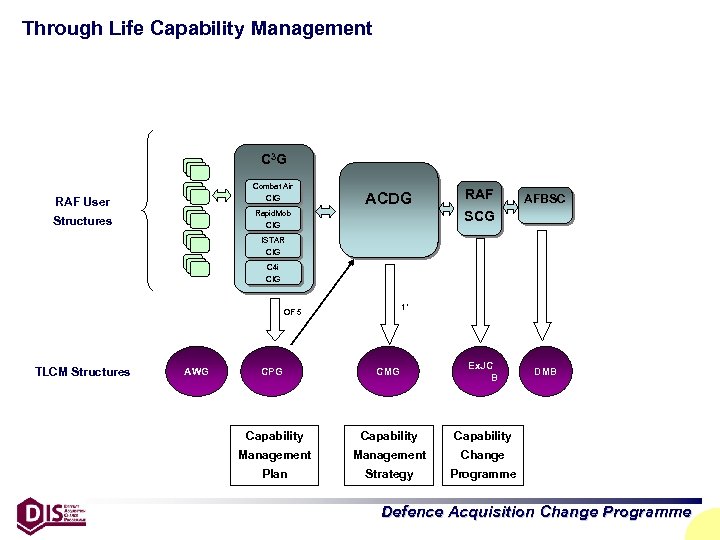
Through Life Capability Management C 3 G Combat Air CIG RAF User ACDG AFBSC SCG Rapid. Mob Structures RAF CIG ISTAR CIG C 4 i CIG 1* OF 5 TLCM Structures AWG CPG CMG Ex. JC B Capability Management Change Plan Strategy Programme DMB Defence Acquisition Change Programme
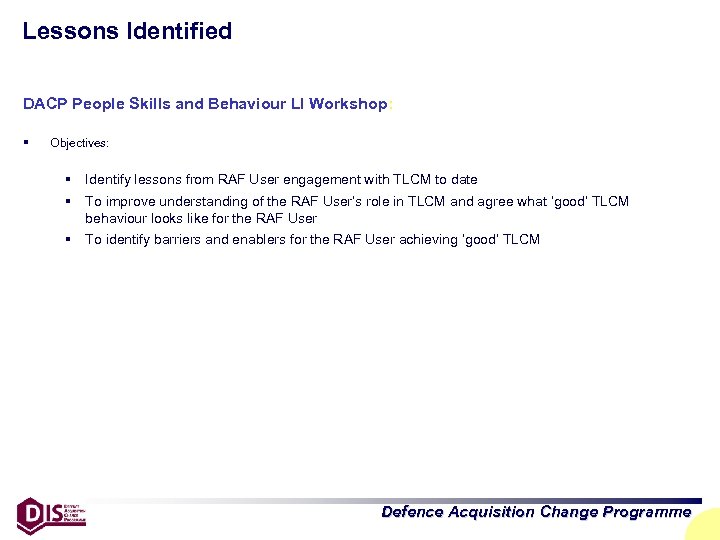
Lessons Identified DACP People Skills and Behaviour LI Workshop: § Objectives: § Identify lessons from RAF User engagement with TLCM to date § To improve understanding of the RAF User’s role in TLCM and agree what ‘good’ TLCM behaviour looks like for the RAF User § To identify barriers and enablers for the RAF User achieving ‘good’ TLCM Defence Acquisition Change Programme
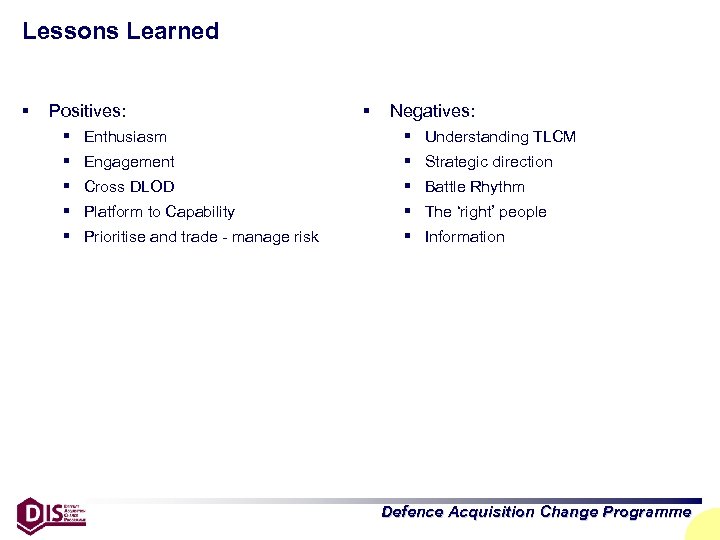
Lessons Learned § Positives: § Negatives: § Enthusiasm § Understanding TLCM § Engagement § Strategic direction § Cross DLOD § Battle Rhythm § Platform to Capability § The ‘right’ people § Prioritise and trade - manage risk § Information Defence Acquisition Change Programme
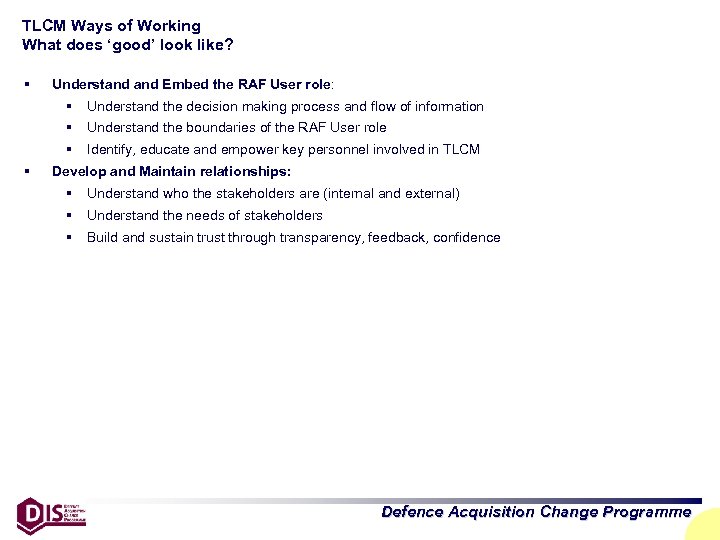
TLCM Ways of Working What does ‘good’ look like? § Understand Embed the RAF User role: § Understand the decision making process and flow of information § Understand the boundaries of the RAF User role § Identify, educate and empower key personnel involved in TLCM § Develop and Maintain relationships: § Understand who the stakeholders are (internal and external) § Understand the needs of stakeholders § Build and sustain trust through transparency, feedback, confidence Defence Acquisition Change Programme
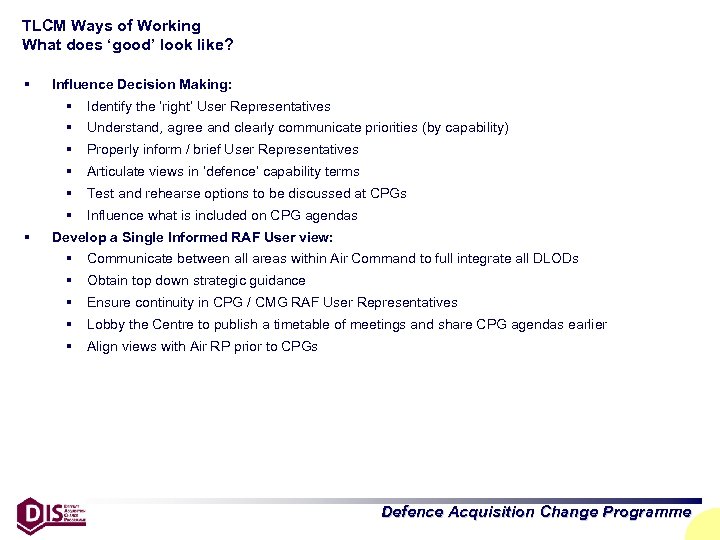
TLCM Ways of Working What does ‘good’ look like? § Influence Decision Making: § Identify the ‘right’ User Representatives § Understand, agree and clearly communicate priorities (by capability) § Properly inform / brief User Representatives § Articulate views in ‘defence’ capability terms § Test and rehearse options to be discussed at CPGs § Influence what is included on CPG agendas § Develop a Single Informed RAF User view: § Communicate between all areas within Air Command to full integrate all DLODs § Obtain top down strategic guidance § Ensure continuity in CPG / CMG RAF User Representatives § Lobby the Centre to publish a timetable of meetings and share CPG agendas earlier § Align views with Air RP prior to CPGs Defence Acquisition Change Programme
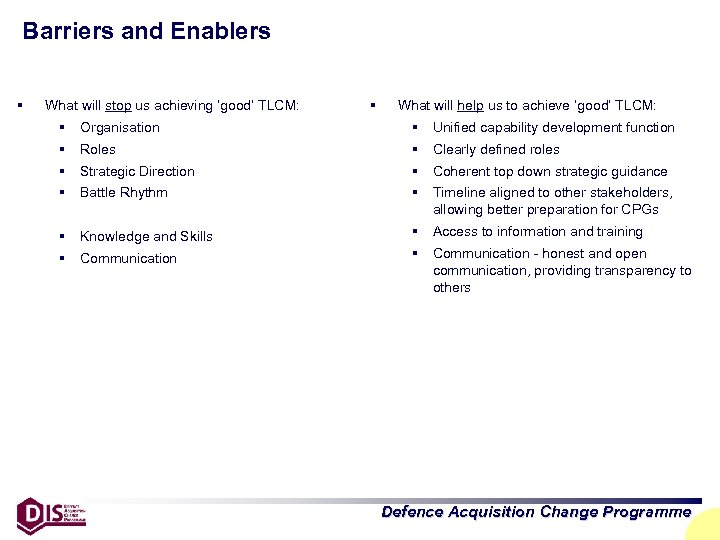
Barriers and Enablers § What will stop us achieving ‘good’ TLCM: § What will help us to achieve ‘good’ TLCM: § Organisation § Unified capability development function § Roles § Clearly defined roles § Strategic Direction § Coherent top down strategic guidance § Battle Rhythm § Timeline aligned to other stakeholders, allowing better preparation for CPGs § Knowledge and Skills § Access to information and training § Communication - honest and open communication, providing transparency to others Defence Acquisition Change Programme
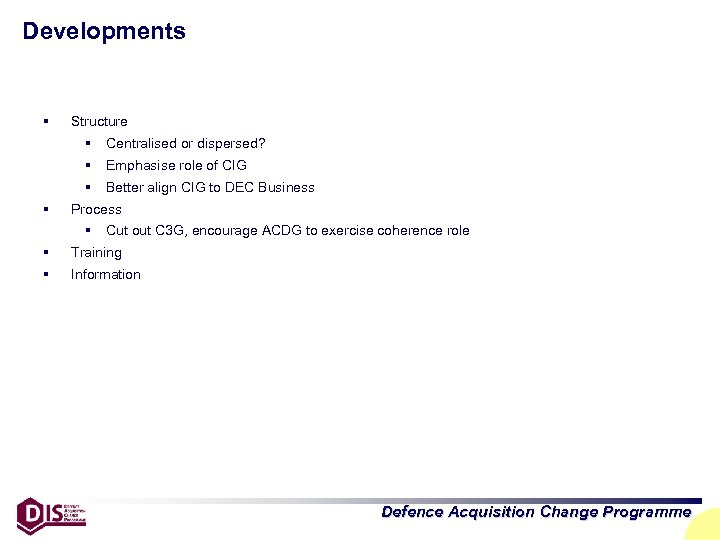
Developments § Structure § Centralised or dispersed? § Emphasise role of CIG § Better align CIG to DEC Business § Process § Cut out C 3 G, encourage ACDG to exercise coherence role § Training § Information Defence Acquisition Change Programme
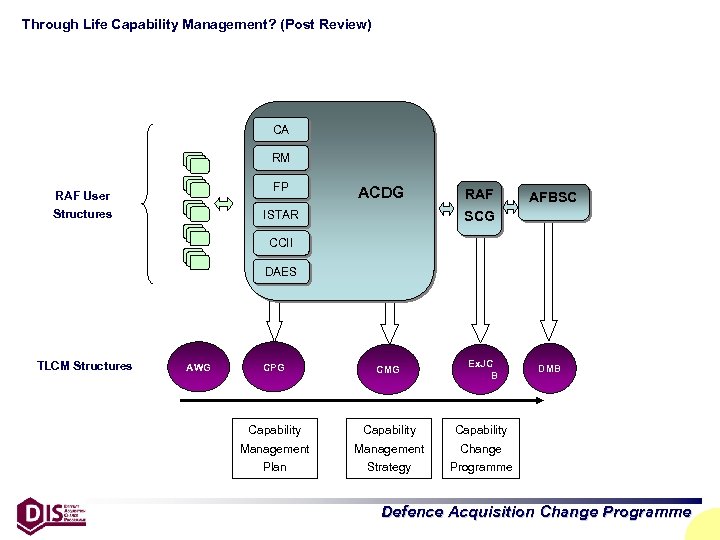
Through Life Capability Management? (Post Review) CA RM FP RAF User Structures ACDG RAF AFBSC SCG ISTAR CCII DAES TLCM Structures AWG CPG CMG Ex. JC B Capability Management Change Plan Strategy Programme DMB Defence Acquisition Change Programme
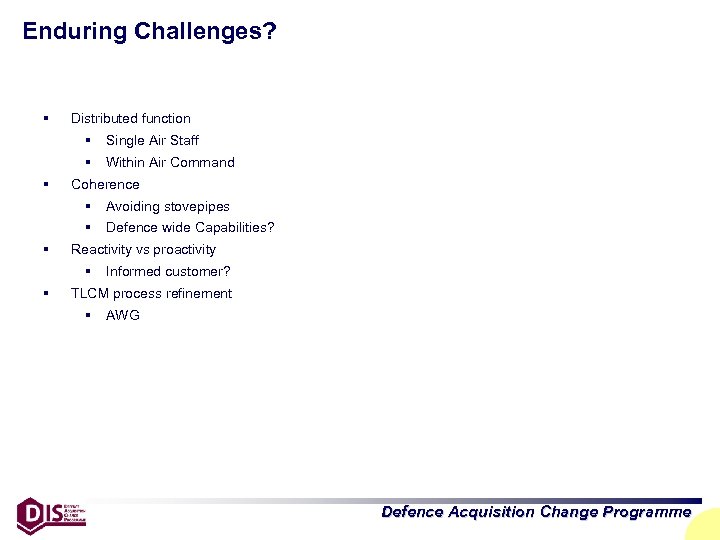
Enduring Challenges? § Distributed function § Single Air Staff § Within Air Command § Coherence § Avoiding stovepipes § Defence wide Capabilities? § Reactivity vs proactivity § Informed customer? § TLCM process refinement § AWG Defence Acquisition Change Programme
A DE&S Perspective of TLCM Action Group (TAG) and Challenges Ahead By Andrew Dixon Defence Acquisition Change Programme
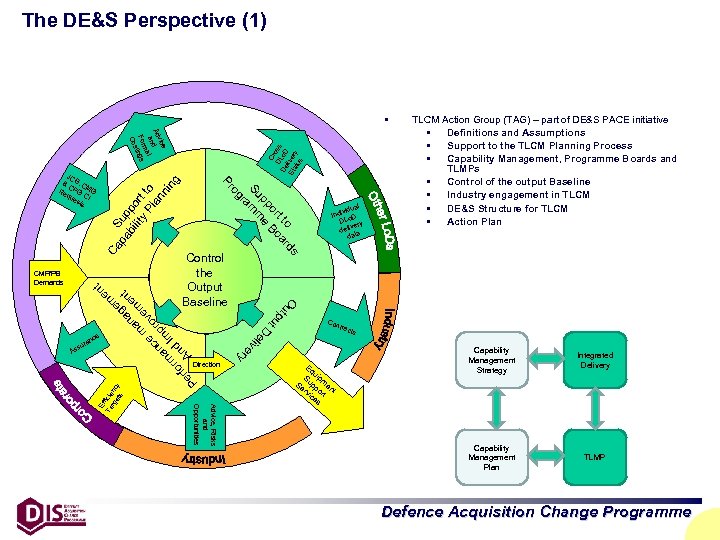
The DE&S Perspective (1) § pa Sup bi po lity rt P to la nn in g Ca t O trac y P s t D Con er en m ge t na en a m em e rov c an mp rm d I rfo An e al vidu Indi o. D DL ry ve deli ta da el iv Direction ut pu Control the Output Baseline e nc ura Advice, Risks and Opportunities Ef Ta ficie rg nc et y s o rd t t a or Bo pp e Su mm ra og s As Pr CMP/PB Demands Cr D os De Lo. D s St liver atu y s e vic Ad and al m For tings s Co JC & C B, C Re PG MG qu CI es ts TLCM Action Group (TAG) – part of DE&S PACE initiative § Definitions and Assumptions § Support to the TLCM Planning Process § Capability Management, Programme Boards and TLMPs § Control of the output Baseline § Industry engagement in TLCM § DE&S Structure for TLCM § Action Plan Eq u Su ipm Se pp en rv or t ice t s ts Capability Management Strategy Integrated Delivery Capability Management Plan TLMP Defence Acquisition Change Programme
The DE&S Perspective (2) § Where TLCM has helped § An agenda for “top down” thinking § More consideration of project & programme interdependencies financially, in time, in their capability contribution (performance) § Programme Management is required to enable Capability Management § Industrial insight into capability problems has offered up solutions which might not have been identified § More to do § Embed early processes to fully benefit from the coherence and resultant synergy Defence Acquisition Change Programme
What Good TLCM Looks Like TLCM Policy The DE&S Twist § § § § A top-down approach to the delivery of Military Capability, based on Defence Policy, tempered by tolerable risk A rigorous proactive decision making process, taking a whole system pan Lines of Development approach, which uses robust trading techniques to optimise and balance demand supply. Taking a Long Term View, building on extant capability, thus identifying opportunities and change drivers and understanding the impacts of today's decisions on the future. Continuous improvement in joint Mo. D and Industry performance in the delivery and availability of enduring Military Capability through improved relationships and behaviours and resilient, stable and coherent plans. Appropriate industry engagement at all stages of the process, to inform the high level trade and participate actively in the other levels. Joint teams, joint approach, joint information. An approach that is capable of responding to changes and the changing environment. § § § Look for traceability of requirements and understand the capability risks associated with the decisions taken. Open and honest communication covering the art of the possible and realism of delivery plans; including costs. Plans that reflect the linkages across the DLo. Ds required to deliver capability. A long term view that plans for sustained delivery, including cross project relationships that enable transitions, technology maturation and derisking. An understanding of, and new relationships with, industry to enable effective through life delivery of equipment and support. Industry engagement the enables effective input into capability planning, while retaining the opportunities for engaging industry in appropriately in delivery. Retaining flexibility and agility within plans to accommodate changes; better risk management Defence Acquisition Change Programme
An Industry Perspective Industry’s role in TLCM By Ron Finlayson Defence Acquisition Change Programme
An Industry Perspective (1) § What does industry do to help deliver Military Capability? § we deliver systems and equipment § we deliver services § we provide skills § Why is industry interested in TLCM? § because better through life planning and more stable programmes mean companies can make better investment decisions § Where has industry input added value in MOD capability planning and management? § S 2 C 2 and SAVC Pathfinders § partnering arrangements eg Helicopters, Team CW, Ranges LTPA § assistance to MOD on capability trading Defence Acquisition Change Programme
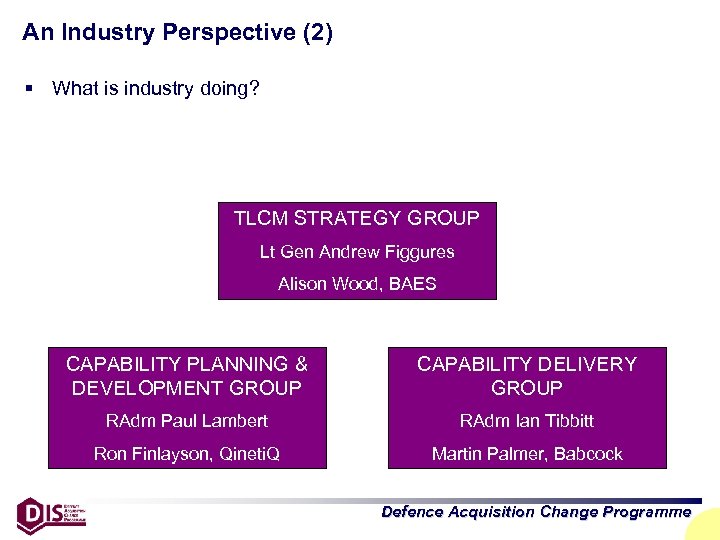
An Industry Perspective (2) § What is industry doing? TLCM STRATEGY GROUP Lt Gen Andrew Figgures Alison Wood, BAES CAPABILITY PLANNING & DEVELOPMENT GROUP CAPABILITY DELIVERY GROUP RAdm Paul Lambert RAdm Ian Tibbitt Ron Finlayson, Qineti. Q Martin Palmer, Babcock Defence Acquisition Change Programme
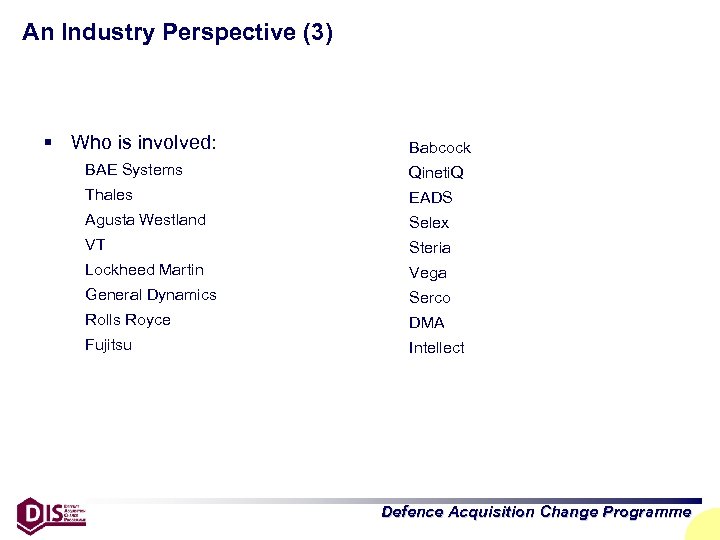
An Industry Perspective (3) § Who is involved: Babcock BAE Systems Qineti. Q Thales EADS Agusta Westland Selex VT Steria Lockheed Martin Vega General Dynamics Serco Rolls Royce DMA Fujitsu Intellect Defence Acquisition Change Programme
Final Words Summary and Challenges Ahead by Brigadier Jon Brittain Defence Acquisition Change Programme
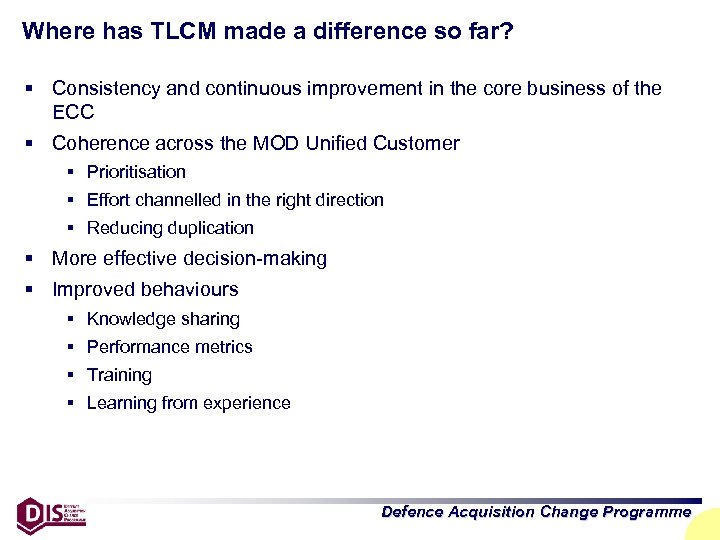
Where has TLCM made a difference so far? § Consistency and continuous improvement in the core business of the ECC § Coherence across the MOD Unified Customer § Prioritisation § Effort channelled in the right direction § Reducing duplication § More effective decision-making § Improved behaviours § Knowledge sharing § Performance metrics § Training § Learning from experience Defence Acquisition Change Programme
What are the major challenges this year: § Recognition of TLCM throughout the Department § Use and continued development of TLCM in all aspects of capability planning and delivery § Governance of TLCM § Successful design and implementation of programme approach to Capability Delivery § Integration and alignment with ongoing DACP workstreams – in particular A 3, PSB and Knowledge Management § Acceptance that the TLCM design will need to continue to evolve and respond to the changing needs of the Acquisition business § Continue to embed the new behaviours and culture across the MOD Unified Customer and within Industry Defence Acquisition Change Programme
Through Life Capability Management Presentation to RUSI 31 st January 2008 Defence Acquisition Change Programme
Скачать презентацию Through Life Capability Management Presentation to RUSI 31
789d31b08cbb770163d294ec514e58bc.ppt