 Скачать презентацию Three Theses of Representation in the Semantic Web
472f72856fcfddb6ff0fed0cc3e65691.ppt
- Количество слайдов: 15



Three Theses of Representation in the Semantic Web Ian Horrocks University of Manchester, UK horrocks@cs. man. ac. uk Peter F. Patel-Schneider Bell Labs Research Murray Hill, NJ, USA pfps@research. bell-labs. com
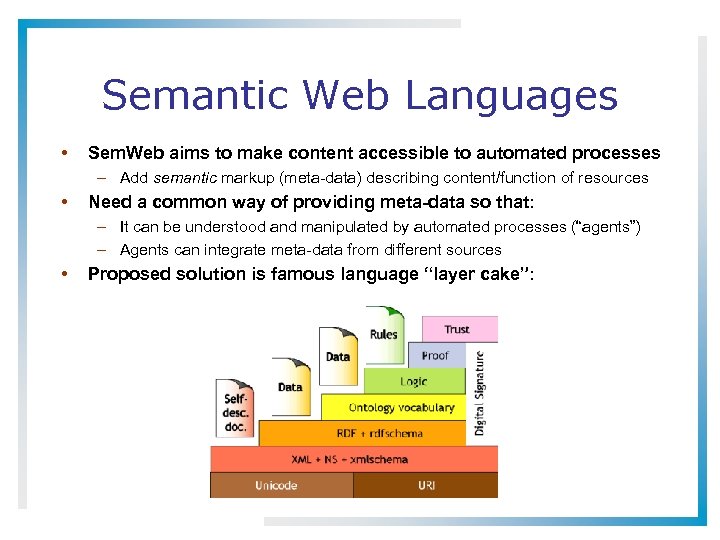
Semantic Web Languages • Sem. Web aims to make content accessible to automated processes – Add semantic markup (meta-data) describing content/function of resources • Need a common way of providing meta-data so that: – It can be understood and manipulated by automated processes (“agents”) – Agents can integrate meta-data from different sources • Proposed solution is famous language “layer cake”:
Language Architecture • Relationship between adjacent layers not clear – XML $ RDF relationship purely syntactic – RDF $ Ontology layer relationship should be something more? • RDF is proposed as base for Sem. Web languages – Used to add metadata annotations to resources – Also used to define syntax and semantics of subsequent layers • Not clear that RDF is appropriate for all these functions – – Limited set of syntax constructs (triples) Not possible to extend syntax (as it is, e. g. , when using XML) Uniform semantic treatment of triple syntax Non standard KR thesis and model theory • May facilitate development of Sem. Web to use more standard KR thesis…
Ontology Language Layer • Ontologies set to play key role in Sem. Web – source of shared and precisely defined terms for use in meta-data • RDF already extended to RDFS – Hierarchies of classes and properties – Domain and range constraints on properties • More expressive ontology languages clearly required – With logical connectives, quantifiers, transitive properties, etc. – E. g. , OIL, DAML+OIL, and now OWL • Possible choices for language layering: – Base ontology language layer(s) on RDF(S) – Base ontology language layer(s) on “classical” FOL – Base ontology language layer(s) on SKIF/Lbase/CL languages
Semantics and Model Theories • • • Ontology/KR languages aim to model (part of) world Constructs in language correspond to entities in world Meaning given by mapping to some formal system – E. g. , a logic such as FOL with its own well defined semantics – or a data model such as XQuery data model for XML – or (for more expressive languages) a Model Theory (MT) • MT defines relationship between syntax and interpretations – Can be many interpretations (models) of one piece of syntax – Models supposed to be analogue of (part of) world • E. g. , elements of model correspond to objects in world – Formal relationship between syntax and models • Structure of models must reflect relationships specified in syntax – Inference (e. g. , entailment) defined in terms of MT • E. g. , A ² B iff every model of A is also a model of B
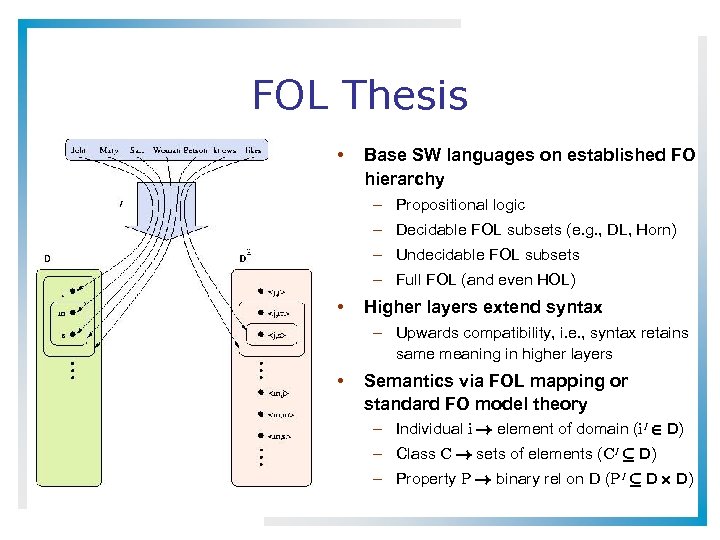
FOL Thesis • Base SW languages on established FO hierarchy – Propositional logic – Decidable FOL subsets (e. g. , DL, Horn) – Undecidable FOL subsets – Full FOL (and even HOL) • Higher layers extend syntax – Upwards compatibility, i. e. , syntax retains same meaning in higher layers • Semantics via FOL mapping or standard FO model theory – Individual i ! element of domain (i. I 2 D) – Class C ! sets of elements (CI µ D) – Property P ! binary rel on D (PI µ D £ D)
(Dis)advantages of FOL Thesis • Pros – Based on well known and extensively studied formalism – Wealth of theoretical knowledge and practical experience – Family of sub-languages with well known formal properties • E. g. , decidability, complexity – Highly optimised reasoners for FOL and many sub-languages • E. g. , DL reasoners, Horn (rule) reasoners, FOL provers – Mapping to FOL provides easy integration, e. g. , of DL and Horn languages – FO subset of RDFS fits well in this framework • Cons – No classes as instances (unless extended to HOL) – Relatively poor fit with full RDFS • Can be axiomatised in FOL, but may damage semantic interoperability and computational properties
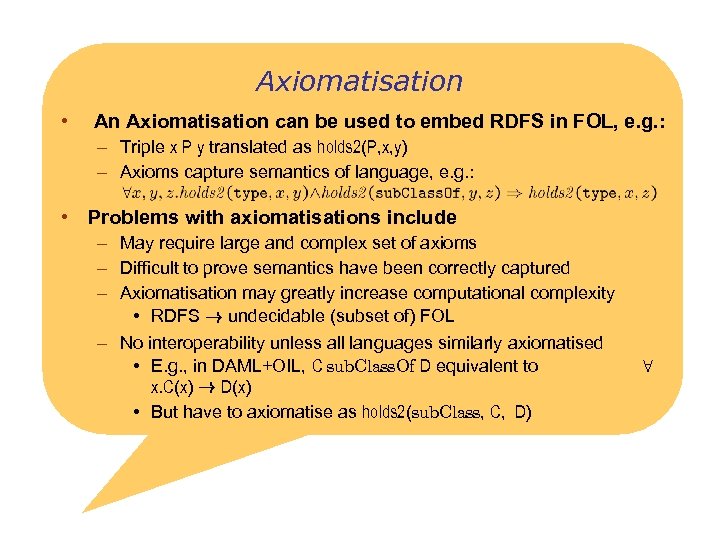
Axiomatisation • An Axiomatisation can be used to embed RDFS in FOL, e. g. : – Triple x P y translated as holds 2(P, x, y) – Axioms capture semantics of language, e. g. : • Problems with axiomatisations include – May require large and complex set of axioms – Difficult to prove semantics have been correctly captured – Axiomatisation may greatly increase computational complexity • RDFS ! undecidable (subset of) FOL – No interoperability unless all languages similarly axiomatised • E. g. , in DAML+OIL, C sub. Class. Of D equivalent to x. C(x) ! D(x) • But have to axiomatise as holds 2(sub. Class, C, D) 8
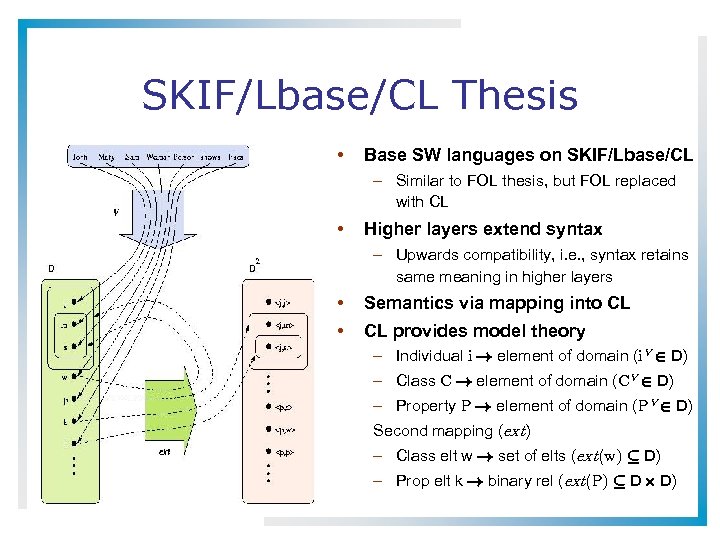
SKIF/Lbase/CL Thesis • Base SW languages on SKIF/Lbase/CL – Similar to FOL thesis, but FOL replaced with CL • Higher layers extend syntax – Upwards compatibility, i. e. , syntax retains same meaning in higher layers • Semantics via mapping into CL • CL provides model theory – Individual i ! element of domain (i. V 2 D) – Class C ! element of domain (CV 2 D) – Property P ! element of domain (PV 2 D) Second mapping (ext) – Class elt w ! set of elts (ext(w) µ D) – Prop elt k ! binary rel (ext(P) µ D £ D)
(Dis)advantages of CL Thesis • Pros – – Classes as individuals without HOL extension Can use as a basis for a family of sub-languages Mapping to CL provides easy integration of sub-languages Better fit with RDFS • Cons – – Relatively new and untried Little known about CL sub-languages Confusion w. r. t. FOL compatibility RDFS still requires axiomatisation due, e. g. , to rdf: type being in domain of discourse • Still no direct semantic interoperability with RDFS – Computational pathway only via (performance-damaging) FOL mapping
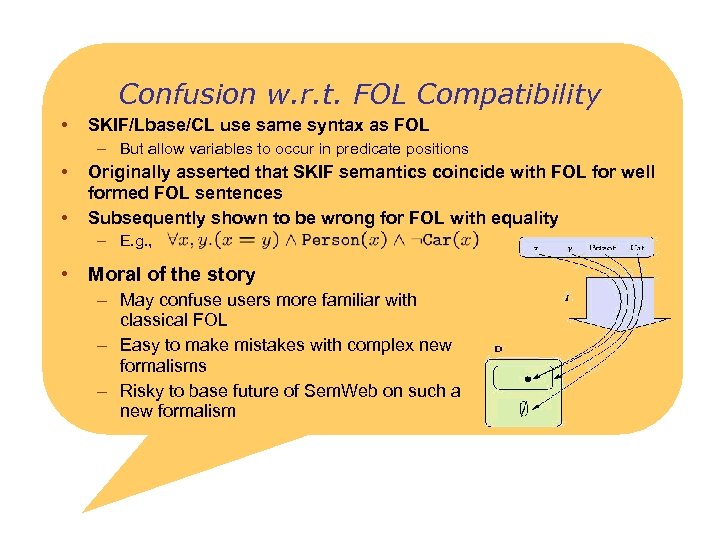
Confusion w. r. t. FOL Compatibility • SKIF/Lbase/CL use same syntax as FOL – But allow variables to occur in predicate positions • • Originally asserted that SKIF semantics coincide with FOL for well formed FOL sentences Subsequently shown to be wrong for FOL with equality – E. g. , • Moral of the story – May confuse users more familiar with classical FOL – Easy to make mistakes with complex new formalisms – Risky to base future of Sem. Web on such a new formalism
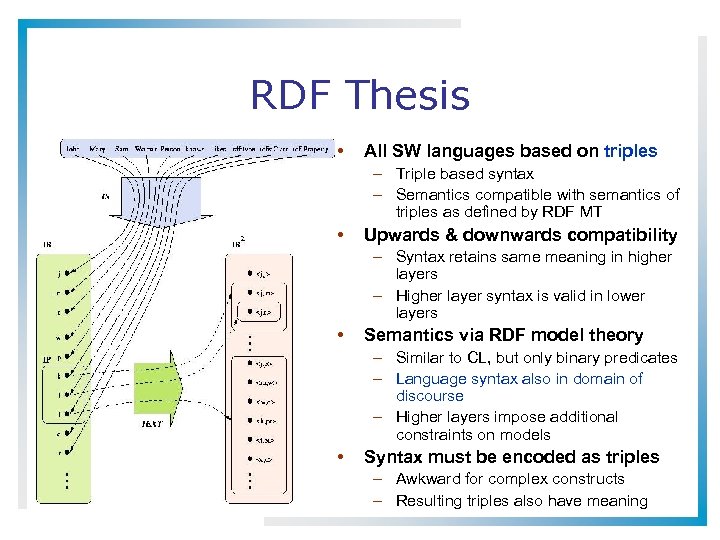
RDF Thesis • All SW languages based on triples – Triple based syntax – Semantics compatible with semantics of triples as defined by RDF MT • Upwards & downwards compatibility – Syntax retains same meaning in higher layers – Higher layer syntax is valid in lower layers • Semantics via RDF model theory – Similar to CL, but only binary predicates – Language syntax also in domain of discourse – Higher layers impose additional constraints on models • Syntax must be encoded as triples – Awkward for complex constructs – Resulting triples also have meaning
(Dis)advantages of RDF Thesis • Pros – (Supposed) interoperability between language layers – RDF tools can be used to parse all SW languages into triples – Large ontologies/KBs can be stored in triple DBs • Cons – Achieving real (semantic) interoperability may be difficult or impossible • E. g. , efforts to layer OWL on top of RDF(S) – Triple encoding of complex languages such as OWL is very clumsy – Triples introduced by encodings have semantic consequences • E. g. , first-rest triples used in list syntax have same consequences as ground facts (even though ordering of list may be arbitrary) – Not clear if technique can be extended to more expressive languages • E. g. , full FOL – Computational pathway only via (performance-damaging) FOL mapping
Summary • Formal meaning of SW languages crucial to interoperability – Common semantic underpinning facilitates layered architecture • Widely assumed that RDF will provide this underpinning – But layering on top of RDF(S) may be difficult/impossible and does not lead to any direct computational pathway – Moreover, benefits are not clear • Alternative would be to use standard FOL as underpinning – – Well established and well understood Established family of languages capturing different trade-offs Direct computational pathway for FOL and many sub-languages FO subset of RDF(S) would fit well in this framework • Third approach is to use CL as underpinning – Relatively new and untested – May not solve problems with RDF(S)
Perhaps we should consider recalling the Semantic Web bandwagon in order to carry out a safety modification on the RDF component!
Скачать презентацию Three Theses of Representation in the Semantic Web
472f72856fcfddb6ff0fed0cc3e65691.ppt