 Скачать презентацию Three periods of Kiev Rus Student Ruben Gazaryan
KievanRus_RubenGazaryan.pptx
- Количество слайдов: 9



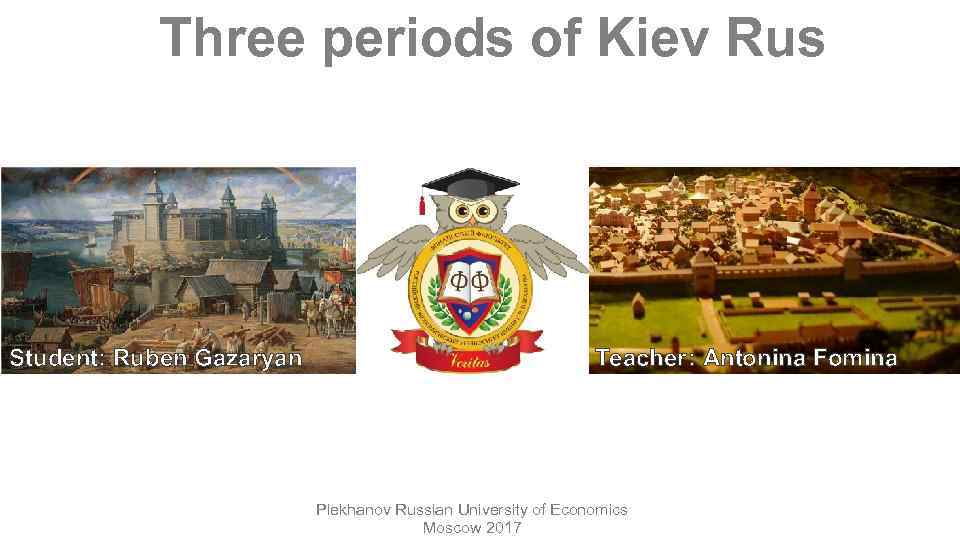
Three periods of Kiev Rus Student: Ruben Gazaryan Teacher: Antonina Fomina Plekhanov Russian University of Economics Moscow 2017
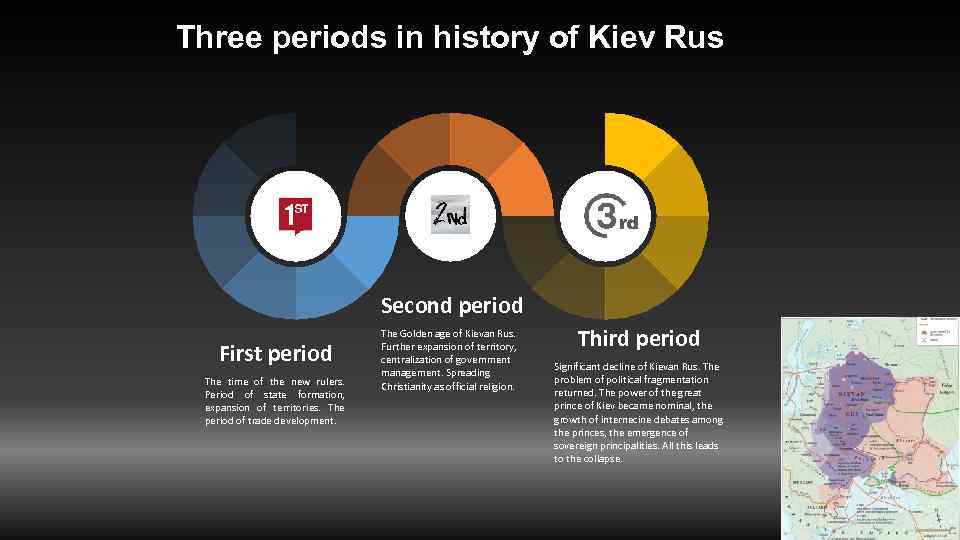
Three periods in history of Kiev Rus rd Second period First period The time of the new rulers. Period of state formation, expansion of territories. The period of trade development. The Golden age of Kievan Rus. Further expansion of territory, centralization of government management. Spreading Christianity as official religion. Third period Significant decline of Kievan Rus. The problem of political fragmentation returned. The power of the great prince of Kiev became nominal, the growth of internecine debates among the princes, the emergence of sovereign principalities. All this leads to the collapse.
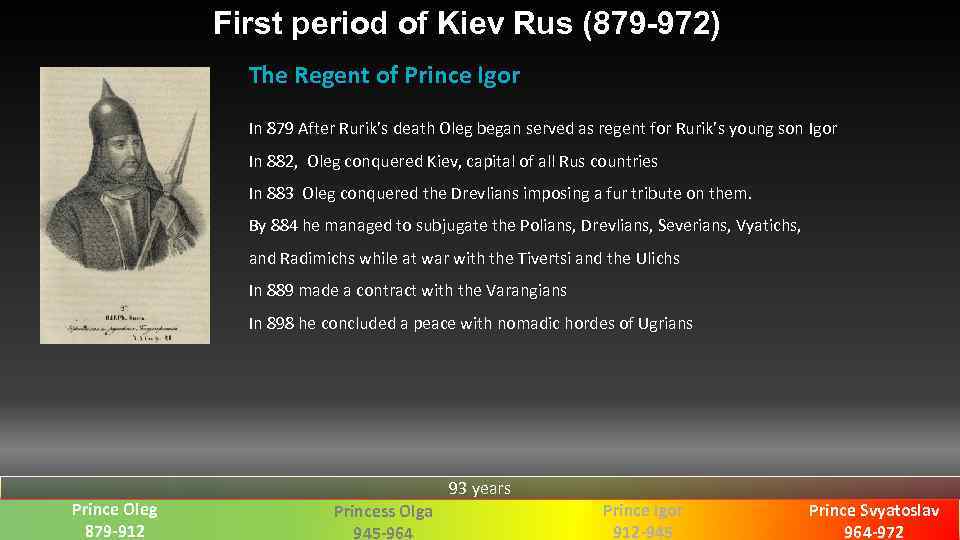
First period of Kiev Rus (879 -972) The Regent of Prince Igor In 879 After Rurik’s death Oleg began served as regent for Rurik’s young son Igor In 882, Oleg conquered Kiev, capital of all Rus countries In 883 Oleg conquered the Drevlians imposing a fur tribute on them. By 884 he managed to subjugate the Polians, Drevlians, Severians, Vyatichs, and Radimichs while at war with the Tivertsi and the Ulichs In 889 made a contract with the Varangians In 898 he concluded a peace with nomadic hordes of Ugrians Prince Oleg 879 -912 93 years Princess Olga 945 -964 Prince Igor 912 -945 Prince Svyatoslav 964 -972
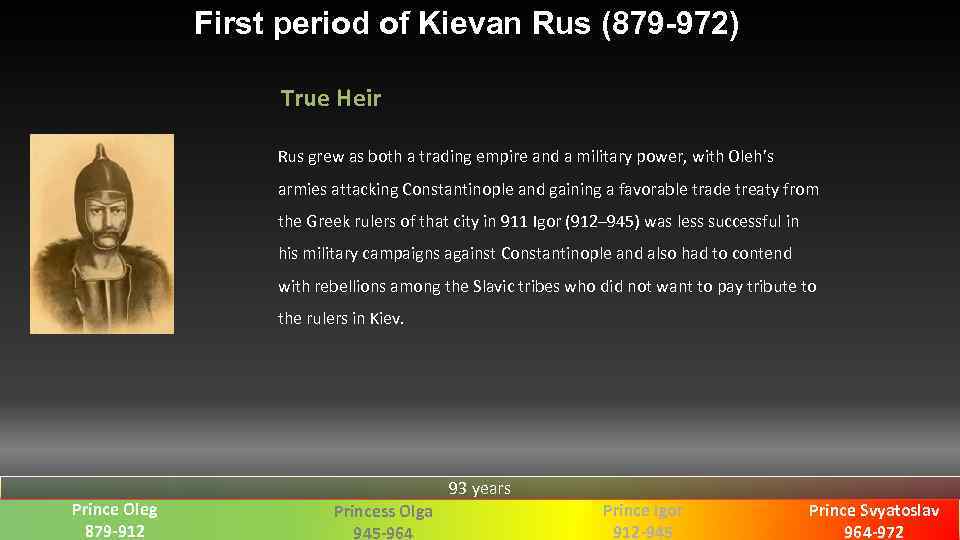
First period of Kievan Rus (879 -972) True Heir Rus grew as both a trading empire and a military power, with Oleh’s armies attacking Constantinople and gaining a favorable trade treaty from the Greek rulers of that city in 911 Igor (912– 945) was less successful in his military campaigns against Constantinople and also had to contend with rebellions among the Slavic tribes who did not want to pay tribute to the rulers in Kiev. Prince Oleg 879 -912 93 years Princess Olga 945 -964 Prince Igor 912 -945 Prince Svyatoslav 964 -972
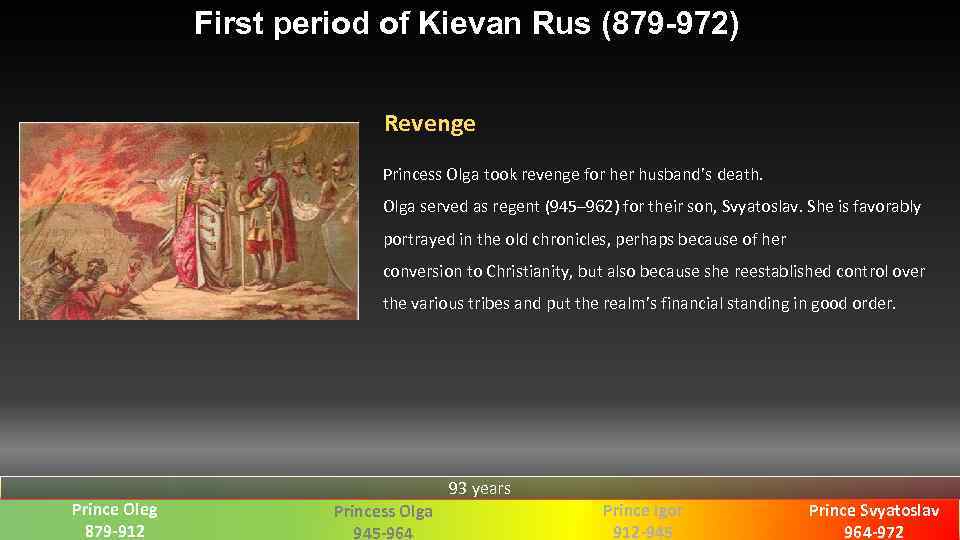
First period of Kievan Rus (879 -972) Revenge Princess Olga took revenge for her husband’s death. Olga served as regent (945– 962) for their son, Svyatoslav. She is favorably portrayed in the old chronicles, perhaps because of her conversion to Christianity, but also because she reestablished control over the various tribes and put the realm’s financial standing in good order. Prince Oleg 879 -912 93 years Princess Olga 945 -964 Prince Igor 912 -945 Prince Svyatoslav 964 -972
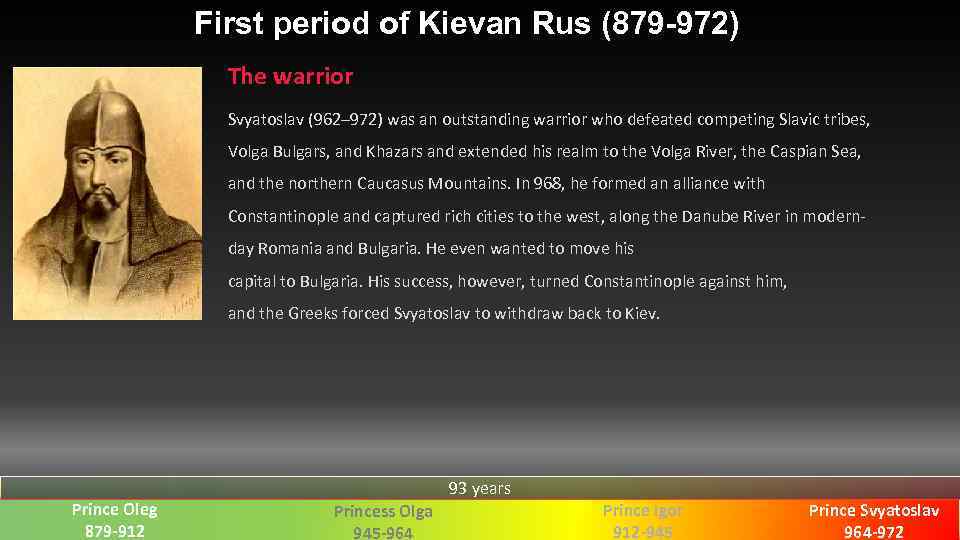
First period of Kievan Rus (879 -972) The warrior Svyatoslav (962– 972) was an outstanding warrior who defeated competing Slavic tribes, Volga Bulgars, and Khazars and extended his realm to the Volga River, the Caspian Sea, and the northern Caucasus Mountains. In 968, he formed an alliance with Constantinople and captured rich cities to the west, along the Danube River in modernday Romania and Bulgaria. He even wanted to move his capital to Bulgaria. His success, however, turned Constantinople against him, and the Greeks forced Svyatoslav to withdraw back to Kiev. Prince Oleg 879 -912 93 years Princess Olga 945 -964 Prince Igor 912 -945 Prince Svyatoslav 964 -972
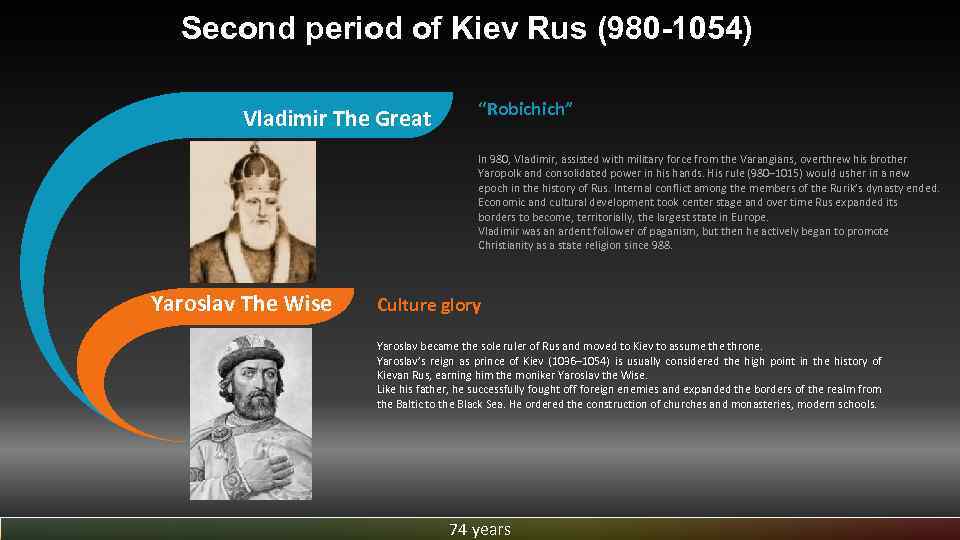
Second period of Kiev Rus (980 -1054) Vladimir The Great “Robichich” In 980, Vladimir, assisted with military force from the Varangians, overthrew his brother Yaropolk and consolidated power in his hands. His rule (980– 1015) would usher in a new epoch in the history of Rus. Internal conflict among the members of the Rurik’s dynasty ended. Economic and cultural development took center stage and over time Rus expanded its borders to become, territorially, the largest state in Europe. Vladimir was an ardent follower of paganism, but then he actively began to promote Christianity as a state religion since 988. Yaroslav The Wise Culture glory Yaroslav became the sole ruler of Rus and moved to Kiev to assume throne. Yaroslav’s reign as prince of Kiev (1036– 1054) is usually considered the high point in the history of Kievan Rus, earning him the moniker Yaroslav the Wise. Like his father, he successfully fought off foreign enemies and expanded the borders of the realm from the Baltic to the Black Sea. He ordered the construction of churches and monasteries, modern schools. 74 years
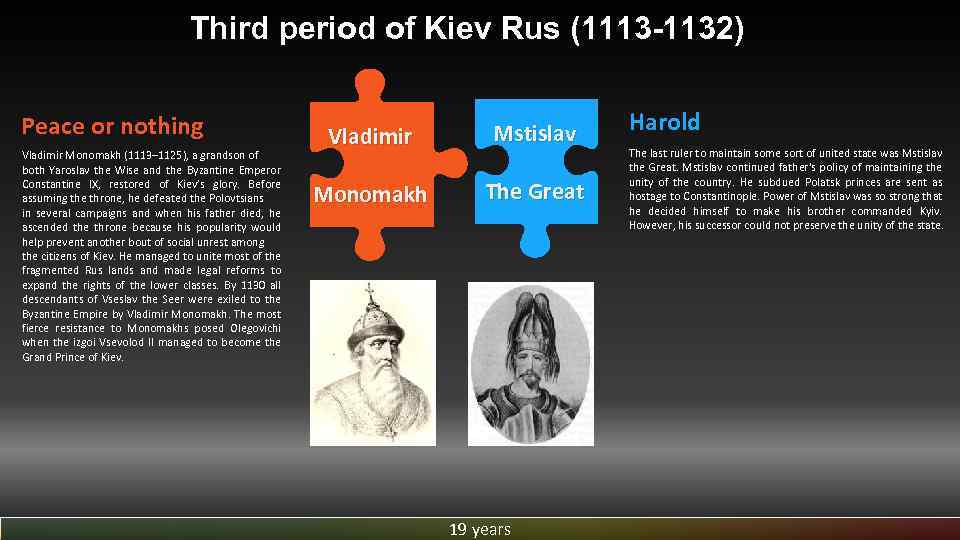
Third period of Kiev Rus (1113 -1132) Peace or nothing Vladimir Monomakh (1113– 1125), a grandson of both Yaroslav the Wise and the Byzantine Emperor Constantine IX, restored of Kiev’s glory. Before assuming the throne, he defeated the Polovtsians in several campaigns and when his father died, he ascended the throne because his popularity would help prevent another bout of social unrest among the citizens of Kiev. He managed to unite most of the fragmented Rus lands and made legal reforms to expand the rights of the lower classes. By 1130 all descendants of Vseslav the Seer were exiled to the Byzantine Empire by Vladimir Monomakh. The most fierce resistance to Monomakhs posed Olegovichi when the izgoi Vsevolod II managed to become the Grand Prince of Kiev. Vladimir Mstislav Monomakh The Great 19 years Harold The last ruler to maintain some sort of united state was Mstislav the Great. Mstislav continued father's policy of maintaining the unity of the country. He subdued Polatsk princes are sent as hostage to Constantinople. Power of Mstislav was so strong that he decided himself to make his brother commanded Kyiv. However, his successor could not preserve the unity of the state.

After Mstislav's death wars between princes broke out with a bang and is quickly Rus split into a dozen lands and principalities, whose rulers continuously competed among themselves for superiority. THANK YOU
Скачать презентацию Three periods of Kiev Rus Student Ruben Gazaryan
KievanRus_RubenGazaryan.pptx