 Скачать презентацию Thoughts on Address Prefix Management Fred Baker
9d2dd5f3688a179f7dca3c2aff4a4b28.ppt
- Количество слайдов: 15




Thoughts on Address Prefix Management Fred Baker
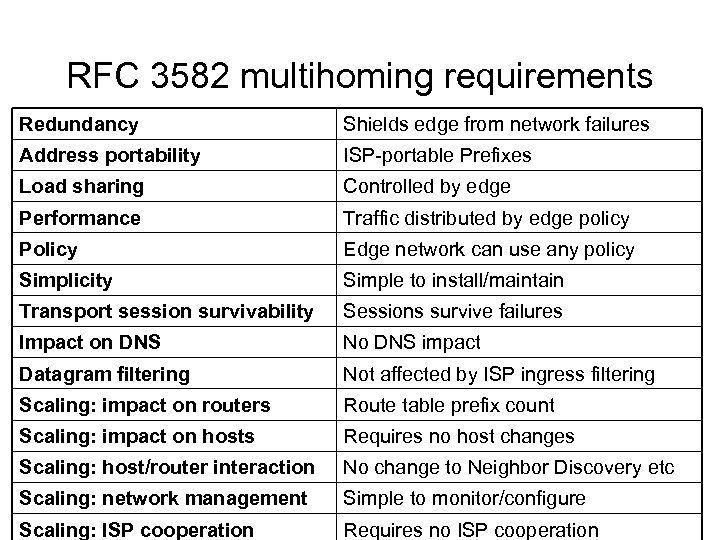
RFC 3582 multihoming requirements Redundancy Shields edge from network failures Address portability ISP-portable Prefixes Load sharing Controlled by edge Performance Traffic distributed by edge policy Policy Edge network can use any policy Simplicity Simple to install/maintain Transport session survivability Sessions survive failures Impact on DNS No DNS impact Datagram filtering Not affected by ISP ingress filtering Scaling: impact on routers Route table prefix count Scaling: impact on hosts Requires no host changes Scaling: host/router interaction No change to Neighbor Discovery etc Scaling: network management Simple to monitor/configure Scaling: ISP cooperation Requires no ISP cooperation
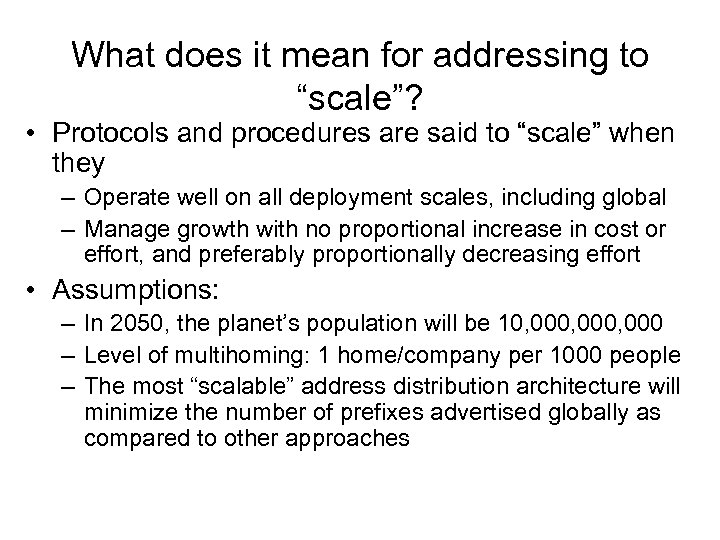
What does it mean for addressing to “scale”? • Protocols and procedures are said to “scale” when they – Operate well on all deployment scales, including global – Manage growth with no proportional increase in cost or effort, and preferably proportionally decreasing effort • Assumptions: – In 2050, the planet’s population will be 10, 000, 000 – Level of multihoming: 1 home/company per 1000 people – The most “scalable” address distribution architecture will minimize the number of prefixes advertised globally as compared to other approaches
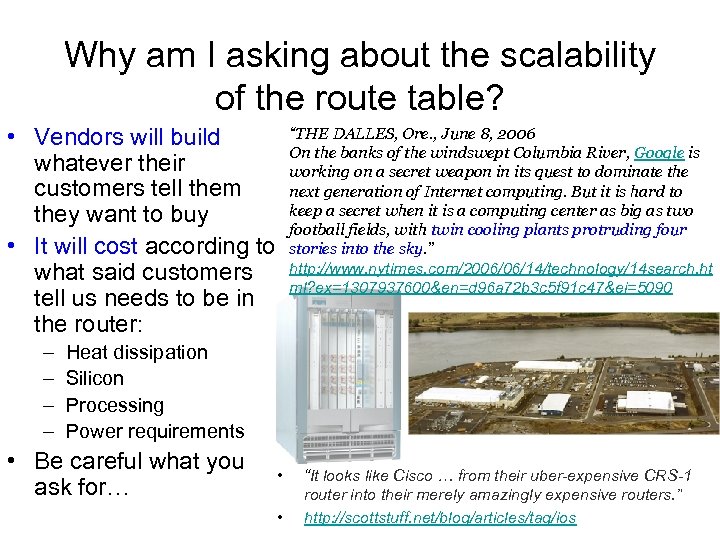
Why am I asking about the scalability of the route table? • Vendors will build whatever their customers tell them they want to buy • It will cost according to what said customers tell us needs to be in the router: – – “THE DALLES, Ore. , June 8, 2006 On the banks of the windswept Columbia River, Google is working on a secret weapon in its quest to dominate the next generation of Internet computing. But it is hard to keep a secret when it is a computing center as big as two football fields, with twin cooling plants protruding four stories into the sky. ” http: //www. nytimes. com/2006/06/14/technology/14 search. ht ml? ex=1307937600&en=d 96 a 72 b 3 c 5 f 91 c 47&ei=5090 Heat dissipation Silicon Processing Power requirements • Be careful what you ask for… • • “It looks like Cisco … from their uber-expensive CRS-1 router into their merely amazingly expensive routers. ” http: //scottstuff. net/blog/articles/tag/ios
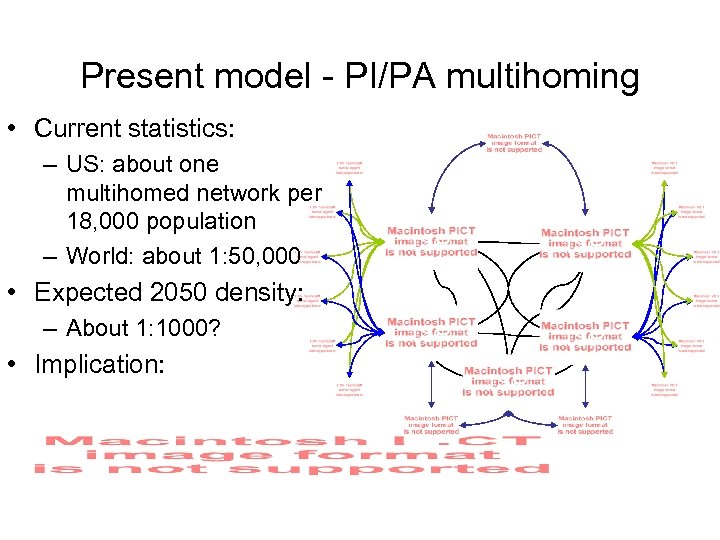
Present model - PI/PA multihoming • Current statistics: – US: about one multihomed network per 18, 000 population – World: about 1: 50, 000 ISP ISP • Expected 2050 density: – About 1: 1000? • Implication: ISP
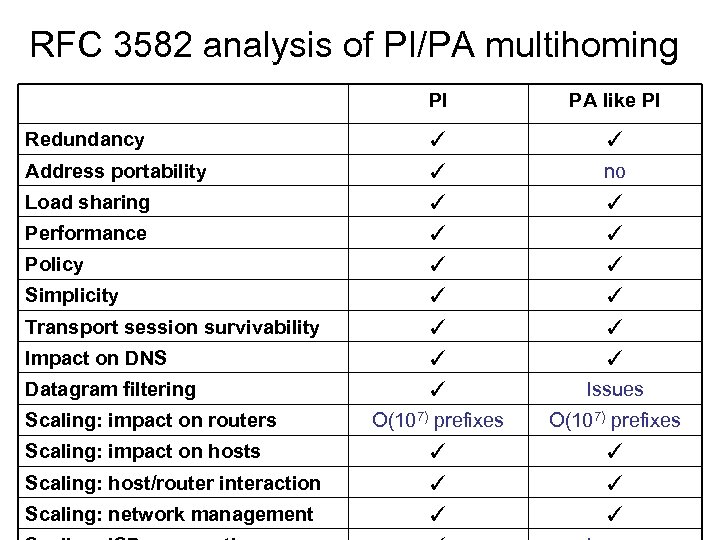
RFC 3582 analysis of PI/PA multihoming PI PA like PI Redundancy ✓ ✓ Address portability ✓ no Load sharing ✓ ✓ Performance ✓ ✓ Policy ✓ ✓ Simplicity ✓ ✓ Transport session survivability ✓ ✓ Impact on DNS ✓ ✓ Datagram filtering ✓ Issues O(107) prefixes Scaling: impact on hosts ✓ ✓ Scaling: host/router interaction ✓ ✓ Scaling: network management ✓ ✓ Scaling: impact on routers
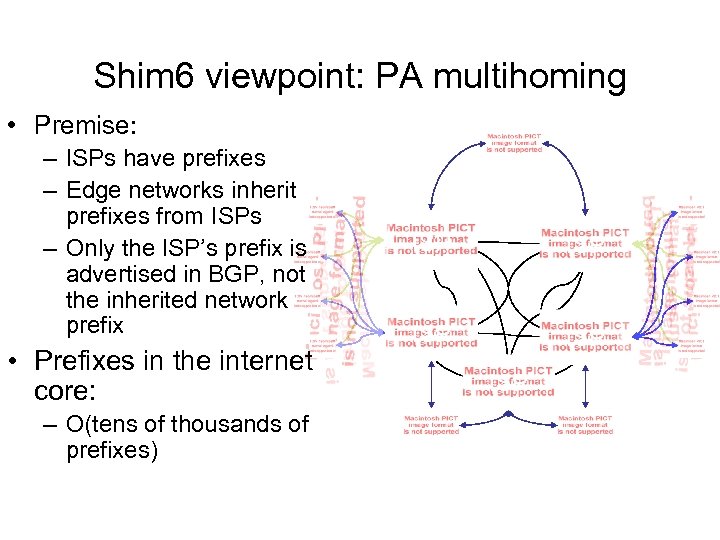
Shim 6 viewpoint: PA multihoming • Premise: – ISPs have prefixes – Edge networks inherit prefixes from ISPs – Only the ISP’s prefix is advertised in BGP, not the inherited network prefix • Prefixes in the internet core: – O(tens of thousands of prefixes) ISP ISP ISP
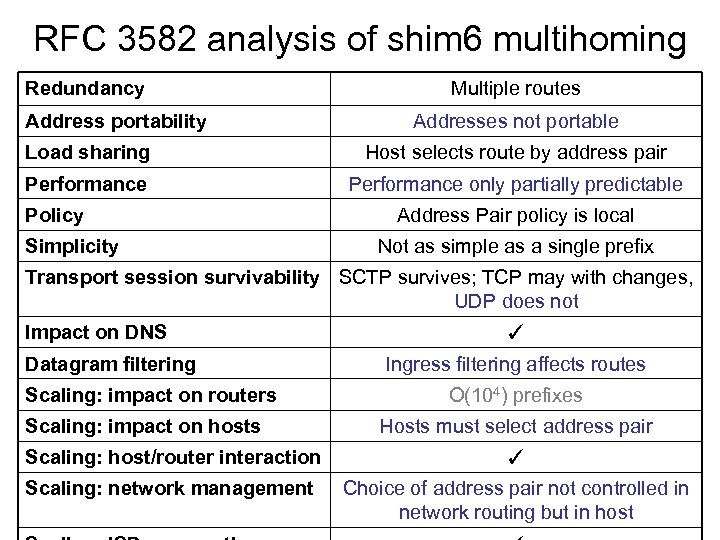
RFC 3582 analysis of shim 6 multihoming Redundancy Address portability Multiple routes Addresses not portable Load sharing Host selects route by address pair Performance only partially predictable Policy Simplicity Address Pair policy is local Not as simple as a single prefix Transport session survivability SCTP survives; TCP may with changes, UDP does not Impact on DNS Datagram filtering Scaling: impact on routers Scaling: impact on hosts ✓ Ingress filtering affects routes O(104) prefixes Hosts must select address pair Scaling: host/router interaction ✓ Scaling: network management Choice of address pair not controlled in network routing but in host
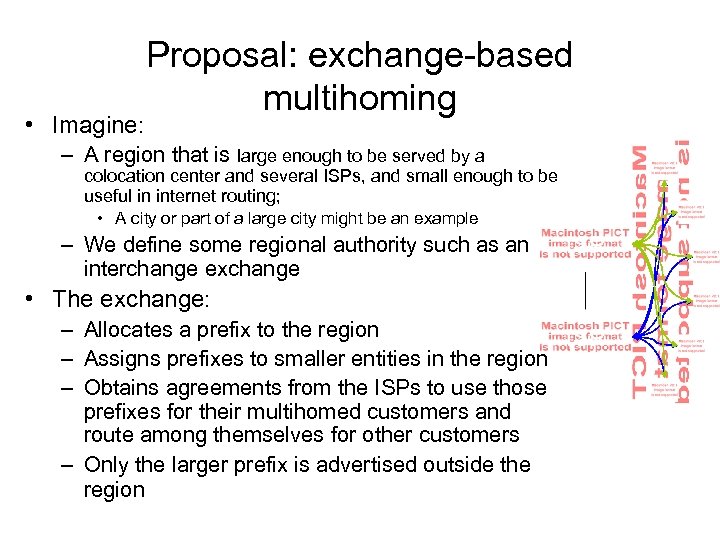
• Imagine: Proposal: exchange-based multihoming – A region that is large enough to be served by a colocation center and several ISPs, and small enough to be useful in internet routing; • A city or part of a large city might be an example – We define some regional authority such as an interchange exchange ISP • The exchange: – Allocates a prefix to the region ISP – Assigns prefixes to smaller entities in the region – Obtains agreements from the ISPs to use those prefixes for their multihomed customers and route among themselves for other customers – Only the larger prefix is advertised outside the region
Possible implementations • Three obvious approaches: • – All the ISPs maintain bilateral contracts with each other and route accordingly (mesh topology) – All of the ISPs contract with an exchange ISP operated by the exchange (star topology) – Some combination of the first two approaches Exchange mini-ISP model: ISP – Exchange manages a router in the colocation center and assigns prefixes to SOHO networks – All ISPs connect to it and to their customers • ISP peers with or buys transit from some ISPs ISP • Other ISPs buy transit from it All ISPs advertise their regional routes to it • It advertises the regional prefix to them – Note that the mini-ISP does not necessarily sell transit service outside the region – ISPs route directly to their customers and otherwise to the exchange ISP ISP
Proposed model - exchange-based multihoming • Imagine: – We deploy a prefix for every 1, 000 people in a regional prefix • (Exact number not algorithmically important) – Interchange ISP could be government-related or simply an exchange cooperative • The prefix identifies the general region – Delivery is to an ISP’s customer or to the regional switch and then to the customer • Implication: ISP ISP ISP
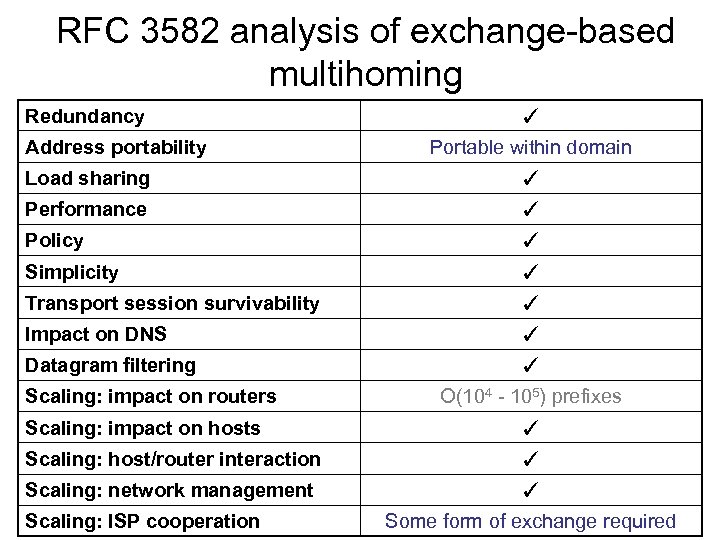
RFC 3582 analysis of exchange-based multihoming Redundancy Address portability ✓ Portable within domain Load sharing ✓ Performance ✓ Policy ✓ Simplicity ✓ Transport session survivability ✓ Impact on DNS ✓ Datagram filtering ✓ Scaling: impact on routers O(104 - 105) prefixes Scaling: impact on hosts ✓ Scaling: host/router interaction ✓ Scaling: network management ✓ Scaling: ISP cooperation Some form of exchange required
Business implications of exchangebased multihoming • Traffic is now carried by the destination’s ISP Remote Network – Hot potato routing shifts traffic there • In exchange-based model, traffic is ISP – Carried by sender’s ISP to the region, and then – Transits to the destination ISP • There is an implied transit model that has to be accounted for – Anti-trust issue: new ISP buys transit from all others? – Transit contracts required between exchange and carriers? A B ISP ISP
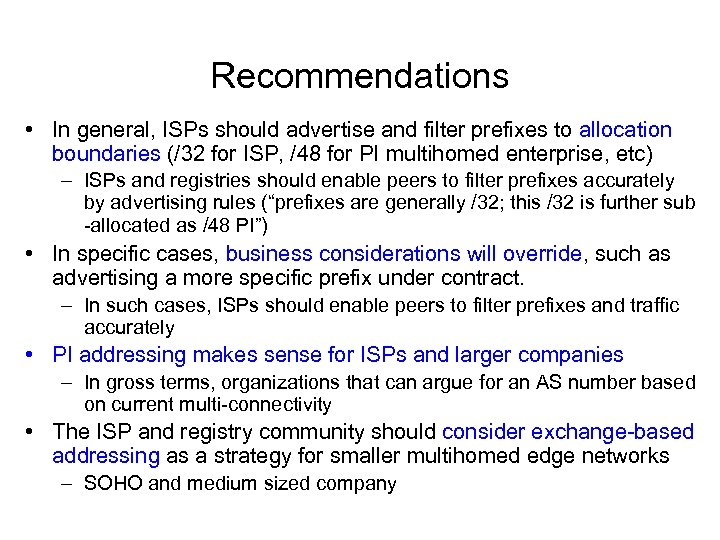
Recommendations • In general, ISPs should advertise and filter prefixes to allocation boundaries (/32 for ISP, /48 for PI multihomed enterprise, etc) – ISPs and registries should enable peers to filter prefixes accurately by advertising rules (“prefixes are generally /32; this /32 is further sub -allocated as /48 PI”) • In specific cases, business considerations will override, such as advertising a more specific prefix under contract. – In such cases, ISPs should enable peers to filter prefixes and traffic accurately • PI addressing makes sense for ISPs and larger companies – In gross terms, organizations that can argue for an AS number based on current multi-connectivity • The ISP and registry community should consider exchange-based addressing as a strategy for smaller multihomed edge networks – SOHO and medium sized company

Thoughts on address prefix management Fred Baker
Скачать презентацию Thoughts on Address Prefix Management Fred Baker
9d2dd5f3688a179f7dca3c2aff4a4b28.ppt