


 Скачать презентацию Thomas Paine 1737 1809 The outstanding and
thomas_paine66 12.pptx
- Количество слайдов: 7
 Thomas Paine (1737 – 1809) The outstanding and progressive writer Anastasia Kovalyova Form 11 B School № 5 Teacher: Savko N. G.
 Old School at Thetford Grammar School, where Paine was educated. Thomas Paine's house in Lewes 2
 In 1802, he returned to the U. S. where he died on June 8, 1809. Only six people attended his funeral as he had been ostracized for his ridicule of Christianity. Paine lived in France for most of the 1790 s, becoming deeply involved in the French Revolution. Born in Thetford, England (February 9, 1737), in the county of Norfolk, Paine emigrated to the British American colonies in 1774 with the help of Benjamin Franklin, arriving just in time to participate in the American Revolution. The life in September, 1774, mathematician, Fellow of the Royal Society, and Commissioner of the Excise George Lewis Scott introduced him to Benjamin Franklin, who suggested emigration to British colonial America, and gave him a letter of recommendation. In October, Thomas Paine emigrated from Great Britain to the American colonies, arriving in Philadelphia 3 on November 30, 1774.
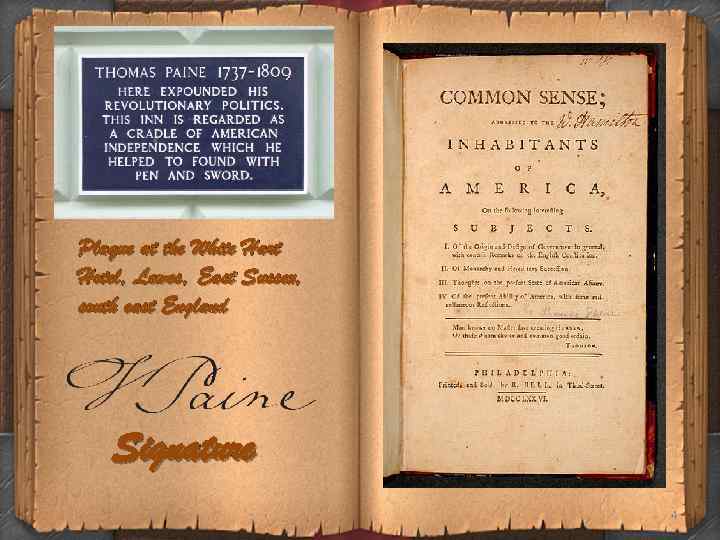 Plaque at the White Hart Hotel, Lewes, East Sussex, south east England Signature 4
 He became notorious because of his pamphlet The Age of Reason (1793 – 94), in which he advocated deism, promoted reason and free thought, and argued againstitutionalized religion in general and Christian doctrine in particular. Virtually every patriot read (or listened to a reading) of his powerful pamphlet Common Sense (1776), which crystallized the Patriot demand for independence from Great Britain. Creativity He also wrote the pamphlet Agrarian Justice (1795), discussing the origins of property, and introduced the concept of a guaranteed minimum income. His The American Crisis (1776– 83) was a prorevolutionary pamphlet series. Common Sense was so influential that John Adams said, "Without the pen of the author of Common Sense, the sword of Washington would have been raised in vain. " 5
 Common Sense In clear, simple language it explained the advantages of and the need for immediate independence. It was published anonymously on January 10, 1776, at the beginning of the American Revolution and became an immediate sensation. Forgoing the philosophical and Latin references used by Enlightenment era writers, he structured Common Sense as if it were a sermon, and relied on Biblical references to make his case to the people Common Sense presented the American colonists with an argument for freedom from British rule at a time when the question of whether or not to seek independence was the central issue of the day. Paine wrote and reasoned in a style that common people understood. He connected independence with common dissenting Protestant beliefs as a means to present a distinctly American political identity. Historian Gordon S. Wood described Common Sense as "the most incendiary and popular pamphlet of the entire revolutionary era". 6
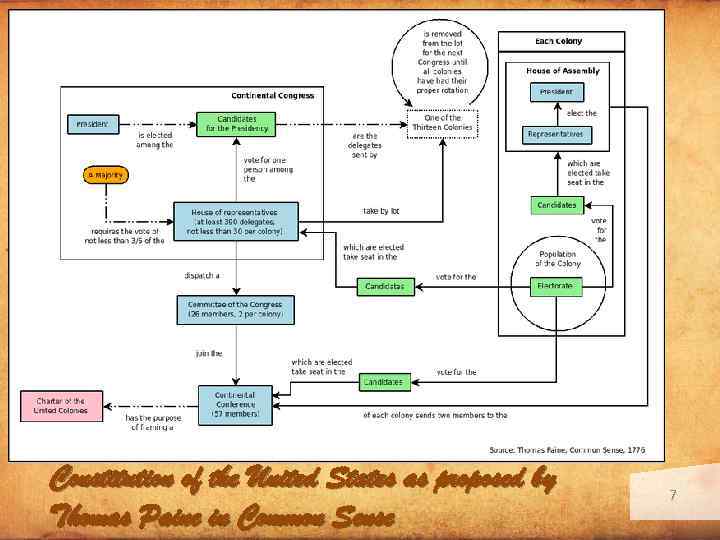 Constitution of the United States as proposed by Thomas Paine in Common Sense 7