


 Скачать презентацию Thomas Mayne Reid Thomas Mayne Reid
Thomas Mayne Reid.pptx
- Количество слайдов: 15
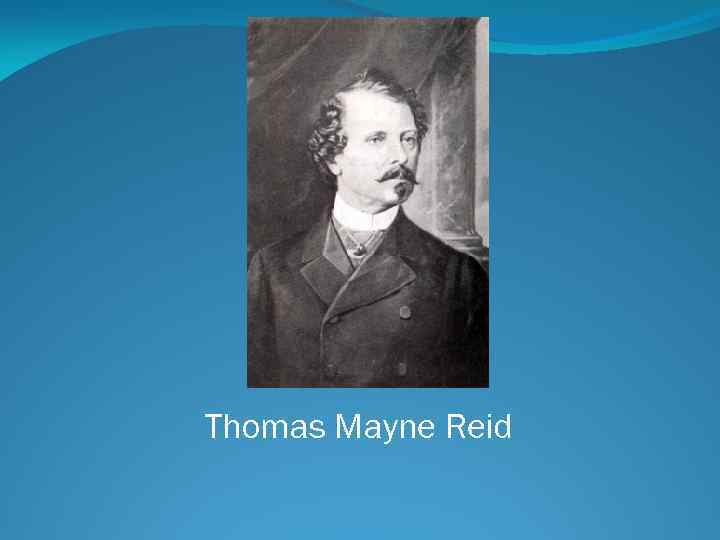 Thomas Mayne Reid
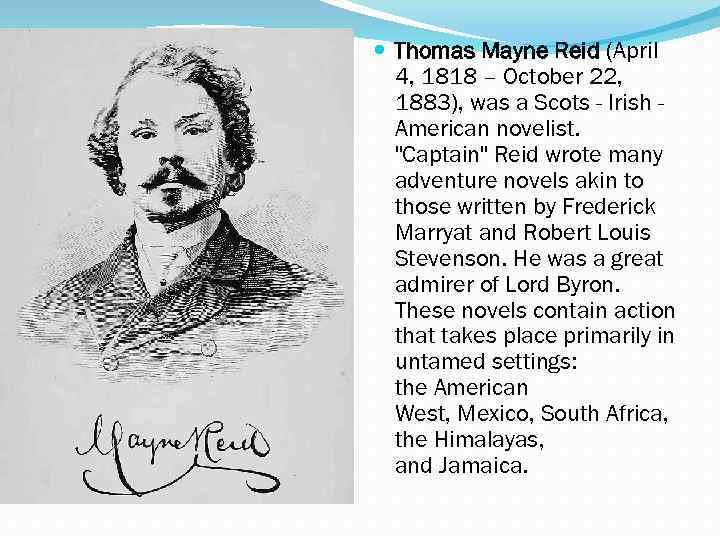 Thomas Mayne Reid (April 4, 1818 – October 22, 1883), was a Scots - Irish American novelist. "Captain" Reid wrote many adventure novels akin to those written by Frederick Marryat and Robert Louis Stevenson. He was a great admirer of Lord Byron. These novels contain action that takes place primarily in untamed settings: the American West, Mexico, South Africa, the Himalayas, and Jamaica.
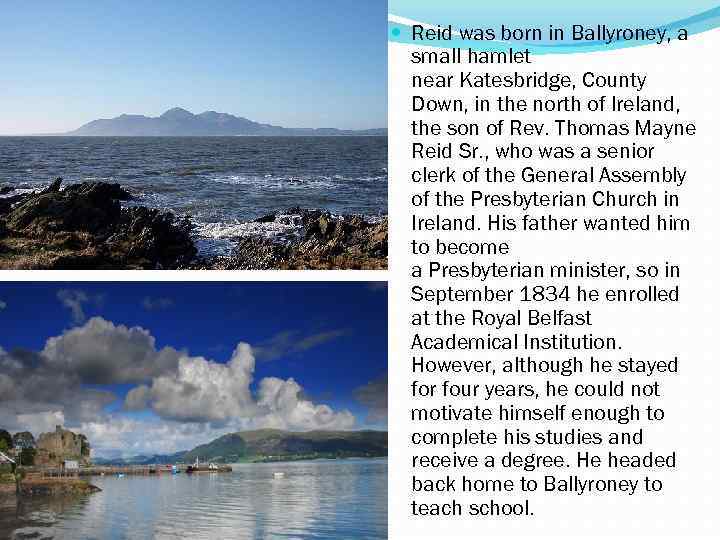 Reid was born in Ballyroney, a small hamlet near Katesbridge, County Down, in the north of Ireland, the son of Rev. Thomas Mayne Reid Sr. , who was a senior clerk of the General Assembly of the Presbyterian Church in Ireland. His father wanted him to become a Presbyterian minister, so in September 1834 he enrolled at the Royal Belfast Academical Institution. However, although he stayed for four years, he could not motivate himself enough to complete his studies and receive a degree. He headed back home to Ballyroney to teach school.
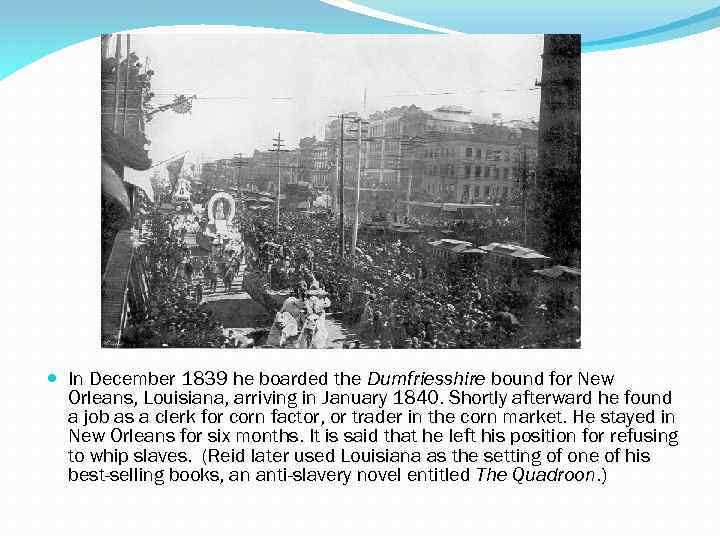 In December 1839 he boarded the Dumfriesshire bound for New Orleans, Louisiana, arriving in January 1840. Shortly afterward he found a job as a clerk for corn factor, or trader in the corn market. He stayed in New Orleans for six months. It is said that he left his position for refusing to whip slaves. (Reid later used Louisiana as the setting of one of his best-selling books, an anti-slavery novel entitled The Quadroon. )
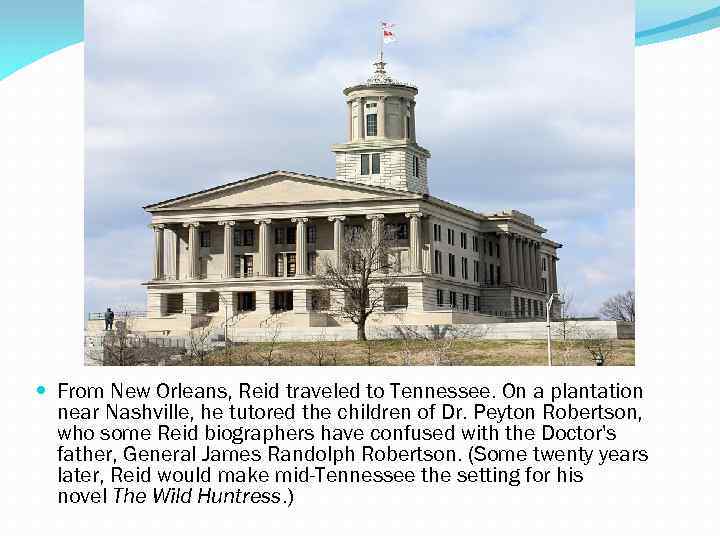 From New Orleans, Reid traveled to Tennessee. On a plantation near Nashville, he tutored the children of Dr. Peyton Robertson, who some Reid biographers have confused with the Doctor's father, General James Randolph Robertson. (Some twenty years later, Reid would make mid-Tennessee the setting for his novel The Wild Huntress. )
 Following Dr. Robertson's death, Reid founded a short-lived private school in Nashville. In 1841 he found work as a clerk for a provision dealer in either Natchez, Mississippi or Natchitoches, Louisiana. Although Reid later claimed to have made several trips to the West during this period of his life (on which he purportedly based some of his novels), the evidence for such journeys is sketchy and confusing at best.
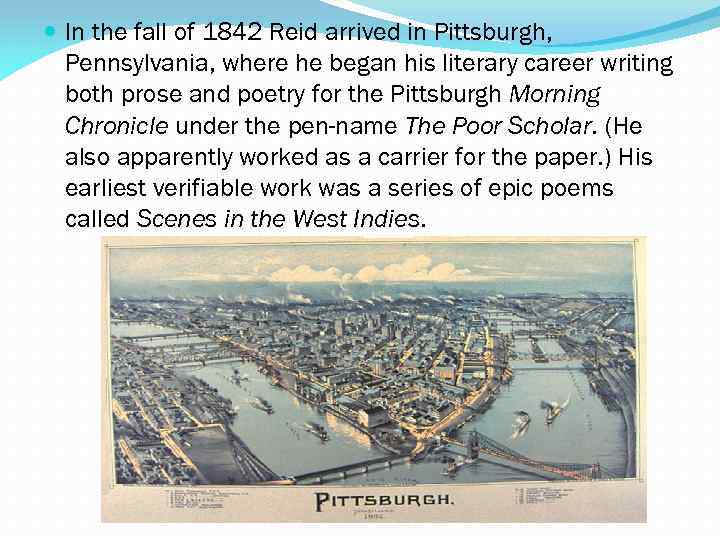 In the fall of 1842 Reid arrived in Pittsburgh, Pennsylvania, where he began his literary career writing both prose and poetry for the Pittsburgh Morning Chronicle under the pen-name The Poor Scholar. (He also apparently worked as a carrier for the paper. ) His earliest verifiable work was a series of epic poems called Scenes in the West Indies.
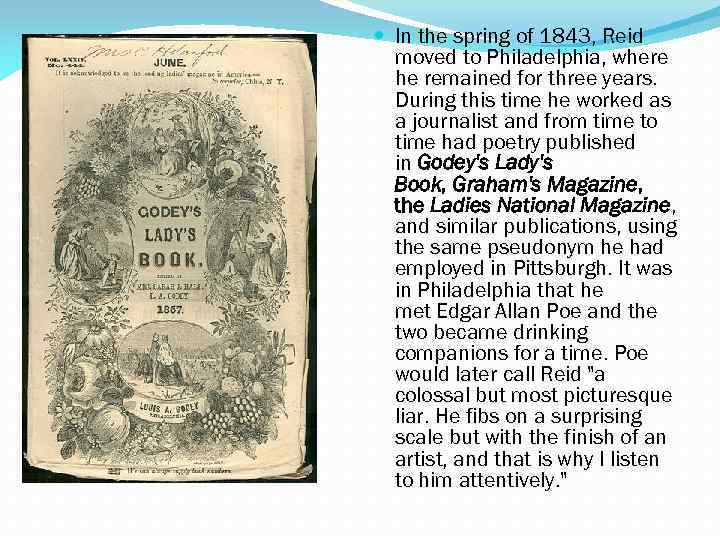 In the spring of 1843, Reid moved to Philadelphia, where he remained for three years. During this time he worked as a journalist and from time to time had poetry published in Godey's Lady's Book, Graham's Magazine, the Ladies National Magazine, and similar publications, using the same pseudonym he had employed in Pittsburgh. It was in Philadelphia that he met Edgar Allan Poe and the two became drinking companions for a time. Poe would later call Reid "a colossal but most picturesque liar. He fibs on a surprising scale but with the finish of an artist, and that is why I listen to him attentively. "
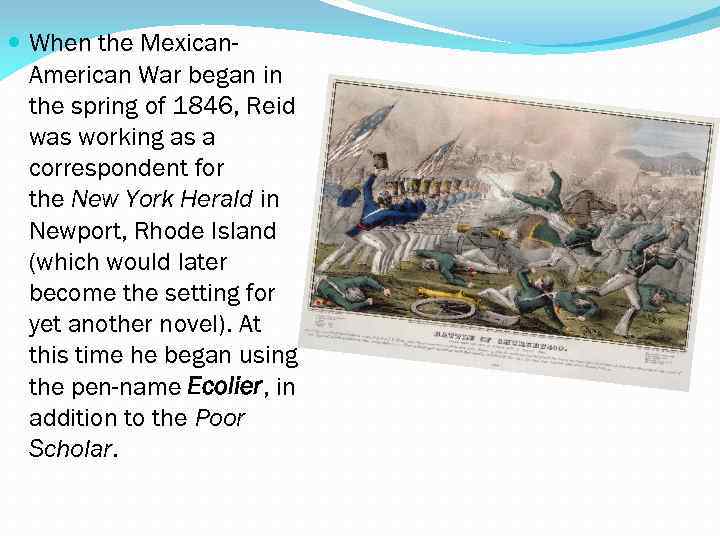 When the Mexican. American War began in the spring of 1846, Reid was working as a correspondent for the New York Herald in Newport, Rhode Island (which would later become the setting for yet another novel). At this time he began using the pen-name Ecolier, in addition to the Poor Scholar.
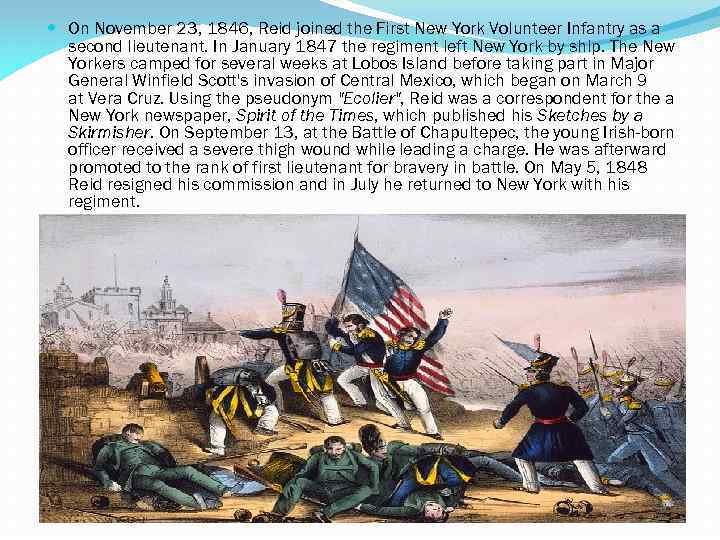 On November 23, 1846, Reid joined the First New York Volunteer Infantry as a second lieutenant. In January 1847 the regiment left New York by ship. The New Yorkers camped for several weeks at Lobos Island before taking part in Major General Winfield Scott's invasion of Central Mexico, which began on March 9 at Vera Cruz. Using the pseudonym "Ecolier", Reid was a correspondent for the a New York newspaper, Spirit of the Times, which published his Sketches by a Skirmisher. On September 13, at the Battle of Chapultepec, the young Irish-born officer received a severe thigh wound while leading a charge. He was afterward promoted to the rank of first lieutenant for bravery in battle. On May 5, 1848 Reid resigned his commission and in July he returned to New York with his regiment.
 Learning of the Bavarian Revolution, he headed to England to volunteer. But, after the Atlantic crossing changed his mind, and instead headed home to northern Ireland. He shortly moved to London, and in 1850 published his first novel, The Rifle Rangers. This was followed by The Scalp Hunters, The Desert Home (1852), and The Boy Hunters (1853). This latter book, set in Texas and Louisiana, was "juvenile scientific travelog". It would become a favorite of young Theodore Roosevelt, who would become a huge Reid fan. That same year Reid married the daughter of his publisher G. W. Hyde, an English aristocrat, Elizabeth Hyde, a 15 -year-old young lady.
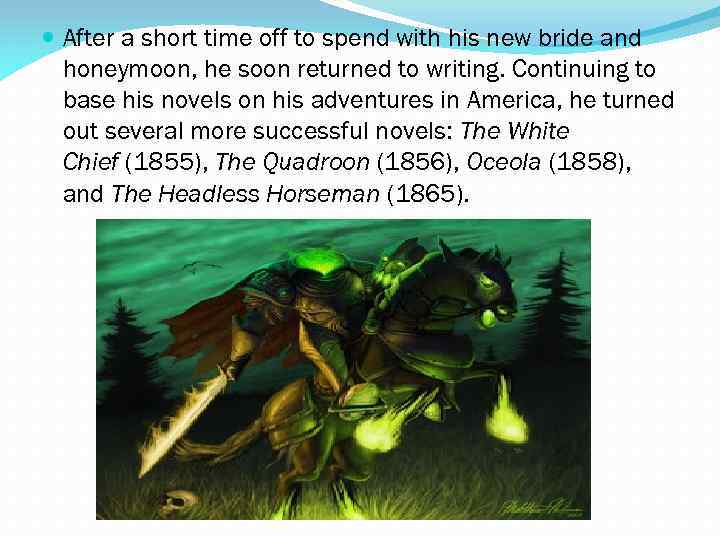 After a short time off to spend with his new bride and honeymoon, he soon returned to writing. Continuing to base his novels on his adventures in America, he turned out several more successful novels: The White Chief (1855), The Quadroon (1856), Oceola (1858), and The Headless Horseman (1865).
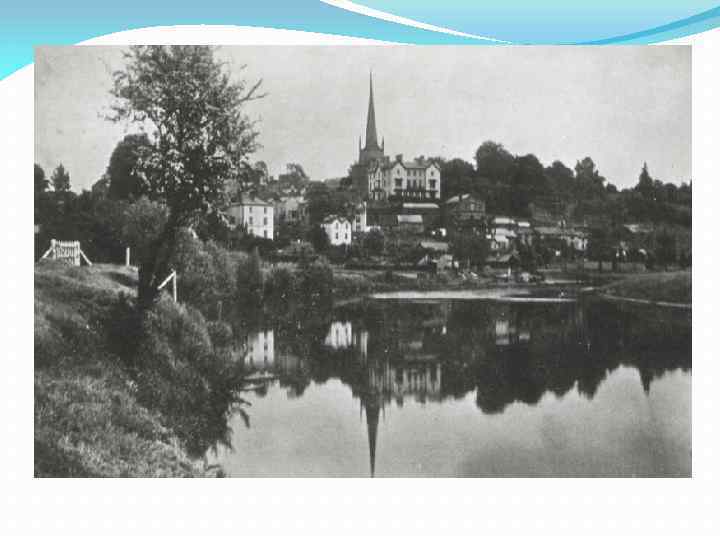
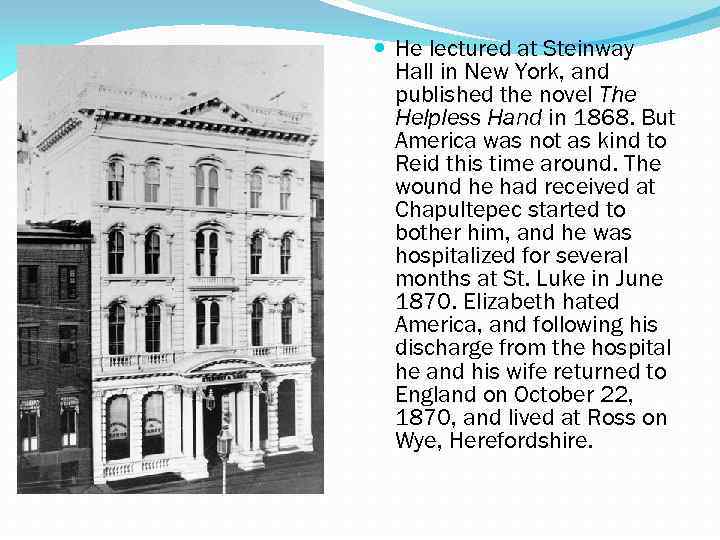 He lectured at Steinway Hall in New York, and published the novel The Helpless Hand in 1868. But America was not as kind to Reid this time around. The wound he had received at Chapultepec started to bother him, and he was hospitalized for several months at St. Luke in June 1870. Elizabeth hated America, and following his discharge from the hospital he and his wife returned to England on October 22, 1870, and lived at Ross on Wye, Herefordshire.
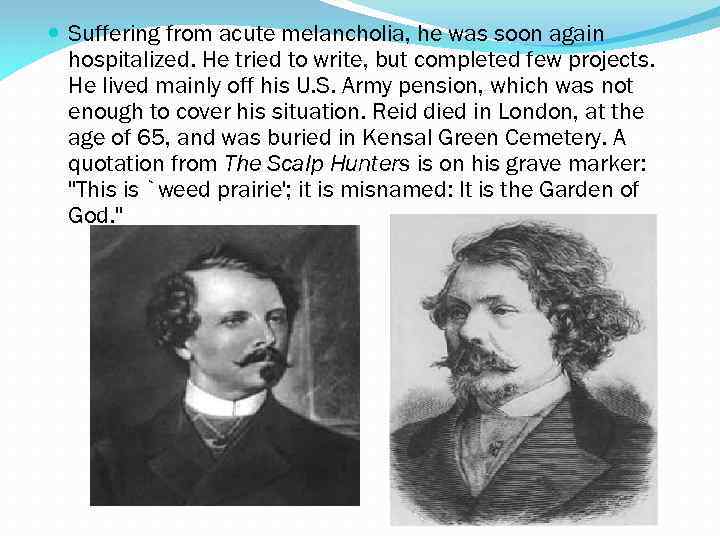 Suffering from acute melancholia, he was soon again hospitalized. He tried to write, but completed few projects. He lived mainly off his U. S. Army pension, which was not enough to cover his situation. Reid died in London, at the age of 65, and was buried in Kensal Green Cemetery. A quotation from The Scalp Hunters is on his grave marker: "This is `weed prairie'; it is misnamed: It is the Garden of God. "