


 Скачать презентацию Thomas Gray Life and creative activity Выполнила Вишнякова
Томас Грэй.ppt
- Количество слайдов: 11
 Thomas Gray. Life and creative activity Выполнила Вишнякова Ирина 2 группа «Б»
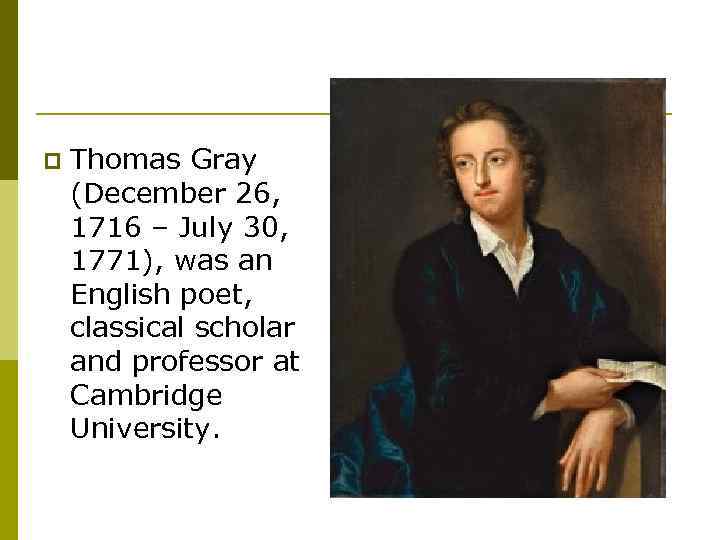 p Thomas Gray (December 26, 1716 – July 30, 1771), was an English poet, classical scholar and professor at Cambridge University.
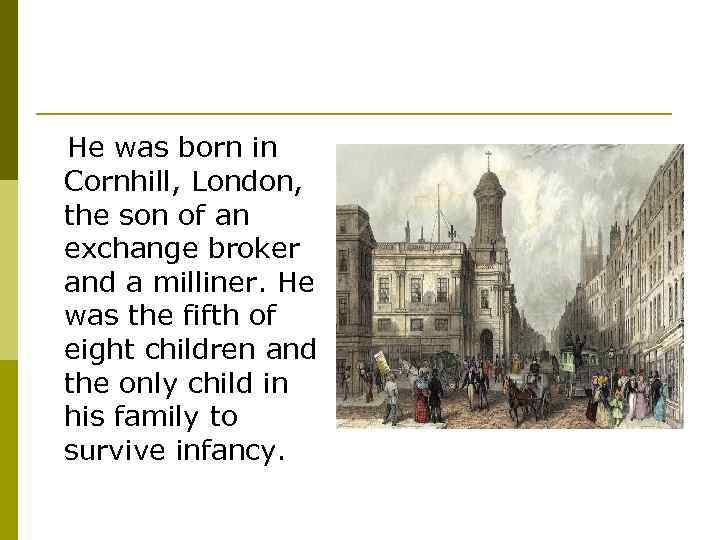 He was born in Cornhill, London, the son of an exchange broker and a milliner. He was the fifth of eight children and the only child in his family to survive infancy.
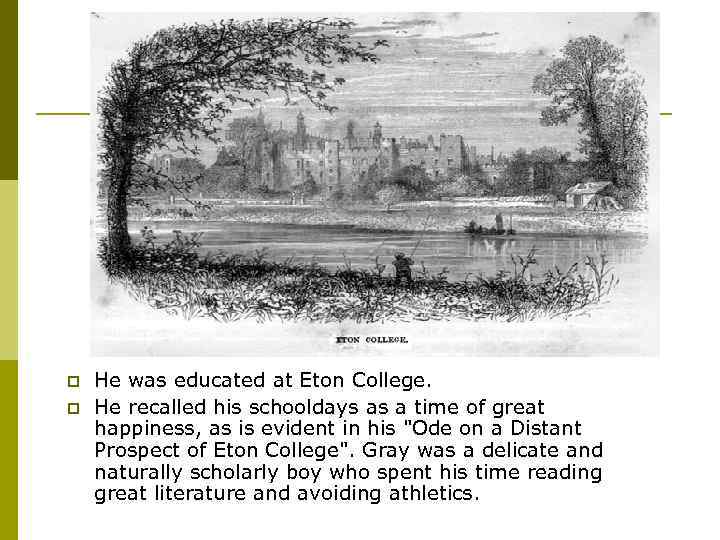 p p He was educated at Eton College. He recalled his schooldays as a time of great happiness, as is evident in his "Ode on a Distant Prospect of Eton College". Gray was a delicate and naturally scholarly boy who spent his time reading great literature and avoiding athletics.
 p He began seriously writing poems in 1742, mainly after his close friend Richard West died. He moved to Cambridge and began a self-imposed programme of literary study, becoming one of the most learned men of his time
 p Gray spent most of his life as a scholar in Cambridge. Although he was one of the least productive poets (his collected works published during his lifetime amount to less than 1, 000 lines), he is regarded as the predominant poetic figure of the mid 18 th century. In 1757, he was offered the post of Poet Laureate, which he refused. In 1768, he succeeded Lawrence Brockett as Regius Professor of Modern History at Cambridge, a sinecure.
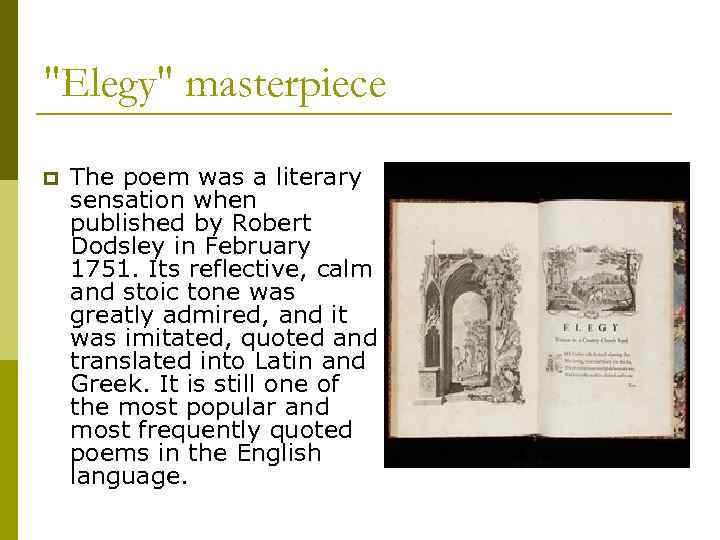 "Elegy" masterpiece p The poem was a literary sensation when published by Robert Dodsley in February 1751. Its reflective, calm and stoic tone was greatly admired, and it was imitated, quoted and translated into Latin and Greek. It is still one of the most popular and most frequently quoted poems in the English language.
 p Gray also wrote light verse, including Ode on the Death of a Favourite Cat, Drowned in a Tub of Gold Fishes.
 p Gray’s surviving letters also show his sharp observation and playful sense of humour. He is well known for his phrase, "where ignorance is bliss, 'tis folly to be wise. " This is from his Ode on a Distant Prospect of Eton College.
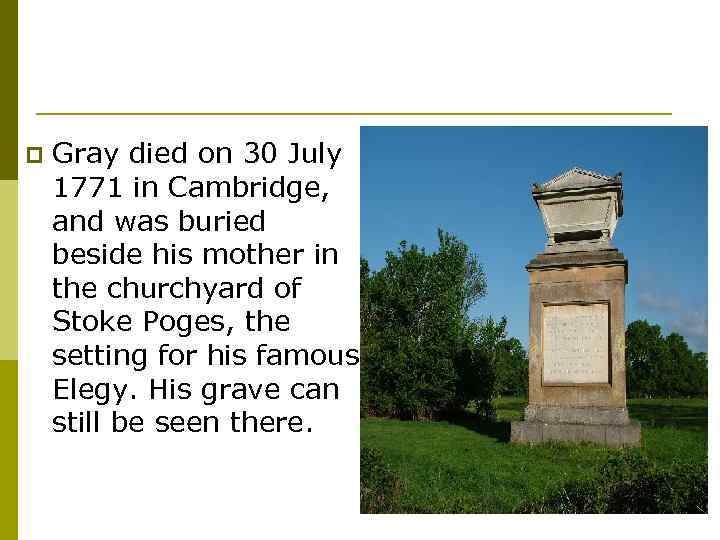 p Gray died on 30 July 1771 in Cambridge, and was buried beside his mother in the churchyard of Stoke Poges, the setting for his famous Elegy. His grave can still be seen there.
 Sonnet on the Death of Mr. Richard West In vain to me the smiling mornings shine, And redd'ning Phoebus lifts his golden fire: The birds in vain their amorous descant join; Or cheerful fields resume their green attire: These ears, alas! for other notes repine, A different object do these eyes require: My lonely anguish melts no heart but mine; And in my breast the imperfect joys expire. Yet morning smiles the busy race to cheer, And new-born pleasure brings to happier men: The fields to all their wonted tribute bear; To warm their little loves the birds complain: I fruitless mourn to him that cannot hear, And weep the more, because I weep in vain.