


 Скачать презентацию This teaching material is a part of e-Photon ONe
57cff19e57db7f71dbd954303a783073.ppt
- Количество слайдов: 62
 This teaching material is a part of e-Photon/ONe Master study in Optical Communications and Networks Course and module: Photonics in Switching Optical Cross Connects Author(s): Guido Maier, Politecnico di Milano, maier@elet. polimi. it Achille Pattavina, Politecnico di Milano, pattavina@elet. polimi. it This tutorial is licensed under the Creative Commons http: //creativecommons. org/licenses/by-nc-sa/3. 0/ http: //www. e-photon-one. org
 The aim of this module • To introduce to optical cross connects • To describe technological implementation of space switching and wavelength conversion • To give an functional overview and classification of the optical cross connects Authors: Guido Maier, Achille Pattavina Course: Photonics in Switching Module: Optical Cross Connects Revision: 2/2008 2
 Summary • Introduction • Evolution of the Optical cross connect • Technologies for optical space switching and wavelength conversion • OXC classification Authors: Guido Maier, Achille Pattavina Course: Photonics in Switching Module: Optical Cross Connects Revision: 2/2008 3
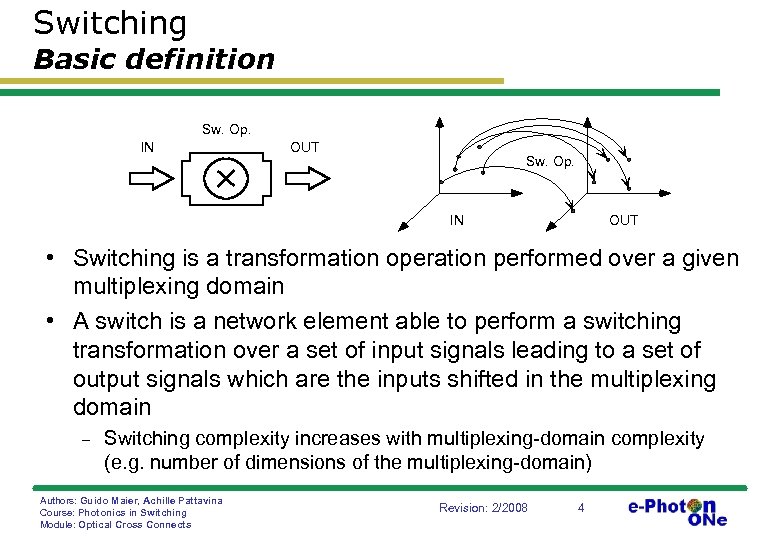 Switching Basic definition Sw. Op. IN OUT Sw. Op. IN OUT • Switching is a transformation operation performed over a given multiplexing domain • A switch is a network element able to perform a switching transformation over a set of input signals leading to a set of output signals which are the inputs shifted in the multiplexing domain - Switching complexity increases with multiplexing-domain complexity (e. g. number of dimensions of the multiplexing-domain) Authors: Guido Maier, Achille Pattavina Course: Photonics in Switching Module: Optical Cross Connects Revision: 2/2008 4
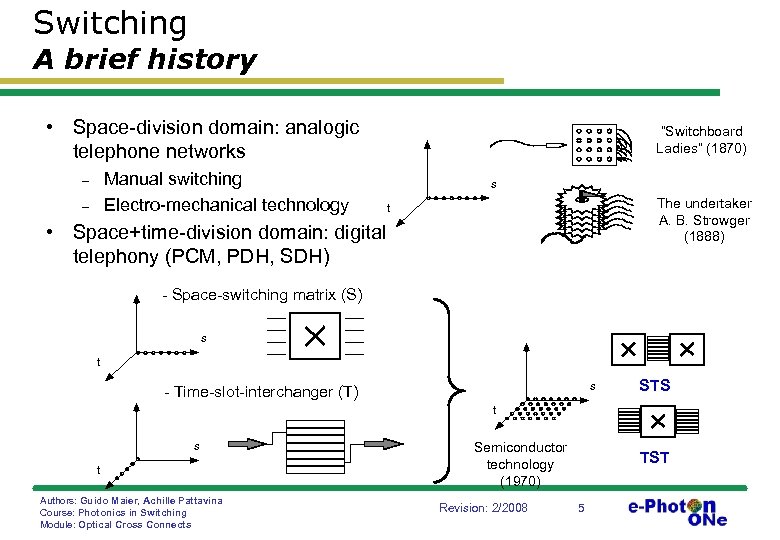 Switching A brief history • Space-division domain: analogic telephone networks Manual switching Electro-mechanical technology - “Switchboard Ladies” (1870) s The undertaker A. B. Strowger (1888) t • Space+time-division domain: digital telephony (PCM, PDH, SDH) - Space-switching matrix (S) s t s - Time-slot-interchanger (T) STS t s t Authors: Guido Maier, Achille Pattavina Course: Photonics in Switching Module: Optical Cross Connects Semiconductor technology (1970) Revision: 2/2008 TST 5
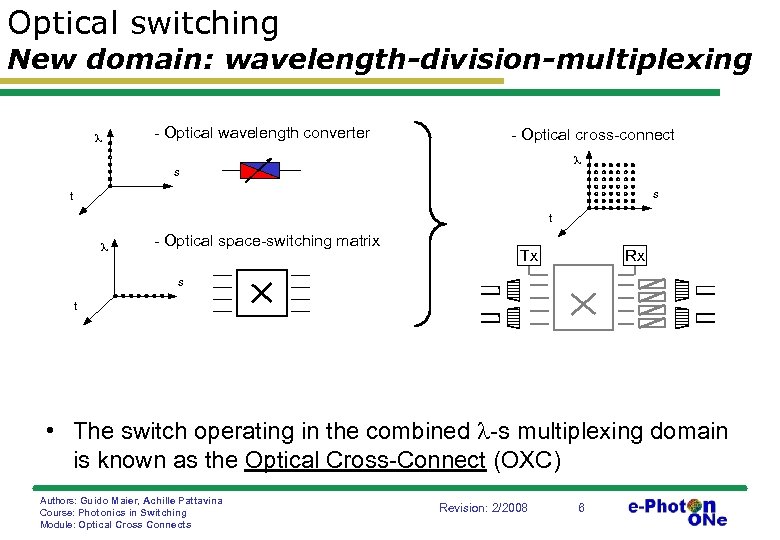 Optical switching New domain: wavelength-division-multiplexing - Optical wavelength converter - Optical cross-connect s s t t - Optical space-switching matrix Tx Rx s t • The switch operating in the combined -s multiplexing domain is known as the Optical Cross-Connect (OXC) Authors: Guido Maier, Achille Pattavina Course: Photonics in Switching Module: Optical Cross Connects Revision: 2/2008 6
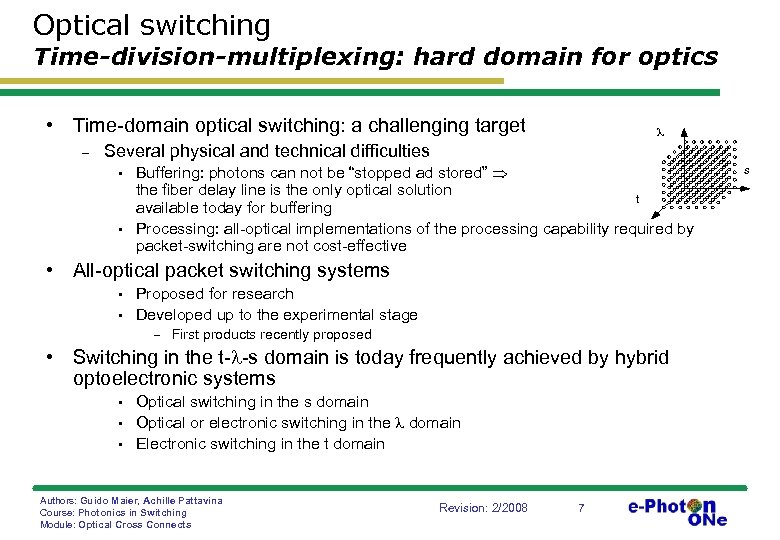 Optical switching Time-division-multiplexing: hard domain for optics • Time-domain optical switching: a challenging target - Several physical and technical difficulties • • Buffering: photons can not be “stopped ad stored” the fiber delay line is the only optical solution t available today for buffering Processing: all-optical implementations of the processing capability required by packet-switching are not cost-effective • All-optical packet switching systems • • Proposed for research Developed up to the experimental stage - First products recently proposed • Switching in the t- -s domain is today frequently achieved by hybrid optoelectronic systems • • • Optical switching in the s domain Optical or electronic switching in the domain Electronic switching in the t domain Authors: Guido Maier, Achille Pattavina Course: Photonics in Switching Module: Optical Cross Connects Revision: 2/2008 7 s
 Summary • Introduction • Evolution of the Optical cross connect • Technologies for optical space switching and wavelength conversion • OXC classification Authors: Guido Maier, Achille Pattavina Course: Photonics in Switching Module: Optical Cross Connects Revision: 2/2008 8
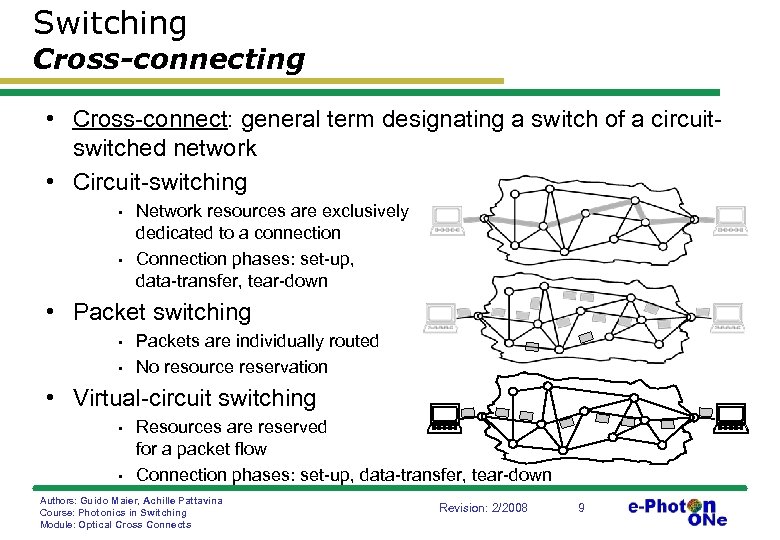 Switching Cross-connecting • Cross-connect: general term designating a switch of a circuitswitched network • Circuit-switching • • Network resources are exclusively dedicated to a connection Connection phases: set-up, data-transfer, tear-down • Packet switching • • Packets are individually routed No resource reservation • Virtual-circuit switching • • Resources are reserved for a packet flow Connection phases: set-up, data-transfer, tear-down Authors: Guido Maier, Achille Pattavina Course: Photonics in Switching Module: Optical Cross Connects Revision: 2/2008 9
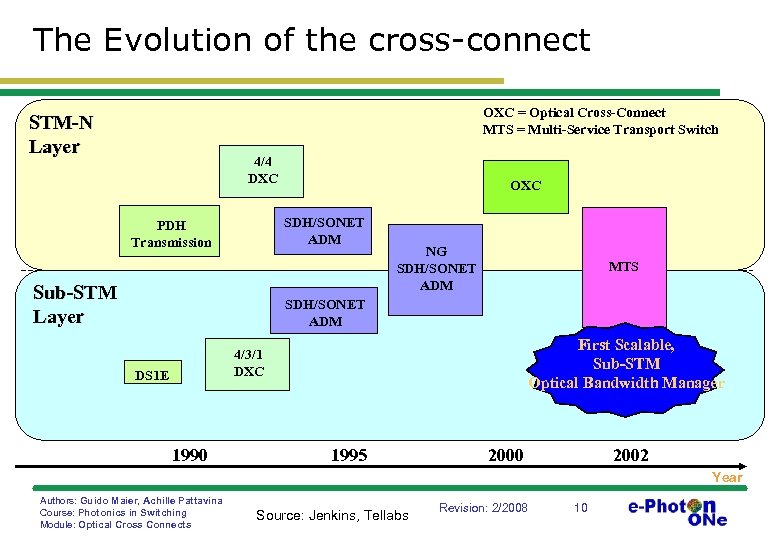 The Evolution of the cross-connect OXC = Optical Cross-Connect MTS = Multi-Service Transport Switch STM-N Layer 4/4 DXC OXC SDH/SONET ADM PDH Transmission Sub-STM Layer NG SDH/SONET ADM MTS SDH/SONET ADM First Scalable, Sub-STM Optical Bandwidth Manager 4/3/1 DXC DS 1 E 1990 1995 2000 2002 Year Authors: Guido Maier, Achille Pattavina Course: Photonics in Switching Module: Optical Cross Connects Source: Jenkins, Tellabs Revision: 2/2008 10
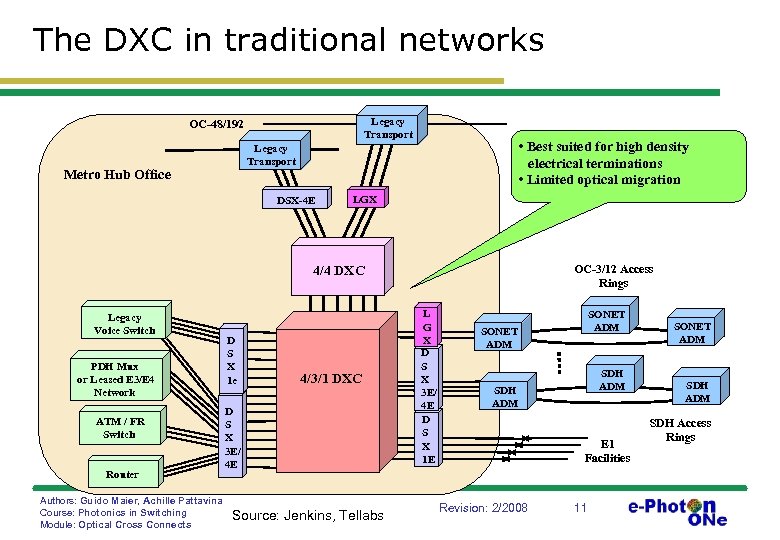 The DXC in traditional networks Legacy Transport OC-48/192 • Best suited for high density electrical terminations • Limited optical migration Legacy Transport Metro Hub Office DSX-4 E LGX OC-3/12 Access Rings 4/4 DXC Legacy Voice Switch PDH Mux or Leased E 3/E 4 Network ATM / FR Switch Router Authors: Guido Maier, Achille Pattavina Course: Photonics in Switching Module: Optical Cross Connects D S X 1 e 4/3/1 DXC D S X 3 E/ 4 E Source: Jenkins, Tellabs L G X D S X 3 E/ 4 E D S X 1 E SONET ADM SDH ADM E 1 Facilities Revision: 2/2008 11 SONET ADM SDH Access Rings
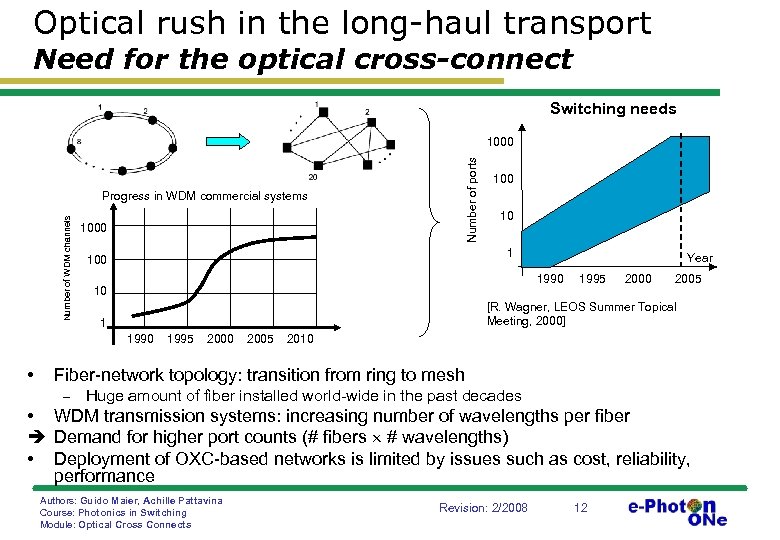 Optical rush in the long-haul transport Need for the optical cross-connect Switching needs Number of WDM channels Progress in WDM commercial systems 1000 10 1 100 Year 1990 10 1995 2000 2005 [R. Wagner, LEOS Summer Topical Meeting, 2000] 1 1990 • Number of ports 1000 1995 2000 2005 2010 Fiber-network topology: transition from ring to mesh - Huge amount of fiber installed world-wide in the past decades • WDM transmission systems: increasing number of wavelengths per fiber è Demand for higher port counts (# fibers # wavelengths) • Deployment of OXC-based networks is limited by issues such as cost, reliability, performance Authors: Guido Maier, Achille Pattavina Course: Photonics in Switching Module: Optical Cross Connects Revision: 2/2008 12
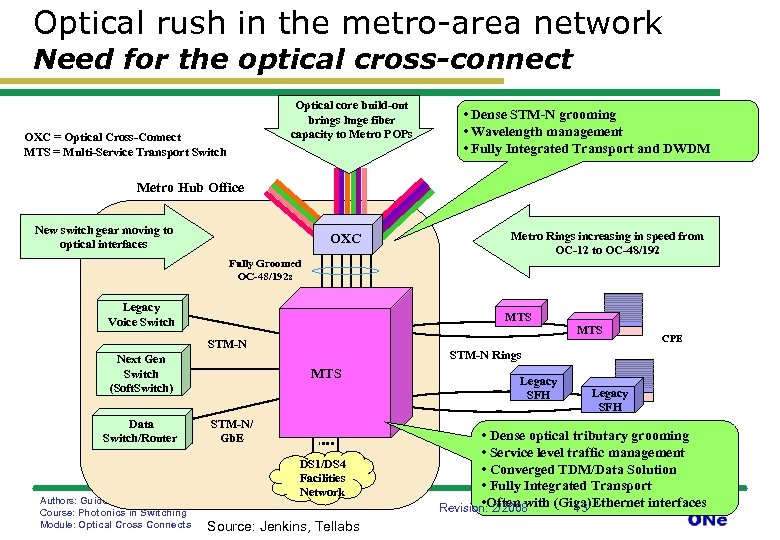 Optical rush in the metro-area network Need for the optical cross-connect Optical core build-out brings huge fiber capacity to Metro POPs OXC = Optical Cross-Connect MTS = Multi-Service Transport Switch • Dense STM-N grooming • Wavelength management • Fully Integrated Transport and DWDM Metro Hub Office New switch gear moving to optical interfaces OXC Metro Rings increasing in speed from OC-12 to OC-48/192 Fully Groomed OC-48/192 s Legacy Voice Switch MTS STM-N Next Gen Switch (Soft. Switch) Data Switch/Router STM-N Rings MTS STM-N/ Gb. E Authors: Guido Maier, Achille Pattavina Course: Photonics in Switching Module: Optical Cross Connects Source: CPE DS 1/DS 4 Facilities Network Jenkins, Tellabs Legacy SFH • Dense optical tributary grooming • Service level traffic management • Converged TDM/Data Solution • Fully Integrated Transport • 2/2008 Revision: Often with (Giga)Ethernet interfaces 13
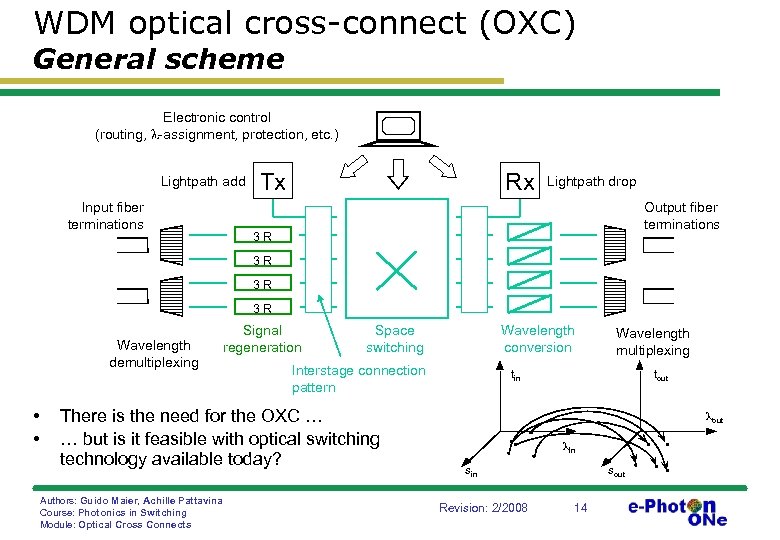 WDM optical cross-connect (OXC) General scheme Electronic control (routing, -assignment, protection, etc. ) Lightpath add Input fiber terminations Tx Rx Lightpath drop Output fiber terminations 3 R 3 R Wavelength demultiplexing • • Signal regeneration Space switching Interstage connection pattern There is the need for the OXC … … but is it feasible with optical switching technology available today? Authors: Guido Maier, Achille Pattavina Course: Photonics in Switching Module: Optical Cross Connects Wavelength conversion Wavelength multiplexing tin tout in sin Revision: 2/2008 sout 14
 Summary • Introduction • Evolution of the Optical cross connect • Technologies for optical space switching and wavelength conversion • OXC classification Authors: Guido Maier, Achille Pattavina Course: Photonics in Switching Module: Optical Cross Connects Revision: 2/2008 15
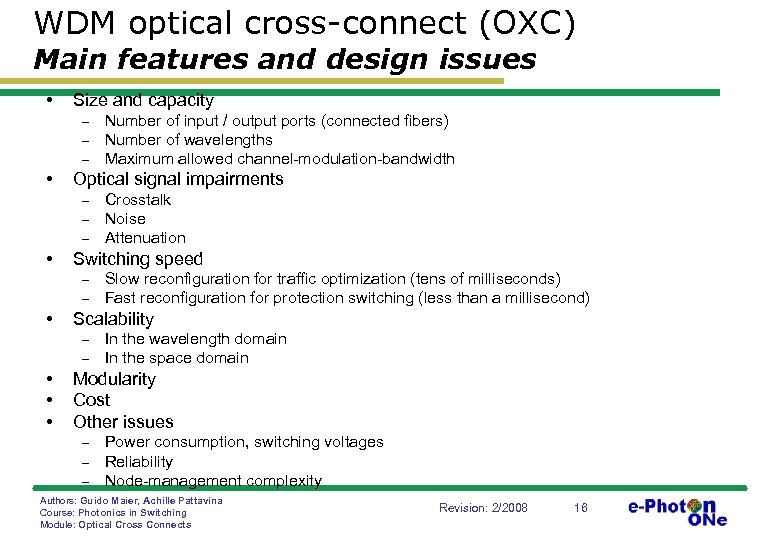 WDM optical cross-connect (OXC) Main features and design issues • Size and capacity - • Optical signal impairments - • - Slow reconfiguration for traffic optimization (tens of milliseconds) Fast reconfiguration for protection switching (less than a millisecond) Scalability - • • • Crosstalk Noise Attenuation Switching speed - • Number of input / output ports (connected fibers) Number of wavelengths Maximum allowed channel-modulation-bandwidth In the wavelength domain In the space domain Modularity Cost Other issues - Power consumption, switching voltages Reliability Node-management complexity Authors: Guido Maier, Achille Pattavina Course: Photonics in Switching Module: Optical Cross Connects Revision: 2/2008 16
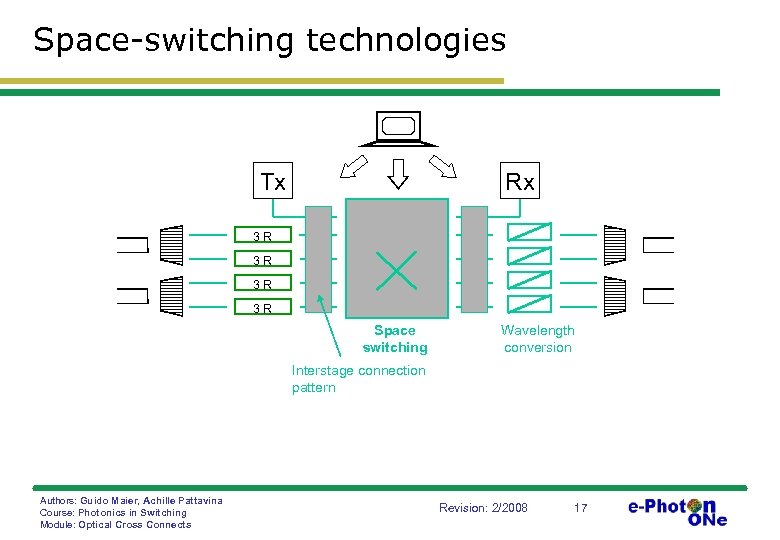 Space-switching technologies Tx Rx 3 R 3 R Space switching Wavelength conversion Interstage connection pattern Authors: Guido Maier, Achille Pattavina Course: Photonics in Switching Module: Optical Cross Connects Revision: 2/2008 17
 Optical technologies for space switching Matrices based on optical switching elements • Simple optical switching elements (active devices – usually 2 x 2) route optical beams through the space-switching fabric - Electronically controlled • Interconnection technology (passive subsystem) - Fiber optics: - - Waveguides: - - Integrated-optics physical architectures Light beams: - - Discrete components Free-space physical architectures Combined technologies (e. g. waveguides + fibers): - Multistage/multimodule architectures • Prototype space-switching matrices limited in size by - Loss Heat dissipation Power consumption Crosstalk Cost Authors: Guido Maier, Achille Pattavina Course: Photonics in Switching Module: Optical Cross Connects Revision: 2/2008 18
 Optical technologies for space switching Switching element technology • Traditional technologies - opto-mechanical Semiconductor Optical Amplifier (SOA) gates liquid crystal electro-optical (Li. Nb. O 3) thermo-optical (polymers, Si. O 2/Si) • New technologies - Micro-electro-mechanical systems (MEMS) Ink-jet-printer-technology based switches (bubbles) Bragg gratings • Wide range of switching time (200 ms ÷ 200 ps), crosstalk (-60 d. B ÷ -20 d. B), power consumption, loss, etc. Authors: Guido Maier, Achille Pattavina Course: Photonics in Switching Module: Optical Cross Connects Revision: 2/2008 19
 Optical technologies for space switching Switching element technology (II) • Wavelength-transparent: state independent of the wavelengths of crossing signals - Micro-electro-mechanical systems (MEMS) Bubbles Switching couplers • • Mach-Zehnder interferometer Directional couplers • Wavelength-sensitive: state depends upon the wavelength - Fiber Bragg gratings Wavelength Grating Router Acousto-Optical Tunable Filters Authors: Guido Maier, Achille Pattavina Course: Photonics in Switching Module: Optical Cross Connects Revision: 2/2008 20
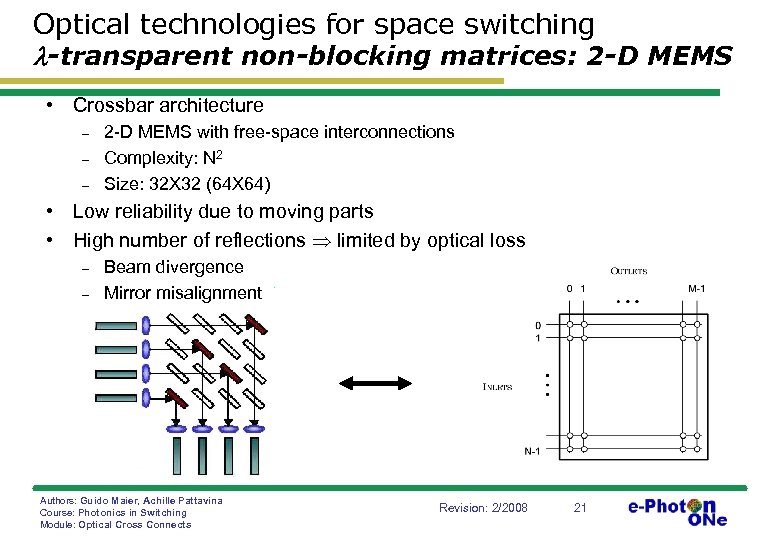 Optical technologies for space switching -transparent non-blocking matrices: 2 -D MEMS • Crossbar architecture - 2 -D MEMS with free-space interconnections Complexity: N 2 Size: 32 X 32 (64 X 64) • Low reliability due to moving parts • High number of reflections limited by optical loss - Beam divergence Mirror misalignment Authors: Guido Maier, Achille Pattavina Course: Photonics in Switching Module: Optical Cross Connects Revision: 2/2008 21
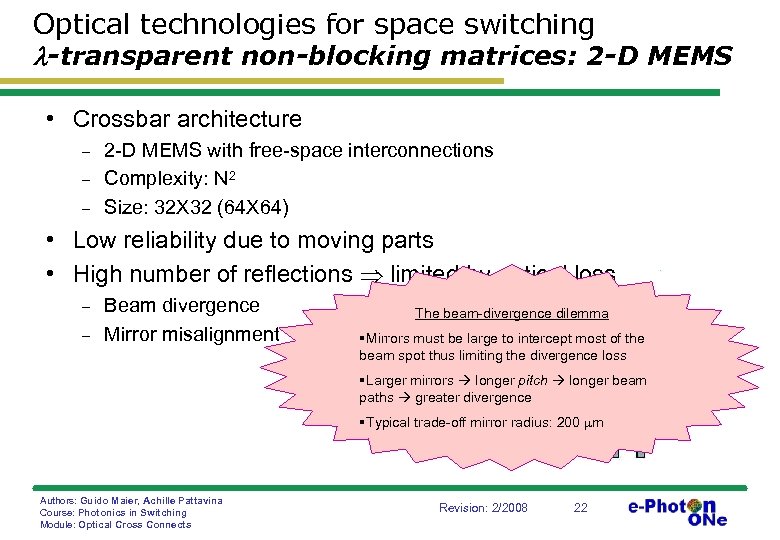 Optical technologies for space switching -transparent non-blocking matrices: 2 -D MEMS • Crossbar architecture - 2 -D MEMS with free-space interconnections Complexity: N 2 Size: 32 X 32 (64 X 64) • Low reliability due to moving parts • High number of reflections limited by optical loss - Beam divergence Mirror misalignment The beam-divergence dilemma §Mirrors must be large to intercept most of the beam spot thus limiting the divergence loss §Larger mirrors longer pitch longer beam paths greater divergence §Typical trade-off mirror radius: 200 m Authors: Guido Maier, Achille Pattavina Course: Photonics in Switching Module: Optical Cross Connects Revision: 2/2008 22
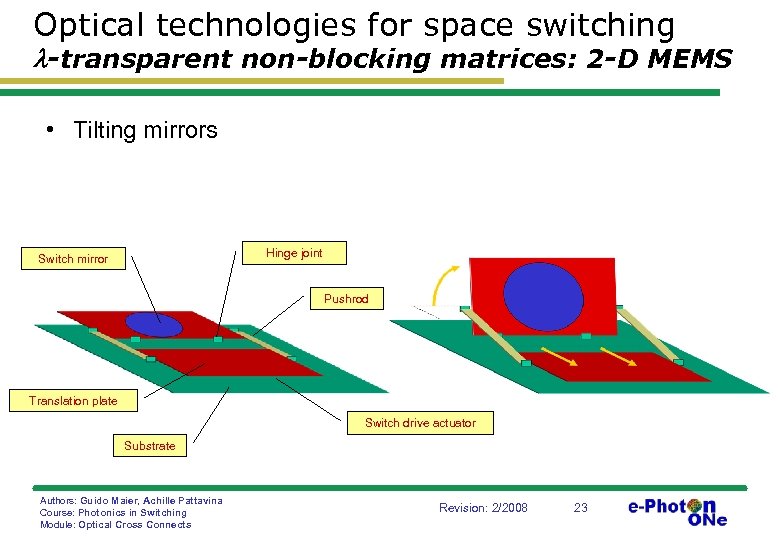 Optical technologies for space switching -transparent non-blocking matrices: 2 -D MEMS • Tilting mirrors Hinge joint Switch mirror Pushrod Translation plate Switch drive actuator Substrate Authors: Guido Maier, Achille Pattavina Course: Photonics in Switching Module: Optical Cross Connects Revision: 2/2008 23
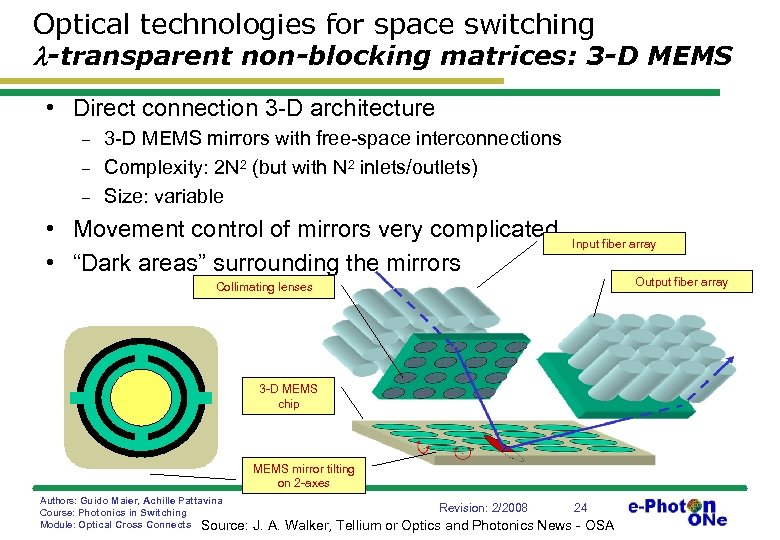 Optical technologies for space switching -transparent non-blocking matrices: 3 -D MEMS • Direct connection 3 -D architecture - 3 -D MEMS mirrors with free-space interconnections Complexity: 2 N 2 (but with N 2 inlets/outlets) Size: variable • Movement control of mirrors very complicated • “Dark areas” surrounding the mirrors Input fiber array Output fiber array Collimating lenses 3 -D MEMS chip MEMS mirror tilting on 2 -axes Authors: Guido Maier, Achille Pattavina Course: Photonics in Switching Module: Optical Cross Connects Source: Revision: 2/2008 24 J. A. Walker, Tellium or Optics and Photonics News - OSA
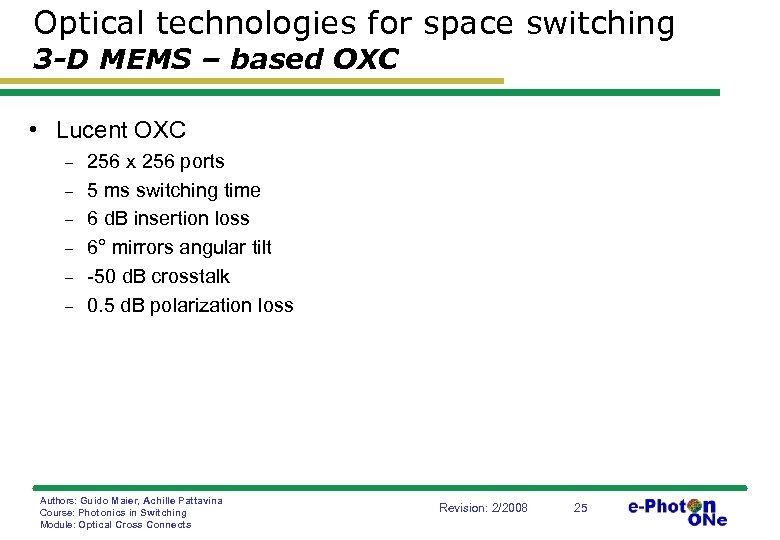 Optical technologies for space switching 3 -D MEMS – based OXC • Lucent OXC - 256 x 256 ports 5 ms switching time 6 d. B insertion loss 6° mirrors angular tilt -50 d. B crosstalk 0. 5 d. B polarization loss Authors: Guido Maier, Achille Pattavina Course: Photonics in Switching Module: Optical Cross Connects Revision: 2/2008 25
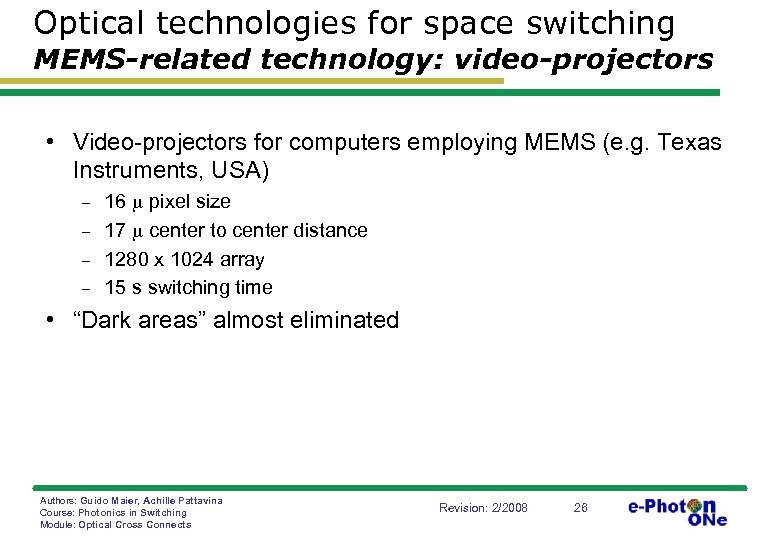 Optical technologies for space switching MEMS-related technology: video-projectors • Video-projectors for computers employing MEMS (e. g. Texas Instruments, USA) - 16 pixel size 17 center to center distance 1280 x 1024 array 15 s switching time • “Dark areas” almost eliminated Authors: Guido Maier, Achille Pattavina Course: Photonics in Switching Module: Optical Cross Connects Revision: 2/2008 26
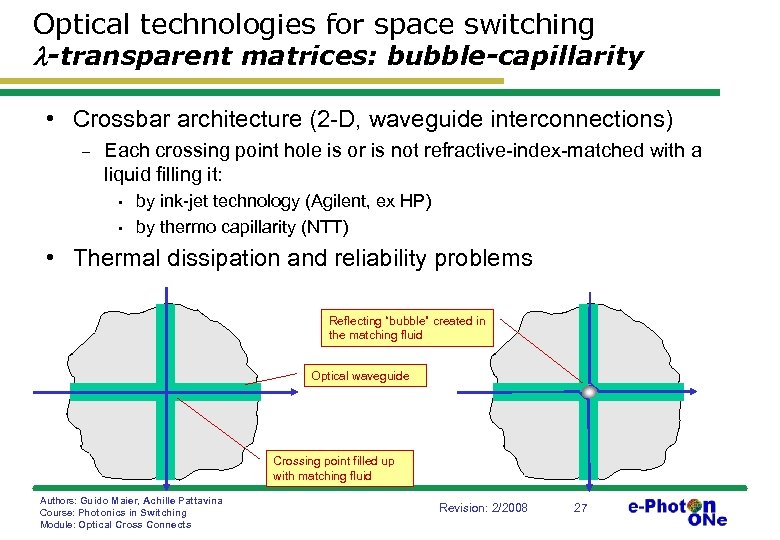 Optical technologies for space switching -transparent matrices: bubble-capillarity • Crossbar architecture (2 -D, waveguide interconnections) - Each crossing point hole is or is not refractive-index-matched with a liquid filling it: • • by ink-jet technology (Agilent, ex HP) by thermo capillarity (NTT) • Thermal dissipation and reliability problems Reflecting “bubble” created in the matching fluid Optical waveguide Crossing point filled up with matching fluid Authors: Guido Maier, Achille Pattavina Course: Photonics in Switching Module: Optical Cross Connects Revision: 2/2008 27
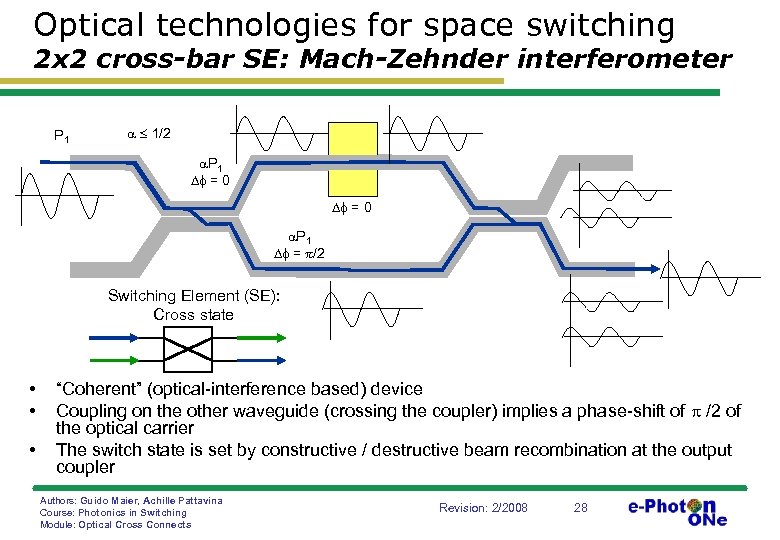 Optical technologies for space switching 2 x 2 cross-bar SE: Mach-Zehnder interferometer P 1 1/2 P 1 = 0 P 1 = /2 Switching Element (SE): Cross state • • • “Coherent” (optical-interference based) device Coupling on the other waveguide (crossing the coupler) implies a phase-shift of /2 of the optical carrier The switch state is set by constructive / destructive beam recombination at the output coupler Authors: Guido Maier, Achille Pattavina Course: Photonics in Switching Module: Optical Cross Connects Revision: 2/2008 28
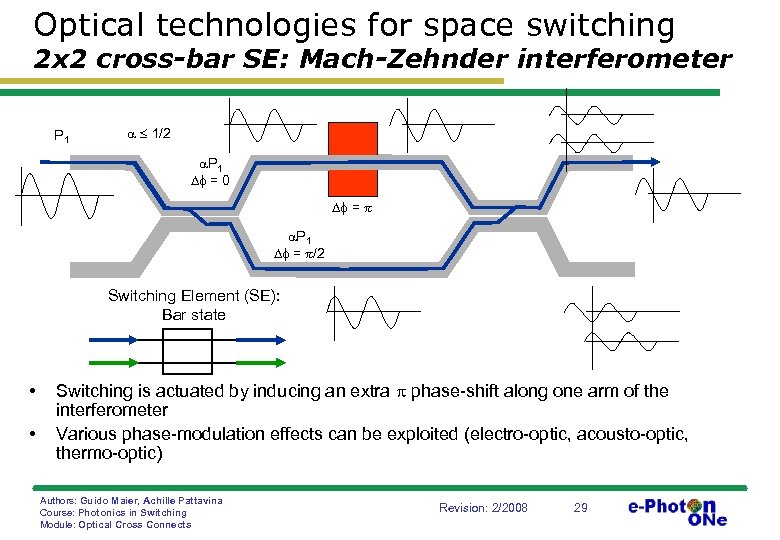 Optical technologies for space switching 2 x 2 cross-bar SE: Mach-Zehnder interferometer P 1 1/2 P 1 = 0 = P 1 = /2 Switching Element (SE): Bar state • • Switching is actuated by inducing an extra phase-shift along one arm of the interferometer Various phase-modulation effects can be exploited (electro-optic, acousto-optic, thermo-optic) Authors: Guido Maier, Achille Pattavina Course: Photonics in Switching Module: Optical Cross Connects Revision: 2/2008 29
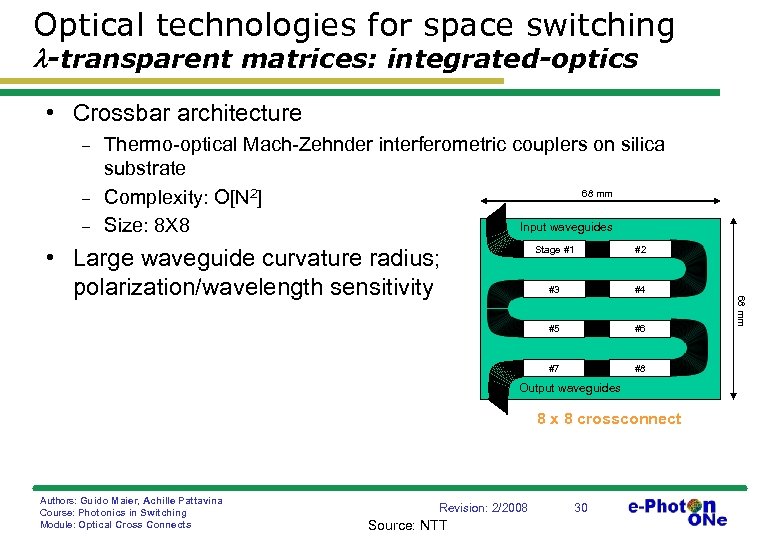 Optical technologies for space switching -transparent matrices: integrated-optics • Crossbar architecture - Thermo-optical Mach-Zehnder interferometric couplers on silica substrate 68 mm Complexity: O[N 2] Input waveguides Size: 8 X 8 #2 #3 #4 #5 #6 #7 #8 Output waveguides 8 x 8 crossconnect Authors: Guido Maier, Achille Pattavina Course: Photonics in Switching Module: Optical Cross Connects Revision: 2/2008 Source: NTT 30 68 mm Stage #1 • Large waveguide curvature radius; polarization/wavelength sensitivity
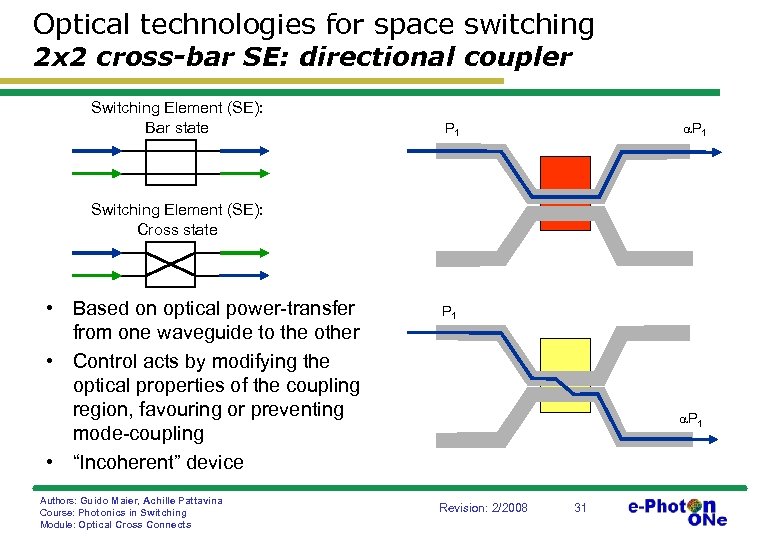 Optical technologies for space switching 2 x 2 cross-bar SE: directional coupler Switching Element (SE): Bar state P 1 Switching Element (SE): Cross state • Based on optical power-transfer from one waveguide to the other • Control acts by modifying the optical properties of the coupling region, favouring or preventing mode-coupling • “Incoherent” device Authors: Guido Maier, Achille Pattavina Course: Photonics in Switching Module: Optical Cross Connects P 1 Revision: 2/2008 31
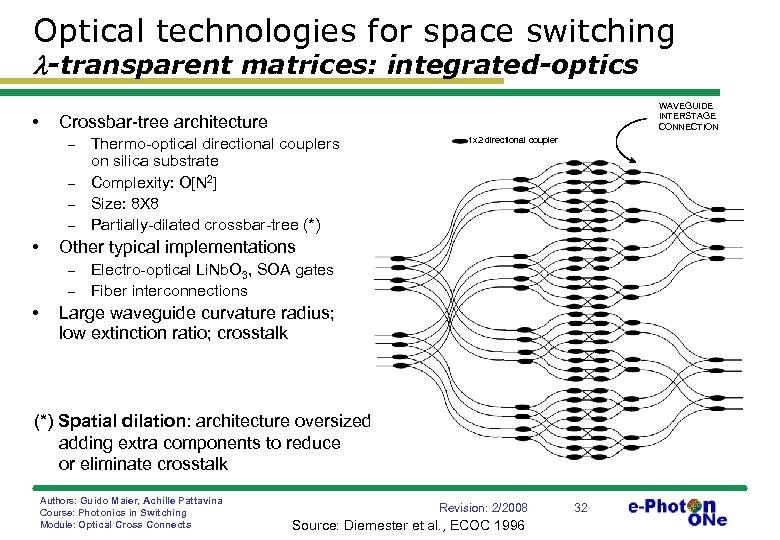 Optical technologies for space switching -transparent matrices: integrated-optics • Crossbar-tree architecture - • Thermo-optical directional couplers on silica substrate Complexity: O[N 2] Size: 8 X 8 Partially-dilated crossbar-tree (*) 1 x 2 directional coupler Other typical implementations - • WAVEGUIDE INTERSTAGE CONNECTION Electro-optical Li. Nb. O 3, SOA gates Fiber interconnections Large waveguide curvature radius; low extinction ratio; crosstalk (*) Spatial dilation: architecture oversized adding extra components to reduce or eliminate crosstalk Authors: Guido Maier, Achille Pattavina Course: Photonics in Switching Module: Optical Cross Connects Revision: 2/2008 Source: Diemester et al. , ECOC 1996 32
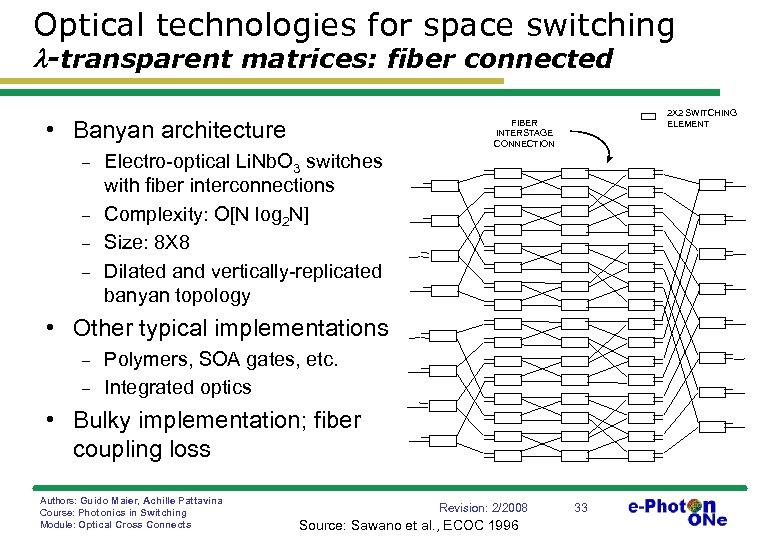 Optical technologies for space switching -transparent matrices: fiber connected • Banyan architecture - 2 X 2 SWITCHING ELEMENT FIBER INTERSTAGE CONNECTION Electro-optical Li. Nb. O 3 switches with fiber interconnections Complexity: O[N log 2 N] Size: 8 X 8 Dilated and vertically-replicated banyan topology • Other typical implementations - Polymers, SOA gates, etc. Integrated optics • Bulky implementation; fiber coupling loss Authors: Guido Maier, Achille Pattavina Course: Photonics in Switching Module: Optical Cross Connects Revision: 2/2008 Source: Sawano et al. , ECOC 1996 33
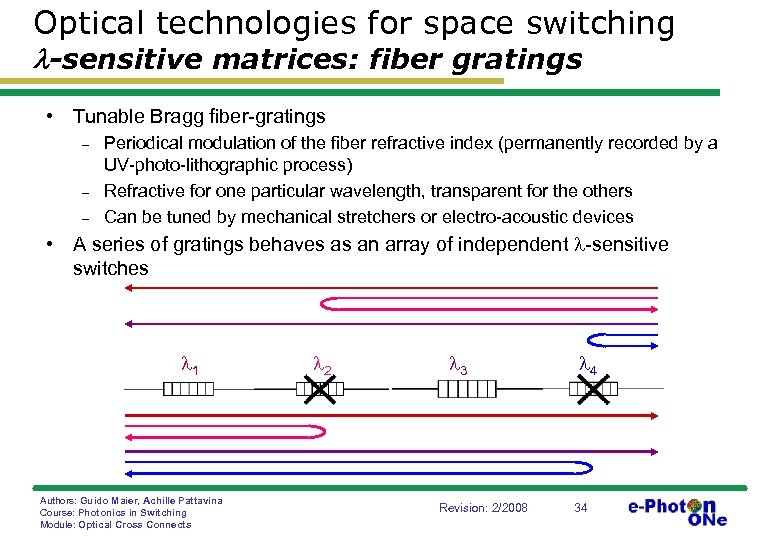 Optical technologies for space switching -sensitive matrices: fiber gratings • Tunable Bragg fiber-gratings - Periodical modulation of the fiber refractive index (permanently recorded by a UV-photo-lithographic process) Refractive for one particular wavelength, transparent for the others Can be tuned by mechanical stretchers or electro-acoustic devices • A series of gratings behaves as an array of independent -sensitive switches 1 Authors: Guido Maier, Achille Pattavina Course: Photonics in Switching Module: Optical Cross Connects 2 3 Revision: 2/2008 4 34
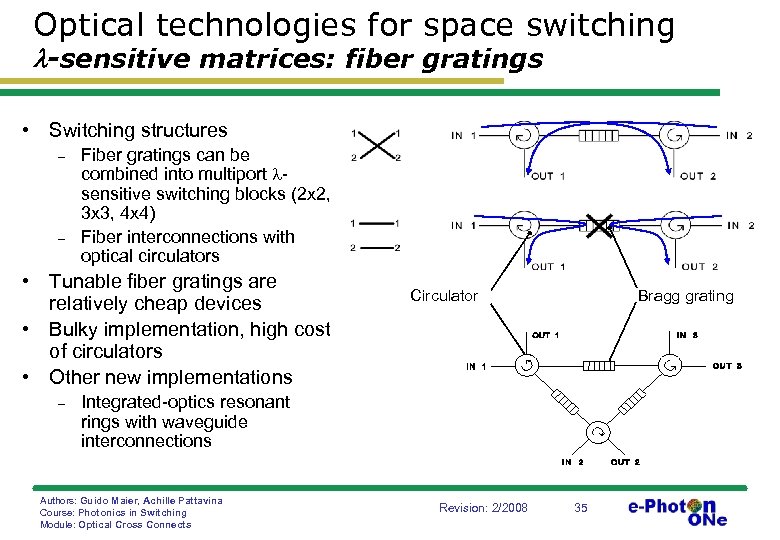 Optical technologies for space switching -sensitive matrices: fiber gratings • Switching structures - - Fiber gratings can be combined into multiport sensitive switching blocks (2 x 2, 3 x 3, 4 x 4) Fiber interconnections with optical circulators • Tunable fiber gratings are relatively cheap devices • Bulky implementation, high cost of circulators • Other new implementations - Circulator Bragg grating Integrated-optics resonant rings with waveguide interconnections Authors: Guido Maier, Achille Pattavina Course: Photonics in Switching Module: Optical Cross Connects Revision: 2/2008 35
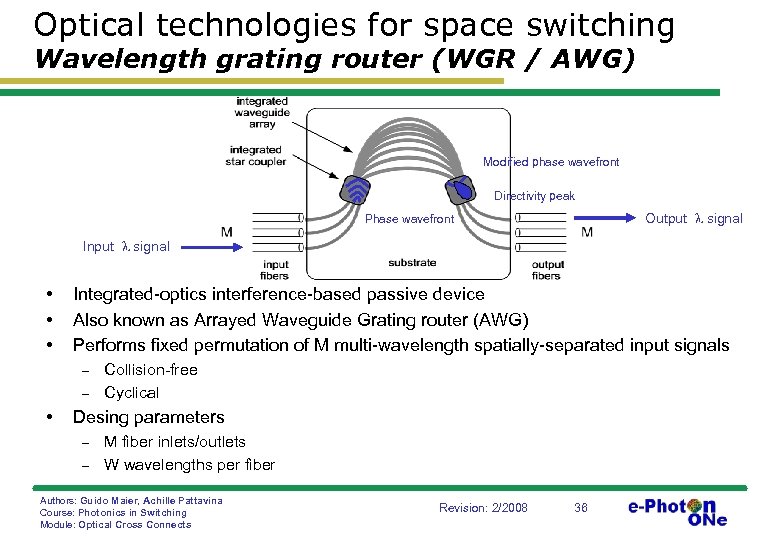 Optical technologies for space switching Wavelength grating router (WGR / AWG) Modified phase wavefront Directivity peak Output signal Phase wavefront Input signal • • • Integrated-optics interference-based passive device Also known as Arrayed Waveguide Grating router (AWG) Performs fixed permutation of M multi-wavelength spatially-separated input signals - • Collision-free Cyclical Desing parameters - M fiber inlets/outlets W wavelengths per fiber Authors: Guido Maier, Achille Pattavina Course: Photonics in Switching Module: Optical Cross Connects Revision: 2/2008 36
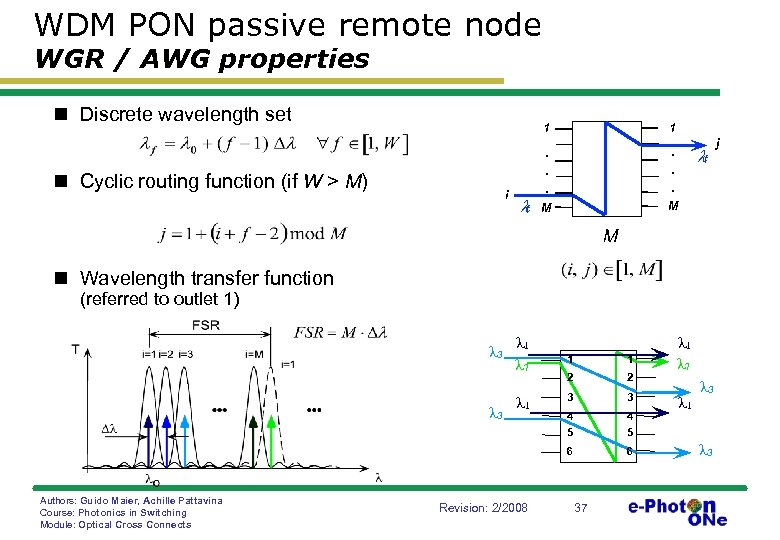 WDM PON passive remote node WGR / AWG properties Discrete wavelength set 1 Cyclic routing function (if W > M) i lf 1 . . . M M lf M Wavelength transfer function (referred to outlet 1) 3 1 7 Authors: Guido Maier, Achille Pattavina Course: Photonics in Switching Module: Optical Cross Connects Revision: 2/2008 2 2 3 3 4 4 5 6 1 1 5 3 1 6 37 1 7 1 3 3 j
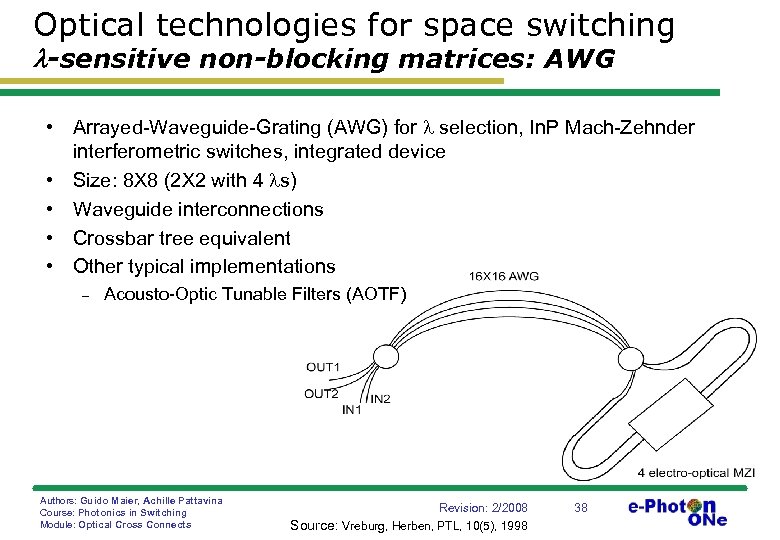 Optical technologies for space switching -sensitive non-blocking matrices: AWG • Arrayed-Waveguide-Grating (AWG) for selection, In. P Mach-Zehnder interferometric switches, integrated device • Size: 8 X 8 (2 X 2 with 4 s) • Waveguide interconnections • Crossbar tree equivalent • Other typical implementations - Acousto-Optic Tunable Filters (AOTF) Authors: Guido Maier, Achille Pattavina Course: Photonics in Switching Module: Optical Cross Connects Revision: 2/2008 Source: Vreburg, Herben, PTL, 10(5), 1998 38
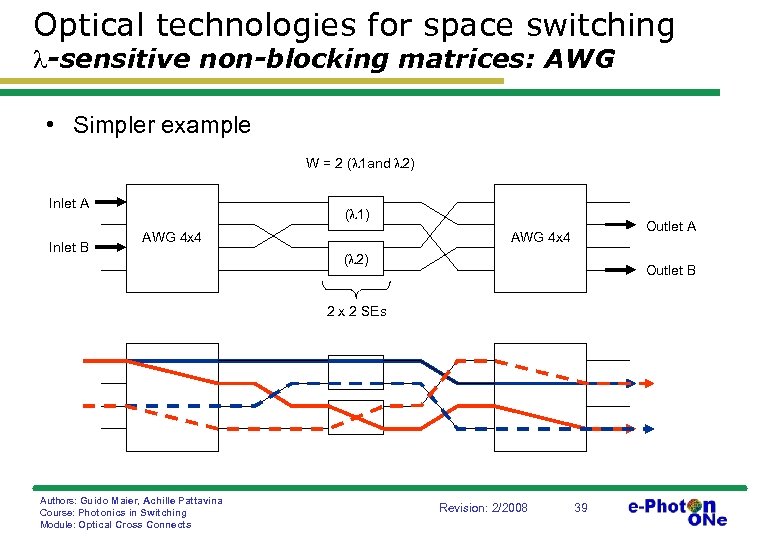 Optical technologies for space switching -sensitive non-blocking matrices: AWG • Simpler example W = 2 ( 1 and 2) Inlet A Inlet B ( 1) AWG 4 x 4 Outlet A AWG 4 x 4 ( 2) Outlet B 2 x 2 SEs Authors: Guido Maier, Achille Pattavina Course: Photonics in Switching Module: Optical Cross Connects Revision: 2/2008 39
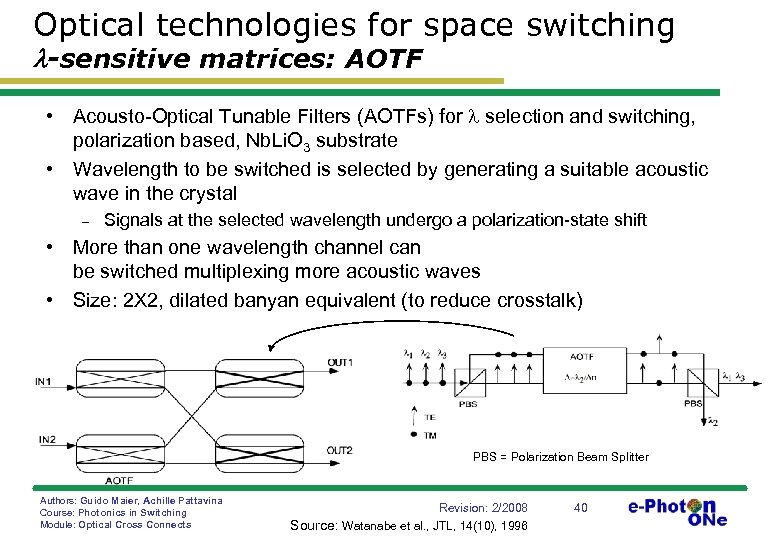 Optical technologies for space switching -sensitive matrices: AOTF • Acousto-Optical Tunable Filters (AOTFs) for selection and switching, polarization based, Nb. Li. O 3 substrate • Wavelength to be switched is selected by generating a suitable acoustic wave in the crystal - Signals at the selected wavelength undergo a polarization-state shift • More than one wavelength channel can be switched multiplexing more acoustic waves • Size: 2 X 2, dilated banyan equivalent (to reduce crosstalk) PBS = Polarization Beam Splitter Authors: Guido Maier, Achille Pattavina Course: Photonics in Switching Module: Optical Cross Connects Revision: 2/2008 Source: Watanabe et al. , JTL, 14(10), 1996 40
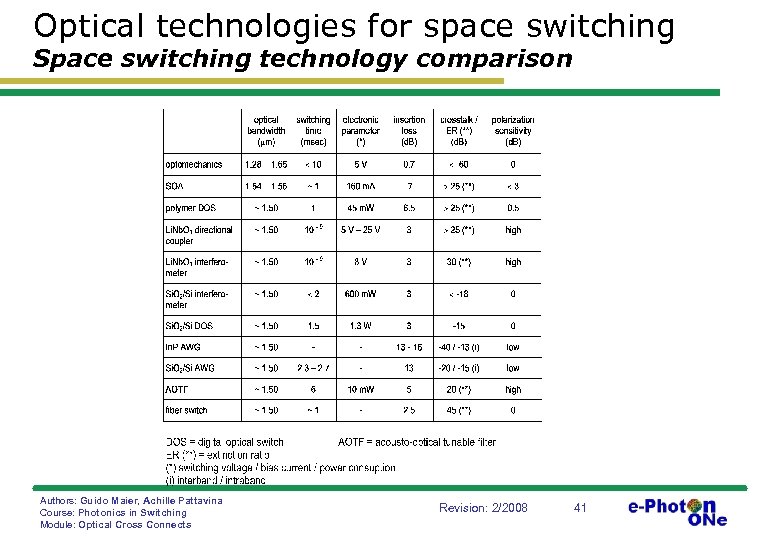 Optical technologies for space switching Space switching technology comparison Authors: Guido Maier, Achille Pattavina Course: Photonics in Switching Module: Optical Cross Connects Revision: 2/2008 41
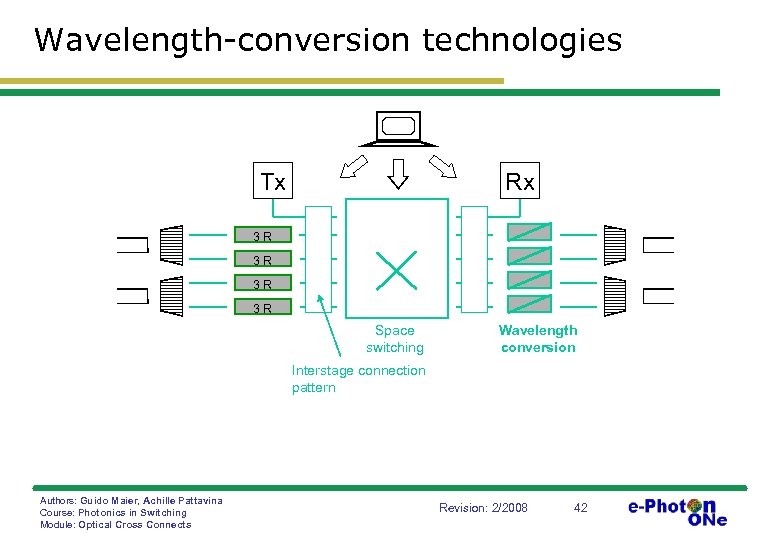 Wavelength-conversion technologies Tx Rx 3 R 3 R Space switching Wavelength conversion Interstage connection pattern Authors: Guido Maier, Achille Pattavina Course: Photonics in Switching Module: Optical Cross Connects Revision: 2/2008 42
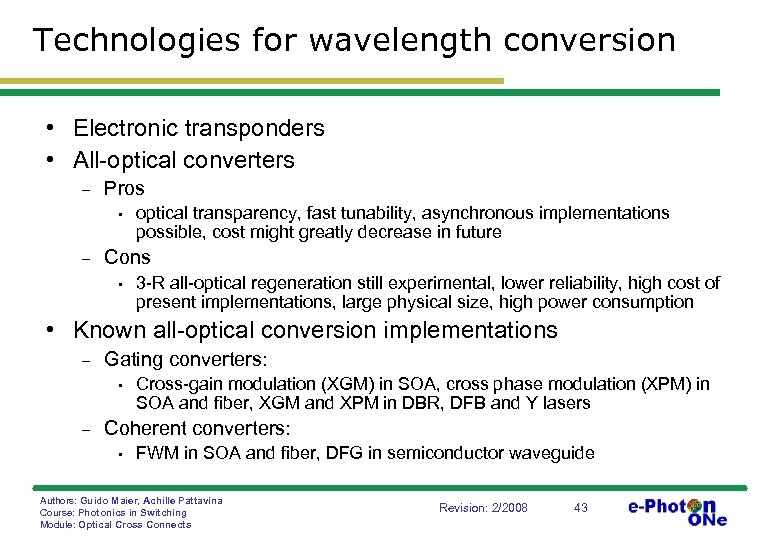 Technologies for wavelength conversion • Electronic transponders • All-optical converters - Pros • - optical transparency, fast tunability, asynchronous implementations possible, cost might greatly decrease in future Cons • 3 -R all-optical regeneration still experimental, lower reliability, high cost of present implementations, large physical size, high power consumption • Known all-optical conversion implementations - Gating converters: • - Cross-gain modulation (XGM) in SOA, cross phase modulation (XPM) in SOA and fiber, XGM and XPM in DBR, DFB and Y lasers Coherent converters: • FWM in SOA and fiber, DFG in semiconductor waveguide Authors: Guido Maier, Achille Pattavina Course: Photonics in Switching Module: Optical Cross Connects Revision: 2/2008 43
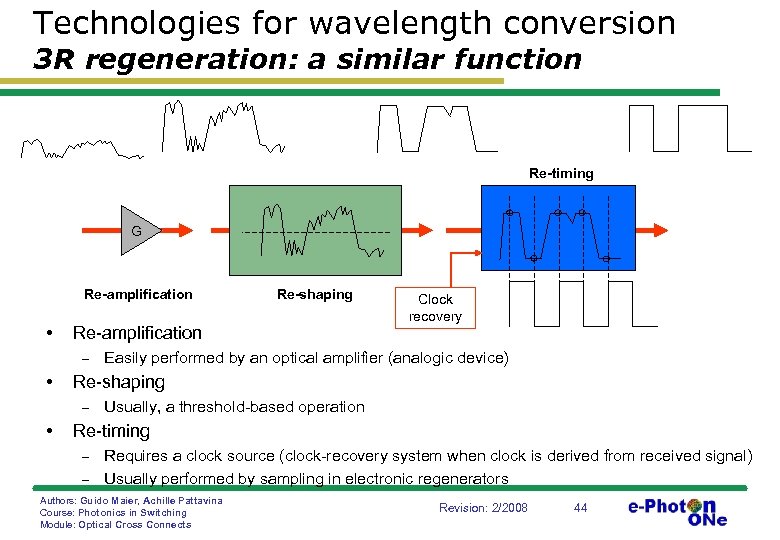 Technologies for wavelength conversion 3 R regeneration: a similar function Re-timing G Re-amplification • Re-amplification - • Clock recovery Easily performed by an optical amplifier (analogic device) Re-shaping - • Re-shaping Usually, a threshold-based operation Re-timing - Requires a clock source (clock-recovery system when clock is derived from received signal) Usually performed by sampling in electronic regenerators Authors: Guido Maier, Achille Pattavina Course: Photonics in Switching Module: Optical Cross Connects Revision: 2/2008 44
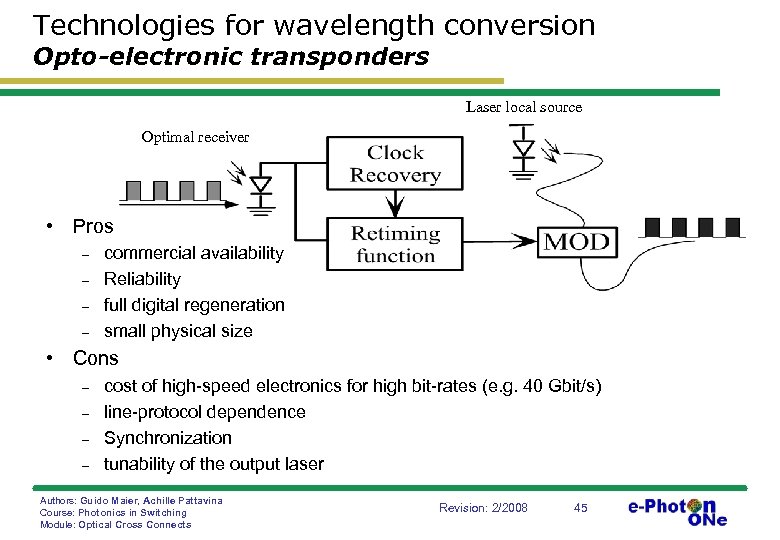 Technologies for wavelength conversion Opto-electronic transponders Laser local source Optimal receiver • Pros - commercial availability Reliability full digital regeneration small physical size • Cons - cost of high-speed electronics for high bit-rates (e. g. 40 Gbit/s) line-protocol dependence Synchronization tunability of the output laser Authors: Guido Maier, Achille Pattavina Course: Photonics in Switching Module: Optical Cross Connects Revision: 2/2008 45
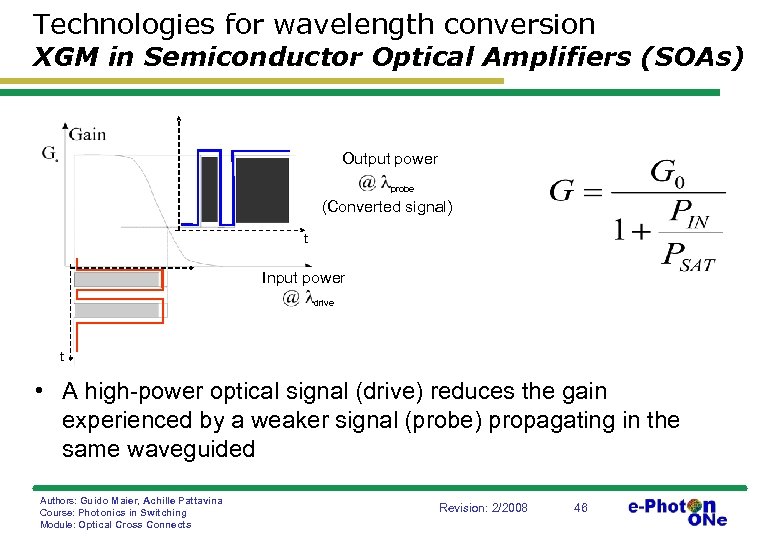 Technologies for wavelength conversion XGM in Semiconductor Optical Amplifiers (SOAs) Output power probe (Converted signal) t Input power drive t • A high-power optical signal (drive) reduces the gain experienced by a weaker signal (probe) propagating in the same waveguided Authors: Guido Maier, Achille Pattavina Course: Photonics in Switching Module: Optical Cross Connects Revision: 2/2008 46
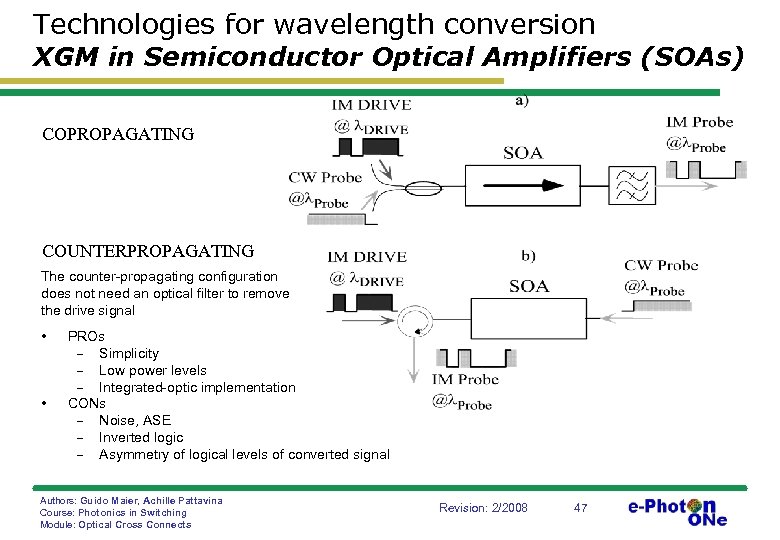 Technologies for wavelength conversion XGM in Semiconductor Optical Amplifiers (SOAs) COPROPAGATING COUNTERPROPAGATING The counter-propagating configuration does not need an optical filter to remove the drive signal • • PROs - Simplicity - Low power levels - Integrated-optic implementation CONs - Noise, ASE - Inverted logic - Asymmetry of logical levels of converted signal Authors: Guido Maier, Achille Pattavina Course: Photonics in Switching Module: Optical Cross Connects Revision: 2/2008 47
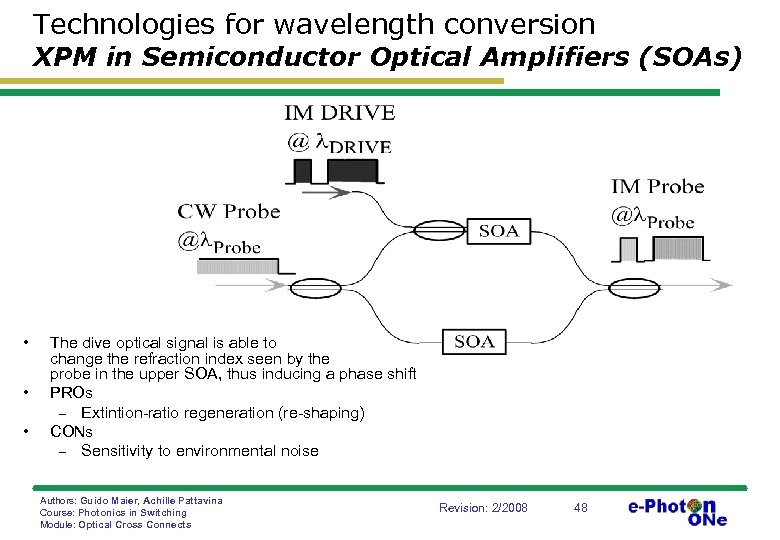 Technologies for wavelength conversion XPM in Semiconductor Optical Amplifiers (SOAs) • • • The dive optical signal is able to change the refraction index seen by the probe in the upper SOA, thus inducing a phase shift PROs - Extintion-ratio regeneration (re-shaping) CONs - Sensitivity to environmental noise Authors: Guido Maier, Achille Pattavina Course: Photonics in Switching Module: Optical Cross Connects Revision: 2/2008 48
 OXC technology Some conclusions • Many different technological solutions do exist for “all-optical” space switching and wavelength conversion … • … but none of them has yet proved to be ready to support OXC large-scale production and deployment - Each solution has a particular major limitation • Electronic implementation of the OXC or of some of its subsystems (typically, wavelength conversion) is still a common approach • Research on optical interconnection network design, combined to technological advances, could open up the way for the future “all-optical” OXC Authors: Guido Maier, Achille Pattavina Course: Photonics in Switching Module: Optical Cross Connects Revision: 2/2008 49
 Summary • Introduction • Evolution of the Optical cross connect • Technologies for optical space switching and wavelength conversion • OXC classification Authors: Guido Maier, Achille Pattavina Course: Photonics in Switching Module: Optical Cross Connects Revision: 2/2008 50
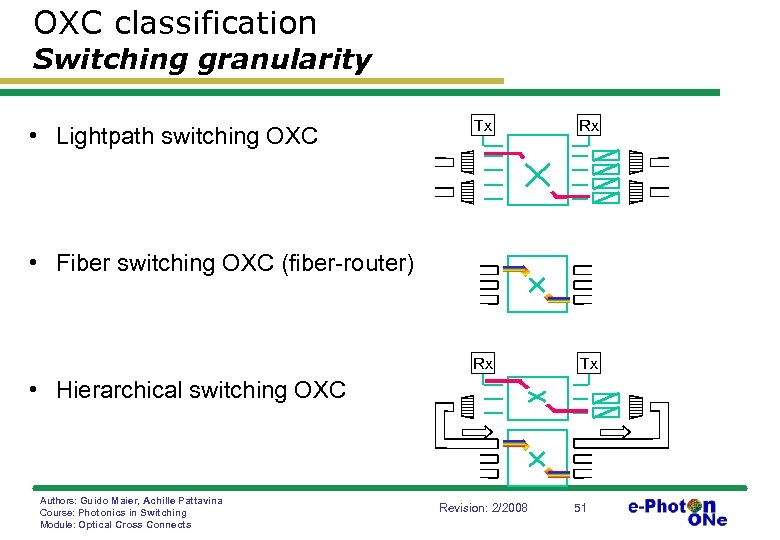 OXC classification Switching granularity Rx Rx • Lightpath switching OXC Tx Tx • Fiber switching OXC (fiber-router) • Hierarchical switching OXC Authors: Guido Maier, Achille Pattavina Course: Photonics in Switching Module: Optical Cross Connects Revision: 2/2008 51
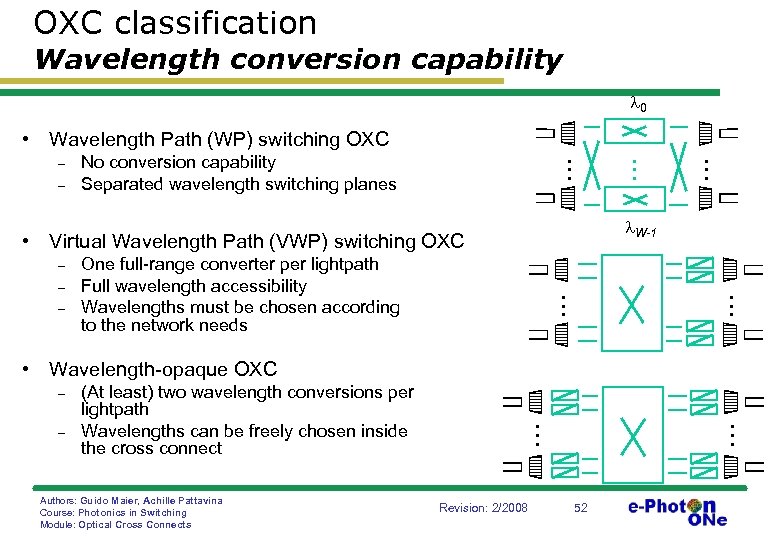 OXC classification Wavelength conversion capability 0 • Wavelength Path (WP) switching OXC - . . . No conversion capability Separated wavelength switching planes . . . W-1 • Virtual Wavelength Path (VWP) switching OXC - . . . One full-range converter per lightpath Full wavelength accessibility Wavelengths must be chosen according to the network needs . . . • Wavelength-opaque OXC - (At least) two wavelength conversions per lightpath Wavelengths can be freely chosen inside the cross connect Authors: Guido Maier, Achille Pattavina Course: Photonics in Switching Module: Optical Cross Connects . . . Revision: 2/2008 . . . 52
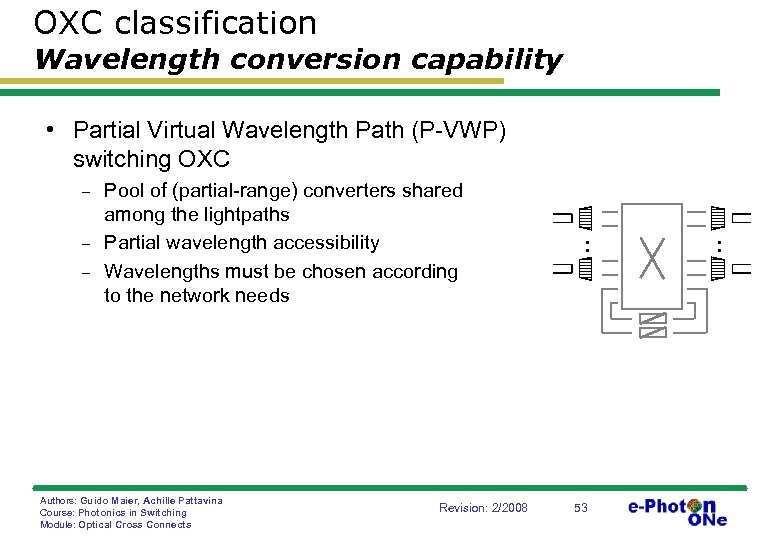 OXC classification Wavelength conversion capability • Partial Virtual Wavelength Path (P-VWP) switching OXC - Pool of (partial-range) converters shared among the lightpaths Partial wavelength accessibility Wavelengths must be chosen according to the network needs Authors: Guido Maier, Achille Pattavina Course: Photonics in Switching Module: Optical Cross Connects Revision: 2/2008 . . 53 . .
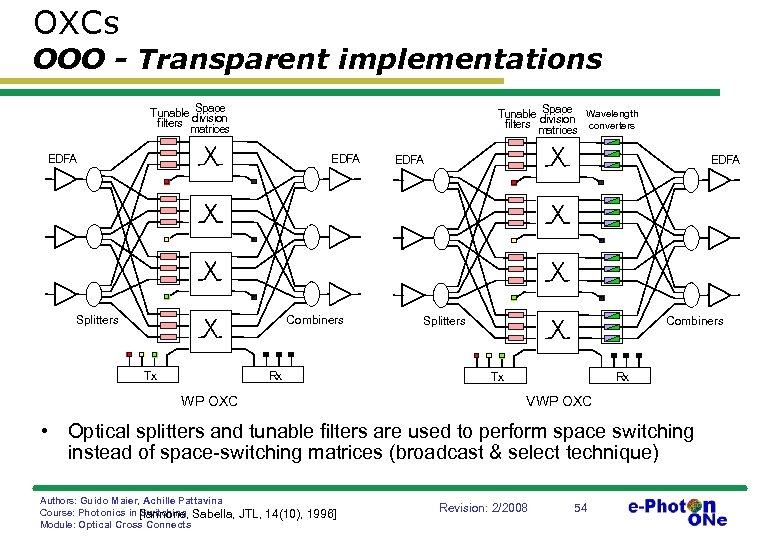 OXCs OOO - Transparent implementations Space Tunable division filters matrices Space Tunable division Wavelength filters matrices converters EDFA Combiners Splitters Tx Rx WP OXC EDFA Combiners Splitters Tx Rx VWP OXC • Optical splitters and tunable filters are used to perform space switching instead of space-switching matrices (broadcast & select technique) Authors: Guido Maier, Achille Pattavina Course: Photonics in [Iannone, Sabella, Switching Module: Optical Cross Connects JTL, 14(10), 1996] Revision: 2/2008 54
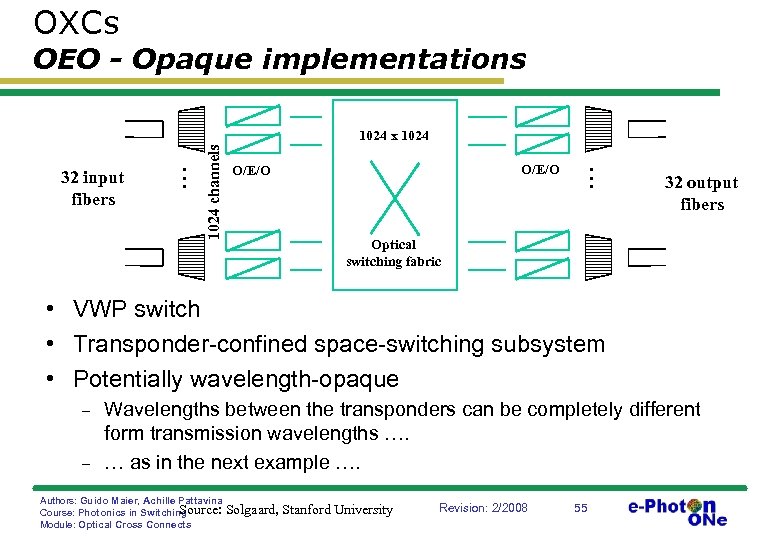 OXCs OEO - Opaque implementations 32 input fibers . . . 1024 channels 1024 x 1024 . . . O/E/O 32 output fibers Optical switching fabric • VWP switch • Transponder-confined space-switching subsystem • Potentially wavelength-opaque - Wavelengths between the transponders can be completely different form transmission wavelengths …. … as in the next example …. Authors: Guido Maier, Achille Pattavina Source: Course: Photonics in Switching Module: Optical Cross Connects Solgaard, Stanford University Revision: 2/2008 55
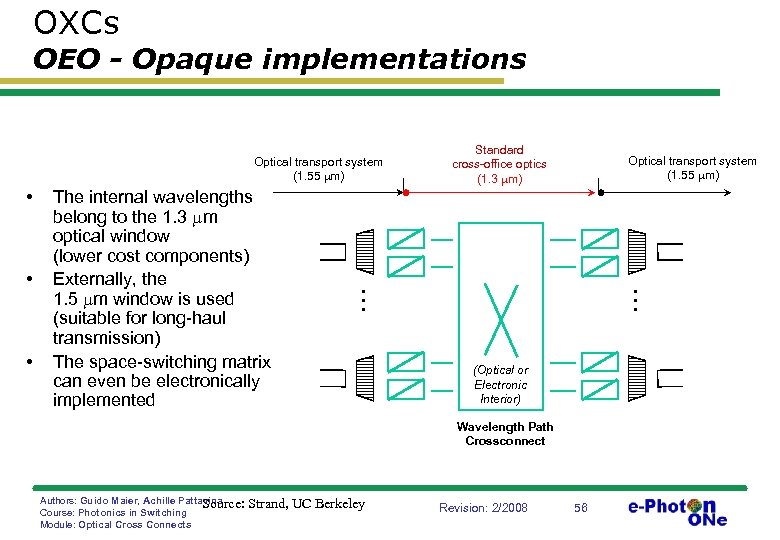 OXCs OEO - Opaque implementations Optical transport system (1. 55 m) • • • The internal wavelengths belong to the 1. 3 m optical window (lower cost components) Externally, the 1. 5 m window is used (suitable for long-haul transmission) The space-switching matrix can even be electronically implemented Standard cross-office optics (1. 3 m) Optical transport system (1. 55 m) . . . (Optical or Electronic Interior) Wavelength Path Crossconnect Authors: Guido Maier, Achille Pattavina Source: Course: Photonics in Switching Module: Optical Cross Connects Strand, UC Berkeley Revision: 2/2008 56
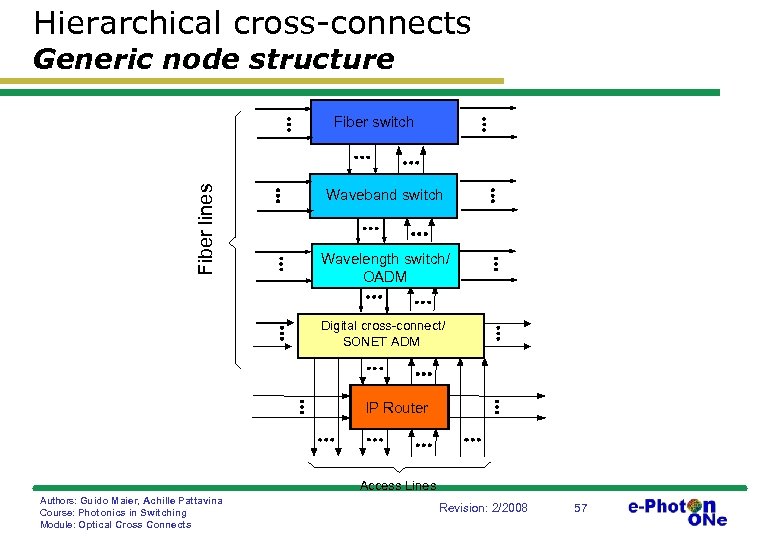 Hierarchical cross-connects Generic node structure Fiber lines Fiber switch Waveband switch Wavelength switch/ OADM Digital cross-connect/ SONET ADM IP Router Access Lines Authors: Guido Maier, Achille Pattavina Course: Photonics in Switching Module: Optical Cross Connects Revision: 2/2008 57
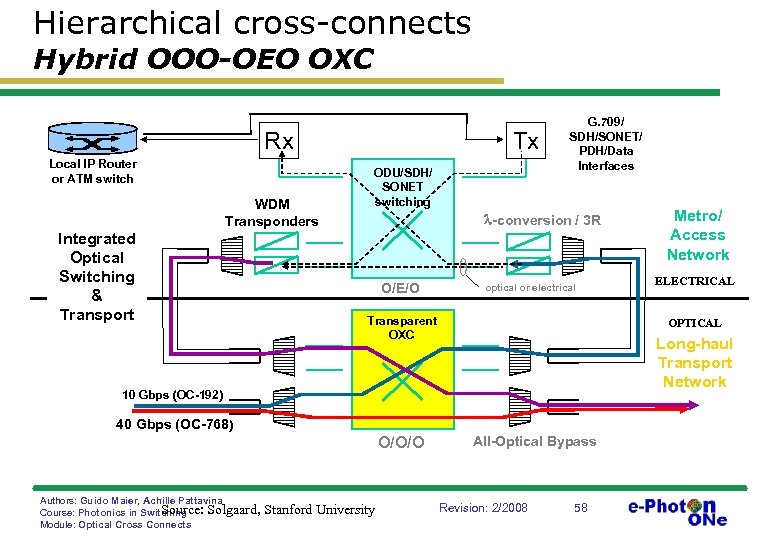 Hierarchical cross-connects Hybrid OOO-OEO OXC Rx Local IP Router or ATM switch WDM Transponders Integrated Optical Switching & Transport Tx ODU/SDH/ SONET switching G. 709/ SDH/SONET/ PDH/Data Interfaces -conversion / 3 R O/E/O optical or electrical Transparent OXC Long-haul Transport Network 40 Gbps (OC-768) Authors: Guido Maier, Achille Pattavina Source: Solgaard, Course: Photonics in Switching Module: Optical Cross Connects Stanford University ELECTRICAL OPTICAL 10 Gbps (OC-192) O/O/O Metro/ Access Network All-Optical Bypass Revision: 2/2008 58
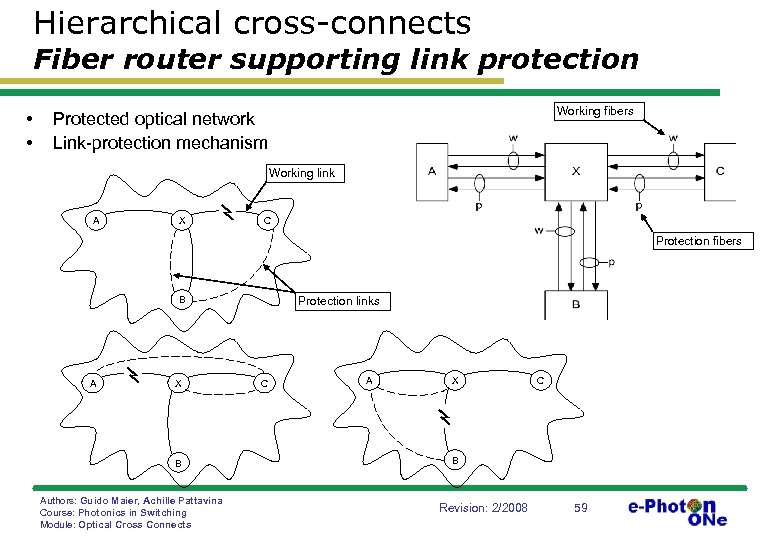 Hierarchical cross-connects Fiber router supporting link protection • • Working fibers Protected optical network Link-protection mechanism Working link A X C Protection fibers B A X B Authors: Guido Maier, Achille Pattavina Course: Photonics in Switching Module: Optical Cross Connects Protection links C A X C B Revision: 2/2008 59
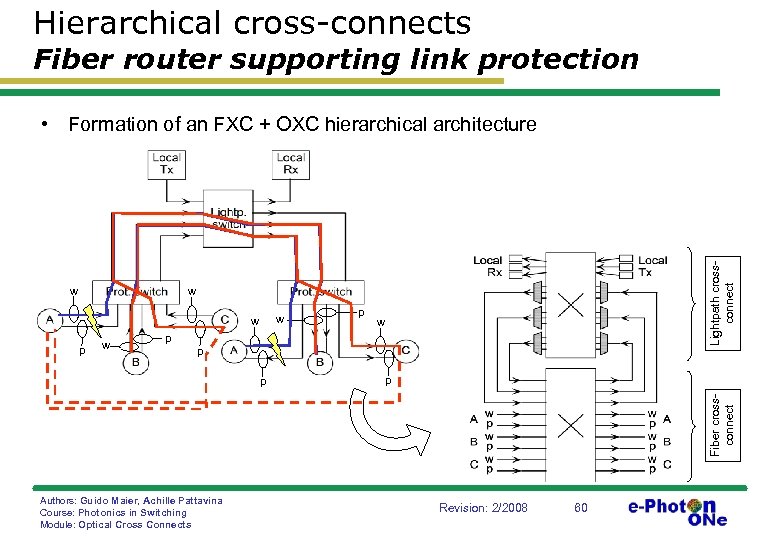 Hierarchical cross-connects Fiber router supporting link protection w Lightpath crossconnect • Formation of an FXC + OXC hierarchical architecture w w w p w p p p Fiber crossconnect p Authors: Guido Maier, Achille Pattavina Course: Photonics in Switching Module: Optical Cross Connects Revision: 2/2008 60
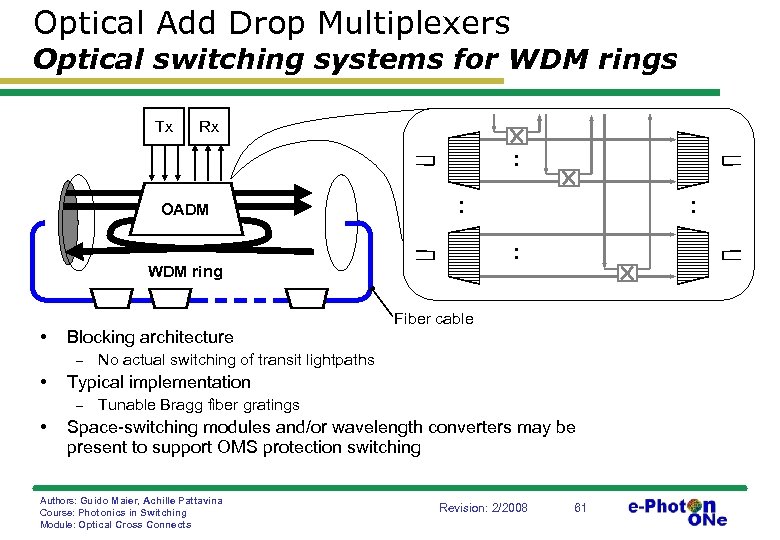 Optical Add Drop Multiplexers Optical switching systems for WDM rings Tx Rx . . OADM . . WDM ring • Fiber cable Blocking architecture - • No actual switching of transit lightpaths Typical implementation - • . . Tunable Bragg fiber gratings Space-switching modules and/or wavelength converters may be present to support OMS protection switching Authors: Guido Maier, Achille Pattavina Course: Photonics in Switching Module: Optical Cross Connects Revision: 2/2008 61
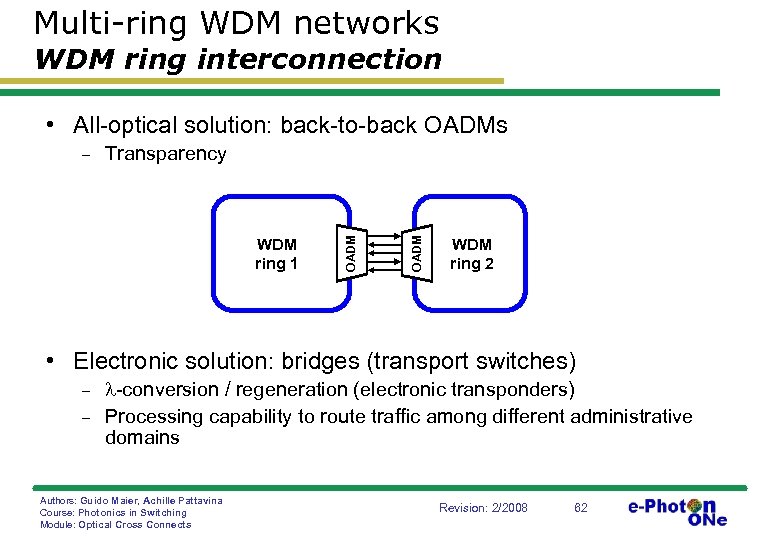 Multi-ring WDM networks WDM ring interconnection • All-optical solution: back-to-back OADMs WDM ring 1 OADM Transparency OADM - WDM ring 2 • Electronic solution: bridges (transport switches) - -conversion / regeneration (electronic transponders) Processing capability to route traffic among different administrative domains Authors: Guido Maier, Achille Pattavina Course: Photonics in Switching Module: Optical Cross Connects Revision: 2/2008 62