 Скачать презентацию This Presentation Is Sponsored By Atlantic Region
736afa6fad1a867d0b95e888caf5a75d.ppt
- Количество слайдов: 62



This Presentation Is Sponsored By Atlantic Region
Nova Scotia Hospice Palliative Care Association Annual Conference 2011 HOSPICE AND PALLIATIVE CARE Roots Reality Reaching Out Dr Nigel Sykes St Christopher's Hospice London
“I want what is in your heart and what is in your mind”
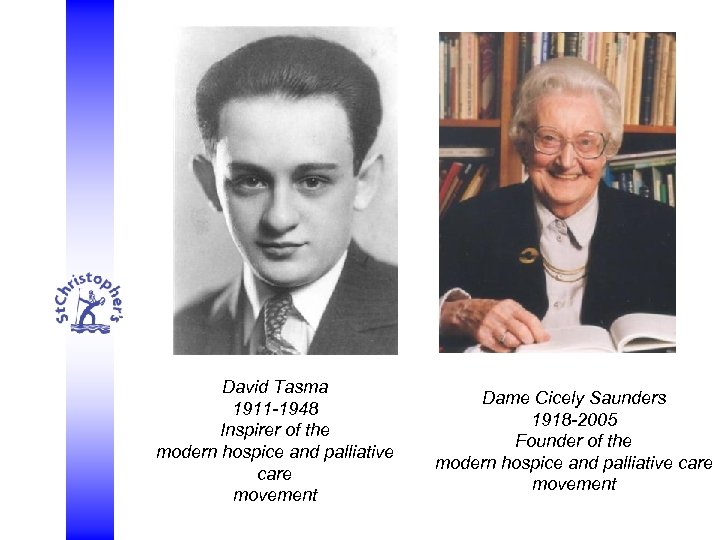
David Tasma 1911 -1948 Inspirer of the modern hospice and palliative care movement Dame Cicely Saunders 1918 -2005 Founder of the modern hospice and palliative care movement
Where did Palliative Care come from? u. Hospice and Palliative Care began as a healthcare reform initiative inspired by: v. The perceived failure of existing cancer care v. The particular failure of doctors to deal adequately with dying patients u. At heart it has therefore always been medical in nature v. But firmly centred on the patient experience
Initial planning of St Christopher’s u. The initial emphasis was on care : v“Patients must be able to see the life of the world outside and yet not have the light in their eyes or the draught round their necks. ”
A Three Part Vision u St Christopher’s was legally registered in 1961 u Care was now joined by research and teaching: v Provide care both in the Hospice and in patients’ homes v Encourage the teaching and training of doctors and nurses v Promote research into the care and treatment of the dying u Construction commenced in March 1965 u St Christopher’s opened in July 1967
The Prospectus for St Christopher’s The Hospice “will try to fill the gap that exists in both research and teaching concerning the care of patients dying of cancer and those needing skilled relief in other longterm illnesses and their relatives. ” Saunders, 1967
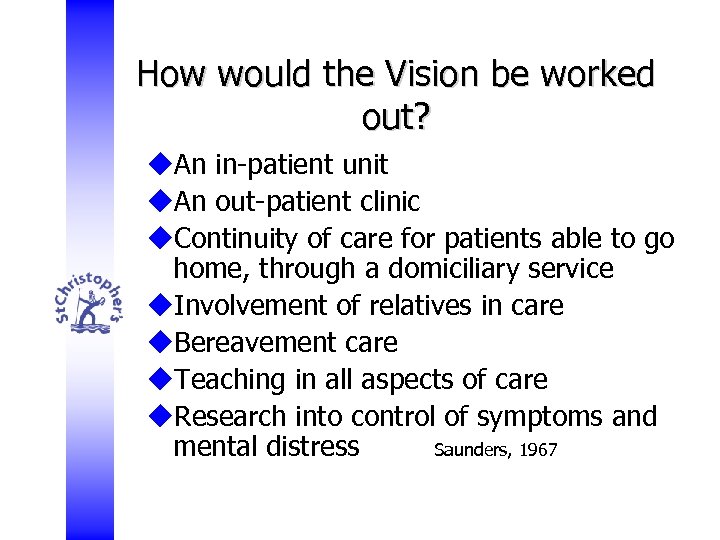
How would the Vision be worked out? u. An in-patient unit u. An out-patient clinic u. Continuity of care for patients able to go home, through a domiciliary service u. Involvement of relatives in care u. Bereavement care u. Teaching in all aspects of care u. Research into control of symptoms and mental distress Saunders, 1967
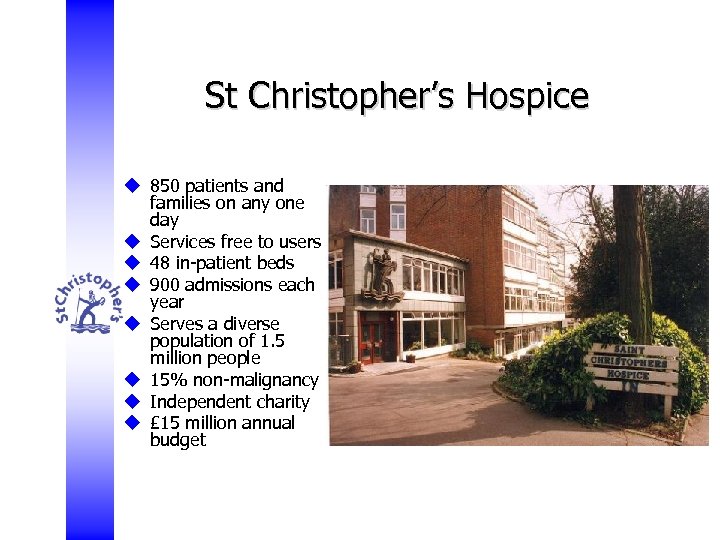
St Christopher’s Hospice u 850 patients and families on any one day u Services free to users u 48 in-patient beds u 900 admissions each year u Serves a diverse population of 1. 5 million people u 15% non-malignancy u Independent charity u £ 15 million annual budget
Hospice has Grown Up u. It gave rise to Palliative Care v. By 1975 (Balfour Mount, Montreal) u. It became a “Movement” v. By 1978 (Sandol Stoddard) u. It spread: v. Usually by inspiring dynamic individuals recreating Hospice in locally adapted versions t A strength? v. Not often by governments t A weakness? u. It can save money and lengthen life (Temel et al. , 2010)
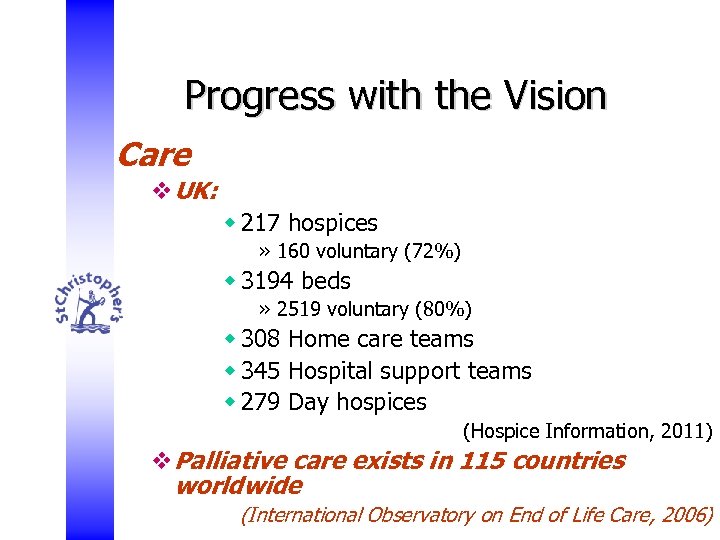
Progress with the Vision Care v. UK: w 217 hospices » 160 voluntary (72%) w 3194 beds » 2519 voluntary (80%) w 308 Home care teams w 345 Hospital support teams w 279 Day hospices (Hospice Information, 2011) v. Palliative care exists in 115 countries worldwide (International Observatory on End of Life Care, 2006)
Progress with the vision Teaching u. Palliative care routinely taught in UK medical schools u. Specialty or sub-specialty training schemes for palliative medicine in UK, Ireland, USA, Australia, New Zealand u. Nursing, medical and multiprofessional degree and diploma courses u. Major international conferences on five continents
Progress with the vision Research u. Thirteen UK professorial chairs related to palliative care and over 30 internationally u. At least 12 peer-reviewed Englishlanguage journals primarily devoted to palliative care research and development u. Regular national and international meetings dedicated to palliative care research
In the United Kingdom u. Hospice and Palliative Care have become routin v. Palliative Medicine has been a recognised specialty for nearly 25 years t With training schemes – just like any other specialty v. Palliative Care has entered government policy t The Cancer Plan 2000 t National Institute for Clinical Effectiveness Guidance 2004 t End of Life care Strategy 2008 v. Hospices have Care Quality Commission regulation
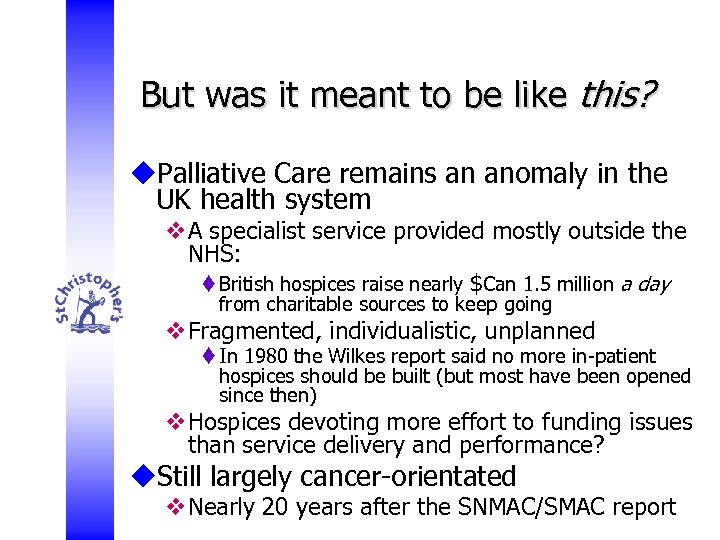
But was it meant to be like this? u. Palliative Care remains an anomaly in the UK health system v. A specialist service provided mostly outside the NHS: t British hospices raise nearly $Can 1. 5 million a day from charitable sources to keep going v. Fragmented, individualistic, unplanned t In 1980 the Wilkes report said no more in-patient hospices should be built (but most have been opened since then) v. Hospices devoting more effort to funding issues than service delivery and performance? u. Still largely cancer-orientated v. Nearly 20 years after the SNMAC/SMAC report
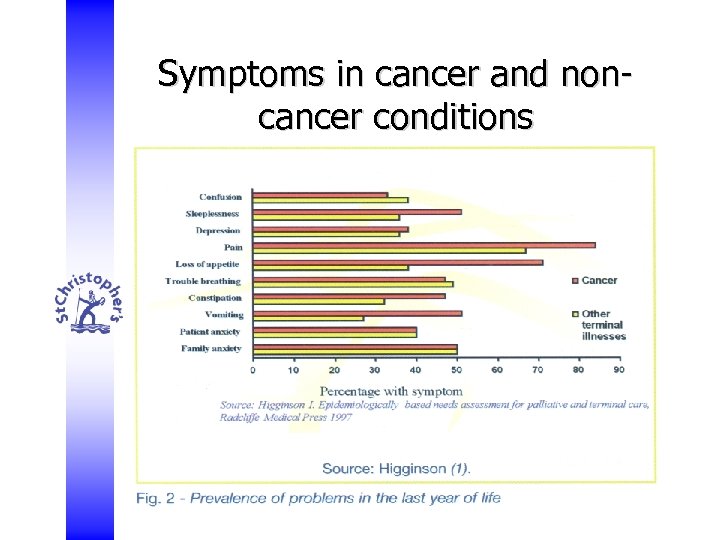
Symptoms in cancer and noncancer conditions
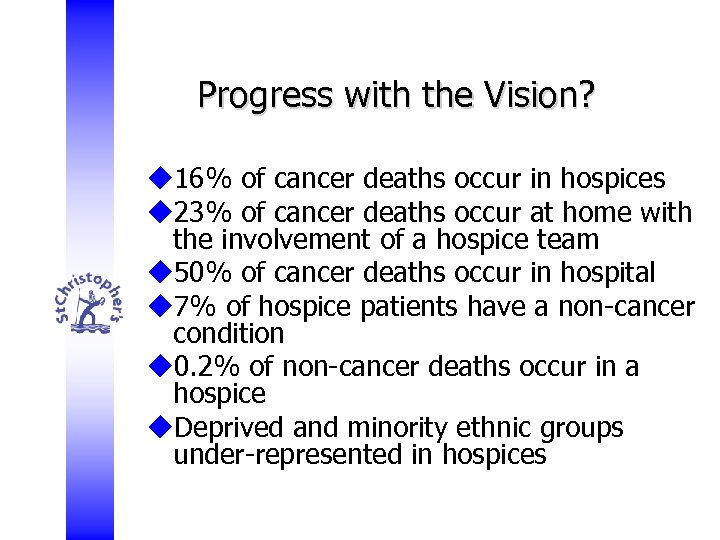
Progress with the Vision? u 16% of cancer deaths occur in hospices u 23% of cancer deaths occur at home with the involvement of a hospice team u 50% of cancer deaths occur in hospital u 7% of hospice patients have a non-cancer condition u 0. 2% of non-cancer deaths occur in a hospice u. Deprived and minority ethnic groups under-represented in hospices
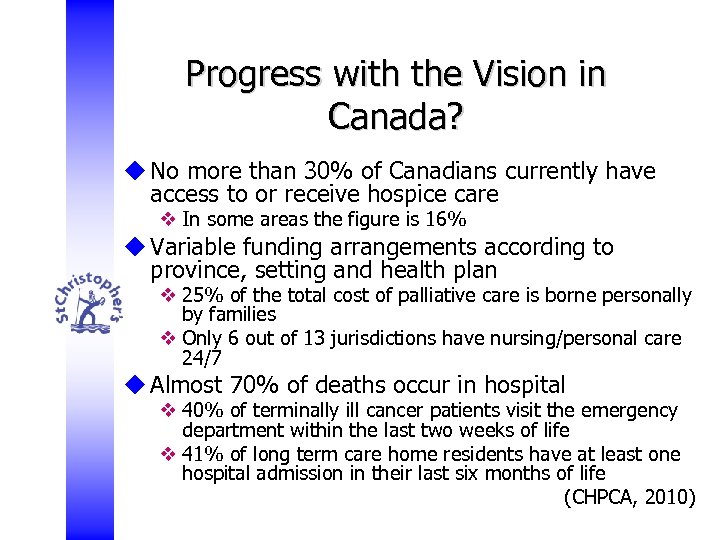
Progress with the Vision in Canada? u No more than 30% of Canadians currently have access to or receive hospice care v In some areas the figure is 16% u Variable funding arrangements according to province, setting and health plan v 25% of the total cost of palliative care is borne personally by families v Only 6 out of 13 jurisdictions have nursing/personal care 24/7 u Almost 70% of deaths occur in hospital v 40% of terminally ill cancer patients visit the emergency department within the last two weeks of life v 41% of long term care home residents have at least one hospital admission in their last six months of life (CHPCA, 2010)
Hospices – and Palliative Care u. Are hospices an intrinsic part of the palliative care vision? v“We went out in order to go back in again” v“There is need for diversity in this field” u. Historically, the vision was brought to life through hospices u. What is their place now?
A bit more vision… “A few hospices will be needed for… intractable problems, research and teaching, …but most patients will continue to die in hospitals, cancer centres or their own homes; the staff they will find there should be learning how to meet their needs” Saunders, 1978
Society is changing u. Family splits and dispersal u. Ethnic and cultural diversity v. Ethnic minorities make up 8% of the UK population but only 3% of hospice deaths u. An ageing society v. The number of over 65 year olds in Canada has doubled in less than 30 years… v…and will double again in the next 25 years v. The annual number of deaths in Canada will increase by 33% by 2020
Society is changing u. More chronic illness v 80% of Canadians over 65 have a chronic illness v. Nearly 60% have two or more chronic illnesses u. Increased personal aspirations u. Increased expectations of healthcare v. But not necessarily the money to pay for them v. Shrinking workforce relative to the numbers who need to be looked after u. Changing patterns of volunteering
The Choice Agenda u“No decision about me without me” u. Palliative care for all who need it v. When they need it v. Where they want it v. How they want it u. The choice of death v. Physician-assisted suicide/euthanasia?
How do Hospice and Palliative Care respond to these societal changes and pressures?
Taking the Palliative Care Vision into the future… Means bringing physical, psychological, social and spiritual care to all dying people who need it This can only happen if Palliative Care becomes an integral strand of healthcare and gains stable funding
The Hospice Vision is about transforming healthcare If this is to happen we must: u. Influence the generalists v. Share our knowledge and facilities u. Open up our care: v. Increase the number of people we care for v. Improve access across disease labels v. Maintain quality v. Contain costs
Currently Hospice Care receives huge public support - Why? u. It is there for people and their social networks at the most emotionally traumatic life transition u. It is widely perceived to do what it promises – giving of mind and heart u. It makes other bits of the health and social care systems work in the way they are supposed to Strong public support means that government support can continue to be niggardly (‘Big Society’ in action? )
The Dilemma for a Palliative Care service u. Investment in a social worker is likely to result in enhanced quality of care for current patients but not much increase in patient numbers u. Investment in another nurse may increase access to more patients but not quality of care for current patients (Tebbitt, 2006)
Is our Choice: u. Icebergs of Excellence versus u. A Sea of Mediocrity ?
“Mainstreaming excellence” (Going back in again) Better care for the dying should become a touchstone for success in modernising the NHS. This is one of the really big issues — we must make it happen Nigel Crisp (NHS Chief Executive), 2008
Taking the vision into the future… u. How do we “mainstream excellence”? v. To provide UK hospice deaths to NICE standards for all who want them would entail a transfer of £ 1, 300 m from hospitals u. The risk is a reduction to a symptom control service focused only on the patient’s obvious physical needs v. A little for a lot (Randall and Downie, 2006) u. Can we maintain a balance? v. Rather more for rather more
Palliative Care In-Patient Units (Hospices? )? u. Access to specialist palliative care beds is needed v. Not necessarily many: t In 1991 St Christopher’s used 62 beds to support a home care case load of 85 patients t In 2011 St Christopher’s has 48 beds for a home care case load of 850 patients v. But they produce better outcomes than a consult service alone (Casarett et al. , 2011) v. They ought to deal with complexity t How do you maintain the staff to do that if your unit is very small?
UK Department of Health End of Life Care Strategy Palliative care now has a prominence it has never had before u“How we care for the dying is an indicator of how we care for all sick and vulnerable people. It is a measure of society as a whole and a litmus test for health and social care services” End of Life Care Strategy 2008
Making Palliative Care an integral strand of healthcare (According to the UK End of Life Care Strategy) u. The key is a whole systems approach v. Dying well in the bed you’re in v(Actually, not having a bad death – 56% of NHS hospital complaints relate to end of life care) u. Hospices are called to contribute their expertise to this effort v. But the emphasis is on generalists
Whole systems approach - 1 u. Identify people approaching the end of life v. Raise community awareness of death and dying (an opportunity for hospices) v. Start discussion about end of life care preferences v. Not just those dying of cancer v. Advance Care Planning t. Note preferences and review over time
Whole systems approach - 2 u. Coordination of care v. Locality-wide End of Life register (not restricted to cancer) to facilitate priority care v. Care plans available to out of hours and emergency services u. Palliative care crises do not just happen in hours v. There must be specialist access 24/7, backed up by out of hours generic services
Whole systems approach - 3 u. Make high quality services available everywhere v. Not just for cancer v. Improve the skills of staff who provide generic palliative care v. Regulatory and higher education bodies need to be involved
Whole systems approach - 4 u. Appropriate management of the last days of life v. Wherever they occur v. Not just for cancer – care based on need not illness v. Involves 24/7 access to skilled nursing, medical and personal care u. Support of carers v. Before the patient’s death and into bereavement
What is Missing? u. Actually making it happen u. Quality v. What is practically measurable? v. What is worth measuring? u. An equitable funding mechanism v. When government currently pays barely 50% of total Palliative Care costs v. There is no extra money v. The Australian AN-SNAP system is one approach t Paying by case-mix
Challenges for Hospices u. Contributing imaginatively to the healthcare community as a whole u. Performing to a standard v. A properly constituted multiprofessional team v 24 h service availability v. Demonstrating their outcomes u. The non-malignancy agenda u. Being efficient and providing value for money v. Why do some hospices spend 90% of their income on their service and others only 50%?
So what is St Christopher’s doing? u Extending our reach v Making generalists the centre of our education v Training care home staff and introducing end of life registers v New initiatives in public education v Finding ways of looking after more people within our budget and while maintaining quality t Expanding our clinics t Medical and nursing consultancies u Staying viable v Living within our means v Getting better at raising money v Looking for opportunities to merge t Containing costs t Increased bargaining power
Education for Generalists u. Making partnerships with the NHS v. Advanced Nursing Practice for Palliative Care (Masters level) v. Foundations Course in Palliative Care nursing v. Innovative action learning programme for senior hospital nurses v. End of Life Care for Social Services Care Managers v. Educational project with Mental Health Services involved with Dementia Over 4, 700 participants on 180 courses in 2010
Education for Generalists u. Enhancing skills in care homes v. Advance Care Planning v. The first syndicated training centre for the Gold Standards Framework v. Over 120 care homes accredited to date v. Deaths in care homes associated with the programme have increased by 20% t Care Homes have 3 times as many beds as the NHS but only 16% of deaths occur there
Public Education Aiming to create healthier attitudes towards death and dying u. Schools project u. Work with the BRIT School (Performing Arts and Technology College) v. Drama v. Video u. Open Fridays u. Concerts
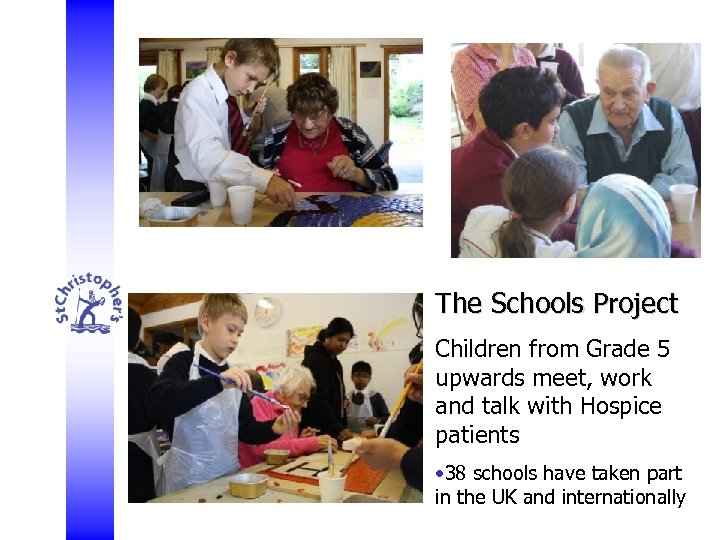
The Schools Project Children from Grade 5 upwards meet, work and talk with Hospice patients • 38 schools have taken part in the UK and internationally
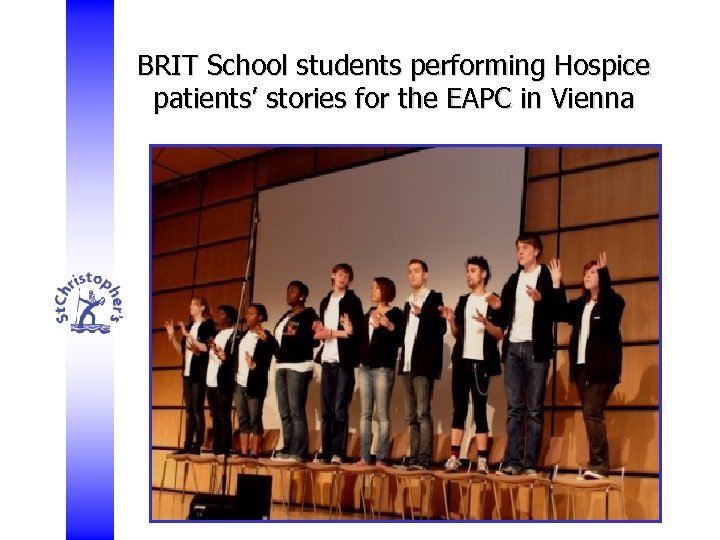
BRIT School students performing Hospice patients’ stories for the EAPC in Vienna
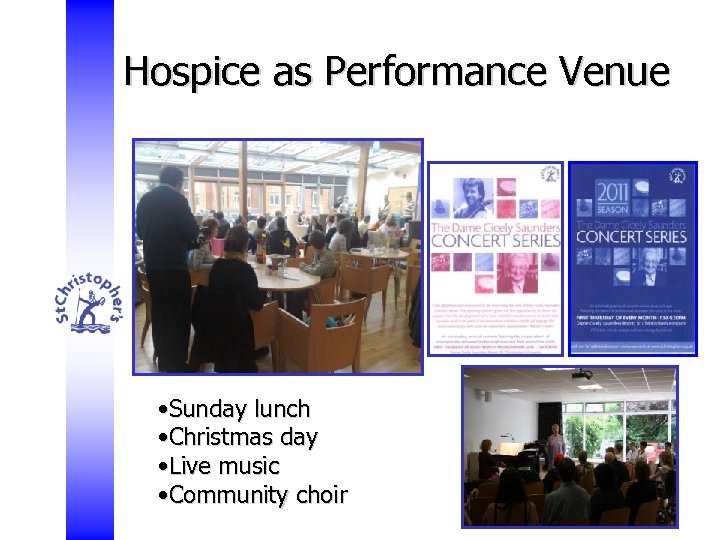
Hospice as Performance Venue • Sunday lunch • Christmas day • Live music • Community choir
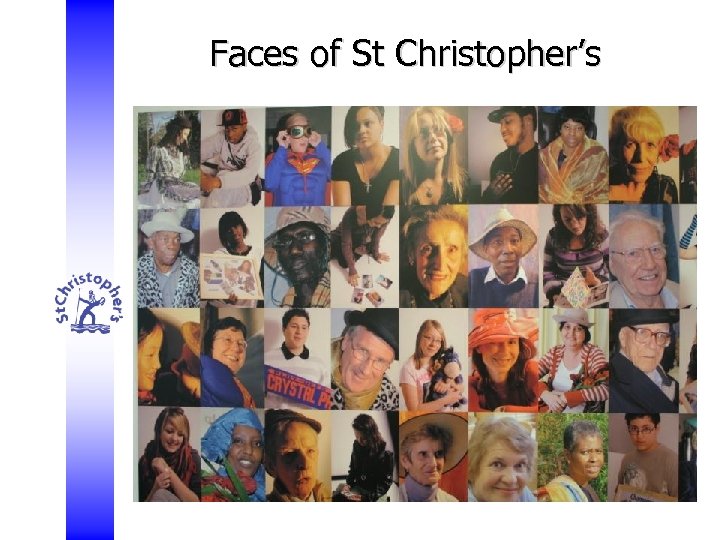
Faces of St Christopher’s
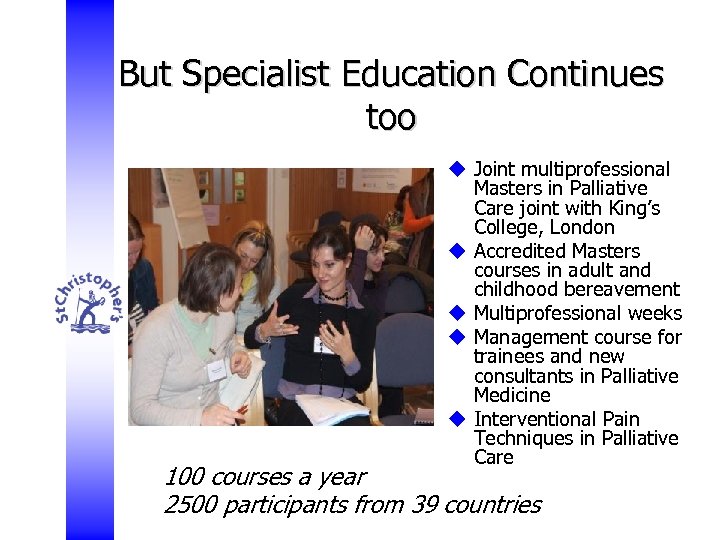
But Specialist Education Continues too u Joint multiprofessional Masters in Palliative Care joint with King’s College, London u Accredited Masters courses in adult and childhood bereavement u Multiprofessional weeks u Management course for trainees and new consultants in Palliative Medicine u Interventional Pain Techniques in Palliative Care 100 courses a year 2500 participants from 39 countries
The Anniversary Centre u. Opening up our Day Centre activities v. More choice of therapies and activities flexibility what you do and when chances to socialise opportunity to get information u. More scope to see patients and families at the Hospice v. Better use of our Home Care nurses’ time v. Opportunities to join in Day Centre activities
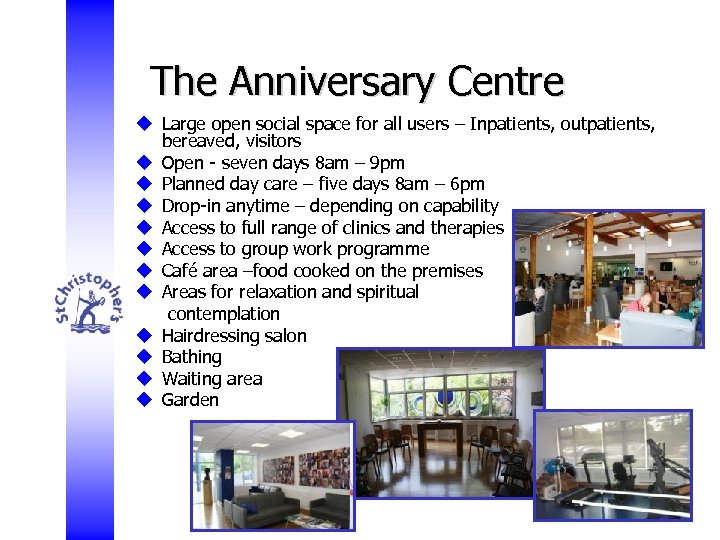
The Anniversary Centre u Large open social space for all users – Inpatients, outpatients, bereaved, visitors u Open - seven days 8 am – 9 pm u Planned day care – five days 8 am – 6 pm u Drop-in anytime – depending on capability u Access to full range of clinics and therapies u Access to group work programme u Café area –food cooked on the premises u Areas for relaxation and spiritual contemplation u Hairdressing salon u Bathing u Waiting area u Garden
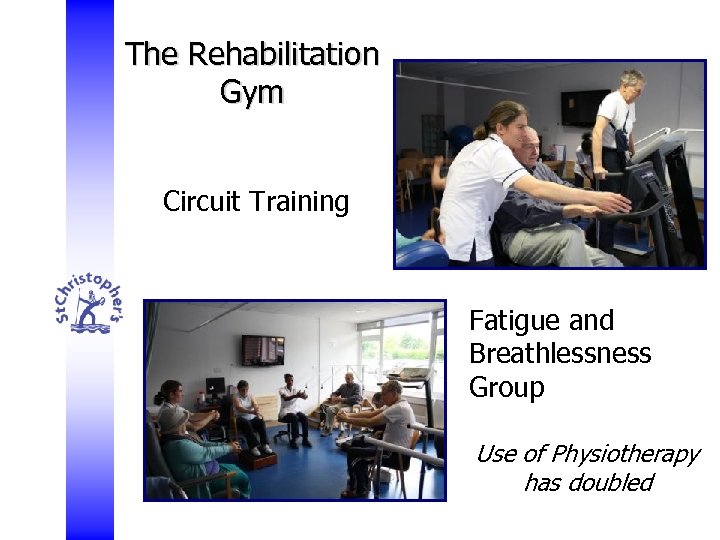
The Rehabilitation Gym Circuit Training Fatigue and Breathlessness Group Use of Physiotherapy has doubled
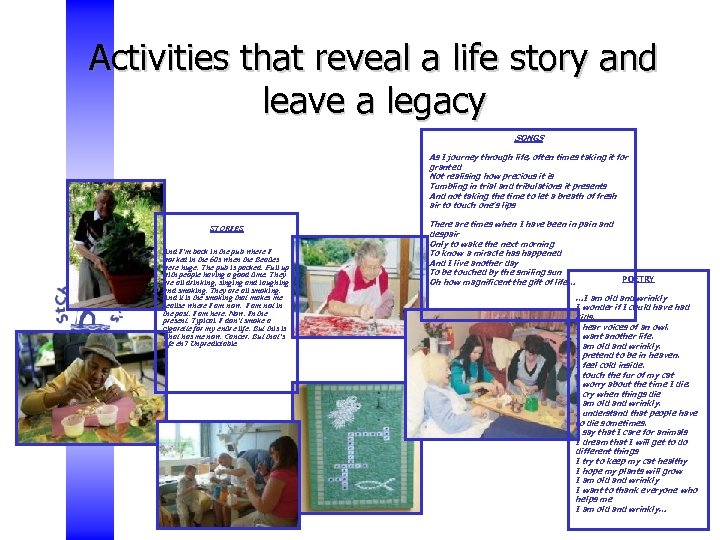
Activities that reveal a life story and leave a legacy SONGS As I journey through life, often times taking it for granted Not realising how precious it is Tumbling in trial and tribulations it presents And not taking the time to let a breath of fresh air to touch one’s lips STORIES And I’m back in the pub where I worked in the 60 s when the Beatles were huge. The pub is packed. Full up with people having a good time. They are all drinking, singing and laughing and smoking. They are all smoking. And it is the smoking that makes me realise where I am now. I am not in the past. I am here. Now. In the present. Typical. I don’t smoke a cigarette for my entire life. But this is what has me now. Cancer. But that’s life eh? Unpredictable. . There are times when I have been in pain and despair Only to wake the next morning To know a miracle has happened And I live another day To be touched by the smiling sun Oh how magnificent the gift of life… POETRY …I am old and wrinkly I wonder if I could have had kids. I hear voices of an owl. I want another life. I am old and wrinkly. I pretend to be in heaven. I feel cold inside. I touch the fur of my cat I worry about the time I die. I cry when things die I am old and wrinkly. I understand that people have to die sometimes. I say that I care for animals I dream that I will get to do different things I try to keep my cat healthy I hope my plants will grow I am old and wrinkly I want to thank everyone who helps me I am old and wrinkly…
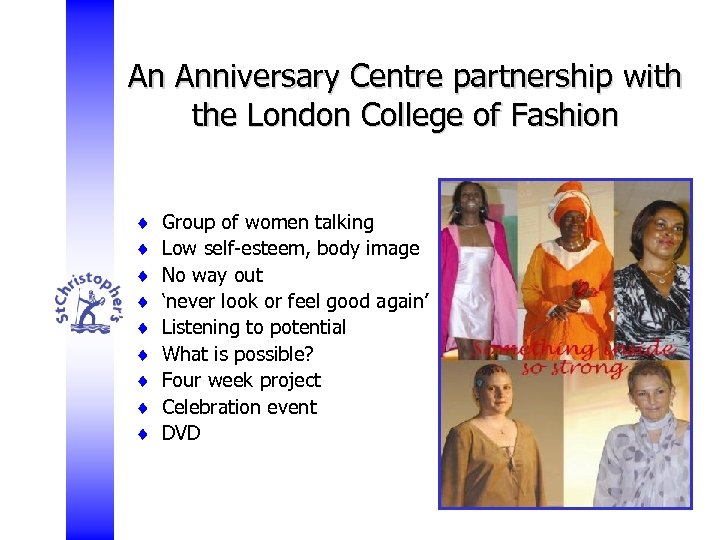
An Anniversary Centre partnership with the London College of Fashion ¨ ¨ ¨ ¨ ¨ Group of women talking Low self-esteem, body image No way out ‘never look or feel good again’ Listening to potential What is possible? Four week project Celebration event DVD
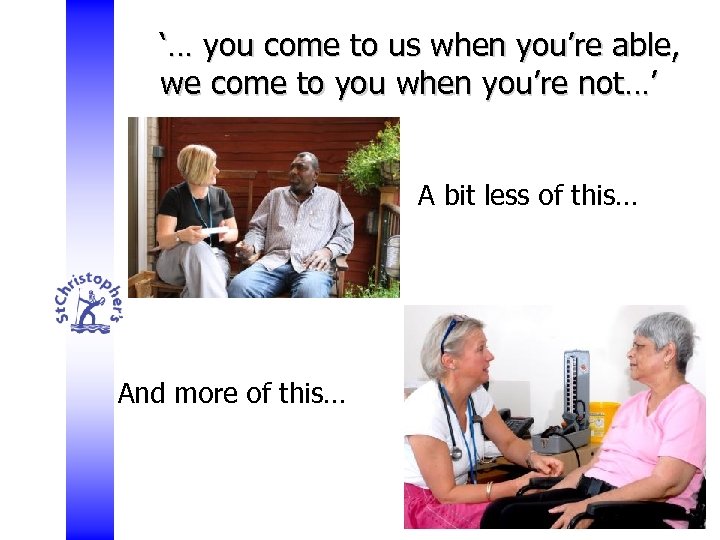
‘… you come to us when you’re able, we come to you when you’re not…’ A bit less of this… And more of this…
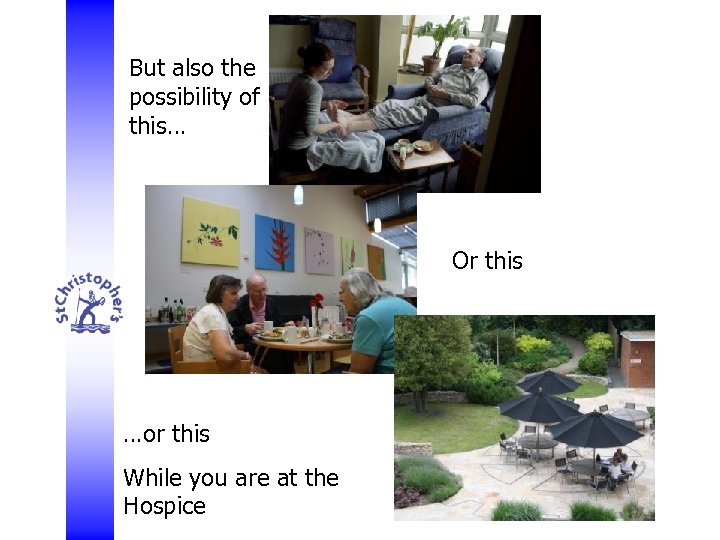
But also the possibility of this… Or this …or this While you are at the Hospice
Research Some recent partnerships: u. With the Maudsley Hospital v. The prevalence and determinants of depression in people receiving Palliative Care v. The effect of basic Cognitive Behaviour Therapy training on hospice nurses’ ability to help anxiety and depression u. With Southampton University v. Developing user feedback measures (SKIPP and VOICES-SCH) tailored to Palliative Care t Overcoming the problem of response shift
The Reach of Palliative Care u Palliative Care should reach all dying people and those close to them u So that they have access to appropriate care and support v when they need it v wherever they need it v whoever they are u Hospices’ independence and single focus allow them to innovate and to demonstrate standards u But only the incorporation of a Palliative Care approach into all areas of healthcare where dying people are to be found will achieve this vision
“ You matter because you are you, and you matter until the end of your life ” Cicely Saunders
Thank you for Listening
Скачать презентацию This Presentation Is Sponsored By Atlantic Region
736afa6fad1a867d0b95e888caf5a75d.ppt