


 Скачать презентацию This is a Power Point presentation on elementary
f6221c4065584cb6bc82ba21b2b3dd3a.ppt
- Количество слайдов: 40
 This is a Power. Point presentation on elementary supply and demand. A left mouse click or the enter key will add and element to a slide or move you to the next slide. The back space key will take you back an element or slide. If you wish to exit the presentation, the escape key will do it! R. Larry Reynolds ã 1997 1
 Demand Supply · Markets as allocative mechanism require: · nonattenuated property rights [exclusive, enforceable, transferable] · “voluntary” transactions · Markets include all “potential buyers and sellers” · behavior of buyers is represented by “demand” [benefits side of model] · behavior of sellers is represented by “supply” [cost side of model] 2
 Markets, Supply and Demand · markets include all potential buyers and sellers · geographic boundaries of market · markets defined by nature of product and characteristics of buyers · conditions of entry into market · markets, competition and substitutes 3
 Demand · Definition: “A schedule of the quantities of a good that buyers are willing and able to purchase at each possible price during a period of time, ceteris paribus. [all other things held constant]” · Demand can also be perceived as a schedule of the maximum prices buyers are willing and able to pay for each unit of a good. 4
 Demand Function · Is the functional relationship between the price of the good and the quantity of that good purchased in a given time period [UT], income, other prices and preferences being held constant. · A change in income, prices of other goods or preferences will alter [‘shift’] the demand function. 5
 Quantity demanded · A change in the price of the good under consideration will change the “quantity demanded. ” · Q = f (P, holding M, Pr , preferences constant); where: M = income Pr = prices of related goods · DP causes a change in X [DQ], this is a “change in quantity demanded” 6
 Change in demand · If M, Pr, or preferences change, the demand function [relationship between P and Q] will change. · These are sometimes called “demand shifters” · Be sure to understand difference between a “change in demand” and a “change in quantity demanded” · change in demand --- shift of the function · change in quantity demanded --- move on the function 7
 “Law of Demand” · Theory and empirical evidence suggest that the relationship between Price and Quantity is an inverse or negative relationship · At higher prices, quantity purchased is smaller, or at lower prices the quantity purchased is greater. 8
 An example of hot chocolate: There is a coffee cart in the building that primarily serves the individuals who work in the building. The market is defined to some extent by the geography of the building. Individuals who buy the hot chocolate rarely come from other buildings to purchase a cup. During the time period [UT]under consideration [8: 00 -9: 00 am on a week day ] the incomes and preferences of buyers are unlikely to change. The prices of coffee, lattes, etc. can be controlled by the vendor and the price of soft drinks from the machines remains constant. The number of workers in the building remain at a constant level. Under these circumstances, we observe the number of cups of hot chocolate [H] sold each morning as the price [P] is changed. From these observations the demand relationship is estimated. 9
![The demand relationship can be demonstrated as a table: DP > 0 [+. 75]](https://present5.com/presentation/f6221c4065584cb6bc82ba21b2b3dd3a/image-10.jpg "The demand relationship can be demonstrated as a table: DP > 0 [+. 75]") The demand relationship can be demonstrated as a table: DP > 0 [+. 75] DQ < 0 [-7. 5] Demand is a schedule of quantities that will be purchased schedule at a of prices during a given time period, cet. par. As the price is increased, the quantity purchased decreases. This demand relationship can be expressed as an equation: P = 2 -. 1 Q or Q = 20 - 10 P: [Q = f (P, . . . ) but we graph P on the Y axis and Q on the X axis. ] 10
The demand relationship can be demonstrated as a table: DP > 0 [+. 75] DQ < 0 [-7. 5] Demand is a schedule of quantities that will be purchased schedule at a of prices during a given time period, cet. par. As the price is increased, the quantity purchased decreases. This demand relationship can be expressed as an equation: P = 2 -. 1 Q or Q = 20 - 10 P: [Q = f (P, . . . ) but we graph P on the Y axis and Q on the X axis. ] 10
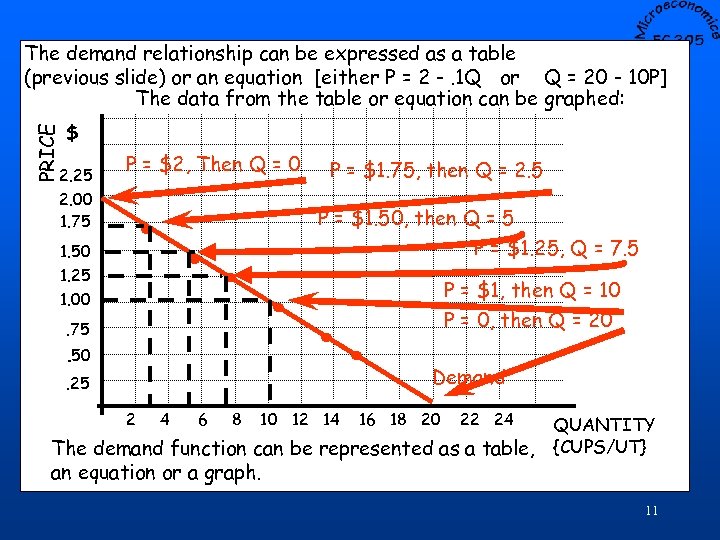 PRICE The demand relationship can be expressed as a table (previous slide) or an equation [either P = 2 -. 1 Q or Q = 20 - 10 P] The data from the table or equation can be graphed: $ 2. 25 2. 00 1. 75 1. 50 1. 25 1. 00 P = $2, Then Q = 0 . . . 75 . . . 50. 25 2 4 6 8 P = $1. 75, then Q = 2. 5 P = $1. 50, then Q = 5 P = $1. 25, Q = 7. 5 . . 10 12 14 P = $1, then Q = 10 P = 0, then Q = 20 Demand 16 18 20 22 24 QUANTITY The demand function can be represented as a table, {CUPS/UT} an equation or a graph. 11
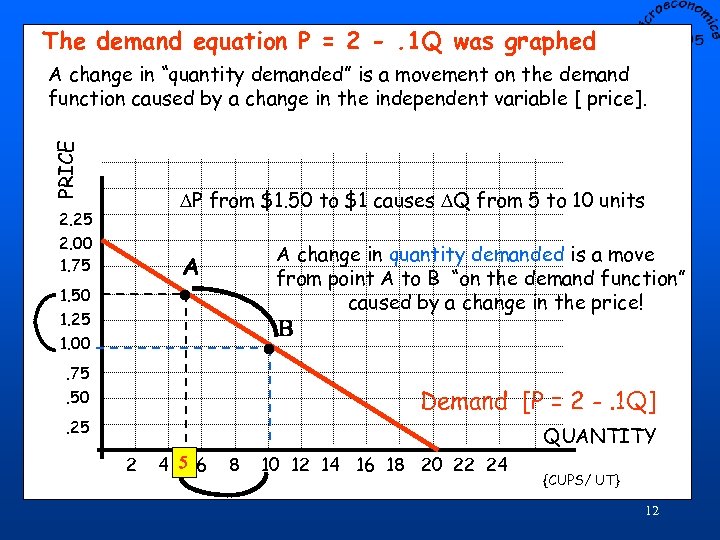 The demand equation P = 2 -. 1 Q was graphed PRICE A change in “quantity demanded” is a movement on the demand function caused by a change in the independent variable [ price]. DP from $1. 50 to $1 causes DQ from 5 to 10 units 2. 25 2. 00 1. 75 . A change in quantity demanded is a move from point A to B “on the demand function” caused by a change in the price! A 1. 50 1. 25 1. 00 . B . 75. 50 Demand [P = 2 -. 1 Q] . 25 QUANTITY 2 4 5 6 8 10 12 14 16 18 20 22 24 {CUPS/ UT} 12
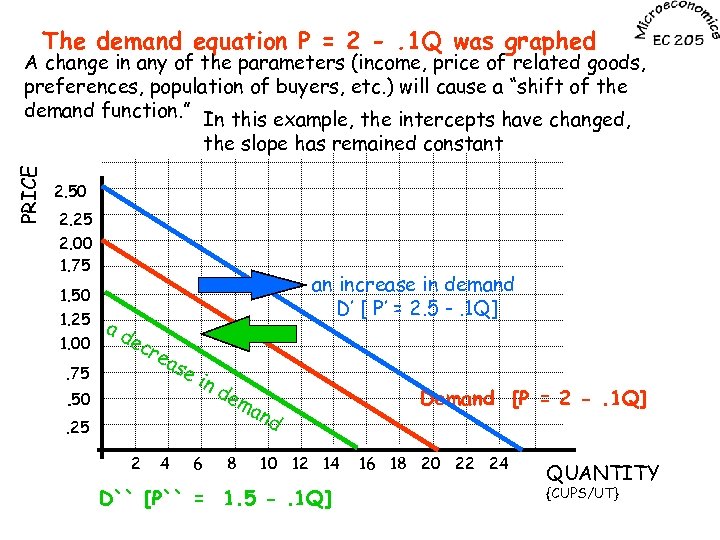 The demand equation P = 2 -. 1 Q was graphed A change in any of the parameters (income, price of related goods, preferences, population of buyers, etc. ) will cause a “shift of the demand function. ” In this example, the intercepts have changed, PRICE the slope has remained constant 2. 50 2. 25 2. 00 1. 75 1. 50 1. 25 1. 00. 75 an increase in demand D’ [ P’ = 2. 5 -. 1 Q] ad ec re ase . 50 in d em an d . 25 2 4 6 8 10 12 14 D`` [P`` = 1. 5 -. 1 Q] Demand [P = 2 -. 1 Q] 16 18 20 22 24 QUANTITY {CUPS/UT} 13
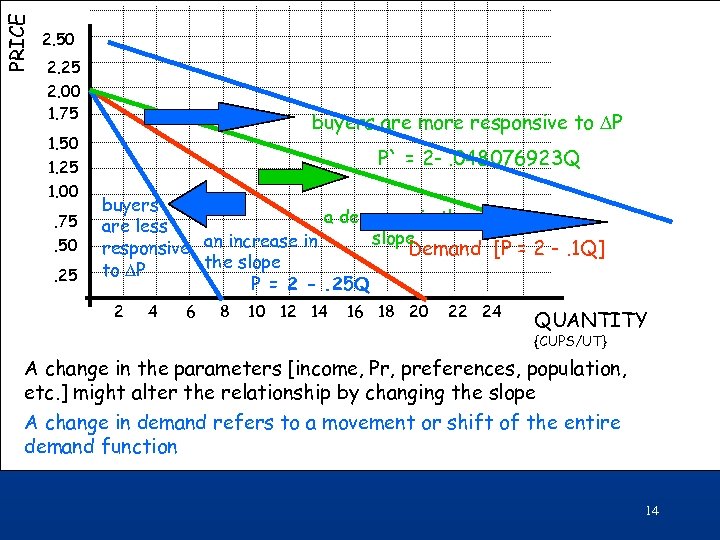 PRICE 2. 50 2. 25 2. 00 1. 75 buyers are more responsive to DP 1. 50 1. 25 1. 00. 75. 50. 25 P` = 2 -. 048076923 Q buyers a decrease in the are less slope responsive an increase in Demand [P = 2 -. 1 Q] the slope to DP P = 2 -. 25 Q 2 4 6 8 10 12 14 16 18 20 22 24 QUANTITY {CUPS/UT} A change in the parameters [income, Pr, preferences, population, etc. ] might alter the relationship by changing the slope A change in demand refers to a movement or shift of the entire demand function 14
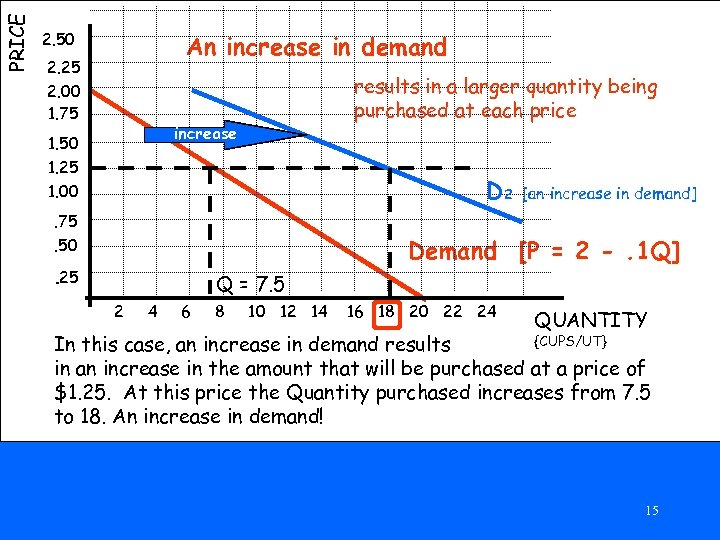 PRICE 2. 50 An increase in demand 2. 25 2. 00 1. 75 results in a larger quantity being purchased at each price increase 1. 50 1. 25 1. 00 D 2 . 75. 50 [an increase in demand] Demand [P = 2 -. 1 Q] . 25 Q = 7. 5 2 4 6 8 10 12 14 16 18 20 22 24 QUANTITY {CUPS/UT} In this case, an increase in demand results in an increase in the amount that will be purchased at a price of $1. 25. At this price the Quantity purchased increases from 7. 5 to 18. An increase in demand! 15
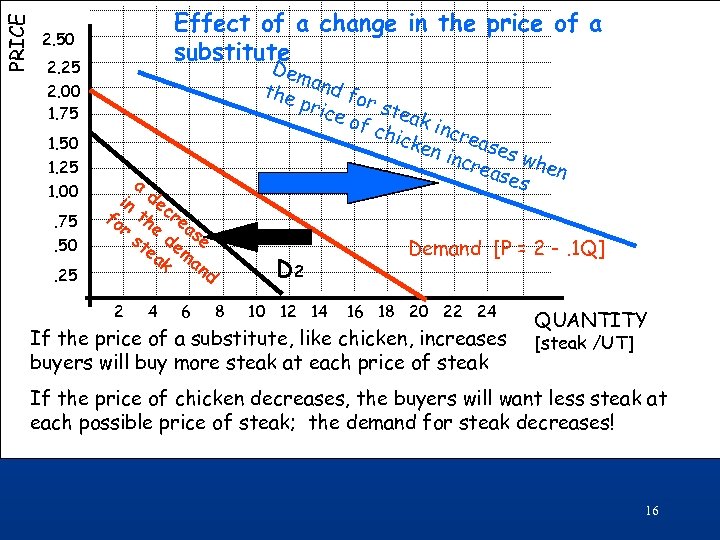 PRICE Effect of a change in the price of a substitute 2. 50 2. 25 2. 00 1. 75 Dem the and fo r st pric e of eak chic incre as ken incr es wh e eas es n 1. 50 1. 25 1. 00. 75. 50. 25 a in dec fo th re r e as st de e ea m k an d 2 4 6 D 2 8 10 12 14 Demand [P = 2 -. 1 Q] 16 18 20 22 24 If the price of a substitute, like chicken, increases buyers will buy more steak at each price of steak QUANTITY [steak /UT] If the price of chicken decreases, the buyers will want less steak at each possible price of steak; the demand for steak decreases! 16
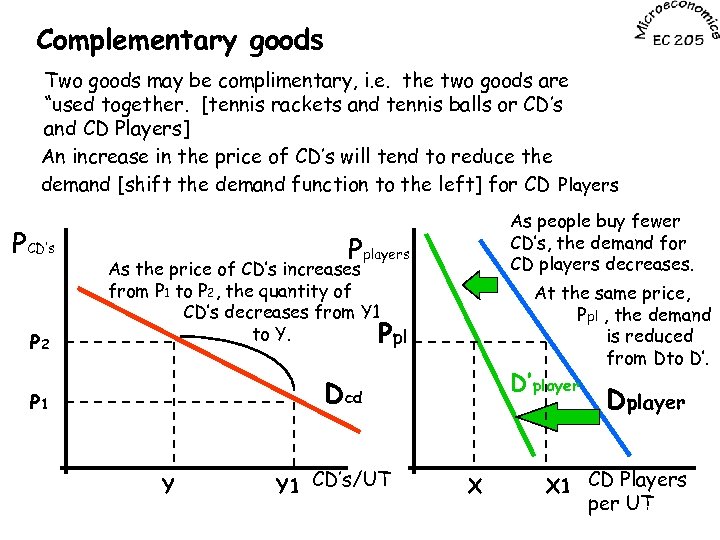 Complementary goods Two goods may be complimentary, i. e. the two goods are “used together. [tennis rackets and tennis balls or CD’s and CD Players] An increase in the price of CD’s will tend to reduce the demand [shift the demand function to the left] for CD Players PCD’s P 2 As people buy fewer CD’s, the demand for CD players decreases. Pplayers As the price of CD’s increases from P 1 to P 2, the quantity of CD’s decreases from Y 1 to Y. Ppl At the same price, Ppl , the demand is reduced from Dto D’. D’player Dcd P 1 Y Y 1 CD’s/UT X Dplayer X 1 CD Players per UT 17
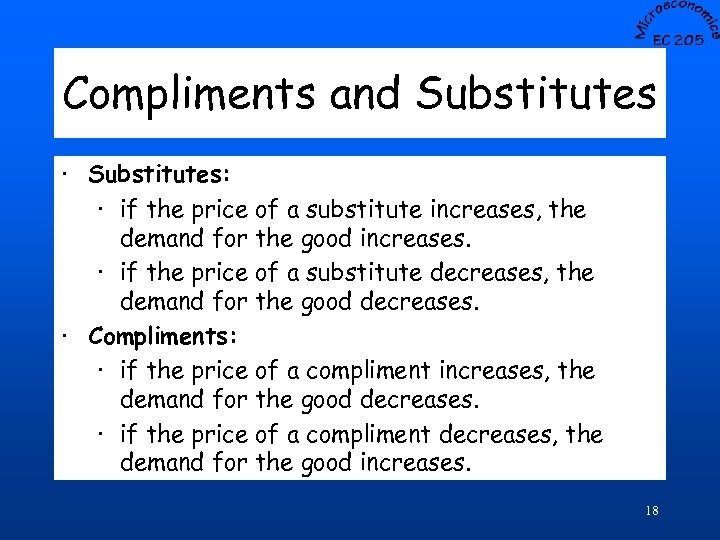 Compliments and Substitutes · Substitutes: · if the price of a substitute increases, the demand for the good increases. · if the price of a substitute decreases, the demand for the good decreases. · Compliments: · if the price of a compliment increases, the demand for the good decreases. · if the price of a compliment decreases, the demand for the good increases. 18
 Demand Summary · “Law of Demand” holds that usually as the price of a good increases, individuals will buy less of it. · The nature of this relationship is influenced by a variety of other variables; · income, preferences, prices of related goods, and other circumstances · as these circumstances change, the demand relationship changes or “shifts. ” 19
![Demand Summary [cont. . . ] · A “change in demand” means the relationship](https://present5.com/presentation/f6221c4065584cb6bc82ba21b2b3dd3a/image-20.jpg "Demand Summary [cont. . . ] · A “change in demand” means the relationship") Demand Summary [cont. . . ] · A “change in demand” means the relationship between price and quantity was altered by a change in some other variable [a demand “shifter”] The demand “shifts. ” · A “change in quantity demanded” is a change in the quantity bought that was caused by a change in the price of the good. There is a movement on the demand function. 20
Demand Summary [cont. . . ] · A “change in demand” means the relationship between price and quantity was altered by a change in some other variable [a demand “shifter”] The demand “shifts. ” · A “change in quantity demanded” is a change in the quantity bought that was caused by a change in the price of the good. There is a movement on the demand function. 20
 Supply · Supply is defined as a schedule of quantities of a good that will be produced and offered for sale at a schedule of prices during a given time [UT], ceteris paribus. · Generally, producers are willing to offer greater quantities of a good for sale at higher prices; a positive relationship between price and quantity supplied. 21
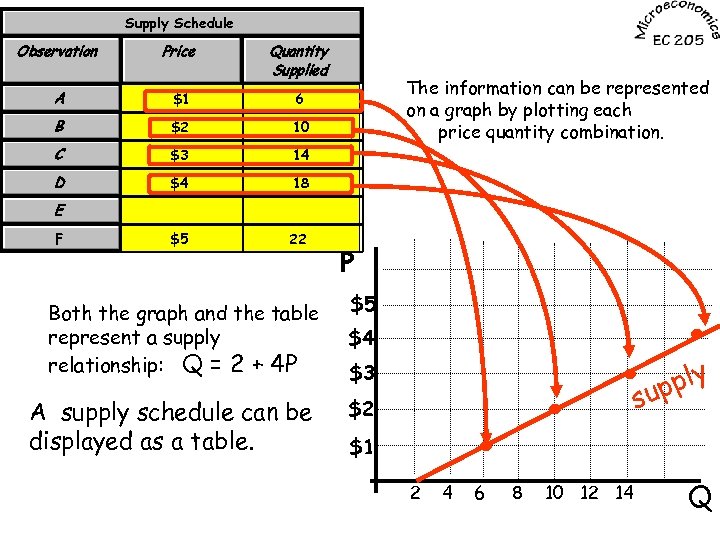 Supply Schedule Observation Price Quantity Supplied A $1 6 B $2 10 C $3 14 D $4 18 $5 22 The information can be represented on a graph by plotting each price quantity combination. E F Both the graph and the table represent a supply relationship: Q = 2 + 4 P A supply schedule can be displayed as a table. P $5 . . $4 $3 . $2 $1 2 4 6 . ply up s 8 10 12 14 22 Q
 Change in Quantity Supplied · A change in the price of the good causes a change in the “quantity supplied. ” · The change in the price of the good causes a “movement on the supply function, ” not a change or “shift of the supply function. ” 23
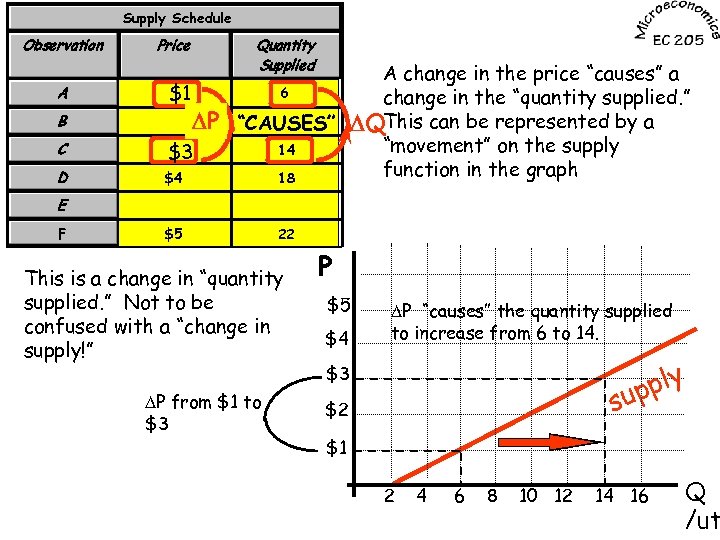 Supply Schedule Observation Price Quantity Supplied A $1 $1 B $2 C $3 $3 D $4 DP A change in the price “causes” a 6 change in the “quantity supplied. ” 10 “CAUSES” DQThis can be represented by a “movement” on the supply 14 function in the graph 18 E F $5 22 This is a change in “quantity supplied. ” Not to be confused with a “change in supply!” DP from $1 to $3 P $5 $4 DP “causes” the quantity supplied to increase from 6 to 14. ply up $3 s $2 $1 2 4 6 8 10 12 14 16 24 Q /ut
![“Change in Supply” · A change in supply [like a change in demand] refers](https://present5.com/presentation/f6221c4065584cb6bc82ba21b2b3dd3a/image-25.jpg "“Change in Supply” · A change in supply [like a change in demand] refers") “Change in Supply” · A change in supply [like a change in demand] refers to a change in the relationship between the price and quantity supplied. · A change in supply is “caused” by a change in any variable, other than price, that influences supply · A change in supply can be represented by a shift of the supply function on a graph 25
“Change in Supply” · A change in supply [like a change in demand] refers to a change in the relationship between the price and quantity supplied. · A change in supply is “caused” by a change in any variable, other than price, that influences supply · A change in supply can be represented by a shift of the supply function on a graph 25
![“Change in Supply” [cont. . . ] · There are many factors that infuence](https://present5.com/presentation/f6221c4065584cb6bc82ba21b2b3dd3a/image-26.jpg "“Change in Supply” [cont. . . ] · There are many factors that infuence") “Change in Supply” [cont. . . ] · There are many factors that infuence the willingness of producers to supply a good. · · technology prices of inputs returns in alternative choices taxes, expectations, weather, number of sellers, . . . · Qs = fs (P, Pinputs, technology, . . . ) 26
“Change in Supply” [cont. . . ] · There are many factors that infuence the willingness of producers to supply a good. · · technology prices of inputs returns in alternative choices taxes, expectations, weather, number of sellers, . . . · Qs = fs (P, Pinputs, technology, . . . ) 26
![“Change in Supply” [cont. . . ] · Qs = fs (P, Pinputs, technology,](https://present5.com/presentation/f6221c4065584cb6bc82ba21b2b3dd3a/image-27.jpg "“Change in Supply” [cont. . . ] · Qs = fs (P, Pinputs, technology,") “Change in Supply” [cont. . . ] · Qs = fs (P, Pinputs, technology, number of sellers, taxes, . . . ) · A change in the price [P] causes a “change in quantity supplied; ” · a change in any other variable causes a “change in supply” 27
“Change in Supply” [cont. . . ] · Qs = fs (P, Pinputs, technology, number of sellers, taxes, . . . ) · A change in the price [P] causes a “change in quantity supplied; ” · a change in any other variable causes a “change in supply” 27
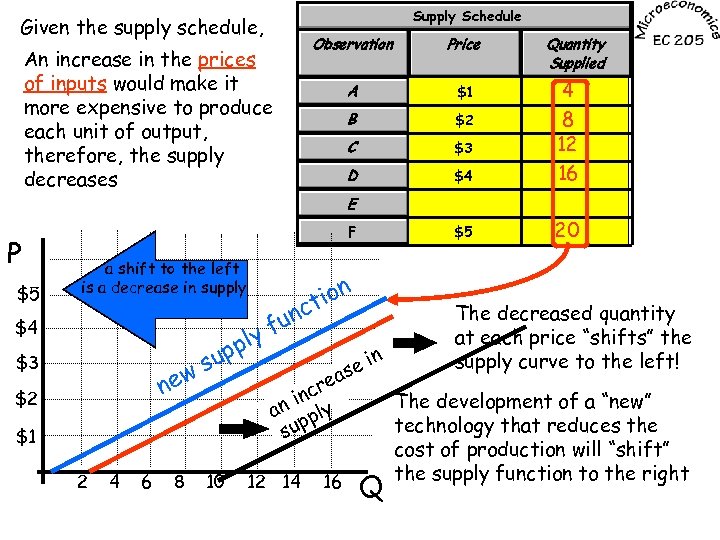 Supply Schedule Given the supply schedule, Price A $1 B $2 C $3 D An increase in the prices of inputs would make it more expensive to produce each unit of output, therefore, the supply decreases Observation Quantity Supplied $4 46 10 8 12 14 16 18 $5 22 20 E P $5 F a shift to the left is a decrease in supply $4 ly $3 w ne $2 p up s $1 2 4 6 8 10 ion ct fun ply up The decreased quantity at each price “shifts” the supply curve to the left! n ei eas r inc The development of a “new” an ply technology that reduces the sup cost of production will “shift” 12 14 16 Q the supply function to the right s 28
 Equilibrium · Equilibrium: 1. a state of rest or balance due to the equal action of opposing forces. 2. equal balance between any powers, influences, [Webster’s Encyclopedic Unabridged Dictionary of the English Language] · In a market an equilibrium is said to exist when the forces of supply [sellers] and demand [buyers] are in balance: the actions of sellers and buyers are coordinated. The quantity supplied equals the quantity demanded! 29
![[Price] Px ply p 100 Su 90 80 $70 70 Given a demand function](https://present5.com/presentation/f6221c4065584cb6bc82ba21b2b3dd3a/image-30.jpg "[Price] Px ply p 100 Su 90 80 $70 70 Given a demand function") [Price] Px ply p 100 Su 90 80 $70 70 Given a demand function [which represents the behavior or choices of buyers, 60 50 40 30 and a supply function that represents the behavior of De m sellers, 20 an d 10 10 20 30 40 50 60 60 70 80 90 100 110 120 130 Qx/ UT Where the quantity that people want to buy is equal to the quantity that the producers want to sell, there is an equilibrium quantity. The price that coordinates the preferences of the buyers and sellers is the equilibrium price. At the equilibrium price of $70, the quantity supplied is equal to the quantity demanded. 30
[Price] Px ply p 100 Su 90 80 $70 70 Given a demand function [which represents the behavior or choices of buyers, 60 50 40 30 and a supply function that represents the behavior of De m sellers, 20 an d 10 10 20 30 40 50 60 60 70 80 90 100 110 120 130 Qx/ UT Where the quantity that people want to buy is equal to the quantity that the producers want to sell, there is an equilibrium quantity. The price that coordinates the preferences of the buyers and sellers is the equilibrium price. At the equilibrium price of $70, the quantity supplied is equal to the quantity demanded. 30
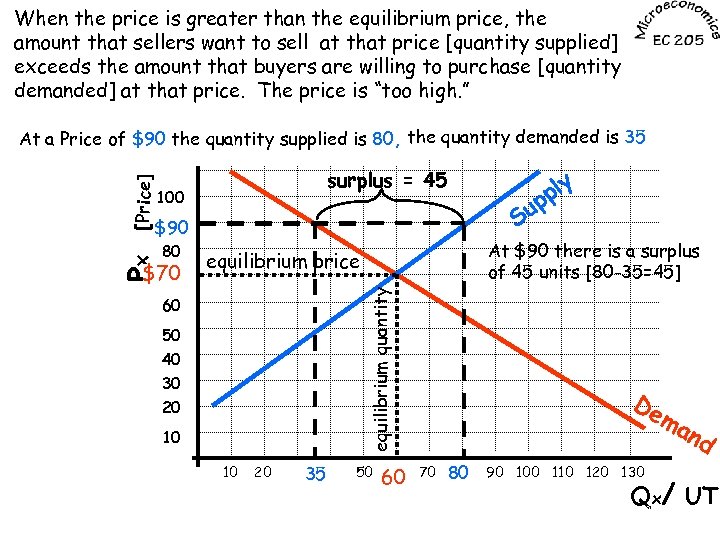 When the price is greater than the equilibrium price, the amount that sellers want to sell at that price [quantity supplied] exceeds the amount that buyers are willing to purchase [quantity demanded] at that price. The price is “too high. ” [Price] At a Price of $90 the quantity supplied is 80, the quantity demanded is 35 ply p surplus = 45 100 Su 90 $90 At $90 there is a surplus of 45 units [80 -35=45] equilibrium price equilibrium quantity Px 80 $70 70 60 50 40 30 20 10 10 20 3035 40 50 60 60 De ma nd 70 80 80 90 100 110 120 130 Qx/ UT 31
![[Price] 100 90 $90 Px ply p surplus = 45 . lower price 80](https://present5.com/presentation/f6221c4065584cb6bc82ba21b2b3dd3a/image-32.jpg "[Price] 100 90 $90 Px ply p surplus = 45 . lower price 80") [Price] 100 90 $90 Px ply p surplus = 45 . lower price 80 $70 70 60 50 40 30 20 Su At a price of $90 a surplus of 45 units exists Suppliers have more to sell than buyers will purchase at a price of $90. To get rid of these unsold units [inventory], the Quantity sellers lower supplied decreases the price. D Quantity demanded increases em an 10 10 20 3035 40 50 60 60 70 80 80 90 d 100 110 120 130 Qx/ UT As the price of the good is reduced, the quantity supplied decreases. The quantity demanded increases as the price falls. As the price moves toward equilibrium, quantity supplied and quantity demanded are brought into equilibrium. . 32
[Price] 100 90 $90 Px ply p surplus = 45 . lower price 80 $70 70 60 50 40 30 20 Su At a price of $90 a surplus of 45 units exists Suppliers have more to sell than buyers will purchase at a price of $90. To get rid of these unsold units [inventory], the Quantity sellers lower supplied decreases the price. D Quantity demanded increases em an 10 10 20 3035 40 50 60 60 70 80 80 90 d 100 110 120 130 Qx/ UT As the price of the good is reduced, the quantity supplied decreases. The quantity demanded increases as the price falls. As the price moves toward equilibrium, quantity supplied and quantity demanded are brought into equilibrium. . 32
![[Price] Px 100 As a result of market forces the market moves to 90](https://present5.com/presentation/f6221c4065584cb6bc82ba21b2b3dd3a/image-33.jpg "[Price] Px 100 As a result of market forces the market moves to 90") [Price] Px 100 As a result of market forces the market moves to 90 80 $70 70 60 50 40 30 $30 20 10 . equilibrium price rises quantity supplied increases 10 15 20 30 40 ply p Su At a price below equilibrium the quantity demanded exceeds the quantity supplied. At a price of $30 the quantity The demanded is 110. quantity supplied is 15. quantity demanded decreases shortage = 95 50 60 60 70 80 De 90 100 110 120 130 110 ma nd Qx/ UT At a price of $30 the quantity demanded exceeds the quantity supplied by 95 units [110 - 15 = 95]. This is a shortage. Since the buyers cannot obtain all they want at a price of $30, some buyers will offer to pay more. Some buyers will not pay the higher price, they buy less so the quantity demanded decreases. At the higher price the quantity supplied increases . . 33
[Price] Px 100 As a result of market forces the market moves to 90 80 $70 70 60 50 40 30 $30 20 10 . equilibrium price rises quantity supplied increases 10 15 20 30 40 ply p Su At a price below equilibrium the quantity demanded exceeds the quantity supplied. At a price of $30 the quantity The demanded is 110. quantity supplied is 15. quantity demanded decreases shortage = 95 50 60 60 70 80 De 90 100 110 120 130 110 ma nd Qx/ UT At a price of $30 the quantity demanded exceeds the quantity supplied by 95 units [110 - 15 = 95]. This is a shortage. Since the buyers cannot obtain all they want at a price of $30, some buyers will offer to pay more. Some buyers will not pay the higher price, they buy less so the quantity demanded decreases. At the higher price the quantity supplied increases . . 33
![[Price] Px 100 90 $89 80 $70 70 demand increases price rises ply p](https://present5.com/presentation/f6221c4065584cb6bc82ba21b2b3dd3a/image-34.jpg "[Price] Px 100 90 $89 80 $70 70 demand increases price rises ply p") [Price] Px 100 90 $89 80 $70 70 demand increases price rises ply p Su The market for good X is in equilibrium at Px = $70 60 50 40 30 equilibrium quantity increases 20 De ma nd 10 10 20 30 40 50 60 70 80 90 100 110 120 130 60 80 An increase in the price of a substitute [good Y] causes the demand for good X to increase. As a result of the increased demand, market forces push Px up. D 2 Qx/ UT The increase in the demand for good X results in an increase in both the equilibrium price and quantity. Identify other factors that could increase demand! 34
[Price] Px 100 90 $89 80 $70 70 demand increases price rises ply p Su The market for good X is in equilibrium at Px = $70 60 50 40 30 equilibrium quantity increases 20 De ma nd 10 10 20 30 40 50 60 70 80 90 100 110 120 130 60 80 An increase in the price of a substitute [good Y] causes the demand for good X to increase. As a result of the increased demand, market forces push Px up. D 2 Qx/ UT The increase in the demand for good X results in an increase in both the equilibrium price and quantity. Identify other factors that could increase demand! 34
![[Price] Px 100 90 80 70 60 $50. 89 50 40 30 20 ply](https://present5.com/presentation/f6221c4065584cb6bc82ba21b2b3dd3a/image-35.jpg "[Price] Px 100 90 80 70 60 $50. 89 50 40 30 20 ply") [Price] Px 100 90 80 70 60 $50. 89 50 40 30 20 ply p Su Given a demand function, an equilibrium is defined. A decrease in demand, establishes a new equilibrium at a lower price and quantity. D 1 De ma nd 10 10 20 30 39. 2 50 60 70 80 90 100 110 120 130 40 Demand might be reduced by: a decrease in the price of a substitute, an increase in the price of a compliment, a change in income, a change in the number of buyers or their preferences, or, . . Qx/ UT A change in the price of the good does not change demand! It changes the quantity demanded. 35
[Price] Px 100 90 80 70 60 $50. 89 50 40 30 20 ply p Su Given a demand function, an equilibrium is defined. A decrease in demand, establishes a new equilibrium at a lower price and quantity. D 1 De ma nd 10 10 20 30 39. 2 50 60 70 80 90 100 110 120 130 40 Demand might be reduced by: a decrease in the price of a substitute, an increase in the price of a compliment, a change in income, a change in the number of buyers or their preferences, or, . . Qx/ UT A change in the price of the good does not change demand! It changes the quantity demanded. 35
![[Price] Px ply p 100 Su 90 80 $70 70 price falls 60 S](https://present5.com/presentation/f6221c4065584cb6bc82ba21b2b3dd3a/image-36.jpg "[Price] Px ply p 100 Su 90 80 $70 70 price falls 60 S") [Price] Px ply p 100 Su 90 80 $70 70 price falls 60 S 2 supply increases 50 $50 40 30 De 20 ma nd 10 10 20 30 40 50 60 70 80 90 100 110 120 130 60 86 Given an equilibrium condition in a market, an increase in supply will increase the equilibrium quantity and decrease equilibrium P. Quantity increases Qx/ UT Identify 1. 2. 3. 4. factors that increase supply: fall in price of inputs improved technology increase in number of sellers fall in return in alternative uses of inputs 5. or, . . . 36
[Price] Px ply p 100 Su 90 80 $70 70 price falls 60 S 2 supply increases 50 $50 40 30 De 20 ma nd 10 10 20 30 40 50 60 70 80 90 100 110 120 130 60 86 Given an equilibrium condition in a market, an increase in supply will increase the equilibrium quantity and decrease equilibrium P. Quantity increases Qx/ UT Identify 1. 2. 3. 4. factors that increase supply: fall in price of inputs improved technology increase in number of sellers fall in return in alternative uses of inputs 5. or, . . . 36
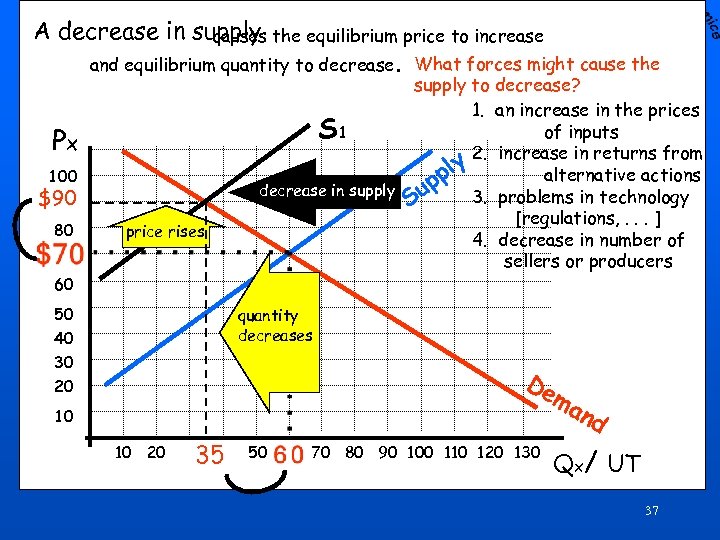 A decrease in supply the equilibrium price to increase causes and equilibrium quantity to decrease. What forces might cause the Px 100 $90 90 80 70 price rises supply to decrease? 1. an increase in the prices S 1 of inputs y 2. increase in returns from alternative actions pl p decrease in supply 3. problems in technology Su [regulations, . . . ] 4. decrease in number of sellers or producers 60 50 40 30 20 quantity decreases De ma nd 10 10 20 30 40 50 60 70 80 90 100 110 120 130 35 Qx/ UT 37
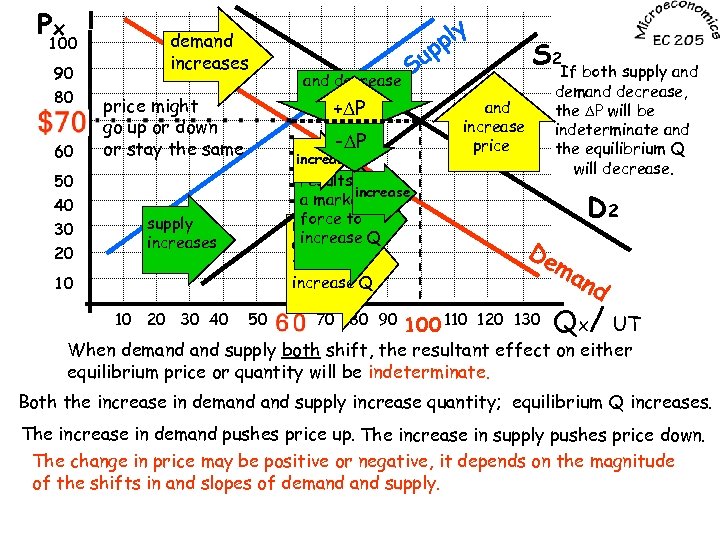 Px 100 90 80 70 60 50 40 30 20 demand increases price might go up or down or stay the same supply increases 10 10 20 30 40 ply p and decrease price Su +DP -DP increase results in increase a market force in results to aincrease Q market force to increase Q S 2 If both supply and demand decrease, the DP will be indeterminate and the equilibrium Q will decrease. and increase price D 2 De 50 60 70 80 90 100 110 120 130 100 ma nd Qx/ UT When demand supply both shift, the resultant effect on either equilibrium price or quantity will be indeterminate. Both the increase in demand supply increase quantity; equilibrium Q increases. The increase in demand pushes price up. The increase in supply pushes price down. The change in price may be positive or negative, it depends on the magnitude of the shifts in and slopes of demand supply. 38
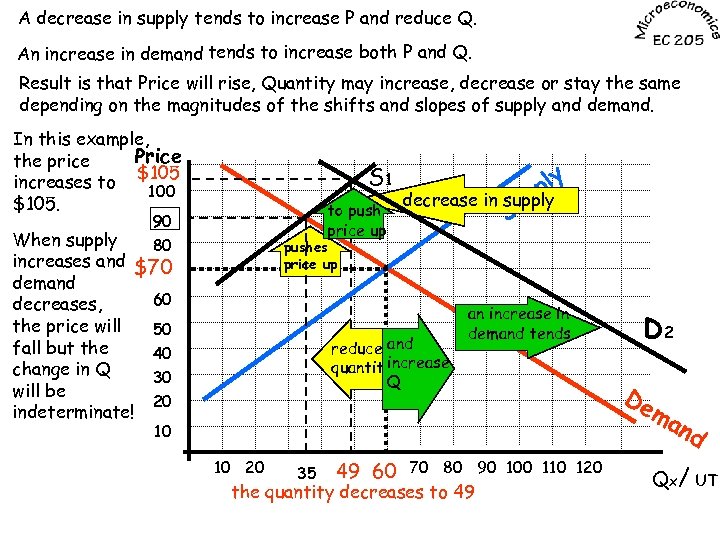 A decrease in supply tends to increase P and reduce Q. An increase in demand tends to increase both P and Q. Result is that Price will rise, Quantity may increase, decrease or stay the same depending on the magnitudes of the shifts and slopes of supply and demand. In this example, Price the price $105 increases to 100 $105. 90 When supply 80 increases and $70 70 demand 60 decreases, the price will 50 fall but the 40 change in Q 30 will be 20 indeterminate! S 1 to push price up ply decrease in supply up S pushes price up reducesand increase quantity Q an increase in demand tends D 2 De ma nd 10 10 20 3035 49 60 70 80 90 100 110 120 40 50 60 the quantity decreases to 49 Qx/ UT 39
 Supply and Demand Analysis · Supply and demand is a simplistic model that provides insights into the effects of events that are related to a specific market. · Whether an event will tend to cause the price of a good to increase or decrease is of importance to decision makers. · To estimate the magnitude of price and quantity changes more sophisticated models are needed. 40