


 Скачать презентацию This institution is an equal opportunity provider
3b9d5d71652ead0cf74b3121dad484ce.ppt
- Количество слайдов: 51
 “This institution is an equal opportunity provider. ” Civil Rights Compliance In Child Nutrition Programs Arizona Department of Education Health and Nutrition Services
 Civil Rights Compliance In Child Nutrition Programs Length: 1 hour Professional Standards Learning Code: 3420 Objective: Implement current personnel policies and procedures related to the Civil Rights provision 7 CFR 210. 23(b) of the NSLP regulations. Training can be completed by single user or used by a facilitator in a group training.
 Facilitator Directions ADE has provided this sample Civil Rights Training that contains all topics required of the annual Civil Rights training requirement. It is recommended to add school specific content to ensure it meets the needs of your staff. Using Slide Show mode, click on each slide and review the information to the attendees.
 Professional Standards Since Civil Rights training is an annual requirement for all school nutrition program staff, this training may be counted towards Professional Standards training hours. If this training was delivered by the School Nutrition Program Director or Manager to program staff, the training may count toward his/her own annual training. If this session is offered multiple times, only the time spent on one of the training sessions may count towards the annual training hours. (Per Q. 18, USDA Memo SP 38 -2016)
 Documenting Training for Professional Standards Please track the following information: Employee Name in attendance or Director/Manager delivering the training Training Title: Civil Rights Compliance In Child Nutrition Programs Professional Standards Learning Code: 3420 Professional Standards Key Area: 3000 Length of time: 1 hour* *Note, if this training has been modified, please document the amount of time the training took. Please note, ADE will not be able to grant a training certificate for this training. You may contact ADESchool. Nutrition@azed. gov for a copy of ADE’s fillable training certificate or the school may create their own.
 Agenda Goals Mission and Laws Protected Classes Types of Discrimination FNS Instruction 113 -1 Situations
 Goals of Civil Rights Equal treatment for all applicants and beneficiaries Knowledge of rights and responsibilities Elimination of illegal barriers that prevent or deter people from receiving benefits Dignity and respect for all
 Civil Rights Mission Civil Rights Division’s mission is to ensure compliance with applicable laws, regulations, and policies for Food and Nutrition Services (FNS) customers and employees regardless of race, color, national origin, gender, religion, age, disability, sexual orientation, marital or family status, political beliefs, parental status, protected genetic information, or because all or part of an individual’s income is derived from any public assistance program.
 Civil Rights Laws Title VI of the Civil Rights Act of 1964 which prohibits discrimination based on race, color, and national origin in programs and activities receiving Federal financial assistance; and USDA Implementing Regulation 7 CFR Part 15, Subpart A and Subpart C. Title IX of the Education Amendments Act of 1972 which prohibits discrimination based on sex under any education program or activity receiving Federal financial assistance; and USDA Implementing Regulation 7 CFR Part 15 a. Section 504 of the Rehabilitation Act of 1973 which prohibits discrimination based on disability; and USDA Implementing Regulation 7 CFR Part 15 b.
 Civil Rights Laws Age Discrimination Act of 1975 which prohibits discrimination based on age in programs or activities receiving Federal financial assistance. Civil Rights Restoration Act of 1987 which clarifies the intent of Congress as it relates to the scope of Title VI of the Civil Rights Act of 1964 (race, color & national origin) and related nondiscrimination statutes to ensure nondiscrimination in all programs and activities of a recipient, whether those programs and activities are federally funded or not. Americans with Disabilities Act (28 CFR Part 35, Title II, Subtitle A) which prohibits discrimination on the basis of disability in all services, programs, and activities provided to the public by State and local governments, except public transportation services.
 What is a Protected Class? A protected class refers to any person or group of people who have a characteristic for which discrimination is prohibited based on a law, regulation, or executive order.
 Protected classes in the Child Nutrition Programs: Race Color National Origin Sex Disability Age
 What is Discrimination? Discrimination is defined as different treatment which makes a distinction of one person or a group of persons from others; either intentionally, by neglect, or by the actions or lack of actions based on six protected classes: race, color, national origin, sex, age, or disability.
 Types of Discrimination Disparate Treatment violation is made when an individual of a protected group is shown to have been singled out and treated less favorably than others similarly situated on the basis of an impermissible criterion under Title VII. Disparate Impacts are practices that may be considered discriminatory and illegal if they have a disproportionate "adverse impact" on members of a minority group. A disparate impact is unintentional, whereas a disparate treatment is an intentional decision to treat people differently based on their race or other protected characteristics.
 Types of Discrimination Reprisal/Retaliation: All laws make it illegal to fire, demote, harass, or otherwise “retaliate” against people because they filed a charge of discrimination.
 Civil Rights Training is required on an annual basis. Subject matter required, but not limited to: • Collection and use of data • Effective public notification systems • Complaint procedures • Compliance review techniques • Resolution of noncompliance • Requirements for reasonable accommodations for persons with disabilities • Requirements for language assistance • Conflict resolution • Customer service
 FNS Instruction 113 -1 Technical Assistance and Training Data Collection and Reporting Public Notification Systems/Outreach Complaint Procedures Compliance Review Techniques Resolution of Noncompliance Reasonable Accommodations Language Assistance Conflict Resolution Customer Service
 Data Collection and Reporting Child Nutrition Programs (CNP) are required to obtain data by race and ethnic category on potentially eligible populations, applicants, and participants in their program service area. The purpose is to determine how effectively FNS programs are reaching potential eligible persons and where outreach may be needed. Data must be collected and retained by the service delivery point for each program specified in the program regulations, instructions, policies and guidelines. Records must be maintained for 5 years. Access is restricted to authorized personnel only. This requirement is met through the collection of enrollment applications and the information provided on the Civil Rights data collection/compliance form.
 Race and Ethnic Categories Race categories: American Indian/Alaskan Native Asian Black/African American Native Hawaiian/Other Pacific Islander White Ethnicity categories: Hispanic or Latino Non Hispanic or Latino
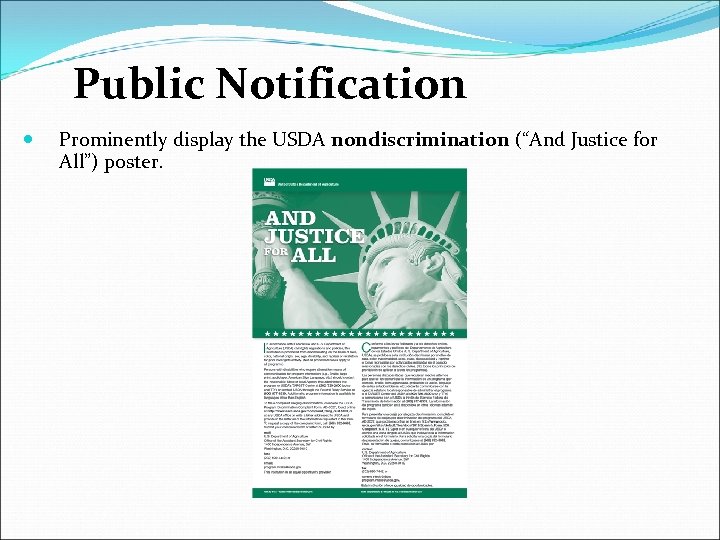 Public Notification Prominently display the USDA nondiscrimination (“And Justice for All”) poster.
 Program Availability Provide appropriate information in alternative formats for persons with disabilities. Inform potentially eligible persons, applicants, participants and grassroots organizations of programs or changes in programs. Include the required nondiscrimination statement on all appropriate FNS and agency publications, posters and informational materials. Convey the message of equal opportunity in all photos and other graphics that are used to provide program or related information. Provide a public release to inform potentially eligible persons of program eligibility, benefits and services, the location of delivery, and hours of service. Websites must contain the nondiscrimination statement, or a link to it, on the home page of the program information.
 USDA Nondiscrimination Statement In accordance with Federal civil rights law and U. S. Department of Agriculture (USDA) civil rights regulations and policies, the USDA, its Agencies, offices, and employees, and institutions participating in or administering USDA programs are prohibited from discriminating based on race, color, national origin, sex, disability, age, or reprisal or retaliation for prior civil rights activity in any program or activity conducted or funded by USDA. Persons with disabilities who require alternative means of communication for program information (e. g. , Braille, large print, audiotape, American Sign Language, etc. ) should contact the Agency (State or local) where they applied for benefits. Individuals who are deaf, hard of hearing or have speech disabilities may contact USDA through the Federal Relay Service at (800) 877 -8339. Additionally, program information may be made available in languages other than English. To file a program complaint of discrimination, complete the USDA Program Discrimination Complaint Form, AD-3027, found online at http: //www. ascr. usda. gov/complaint_filing_cust. html, and at any USDA office, or write a letter addressed to USDA and provide in the letter all of the information requested in the form. To request a copy of the complaint form, call (866) 632 -9992. Submit your completed form or letter to USDA by: (1) mail: U. S. Department of Agriculture, Office of the Assistant Secretary for Civil Rights, 1400 Independence Avenue, SW, Washington, D. C. 20250 -9410; (2) fax: (202) 690 -7442; or (3) email: program. intake@usda. gov. This institution is an equal opportunity provider.
 Public Notification If the material is too small to permit the full statement, the following may be used in a print size no smaller than the text of the document: “This institution is an equal opportunity provider. ”
 Complaints Procedure Any person has the right to file a discrimination complaint The verbal or written complaint must contain: Contact information (name, address, phone number) Location of incident Nature of incident Basis for alleged discrimination Names, titles, and business addresses of persons who may have knowledge of the discriminatory action Date(s) during which the alleged actions occured Complaint must be filed within 180 days from the alleged act of discrimination To file a complaint, complainants may: Write: USDA, Office of the Assistant Secretary for Civil Rights 1400 Independence Avenue SW, Washington, D. C. 20250 -9410 Fax: (202)690 -7442 Email: program. intake@usda. gov.
 Complaints Procedure If a complaint of discrimination is received, the person alleging the complaint must be provided with the nondiscrimination statement and a copy of the procedure for complaints of discrimination. Complaints should be forwarded promptly to the State Agency or directly to USDA using the address in the nondiscrimination statement. All written or verbal complaints alleging discrimination on the basis of race, color, national origin, age, sex, or disability, must be processed within 90 days of receipt. Document all potential complaints in a Civil Rights Complaint Log. Have a central location where the Civil Rights Complaint Forms and Log will be kept.
 Compliance To examine the civil rights activities to determine their adherence with the requirements FNS Region will review the state agencies and their compliance with civil rights State agency must also review their own operations 3 types of Compliance reviews: Pre-approval or Pre-Award Post-award or routine Special
 Compliance Review Pre-Award: A CNP’s review of Civil Rights procedures to determine compliance prior to receipt of federal funds. Post-Award: A CNP’s routine review which includes an evaluation of Civil Rights compliance. Special: A Federal review conducted when Civil Rights concerns having a direct effect on the delivery of CNP services or benefits have been identified.
 Resolution of Noncompliance Once noncompliance is determined, steps must be taken immediately to obtain voluntary compliance. The effective date of the finding of noncompliance is the date of the written notice of compliance to the State Agency, local agency, or other subrecipient. The State Agency must provide immediate written notice to the local agency or other subrecipient indicating the area of noncompliance and the action required to correct the situation. Corrective action must be completed within 60 days of finding. Failure or refusal can result in loss of federal assistance from all federal sources.
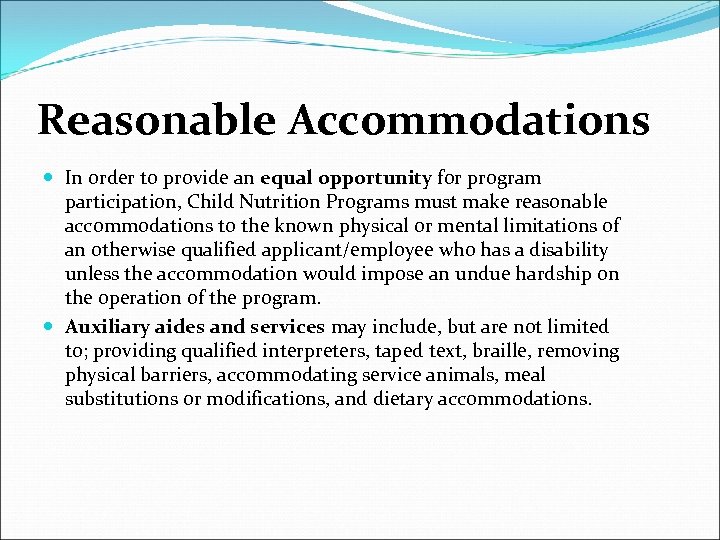 Reasonable Accommodations In order to provide an equal opportunity for program participation, Child Nutrition Programs must make reasonable accommodations to the known physical or mental limitations of an otherwise qualified applicant/employee who has a disability unless the accommodation would impose an undue hardship on the operation of the program. Auxiliary aides and services may include, but are not limited to; providing qualified interpreters, taped text, braille, removing physical barriers, accommodating service animals, meal substitutions or modifications, and dietary accommodations.
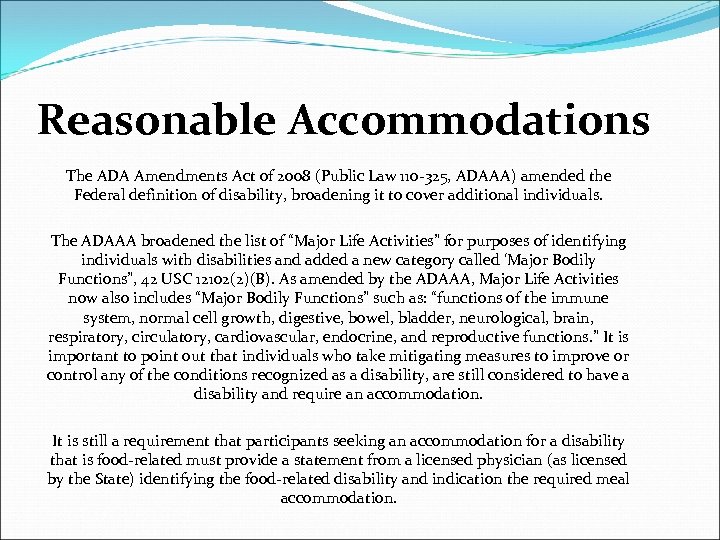 Reasonable Accommodations The ADA Amendments Act of 2008 (Public Law 110 -325, ADAAA) amended the Federal definition of disability, broadening it to cover additional individuals. The ADAAA broadened the list of “Major Life Activities” for purposes of identifying individuals with disabilities and added a new category called ‘Major Bodily Functions”, 42 USC 12102(2)(B). As amended by the ADAAA, Major Life Activities now also includes “Major Bodily Functions” such as: “functions of the immune system, normal cell growth, digestive, bowel, bladder, neurological, brain, respiratory, circulatory, cardiovascular, endocrine, and reproductive functions. ” It is important to point out that individuals who take mitigating measures to improve or control any of the conditions recognized as a disability, are still considered to have a disability and require an accommodation. It is still a requirement that participants seeking an accommodation for a disability that is food-related must provide a statement from a licensed physician (as licensed by the State) identifying the food-related disability and indication the required meal accommodation.
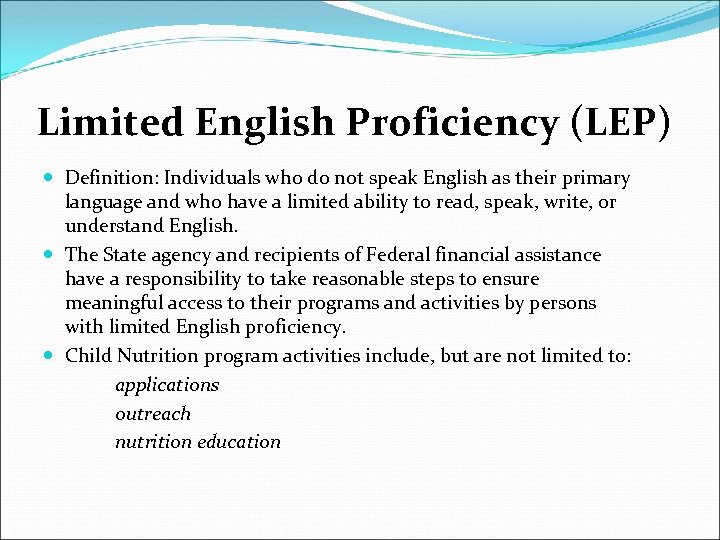 Limited English Proficiency (LEP) Definition: Individuals who do not speak English as their primary language and who have a limited ability to read, speak, write, or understand English. The State agency and recipients of Federal financial assistance have a responsibility to take reasonable steps to ensure meaningful access to their programs and activities by persons with limited English proficiency. Child Nutrition program activities include, but are not limited to: applications outreach nutrition education
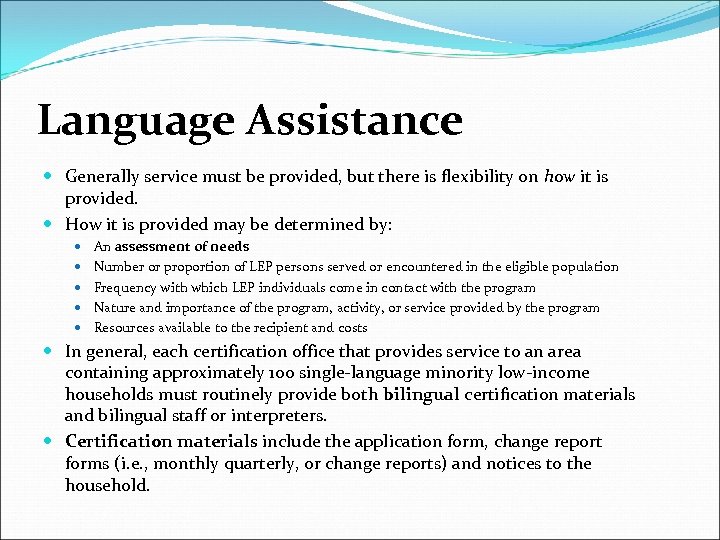 Language Assistance Generally service must be provided, but there is flexibility on how it is provided. How it is provided may be determined by: An assessment of needs Number or proportion of LEP persons served or encountered in the eligible population Frequency with which LEP individuals come in contact with the program Nature and importance of the program, activity, or service provided by the program Resources available to the recipient and costs In general, each certification office that provides service to an area containing approximately 100 single-language minority low-income households must routinely provide both bilingual certification materials and bilingual staff or interpreters. Certification materials include the application form, change report forms (i. e. , monthly quarterly, or change reports) and notices to the household.
 LEP Interpreters and Resources Children should not be used as interpreters. Volunteers may be used, but make sure they understand interpreter ethics – particularly confidentiality! Language line phone services may be available for a subscription fee through your local telephone service provider A shortage of resources does not eliminate the translation requirement. LEAs may share resources to save money: Use an interpreter from another area Train bilingual staff to be interpreters Contact grassroots organizations to discuss translation or assistance from within the community
 Conflict Resolution USDA encourages the resolution of complaints at the lowest possible level and as quickly as possible. Create a written code of conduct and post it with your policy for dealing with unacceptable behavior and conflict. Use alternative dispute resolution (ADR) techniques.
 Conflict Resolution Skills Use a win/win approach and solve the conflict as partners rather than opponents. Transform problems into creative opportunities. Develop communication tools to build rapport and use listening to clarify understanding. Apply strategies to atatck the problem and not the person. Plan and apply effective strategies to reach agreement. Go to www. crnhq. org for more ideas.
 Customer Service Live by the platinum rule: “Treat others the way they want to be treated. ” Good customer service will help reduce or eliminate complaints of discrimination. All participants must be treated in the same manner (i. e. seating arrangements, serving lines, services and facilities, assignment of eating periods, methods of selection for application approval processes). All participants must be allowed equal opportunities to participate in Child Nutrition programs regardless of race, color, national origin, sex, age, or disability.
 Food for Thought In order to reduce the risk of a civil rights discrimination complaint, ask yourself the following questions each time an applicant and/or participant comes to your program. Am I treating this person in the same manner I treat others? Have I given this person the opportunity to clarify all relevant factors or inconsistencies? Have I told this person exactly what information I need to make a determination on the application? Have I provided the person with the information he or she needs to make necessary decisions?
 Situations Is this a Civil Rights Complaint? They may be valid and important, but some are not covered by the rules for Civil Rights complaints. 38
 Is this a Civil Rights Complaint? Situation 1: A complaint is received from a site that someone who came to conduct a review was rude and disrespectful. The complaint states that the reviewer’s tone was demeaning and generally unpleasant. Is this a civil rights complaint and should it be reported? Answer: Depends. It needs to be investigated to see if the rude behavior was because of a protected class. People can discriminate someone of their own race. When in doubt of whether it is a civil rights violation, always provide complaint information.
 Is this a Civil Rights Complaint? Situation 2: To meet the annual training requirement for site supervisors, the sponsor develops a computer based training program that everyone will be required to complete. Is this a civil rights violation and should it be reported? Answer: No, as long as reasonable accommodations are provided.
 Is this a Civil Rights Complaint? Situation 3: A community group approaches a Summer Food Service Program sponsor and asks for a list of Hispanic children so it can provide holiday presents to them. Is this a civil rights violation and should it be reported? Answer: Yes, this is a confidential list and raises issues of national origin.
 Is this a Civil Rights Complaint? Situation 4: A parent of a child alleges program discrimination by a site and wants to file a complaint. You know that the site does not discriminate. Is this a civil rights complaint and should it be reported? Answer: Yes, if discrimination is alleged, you must provide the complaint information.
 Is this a Civil Rights Complaint? Situation 5: A sponsor is very angry that someone filed a frivolous discrimination complaint and took up a lot of her time and made her look bad. She tells her site supervisor to watch out for this “troublemaker. ” The next time the person visits, he encounters “attitude” from the co-provider. Is this a civil rights violation and should it be reported? Answer: Yes, this is reprisal and retaliation. There is also a confidentiality issue.
 Is this a Civil Rights Complaint? Situation 6: A parent complains about the choices provided during breakfast and demands that gluten-free products be provided for her child. Is this a civil rights complaint and should it be reported? Answer: Yes, this relates to civil rights if it is a disability defined by a physician special rule that provides accommodating food when there is a disability.
 Is this a Civil Rights Complaint? Situation 7: A parent contacts the School Food Service Director and says their child is being denied their religious right to be able to eat only vegetarian meals. Is this a civil rights complaint and should it be reported? Answer: No. Religion is not a protected class in Child Nutrition Programs under FNS Instruction 113 -1 Civil Rights Compliance and Enforcement Nutrition Programs. It is suggested that the SFA try to work with the complainant and try to accommodate their religious needs.
 Is this a Civil Rights Complaint? Situation 8: A minority high school football player approaches the cafeteria manager and says he isn’t getting enough food when he selects a reimbursable meal and would like larger servings. Is this a civil rights complaint and should it be reported? Answer on next slide…
 Is this a Civil Rights Complaint? Answer: No. Just because the student is a minority student does not mean he automatically is considered to be alleging discrimination. He did not state that he was not getting adequate servings because of his minority status. He only wants a larger serving. If he had said that he was not getting a large enough serving because of his racial/ethnic background, then, yes, it would be a complaint and you would need to report it.
 Civil Rights “Must Do” List üProvide Child Nutrition Programs in a nondiscriminatory manner üMust offer meals to all children and meal substitutions to participants with disabilities üProminently display the “And Justice for All” poster üAnnually complete the Civil Rights Data Collection/Compliance Form
 Civil Rights “Must Do” List üNon-discrimination statement must be on all printed materials available to the public which mention USDA and/or SFSP, including websites üProvide informational materials in the appropriate translation concerning the availability and nutritional benefits of the SFSP
 Civil Rights “Must Do” List üTrain staff annually on Civil Rights and complete a training form üDevelop & fully implement your Civil Rights Complaint Procedure üMake available to all staff: Civil Rights complaint forms, Civil Rights Log and Civil Rights complaint procedure üRefer all Civil Rights complaints to ADE or USDA
 In accordance with Federal civil rights law and U. S. Department of Agriculture (USDA) civil rights regulations and policies, the USDA, its Agencies, offices, and employees, and institutions participating in or administering USDA programs are prohibited from discriminating based on race, color, national origin, sex, disability, age, or reprisal or retaliation for prior civil rights activity in any program or activity conducted or funded by USDA. Persons with disabilities who require alternative means of communication for program information (e. g. , Braille, large print, audiotape, American Sign Language, etc. ) should contact the Agency (State or local) where they applied for benefits. Individuals who are deaf, hard of hearing or have speech disabilities may contact USDA through the Federal Relay Service at (800) 877 -8339. Additionally, program information may be made available in languages other than English. To file a program complaint of discrimination, complete the USDA Program Discrimination Complaint Form, AD-3027, found online at http: //www. ascr. usda. gov/complaint_filing_cust. html, and at any USDA office, or write a letter addressed to USDA and provide in the letter all of the information requested in the form. To request a copy of the complaint form, call (866) 632 -9992. Submit your completed form or letter to USDA by: (1) mail: U. S. Department of Agriculture, Office of the Assistant Secretary for Civil Rights, 1400 Independence Avenue, SW, Washington, D. C. 20250 -9410; (2) fax: (202) 690 -7442; or (3) email: program. intake@usda. gov. This institution is an equal opportunity provider.