 Скачать презентацию Third International Conference on Establishment Surveys Introductory Overview
816ed3526931815f5d4f40bf94b214b8.ppt
- Количество слайдов: 44



Third International Conference on Establishment Surveys Introductory Overview Lecture Statistical Business Register Content, Place and Role in Economic Statistics Jean Ritzen, Statistics Netherlands June 19, 2007 Montréal ICES-III June 19, 2007 1
Content of the lecture 1. 2. 3. 4. 5. 6. 7. 8. 9. June 19, 2007 Introduction Modeling society: several and different views Why and what a business register Difference between an administrative BR and a statistical BR (administrative: instruments for control and governance) Basic content and requirements of SBR Goals and uses in statistics Challenges Some figures Discussion Montréal ICES-III June 19, 2007 2
Modeling society • Social order • Social structure • Social processes June 19, 2007 Montréal ICES-III June 19, 2007 3
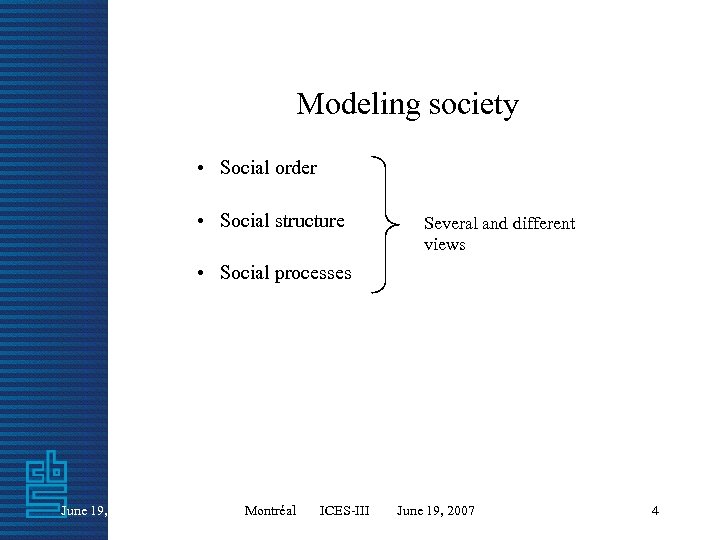
Modeling society • Social order • Social structure Several and different views • Social processes June 19, 2007 Montréal ICES-III June 19, 2007 4
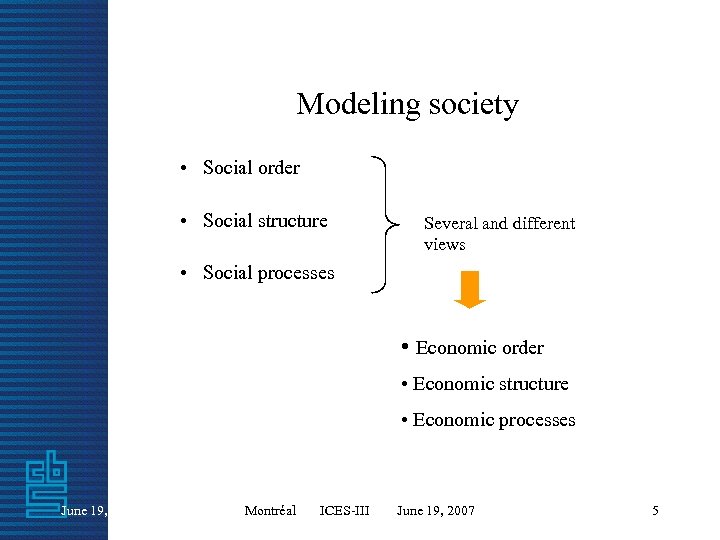
Modeling society • Social order • Social structure Several and different views • Social processes • Economic order • Economic structure • Economic processes June 19, 2007 Montréal ICES-III June 19, 2007 5
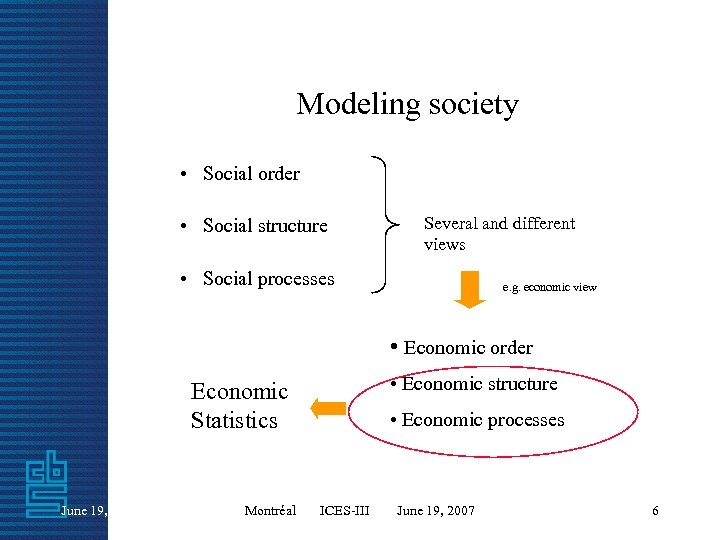
Modeling society • Social order • Social structure Several and different views • Social processes e. g. economic view • Economic order Economic Statistics June 19, 2007 • Economic structure • Economic processes Montréal ICES-III June 19, 2007 6
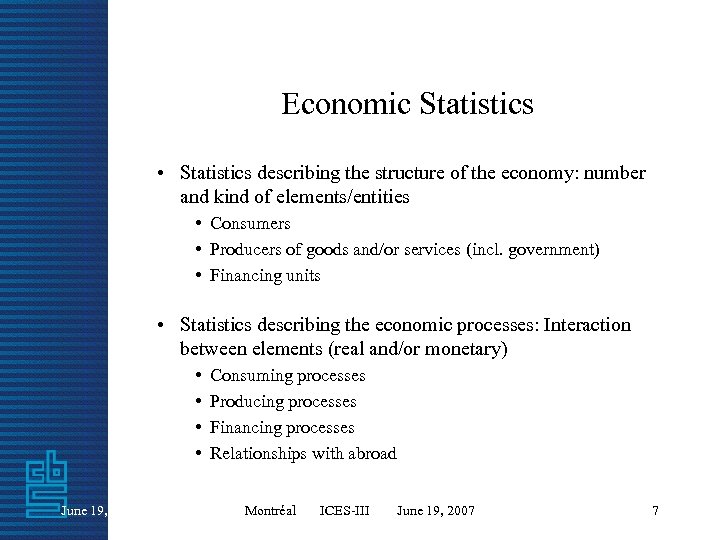
Economic Statistics • Statistics describing the structure of the economy: number and kind of elements/entities • Consumers • Producers of goods and/or services (incl. government) • Financing units • Statistics describing the economic processes: Interaction between elements (real and/or monetary) • • June 19, 2007 Consuming processes Producing processes Financing processes Relationships with abroad Montréal ICES-III June 19, 2007 7
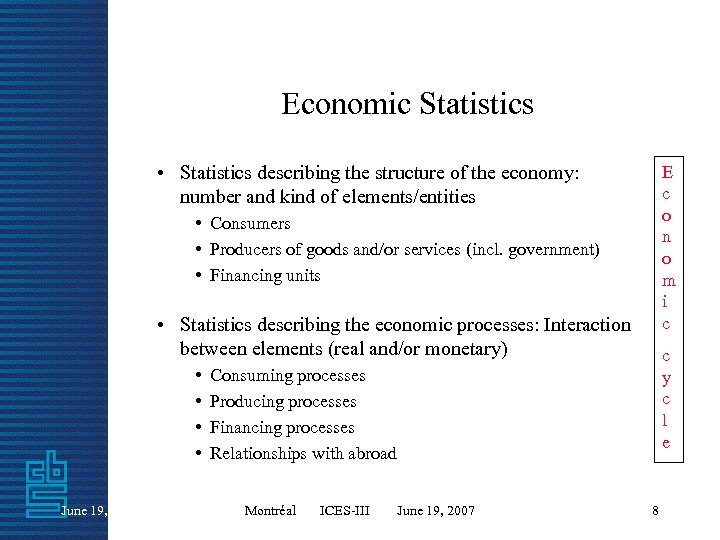
Economic Statistics • Statistics describing the structure of the economy: number and kind of elements/entities E c o n o m i c • Consumers • Producers of goods and/or services (incl. government) • Financing units • Statistics describing the economic processes: Interaction between elements (real and/or monetary) • • June 19, 2007 c y c l e Consuming processes Producing processes Financing processes Relationships with abroad Montréal ICES-III June 19, 2007 8
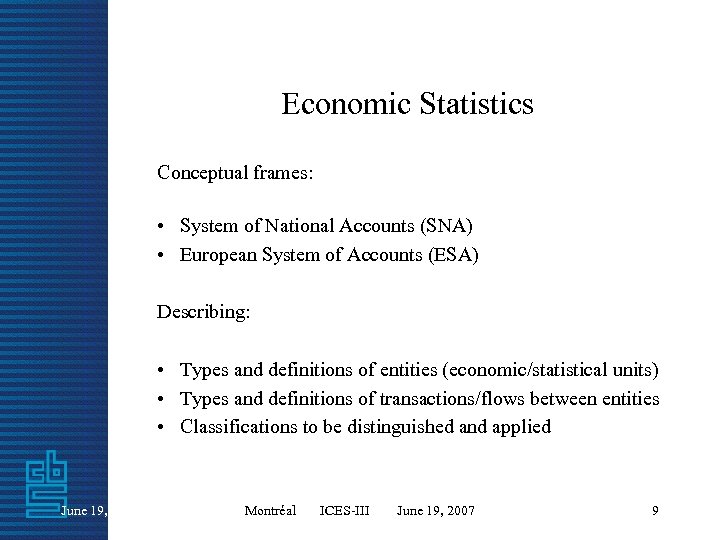
Economic Statistics Conceptual frames: • System of National Accounts (SNA) • European System of Accounts (ESA) Describing: • Types and definitions of entities (economic/statistical units) • Types and definitions of transactions/flows between entities • Classifications to be distinguished and applied June 19, 2007 Montréal ICES-III June 19, 2007 9
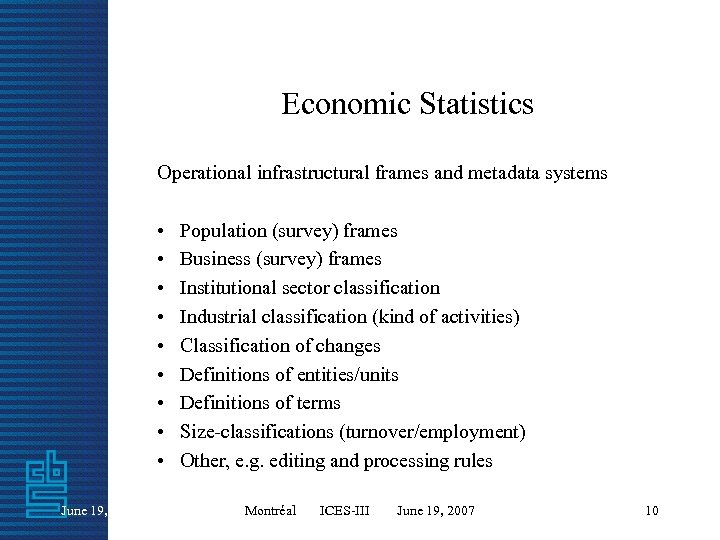
Economic Statistics Operational infrastructural frames and metadata systems • • • June 19, 2007 Population (survey) frames Business (survey) frames Institutional sector classification Industrial classification (kind of activities) Classification of changes Definitions of entities/units Definitions of terms Size-classifications (turnover/employment) Other, e. g. editing and processing rules Montréal ICES-III June 19, 2007 10
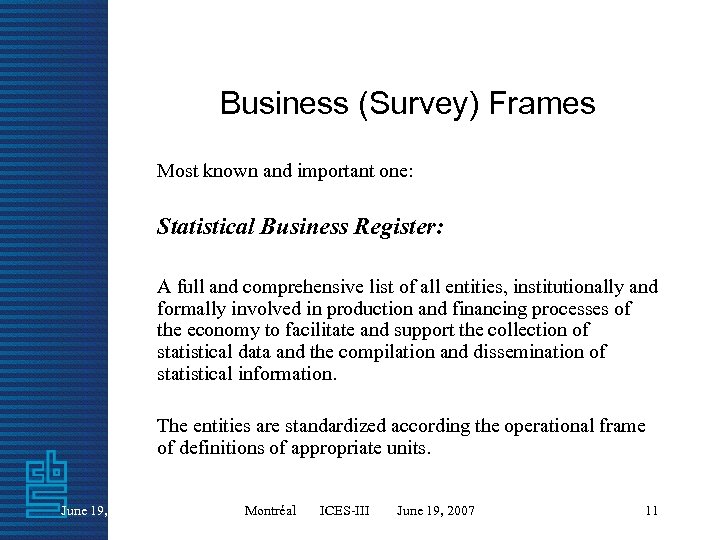
Business (Survey) Frames Most known and important one: Statistical Business Register: A full and comprehensive list of all entities, institutionally and formally involved in production and financing processes of the economy to facilitate and support the collection of statistical data and the compilation and dissemination of statistical information. The entities are standardized according the operational frame of definitions of appropriate units. June 19, 2007 Montréal ICES-III June 19, 2007 11
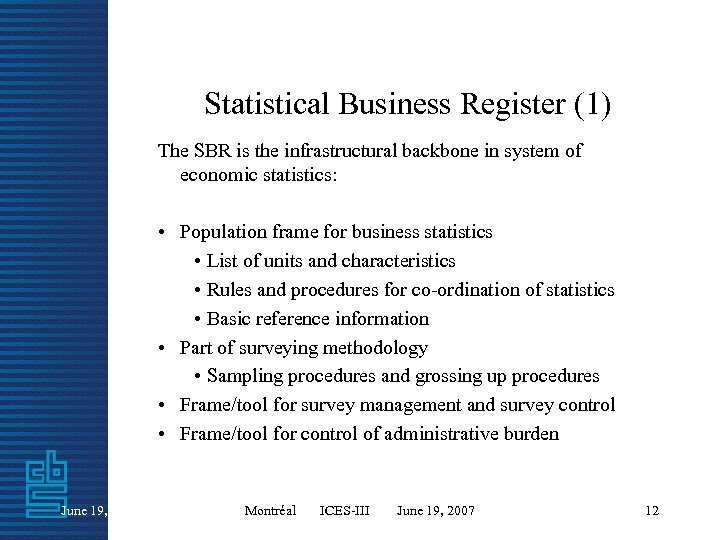
Statistical Business Register (1) The SBR is the infrastructural backbone in system of economic statistics: • Population frame for business statistics • List of units and characteristics • Rules and procedures for co-ordination of statistics • Basic reference information • Part of surveying methodology • Sampling procedures and grossing up procedures • Frame/tool for survey management and survey control • Frame/tool for control of administrative burden June 19, 2007 Montréal ICES-III June 19, 2007 12
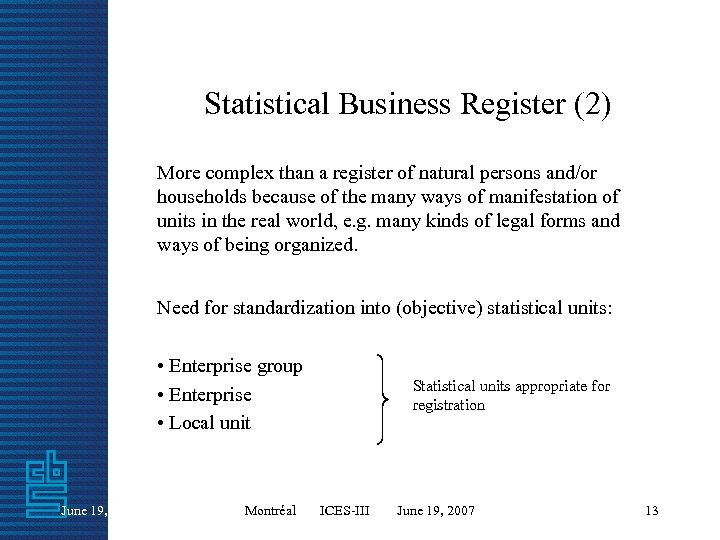
Statistical Business Register (2) More complex than a register of natural persons and/or households because of the many ways of manifestation of units in the real world, e. g. many kinds of legal forms and ways of being organized. Need for standardization into (objective) statistical units: • Enterprise group • Enterprise • Local unit June 19, 2007 Statistical units appropriate for registration Montréal ICES-III June 19, 2007 13
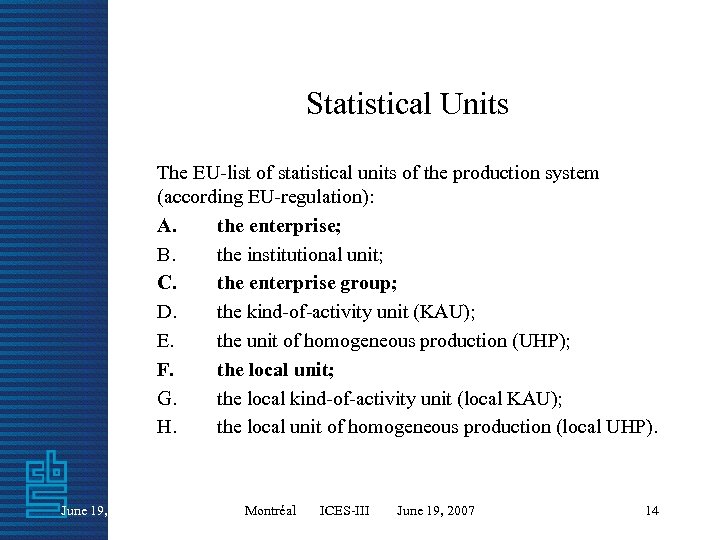
Statistical Units The EU-list of statistical units of the production system (according EU-regulation): A. the enterprise; B. the institutional unit; C. the enterprise group; D. the kind-of-activity unit (KAU); E. the unit of homogeneous production (UHP); F. the local unit; G. the local kind-of-activity unit (local KAU); H. the local unit of homogeneous production (local UHP). June 19, 2007 Montréal ICES-III June 19, 2007 14
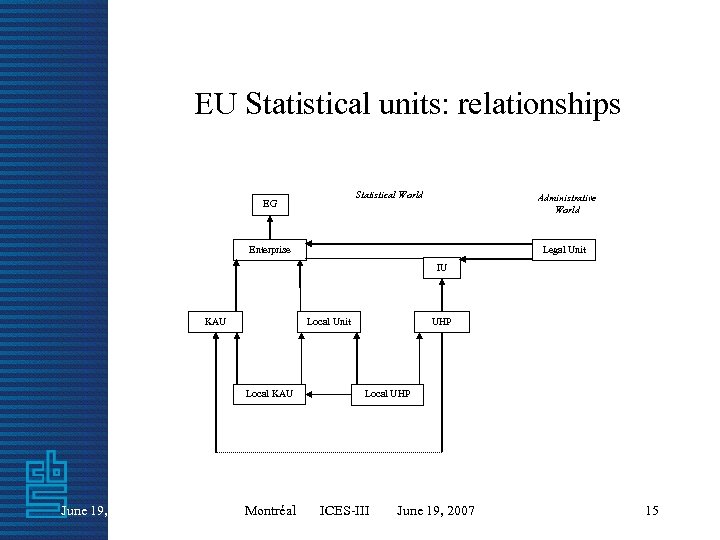
EU Statistical units: relationships Statistical World EG Administrative World Enterprise Legal Unit IU KAU Local Unit Local KAU June 19, 2007 UHP Local UHP Montréal ICES-III June 19, 2007 15
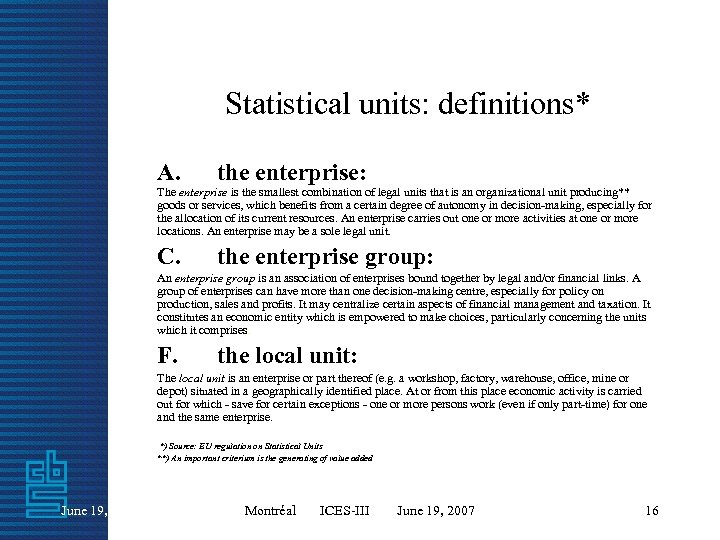
Statistical units: definitions* A. the enterprise: C. the enterprise group: The enterprise is the smallest combination of legal units that is an organizational unit producing** goods or services, which benefits from a certain degree of autonomy in decision-making, especially for the allocation of its current resources. An enterprise carries out one or more activities at one or more locations. An enterprise may be a sole legal unit. An enterprise group is an association of enterprises bound together by legal and/or financial links. A group of enterprises can have more than one decision-making centre, especially for policy on production, sales and profits. It may centralize certain aspects of financial management and taxation. It constitutes an economic entity which is empowered to make choices, particularly concerning the units which it comprises. F. the local unit: The local unit is an enterprise or part thereof (e. g. a workshop, factory, warehouse, office, mine or depot) situated in a geographically identified place. At or from this place economic activity is carried out for which - save for certain exceptions - one or more persons work (even if only part-time) for one and the same enterprise. *) Source: EU regulation on Statistical Units **) An important criterium is the generating of value added June 19, 2007 Montréal ICES-III June 19, 2007 16
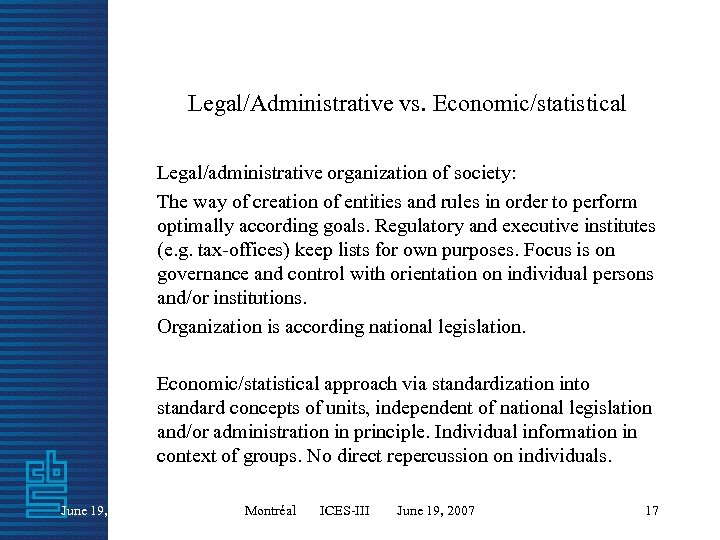
Legal/Administrative vs. Economic/statistical Legal/administrative organization of society: The way of creation of entities and rules in order to perform optimally according goals. Regulatory and executive institutes (e. g. tax-offices) keep lists for own purposes. Focus is on governance and control with orientation on individual persons and/or institutions. Organization is according national legislation. Economic/statistical approach via standardization into standard concepts of units, independent of national legislation and/or administration in principle. Individual information in context of groups. No direct repercussion on individuals. June 19, 2007 Montréal ICES-III June 19, 2007 17
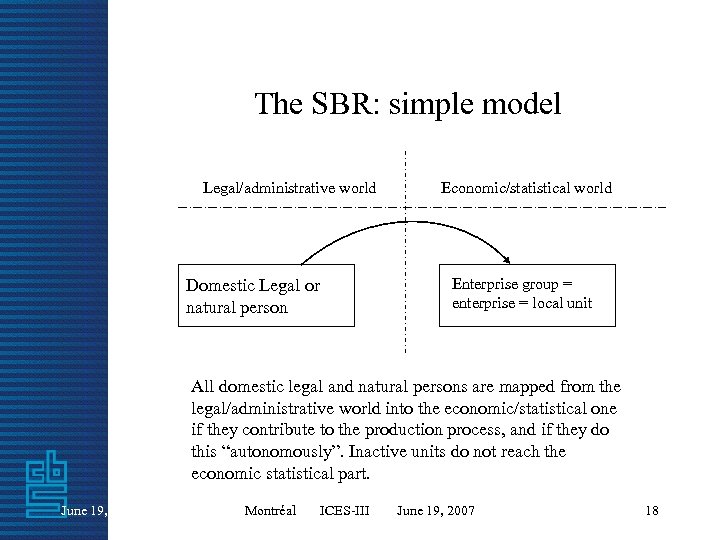
The SBR: simple model Legal/administrative world Domestic Legal or natural person Economic/statistical world Enterprise group = enterprise = local unit All domestic legal and natural persons are mapped from the legal/administrative world into the economic/statistical one if they contribute to the production process, and if they do this “autonomously”. Inactive units do not reach the economic statistical part. June 19, 2007 Montréal ICES-III June 19, 2007 18
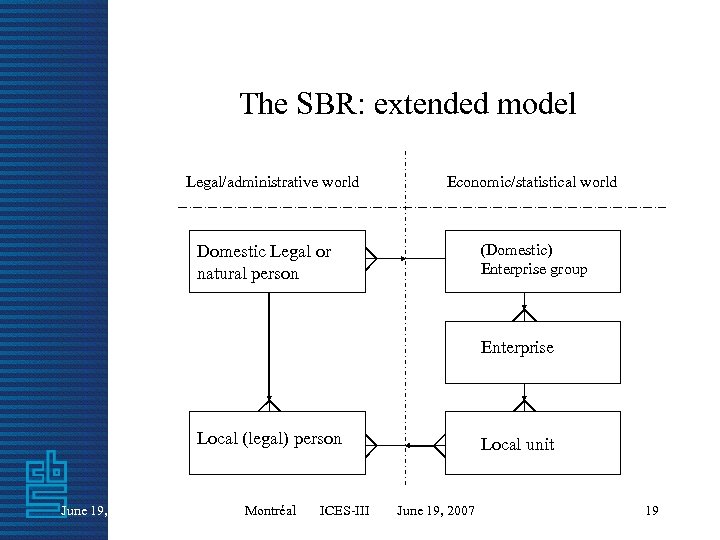
The SBR: extended model Legal/administrative world Economic/statistical world Domestic Legal or natural person (Domestic) Enterprise group Enterprise Local (legal) person June 19, 2007 Montréal ICES-III June 19, 2007 Local unit 19
SBR: Related EU Regulations For standardization in European Union: • Regulation on statistical units • Regulation on business registers June 19, 2007 Montréal ICES-III June 19, 2007 20
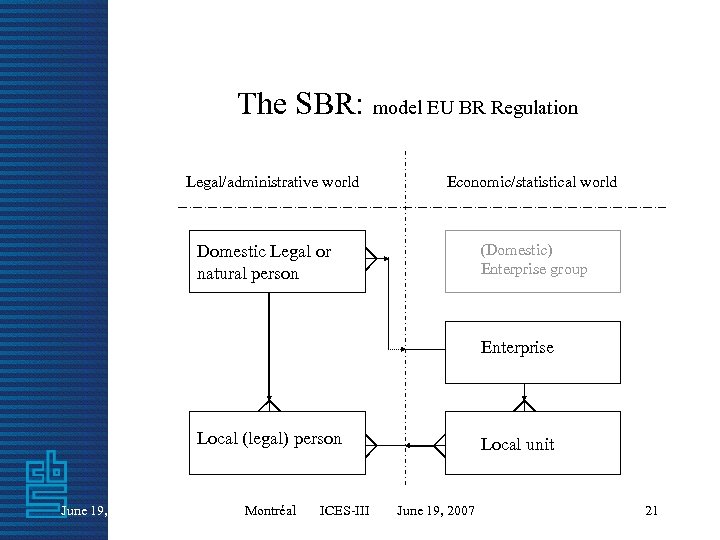
The SBR: model EU BR Regulation Legal/administrative world Economic/statistical world Domestic Legal or natural person (Domestic) Enterprise group Enterprise Local (legal) person June 19, 2007 Montréal ICES-III June 19, 2007 Local unit 21
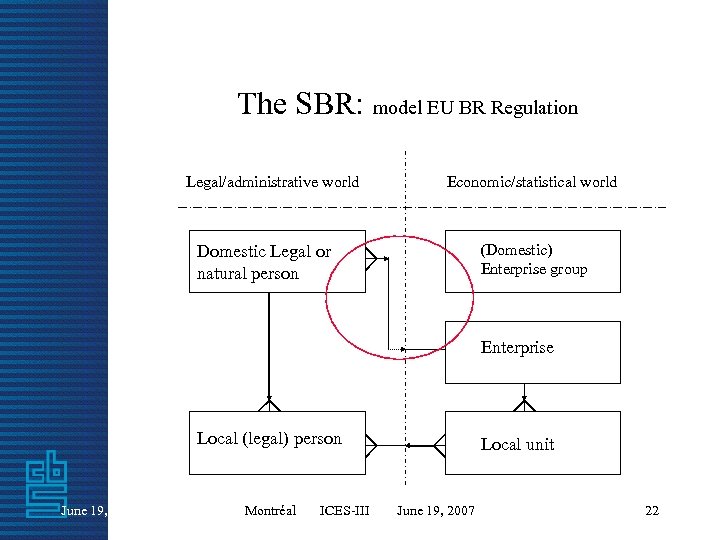
The SBR: model EU BR Regulation Legal/administrative world Economic/statistical world Domestic Legal or natural person (Domestic) Enterprise group Enterprise Local (legal) person June 19, 2007 Montréal ICES-III June 19, 2007 Local unit 22
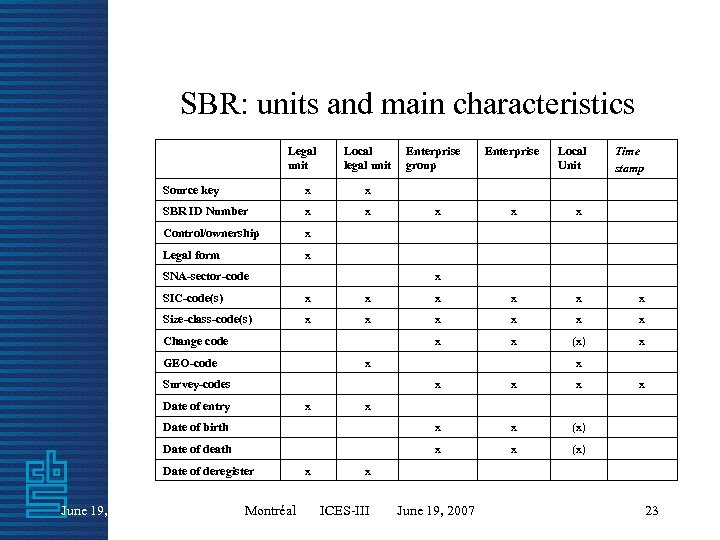
SBR: units and main characteristics Legal unit Local legal unit Source key x x x Control/ownership Local Unit Time stamp x Legal form Enterprise x SBR ID Number Enterprise group x SNA-sector-code x x SIC-code(s) x x x Size-class-code(s) x x x x (x) x Change code GEO-code x Survey-codes x x Date of birth x x (x) Date of death x x (x) Date of entry x Date of deregister June 19, 2007 x x Montréal ICES-III June 19, 2007 23
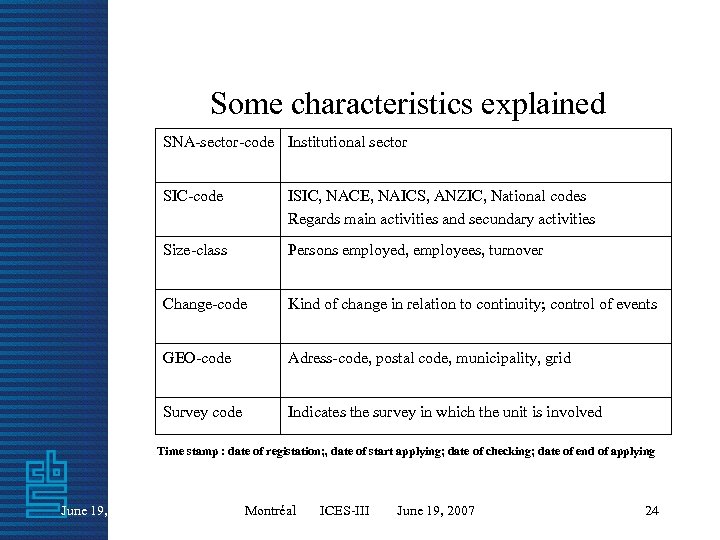
Some characteristics explained SNA-sector-code Institutional sector SIC-code ISIC, NACE, NAICS, ANZIC, National codes Regards main activities and secundary activities Size-class Persons employed, employees, turnover Change-code Kind of change in relation to continuity; control of events GEO-code Adress-code, postal code, municipality, grid Survey code Indicates the survey in which the unit is involved Time stamp : date of registation; , date of start applying; date of checking; date of end of applying June 19, 2007 Montréal ICES-III June 19, 2007 24
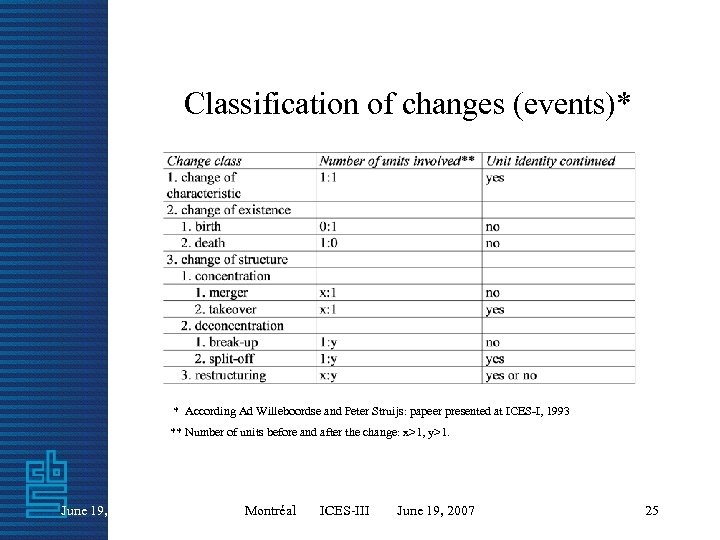
Classification of changes (events)* * According Ad Willeboordse and Peter Struijs: papeer presented at ICES-I, 1993 ** Number of units before and after the change: x>1, y>1. June 19, 2007 Montréal ICES-III June 19, 2007 25
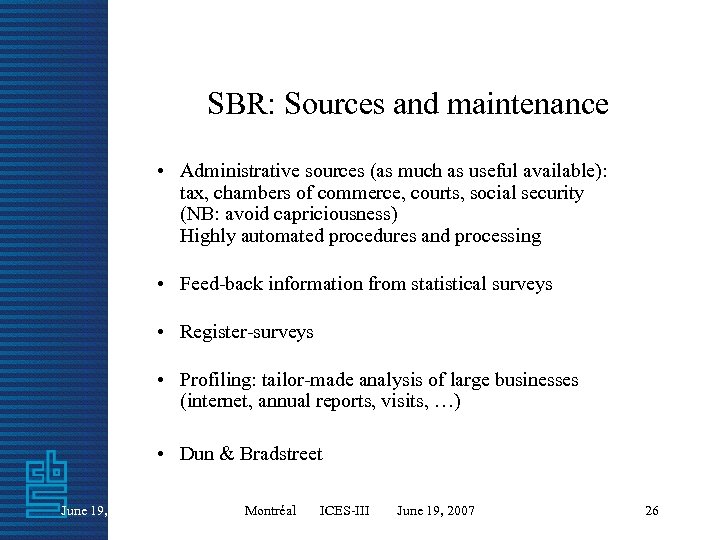
SBR: Sources and maintenance • Administrative sources (as much as useful available): tax, chambers of commerce, courts, social security (NB: avoid capriciousness) Highly automated procedures and processing • Feed-back information from statistical surveys • Register-surveys • Profiling: tailor-made analysis of large businesses (internet, annual reports, visits, …) • Dun & Bradstreet June 19, 2007 Montréal ICES-III June 19, 2007 26
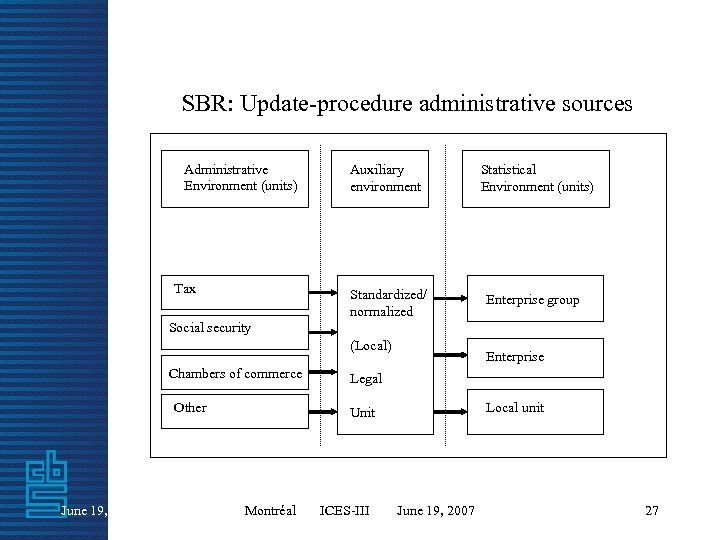
SBR: Update-procedure administrative sources Administrative Environment (units) Statistical Environment (units) Standardized/ normalized Tax Auxiliary environment Enterprise group Social security (Local) Chambers of commerce Other June 19, 2007 Enterprise Legal Unit Montréal ICES-III June 19, 2007 Local unit 27
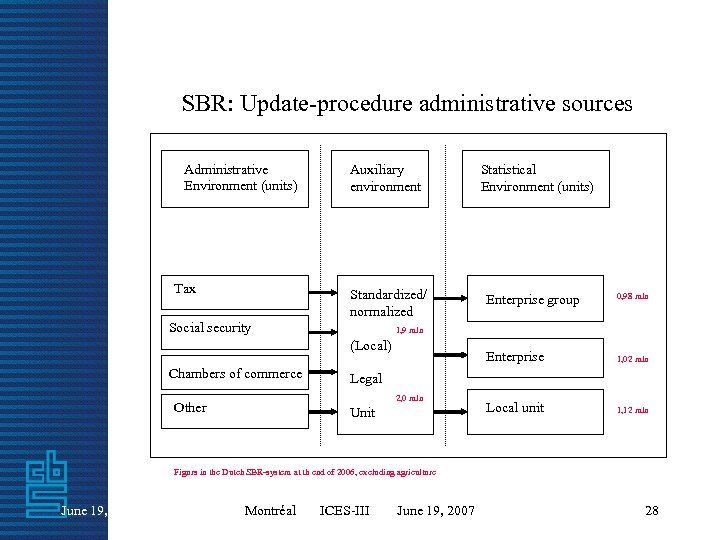
SBR: Update-procedure administrative sources Administrative Environment (units) Statistical Environment (units) Standardized/ normalized Tax Auxiliary environment Enterprise group 0, 98 mln Enterprise 1, 02 mln Local unit 1, 12 mln Social security 1, 9 mln (Local) Chambers of commerce Other Legal 2, 0 mln Unit Figurs in the Dutch SBR-system at th end of 2006, excluding agriculture June 19, 2007 Montréal ICES-III June 19, 2007 28
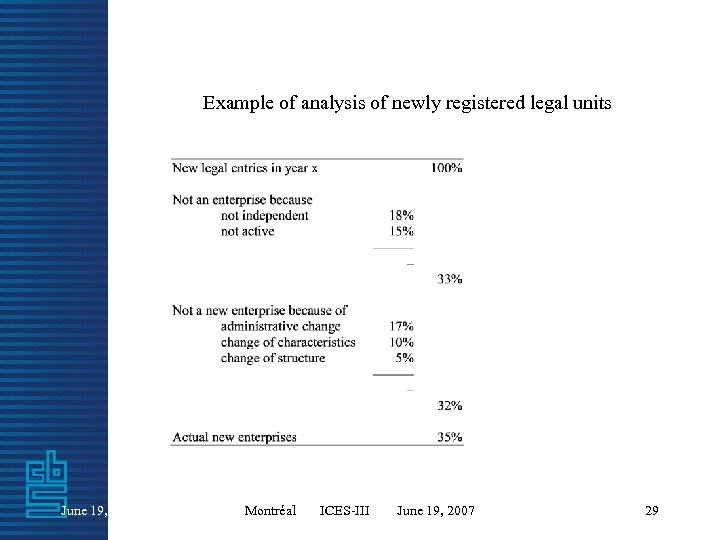
Example of analysis of newly registered legal units June 19, 2007 Montréal ICES-III June 19, 2007 29
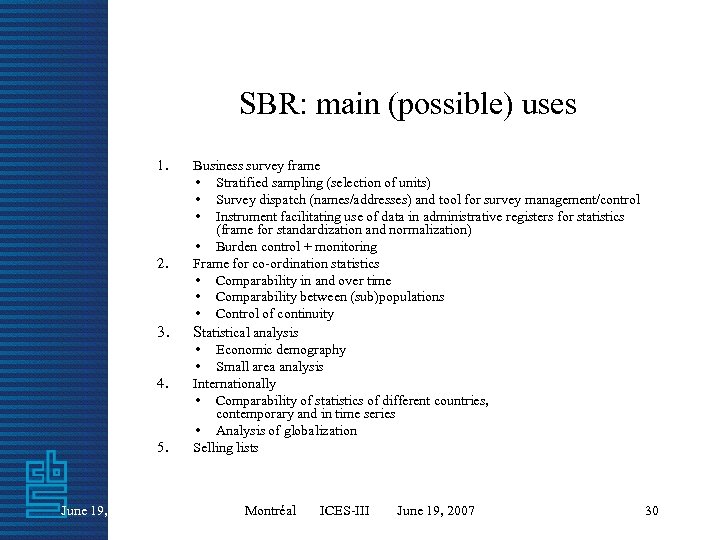
SBR: main (possible) uses 1. 2. 3. 4. 5. June 19, 2007 Business survey frame • Stratified sampling (selection of units) • Survey dispatch (names/addresses) and tool for survey management/control • Instrument facilitating use of data in administrative registers for statistics (frame for standardization and normalization) • Burden control + monitoring Frame for co-ordination statistics • Comparability in and over time • Comparability between (sub)populations • Control of continuity Statistical analysis • Economic demography • Small area analysis Internationally • Comparability of statistics of different countries, contemporary and in time series • Analysis of globalization Selling lists Montréal ICES-III June 19, 2007 30
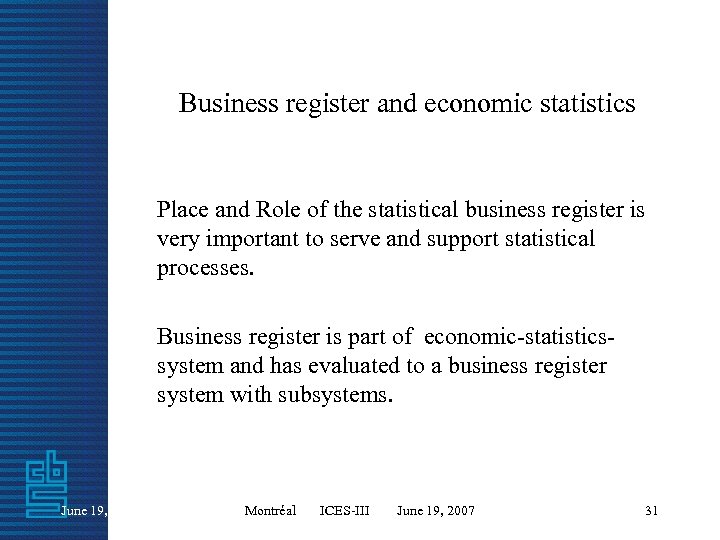
Business register and economic statistics Place and Role of the statistical business register is very important to serve and support statistical processes. Business register is part of economic-statisticssystem and has evaluated to a business register system with subsystems. June 19, 2007 Montréal ICES-III June 19, 2007 31
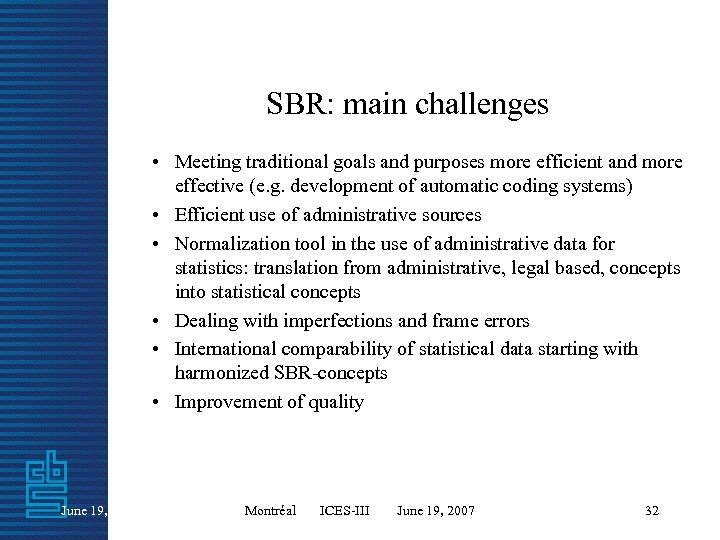
SBR: main challenges • Meeting traditional goals and purposes more efficient and more effective (e. g. development of automatic coding systems) • Efficient use of administrative sources • Normalization tool in the use of administrative data for statistics: translation from administrative, legal based, concepts into statistical concepts • Dealing with imperfections and frame errors • International comparability of statistical data starting with harmonized SBR-concepts • Improvement of quality June 19, 2007 Montréal ICES-III June 19, 2007 32
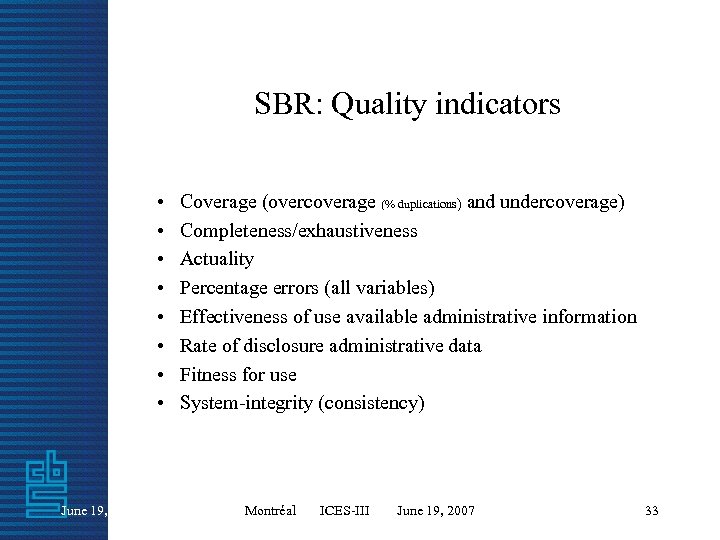
SBR: Quality indicators • • June 19, 2007 Coverage (overcoverage (% duplications) and undercoverage) Completeness/exhaustiveness Actuality Percentage errors (all variables) Effectiveness of use available administrative information Rate of disclosure administrative data Fitness for use System-integrity (consistency) Montréal ICES-III June 19, 2007 33
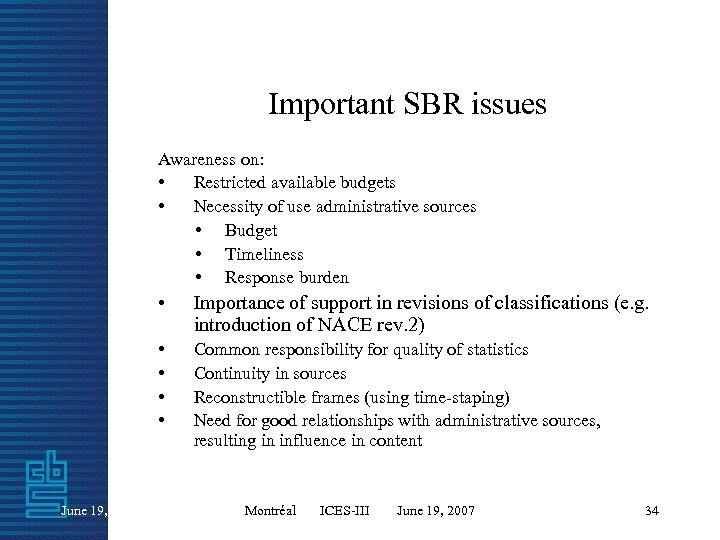
Important SBR issues Awareness on: • Restricted available budgets • Necessity of use administrative sources • Budget • Timeliness • Response burden • • • June 19, 2007 Importance of support in revisions of classifications (e. g. introduction of NACE rev. 2) Common responsibility for quality of statistics Continuity in sources Reconstructible frames (using time-staping) Need for good relationships with administrative sources, resulting in influence in content Montréal ICES-III June 19, 2007 34
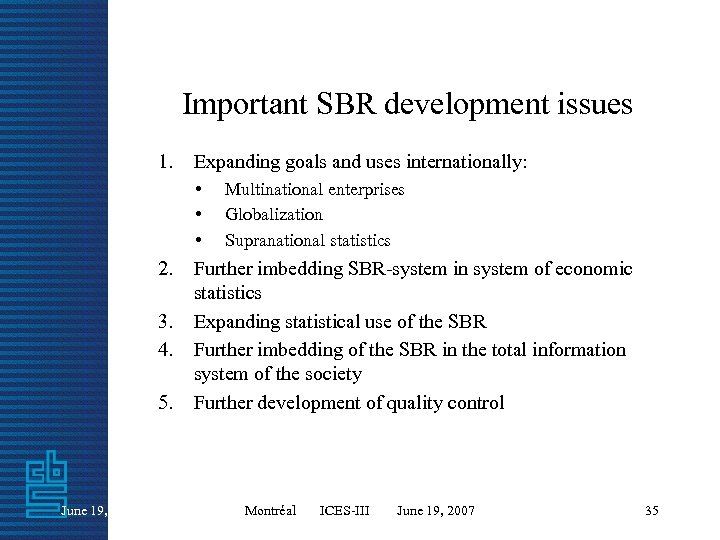
Important SBR development issues 1. Expanding goals and uses internationally: • • • 2. 3. 4. 5. June 19, 2007 Multinational enterprises Globalization Supranational statistics Further imbedding SBR-system in system of economic statistics Expanding statistical use of the SBR Further imbedding of the SBR in the total information system of the society Further development of quality control Montréal ICES-III June 19, 2007 35
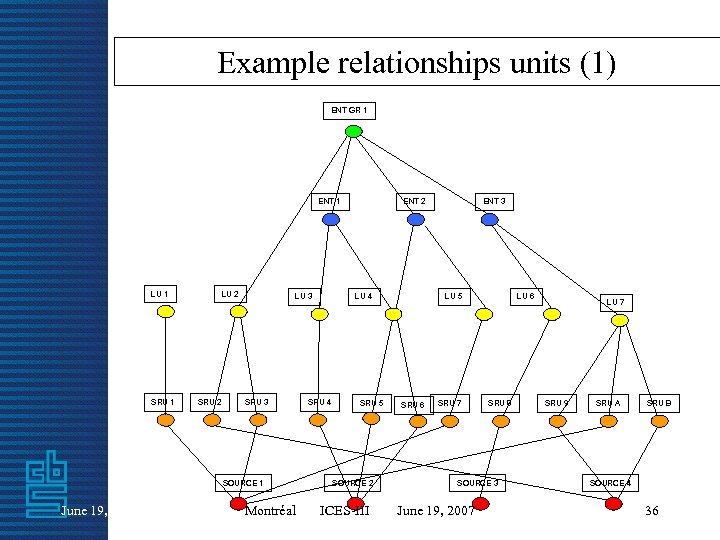
Example relationships units (1) ENT GR 1 ENT 1 LU 1 SRU 1 LU 2 SRU 2 LU 3 SRU 3 SOURCE 1 June 19, 2007 SRU 4 ENT 2 LU 4 SRU 5 SOURCE 2 ENT 3 LU 5 SRU 6 SRU 7 LU 6 SRU 8 SOURCE 3 Montréal ICES-III June 19, 2007 LU 7 SRU 9 SRU A SRU B SOURCE 4 36
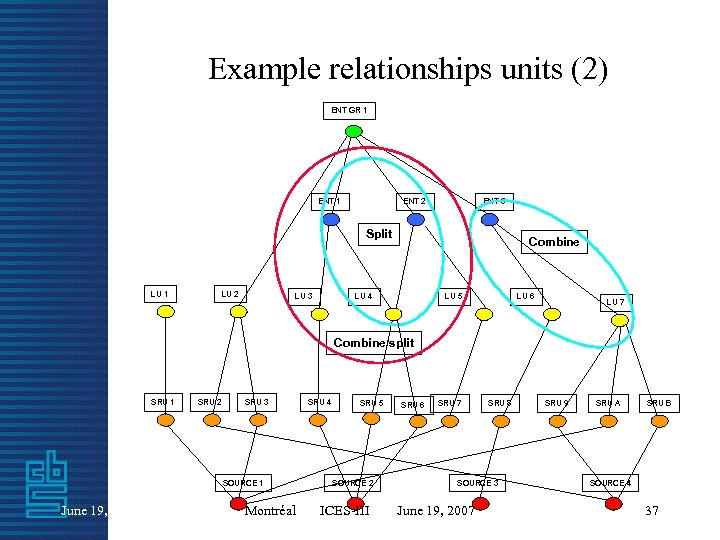
Example relationships units (2) ENT GR 1 ENT 2 ENT 3 Split LU 1 LU 2 LU 3 Combine LU 4 LU 5 LU 6 LU 7 Combine/split SRU 1 SRU 2 SRU 3 SOURCE 1 June 19, 2007 SRU 4 SRU 5 SOURCE 2 SRU 6 SRU 7 SRU 8 SOURCE 3 Montréal ICES-III June 19, 2007 SRU 9 SRU A SRU B SOURCE 4 37
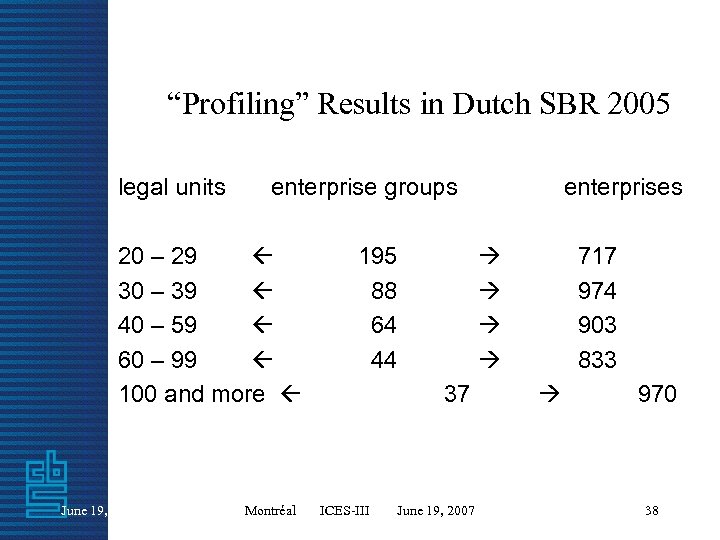
“Profiling” Results in Dutch SBR 2005 legal units enterprise groups 20 – 29 30 – 39 40 – 59 60 – 99 100 and more June 19, 2007 195 88 64 44 enterprises 717 974 903 833 37 Montréal ICES-III June 19, 2007 970 38
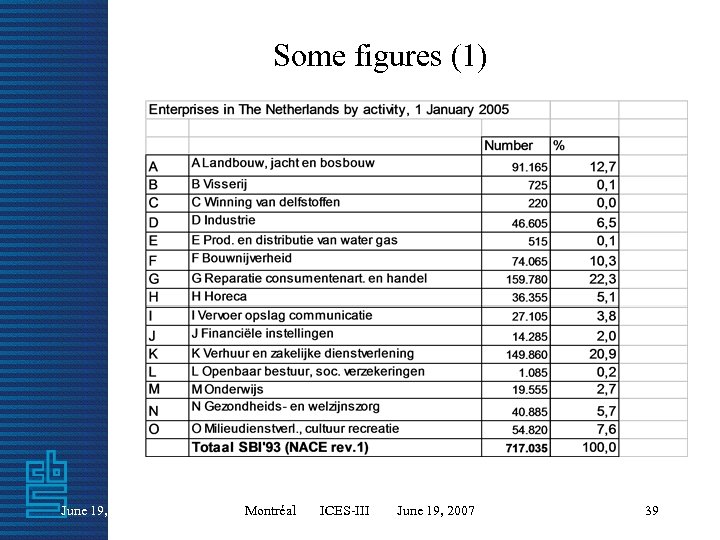
Some figures (1) June 19, 2007 Montréal ICES-III June 19, 2007 39
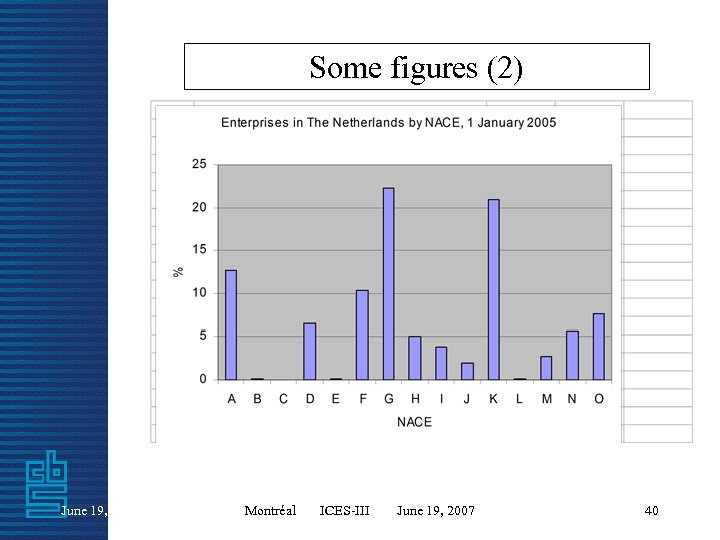
Some figures (2) June 19, 2007 Montréal ICES-III June 19, 2007 40
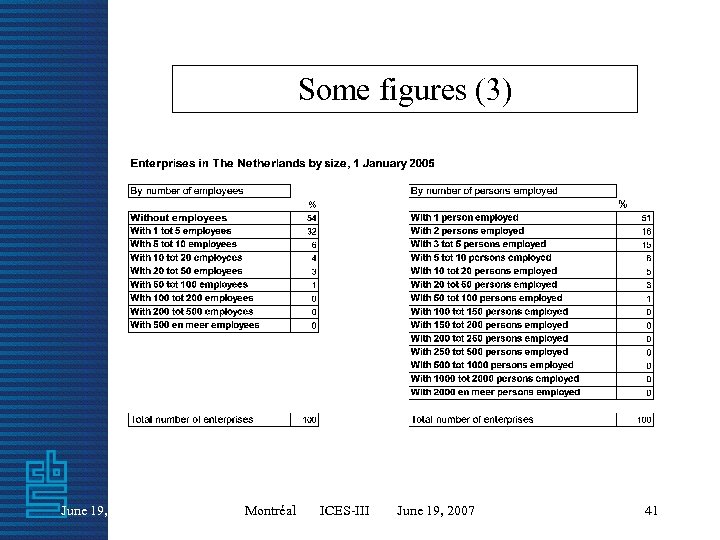
Some figures (3) June 19, 2007 Montréal ICES-III June 19, 2007 41
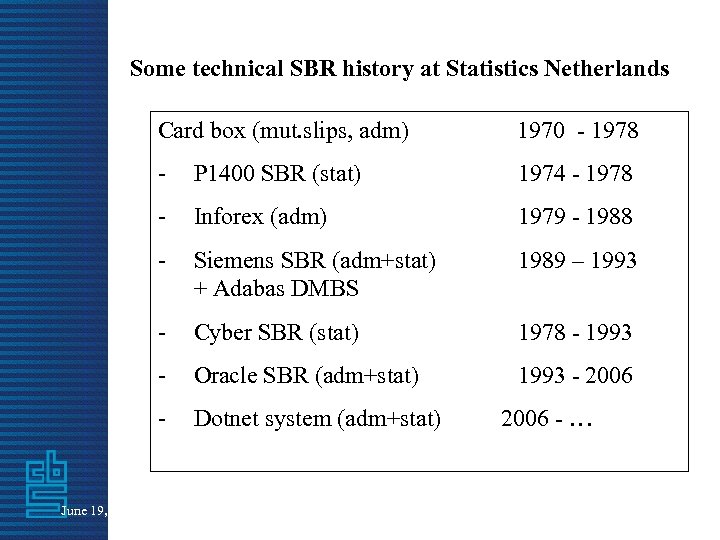
Some technical SBR history at Statistics Netherlands Card box (mut. slips, adm) 1970 - 1978 - Inforex (adm) - Siemens SBR (adm+stat) 1989 – 1993 + Adabas DMBS - Cyber SBR (stat) - Oracle SBR (adm+stat) - June 19, 2007 P 1400 SBR (stat) Dotnet system (adm+stat) 2006 - … 1974 - 1978 1979 - 1988 Montréal ICES-III June 19, 2007 1978 - 1993 - 2006 42
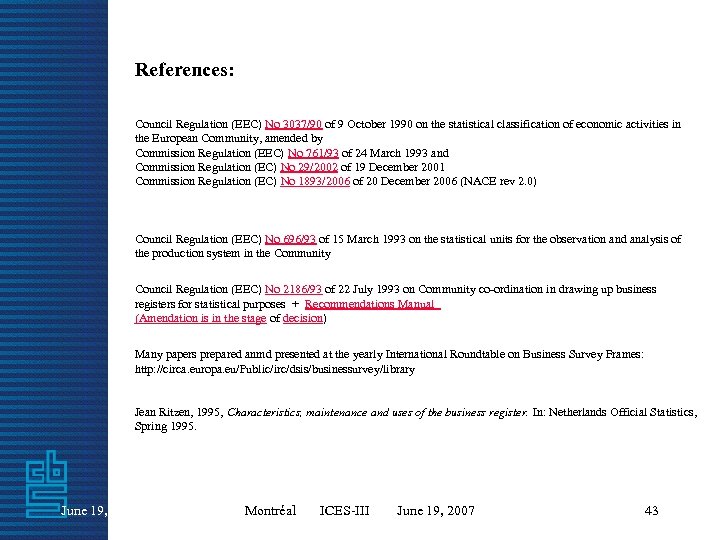
References: Council Regulation (EEC) No 3037/90 of 9 October 1990 on the statistical classification of economic activities in the European Community, amended by Commission Regulation (EEC) No 761/93 of 24 March 1993 and Commission Regulation (EC) No 29/2002 of 19 December 2001 Commission Regulation (EC) No 1893/2006 of 20 December 2006 (NACE rev 2. 0) Council Regulation (EEC) No 696/93 of 15 March 1993 on the statistical units for the observation and analysis of the production system in the Community Council Regulation (EEC) No 2186/93 of 22 July 1993 on Community co-ordination in drawing up business registers for statistical purposes + Recommendations Manual (Amendation is in the stage of decision) Many papers prepared anmd presented at the yearly International Roundtable on Business Survey Frames: http: //circa. europa. eu/Public/irc/dsis/businessurvey/library Jean Ritzen, 1995, Characteristics, maintenance and uses of the business register. In: Netherlands Official Statistics, Spring 1995. June 19, 2007 Montréal ICES-III June 19, 2007 43
Thank you for your attention! Questions? => jrtn@cbs. nl June 19, 2007 Montréal ICES-III June 19, 2007 44
Скачать презентацию Third International Conference on Establishment Surveys Introductory Overview
816ed3526931815f5d4f40bf94b214b8.ppt