


 Скачать презентацию Third FIW Research Conference in International Economics Conventions
4f016916cf19bc834f4aea96beefb764.ppt
- Количество слайдов: 14
 Third FIW Research Conference in International Economics Conventions in the Foreign Exchange Market: Do they really Explain Exchange Rate Dynamics ? Gabriele Di Filippo LEDA-SDFi University Paris IX Dauphine 1
![1 Intuition Stylised Fact: De Grauwe (2000) [Statistical Study] « Market agents look for](https://present5.com/presentation/4f016916cf19bc834f4aea96beefb764/image-2.jpg "1 Intuition Stylised Fact: De Grauwe (2000) [Statistical Study] « Market agents look for") 1 Intuition Stylised Fact: De Grauwe (2000) [Statistical Study] « Market agents look for fundamentals that justify the dynamics of exchange rates » Examples: Appreciation of the dollar vis-à-vis the euro between January 1999 and December 2002 → High growth perspectives in the US economy Depreciation of the dollar vis-à-vis the euro between January 2003 and December 2004 → Fears concerning the sustainability of the US debt Bachetta and Van Wincoop (2005) [Theoretical Study] Theoretical model based on the idea of De Grauwe (2000) – « Scapegoat Model » 2
1 Intuition Stylised Fact: De Grauwe (2000) [Statistical Study] « Market agents look for fundamentals that justify the dynamics of exchange rates » Examples: Appreciation of the dollar vis-à-vis the euro between January 1999 and December 2002 → High growth perspectives in the US economy Depreciation of the dollar vis-à-vis the euro between January 2003 and December 2004 → Fears concerning the sustainability of the US debt Bachetta and Van Wincoop (2005) [Theoretical Study] Theoretical model based on the idea of De Grauwe (2000) – « Scapegoat Model » 2
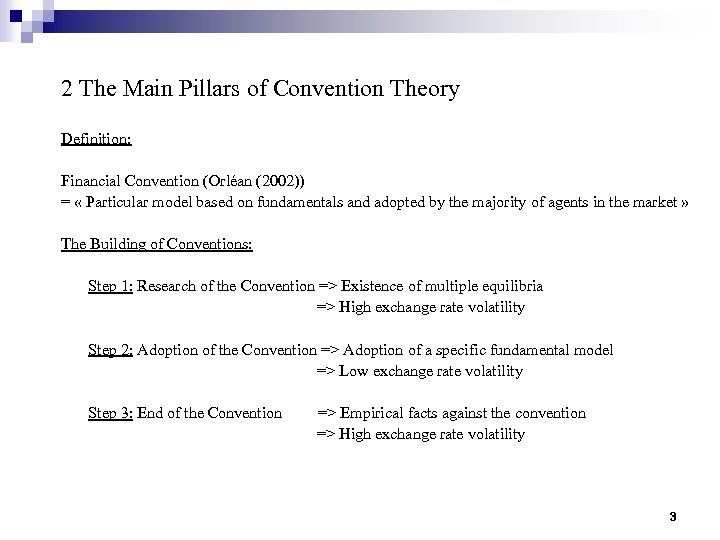 2 The Main Pillars of Convention Theory Definition: Financial Convention (Orléan (2002)) = « Particular model based on fundamentals and adopted by the majority of agents in the market » The Building of Conventions: Step 1: Research of the Convention => Existence of multiple equilibria => High exchange rate volatility Step 2: Adoption of the Convention => Adoption of a specific fundamental model => Low exchange rate volatility Step 3: End of the Convention => Empirical facts against the convention => High exchange rate volatility 3
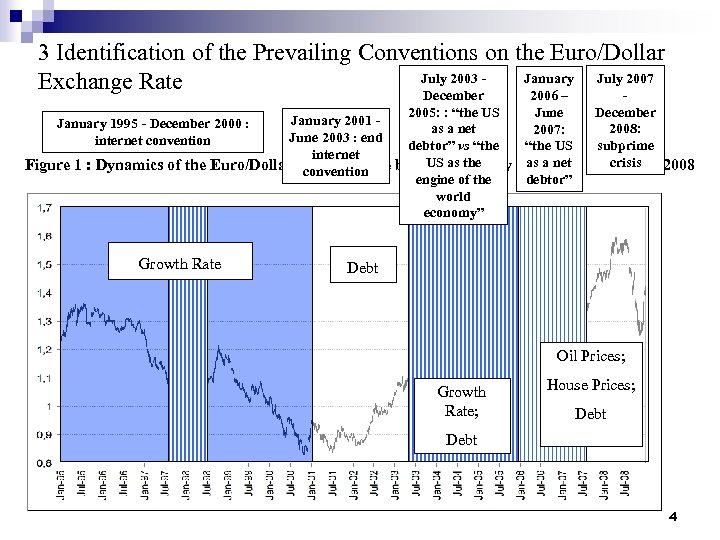 3 Identification of the Prevailing Conventions on the Euro/Dollar July 2003 July 2007 January Exchange Rate December 2006 – 2005: : “the US December June January 2001 as a net 2008: 2007: June 2003 : end debtor” vs “the subprime “the US internet US as the crisis as a net Figure 1 : Dynamics of the Euro/Dollar exchange rate between January 1995 and December 2008 convention engine of the debtor” world economy” January 1995 - December 2000 : internet convention Growth Rate Debt Oil Prices; Growth Rate; House Prices; Debt 4
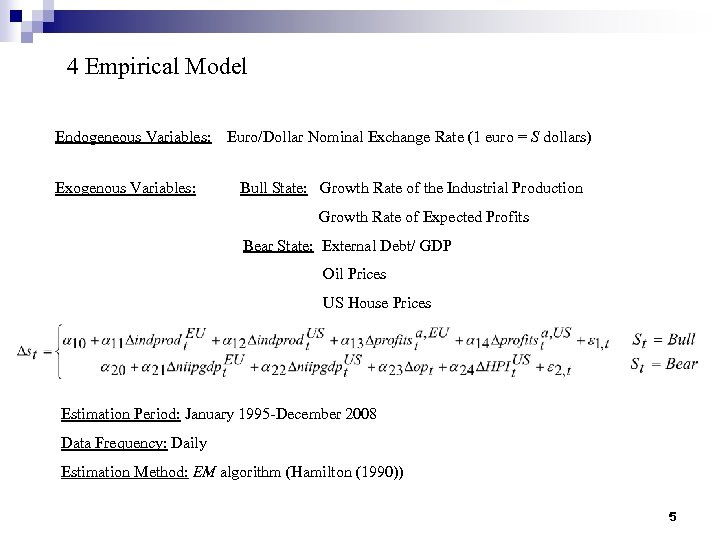 4 Empirical Model Endogeneous Variables: Euro/Dollar Nominal Exchange Rate (1 euro = S dollars) Exogenous Variables: Bull State: Growth Rate of the Industrial Production Growth Rate of Expected Profits Bear State: External Debt/ GDP Oil Prices US House Prices Estimation Period: January 1995 -December 2008 Data Frequency: Daily Estimation Method: EM algorithm (Hamilton (1990)) 5
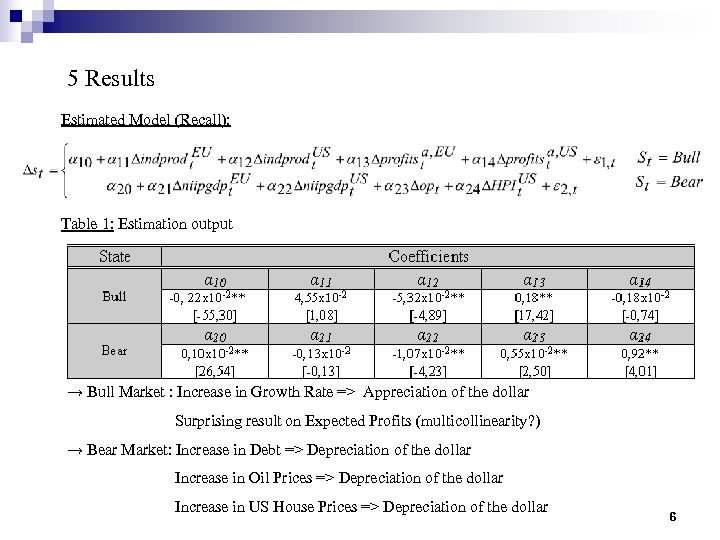 5 Results Estimated Model (Recall): Table 1: Estimation output → Bull Market : Increase in Growth Rate => Appreciation of the dollar Surprising result on Expected Profits (multicollinearity? ) → Bear Market: Increase in Debt => Depreciation of the dollar Increase in Oil Prices => Depreciation of the dollar Increase in US House Prices => Depreciation of the dollar 6
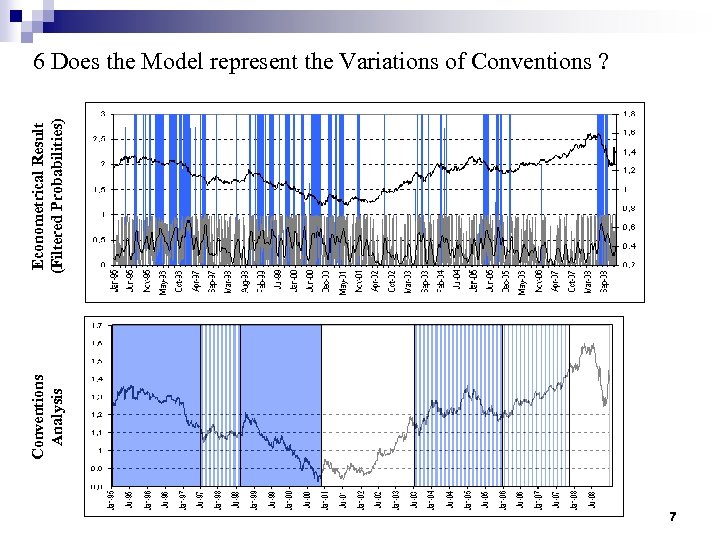 Conventions Analysis Econometrical Result (Filtered Probabilities) 6 Does the Model represent the Variations of Conventions ? 7
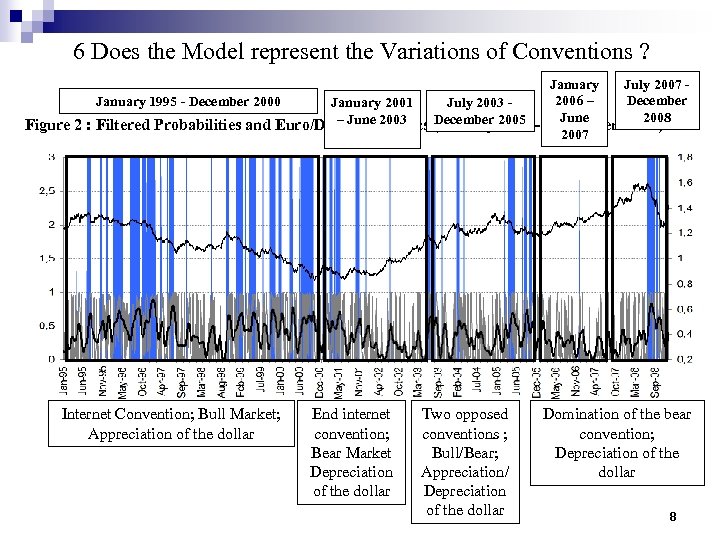 6 Does the Model represent the Variations of Conventions ? January July 2007 2006 – December January 1995 - December 2000 January 2001 July 2003 June 2008 – June 2003 December 1995 Figure 2 : Filtered Probabilities and Euro/Dollar Dynamics (January 2005 - December 2008) 2007 Internet Convention; Bull Market; Appreciation of the dollar End internet convention; Bear Market Depreciation of the dollar Two opposed conventions ; Bull/Bear; Appreciation/ Depreciation of the dollar Domination of the bear convention; Depreciation of the dollar 8
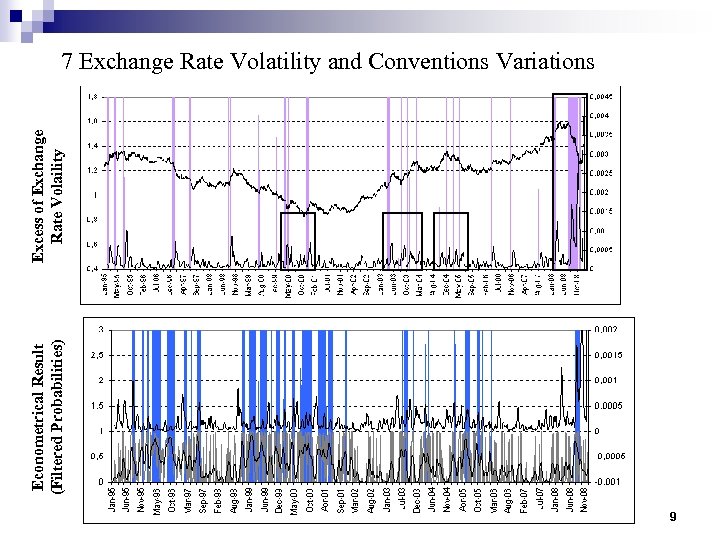 Econometrical Result (Filtered Probabilities) Excess of Exchange Rate Volaility 7 Exchange Rate Volatility and Conventions Variations 9
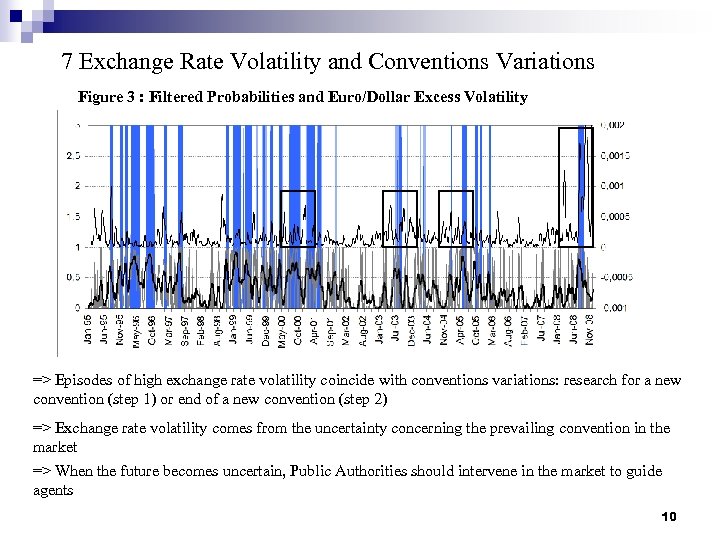 7 Exchange Rate Volatility and Conventions Variations Figure 3 : Filtered Probabilities and Euro/Dollar Excess Volatility => Episodes of high exchange rate volatility coincide with conventions variations: research for a new convention (step 1) or end of a new convention (step 2) => Exchange rate volatility comes from the uncertainty concerning the prevailing convention in the market => When the future becomes uncertain, Public Authorities should intervene in the market to guide agents 10
 8 Resolution of the Exchange Rate Disconnection Puzzle (Meese et Rogoff (1983)): => Exchange Rate Dynamics is disconnected from the fundamentals Advantages related to the Convention Model: => Asymmetric World => Non-Linear Structure Problems with Traditional Models of Exchange Rate: Invariance of the coefficients associated to fundamentals => Exchange Rate Disconnection Puzzle = Pure Artefact ? 11
 9 Limits of the Model Limits: Daily Frequency Model => Extrapolation of Macroeconomic Data => Very Strong Hypothesis => Highly contestable hypothesis Choice of the Variables ? Questions: Is the model correctly specified ? If the model is badly specified, then why does it provide the expected results ? 12
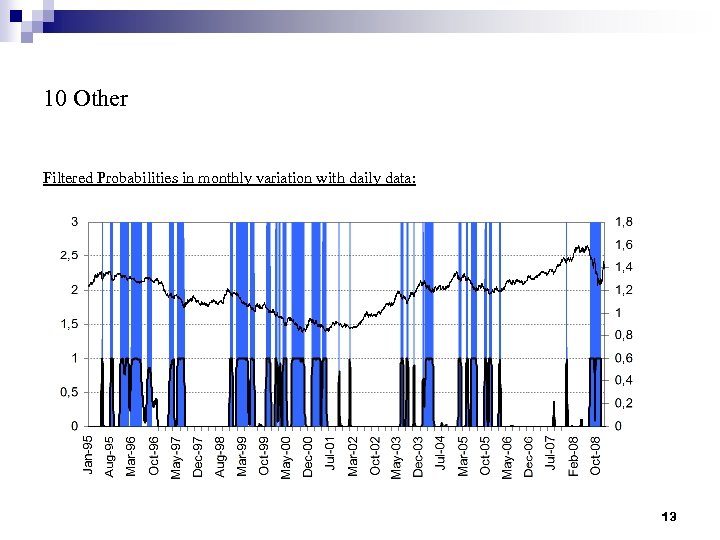 10 Other Filtered Probabilities in monthly variation with daily data: 13
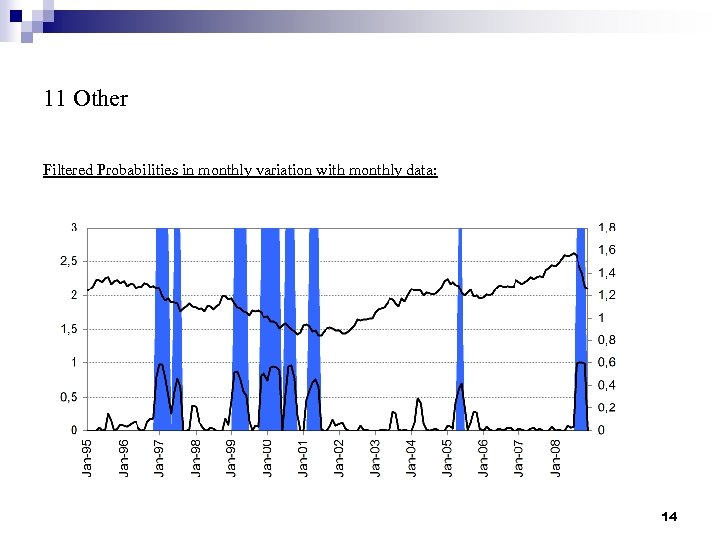 11 Other Filtered Probabilities in monthly variation with monthly data: 14