


 Скачать презентацию Third Canadian Edition Kendall Murray Linden Copyright
1be34d79b6e74d30d393c7f5bb550425.ppt
- Количество слайдов: 39
 Third Canadian Edition Kendall Murray Linden Copyright © 2004 by Nelson, a division of Thomson Canada
 The Sociological Perspective Chapter One
 Focus Questions § Why is it important to use your sociological imagination when studying issues such as suicide? § What is the sociological imagination? § Why were early thinkers concerned with social order and stability? § Why were middle 20 th century authors concerned with change? § What are the assumptions behind the various perspectives? Copyright © 2004 by Nelson, a division of Thomson Canada
 Suicide as an example of using sociology to try to understand suicides’ sources and effects in people’s lives Copyright © 2004 by Nelson, a division of Thomson Canada
 Outline § § Putting Social Life into Perspective The Origins of Sociological Thinking The Development of Modern Sociology Contemporary Theoretical Perspectives Copyright © 2004 by Nelson, a division of Thomson Canada
 Putting Social Life into Perspective § § § Why Study Sociology? The Sociological Imagination The Importance of a Global Sociological Imagination Copyright © 2004 by Nelson, a division of Thomson Canada
 Why Study Sociology? § Central concepts: – Society – Global interdependence – Commonsense knowledge § The discipline assists us in understanding ourselves and our social world § Our worlds are created for us by others as well as being created by us Copyright © 2004 by Nelson, a division of Thomson Canada
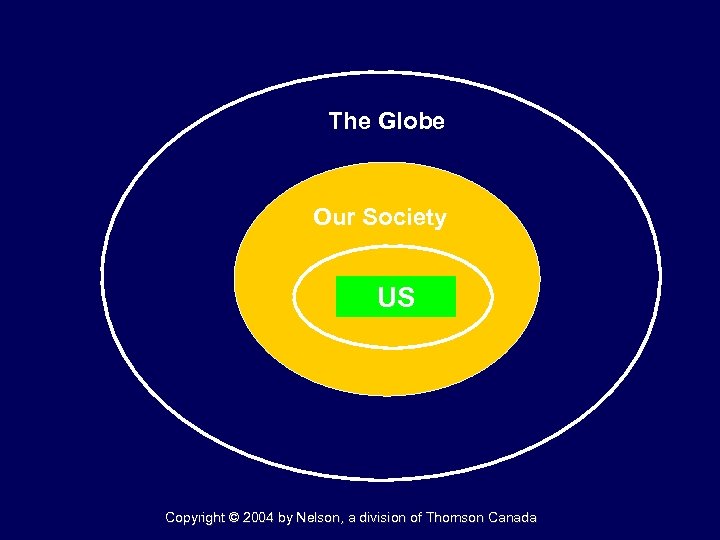 The Globe Our Society US Copyright © 2004 by Nelson, a division of Thomson Canada
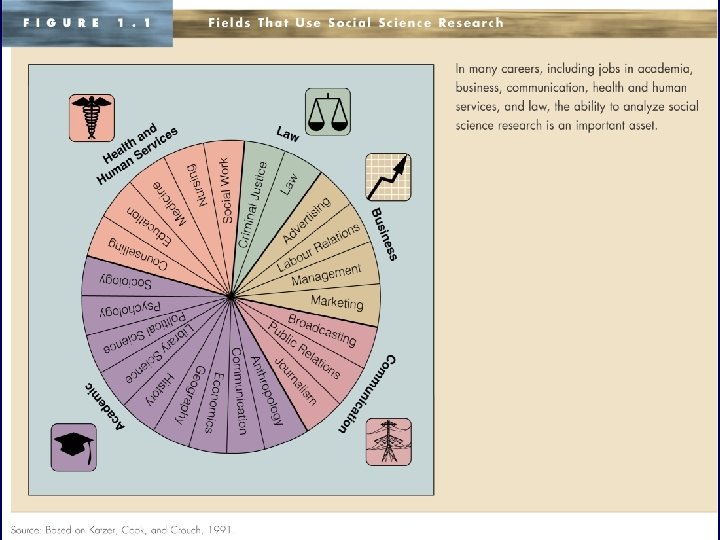 Copyright © 2004 by Nelson, a division of Thomson Canada
 The Sociological Imagination § Author: C. Wright Mills § Defined as: “the ability to see the relationship between individual experiences and the larger society” p. 8 § Two dimensions – Personal trouble (suicide as an example) – Public issue (suicide as an example) Copyright © 2004 by Nelson, a division of Thomson Canada
 The Global Element § Elements – – – High-income countries Middle-income countries Low-income countries § Central theme: we are not alone. All of us are deeply intertwined with the reality of all nations in the world. Consider the impact of the “Mad Cow” disease in the spring/summer of 2003 § Special terms: race, ethnicity, class, sex and gender Copyright © 2004 by Nelson, a division of Thomson Canada
 Origins of Sociological Thinking § Classic origins go back to Ionic beginnings – Aristotle and Plato, for example § The growth of the natural sciences in the 17 th-18 th centuries set the pace of how science can be applied to society § Vitality of the Enlightenment (Age of Reason) – Emphasis of critical thinking; some applied it to social issues – Persons such as Montesquieu, Rousseau, Turgot, and Mary Wollstonecraft reflected on social concerns of their times Copyright © 2004 by Nelson, a division of Thomson Canada
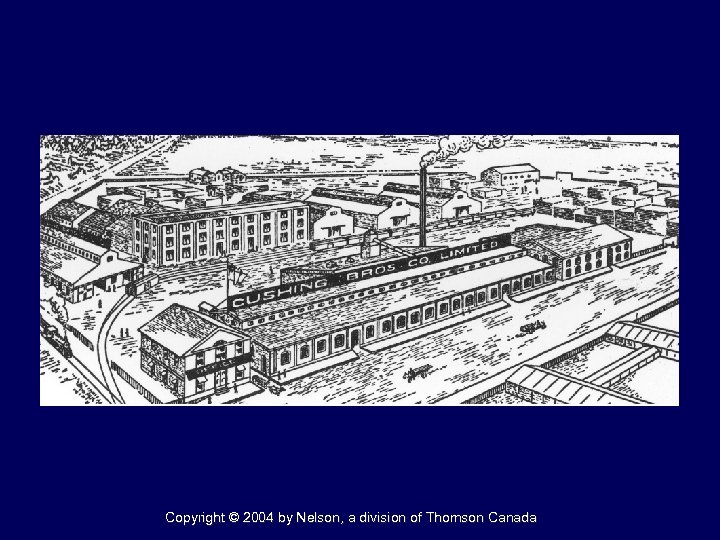
 Revolution, Industrialization, and Urbanization Meaning of these terms: § Revolution: Change of political structures § Industrialization: Changes of means of production or how people make a living § Urbanization: Movement from the rural to the urban environments Copyright © 2004 by Nelson, a division of Thomson Canada
 Copyright © 2004 by Nelson, a division of Thomson Canada
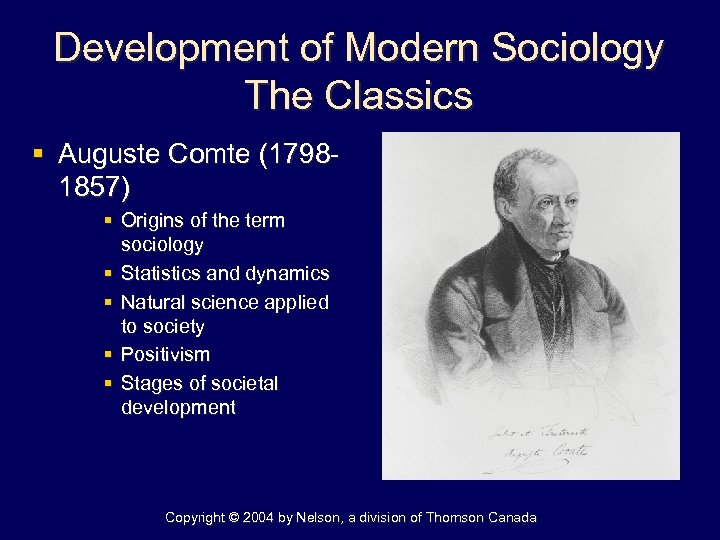 Development of Modern Sociology The Classics § Auguste Comte (17981857) § Origins of the term sociology § Statistics and dynamics § Natural science applied to society § Positivism § Stages of societal development Copyright © 2004 by Nelson, a division of Thomson Canada
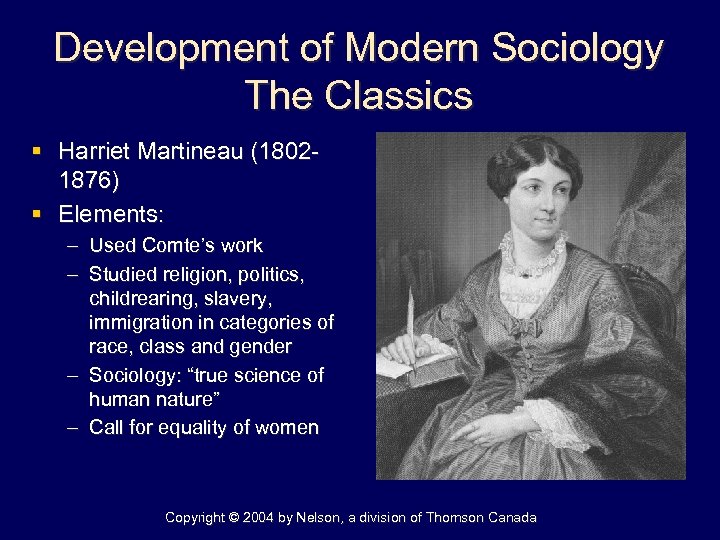 Development of Modern Sociology The Classics § Harriet Martineau (18021876) § Elements: – Used Comte’s work – Studied religion, politics, childrearing, slavery, immigration in categories of race, class and gender – Sociology: “true science of human nature” – Call for equality of women Copyright © 2004 by Nelson, a division of Thomson Canada
 Development of Modern Sociology The Classics § Herbert Spencer (1820 -1903) § Elements – Society as evolving as organic species – Process of struggle – “Social Darwinism” – Only the fittest of persons (and societies) would survive Copyright © 2004 by Nelson, a division of Thomson Canada
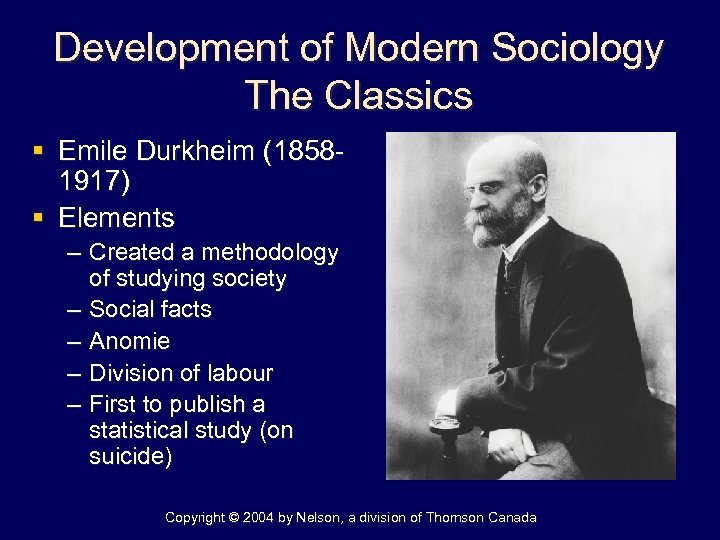 Development of Modern Sociology The Classics § Emile Durkheim (18581917) § Elements – Created a methodology of studying society – Social facts – Anomie – Division of labour – First to publish a statistical study (on suicide) Copyright © 2004 by Nelson, a division of Thomson Canada
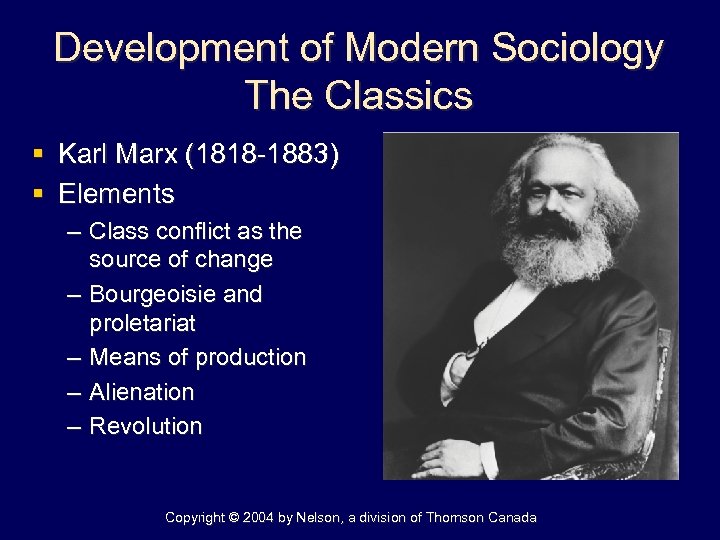 Development of Modern Sociology The Classics § Karl Marx (1818 -1883) § Elements – Class conflict as the source of change – Bourgeoisie and proletariat – Means of production – Alienation – Revolution Copyright © 2004 by Nelson, a division of Thomson Canada
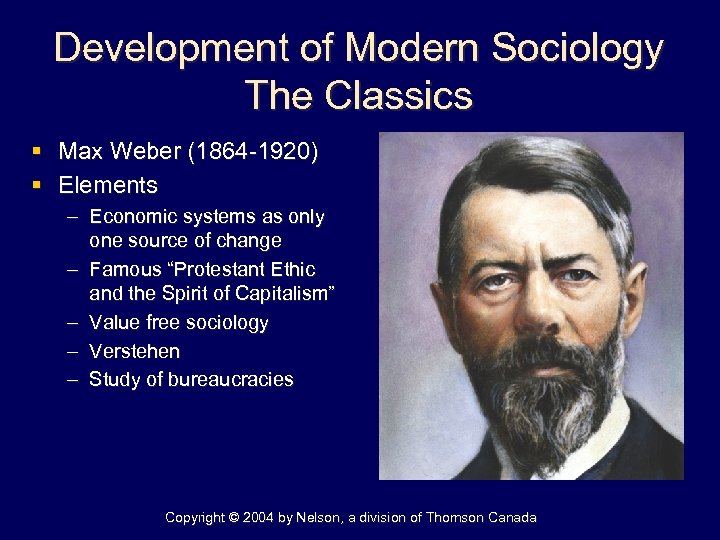 Development of Modern Sociology The Classics § Max Weber (1864 -1920) § Elements – Economic systems as only one source of change – Famous “Protestant Ethic and the Spirit of Capitalism” – Value free sociology – Verstehen – Study of bureaucracies Copyright © 2004 by Nelson, a division of Thomson Canada
 Development of Modern Sociology The Classics § George Simmel (1858 -1918) § Elements – – Society as a web of patterned interactions Focus of sociology: social interaction in groups Interaction conditioned by size: dyads, triads, etc Formal sociology: accenting the universal, recurring social forms that underlie the varying content of social interaction – Contrast of form ( a geometry of social life) and content of social interaction in different contexts Copyright © 2004 by Nelson, a division of Thomson Canada
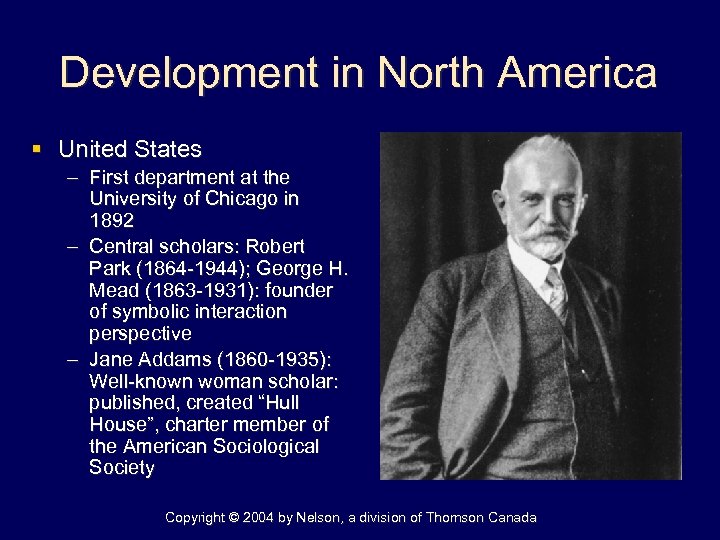 Development in North America § United States – First department at the University of Chicago in 1892 – Central scholars: Robert Park (1864 -1944); George H. Mead (1863 -1931): founder of symbolic interaction perspective – Jane Addams (1860 -1935): Well-known woman scholar: published, created “Hull House”, charter member of the American Sociological Society Copyright © 2004 by Nelson, a division of Thomson Canada
 Development in North America § United States – W. E. B. Du Bois (1868 -1963, African American) – Classic study of Philadelphia’s African American community § Canada – 1925 at Mc. Gill University: model after the “Chicago School of Sociology” – 1963 at University of Toronto: focus on the political and economic history of Canada – Foundation of the Canadian Review of Sociology in 1965 Copyright © 2004 by Nelson, a division of Thomson Canada
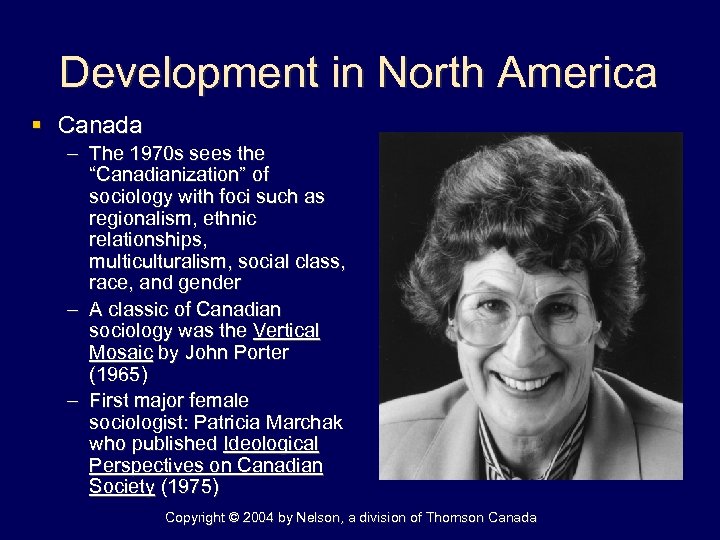 Development in North America § Canada – The 1970 s sees the “Canadianization” of sociology with foci such as regionalism, ethnic relationships, multiculturalism, social class, race, and gender – A classic of Canadian sociology was the Vertical Mosaic by John Porter (1965) – First major female sociologist: Patricia Marchak who published Ideological Perspectives on Canadian Society (1975) Copyright © 2004 by Nelson, a division of Thomson Canada
 Contemporary Theoretical Perspectives § § § Functionalist Conflict Feminist Symbolic Interactionist Postmodernist Copyright © 2004 by Nelson, a division of Thomson Canada
 Functionalist § Assumption: Society is a stable, orderly system § Basis of society: societal consensus of shared values, beliefs, and behavioural expectations § Society as parts to a whole with each part having a function § Society like a living organism Copyright © 2004 by Nelson, a division of Thomson Canada
 Functionalist Talcott Parsons (1902 -1979) – All societies must make provisions for meeting social needs in order to survive – Division of Labour necessary for this survival – Instrumental and expressive roles necessary also for this survival R. K. Merton (1910 -2003) – – – Manifest and Latent Functions Dysfunctions as well as functions Famous “Anomie Theory” of Deviance Copyright © 2004 by Nelson, a division of Thomson Canada
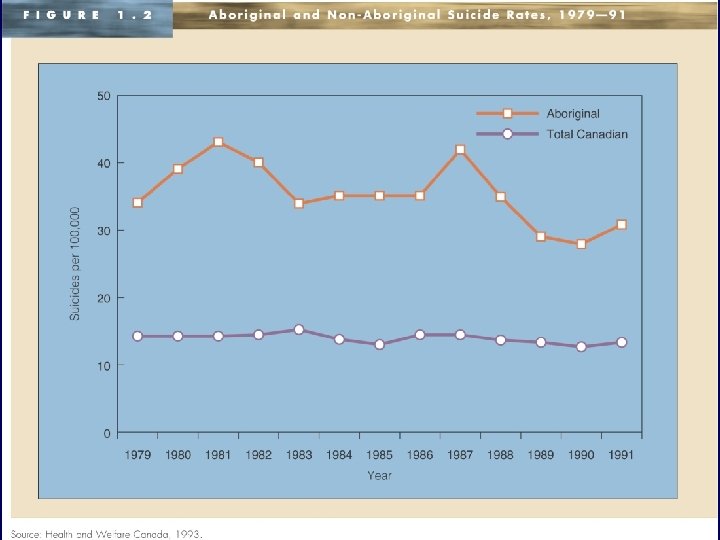
 Functionalist § Applying a Functionalist Perspective to the Study of Suicide § Durkheim’s lead with his famous empirical study of suicide § Key theory: suicide is to be seen as an effect of social rather than personal factors; that where there is no or little shared sense of community, suicide rates will be higher (Canadian example among some Aboriginal Communities) Copyright © 2004 by Nelson, a division of Thomson Canada
 Copyright © 2004 by Nelson, a division of Thomson Canada
 Conflict § Assumption: groups in society are engaged in a continuous power struggle for control of scarce resources § Key classical figures: Karl Marx, Max Weber, and Georg Simmel § The American C. W. Mills (1916 -1962) focused on power and resource inequalities with the goal of social reform § Key concept: the Power Elite Copyright © 2004 by Nelson, a division of Thomson Canada
 Conflict § Applying a Functionalist Perspective to the Study of Suicide § Searching for social roots (like functionalism) of the problem § Of special note: Social Class and Race (see next slide) Copyright © 2004 by Nelson, a division of Thomson Canada
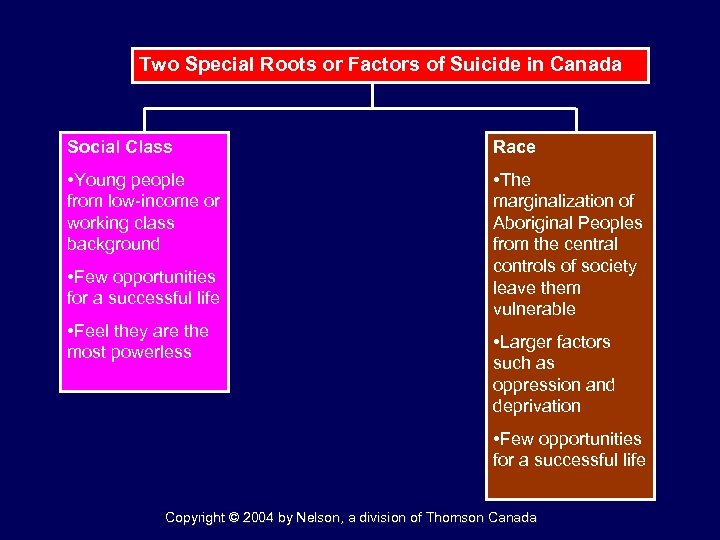 Two Special Roots or Factors of Suicide in Canada Social Class Race • Young people from low-income or working class background • The marginalization of Aboriginal Peoples from the central controls of society leave them vulnerable • Few opportunities for a successful life • Feel they are the most powerless • Larger factors such as oppression and deprivation • Few opportunities for a successful life Copyright © 2004 by Nelson, a division of Thomson Canada
 Feminist § Assumption: that gender is necessary category to understand to explain inequalities in homes, paid labour, politics, law, and culture § Many different “feminisms” § Some variations: the structure of society is male dominated; male dominated social interactions § Focus on patriarchy and a call for freedom from control and an egalitarian society Copyright © 2004 by Nelson, a division of Thomson Canada
 Feminist § Applying a Feminist perspective to suicide § Research shows that men are more likely to commit suicide and succeed at it than women § However, women are more likely to attempt suicide than men. Why? § Because of continued gendered inequalities in the social system Copyright © 2004 by Nelson, a division of Thomson Canada
 Symbolic Interactionist § Assumption: Society is a sum of the interactions of individuals and groups § Key terms: – macrolevel and microlevel analysis – Symbol – Importance of subjective interpretations of the social world – Looking glass self and generalized other (under the chapter on Socialization) – Impression management and dramaturgical analysis Copyright © 2004 by Nelson, a division of Thomson Canada
 Symbolic Interactionist § Applying a Symbolic Interactionist perspective to suicide – How does the meaning of suicide differ in various cultures? – Among Aboriginal Communities, some youth define suicide in heroic terms – Al Quada terrorists consider suicide a heroic, religious act – Focus on interactions and group behaviours Copyright © 2004 by Nelson, a division of Thomson Canada
 Postmodernist § Assumption: Existing theories of society have been unsuccessful in explaining social life that is a result of post-industrialization, consumerism, and global communication § Central terms – Information explosion – Rise of consumer society – Global village image – Post-industrial society Copyright © 2004 by Nelson, a division of Thomson Canada
 Postmodernist § Applying Postmodern Perspectives to Suicide § Because of media, many false realities and pseudo -explanations in the absence of real knowledge about events or their causes § That the media, the internet, and cyberspace have “agency” and can act on their own § May explain the mass suicide of a destructive cult called “Heaven’s Gate” Copyright © 2004 by Nelson, a division of Thomson Canada
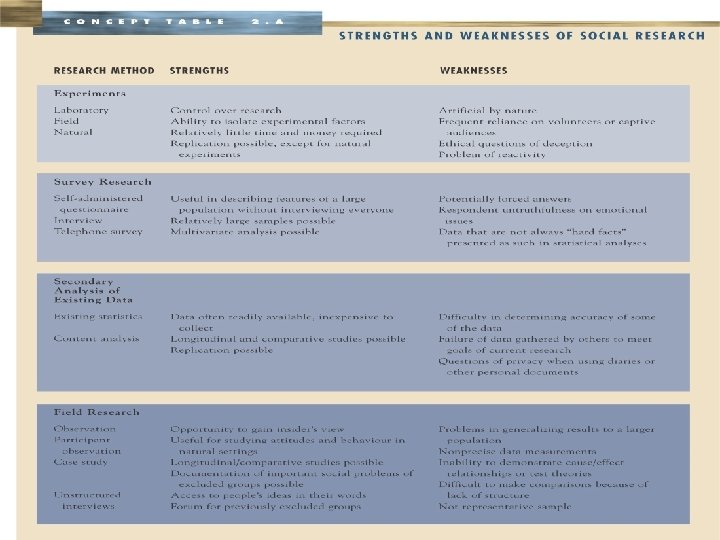 Copyright © 2004 by Nelson, a division of Thomson Canada