 Скачать презентацию Thinking Outside The Box Remote Viewing and its
91cc0a7caec05cbcf256e643e4488f6c.ppt
- Количество слайдов: 35



Thinking Outside The Box Remote Viewing and its Applications
The Need for Applications
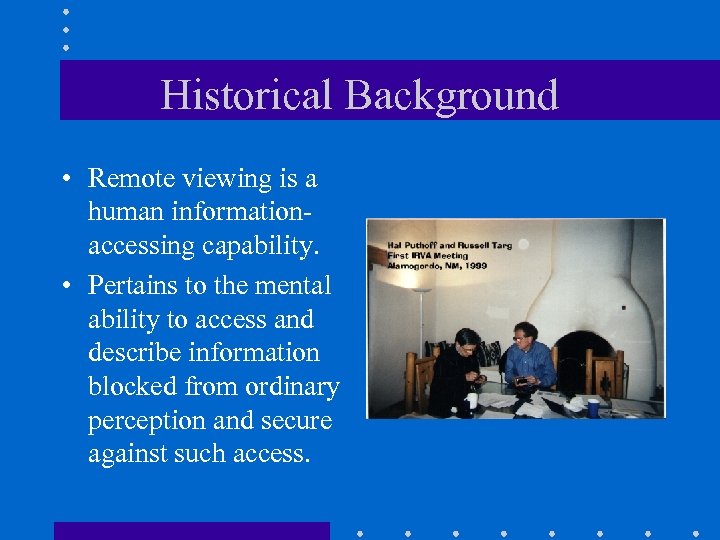
Historical Background • Remote viewing is a human informationaccessing capability. • Pertains to the mental ability to access and describe information blocked from ordinary perception and secure against such access.
Remote Viewing • Term remote viewing coined by Ingo Swann and Janet Mitchell in early 1970’s. • Researched at Stanford Research Institute, CA and then at SAIC, Palo Alto, CA. • Defense Intelligence Agency (DIA) created U. S. Army remote viewing unit at Fort Meade, MD. Operational until 1995.
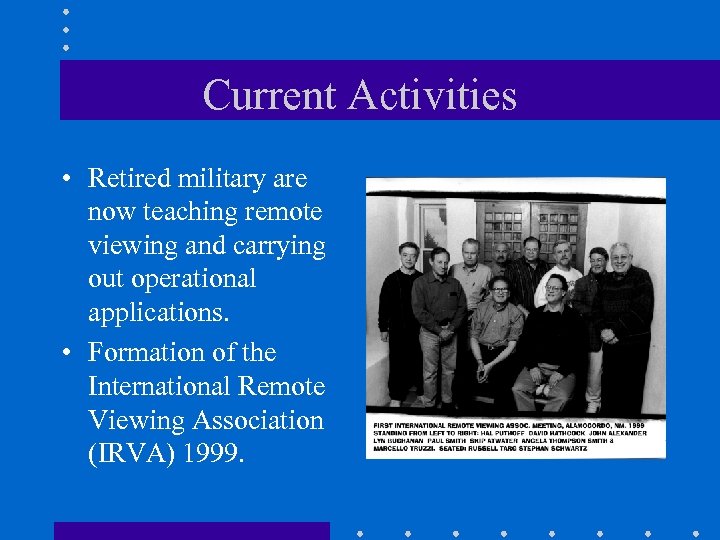
Current Activities • Retired military are now teaching remote viewing and carrying out operational applications. • Formation of the International Remote Viewing Association (IRVA) 1999.
What Remote Viewing is Not! • Remote viewing is NOT… • Witchcraft • Store-Front Psychics • Voodoo • Satanism • New-Age Hype
What Is Remote Viewing? • Remote Viewing is the trained mental ability to access and report in a prescribed protocol information that is accessed via “something other than the known five senses” using methods and techniques that were developed over 30 years of research. • Descriptions and examples of the main remote viewing techniques are as follows:
Outbounder Protocol • • Developed at ASPR and SRI by Swann Researched at Princeton University. Viewer perceives location of “beacon” Useful for tracking criminals, terrorists, and missing persons. • Usually carried out with an interviewer (monitor) and data relayed to an analyst.
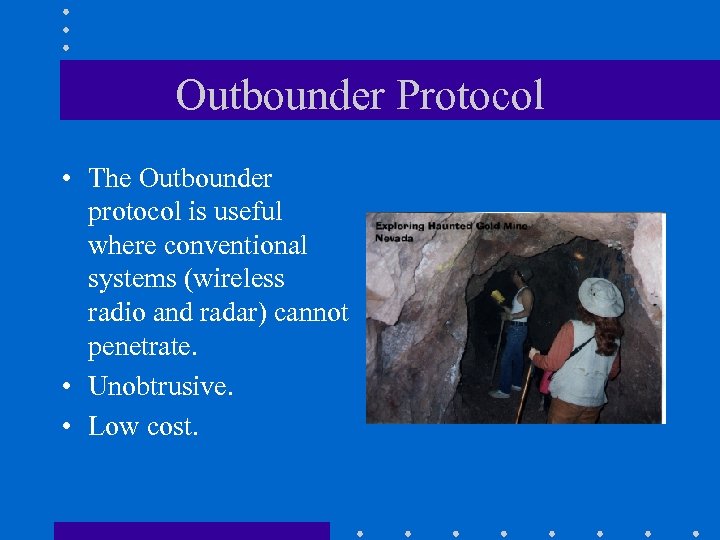
Outbounder Protocol • The Outbounder protocol is useful where conventional systems (wireless radio and radar) cannot penetrate. • Unobtrusive. • Low cost.
Coordinate Remote Viewing • Coordinate Remote Viewing was developed at Stanford Research Institute, CA. • Viewing is done “blind” or with minimal “front loading”, no sensory cueing. • Consists of written perceptions & sketches. • Bypasses imagination & logical deduction. • Data usually evaluated by an analyst.
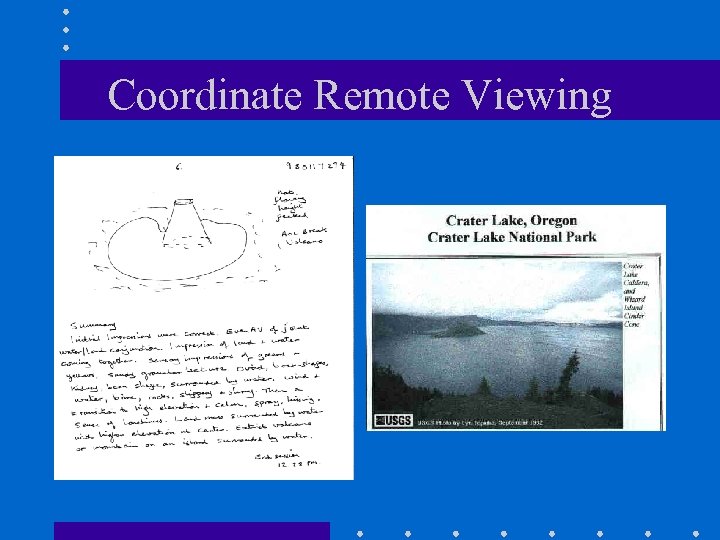
Coordinate Remote Viewing
Controlled Remote Viewing • Controlled Remote Viewing (CRV) is a protocol consisting of sequential stages that allow the viewer increasing target contact. • Viewing is done “blind” or with minimal “front loading”, no sensory cueing. • Consists of written perceptions & sketches. • Bypasses imagination & logical deduction. • Data usually evaluated by an analyst.
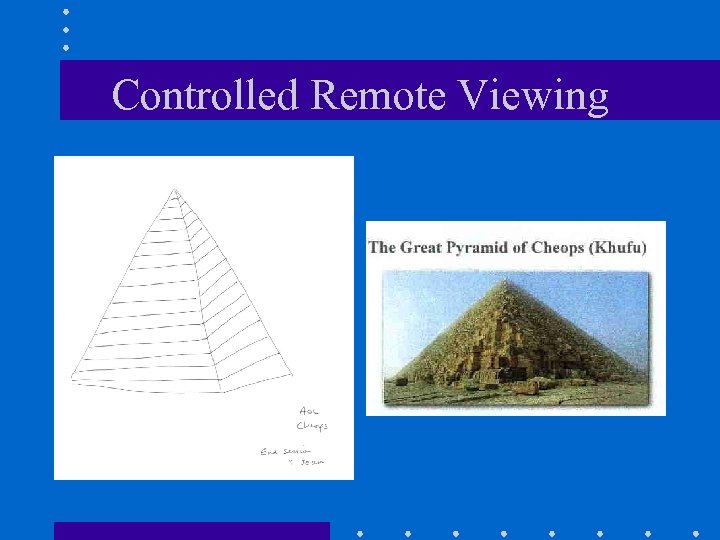
Controlled Remote Viewing
Extended Remote Viewing • Extended Remote Viewing (ERV) developed at Fort Meade Army RV unit. • Viewing is done “blind” or with minimal “front loading”, no sensory cueing. • Consists of viewer in a focused state of consciousness relating perceptions to a monitor who relays data to an analyst.
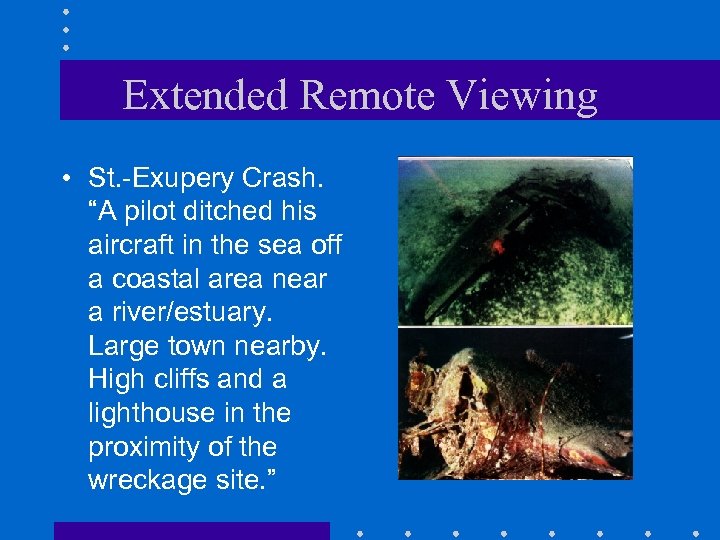
Extended Remote Viewing • St. -Exupery Crash. “A pilot ditched his aircraft in the sea off a coastal area near a river/estuary. Large town nearby. High cliffs and a lighthouse in the proximity of the wreckage site. ”
Associative Remote Viewing • Associative Remote Viewing (ARV) developed by Targ for silver futures work. • Useful for outcomes that have an ambiguous outcome such as the stock market (up, down) or targets with numbers. • Viewer perceives one of two hidden targets that correspond to event outcomes. Viewer shown one target when outcome known.
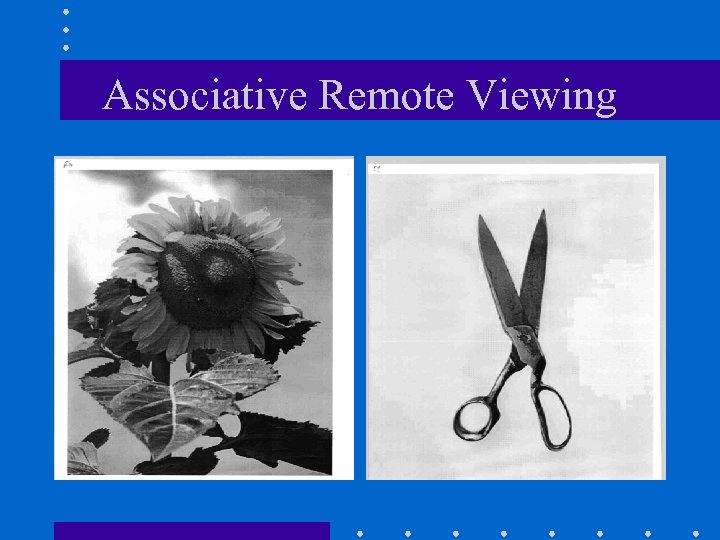
Associative Remote Viewing
Vector Dowsing • Adapted from dowsing skills taught to marines in Vietnam. • Uses map coordinates distant from target. location. No local presence needed at site. • Underground artifacts, tunnels, caves. • Used for archaeological excavations and mining applications.
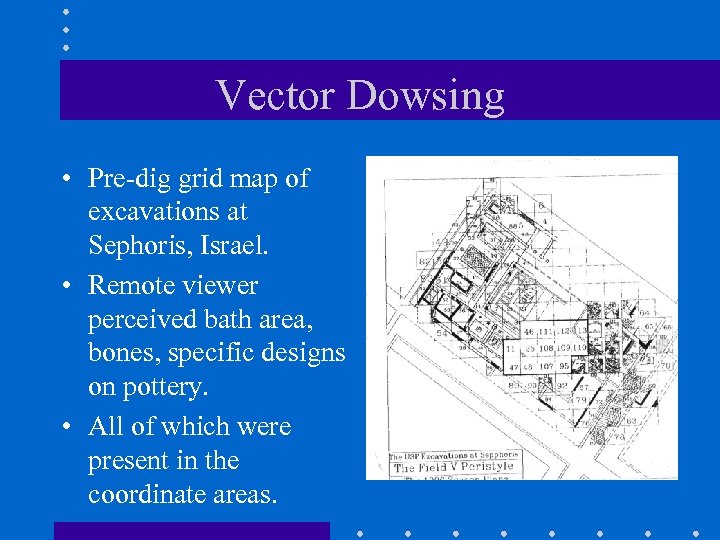
Vector Dowsing • Pre-dig grid map of excavations at Sephoris, Israel. • Remote viewer perceived bath area, bones, specific designs on pottery. • All of which were present in the coordinate areas.
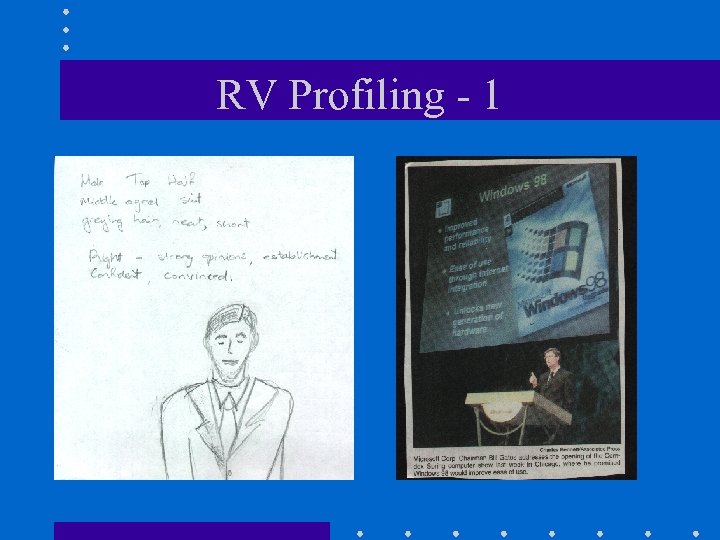
RV Profiling - 1
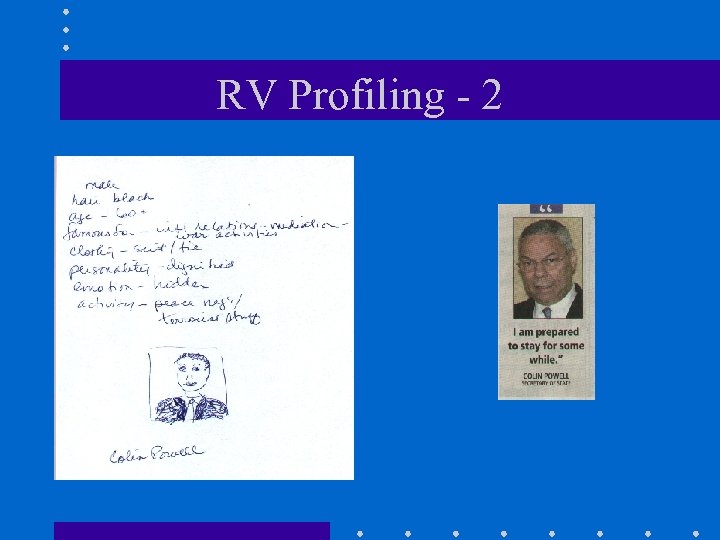
RV Profiling - 2
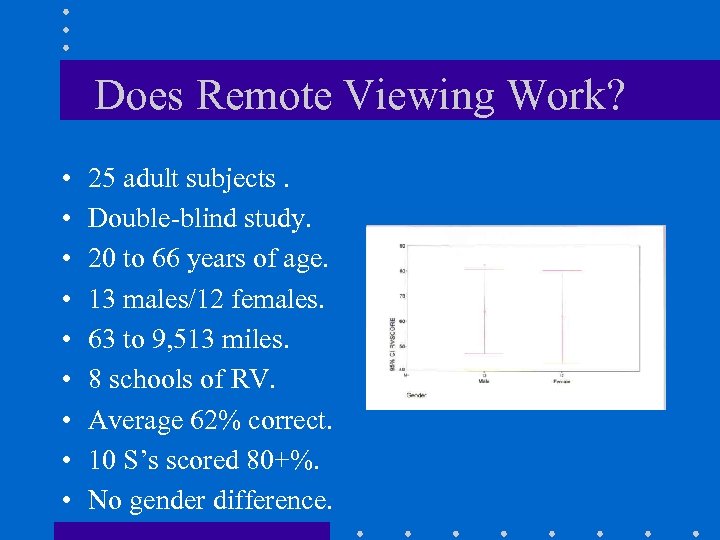
Does Remote Viewing Work? • • • 25 adult subjects. Double-blind study. 20 to 66 years of age. 13 males/12 females. 63 to 9, 513 miles. 8 schools of RV. Average 62% correct. 10 S’s scored 80+%. No gender difference.
Examples of Study Work • Following are examples of remote viewing work performed double-blind for the study. • Viewers used mainly CRV and ERV. • Sessions took an hour, on average, to complete and most were performed solo. • Session summaries were often several pages long and extracts have been presented.
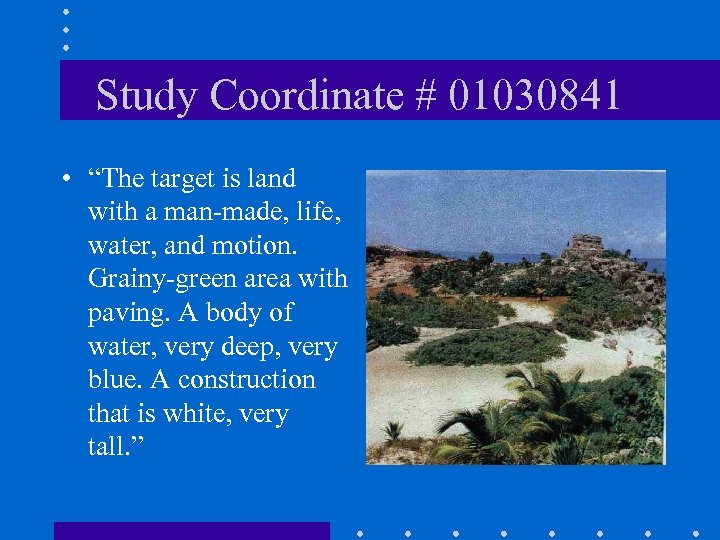
Study Coordinate # 01030841 • “The target is land with a man-made, life, water, and motion. Grainy-green area with paving. A body of water, very deep, very blue. A construction that is white, very tall. ”
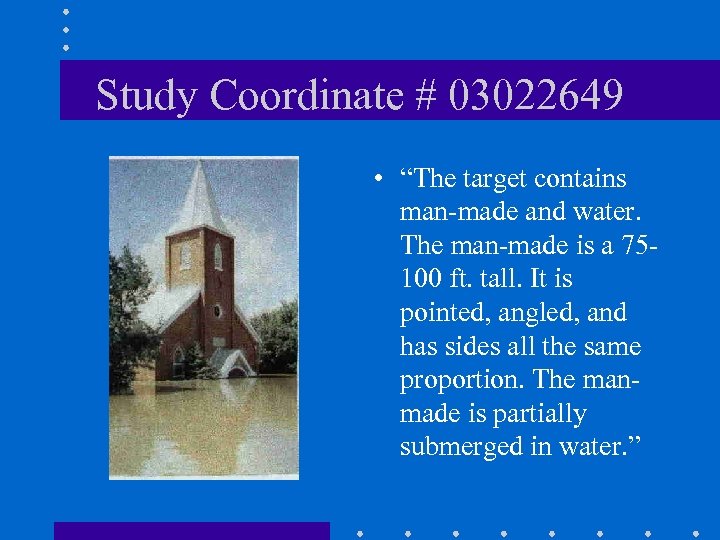
Study Coordinate # 03022649 • “The target contains man-made and water. The man-made is a 75100 ft. tall. It is pointed, angled, and has sides all the same proportion. The manmade is partially submerged in water. ”
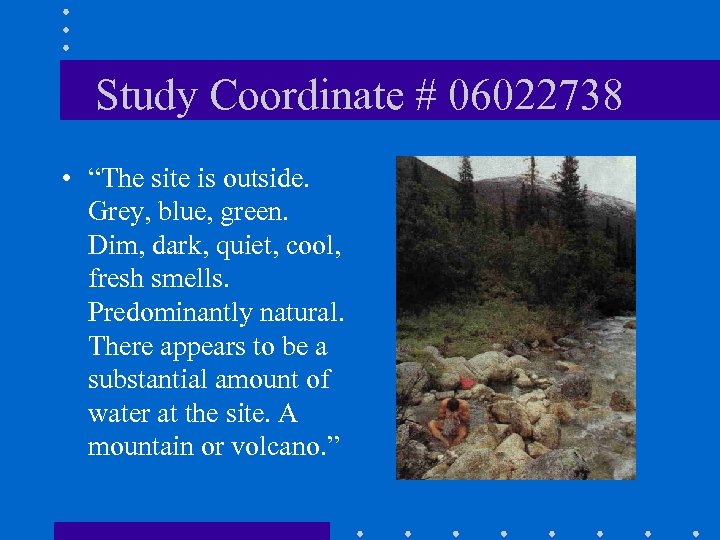
Study Coordinate # 06022738 • “The site is outside. Grey, blue, green. Dim, dark, quiet, cool, fresh smells. Predominantly natural. There appears to be a substantial amount of water at the site. A mountain or volcano. ”
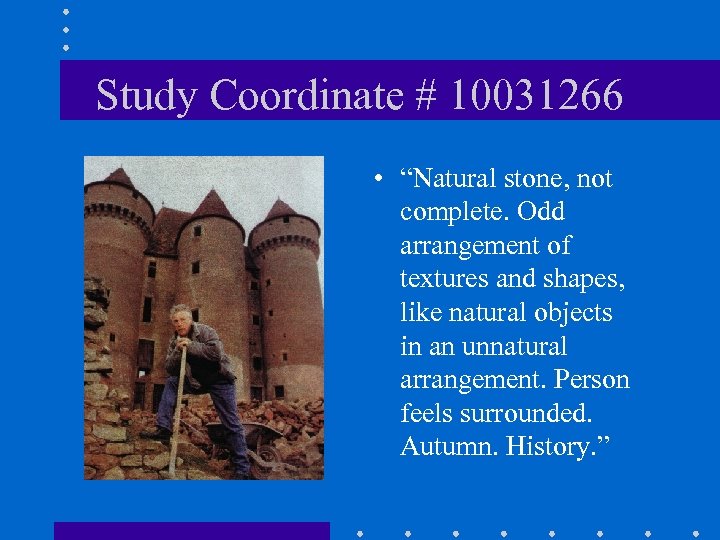
Study Coordinate # 10031266 • “Natural stone, not complete. Odd arrangement of textures and shapes, like natural objects in an unnatural arrangement. Person feels surrounded. Autumn. History. ”
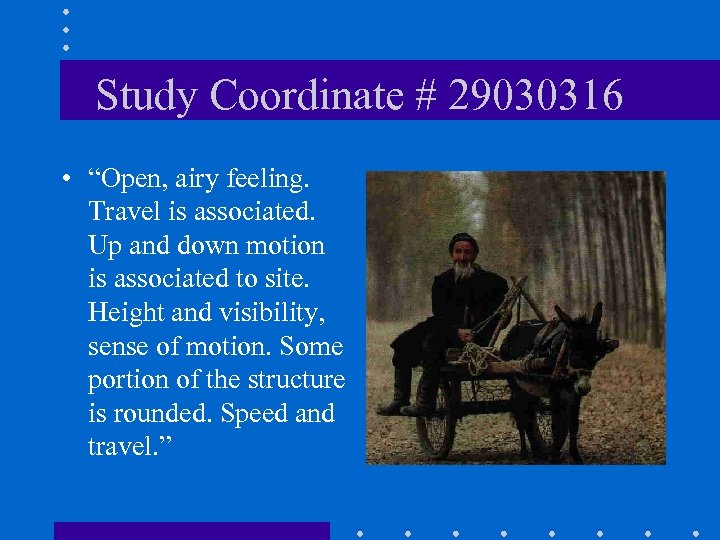
Study Coordinate # 29030316 • “Open, airy feeling. Travel is associated. Up and down motion is associated to site. Height and visibility, sense of motion. Some portion of the structure is rounded. Speed and travel. ”

Study Coordinate # 17032727 • “Neutral colors brown, sepia, beige and black. Surfaces that are shiny, others grainy. Sense of “stepping down” in a series of “serrated ranks. ” Rounded, sequential arrangement. ”
Remote Viewing in Action • Civilian RV applications have been in place since late 1980’s up to present time. • Accuracy rate averages 50 -75% compared to 20% achieved by chance. • Real-world targets have included: historic events, archaeological sites, criminal cases, missing children and adults, business futures, and real estate development.
Operational Examples • Following are three types of operational examples carried out by a trained remote viewer using ERV and CRV. • The viewer was tasked with coordinates and simple “front-loading”, such as what, why, when, where, and who questions, that did not reveal target information to the viewer.
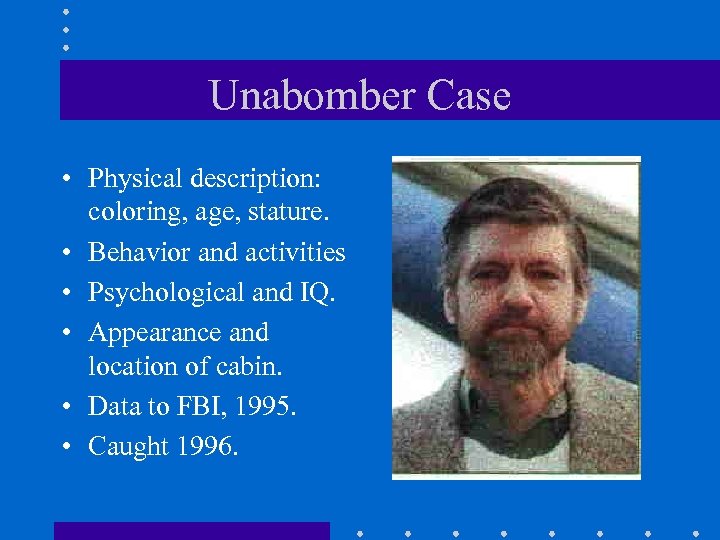
Unabomber Case • Physical description: coloring, age, stature. • Behavior and activities • Psychological and IQ. • Appearance and location of cabin. • Data to FBI, 1995. • Caught 1996.
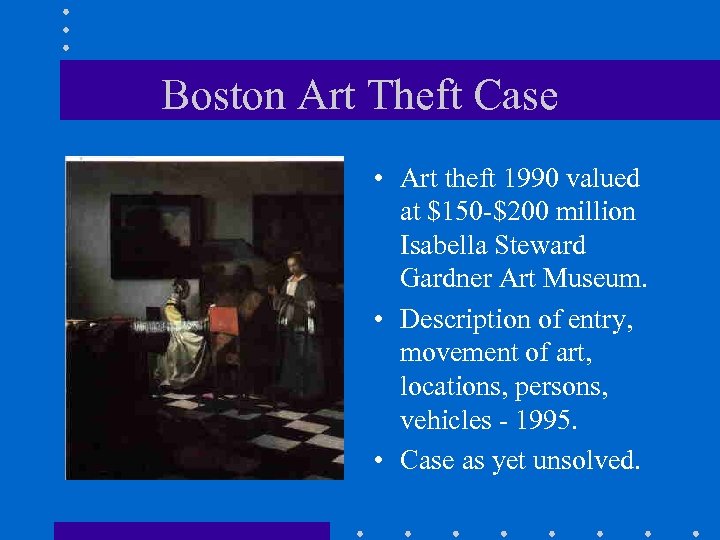
Boston Art Theft Case • Art theft 1990 valued at $150 -$200 million Isabella Steward Gardner Art Museum. • Description of entry, movement of art, locations, persons, vehicles - 1995. • Case as yet unsolved.
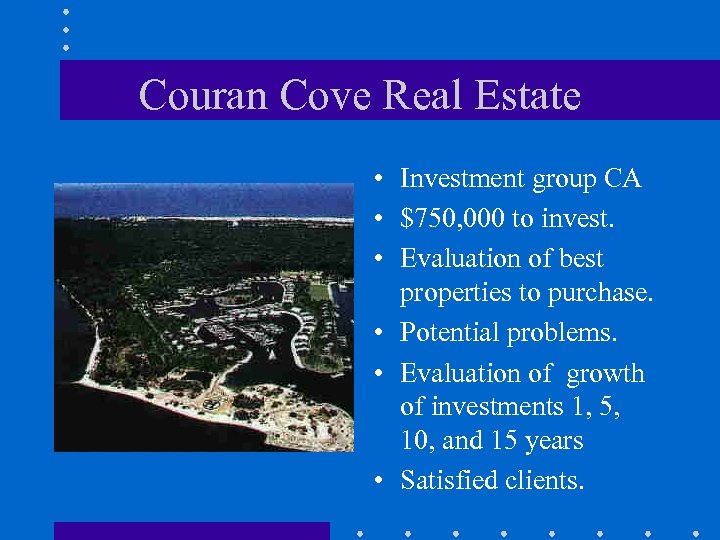
Couran Cove Real Estate • Investment group CA • $750, 000 to invest. • Evaluation of best properties to purchase. • Potential problems. • Evaluation of growth of investments 1, 5, 10, and 15 years • Satisfied clients.
Recommendations • Data sessions are just the tip of the iceberg. • This resource is wastefully managed. • Essential to garner this source of human intelligence by the development of an interdisciplinary team that understands the concepts of remote viewing, tasking, monitoring, and analysis.
Скачать презентацию Thinking Outside The Box Remote Viewing and its
91cc0a7caec05cbcf256e643e4488f6c.ppt