


 Скачать презентацию Thinking Like an Economist Chapter 2 Copyright
Chapter 02.ppt
- Количество слайдов: 36
 Thinking Like an Economist Chapter 2 Copyright © 2001 by Harcourt, Inc. All rights reserved. Requests for permission to make copies of any part of the work should be mailed to: Permissions Department, Harcourt College Publishers, 6277 Sea Harbor Drive, Orlando, Florida 32887 -6777.
 Every field of study has its own terminology Mathematics axioms integrals vector spaces Psychology ego id torts Law Promissory estoppel venues Harcourt, Inc. items and derived items copyright © 2001 by Harcourt, Inc. cognitive dissonance
 Every field of study has its own terminology Economics Supply Opportunity cost Elasticity Consumer Surplus Comparative advantage Demand Harcourt, Inc. items and derived items copyright © 2001 by Harcourt, Inc. Deadweight loss
 Economics trains you to. . u. Think in terms of alternatives. u. Evaluate the cost of individual and social choices. u. Examine and understand how certain events and issues are related. Harcourt, Inc. items and derived items copyright © 2001 by Harcourt, Inc.
 The Economist as a Scientist The economic way of thinking. . . u Involves thinking analytically and objectively. u Makes use of the scientific method. Harcourt, Inc. items and derived items copyright © 2001 by Harcourt, Inc.
 The Scientific Method u. Uses abstract models to help explain how a complex, real world operates. u. Develops theories, collects, and analyzes data to prove theories. Observation, Theory and More Observation! Harcourt, Inc. items and derived items copyright © 2001 by Harcourt, Inc.
 The Role of Assumptions Economists make assumptions in order to make the world easier to understand. u The art in scientific thinking is deciding which assumptions to make. u Economists use different assumptions to answer different questions. u Harcourt, Inc. items and derived items copyright © 2001 by Harcourt, Inc.
 The Economic Way of Thinking u. Includes developing abstract models from theories and the analysis of the models. u. Uses two approaches: Descriptive (reporting facts, etc. ) u Analytical (abstract reasoning) u Harcourt, Inc. items and derived items copyright © 2001 by Harcourt, Inc.
 Economic Models Economists use models to simplify reality in order to improve our understanding of the world u Two of the most basic economic models include: u The Circular Flow Model u The Production Possibilities Frontier u Harcourt, Inc. items and derived items copyright © 2001 by Harcourt, Inc.
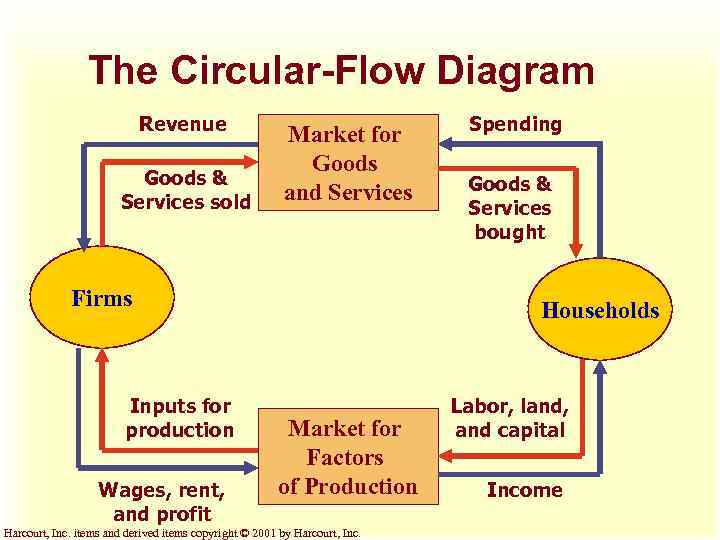
 The Circular-Flow Model The circular-flow model is a simple way to visually show the economic transactions that occur between households and firms in the economy. Harcourt, Inc. items and derived items copyright © 2001 by Harcourt, Inc.
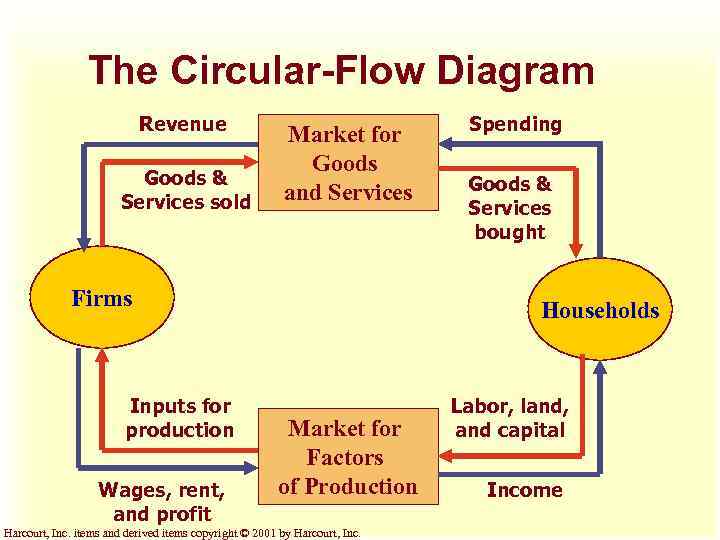 The Circular-Flow Diagram Revenue Goods & Services sold Market for Goods and Services Firms Inputs for production Wages, rent, and profit Spending Goods & Services bought Households Market for Factors of Production Harcourt, Inc. items and derived items copyright © 2001 by Harcourt, Inc. Labor, land, and capital Income
 The Circular-Flow Diagram Firms u Produce and sell goods and services u Hire and use factors of production Households u Buy and consume goods and services u Own and sell factors of production Harcourt, Inc. items and derived items copyright © 2001 by Harcourt, Inc.
 The Circular-Flow Diagram Markets for Goods & Services u Firms u sell Households buy Markets for Factors of Production u Households sell u Firms buy Harcourt, Inc. items and derived items copyright © 2001 by Harcourt, Inc.
 The Circular-Flow Diagram Factors of Production Inputs used to produce goods and services u u Land, labor, and capital Harcourt, Inc. items and derived items copyright © 2001 by Harcourt, Inc.
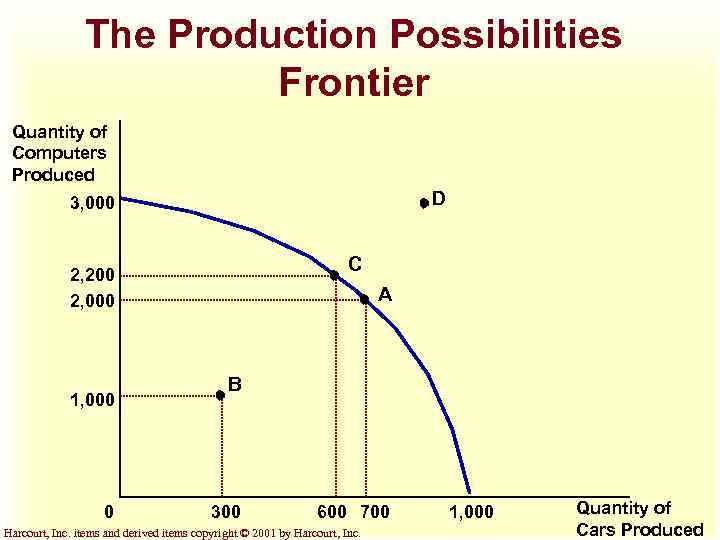
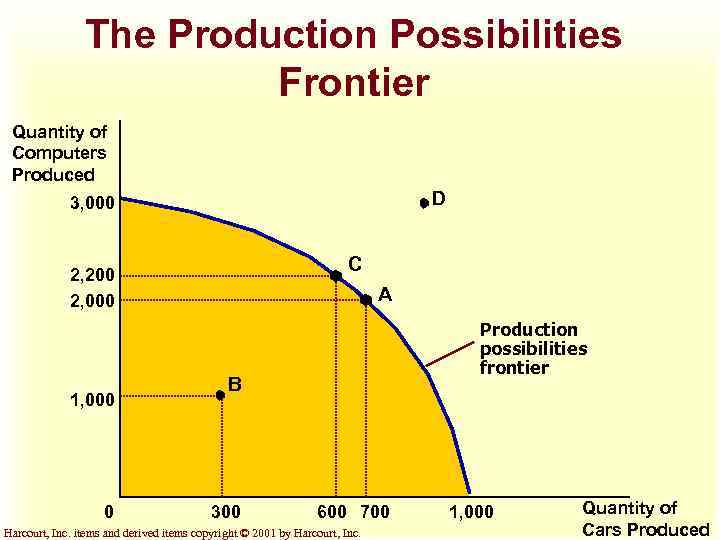
 The Production Possibilities Frontier The production possibilities frontier is a graph showing the various combinations of output that the economy can possibly produce given the available factors of production and technology. Harcourt, Inc. items and derived items copyright © 2001 by Harcourt, Inc.
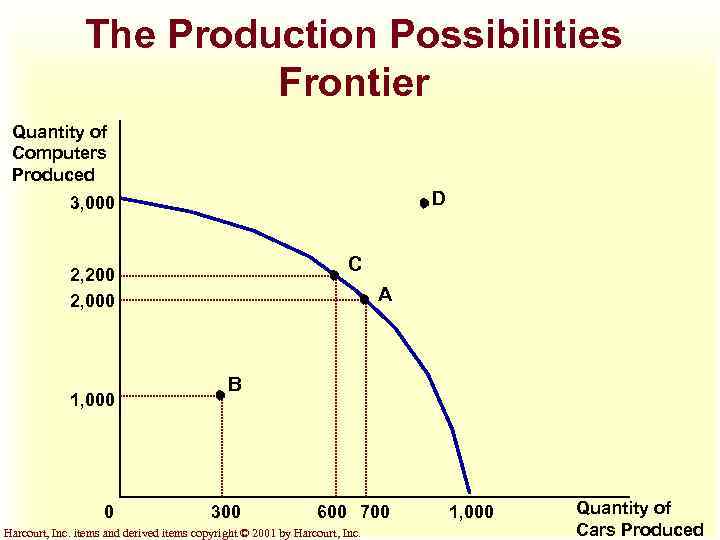 The Production Possibilities Frontier Quantity of Computers Produced D 3, 000 C 2, 200 2, 000 1, 000 0 A B 300 600 700 Harcourt, Inc. items and derived items copyright © 2001 by Harcourt, Inc. 1, 000 Quantity of Cars Produced
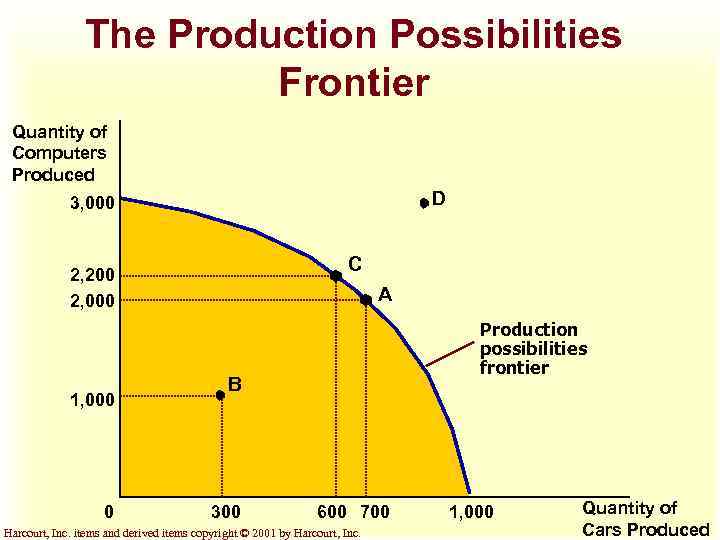 The Production Possibilities Frontier Quantity of Computers Produced D 3, 000 C 2, 200 2, 000 1, 000 0 A Production possibilities frontier B 300 600 700 Harcourt, Inc. items and derived items copyright © 2001 by Harcourt, Inc. 1, 000 Quantity of Cars Produced
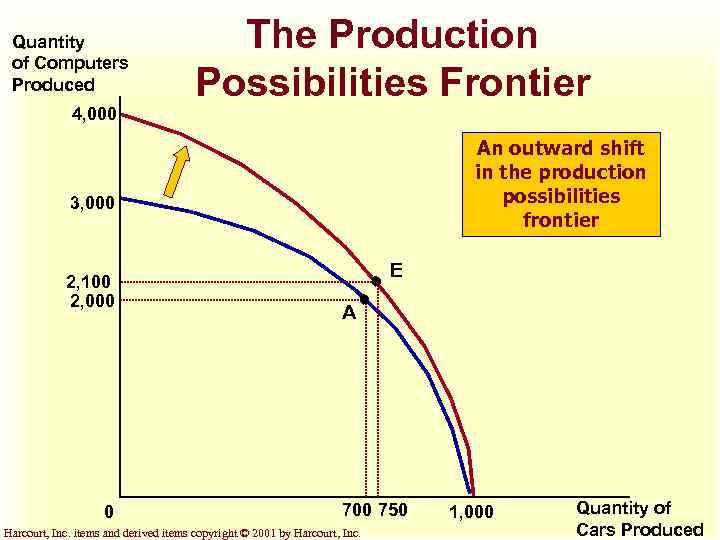
 Concepts Illustrated by the Production Possibilities Frontier u. Efficiency u. Tradeoffs u. Opportunity Cost u. Economic Growth Harcourt, Inc. items and derived items copyright © 2001 by Harcourt, Inc.
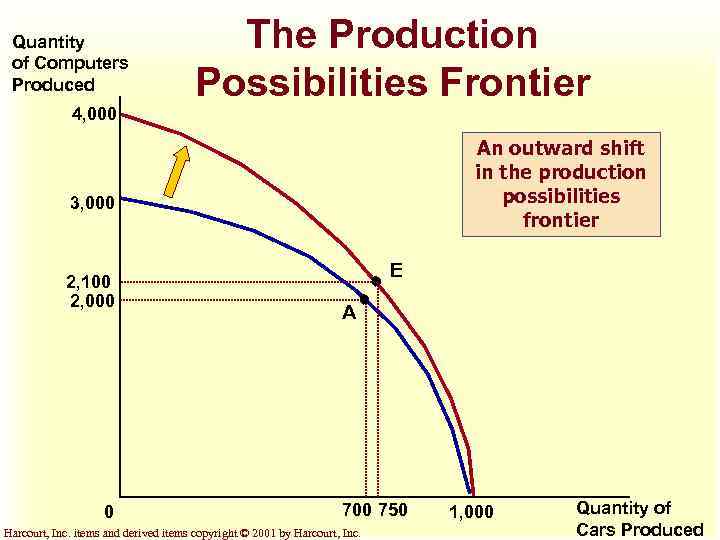 Quantity of Computers Produced 4, 000 The Production Possibilities Frontier An outward shift in the production possibilities frontier 3, 000 2, 100 2, 000 0 E A 700 750 Harcourt, Inc. items and derived items copyright © 2001 by Harcourt, Inc. 1, 000 Quantity of Cars Produced
 Microeconomics and Macroeconomics u Microeconomics focuses on the individual parts of the economy. u How households and firms make decisions and how they interact in specific markets u Macroeconomics looks at the economy as a whole. u How the markets, as a whole, interact at the national level. Harcourt, Inc. items and derived items copyright © 2001 by Harcourt, Inc.
 Two Roles of Economists u. When they are trying to explain the world, they are scientists. u. When they are trying to change the world, they are policymakers. Harcourt, Inc. items and derived items copyright © 2001 by Harcourt, Inc.
 Positive versus Normative Analysis u. Positive statements are statements that describe the world as it is. u. Called descriptive analysis u. Normative statements are statements about how the world should be. u. Called prescriptive analysis Harcourt, Inc. items and derived items copyright © 2001 by Harcourt, Inc.
 Positive or Normative Statements? An increase in the minimum wage will cause a decrease in employment among the least-skilled. ? Harcourt, Inc. items and derived items copyright © 2001 by Harcourt, Inc. ?
 Positive or Normative Statements? Higher federal budget deficits will cause interest rates to increase. ? Harcourt, Inc. items and derived items copyright © 2001 by Harcourt, Inc. ? ?
 Positive or Normative Statements? ? ? The income gains from a higher minimum wage are worth more than any slight reductions in employment. ? Harcourt, Inc. items and derived items copyright © 2001 by Harcourt, Inc. ?
 Positive or Normative Statements? ? ? State governments should be allowed to collect from tobacco companies the costs of treating smoking-related illnesses among the poor. ? Harcourt, Inc. items and derived items copyright © 2001 by Harcourt, Inc.
 Economists in Washington. . . serve as advisers in the policymaking process of the three branches of government: u Legislative u Executive u Judicial Harcourt, Inc. items and derived items copyright © 2001 by Harcourt, Inc.
 Why Economists Disagree u. They may disagree on theories about how the world works. u. They may hold different values and, thus, different normative views. Harcourt, Inc. items and derived items copyright © 2001 by Harcourt, Inc.
 Examples of What Most Economists Agree On u. A ceiling on rents reduces the quantity and quality of housing available. u. Tariffs and import quotas usually reduce general economic welfare. Harcourt, Inc. items and derived items copyright © 2001 by Harcourt, Inc.
 Summary u. In order to address subjects with objectivity, economics makes use of the scientific method. u. The field of economics is divided into two subfields: microeconomics and macroeconomics. Harcourt, Inc. items and derived items copyright © 2001 by Harcourt, Inc.
 Summary u. Economics relies on both positive and normative analysis. Positive statements assert how the world “is” while normative statements assert how the world “should be. ” u. Economists may offer conflicting advice due to differences in scientific judgments or to differences in values. Harcourt, Inc. items and derived items copyright © 2001 by Harcourt, Inc.
 Graphical Review Harcourt, Inc. items and derived items copyright © 2001 by Harcourt, Inc.
 The Circular-Flow Diagram Revenue Goods & Services sold Market for Goods and Services Firms Inputs for production Wages, rent, and profit Spending Goods & Services bought Households Market for Factors of Production Harcourt, Inc. items and derived items copyright © 2001 by Harcourt, Inc. Labor, land, and capital Income
 The Production Possibilities Frontier Quantity of Computers Produced D 3, 000 C 2, 200 2, 000 1, 000 0 A B 300 600 700 Harcourt, Inc. items and derived items copyright © 2001 by Harcourt, Inc. 1, 000 Quantity of Cars Produced
 The Production Possibilities Frontier Quantity of Computers Produced D 3, 000 C 2, 200 2, 000 1, 000 0 A Production possibilities frontier B 300 600 700 Harcourt, Inc. items and derived items copyright © 2001 by Harcourt, Inc. 1, 000 Quantity of Cars Produced
 Quantity of Computers Produced 4, 000 The Production Possibilities Frontier An outward shift in the production possibilities frontier 3, 000 2, 100 2, 000 0 E A 700 750 Harcourt, Inc. items and derived items copyright © 2001 by Harcourt, Inc. 1, 000 Quantity of Cars Produced