


 Скачать презентацию Thinking and Decision Making Psychology 2235 Prof Elke
5cf3d85e500a6e681be98678e6111ebf.ppt
- Количество слайдов: 7
 Thinking and Decision Making Psychology 2235 Prof. Elke Weber Segment 2 Descriptive Models
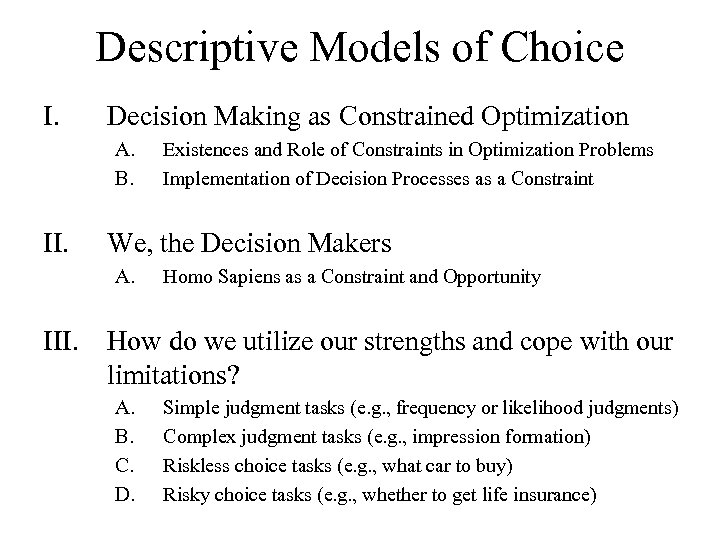 Descriptive Models of Choice I. Decision Making as Constrained Optimization A. B. II. Existences and Role of Constraints in Optimization Problems Implementation of Decision Processes as a Constraint We, the Decision Makers A. Homo Sapiens as a Constraint and Opportunity III. How do we utilize our strengths and cope with our limitations? A. B. C. D. Simple judgment tasks (e. g. , frequency or likelihood judgments) Complex judgment tasks (e. g. , impression formation) Riskless choice tasks (e. g. , what car to buy) Risky choice tasks (e. g. , whether to get life insurance)
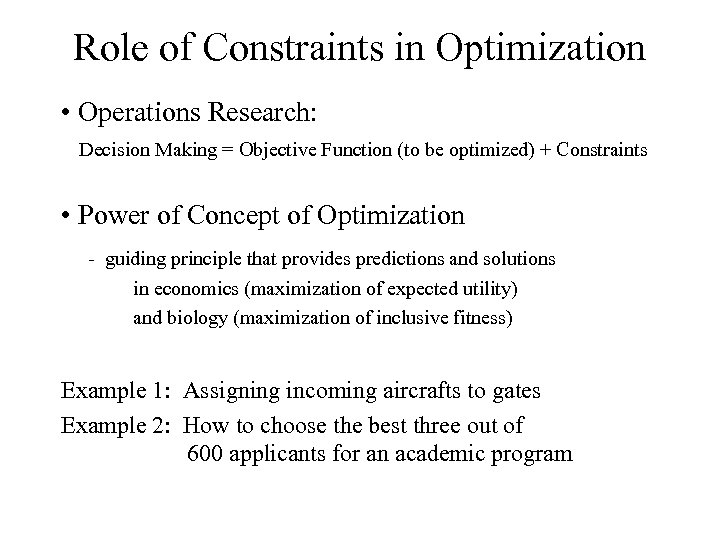 Role of Constraints in Optimization • Operations Research: Decision Making = Objective Function (to be optimized) + Constraints • Power of Concept of Optimization - guiding principle that provides predictions and solutions in economics (maximization of expected utility) and biology (maximization of inclusive fitness) Example 1: Assigning incoming aircrafts to gates Example 2: How to choose the best three out of 600 applicants for an academic program
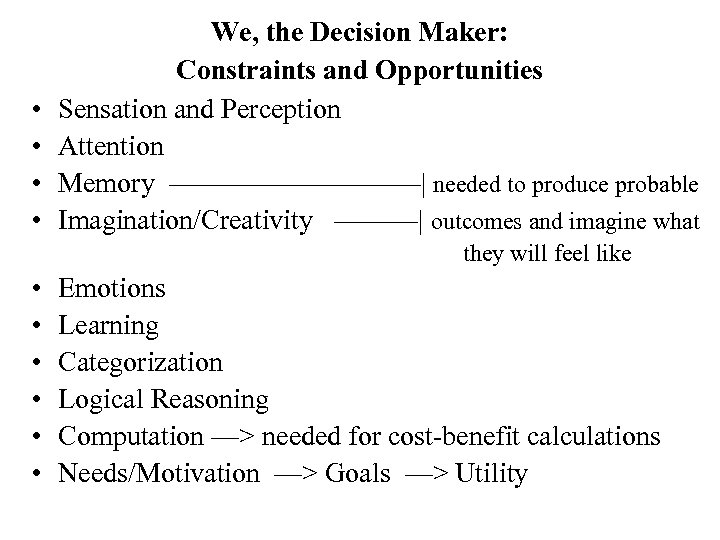 • • We, the Decision Maker: Constraints and Opportunities Sensation and Perception Attention Memory —————| needed to produce probable Imagination/Creativity ———| outcomes and imagine what they will feel like • • • Emotions Learning Categorization Logical Reasoning Computation —> needed for cost-benefit calculations Needs/Motivation —> Goals —> Utility
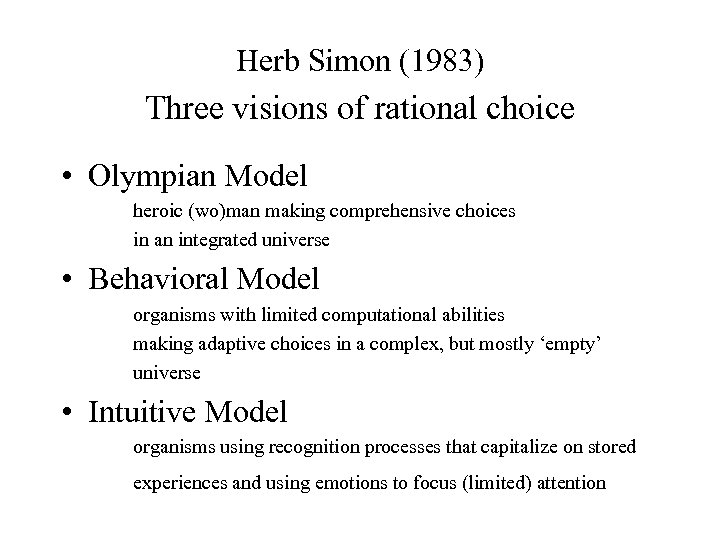 Herb Simon (1983) Three visions of rational choice • Olympian Model heroic (wo)man making comprehensive choices in an integrated universe • Behavioral Model organisms with limited computational abilities making adaptive choices in a complex, but mostly ‘empty’ universe • Intuitive Model organisms using recognition processes that capitalize on stored experiences and using emotions to focus (limited) attention
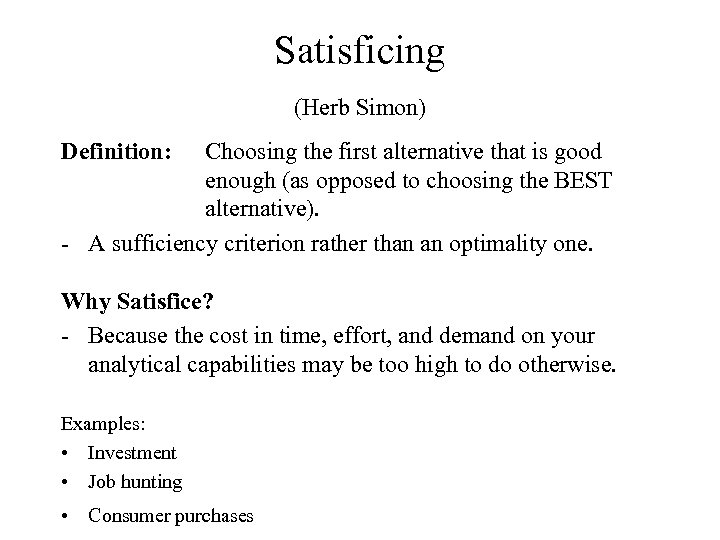 Satisficing (Herb Simon) Definition: Choosing the first alternative that is good enough (as opposed to choosing the BEST alternative). - A sufficiency criterion rather than an optimality one. Why Satisfice? - Because the cost in time, effort, and demand on your analytical capabilities may be too high to do otherwise. Examples: • Investment • Job hunting • Consumer purchases
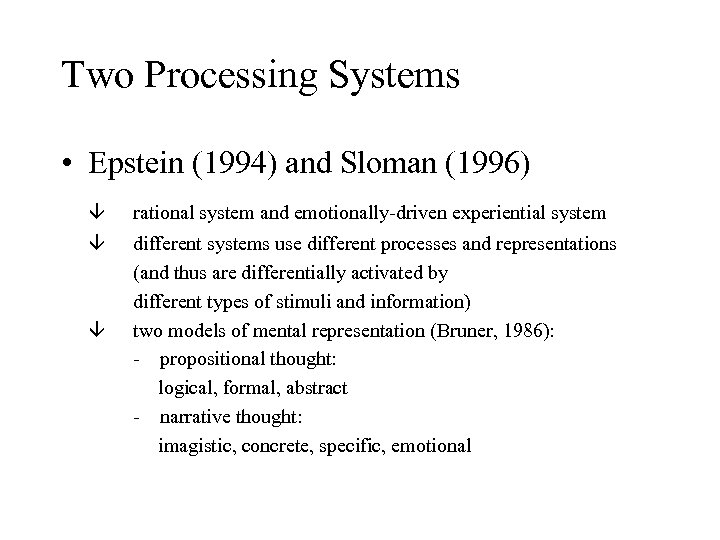 Two Processing Systems • Epstein (1994) and Sloman (1996) rational system and emotionally-driven experiential system different systems use different processes and representations (and thus are differentially activated by different types of stimuli and information) two models of mental representation (Bruner, 1986): - propositional thought: logical, formal, abstract - narrative thought: imagistic, concrete, specific, emotional