 Скачать презентацию Thinking about information and what we do with
c7f5027a4772288db8f3a785b61242dd.ppt
- Количество слайдов: 19



Thinking about information and what we do with it: A taxonomy of sorts Tony Stavely HCI Seminar 23 November 2000 © 2000 Homer E. Stavely
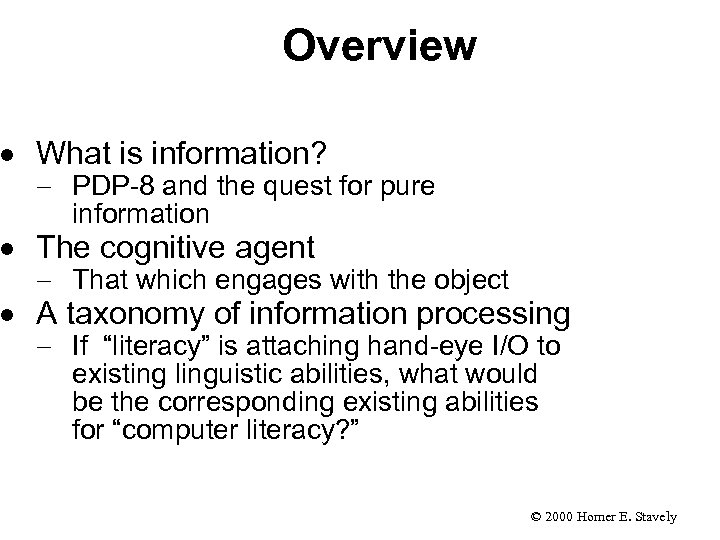
Overview · What is information? - PDP-8 and the quest for pure information · The cognitive agent - That which engages with the object · A taxonomy of information processing - If “literacy” is attaching hand-eye I/O to existing linguistic abilities, what would be the corresponding existing abilities for “computer literacy? ” © 2000 Homer E. Stavely
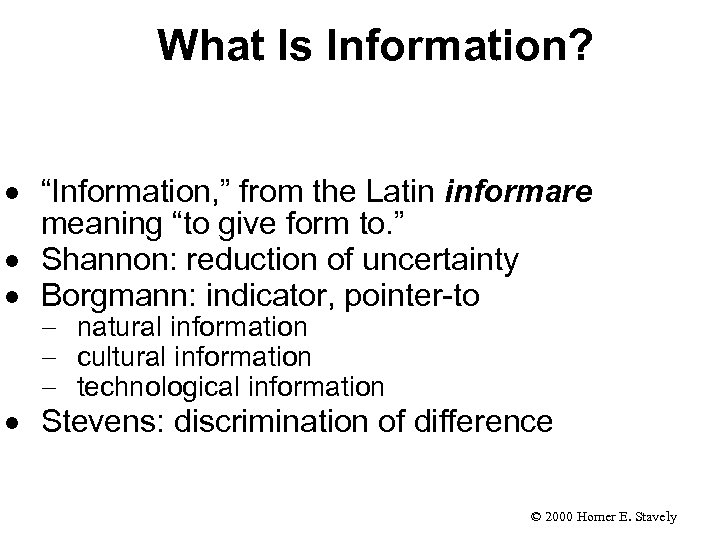
What Is Information? · “Information, ” from the Latin informare meaning “to give form to. ” · Shannon: reduction of uncertainty · Borgmann: indicator, pointer-to - natural information - cultural information - technological information · Stevens: discrimination of difference © 2000 Homer E. Stavely
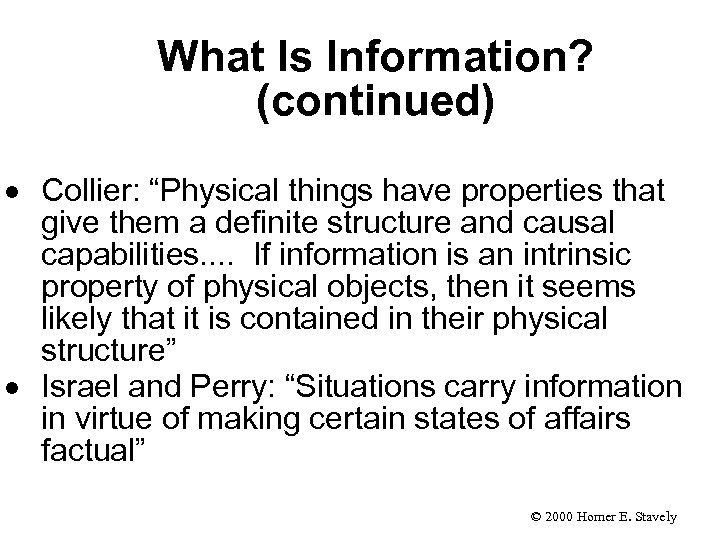
What Is Information? (continued) · Collier: “Physical things have properties that give them a definite structure and causal capabilities. . If information is an intrinsic property of physical objects, then it seems likely that it is contained in their physical structure” · Israel and Perry: “Situations carry information in virtue of making certain states of affairs factual” © 2000 Homer E. Stavely
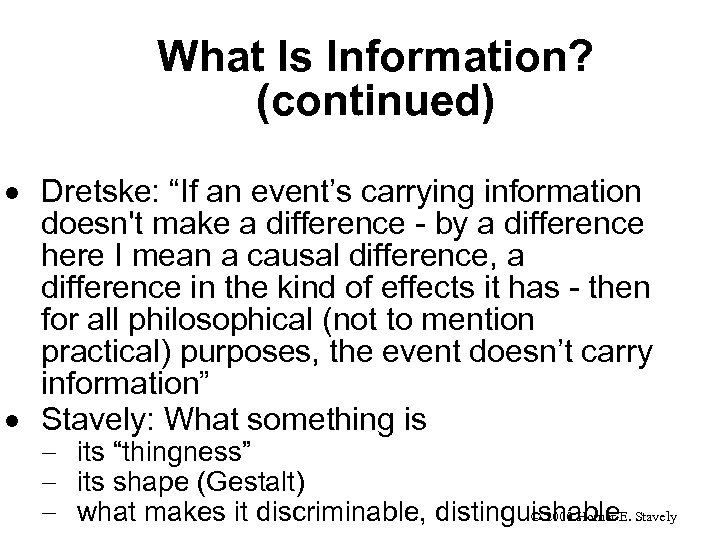
What Is Information? (continued) · Dretske: “If an event’s carrying information doesn't make a difference - by a difference here I mean a causal difference, a difference in the kind of effects it has - then for all philosophical (not to mention practical) purposes, the event doesn’t carry information” · Stavely: What something is - its “thingness” - its shape (Gestalt) - what makes it discriminable, distinguishable. E. Stavely © 2000 Homer
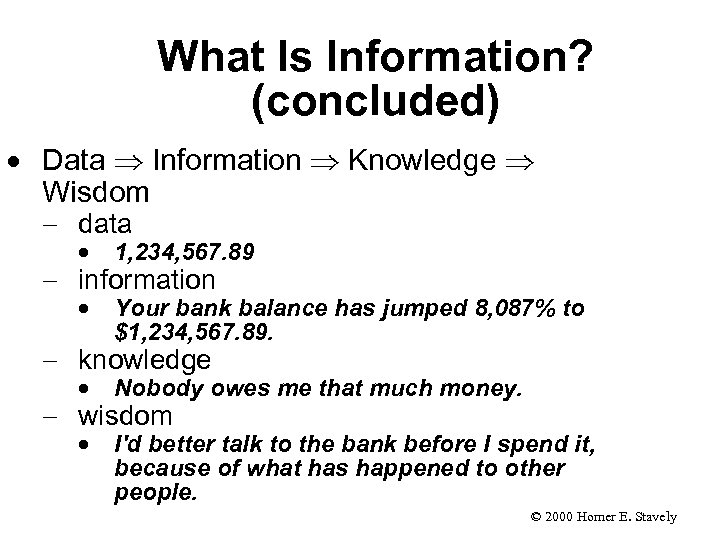
What Is Information? (concluded) · Data Information Knowledge Wisdom - data · 1, 234, 567. 89 · Your bank balance has jumped 8, 087% to $1, 234, 567. 89. - information - knowledge · Nobody owes me that much money. · I'd better talk to the bank before I spend it, because of what has happened to other people. - wisdom © 2000 Homer E. Stavely
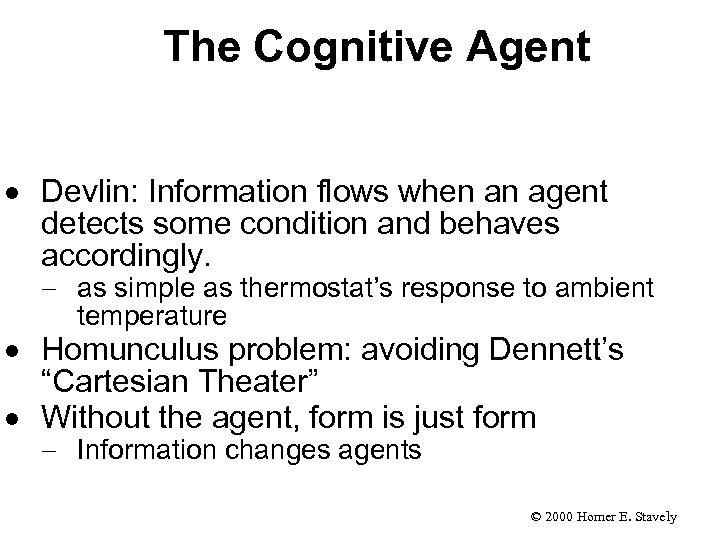
The Cognitive Agent · Devlin: Information flows when an agent detects some condition and behaves accordingly. - as simple as thermostat’s response to ambient temperature · Homunculus problem: avoiding Dennett’s “Cartesian Theater” · Without the agent, form is just form - Information changes agents © 2000 Homer E. Stavely
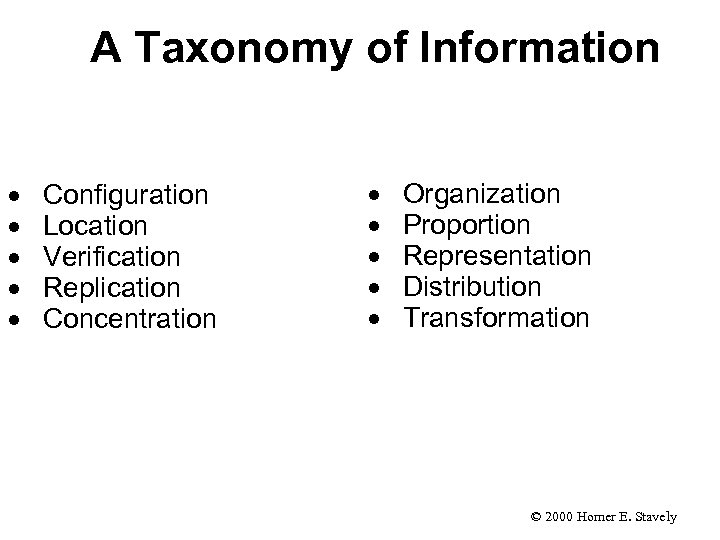
A Taxonomy of Information · · · Configuration Location Verification Replication Concentration · · · Organization Proportion Representation Distribution Transformation © 2000 Homer E. Stavely
Taxonomy Context · Prototypical activities - conducting library research for a literature review - going grocery shopping - going to the hardware store and lumberyard for a long-postponed home repair · Using a computer calls for the same behaviors at some level - a matter of handling and managing objects. © 2000 Homer E. Stavely
Taxonomy · Configuration: distinguishability - recognition - identification - pattern detection · Location: what exists in some place - Search is the primary activity · · Search strategies Domain knowledge Sense of direction Familiarity with tools - Useless without agent access © 2000 Homer E. Stavely
Taxonomy · Verification - Is the object what it appears, what it purports to be? · · illusion vs. reality Borgmann: signification – Does X signify (give information about) Y? Or something about else? - encoding/decoding: encrypting/decrypting · · trust/mistrust: certification, masquerade analysis, testing - vigilance, experience © 2000 Homer E. Stavely
Taxonomy · Replication: copying - Haldane: The chicken is the egg's way of making another egg. - Configuration-replicating technologies have shaped human history. © 2000 Homer E. Stavely
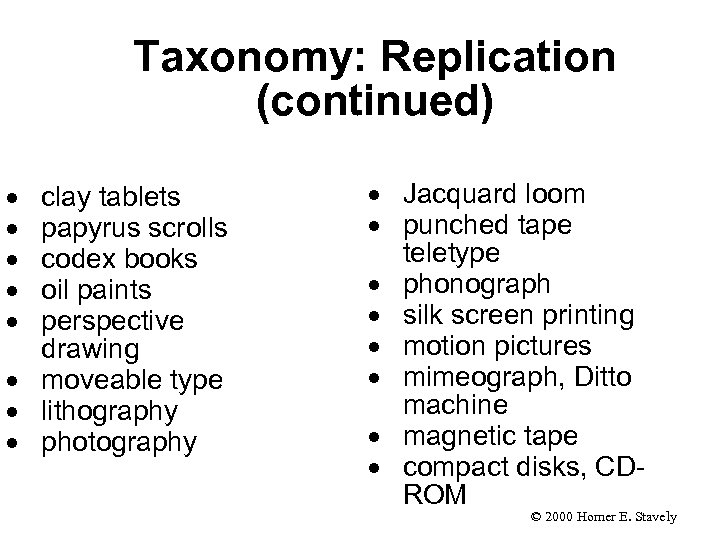
Taxonomy: Replication (continued) · · · clay tablets papyrus scrolls codex books oil paints perspective drawing · moveable type · lithography · photography · Jacquard loom · punched tape teletype · phonograph · silk screen printing · motion pictures · mimeograph, Ditto machine · magnetic tape · compact disks, CDROM © 2000 Homer E. Stavely
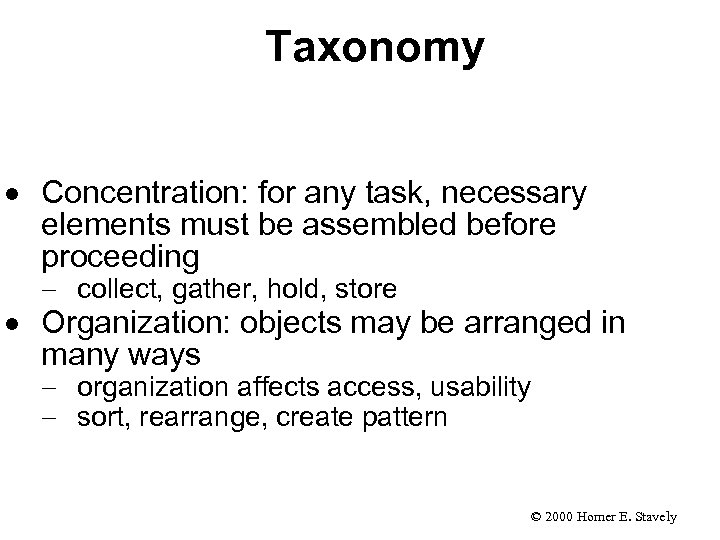
Taxonomy · Concentration: for any task, necessary elements must be assembled before proceeding - collect, gather, hold, store · Organization: objects may be arranged in many ways - organization affects access, usability - sort, rearrange, create pattern © 2000 Homer E. Stavely
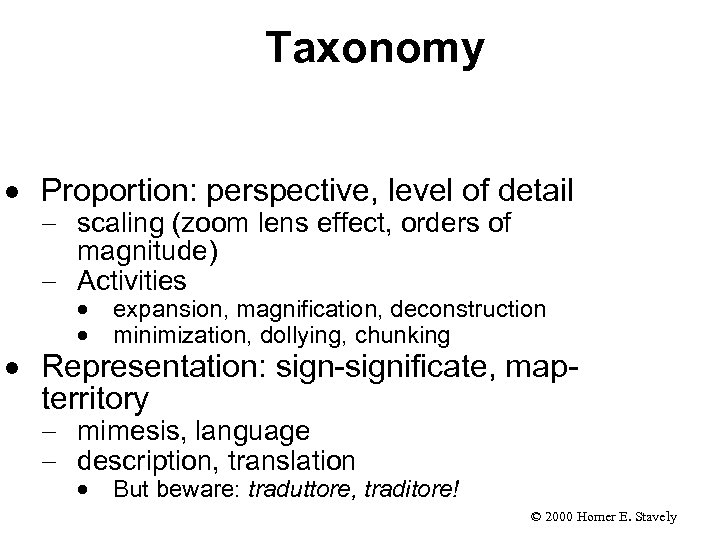
Taxonomy · Proportion: perspective, level of detail - scaling (zoom lens effect, orders of magnitude) - Activities · · expansion, magnification, deconstruction minimization, dollying, chunking · Representation: sign-significate, mapterritory - mimesis, language - description, translation · But beware: traduttore, traditore! © 2000 Homer E. Stavely
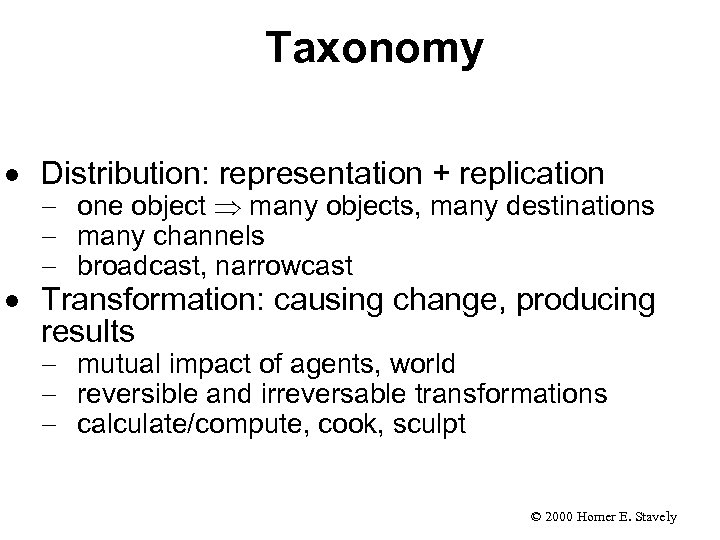
Taxonomy · Distribution: representation + replication - one object many objects, many destinations - many channels - broadcast, narrowcast · Transformation: causing change, producing results - mutual impact of agents, world - reversible and irreversable transformations - calculate/compute, cook, sculpt © 2000 Homer E. Stavely
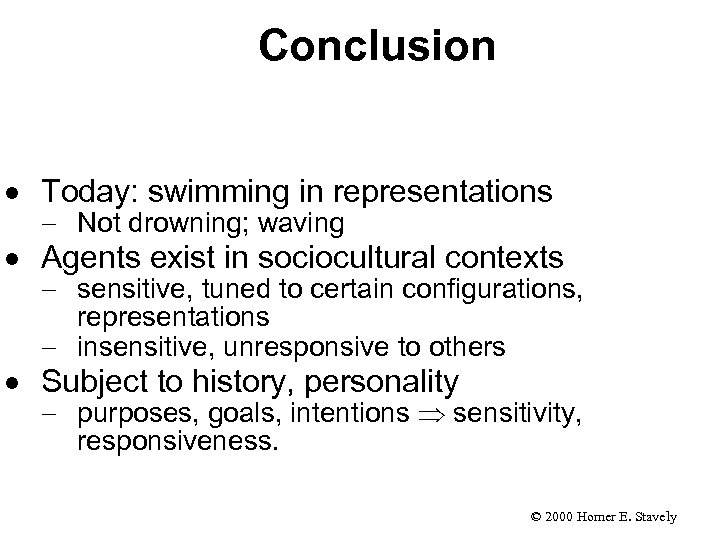
Conclusion · Today: swimming in representations - Not drowning; waving · Agents exist in sociocultural contexts - sensitive, tuned to certain configurations, representations - insensitive, unresponsive to others · Subject to history, personality - purposes, goals, intentions sensitivity, responsiveness. © 2000 Homer E. Stavely
Conclusion Information literacy means apprenticeship, journeyman skill in engaging these dimensions of a various, changing, altogether uncertain world. © 2000 Homer E. Stavely
Conclusion Knowledge is limited; ignorance is not. © 2000 Homer E. Stavely
Скачать презентацию Thinking about information and what we do with
c7f5027a4772288db8f3a785b61242dd.ppt