


 Скачать презентацию Thin Film CIGS Photovoltaics Rommel Noufi Solo Power
b9d497fa2e719ed87bbc52d32f0aca2c.ppt
- Количество слайдов: 35
 Thin Film CIGS Photovoltaics Rommel Noufi Solo. Power, Inc. 5981 Optical Court, San Jose, CA 95138 www. solopower. com • email: rnoufi@solopower. com 2008 Solo. Power
 Acknowledgements: Bulent Basol Solo. Power, Inc. , California Robert Birkmire Institute of Energy Conversion, Delaware Bolko von Roedern, Michael Kempe, and Joel Del Cueto National Renewable Energy Laboratory, Colorado 2008 Solo. Power 2
 Outline Status of the Technology – Laboratory cells – Modules Challenges Ahead 2008 Solo. Power 3
 Status of PV • 3700 MW produced world wide • 266 MW produced in the US • Thin Film Market Share: 10% world wide, 65% in the US Source: PV News, Photon International, Navigant Consultants 2008 Solo. Power 4
![Status of Thin Film PV • Currently, FIRST SOLAR [ Cd. Te ] is](https://present5.com/presentation/b9d497fa2e719ed87bbc52d32f0aca2c/image-5.jpg "Status of Thin Film PV • Currently, FIRST SOLAR [ Cd. Te ] is") Status of Thin Film PV • Currently, FIRST SOLAR [ Cd. Te ] is the largest Thin Film manufacturing company in the US - 277 MW in 2007 - 910 MW expected in 2009 • Demonstrated the viability of Thin Film PV - High Throughput - Large Scale - Low Cost per Watt Source: First Solar. com 2008 Solo. Power 5
Status of Thin Film PV • Currently, FIRST SOLAR [ Cd. Te ] is the largest Thin Film manufacturing company in the US - 277 MW in 2007 - 910 MW expected in 2009 • Demonstrated the viability of Thin Film PV - High Throughput - Large Scale - Low Cost per Watt Source: First Solar. com 2008 Solo. Power 5
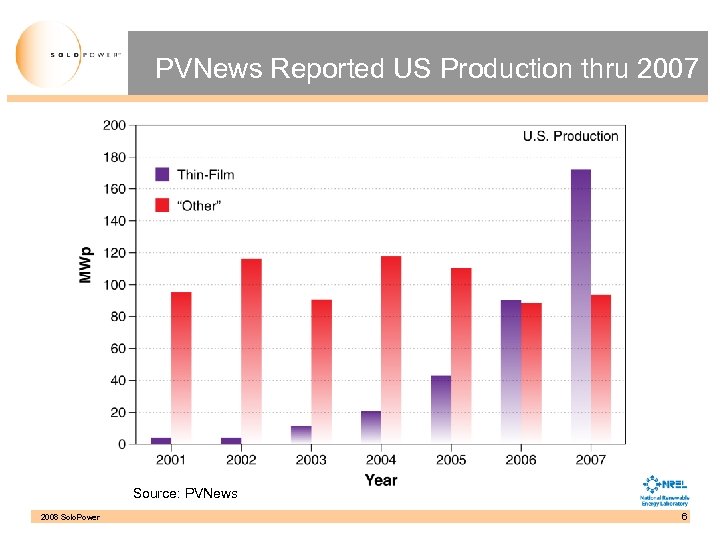 PVNews Reported US Production thru 2007 Source: PVNews 2008 Solo. Power 6
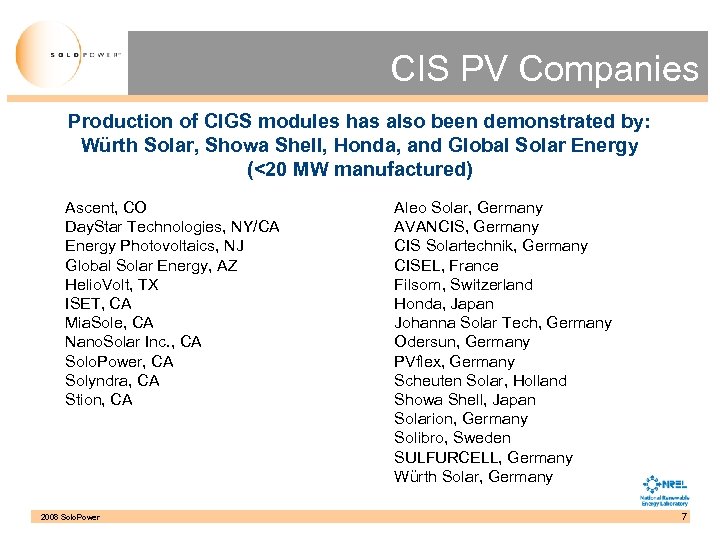 CIS PV Companies Production of CIGS modules has also been demonstrated by: Würth Solar, Showa Shell, Honda, and Global Solar Energy (<20 MW manufactured) Ascent, CO Day. Star Technologies, NY/CA Energy Photovoltaics, NJ Global Solar Energy, AZ Helio. Volt, TX ISET, CA Mia. Sole, CA Nano. Solar Inc. , CA Solo. Power, CA Solyndra, CA Stion, CA 2008 Solo. Power Aleo Solar, Germany AVANCIS, Germany CIS Solartechnik, Germany CISEL, France Filsom, Switzerland Honda, Japan Johanna Solar Tech, Germany Odersun, Germany PVflex, Germany Scheuten Solar, Holland Showa Shell, Japan Solarion, Germany Solibro, Sweden SULFURCELL, Germany Würth Solar, Germany 7
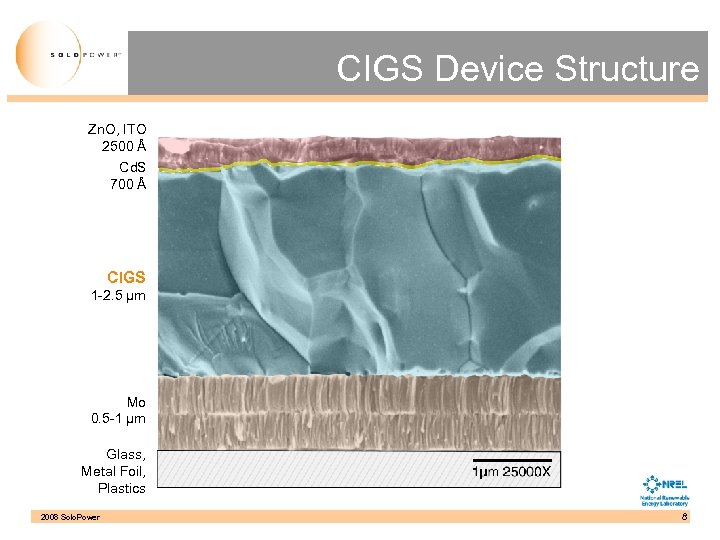 CIGS Device Structure Zn. O, ITO 2500 Å Cd. S 700 Å CIGS 1 -2. 5 µm Mo 0. 5 -1 µm Glass, Metal Foil, Plastics 2008 Solo. Power 8
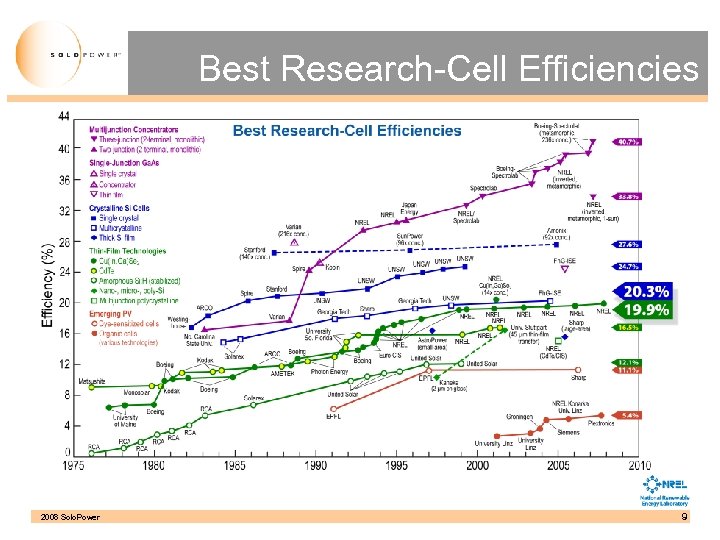 Best Research-Cell Efficiencies 2008 Solo. Power 9
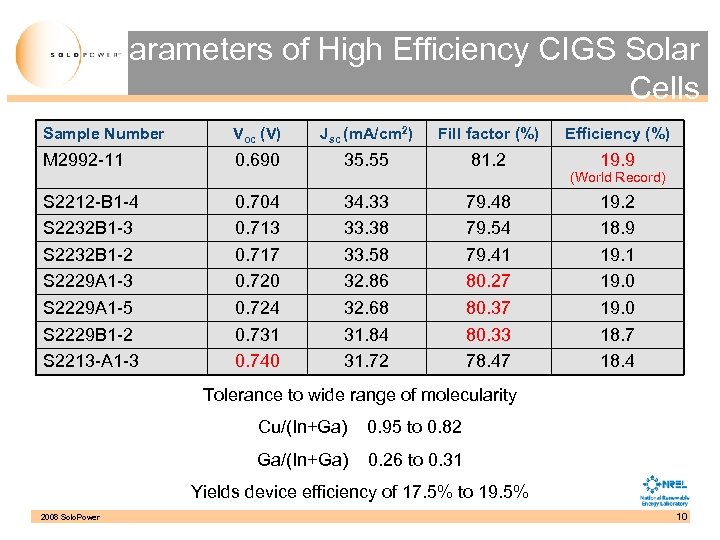 Parameters of High Efficiency CIGS Solar Cells Sample Number Voc (V) Jsc (m. A/cm 2) Fill factor (%) Efficiency (%) M 2992 -11 0. 690 35. 55 81. 2 19. 9 S 2212 -B 1 -4 S 2232 B 1 -3 S 2232 B 1 -2 S 2229 A 1 -3 S 2229 A 1 -5 S 2229 B 1 -2 S 2213 -A 1 -3 0. 704 0. 713 0. 717 0. 720 0. 724 0. 731 0. 740 34. 33 33. 38 33. 58 32. 86 32. 68 31. 84 31. 72 79. 48 79. 54 79. 41 80. 27 80. 33 78. 47 (World Record) 19. 2 18. 9 19. 1 19. 0 18. 7 18. 4 Tolerance to wide range of molecularity Cu/(In+Ga) 0. 95 to 0. 82 Ga/(In+Ga) 0. 26 to 0. 31 Yields device efficiency of 17. 5% to 19. 5% 2008 Solo. Power 10
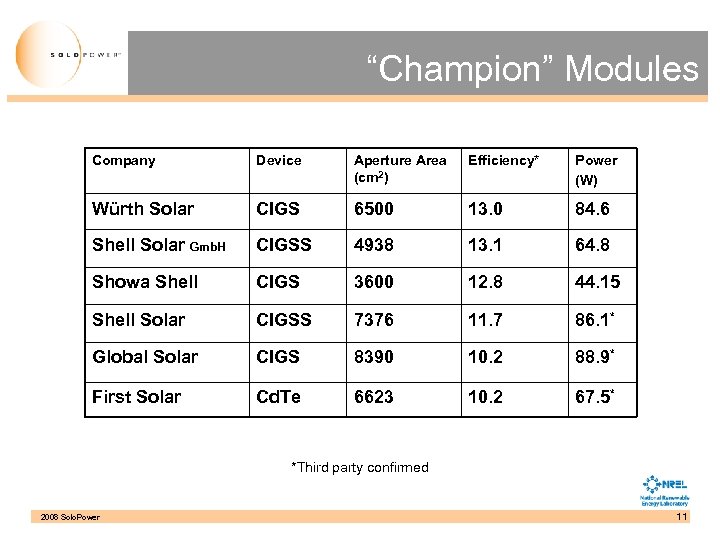 “Champion” Modules Company Device Aperture Area (cm 2) Efficiency* Power (W) Würth Solar CIGS 6500 13. 0 84. 6 Shell Solar Gmb. H CIGSS 4938 13. 1 64. 8 Showa Shell CIGS 3600 12. 8 44. 15 Shell Solar CIGSS 7376 11. 7 86. 1* Global Solar CIGS 8390 10. 2 88. 9* First Solar Cd. Te 6623 10. 2 67. 5* *Third party confirmed 2008 Solo. Power 11
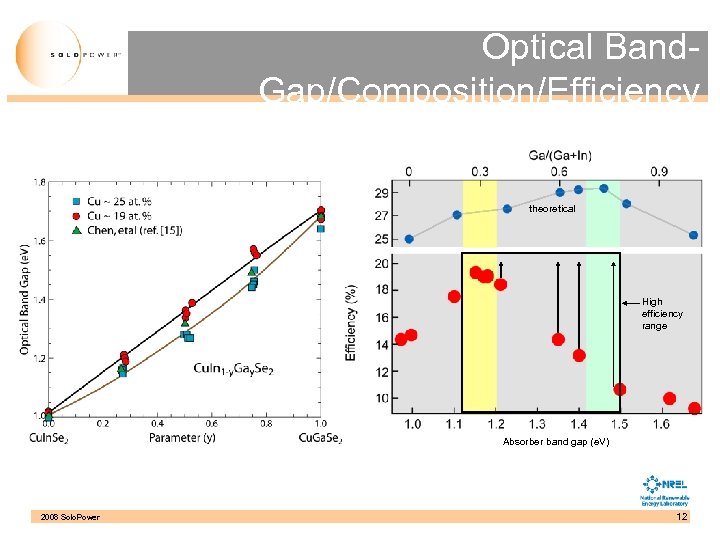 Optical Band. Gap/Composition/Efficiency theoretical High efficiency range Absorber band gap (e. V) 2008 Solo. Power 12
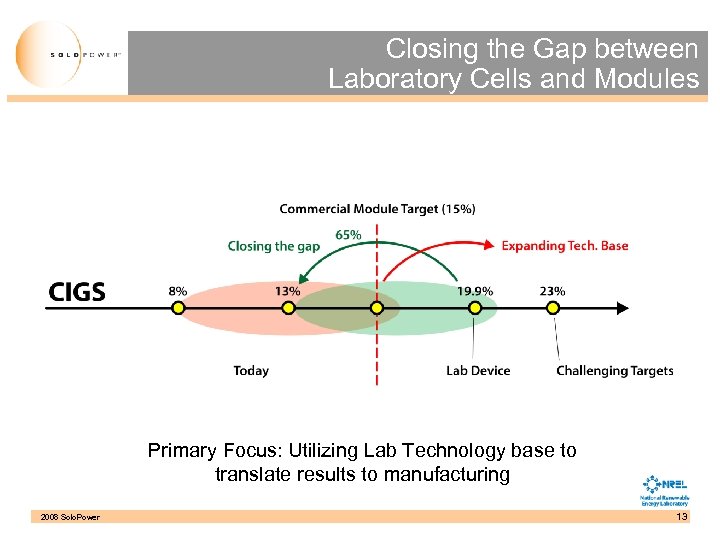 Closing the Gap between Laboratory Cells and Modules Primary Focus: Utilizing Lab Technology base to translate results to manufacturing 2008 Solo. Power 13
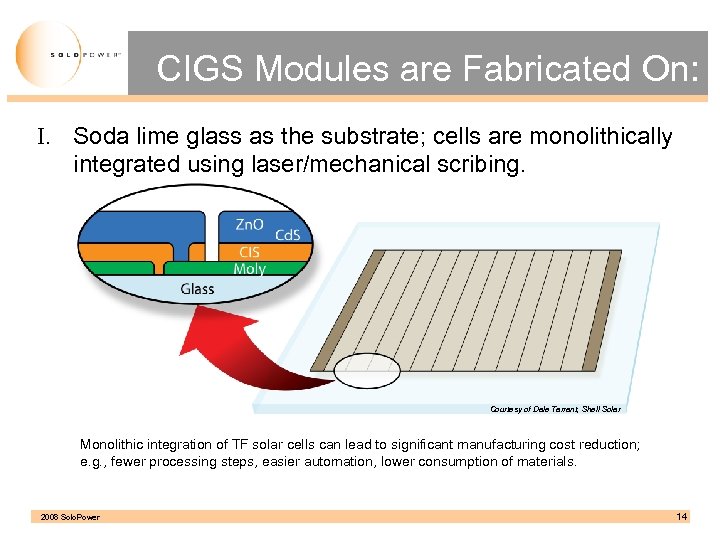 CIGS Modules are Fabricated On: I. Soda lime glass as the substrate; cells are monolithically integrated using laser/mechanical scribing. Courtesy of Dale Tarrant, Shell Solar Monolithic integration of TF solar cells can lead to significant manufacturing cost reduction; e. g. , fewer processing steps, easier automation, lower consumption of materials. 2008 Solo. Power 14
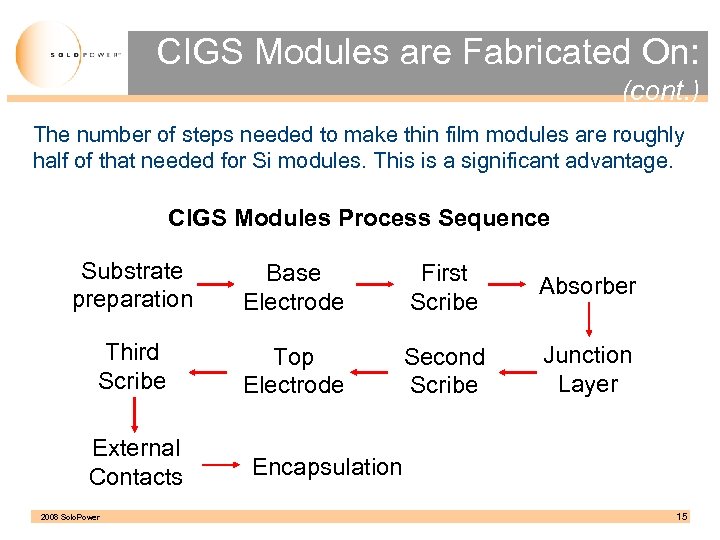 CIGS Modules are Fabricated On: (cont. ) The number of steps needed to make thin film modules are roughly half of that needed for Si modules. This is a significant advantage. CIGS Modules Process Sequence Substrate preparation Base Electrode First Scribe Absorber Third Scribe Top Electrode Second Scribe Junction Layer External Contacts 2008 Solo. Power Encapsulation 15
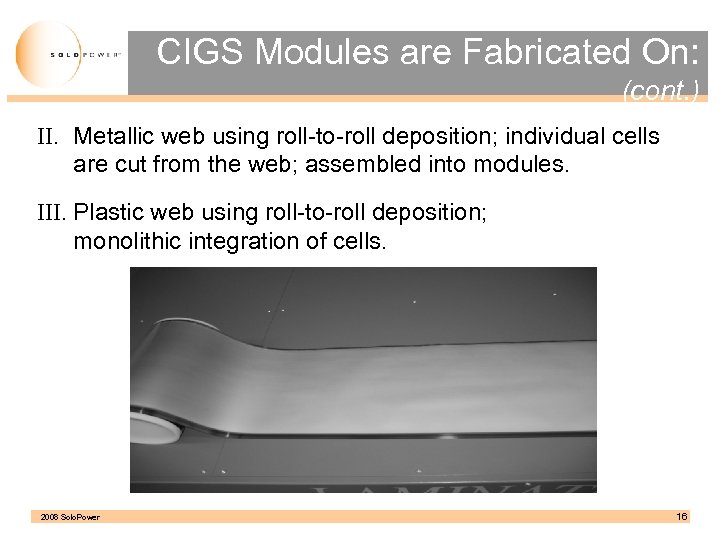 CIGS Modules are Fabricated On: (cont. ) II. Metallic web using roll-to-roll deposition; individual cells are cut from the web; assembled into modules. III. Plastic web using roll-to-roll deposition; monolithic integration of cells. 2008 Solo. Power 16
 Challenges 2008 Solo. Power 17
 Long-Term Stability (Durability) • Improved module package allowed CIGS to pass damp heat test (measured at 85°C/85% relative humidity). • CIGS modules have shown long-term stability. However, performance degradation has also been observed. • CIGS devices are sensitive to water vapor; e. g. , change in properties of Zn. O. - Thin Film Barrier to Water Vapor - New encapsulants and less aggressive application process • Stability of thin film modules are acceptable if the right encapsulation process is used. • Need for better understanding degradation mechanisms at the prototype module level. 2008 Solo. Power 18
 Processing Improvements: I. Uniform Deposition over large area: (a) significant for monolithic integration (b) somewhat relaxed for modules made from individual cells II. Process speed and yield: some fabrication approaches have advantage over others III. Controls and diagnostics based on material properties and film growth: benefits throughput and yield, reliability and reproducibility of the process, and higher performance 2008 Solo. Power 19
 Processing Improvements: (cont. ) IV. Approaches to the thin film CIGS Deposition 1. Multi-source evaporation of the elements - Produces the highest efficiency - Requires high source temperatures, e. g. , Cu source operates at 1400°-1600°C - Inherent non-uniformity in in-line processing - Fast growth rates my become diffusion limited - Complexity of the hardware with controls and diagnostic - One of a kind hardware design and construction - Expensive - Throughput, and material utilization need improvement 2008 Solo. Power 20
 Processing Improvements: (cont. ) IV. Approaches to the thin film CIGS Deposition (cont. ) 2. Reaction of precursors in Se and/or S (Selenization) to form thin film CIGS: two stage process - Variety of materials delivery approaches: (a) sputtering of the elements (b) electroplating of metals or binaries (c) Printing of metal (or binaries) particles on substrate - Reaction time to form high quality CIGS films is limited by reaction/diffusion - Modules on glass are processed in batch mode in order to deal with long reaction time - Flexible roll-to-roll requires good control of Se vapor and reaction speed - Ga concentration thru the film is inhomogeneous limiting performance 2008 Solo. Power 21
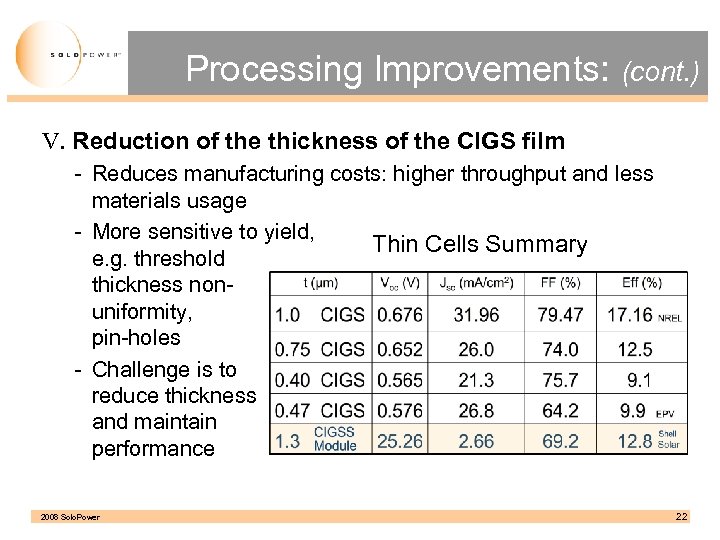 Processing Improvements: (cont. ) V. Reduction of the thickness of the CIGS film - Reduces manufacturing costs: higher throughput and less materials usage - More sensitive to yield, Thin Cells Summary e. g. threshold thickness nonuniformity, pin-holes - Challenge is to reduce thickness and maintain performance 2008 Solo. Power 22
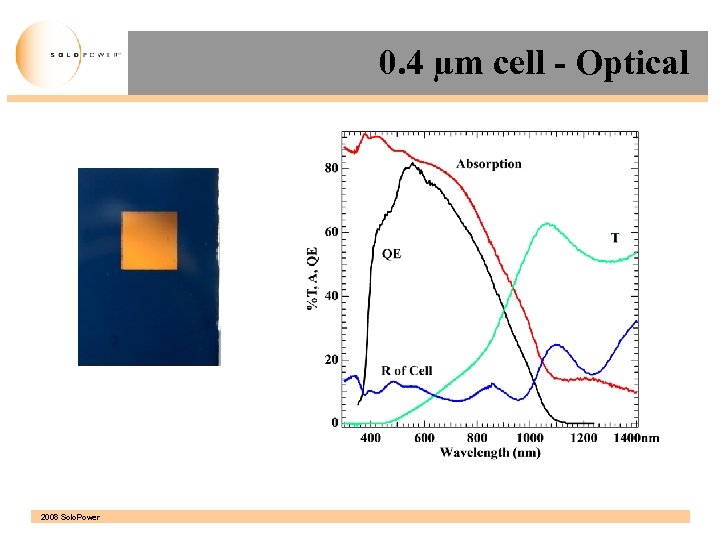 0. 4 µm cell - Optical 2008 Solo. Power
 Toward Low Cost • Module performance is a significant determining factor of cost • Cell processing affects performance • The benefits of each process and how it is handled in manufacturing need to be assessed • To date, relatively high cost methods adapted for manufacturing 2008 Solo. Power 24
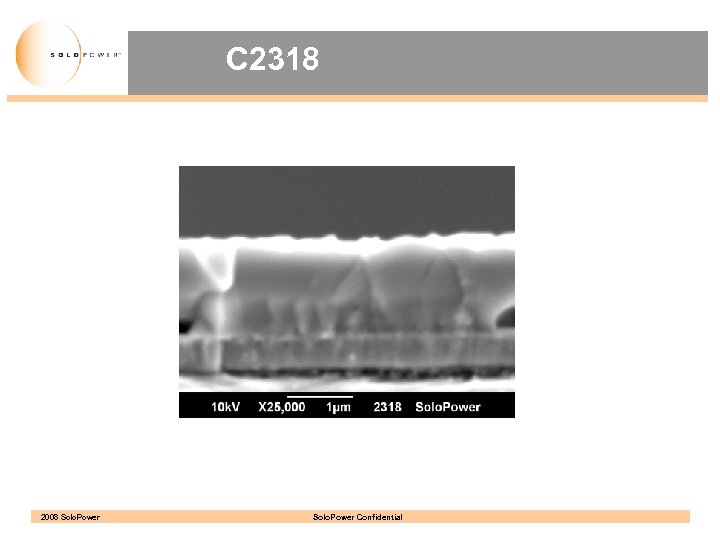
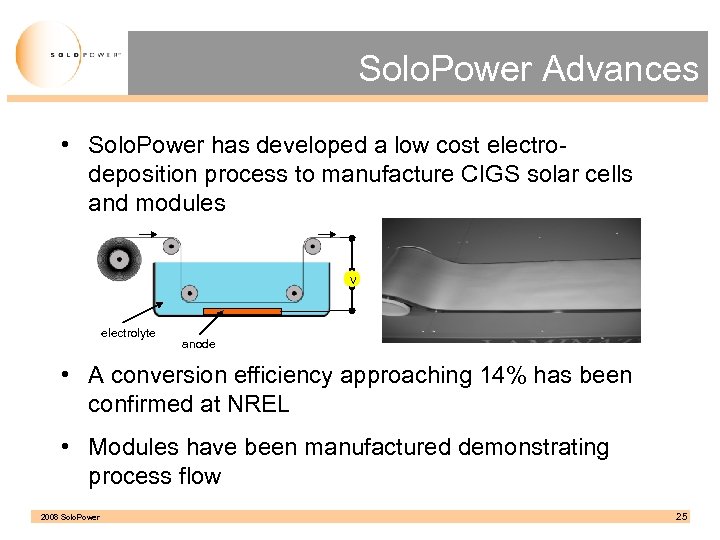 Solo. Power Advances • Solo. Power has developed a low cost electrodeposition process to manufacture CIGS solar cells and modules V electrolyte anode • A conversion efficiency approaching 14% has been confirmed at NREL • Modules have been manufactured demonstrating process flow 2008 Solo. Power 25
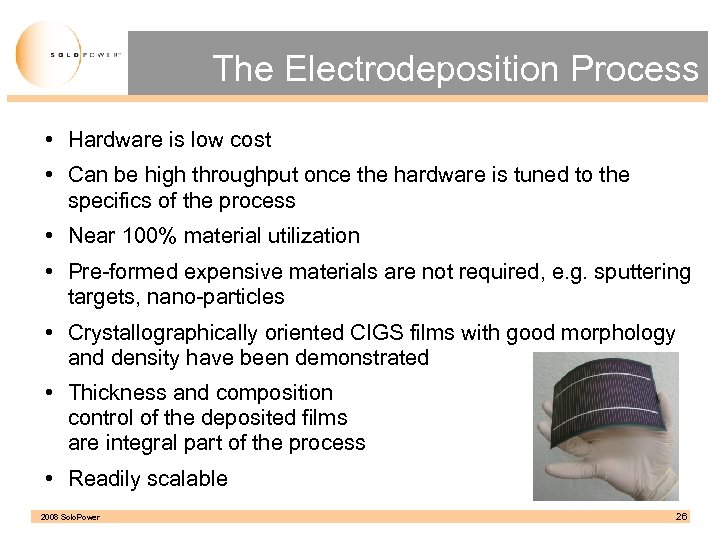 The Electrodeposition Process • Hardware is low cost • Can be high throughput once the hardware is tuned to the specifics of the process • Near 100% material utilization • Pre-formed expensive materials are not required, e. g. sputtering targets, nano-particles • Crystallographically oriented CIGS films with good morphology and density have been demonstrated • Thickness and composition control of the deposited films are integral part of the process • Readily scalable 2008 Solo. Power 26
 C 2318 2008 Solo. Power Confidential
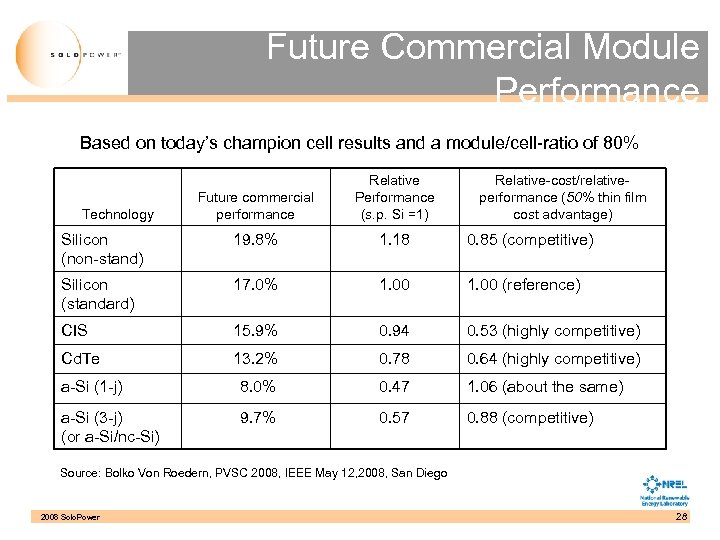 Future Commercial Module Performance Based on today’s champion cell results and a module/cell-ratio of 80% Future commercial performance Relative Performance (s. p. Si =1) Silicon (non-stand) 19. 8% 1. 18 0. 85 (competitive) Silicon (standard) 17. 0% 1. 00 (reference) CIS 15. 9% 0. 94 0. 53 (highly competitive) Cd. Te 13. 2% 0. 78 0. 64 (highly competitive) a-Si (1 -j) 8. 0% 0. 47 1. 06 (about the same) a-Si (3 -j) (or a-Si/nc-Si) 9. 7% 0. 57 0. 88 (competitive) Technology Relative-cost/relativeperformance (50% thin film cost advantage) Source: Bolko Von Roedern, PVSC 2008, IEEE May 12, 2008, San Diego 2008 Solo. Power 28
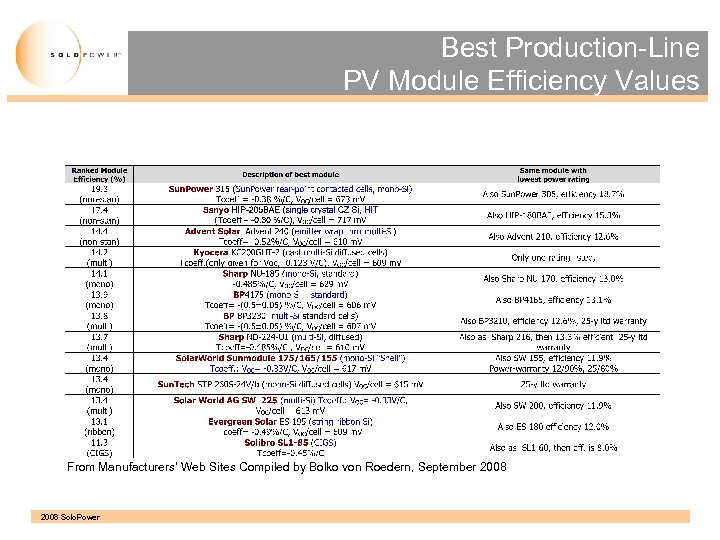 Best Production-Line PV Module Efficiency Values From Manufacturers’ Web Sites Compiled by Bolko von Roedern, September 2008 Solo. Power
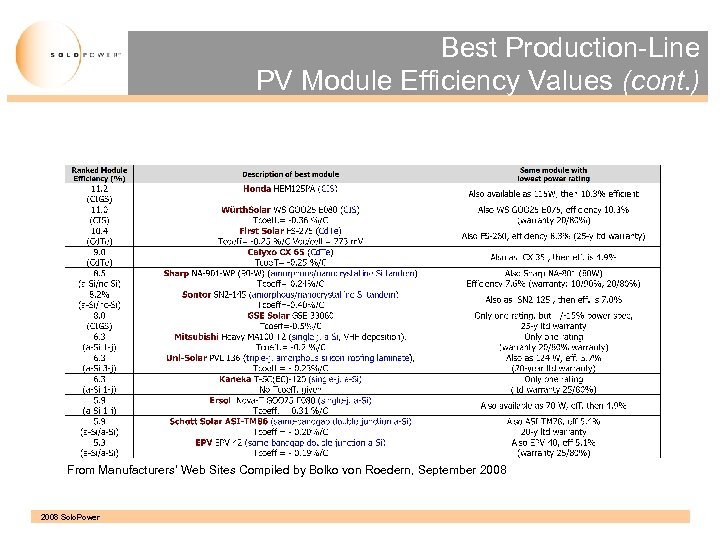 Best Production-Line PV Module Efficiency Values (cont. ) From Manufacturers’ Web Sites Compiled by Bolko von Roedern, September 2008 Solo. Power
 Further Reading Sources “Accelerated UV Test Methods for Encapsulants of Photovoltaic Modules” “Stress Induced Degradation Modes in CIGS Mini-Modules” Michael D. Kempe et al, Proceedings of the 33 rd IEEE, PVSC, May 11, 2008, San Diego “Modeling of Rates of Moisture Ingress into Photovoltaic Modules” Michael D. Kempe, Solar Energy Materials & Solar Cells, 90 (2006) 2720– 2738 “Stability of CIS/CIGS Modules at the Outdoor Test Facility Over Two Decades” J. A. del Cueto, S. Rummel, B. Kroposki, C. Osterwald, A. Anderberg, Proceedings of the 33 rd IEEE, PVSC , May 11, 2008, San Diego “Pathways to Improved Performance and Processing of Cd. Te & Cu. In. Se 2 Based Modules” Robert W. Birkmire, Proceedings of the 33 rd IEEE, PVSC, May 11, 2008, San Diego “The Role of Polycrystalline Thin-Film PV Technologies in Competitive PV Module Markets” Bolko von Roedern and Harin S. Ullal, Proceedings of the 33 rd IEEE, PVSC , May 11, 2008, San Diego “High Efficiency Cd. Te and CIGS Thin Film Solar Cells: Highlights and Challenges” Rommel Noufi and Ken Zweibel Proceedings of the 4 th WCPEC, May 7, 2006, Hawaii 2008 Solo. Power 31
 The End 2008 Solo. Power 32
 2008 Solo. Power 33
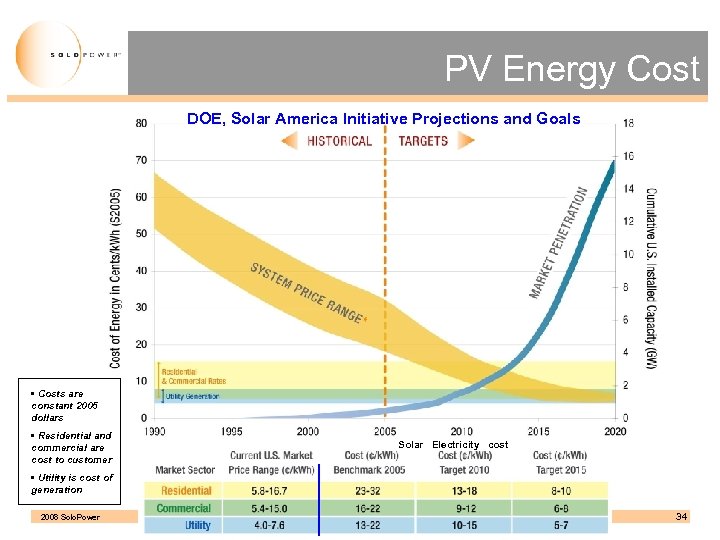 PV Energy Cost DOE, Solar America Initiative Projections and Goals • Costs are constant 2005 dollars • Residential and commercial are cost to customer Solar Electricity cost • Utility is cost of generation 2008 Solo. Power 34
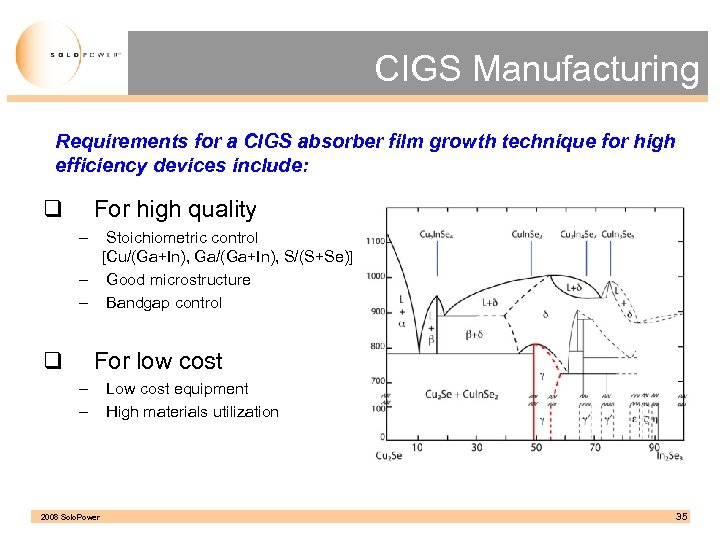 CIGS Manufacturing Requirements for a CIGS absorber film growth technique for high efficiency devices include: For high quality q – Stoichiometric control [Cu/(Ga+In), Ga/(Ga+In), S/(S+Se)] – Good microstructure – Bandgap control For low cost q – – 2008 Solo. Power Low cost equipment High materials utilization 35