


 Скачать презентацию Thermochemistry Chapters 6 and 16 Units of
a89c767e06e3a0cab7f73aea34918989.ppt
- Количество слайдов: 60
 Thermochemistry Chapters 6 and 16
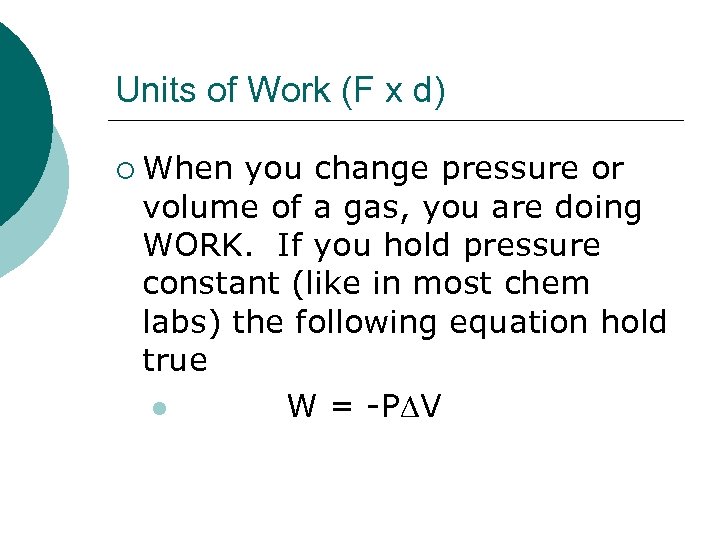 Units of Work (F x d) ¡ When you change pressure or volume of a gas, you are doing WORK. If you hold pressure constant (like in most chem labs) the following equation hold true l W = -P V
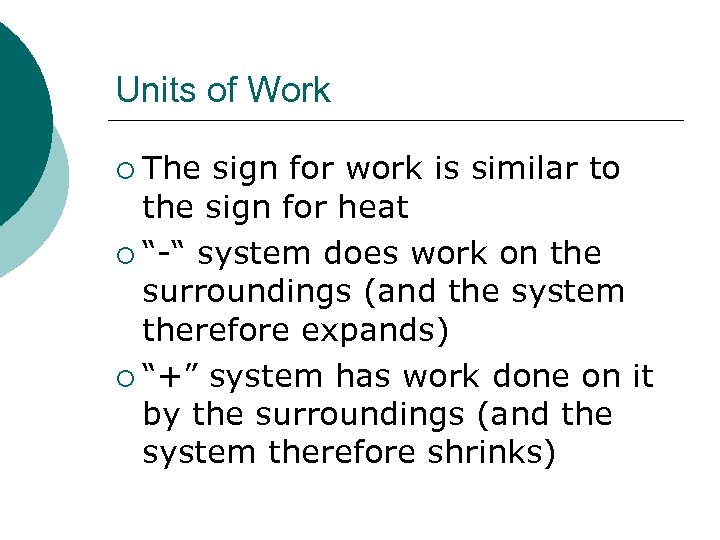 Units of Work ¡ The sign for work is similar to the sign for heat ¡ “-“ system does work on the surroundings (and the system therefore expands) ¡ “+” system has work done on it by the surroundings (and the system therefore shrinks)
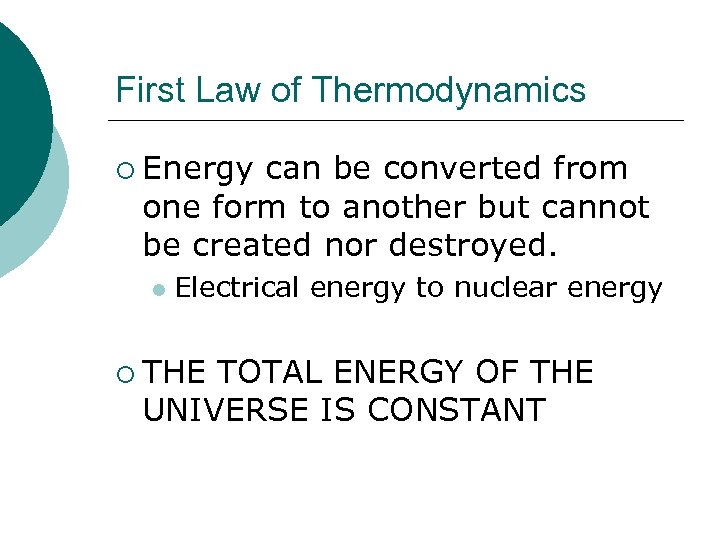 First Law of Thermodynamics ¡ Energy can be converted from one form to another but cannot be created nor destroyed. l Electrical energy to nuclear energy ¡ THE TOTAL ENERGY OF THE UNIVERSE IS CONSTANT
 First Law of Thermodynamics ¡ For all reactions, the energy change of the SYSTEM is equal to the SYSTEM’S WORK plus the SYSTEM’S HEAT FLOW. ¡ Ex What is the energy change in a system that does 38. 9 j of work when it loses 16. 2 joules of heat?
 First Law of Thermodynamics ¡ So the energy change of a system is related to both 1. Work the system does/has done l 2. Heat exchanged in/out of the system l ¡ delta E (-) system loses energy ¡ delta E (+) system gains energy
 Enthalpy, H, (Heat Content) ¡ Energy of a system at a given pressure and volume. Very difficult to measure in practice, but it is VERY EASY to measure the CHANGE in enthalpy, delta H ¡ H= q at constant pressure (in most chem labs)
 First Law of Thermodynamics ¡ H is most commonly measured heat unit in chemistry labs, and is often used interchangeably with q (since pressure rarely changes within the walls of a chemistry lab)
 First Law of Thermodynamics ¡ H = Hproducts - Hreactants (final enthalpy – initial enthalpy) ¡ H is often called “the heat of reaction”
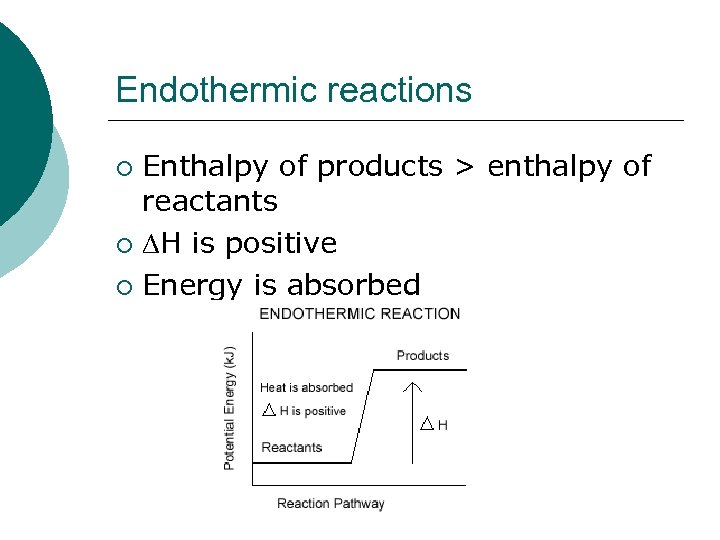 Endothermic reactions Enthalpy of products > enthalpy of reactants ¡ H is positive ¡ Energy is absorbed ¡
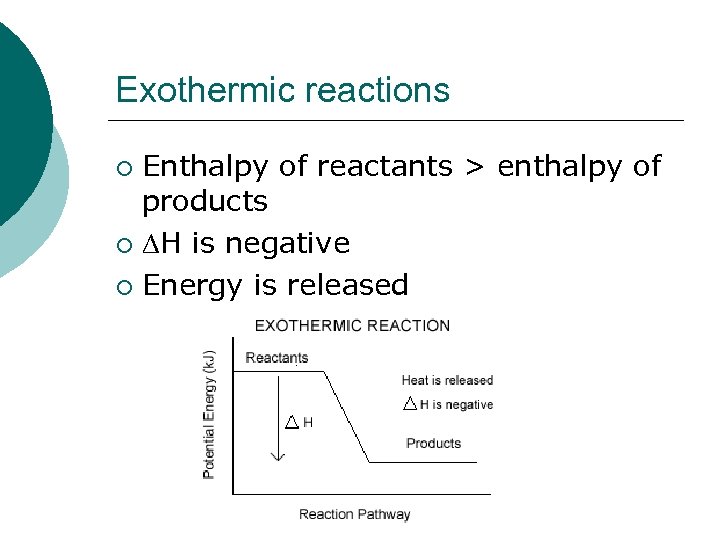 Exothermic reactions Enthalpy of reactants > enthalpy of products ¡ H is negative ¡ Energy is released ¡
 Spontaneity Spontaneous reactions will tend toward conditions of lower enthalpy ¡ More negative H values ¡
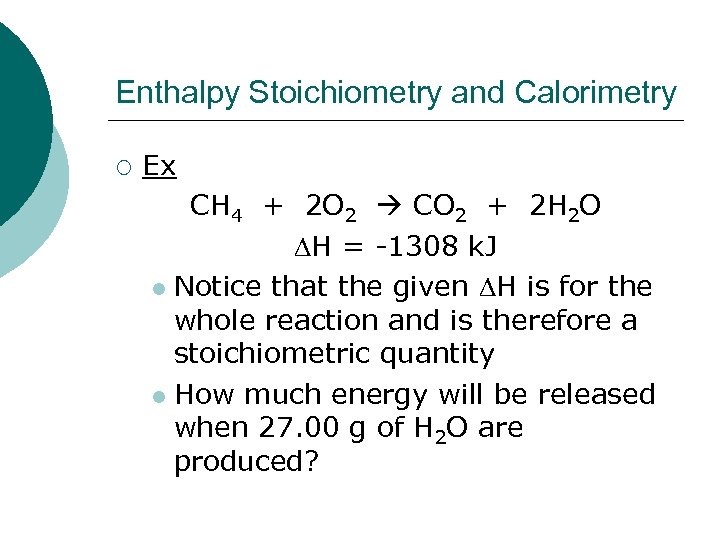 Enthalpy Stoichiometry and Calorimetry ¡ Ex CH 4 + 2 O 2 CO 2 + 2 H 2 O H = -1308 k. J l Notice that the given H is for the whole reaction and is therefore a stoichiometric quantity l How much energy will be released when 27. 00 g of H 2 O are produced?
 Standard Enthalpy of Formation Hfo ¡ def Enthalpy change when one mole of a compound is made FROM ITS ELEMENTS in their standard states under standard conditions.
 Standard Enthalpy of Formation Hfo ¡ Standard States l l for elements the form that the element exists in at 25 o. C and 1 atm (don’t confuse with STP from gases) for compounds gases—at 1. 0 atm ¡ solutions – at 1. 0 M ¡ l a PURE liquid or solid – the actual pure liquid or solid
![Standard Enthalpy of Formation Hfo ¡ Hfo[C 2 H 5 OH(l)] = -279 k.](https://present5.com/presentation/a89c767e06e3a0cab7f73aea34918989/image-16.jpg "Standard Enthalpy of Formation Hfo ¡ Hfo[C 2 H 5 OH(l)] = -279 k.") Standard Enthalpy of Formation Hfo ¡ Hfo[C 2 H 5 OH(l)] = -279 k. J/mol l l Means that when the reaction below is carried out, 279 k. J of energy are released 2 C(graphite)+ 3 H 2(g)+ ½ O 2(g) C 2 H 5 OH(l)
Standard Enthalpy of Formation Hfo ¡ Hfo[C 2 H 5 OH(l)] = -279 k. J/mol l l Means that when the reaction below is carried out, 279 k. J of energy are released 2 C(graphite)+ 3 H 2(g)+ ½ O 2(g) C 2 H 5 OH(l)
 Standard Enthalpy of Formation Hfo ¡ We begin studying Hfo by finding values for several compounds; find these empirical values on page A-21 of your textbook. l l l Al 2 O 3 (s) Ti (s) SO 42 -(aq)
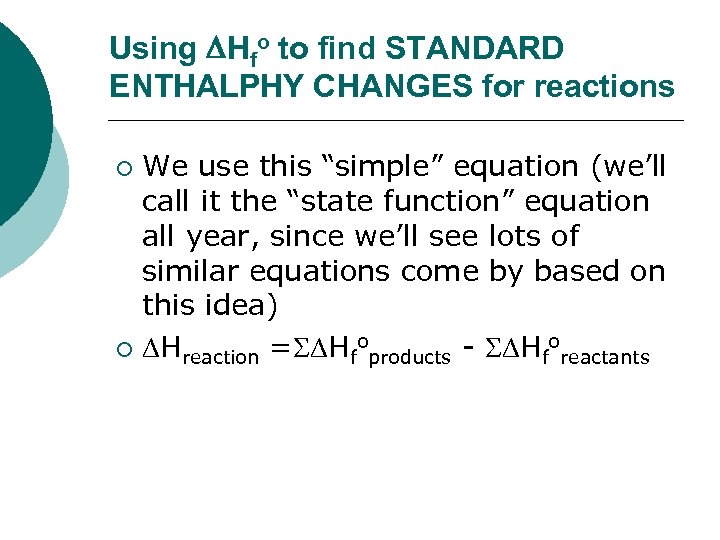 Using Hfo to find STANDARD ENTHALPHY CHANGES for reactions We use this “simple” equation (we’ll call it the “state function” equation all year, since we’ll see lots of similar equations come by based on this idea) ¡ Hreaction =S Hfoproducts - S Hforeactants ¡
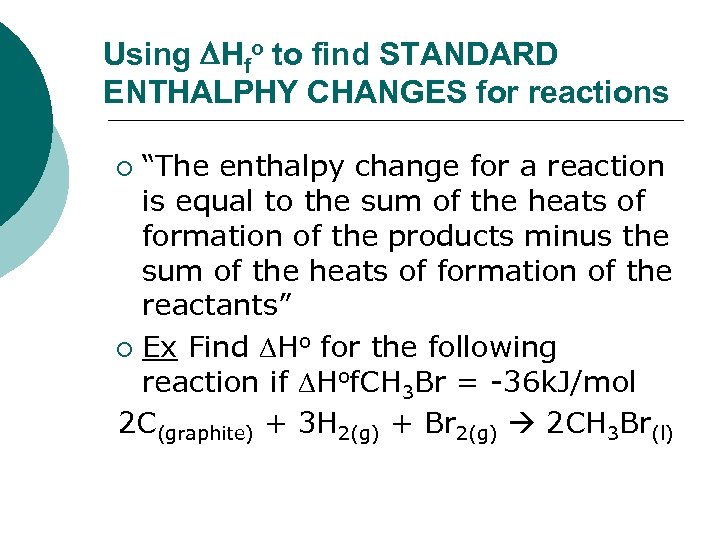 Using Hfo to find STANDARD ENTHALPHY CHANGES for reactions “The enthalpy change for a reaction is equal to the sum of the heats of formation of the products minus the sum of the heats of formation of the reactants” ¡ Ex Find Ho for the following reaction if Hof. CH 3 Br = -36 k. J/mol 2 C(graphite) + 3 H 2(g) + Br 2(g) 2 CH 3 Br(l) ¡
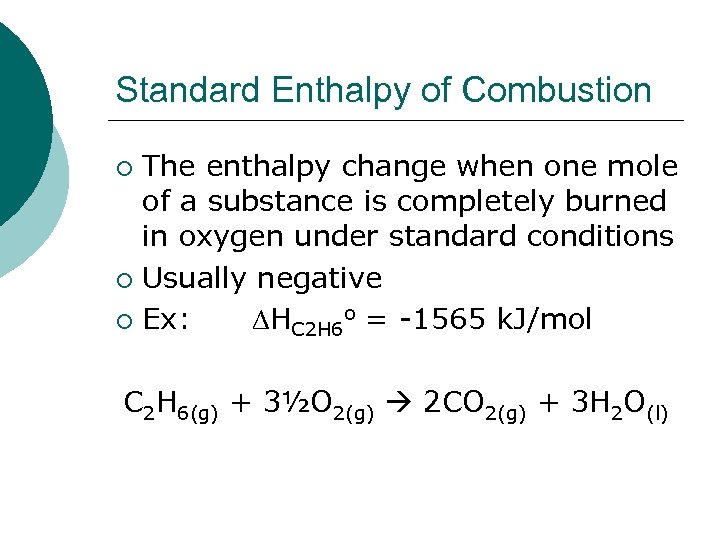 Standard Enthalpy of Combustion The enthalpy change when one mole of a substance is completely burned in oxygen under standard conditions ¡ Usually negative ¡ Ex: HC 2 H 6 o = -1565 k. J/mol ¡ C 2 H 6(g) + 3½O 2(g) 2 CO 2(g) + 3 H 2 O(l)
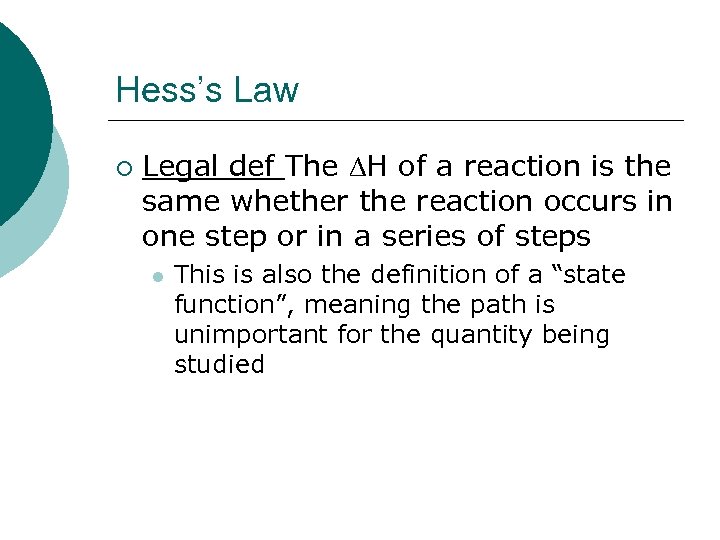 Hess’s Law ¡ Legal def The H of a reaction is the same whether the reaction occurs in one step or in a series of steps l This is also the definition of a “state function”, meaning the path is unimportant for the quantity being studied
 Hess’s Law ¡ Interpreted def If you can combine a series of chemical reactions mathematically to get another reaction, you can also combine the H’s.
 Hess’s Law ¡ 3 tricks to doing Hess’s Law calculations a. You can reverse any equation, but change the sign of the H l b. You can multiply the entire equation by a number, but do the same to the H l c. You can do A and B together. l
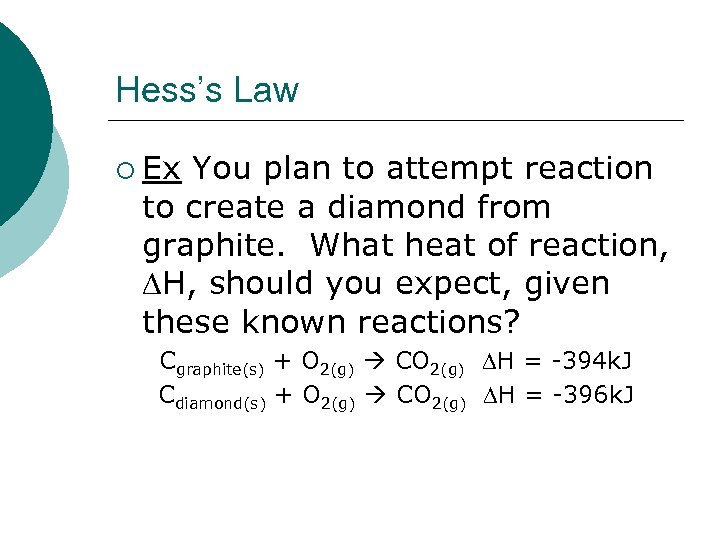 Hess’s Law ¡ Ex You plan to attempt reaction to create a diamond from graphite. What heat of reaction, H, should you expect, given these known reactions? Cgraphite(s) + O 2(g) CO 2(g) H = -394 k. J Cdiamond(s) + O 2(g) CO 2(g) H = -396 k. J
 Hess’s Law ¡ Solution Write a TARGET equation first ¡ By trial and error, we must find species and get them on the same side of the equation as the target.
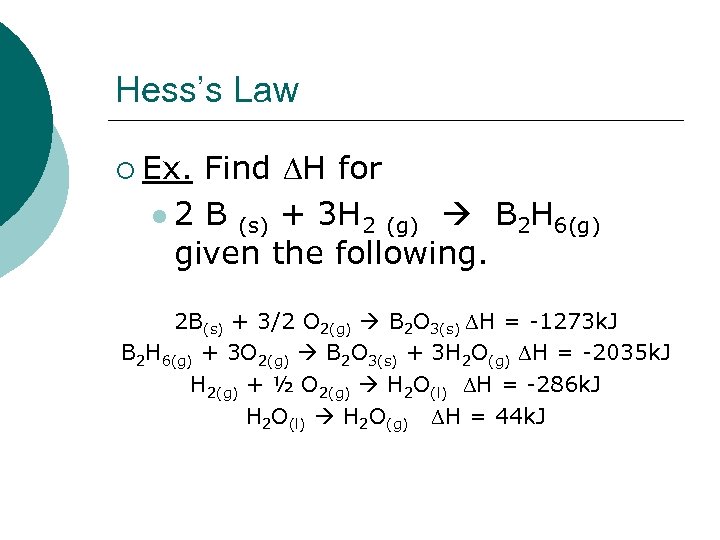 Hess’s Law ¡ Ex. Find H for l 2 B (s) + 3 H 2 (g) B 2 H 6(g) given the following. 2 B(s) + 3/2 O 2(g) B 2 O 3(s) H = -1273 k. J B 2 H 6(g) + 3 O 2(g) B 2 O 3(s) + 3 H 2 O(g) H = -2035 k. J H 2(g) + ½ O 2(g) H 2 O(l) H = -286 k. J H 2 O(l) H 2 O(g) H = 44 k. J
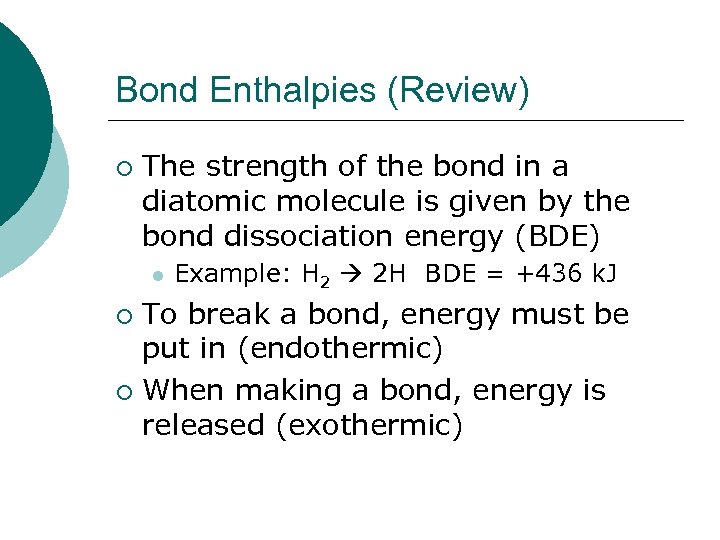 Bond Enthalpies (Review) ¡ The strength of the bond in a diatomic molecule is given by the bond dissociation energy (BDE) l Example: H 2 2 H BDE = +436 k. J To break a bond, energy must be put in (endothermic) ¡ When making a bond, energy is released (exothermic) ¡
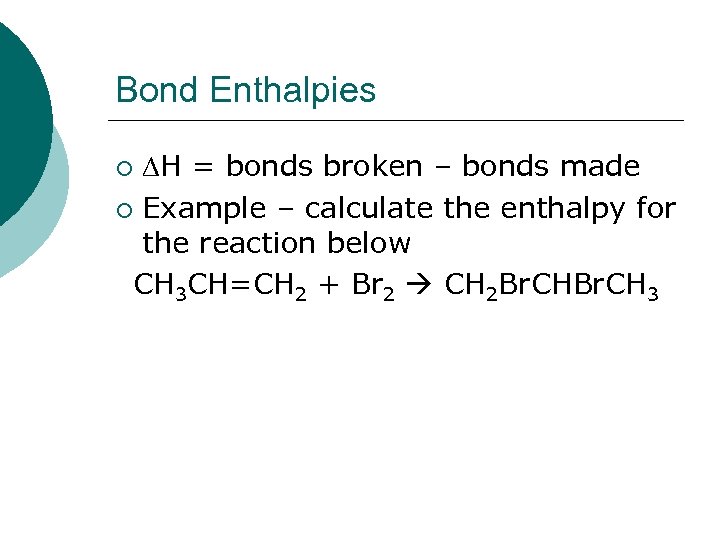 Bond Enthalpies H = bonds broken – bonds made ¡ Example – calculate the enthalpy for the reaction below CH 3 CH=CH 2 + Br 2 CH 2 Br. CH 3 ¡
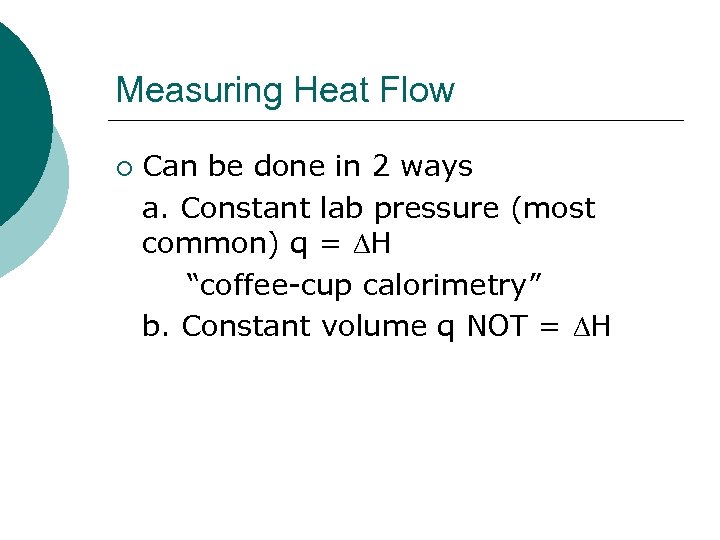 Measuring Heat Flow ¡ Can be done in 2 ways a. Constant lab pressure (most common) q = H “coffee-cup calorimetry” b. Constant volume q NOT = H
 Measuring Heat Flow ¡ The amount of heat energy transferred depends on 3 things a. what you have (specific heat) b. how much you have (mass) c. temperature change you allow to occur ( t)
 Measuring Heat Flow ¡ Specific Heat Capacity (usually just called “specific heat”) is the AMOUNT of heat energy required to raise 1 gram of ANY SUBSTANCE 1. 00 0 C
 Measuring Heat Flow “Calorie” is the specific heat JUST FOR WATER ¡ Notice the table 6. 1 on page 248 lists SH capacities in (J)/(g 0 C) ¡ The LOWER the number, the EASIER heat flows IN or OUT of a substance. Water has a high SH. ¡
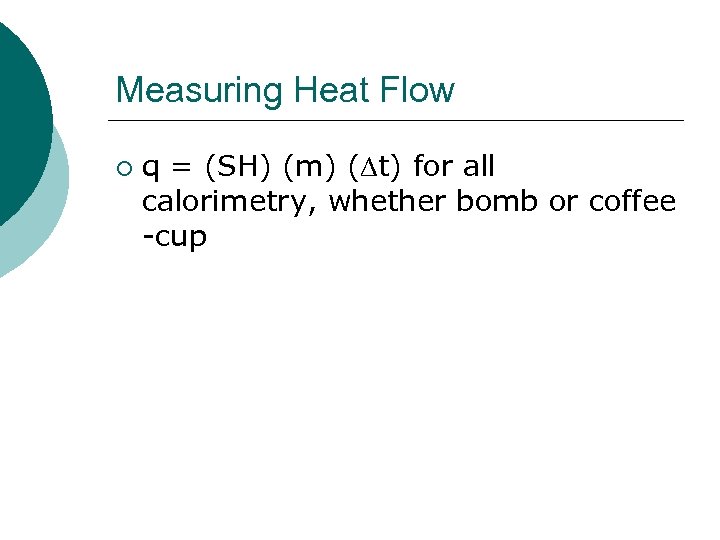 Measuring Heat Flow ¡ q = (SH) (m) ( t) for all calorimetry, whether bomb or coffee -cup
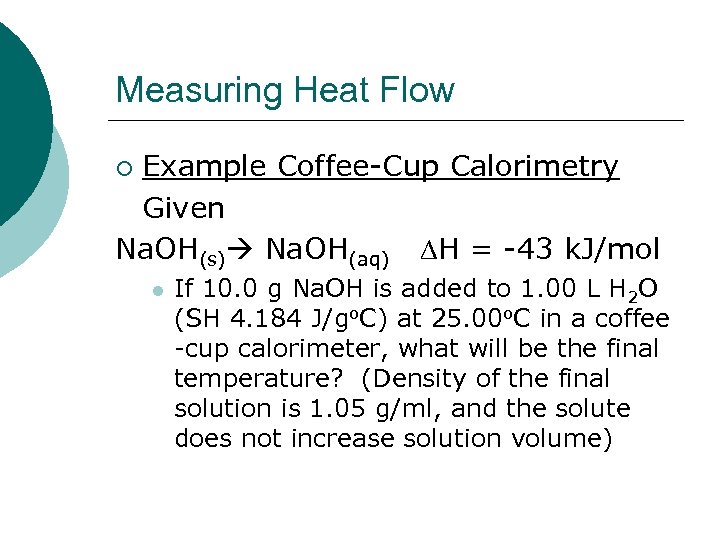 Measuring Heat Flow Example Coffee-Cup Calorimetry Given Na. OH(s) Na. OH(aq) H = -43 k. J/mol ¡ l If 10. 0 g Na. OH is added to 1. 00 L H 2 O (SH 4. 184 J/go. C) at 25. 00 o. C in a coffee -cup calorimeter, what will be the final temperature? (Density of the final solution is 1. 05 g/ml, and the solute does not increase solution volume)
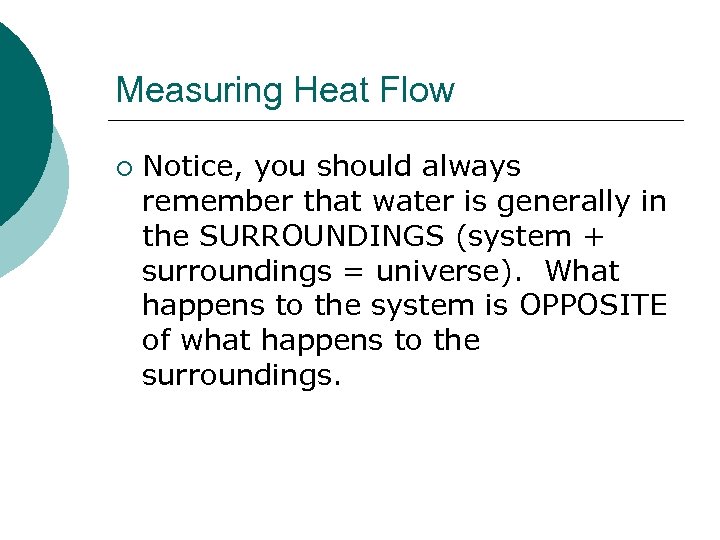 Measuring Heat Flow ¡ Notice, you should always remember that water is generally in the SURROUNDINGS (system + surroundings = universe). What happens to the system is OPPOSITE of what happens to the surroundings.
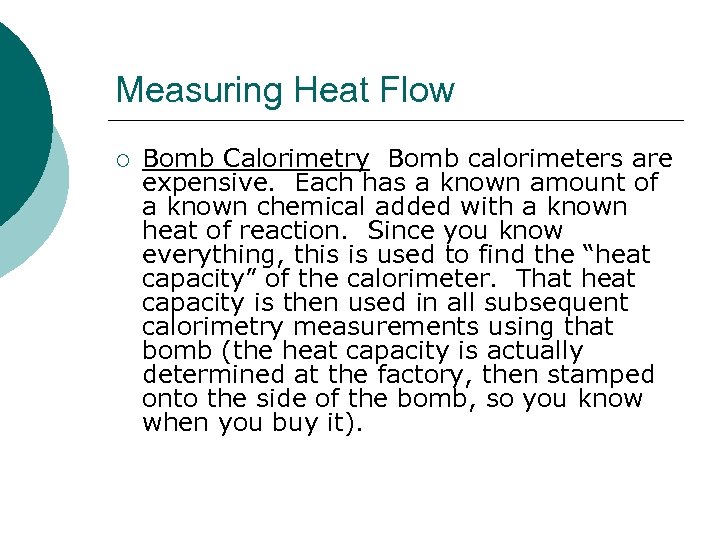 Measuring Heat Flow ¡ Bomb Calorimetry Bomb calorimeters are expensive. Each has a known amount of a known chemical added with a known heat of reaction. Since you know everything, this is used to find the “heat capacity” of the calorimeter. That heat capacity is then used in all subsequent calorimetry measurements using that bomb (the heat capacity is actually determined at the factory, then stamped onto the side of the bomb, so you know when you buy it).
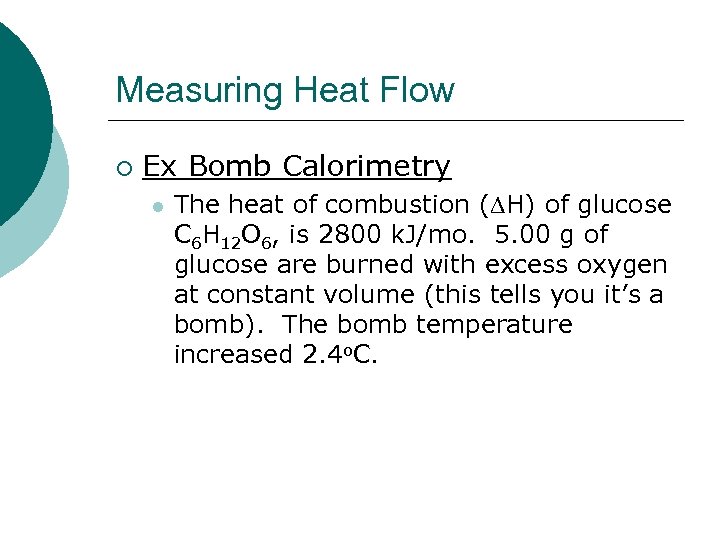 Measuring Heat Flow ¡ Ex Bomb Calorimetry l The heat of combustion ( H) of glucose C 6 H 12 O 6, is 2800 k. J/mo. 5. 00 g of glucose are burned with excess oxygen at constant volume (this tells you it’s a bomb). The bomb temperature increased 2. 4 o. C.
 Heating Curves ¡ A temperature vs time curve that shows the physical states at all temperature points and AT CONSTANT PRESSURE. Consider one mole of water as an example
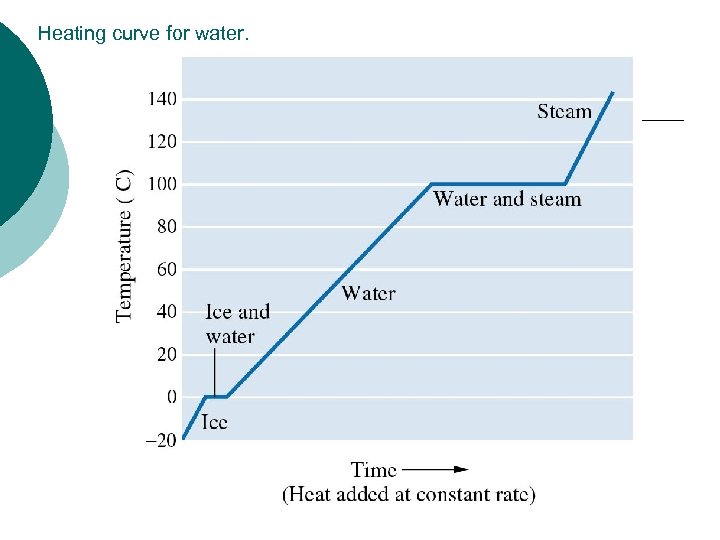 Heating curve for water.
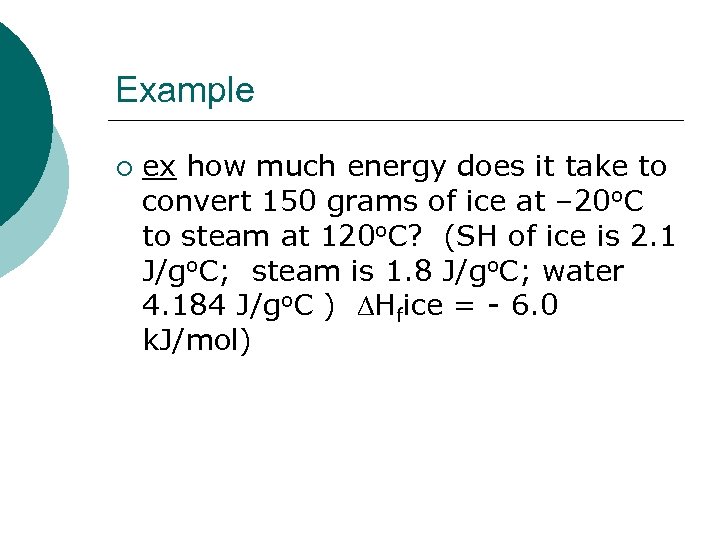 Example ¡ ex how much energy does it take to convert 150 grams of ice at – 20 o. C to steam at 120 o. C? (SH of ice is 2. 1 J/go. C; steam is 1. 8 J/go. C; water 4. 184 J/go. C ) Hfice = - 6. 0 k. J/mol)
 Spontaneous Processes and Entropy ¡ First law l l ¡ “Energy can neither be created nor destroyed" The energy of the universe is constant Spontaneous Processes l l l Processes that occur without outside intervention Products are favored at the stated conditions Spontaneous processes may be fast or slow Many forms of combustion are fast Conversion of diamond to graphite is slow
 Spontaneous Processes and Entropy ¡ Non-spontaneous processes l l Reactant are favored at the stated conditions Generally needs outside intervention to occur
 Entropy (S) ¡ ¡ ¡ A measure of the randomness or disorder The driving force for a spontaneous process is an increase in the entropy of the universe Entropy is a thermodynamic function describing the number of arrangements that are available to a system Nature proceeds toward the states that have the highest probabilities of existing THE MORE ORDERED A COMPOUND IS, THE LESS ENTROPY IT HAS! The unit for entropy is J/K mol
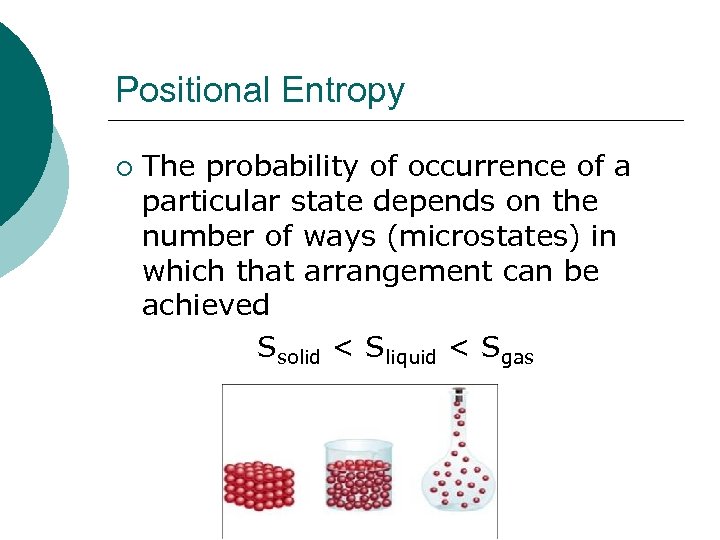 Positional Entropy ¡ The probability of occurrence of a particular state depends on the number of ways (microstates) in which that arrangement can be achieved Ssolid < Sliquid < Sgas
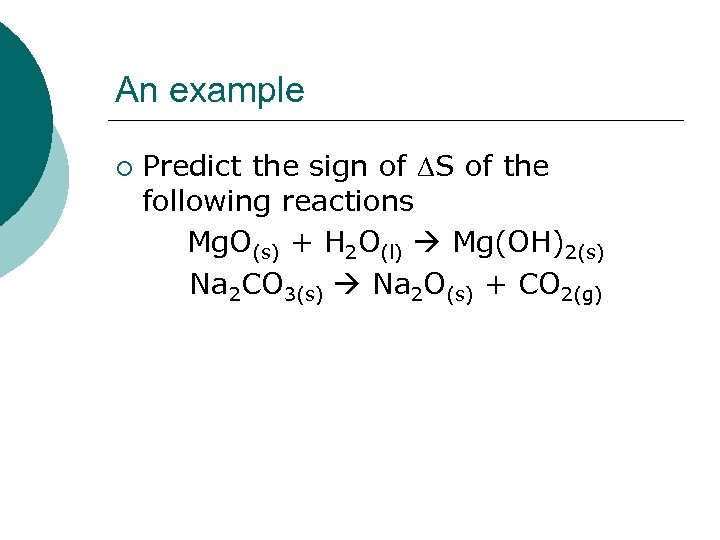 An example ¡ Predict the sign of S of the following reactions Mg. O(s) + H 2 O(l) Mg(OH)2(s) Na 2 CO 3(s) Na 2 O(s) + CO 2(g)
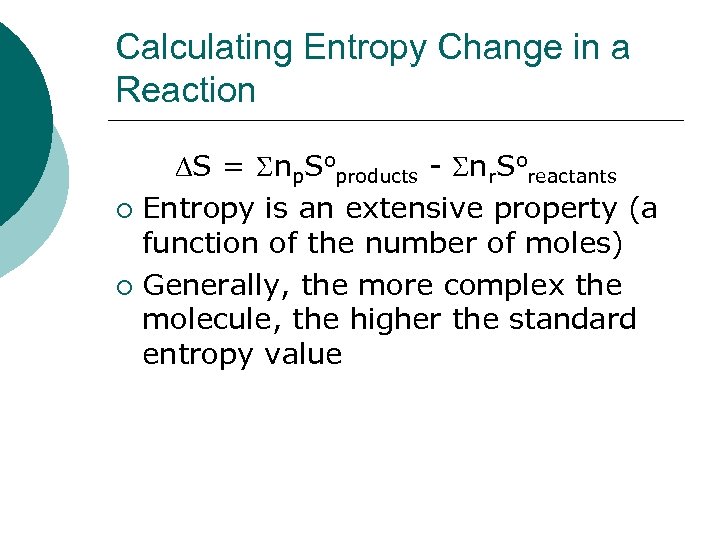 Calculating Entropy Change in a Reaction S = Snp. Soproducts - Snr. Soreactants ¡ Entropy is an extensive property (a function of the number of moles) ¡ Generally, the more complex the molecule, the higher the standard entropy value
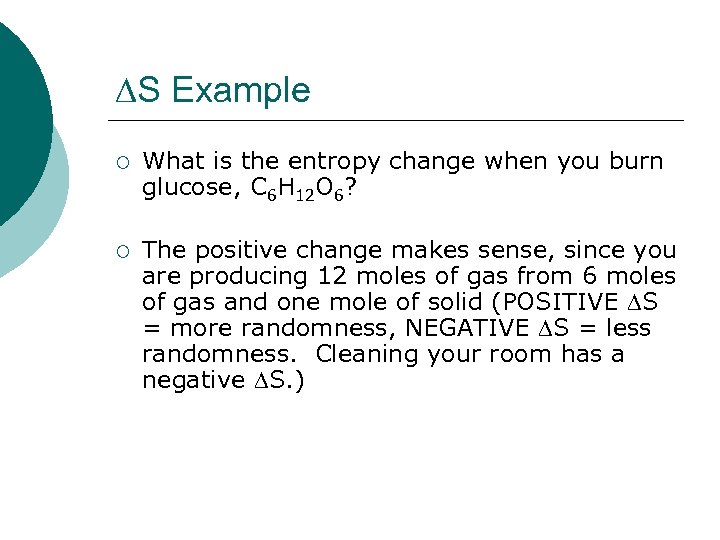 S Example ¡ What is the entropy change when you burn glucose, C 6 H 12 O 6? ¡ The positive change makes sense, since you are producing 12 moles of gas from 6 moles of gas and one mole of solid (POSITIVE S = more randomness, NEGATIVE S = less randomness. Cleaning your room has a negative S. )
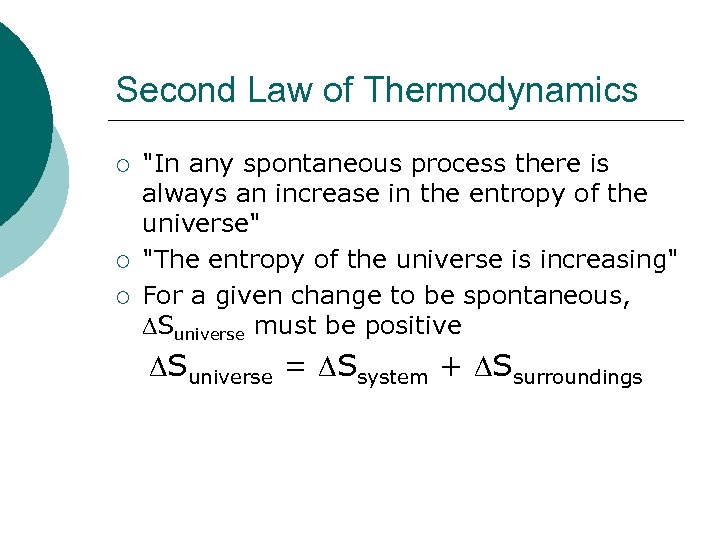 Second Law of Thermodynamics ¡ ¡ ¡ "In any spontaneous process there is always an increase in the entropy of the universe" "The entropy of the universe is increasing" For a given change to be spontaneous, Suniverse must be positive Suniverse = Ssystem + Ssurroundings
 Third Law of Thermodynamics ¡ The entropy of a perfect crystal at absolute zero is zero (and this is impossible to attain)
 General Rules ¡ Reactions that increase the number of moles of a LESS ordered state are more favored ¡ Things that made a mess are more favorable because there are more ways to make something messy than there are ways to keep it clean.
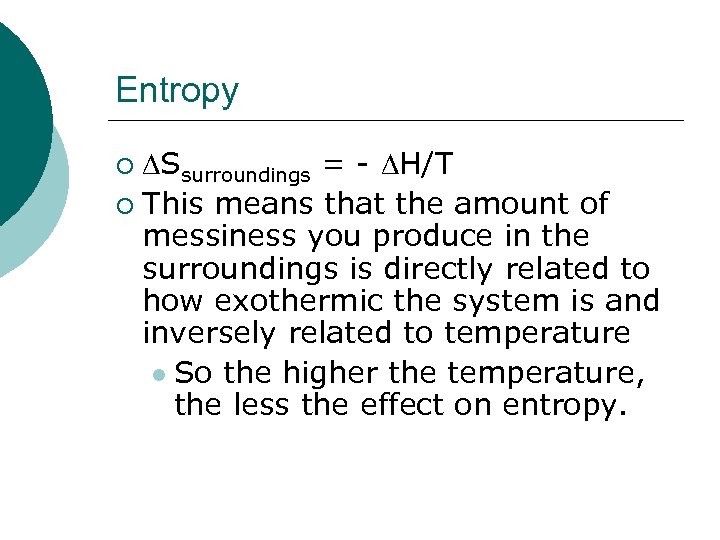 Entropy Ssurroundings = - H/T ¡ This means that the amount of messiness you produce in the surroundings is directly related to how exothermic the system is and inversely related to temperature l So the higher the temperature, the less the effect on entropy. ¡
 Driving Forces ¡ We see that there are 2 driving forces in a reaction system’s spontaneity. Will it become more random, thereby increasing the randomness of the universe (+ S of a system favors spontaneity) l Will it release energy to surroundings, thereby increasing the randomness of the universe (- H for a system favors spontaneity) l
 Standard Free Energy Change Go is the change in free energy that will occur if the reactants in their standard states are converted to the products in their standard states ¡ Go cannot be measured directly ¡ The more negative the value for Go, the farther to the right the reaction will proceed in order to achieve equilibrium ¡ Equilibrium is the lowest possible free energy position for a reaction ¡
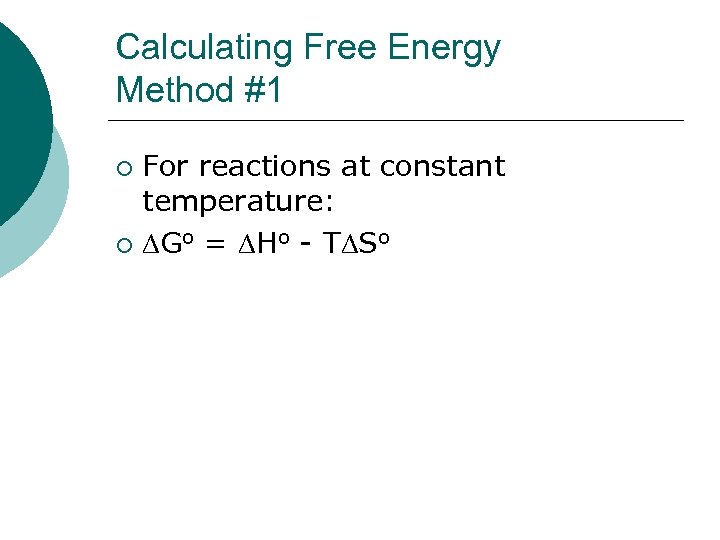 Calculating Free Energy Method #1 For reactions at constant temperature: ¡ Go = Ho - T So ¡
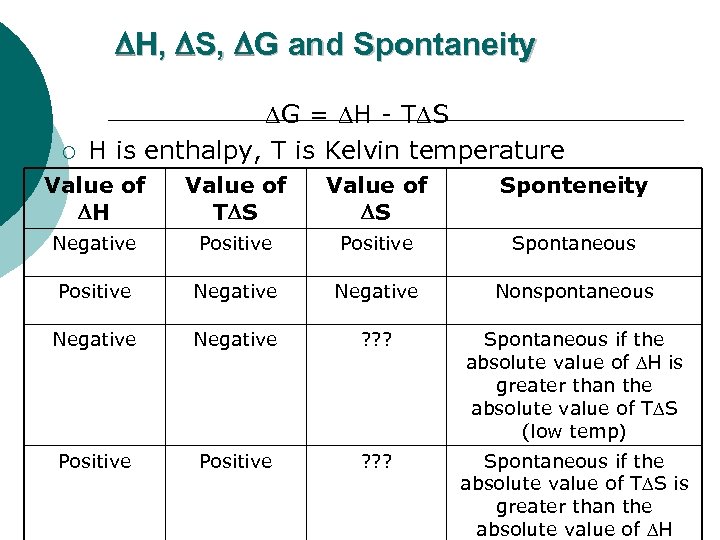 H, S, G and Spontaneity ¡ G = H - T S H is enthalpy, T is Kelvin temperature Value of H Value of T S Value of S Sponteneity Negative Positive Spontaneous Positive Negative Nonspontaneous Negative ? ? ? Spontaneous if the absolute value of H is greater than the absolute value of T S (low temp) Positive ? ? ? Spontaneous if the absolute value of T S is greater than the absolute value of H
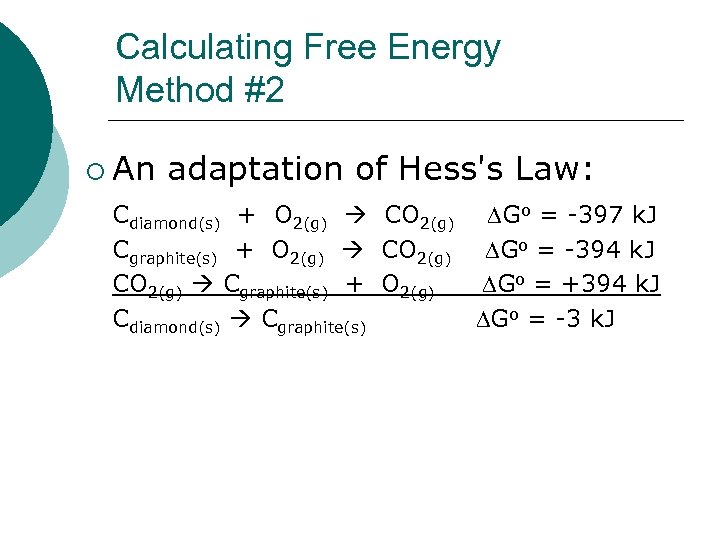 Calculating Free Energy Method #2 ¡ An adaptation of Hess's Law: Cdiamond(s) + O 2(g) CO 2(g) Go = -397 k. J Cgraphite(s) + O 2(g) CO 2(g) Go = -394 k. J CO 2(g) Cgraphite(s) + O 2(g) Go = +394 k. J Cdiamond(s) Cgraphite(s) Go = -3 k. J
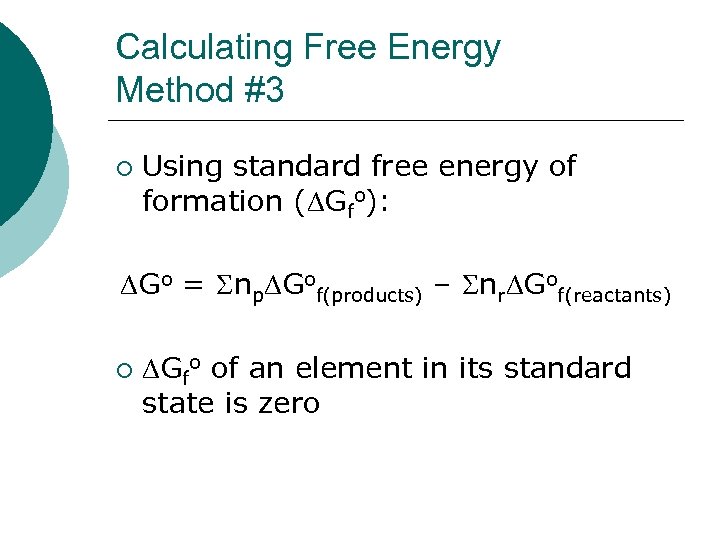 Calculating Free Energy Method #3 ¡ Using standard free energy of formation ( Gfo): Go = Snp Gof(products) – Snr Gof(reactants) ¡ Gfo of an element in its standard state is zero
 Example Calculate Go for the following reaction: N 2(g) + 3 H 2(g) 2 NH 3(g) ¡
 The Dependence of Free Energy on Pressure Enthalpy, H, is not pressure dependent ¡ Entropy, S ¡ l Entropy depends on volume, so it also depends on pressure Slarge volume > Ssmall volume l Slow l pressure > Shigh pressure
 Free Energy and Work ¡ ¡ The maximum possible useful work obtainable from a process at constant temperature and pressure is equal to the change in free energy The amount of work obtained is always less than the maximum Henry Bent's First Two Laws of Thermodynamics l First law: You can't win, you can only break even l Second law: You can't break even l