 Скачать презентацию THERMAL INFRARED PROGRAM HELICOPTER PLATFORMS Alberta Perspective June
b8cd8421580dab77bca2566f7c6e2352.ppt
- Количество слайдов: 33



THERMAL INFRARED PROGRAM HELICOPTER PLATFORMS Alberta Perspective June 8/2006 Detection Conference – Hinton 2006 1
Outline • • • Introduction Why we use IR Statistics – 1998 - 2005 Present concerns effecting IR use Completed to date Future Standards June 8/2006 Detection Conference – Hinton 2006 2
Background • 1982 with Forest Service • Over 2200 hours as an IR operator – 1982 – 1989 – Level I certification - 2005 - FLIR • Variety of helicopter platforms – B 206, B 204, B 205, B 212, H 500 • 3 main IR cameras – AGA 750, AGEMA 782, AGA 110 • Multiple Search /Rescue missions with RCMP • Team Lead – 2001 – 2004 Provincial Fire Mapping Program Coordinator – 2005 1/2 – present Provincial IR Program Coordinator June 8/2006 Detection Conference – Hinton 2006 3
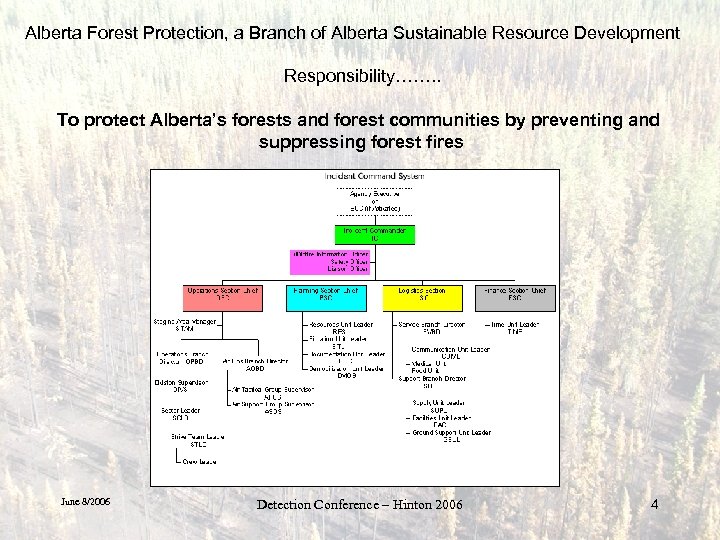
Alberta Forest Protection, a Branch of Alberta Sustainable Resource Development Responsibility……. . To protect Alberta’s forests and forest communities by preventing and suppressing forest fires June 8/2006 Detection Conference – Hinton 2006 4
Why Do We Use IR • ADM believes in the IR program and it’s fiscal use • Aids in Mop-up operations – Maximizes the effective and efficient use of our ground crews • Helps to determine areas of little or no fire activity – CAUTION!!!!! • Tool to determine fire status – OC, BH, UC, EX • Aids in the determination of hotspots, burning areas, and fire perimeter June 8/2006 Detection Conference – Hinton 2006 5
Definitions Hotspot: Area of remnant heat > 300 degrees C. and 25 cm in size Burning Area: Extensive areas of active burning Fire Perimeter: Maximum extent of fire destroyed vegetation June 8/2006 Detection Conference – Hinton 2006 6
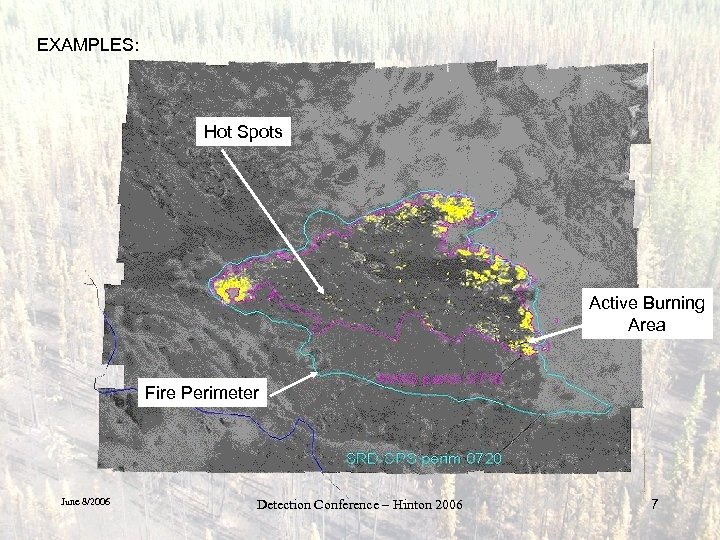
EXAMPLES: Hot Spots Active Burning Area Fire Perimeter June 8/2006 Detection Conference – Hinton 2006 7
Statistics 1998 - 2005 • 29 helicopter companies • 16 different helicopter platforms • Spent $4, 851, 149. 00 • Utilized 5583 hours helicopter time • Utilized 3892 hours of IR operator time June 8/2006 Detection Conference – Hinton 2006 8
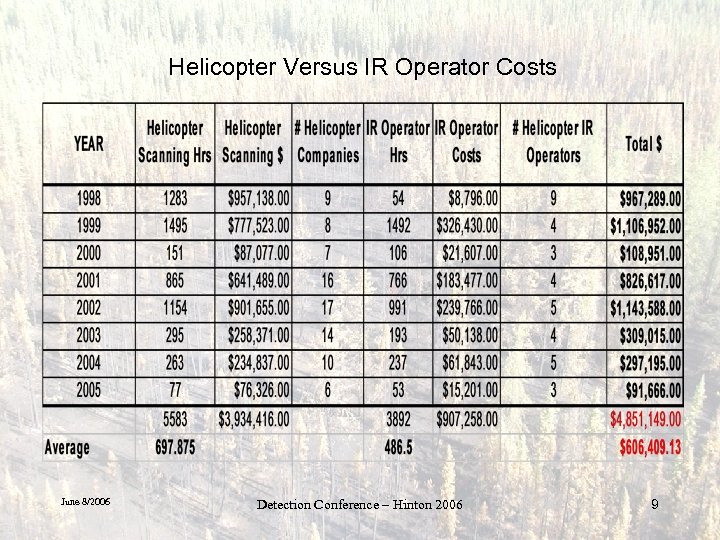
Helicopter Versus IR Operator Costs June 8/2006 Detection Conference – Hinton 2006 9
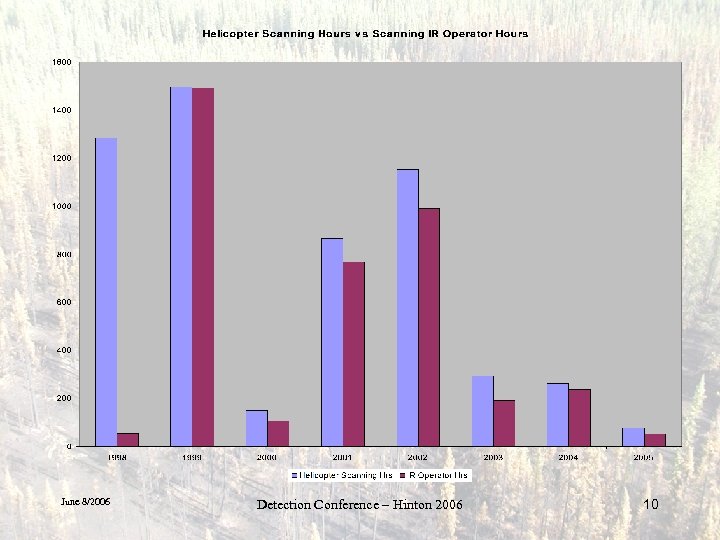
June 8/2006 Detection Conference – Hinton 2006 10
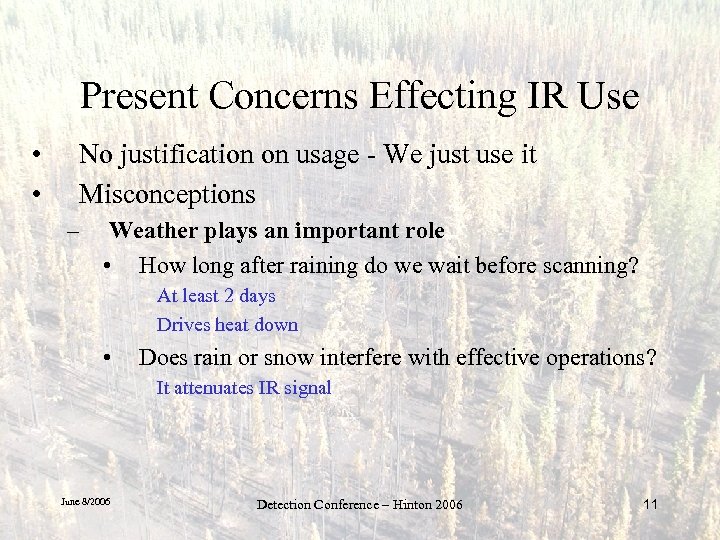
Present Concerns Effecting IR Use • • No justification on usage - We just use it Misconceptions – Weather plays an important role • How long after raining do we wait before scanning? At least 2 days Drives heat down • Does rain or snow interfere with effective operations? It attenuates IR signal June 8/2006 Detection Conference – Hinton 2006 11
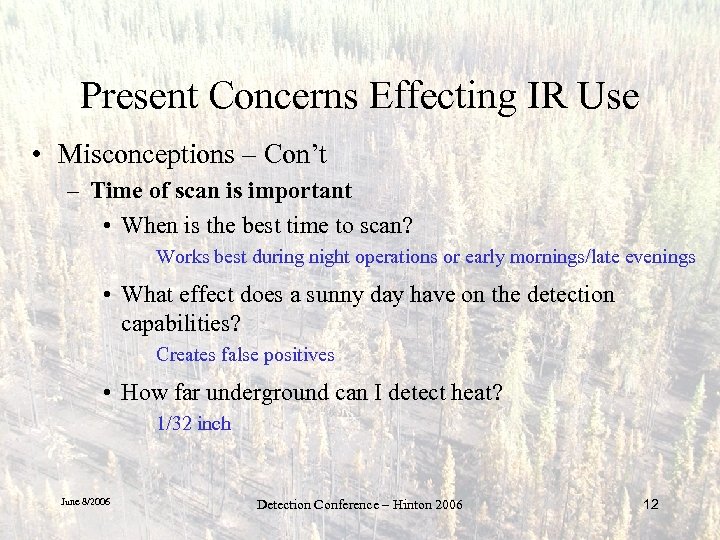
Present Concerns Effecting IR Use • Misconceptions – Con’t – Time of scan is important • When is the best time to scan? Works best during night operations or early mornings/late evenings • What effect does a sunny day have on the detection capabilities? Creates false positives • How far underground can I detect heat? 1/32 inch June 8/2006 Detection Conference – Hinton 2006 12
Present Concerns Effecting IR Use Solar Reflectance And Water Vapour Can be your worst enemies June 8/2006 Detection Conference – Hinton 2006 13
Present Concerns Effecting IR Use • Variety of IR equipment – – Type III gimbel mount ( > $100, 000) Handheld (<$100, 000) • Inconsistent end products – June 8/2006 Can your IR equipment give us the end products we want? Detection Conference – Hinton 2006 14
Present Concerns Effecting IR Use • Lag time of IR mission results to IC, SITL or GIS team – No accountability to the team • Varied delivery times Right after landing Delivery times sometimes 2 hr late • Breakfast more important Never • Nothing to report June 8/2006 Detection Conference – Hinton 2006 15
Present Concerns Effecting IR Use • Delivery formats varied – – Flagged nails Toilet paper Hand drawn maps with hotspots delineated Post-it notes • Numbers transposed wrong • Lost post-it notes – Cigarette packages – GPS coordinates in different formats • DD – this what is needed • DM – helicopter operations • DMS- mapping – Thumb drives sometimes June 8/2006 Detection Conference – Hinton 2006 16
Present Concerns Effecting IR Use • IR experience – IR operators experience varied • None to lots – Pilot and IR operators out on their own • ICS team member not present – Misunderstanding of how operation worked • Pilot felt it was important to see hotspots also June 8/2006 Detection Conference – Hinton 2006 17
Present Concerns Effecting IR Use • Time of hire – Expectations not conveyed • Time of release – Exit evaluations not done IR providers require honest feedback on performance Upcoming companies are asking for direction June 8/2006 Detection Conference – Hinton 2006 18
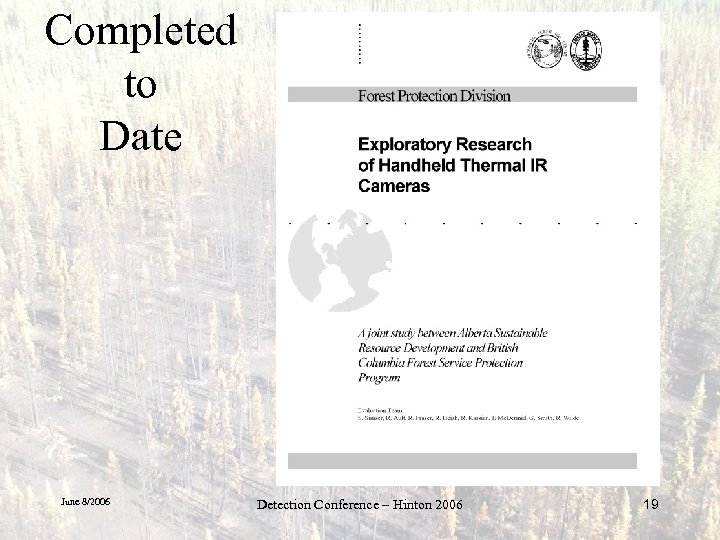
Completed to Date June 8/2006 Detection Conference – Hinton 2006 19
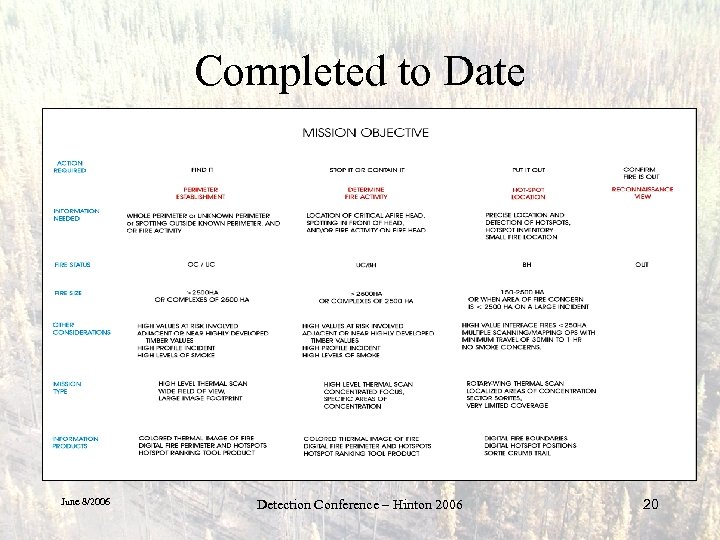
Completed to Date June 8/2006 Detection Conference – Hinton 2006 20
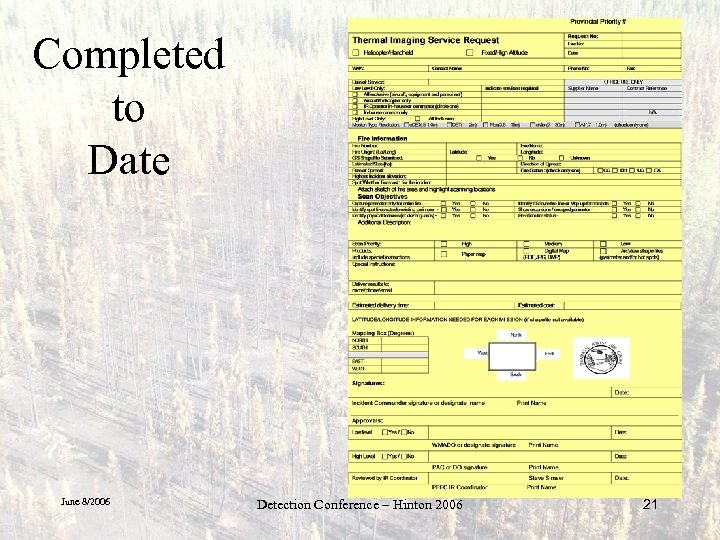
Completed to Date June 8/2006 Detection Conference – Hinton 2006 21
Future Standards Sensitivity/File Format/Accuracy • Ability to detect hotspot targets = > 25 sq cm in size • Ability to provide digital GPS shapefiles of hotspots and flight course taken by helicopter • The coordinates of targets within a spatial accuracy of 10 meters June 8/2006 Detection Conference – Hinton 2006 22
Future Standards Format of Delivered Data • Shapefile – Geographic(lat-long) or degree decimal degrees – NAD 83 datum – Include - *. dbf, *. shp, *. shx, *. prj files June 8/2006 Detection Conference – Hinton 2006 23
Future Standards Format of Delivered Data-con’t • Hardcopy maps – 11 x 17 – Quicklook product of identified targets • JPEG, BMP, PDF format • Must STAND on it’s own – – – June 8/2006 Scale Title Author North arrow Date Detection Conference – Hinton 2006 24
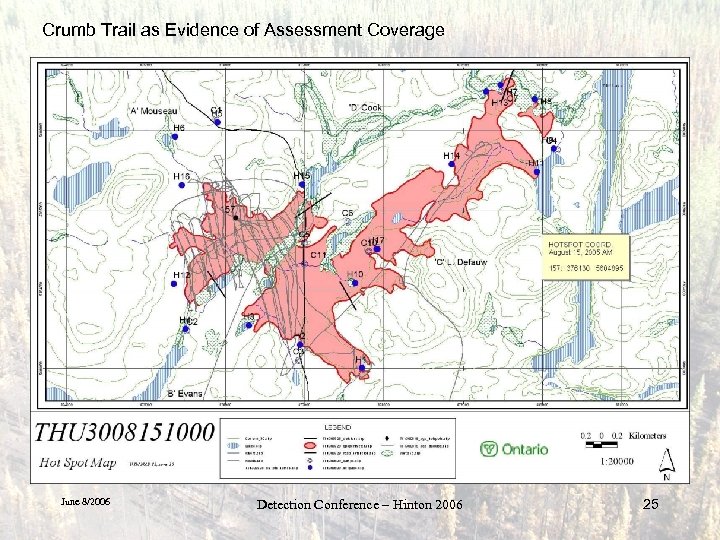
Crumb Trail as Evidence of Assessment Coverage June 8/2006 Detection Conference – Hinton 2006 25
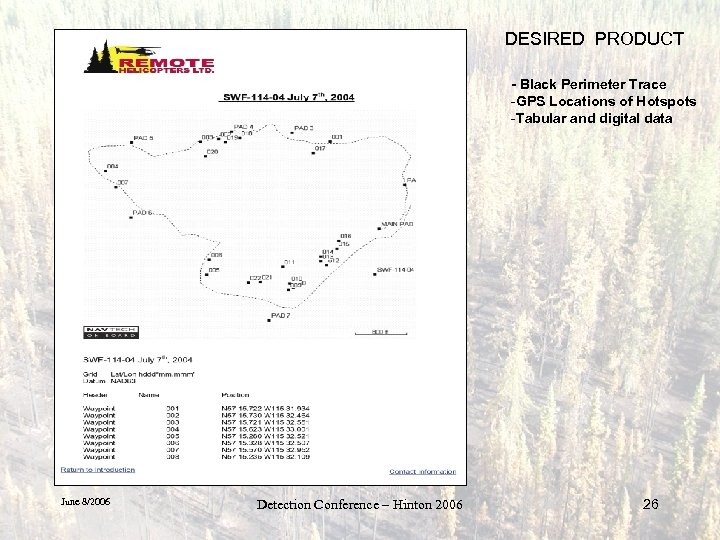
DESIRED PRODUCT - Black Perimeter Trace -GPS Locations of Hotspots -Tabular and digital data June 8/2006 Detection Conference – Hinton 2006 26
Future Standards Information Delivery • Immediate delivery of shapefile data and maps upon landing – To ground crews via drop tube or landing at camps via thumb drive • Future – Downlink capabilities of hotspots to sectors, camps, IC base – Downlink to simple printer – Real time downlink of IR images to IC base to aid planning section and IC in decision making June 8/2006 Detection Conference – Hinton 2006 27
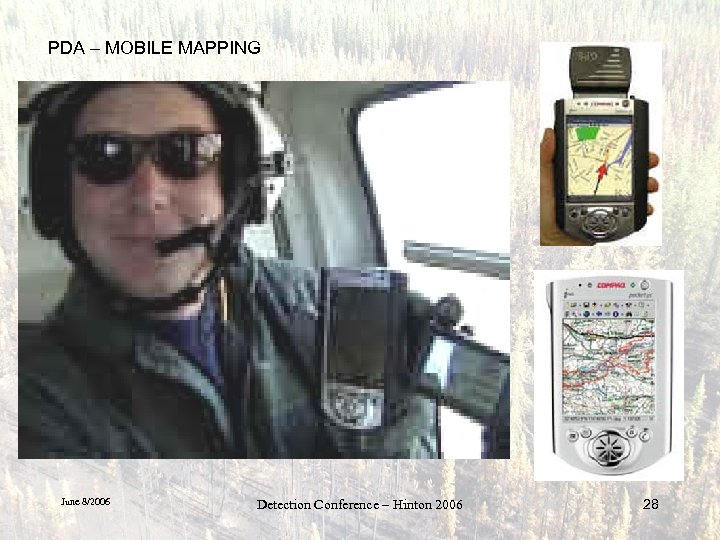
PDA – MOBILE MAPPING June 8/2006 Detection Conference – Hinton 2006 28
Future Standards Mission Plan • Include – – – – – June 8/2006 Where scan took place Scan objectives Average height of flight – AGL Start/stop times Type of scanner used Name of pilot and scanner operator Type and registration of helicopter Fire number / fire name Date of flight Detection Conference – Hinton 2006 29
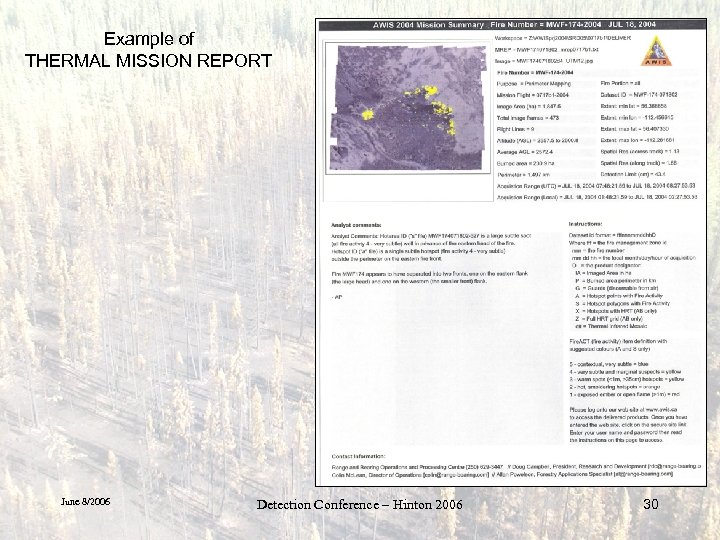
Example of THERMAL MISSION REPORT June 8/2006 Detection Conference – Hinton 2006 30
Future Standards IR Standards for Providers • Standardize training/certification for IR operators – Need to understand the basics of infrared – Known training companies • FLIR - nancy. edwards@flir. com • Snell infrared - gmcintosh@snellinfrared. com • Minimum on-site training requirements • 20 hours? • Test IR companies over grid to promote consistency – Must pass to use on fires June 8/2006 Detection Conference – Hinton 2006 31
Future Standards Performance Feedback • Expectations conveyed – At time of hire – Daily • Evaluation at time of release – Evaluations by designated ICS member – PSC – SITL – IR Coordinator? June 8/2006 Detection Conference – Hinton 2006 32
Thankyou Steve Simser, GIS/IR Specialist Wildfire Resource Information Wildfire Aviation and Geomatics Forest Protection Branch Forestry Division 9 th Floor, 9920 – 108 St. Edmonton, Alberta T 5 K 2 M 4 1 -780 -427 -6754 work 1 -780 -819 -6754 cell steve. simser@ gov. ab. ca June 8/2006 Detection Conference – Hinton 2006 33
Скачать презентацию THERMAL INFRARED PROGRAM HELICOPTER PLATFORMS Alberta Perspective June
b8cd8421580dab77bca2566f7c6e2352.ppt