


 Скачать презентацию Thermal distortion dynamics of the Hart RAO Lunar
60eff789eb78b0a45c4863c54f59bc5c.ppt
- Количество слайдов: 20
 Thermal distortion dynamics of the Hart. RAO Lunar Laser Ranger optical telescope; impacts on pointing, characterisation and modelling Philemon Tsela 1, Ludwig Combrinck 2, 1, Roelf Botha 2 , Bongani Ngcobo 3 1 Department of Geography, Geoinformatics &Meteorology, University of Pretoria, Pretoria 2 Space Geodesy Programme, Hartebeesthoek Radio Astronomy Observatory, Krugersdorp 3 Department of Physics, University of Pretoria, Pretoria logo here…
 OUTLINE • Introduction – – Brief history Applications Operating LLR stations Aim of this study • System requirements • Materials and methods – Optical assembly and properties – Analysis of temperature gradients – Analysis of structural deformations • Results and discussion • Concluding remarks
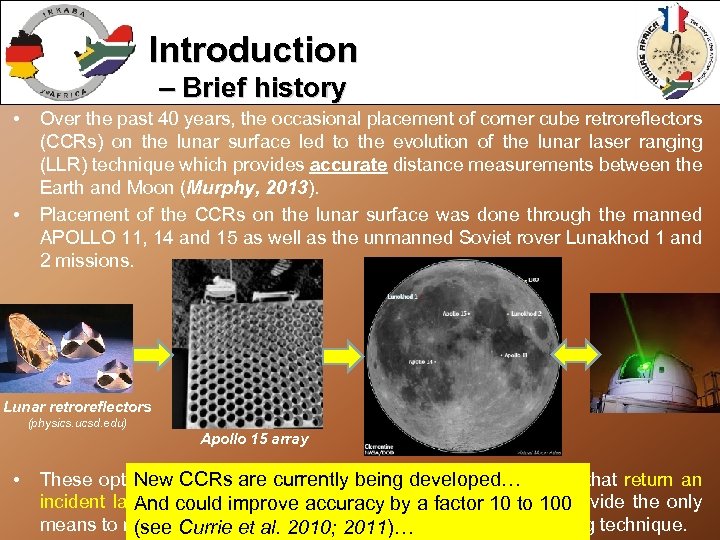 Introduction – Brief history • • Over the past 40 years, the occasional placement of corner cube retroreflectors (CCRs) on the lunar surface led to the evolution of the lunar laser ranging (LLR) technique which provides accurate distance measurements between the Earth and Moon (Murphy, 2013). Placement of the CCRs on the lunar surface was done through the manned APOLLO 11, 14 and 15 as well as the unmanned Soviet rover Lunakhod 1 and 2 missions. Lunar retroreflectors (physics. ucsd. edu) Apollo 15 array • These optical retroreflectors consists of “reflective prism faces” that return an New CCRs are currently being developed… incident laser beam to its original direction and as a result, provide the only And could improve accuracy by a factor 10 to 100 means to measure the Earth-Moon distance with the laser ranging technique. (see Currie et al. 2010; 2011)…
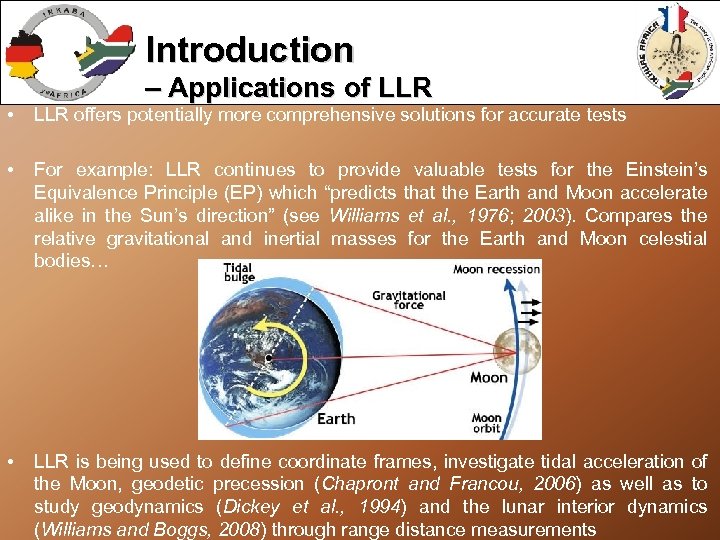 Introduction – Applications of LLR • LLR offers potentially more comprehensive solutions for accurate tests • For example: LLR continues to provide valuable tests for the Einstein’s Equivalence Principle (EP) which “predicts that the Earth and Moon accelerate alike in the Sun’s direction” (see Williams et al. , 1976; 2003). Compares the relative gravitational and inertial masses for the Earth and Moon celestial bodies… • LLR is being used to define coordinate frames, investigate tidal acceleration of the Moon, geodetic precession (Chapront and Francou, 2006) as well as to study geodynamics (Dickey et al. , 1994) and the lunar interior dynamics (Williams and Boggs, 2008) through range distance measurements
 Introduction - Operating LLR stations • Currently, there are three regularly operating LLR stations globally that acquire data regularly and are all located in the Northern hemisphere (i. e. , Mc. Donald Laser Ranging System (MLRS) /USA, Observatoire de la Côte d'Azur (OCA)/ France and Apache Point Observatory Lunar Laser Ranging Operation (APOLLO)/ USA) (http: //ilrs. gsfc. nasa. gov) • Followed by LLR modern stations - Wettzell/ Germany and Matera Laser Ranging Observatory (MLRO) / Italy which are operated during specific times • Australia, Japan and South Africa are among the countries currently developing operating models (coupled with modern instrumentation) for their Lunar Laser Rangers (http: //ilrs. gsfc. nasa. gov) • In particular, The Lunar Laser Ranger being developed at Hartebeesthoek Radio Astronomy Observatory (Hart. RAO) in South Africa would be an addition to the list of operating LLR stations and thus contribute to global ranging data
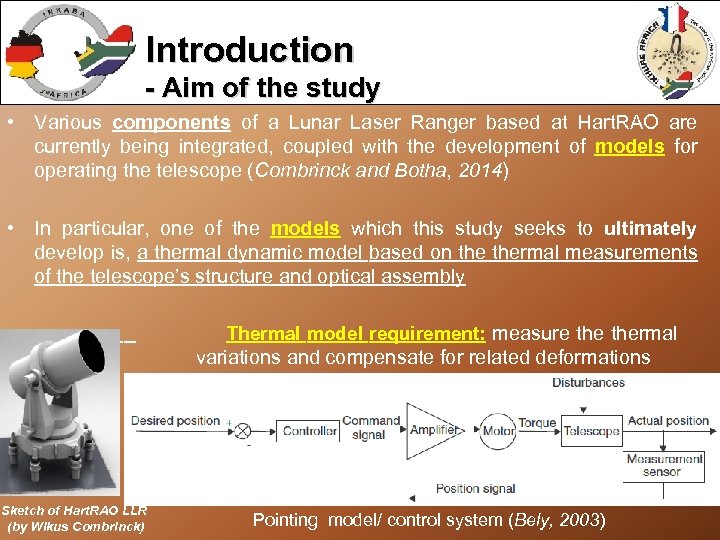 Introduction - Aim of the study • Various components of a Lunar Laser Ranger based at Hart. RAO are currently being integrated, coupled with the development of models for operating the telescope (Combrinck and Botha, 2014) • In particular, one of the models which this study seeks to ultimately develop is, a thermal dynamic model based on thermal measurements of the telescope’s structure and optical assembly • Thermal model requirement: measure thermal variations and compensate for related deformations Sketch of Hart. RAO LLR (by Wikus Combrinck) Pointing model/ control system (Bely, 2003)
 System specifications - Thermal model requirements The specifications proposed for thermal model in this study include the following (Hart. RAO, 2005): • acquire real-time thermal measurements from n number of sensors e. g. RTDs; • Regulate ∆T ºC at ~1 ºC level…. (stringent model requirement (Murphy et al. 2008)) • accuracy of the temperature-sensor-readings needs to be ± 0. 5 ºC;
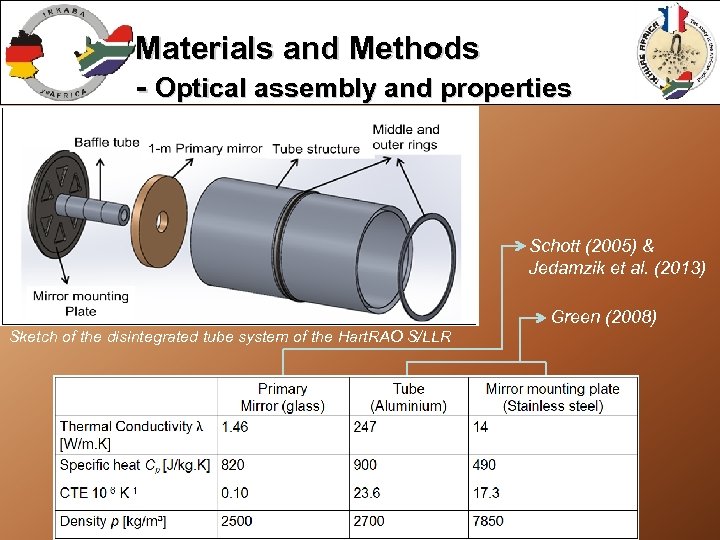 Materials and Methods - Optical assembly and properties Schott (2005) & Jedamzik et al. (2013) Green (2008) Sketch of the disintegrated tube system of the Hart. RAO S/LLR
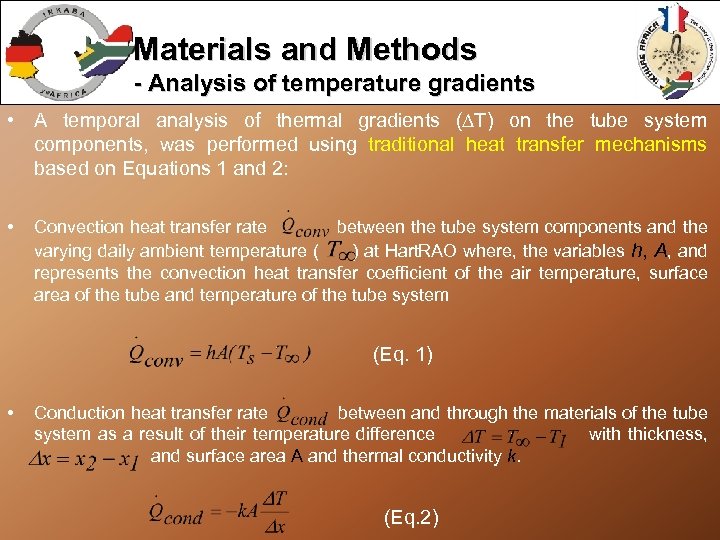 Materials and Methods - Analysis of temperature gradients • A temporal analysis of thermal gradients (∆T) on the tube system components, was performed using traditional heat transfer mechanisms based on Equations 1 and 2: • Convection heat transfer rate between the tube system components and the varying daily ambient temperature ( ) at Hart. RAO where, the variables h, A, and represents the convection heat transfer coefficient of the air temperature, surface area of the tube and temperature of the tube system (Eq. 1) • Conduction heat transfer rate between and through the materials of the tube system as a result of their temperature difference with thickness, and surface area A and thermal conductivity k. (Eq. 2)
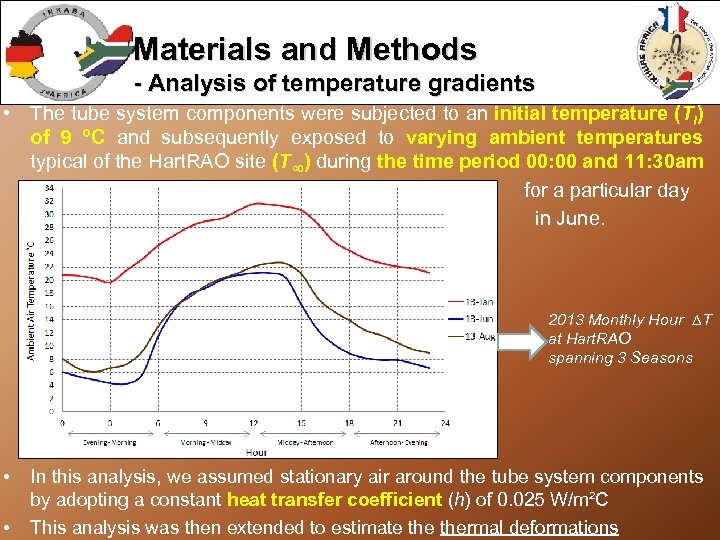 Materials and Methods - Analysis of temperature gradients • The tube system components were subjected to an initial temperature (Ti) of 9 ºC and subsequently exposed to varying ambient temperatures typical of the Hart. RAO site (T∞) during the time period 00: 00 and 11: 30 am for a particular day in June. 2013 Monthly Hour ∆T at Hart. RAO spanning 3 Seasons • • In this analysis, we assumed stationary air around the tube system components by adopting a constant heat transfer coefficient (h) of 0. 025 W/m²C This analysis was then extended to estimate thermal deformations
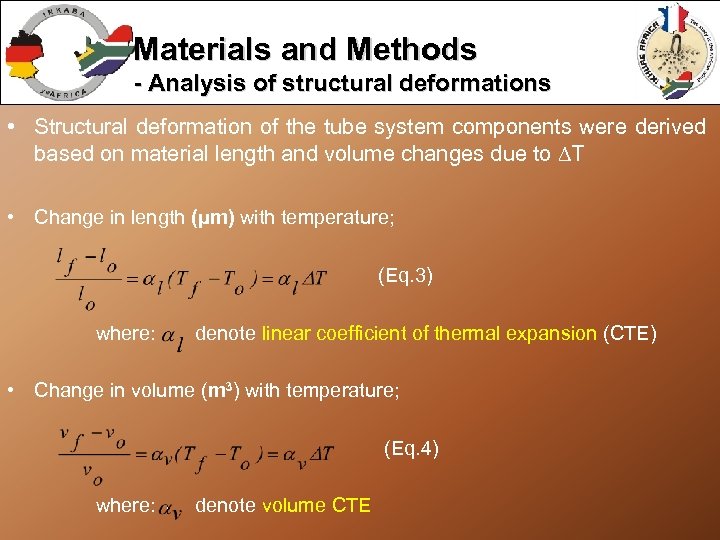 Materials and Methods - Analysis of structural deformations • Structural deformation of the tube system components were derived based on material length and volume changes due to ∆T • Change in length (μm) with temperature; (Eq. 3) where: denote linear coefficient of thermal expansion (CTE) • Change in volume (m 3) with temperature; (Eq. 4) where: denote volume CTE
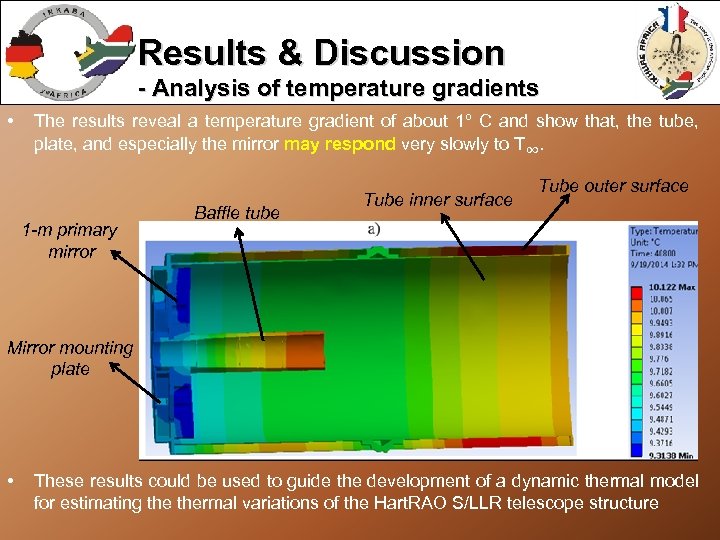 Results & Discussion - Analysis of temperature gradients • The results reveal a temperature gradient of about 1º C and show that, the tube, plate, and especially the mirror may respond very slowly to T∞. 1 -m primary mirror Baffle tube Tube inner surface Tube outer surface Mirror mounting plate • These results could be used to guide the development of a dynamic thermal model for estimating thermal variations of the Hart. RAO S/LLR telescope structure
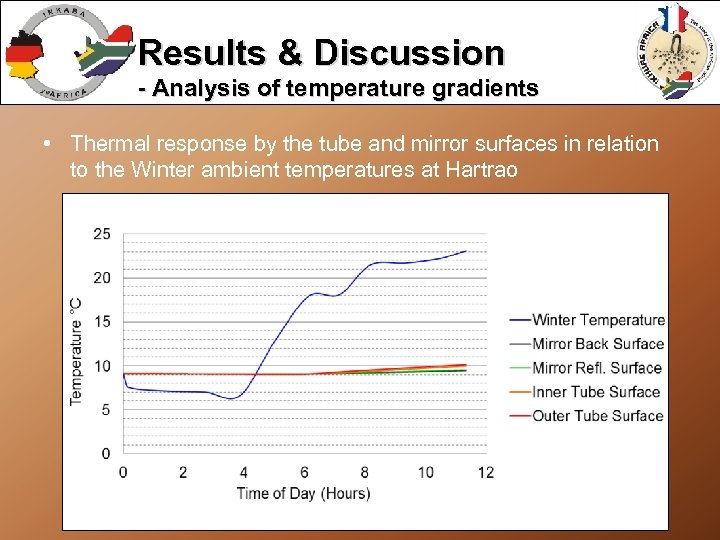 Results & Discussion - Analysis of temperature gradients • Thermal response by the tube and mirror surfaces in relation to the Winter ambient temperatures at Hartrao
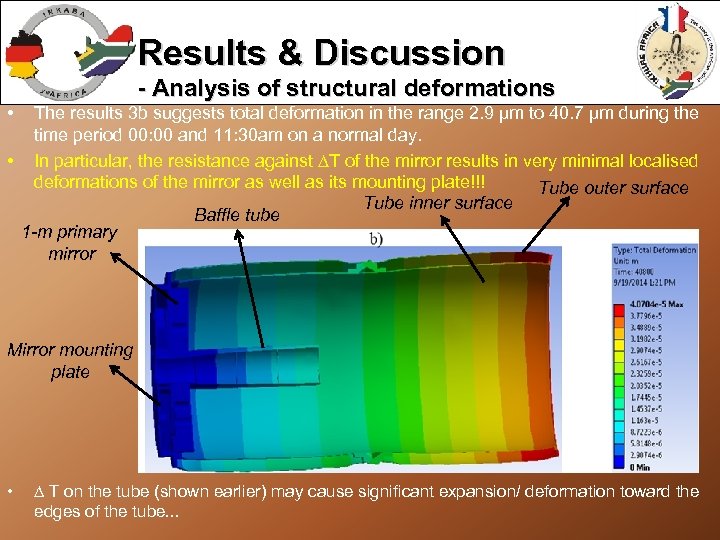 Results & Discussion - Analysis of structural deformations • The results 3 b suggests total deformation in the range 2. 9 μm to 40. 7 μm during the time period 00: 00 and 11: 30 am on a normal day. • In particular, the resistance against ∆T of the mirror results in very minimal localised deformations of the mirror as well as its mounting plate!!! Tube outer surface Tube inner surface Baffle tube 1 -m primary mirror Mirror mounting plate • ∆ T on the tube (shown earlier) may cause significant expansion/ deformation toward the edges of the tube. . .
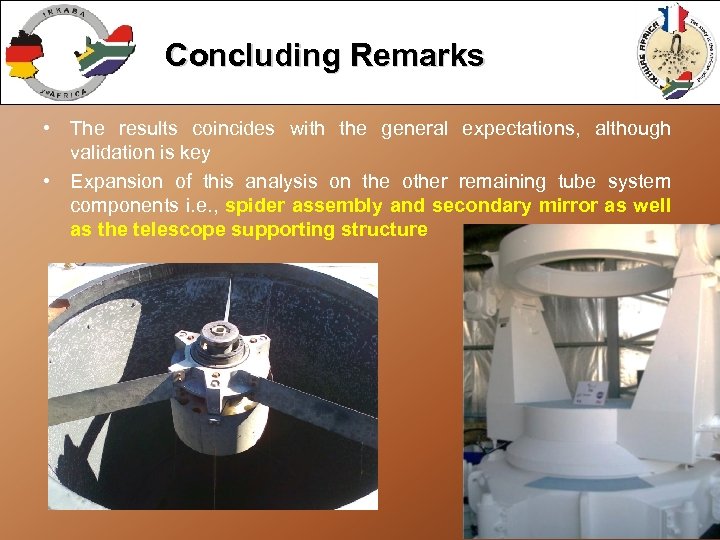 Concluding Remarks • The results coincides with the general expectations, although validation is key • Expansion of this analysis on the other remaining tube system components i. e. , spider assembly and secondary mirror as well as the telescope supporting structure
 Concluding Remarks • These findings provide an indication of: i) understanding thermal behaviour of the telescope’s critical components with respect to the changing thermal environment, ii) guiding the strategic location of thermal sensors on the telescope to read real ∆T (e. g. , this could enable real-time derivation and prediction of deformations), and iii) options for developing a thermal dynamic model which would correct for thermal variations that affect the pointing of the telescope.
 References • • • Murphy, T. W. (2013). Lunar laser ranging: the millimeter challenge. Reports on Progress in Physics, 76(7), 076901. Currie, Dell'Agnello, S. , & Monache, G. D. (2010, October). A Lunar Laser Ranging Retroreflector Array for the 21 st Century: Thermal and emplacement issues. In Optomechatronic Technologies (ISOT), 2010 International Symposium on (pp. 1 -6). IEEE. Currie, D. , Dell’Agnello, S. , & Delle Monache, G. (2011). A lunar laser ranging retroreflector array for the 21 st century. Acta Astronautica, 68(7), 667 -680. Williams, J. G. , Dicke, R. H. , Bender, P. L. , Alley, C. O. , Carter, W. E. , Currie, D. G. , . . . and Wilkinson, D. T. (1976). New test of the equivalence principle from lunar laser ranging. Physical Review Letters, 36(11), 551 Chapront, J. , and Francou, G. (2006). Lunar Laser Ranging: measurements, analysis, and contribution to the reference systems. IERS Technical Note, 34, 97 -116. Dickey, J. , Bender, P. , Faller, J. , Newhall, X. , Ricklefs, R. , Ries, J. , . . . and Yoder, C. (1994). Lunar laser ranging: A continuing legacy of the Apollo program. Williams, J. G. , and Boggs, D. H. (2008, October). Lunar core and mantle. What does LLR see. In Proceedings of the 16 th International Workshop on Laser Ranging, held on (pp. 12 -17) Combrinck, L. , & Botha, R. (2014). Challenges and progress with the development of a Lunar Laser Ranger for South Africa. these proceedings Bely, P. (Ed. ). (2003). The design and construction of large optical telescopes. Springer. Hartebeesthoek Radio Astronomy Observatory (Hart. RAO). (2005). Proposed re-location and conversion of CNES SLR system to South Africa in collaboration with OCA and the greater ILRS community. Retrieved from http: //www. hartrao. ac. za/iisgeo/docs/LLR_proposal. doc Murphy Jr, T. W. , Adelberger, E. G. , Battat, J. B. R. , Carey, L. N. , Hoyle, C. D. , Le. Blanc, P. , . . .
 References • • Jedamzik, R. , Kunisch, C. , & Westerhoff, T. (2013, September). ZERODUR: progress in CTE characterization. In SPIE Optical Engineering+ Applications (pp. 88600 P-88600 P). International Society for Optics and Photonics. Schott, A. G. (2005). Thermal Expansion of Zerodur. Schott Technical Information publication TIE-37. Green, DW. (2008) Perry's chemical engineers' handbook. Vol. 796. New York: Mc. Graw-hill. Dalcher, A. W. , Yang, T. M. , & Chu, C. L. (1977). High temperature thermal-elastic analysis of dissimilar metal transition joints. Journal of Engineering Materials and Technology, 99(1), 65 -69
 Acknowledgements Special thanks to: 1) Inkaba ye. Africa, DST, NRF, Hart. RAO and GFZ for their overwhelming student support, particularly toward this project. 2) The mechanical engineering department at the University of Pretoria for their cordial reception in providing access to ANSYS software
 Thank you! Philemon. tsela@up. ac. za