

There are 38 colleges and 6 permanent



There are 38 colleges and 6 permanent private halls which were founded by different Christian denominations, and still retain their religious character today at Oxford. All colleges accept both men and women. Thirty colleges and five halls admit students for both graduate and undergraduate degrees. 6 Colleges admit only graduate students, as does Kellogg College, which supports the lifelong learning work of the University for adult, part-time, and professional development students. All Souls is unique among Oxford colleges because it has no junior members: all are Fellows (except the Warden). The University’s oldest colleges are University College, Balliol College, and Merton College, all of which were established by the 13 th century. Green Templeton College, which came into existence in October 2008 following the merger of Green College and Templeton College, is the University’s newest college. St Catherine’s College, which takes both undergraduate and graduate students, currently has the largest number of students (788), while some of the permanent private halls have fewer than a hundred student members.
Colleges bring together leading Thirty-eight Colleges, though academics and students across independent and self-governing, form subjects and year groups, and from a core element of the University, to different cultures and countries. which they are related in a federal system, not unlike the United States. The relatively small number of students at each college allows for Each college is granted a charter close and supportive personal approved by the Privy Council, under attention to be given to the induction, which it is governed by a Head of academic development and welfare of House and a Governing Body individual students. comprising of a number of Fellows, most of whom also hold University Colleges invest heavily in facilities posts. including extensive library and IT provision, accommodation and welfare support, and sports and social facilities.
Structure of the University The Vice-Chancellor, who holds office for seven years, is effectively the 'Chief Executive' of the University. Three Pro-Vice-Chancellors have specific, functional responsibility for Academic Matters, Academic Services and University Collections, and Planning and Resource Allocation. The Chancellor, who is usually an eminent public figure elected for life, serves as the titular head of the University, presiding over all major ceremonies. The principal policy-making body is the Council of the University, which has 26 members, including those elected by Congregation, representatives of the Colleges and two members from outside the University. Council is responsible for the academic policy and strategic direction of the University, and operates through four major committees: Educational Policy and Standards, General Purposes, Personnel, and Planning and Resource Allocation. Final responsibility for legislative matters rests with Congregation, which comprises over 3600 members of the academic, senior research, library, museum and administrative staff. Convocation was originally the main governing body of the University, consisting of all doctors and masters of the University, but it now comprises all graduates of the university and its only remaining function is to elect the Chancellor of the University.
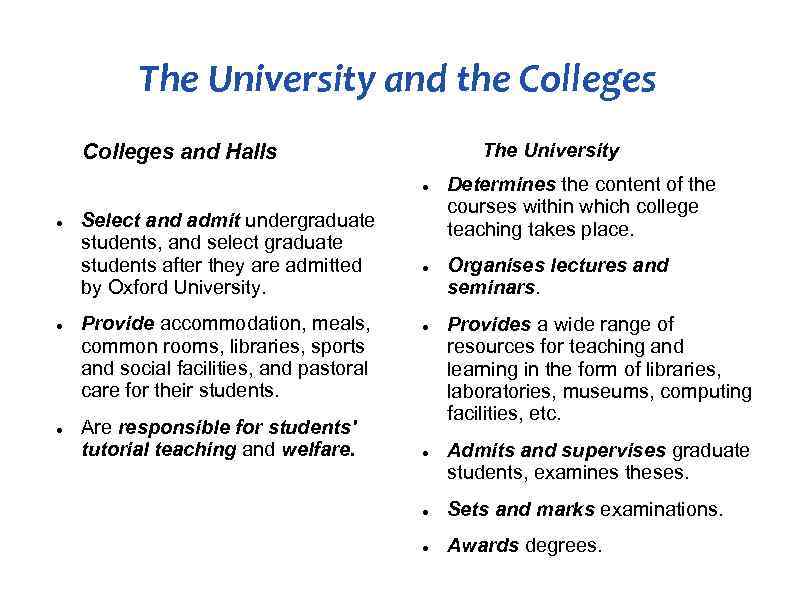
The University and the Colleges and Halls The University Determines the content of the courses within which college Select and admit undergraduate teaching takes place. students, and select graduate students after they are admitted Organises lectures and by Oxford University. seminars. Provide accommodation, meals, Provides a wide range of common rooms, libraries, sports resources for teaching and social facilities, and pastoral learning in the form of libraries, care for their students. laboratories, museums, computing facilities, etc. Are responsible for students' tutorial teaching and welfare. Admits and supervises graduate students, examines theses. Sets and marks examinations. Awards degrees.
Conference of Colleges Represents the common concerns of the colleges. Negotiates with central University bodies on collegiate matters. Appoints members of joint University/College committees. Has representation on Council, its committees, and the four Divisional Boards. Acts as a body for intercollegiate discussion and decision- making.