


 Скачать презентацию Theory of English Grammar synopsis Final examinations
State_exams_ZO.ppt
- Количество слайдов: 55
 Theory of English Grammar synopsis Final examinations © И. В. Дмитриева
 QN 1 MAIN UNITS AND NOTIONS OF GRAMMAR
 GRAMMAR is a subsystem in language which expresses meanings through the opposition of variants of one and the same unit (forms). Grammar as a linguistic discipline: Morphology + Syntax
 Units of grammar • Morpheme - form-building morphemes / inflections asks, oxen. Types of morphemes: en 1 - lexical, lexico-grammatical, grammatical; 2 - free, bound, semi-bound, discountinuous; NB! – zero morpheme = meaningful absence • • Word group / phrase Sentence Units larger than a sentence supraphrasal unities / etc. / texts HIERARCHY
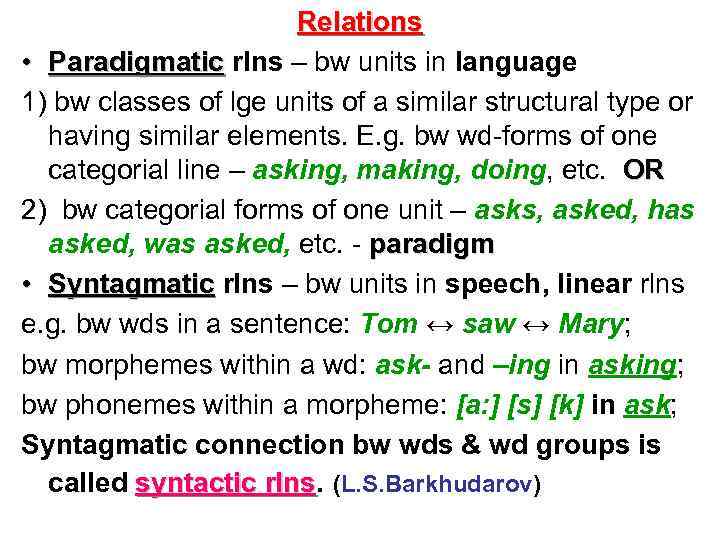 Relations • Paradigmatic rlns – bw units in language 1) bw classes of lge units of a similar structural type or having similar elements. E. g. bw wd-forms of one categorial line – asking, making, doing, etc. OR 2) bw categorial forms of one unit – asks, asked, has asked, was asked, etc. - paradigm • Syntagmatic rlns – bw units in speech, linear rlns e. g. bw wds in a sentence: Tom ↔ saw ↔ Mary; bw morphemes within a wd: ask- and –ing in asking; bw phonemes within a morpheme: [a: ] [s] [k] in ask; Syntagmatic connection bw wds & wd groups is called syntactic rlns. (L. S. Barkhudarov) rlns
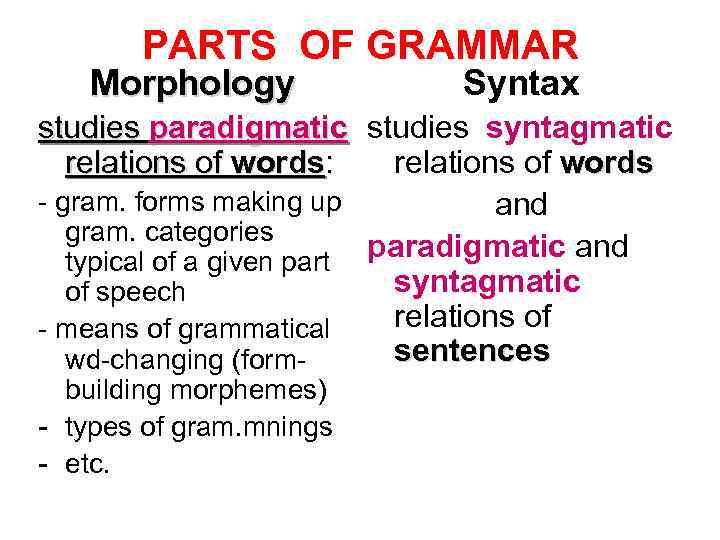 PARTS OF GRAMMAR Morphology Syntax studies paradigmatic studies syntagmatic relations of words: relations of words - gram. forms making up and gram. categories typical of a given part paradigmatic and syntagmatic of speech relations of - means of grammatical sentences wd-changing (formbuilding morphemes) - types of gram. mnings - etc.
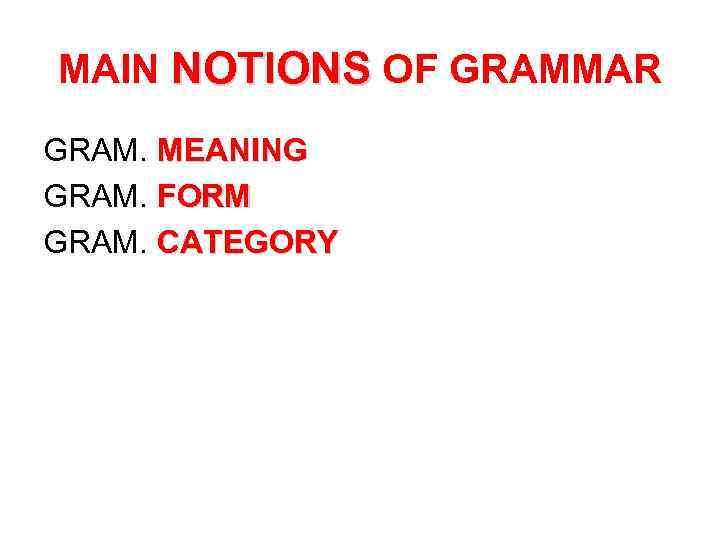 MAIN NOTIONS OF GRAMMAR GRAM. MEANING GRAM. FORM GRAM. CATEGORY
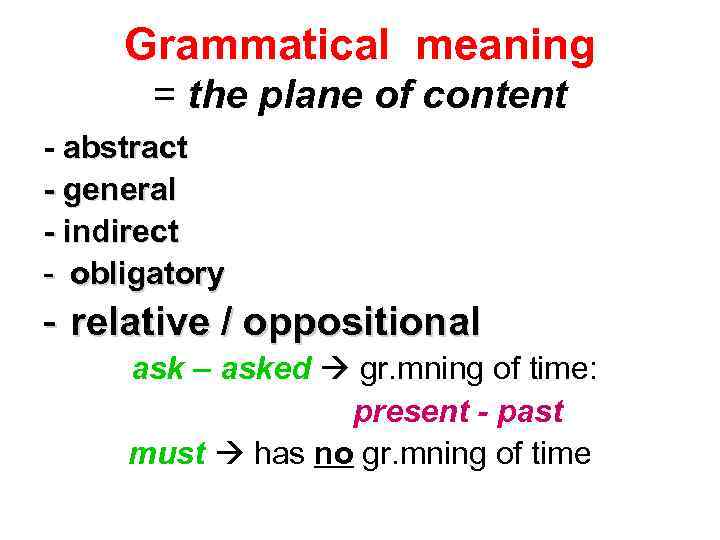 Grammatical meaning = the plane of content - abstract - general - indirect - obligatory - relative / oppositional ask – asked gr. mning of time: present - past must has no gr. mning of time
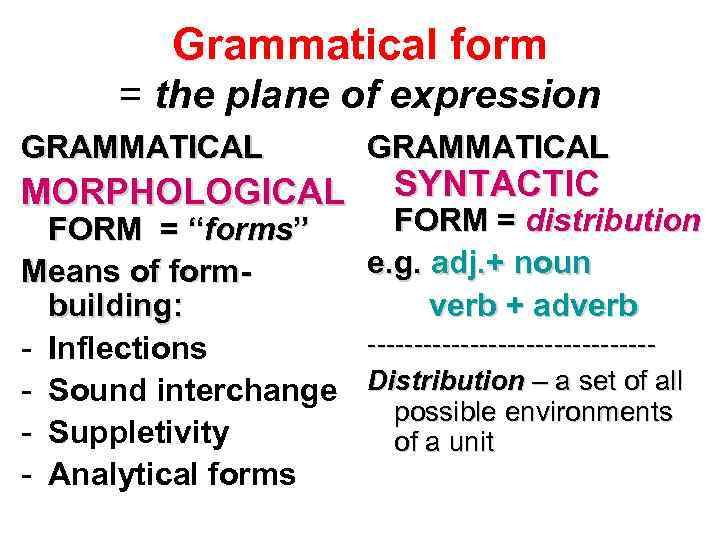 Grammatical form = the plane of expression GRAMMATICAL MORPHOLOGICAL GRAMMATICAL SYNTACTIC FORM = distribution FORM = “forms” e. g. adj. + noun Means of formverb + adverb building: ---------------- Inflections - Sound interchange Distribution – a set of all possible environments - Suppletivity of a unit - Analytical forms
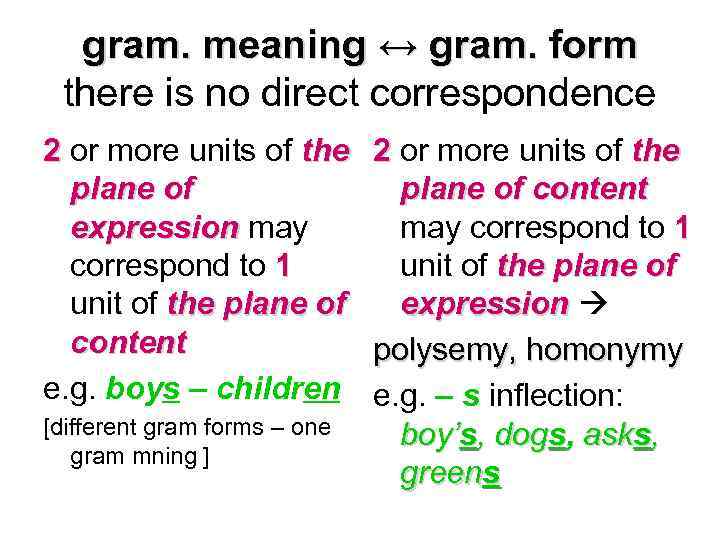 gram. meaning ↔ gram. form there is no direct correspondence 2 or more units of the plane of content expression may correspond to 1 unit of the plane of expression unit of the plane of content polysemy, homonymy e. g. boys – children e. g. – s inflection: [different gram forms – one boy’s, dogs, asks, gram mning ] greens
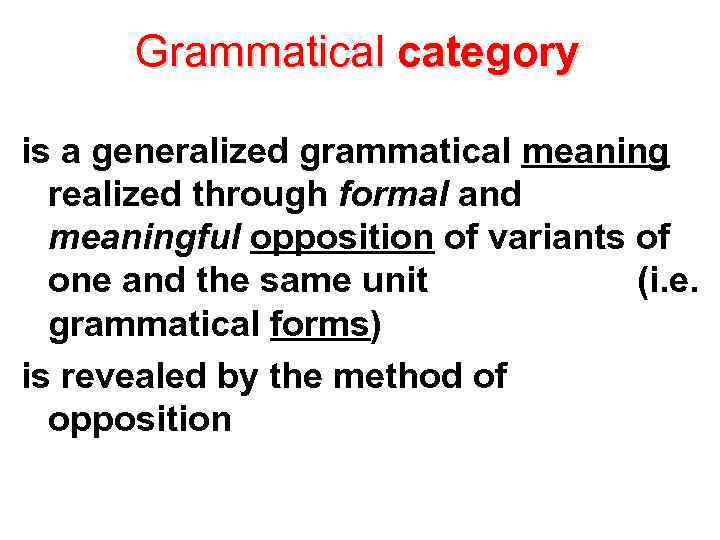 Grammatical category is a generalized grammatical meaning realized through formal and meaningful opposition of variants of one and the same unit (i. e. grammatical forms) is revealed by the method of opposition
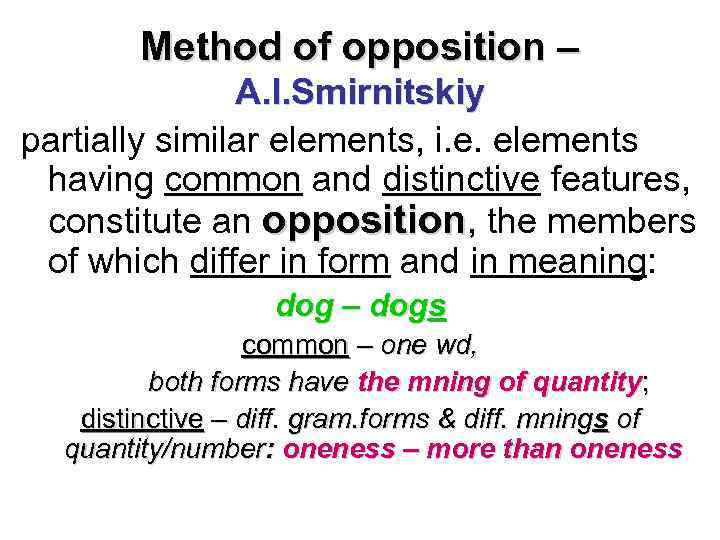 Method of opposition – A. I. Smirnitskiy partially similar elements, i. e. elements having common and distinctive features, constitute an opposition, the members of which differ in form and in meaning: dog – dogs common – one wd, both forms have the mning of quantity; distinctive – diff. gram. forms & diff. mnings of quantity/number: oneness – more than oneness
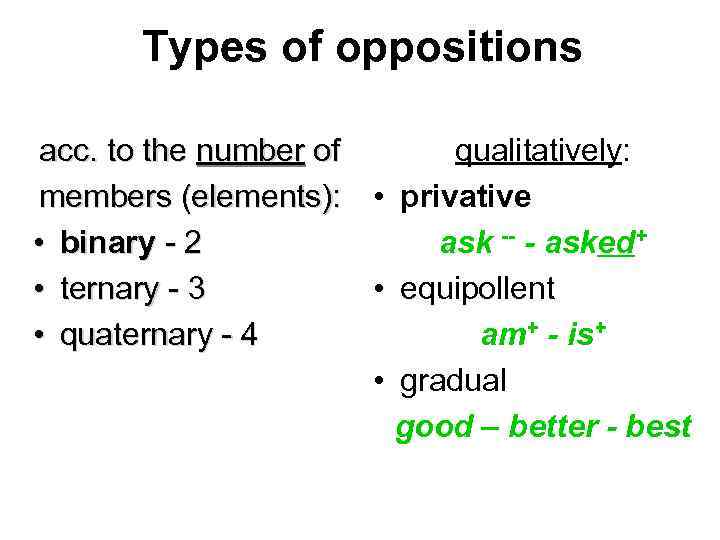 Types of oppositions acc. to the number of qualitatively: members (elements): • privative • binary - 2 ask -- - asked+ • ternary - 3 • equipollent • quaternary - 4 am+ - is+ • gradual good – better - best
 Qn 2 Problems of part-of-speech classification in modern English
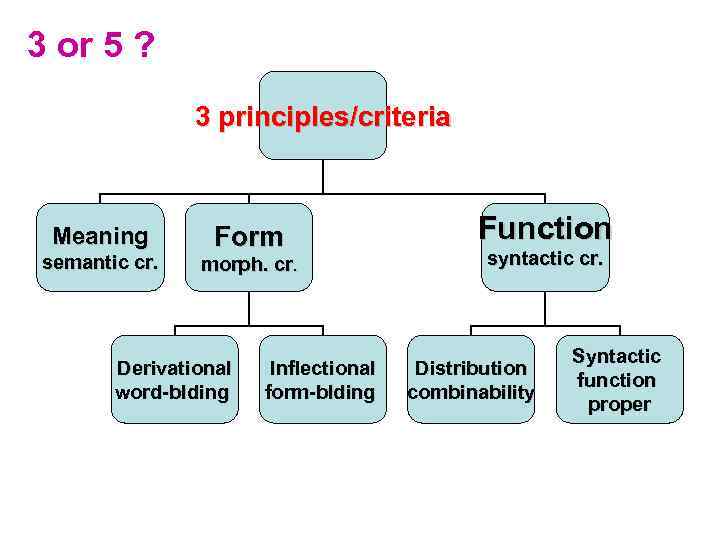 3 or 5 ? 3 principles/criteria Meaning semantic cr. Form morph. cr. Derivational word-blding Inflectional form-blding Function syntactic cr. Distribution combinability Syntactic function proper
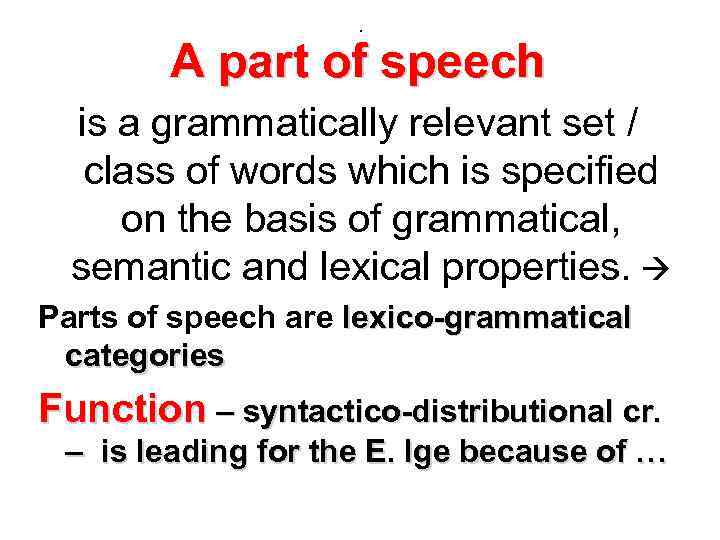 . A part of speech is a grammatically relevant set / class of words which is specified on the basis of grammatical, semantic and lexical properties. Parts of speech are lexico-grammatical categories Function – syntactico-distributional cr. – is leading for the E. lge because of …
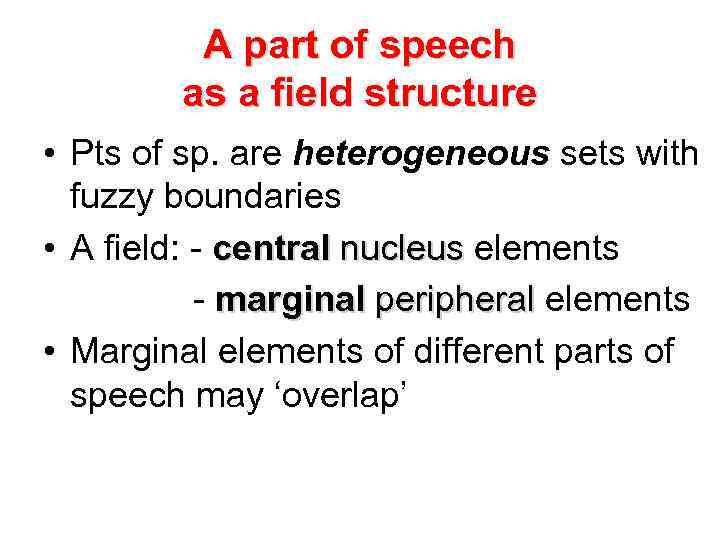 A part of speech as a field structure • Pts of sp. are heterogeneous sets with fuzzy boundaries • A field: - central nucleus elements - marginal peripheral elements • Marginal elements of different parts of speech may ‘overlap’
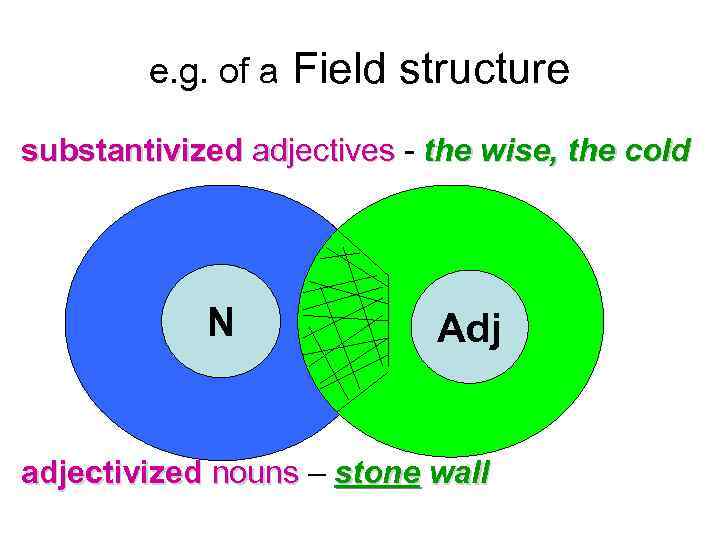 e. g. of a Field structure substantivized adjectives - the wise, the cold N Adj adjectivized nouns – stone wall
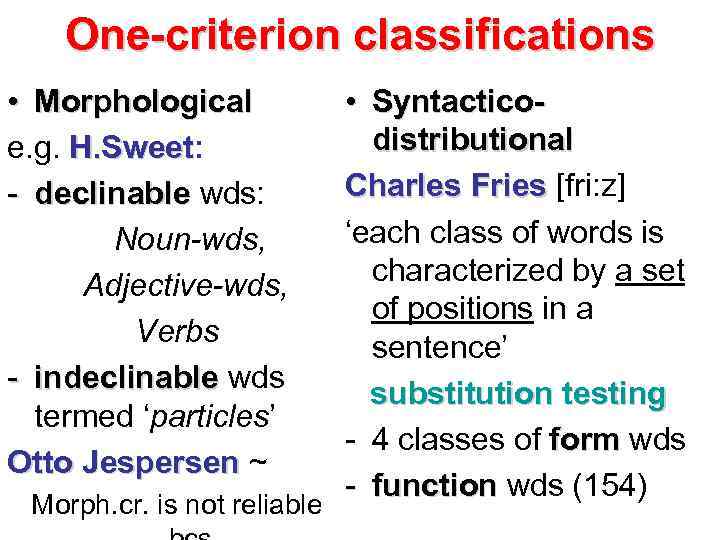 One-criterion classifications • Morphological e. g. H. Sweet: H. Sweet - declinable wds: Noun-wds, Adjective-wds, Verbs - indeclinable wds termed ‘particles’ Otto Jespersen ~ Morph. cr. is not reliable • Syntacticodistributional Charles Fries [fri: z] ‘each class of words is characterized by a set of positions in a sentence’ substitution testing - 4 classes of form wds - function wds (154)
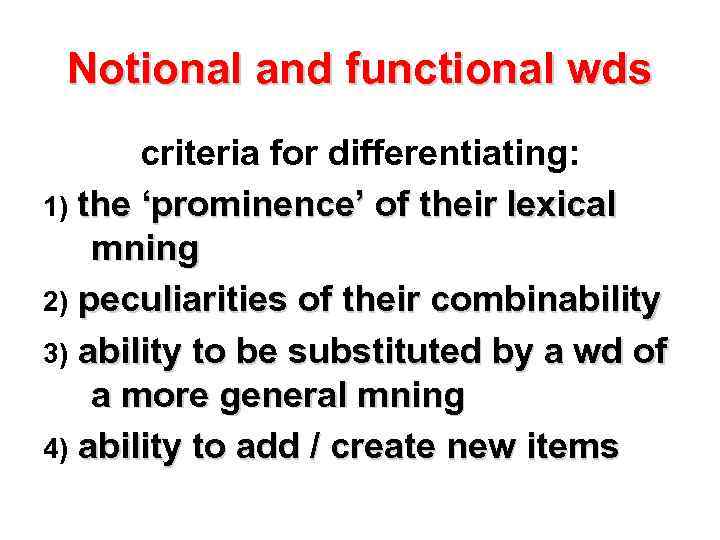 Notional and functional wds criteria for differentiating: 1) the ‘prominence’ of their lexical mning 2) peculiarities of their combinability 3) ability to be substituted by a wd of a more general mning 4) ability to add / create new items
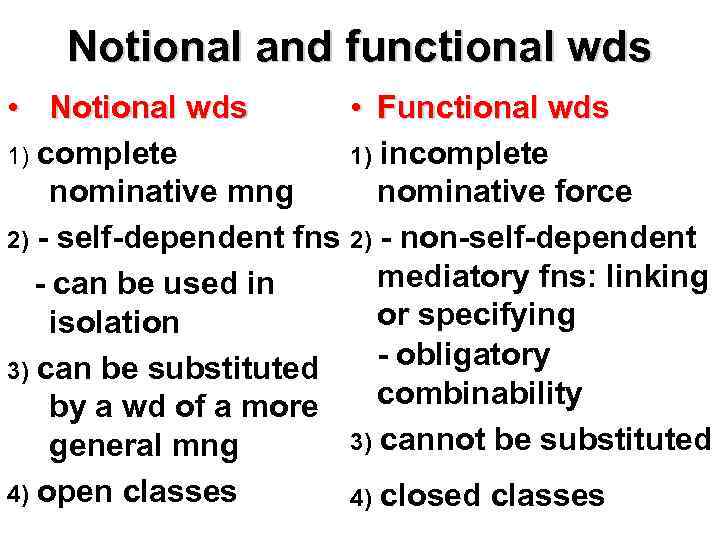 Notional and functional wds • Notional wds • Functional wds 1) complete 1) incomplete nominative mng nominative force 2) - self-dependent fns 2) - non-self-dependent mediatory fns: linking - can be used in or specifying isolation - obligatory 3) can be substituted combinability by a wd of a more 3) cannot be substituted general mng 4) open classes 4) closed classes
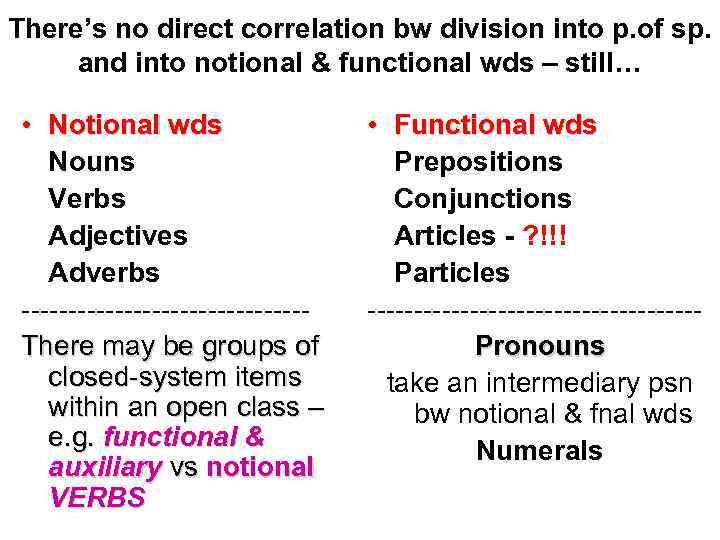 There’s no direct correlation bw division into p. of sp. and into notional & functional wds – still… • Notional wds Nouns Verbs Adjectives Adverbs ---------------There may be groups of closed-system items within an open class – e. g. functional & auxiliary vs notional VERBS • Functional wds Prepositions Conjunctions Articles - ? !!! Particles ------------------Pronouns take an intermediary psn bw notional & fnal wds Numerals
 Qn 5 GRAMMATICAL CHARACTERISTICS OF THE NOUN
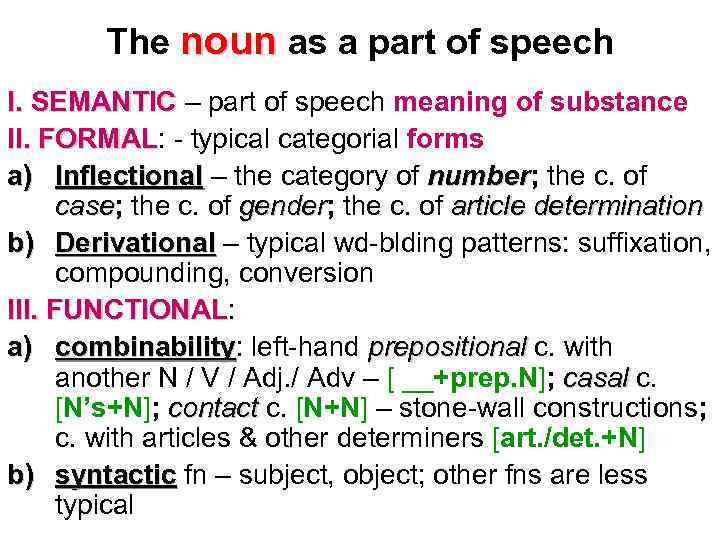 The noun as a part of speech I. SEMANTIC – part of speech meaning of substance II. FORMAL: - typical categorial forms FORMAL a) Inflectional – the category of number; the c. of number case; the c. of gender; the c. of article determination case gender b) Derivational – typical wd-blding patterns: suffixation, compounding, conversion III. FUNCTIONAL: FUNCTIONAL a) combinability: left-hand prepositional c. with combinability another N / V / Adj. / Adv – [ __+prep. N]; casal c. [N’s+N]; contact c. [N+N] – stone-wall constructions; c. with articles & other determiners [art. /det. +N] b) syntactic fn – subject, object; other fns are less typical
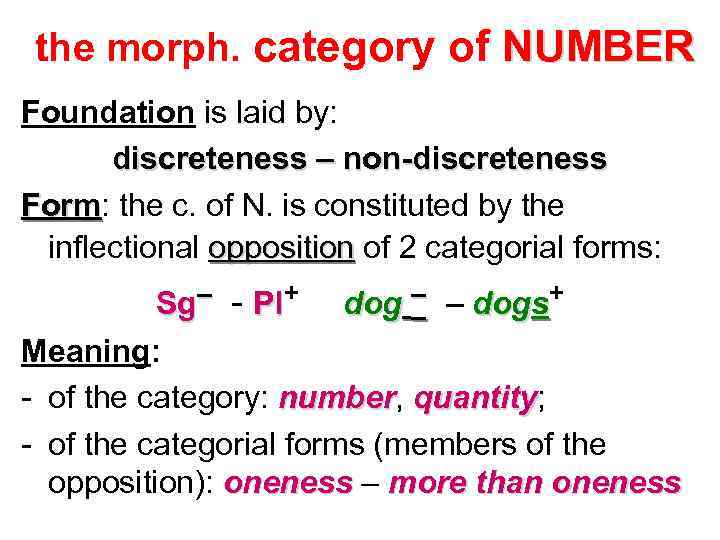 the morph. category of NUMBER Foundation is laid by: discreteness – non-discreteness Form: the c. of N. is constituted by the Form inflectional opposition of 2 categorial forms: Sg– - Pl+ dog – – dogs+ Meaning: - of the category: number, quantity; number quantity - of the categorial forms (members of the opposition): oneness – more than oneness
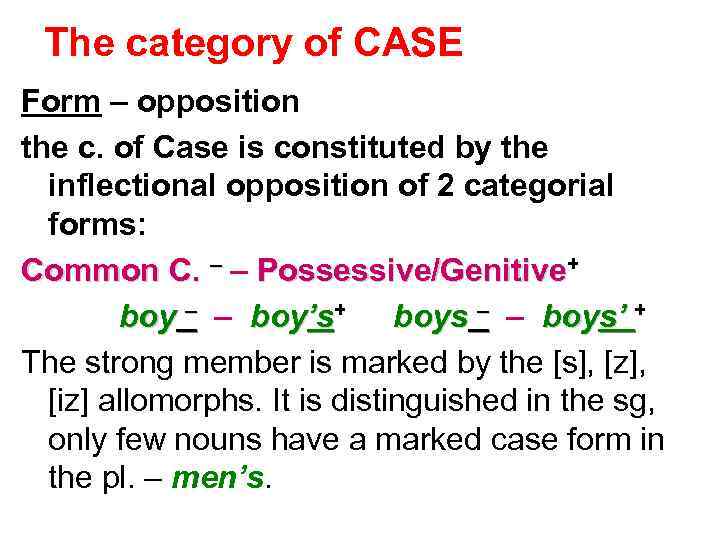 The category of CASE Form – opposition the c. of Case is constituted by the inflectional opposition of 2 categorial forms: Common C. – – Possessive/Genitive+ boy – – boy’s+ boys – – boys’ + The strong member is marked by the [s], [z], [iz] allomorphs. It is distinguished in the sg, only few nouns have a marked case form in the pl. – men’s.
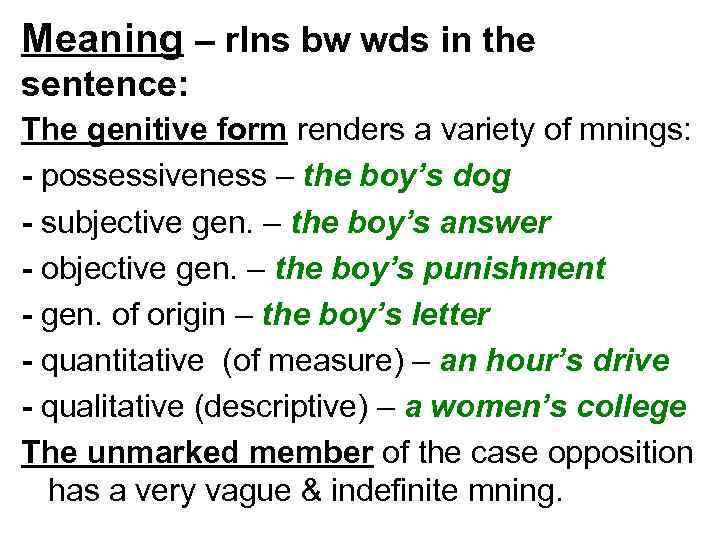 Meaning – rlns bw wds in the sentence: The genitive form renders a variety of mnings: - possessiveness – the boy’s dog - subjective gen. – the boy’s answer - objective gen. – the boy’s punishment - gen. of origin – the boy’s letter - quantitative (of measure) – an hour’s drive - qualitative (descriptive) – a women’s college The unmarked member of the case opposition has a very vague & indefinite mning.
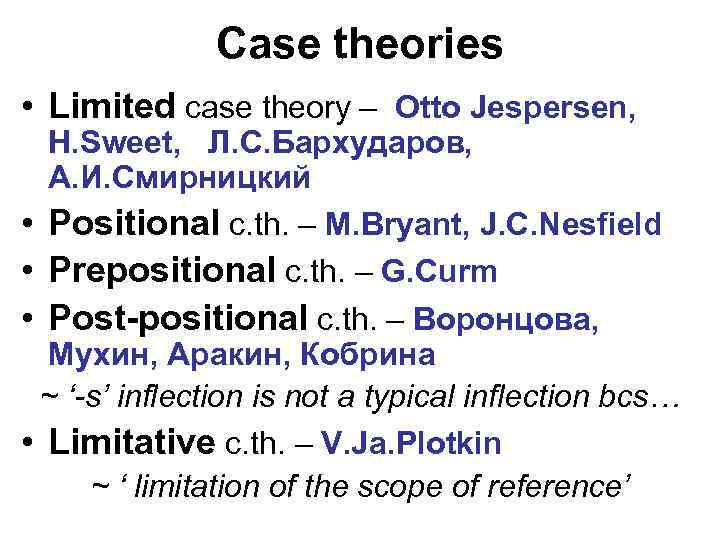 Case theories • Limited case theory – Otto Jespersen, H. Sweet, Л. С. Бархударов, А. И. Смирницкий • Positional c. th. – M. Bryant, J. C. Nesfield • Prepositional c. th. – G. Curm • Post-positional c. th. – Воронцова, Мухин, Аракин, Кобрина ~ ‘-s’ inflection is not a typical inflection bcs… • Limitative c. th. – V. Ja. Plotkin ~ ‘ limitation of the scope of reference’
 The c. of DETERMINATION Many scholars recognize the semantic category of article determination which marks some referents as definite & some as indefinite. A reason for specifying this category – cases of ‘meaningful absence of the article’. Only the absence of a grammatical unit may be ‘meaningful’ the article is not a lexical unit (word) but a grammatical marker.
 The c. of GENDER has no grammatical morphological marking in ME. There are no oppositions of gram. forms. Few nouns have word-blding suffixes (lexical-!) that mark them as feminine or masculine: actor – actress tiger - tigress
 Qn 3 Grammatical categories denoting time and character of action ------------------------------the categories of TENSE, PROSPECT, ASPECT, ORDER
 Temporal relations in ME are expressed by 3 catgs: tense – present – past+ – absolutely – proper only to finite forms of the verb a predicative category prospect – non-future – future+ – abs. or rel-ly order - non-perfect – perfect + – relatively In R. temporal rlns are expressed by 1 c. of tense which denotes time both absolutely & relatively The character of action in ME is expressed by 2 categories: aspect – non-continuous – continuous+ order – non-perfect – perfect + In R. the correlated mnings are expressed lexicaly.
 Qn 6 Syntactically bound morphological categories -----------------------the categories of Voice, Mood (Representation/Finitude)
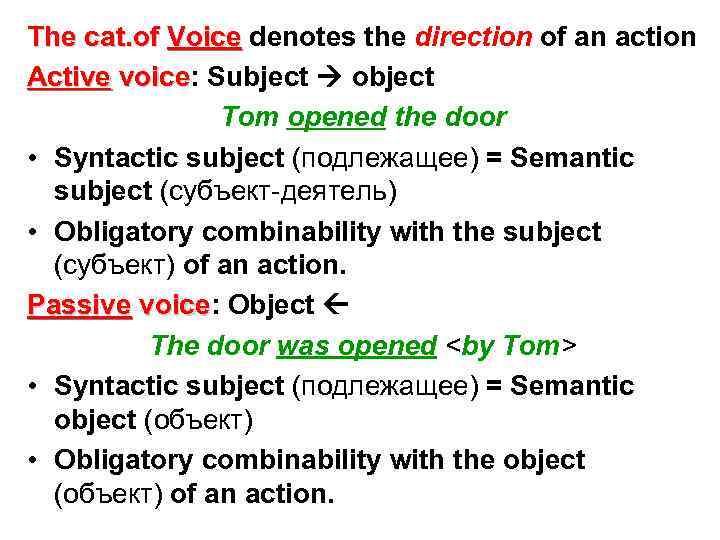 The cat. of Voice denotes the direction of an action Active voice: Subject object voice Tom opened the door • Syntactic subject (подлежащее) = Semantic subject (субъект-деятель) • Obligatory combinability with the subject (субъект) of an action. Passive voice: Object voice The door was opened
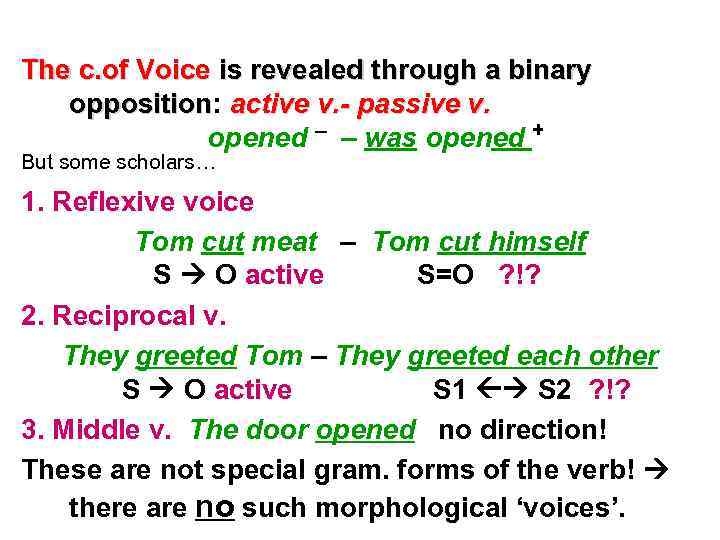 The c. of Voice is revealed through a binary opposition: active v. - passive v. opposition opened – – was opened + But some scholars… 1. Reflexive voice Tom cut meat – Tom cut himself S O active S=O ? !? 2. Reciprocal v. They greeted Tom – They greeted each other S O active S 1 S 2 ? !? 3. Middle v. The door opened no direction! These are not special gram. forms of the verb! there are no such morphological ‘voices’.
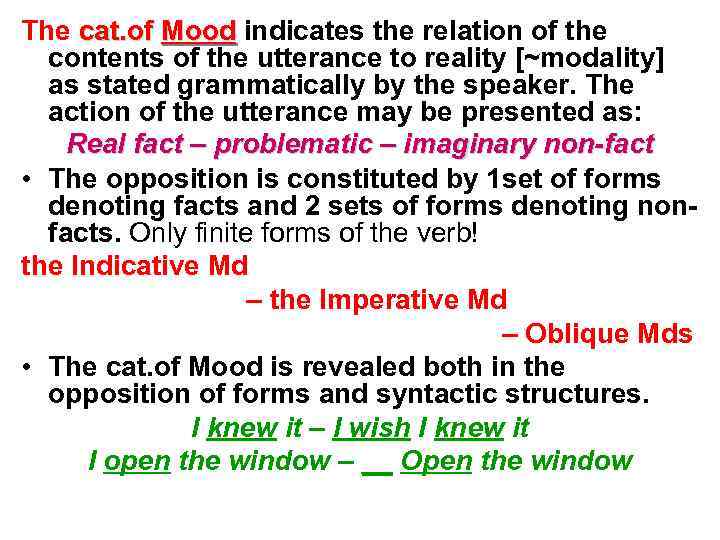 The cat. of Mood indicates the relation of the contents of the utterance to reality [~modality] as stated grammatically by the speaker. The action of the utterance may be presented as: Real fact – problematic – imaginary non-fact • The opposition is constituted by 1 set of forms denoting facts and 2 sets of forms denoting nonfacts. Only finite forms of the verb! the Indicative Md – the Imperative Md – Oblique Mds • The cat. of Mood is revealed both in the opposition of forms and syntactic structures. I knew it – I wish I knew it I open the window – __ Open the window
 Qn 6 Syntactic relations of words. Phrases ------------------------word-groups / free word combinations
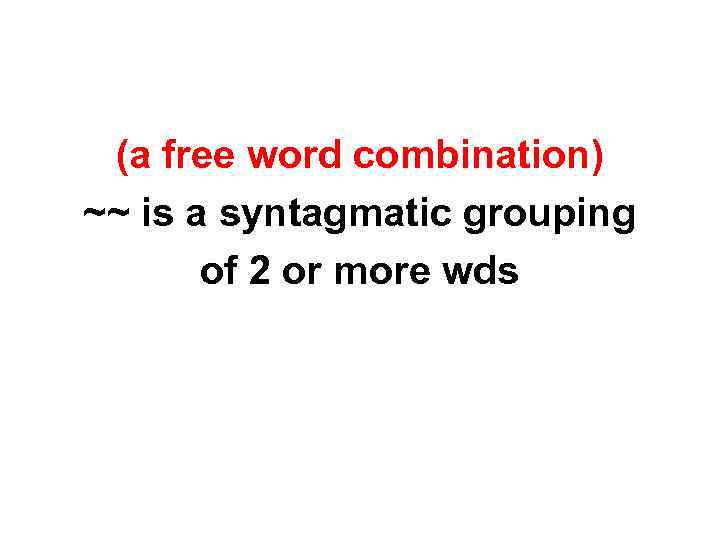 (a free word combination) ~~ is a syntagmatic grouping of 2 or more wds
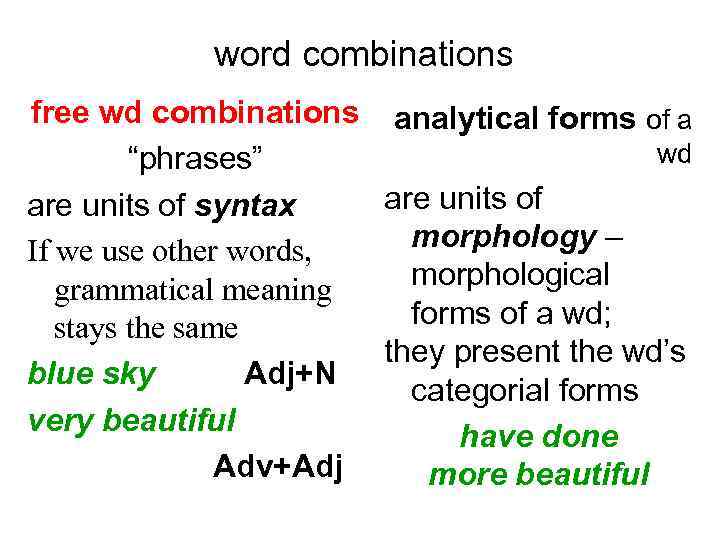 word combinations free wd combinations analytical forms of a wd “phrases” are units of syntax morphology – If we use other words, morphological grammatical meaning forms of a wd; stays the same they present the wd’s blue sky Adj+N categorial forms very beautiful have done Adv+Adj more beautiful
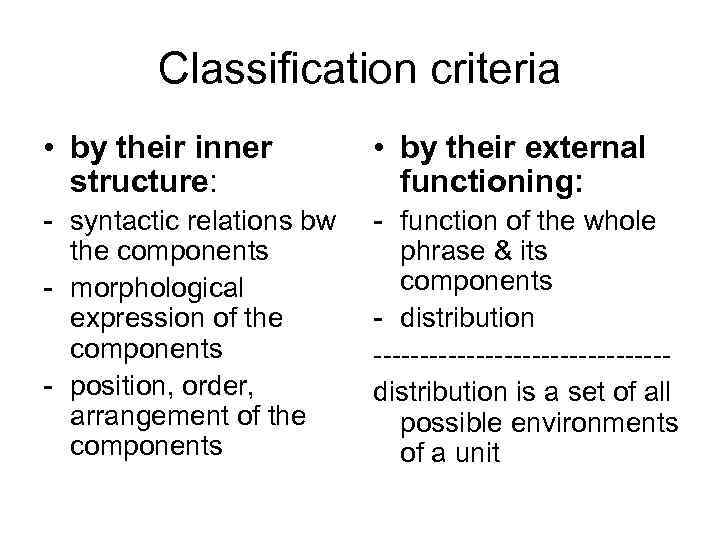 Classification criteria • by their inner structure: • by their external functioning: - syntactic relations bw the components - morphological expression of the components - position, order, arrangement of the components - function of the whole phrase & its components - distribution ----------------distribution is a set of all possible environments of a unit
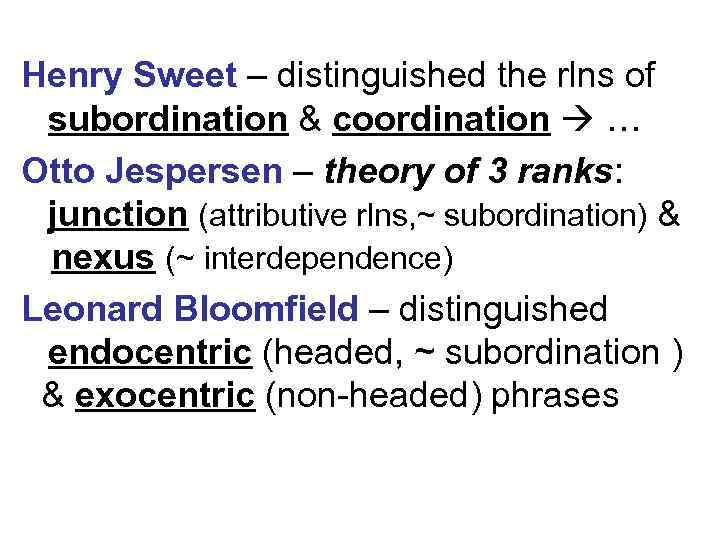 Henry Sweet – distinguished the rlns of subordination & coordination … Otto Jespersen – theory of 3 ranks: junction (attributive rlns, ~ subordination) & nexus (~ interdependence) Leonard Bloomfield – distinguished endocentric (headed, ~ subordination ) & exocentric (non-headed) phrases
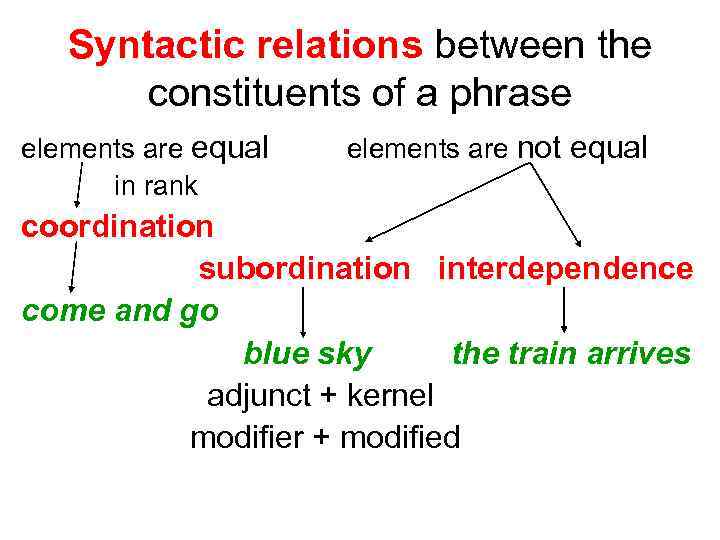 Syntactic relations between the constituents of a phrase elements are equal in rank elements are not equal coordination subordination interdependence come and go blue sky the train arrives adjunct + kernel modifier + modified
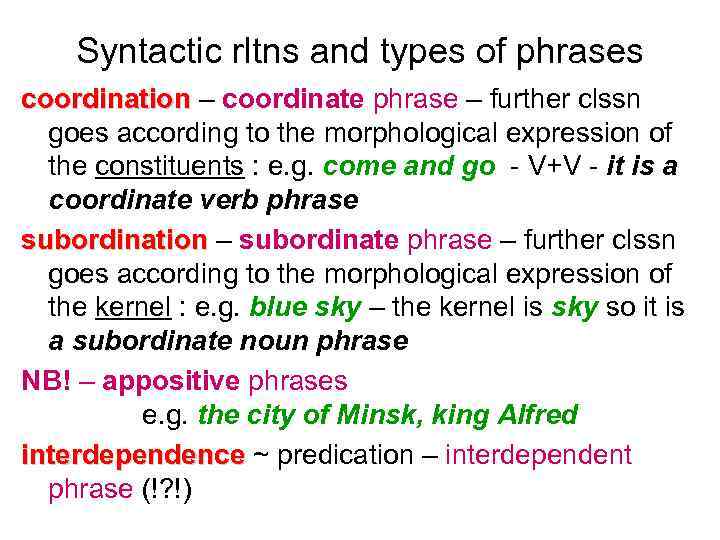 Syntactic rltns and types of phrases coordination – coordinate phrase – further clssn goes according to the morphological expression of the constituents : e. g. come and go - V+V - it is a coordinate verb phrase subordination – subordinate phrase – further clssn goes according to the morphological expression of the kernel : e. g. blue sky – the kernel is sky so it is a subordinate noun phrase NB! – appositive phrases e. g. the city of Minsk, king Alfred interdependence ~ predication – interdependent phrase (!? !)
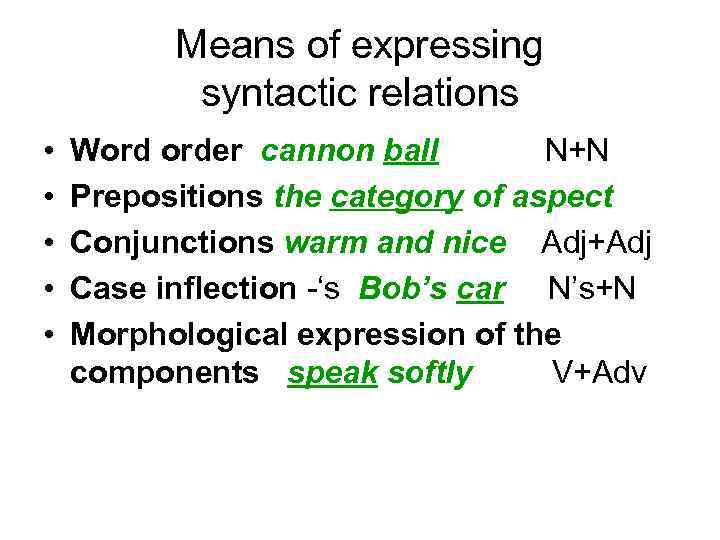 Means of expressing syntactic relations • • • Word order cannon ball N+N Prepositions the category of aspect Conjunctions warm and nice Adj+Adj Case inflection -‘s Bob’s car N’s+N Morphological expression of the components speak softly V+Adv
 Qn 7 Sentence as the main unit of syntax. (Predicativity. Classes of sentences. )
 THE SENTENCE is the immediate integral unit of speech built according to a definite syntactic pattern and distinguished by a contextually relevant communicative purpose (M. J. Blokh) Members of the sentence – see practical grammar It has 2 basic fns: naming and communicative. It can perform the communicative fn because it possesses the property known as predicativity.
 Predicativity is the correlation of what is named by the sentence with the situation of speech.
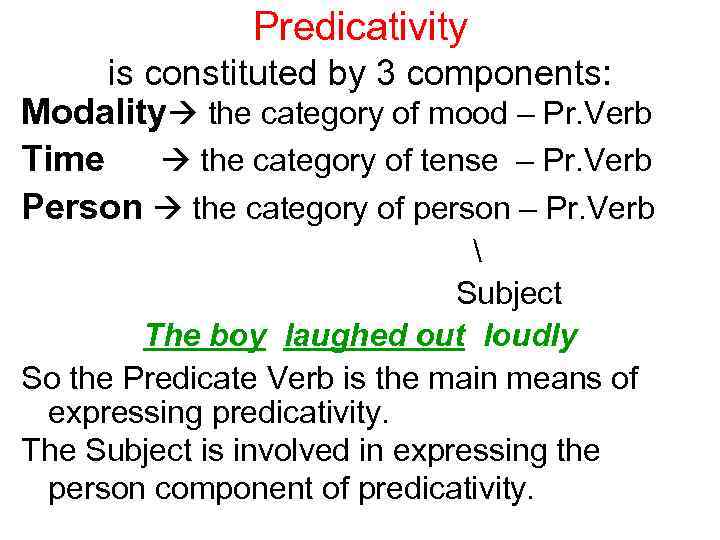 Predicativity is constituted by 3 components: Modality the category of mood – Pr. Verb Time the category of tense – Pr. Verb Person the category of person – Pr. Verb Subject The boy laughed out loudly So the Predicate Verb is the main means of expressing predicativity. The Subject is involved in expressing the person component of predicativity.
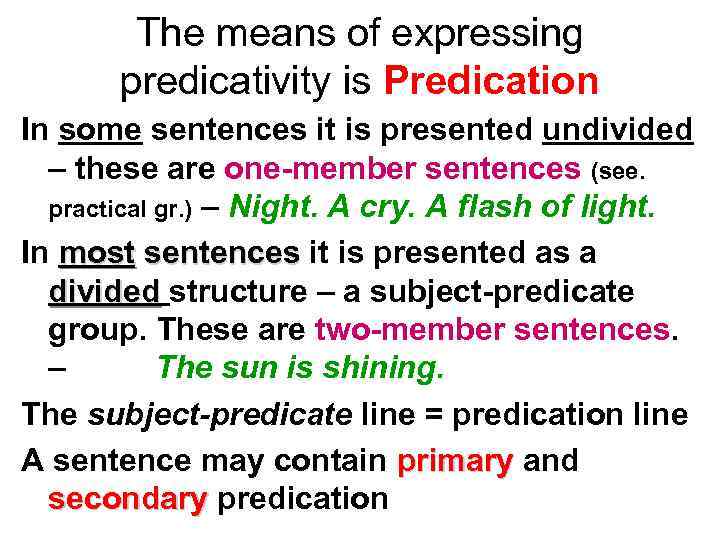 The means of expressing predicativity is Predication In some sentences it is presented undivided – these are one-member sentences (see. practical gr. ) – Night. A cry. A flash of light. In most sentences it is presented as a divided structure – a subject-predicate group. These are two-member sentences. – The sun is shining. The subject-predicate line = predication line A sentence may contain primary and secondary predication
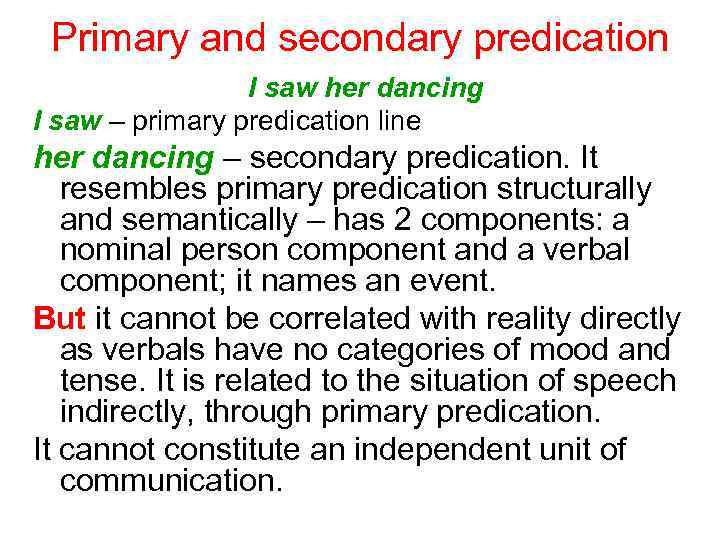 Primary and secondary predication I saw her dancing I saw – primary predication line her dancing – secondary predication. It resembles primary predication structurally and semantically – has 2 components: a nominal person component and a verbal component; it names an event. But it cannot be correlated with reality directly as verbals have no categories of mood and tense. It is related to the situation of speech indirectly, through primary predication. It cannot constitute an independent unit of communication.
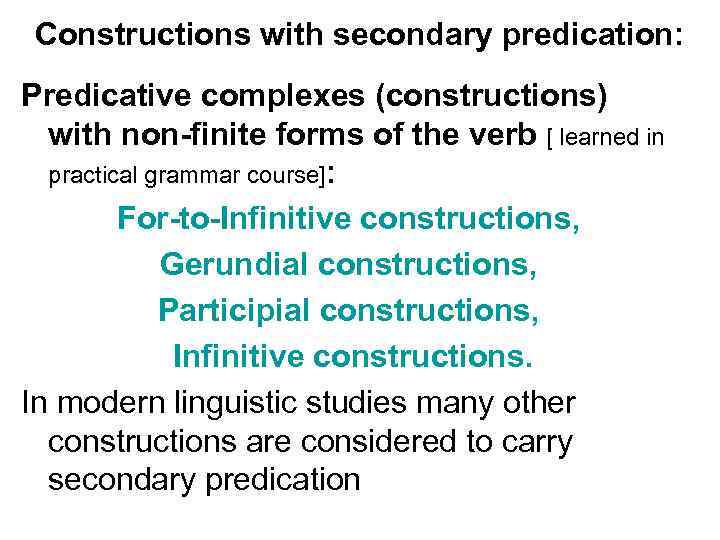 Constructions with secondary predication: Predicative complexes (constructions) with non-finite forms of the verb [ learned in practical grammar course]: For-to-Infinitive constructions, Gerundial constructions, Participial constructions, Infinitive constructions. In modern linguistic studies many other constructions are considered to carry secondary predication
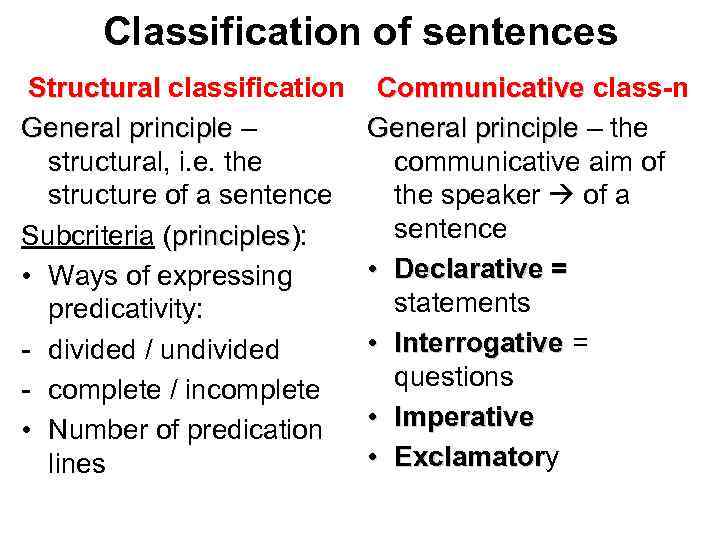 Classification of sentences Structural classification General principle – structural, i. e. the structure of a sentence Subcriteria (principles): principles • Ways of expressing predicativity: - divided / undivided - complete / incomplete • Number of predication lines Communicative class-n General principle – the communicative aim of the speaker of a sentence • Declarative = statements • Interrogative = questions • Imperative • Exclamatory Exclamator
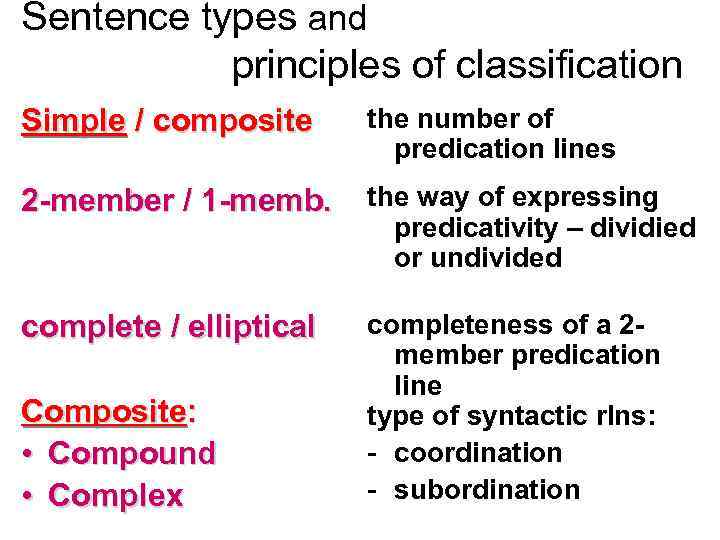 Sentence types and principles of classification Simple / composite the number of predication lines 2 -member / 1 -memb. the way of expressing predicativity – dividied or undivided complete / elliptical completeness of a 2 member predication line type of syntactic rlns: - coordination - subordination Composite: • Compound • Complex
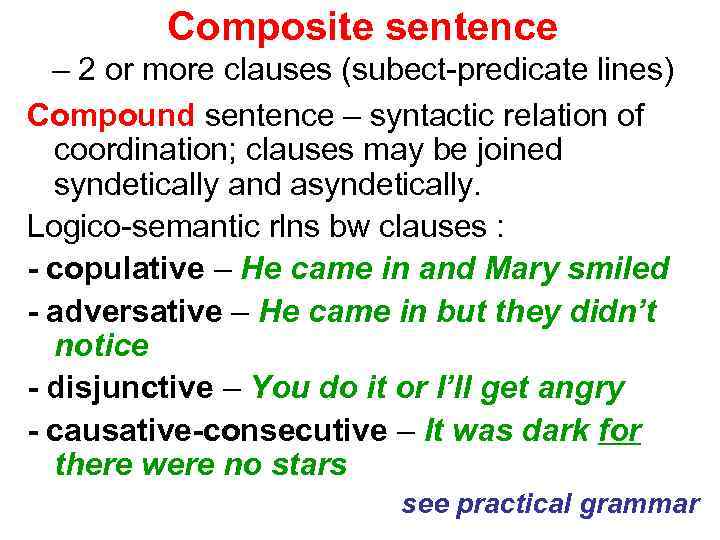 Composite sentence – 2 or more clauses (subect-predicate lines) Compound sentence – syntactic relation of coordination; clauses may be joined syndetically and asyndetically. Logico-semantic rlns bw clauses : - copulative – He came in and Mary smiled - adversative – He came in but they didn’t notice - disjunctive – You do it or I’ll get angry - causative-consecutive – It was dark for there were no stars see practical grammar
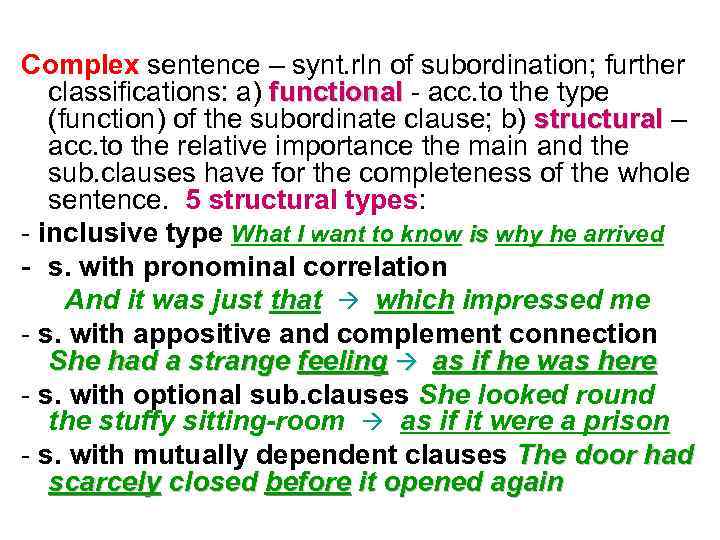 Complex sentence – synt. rln of subordination; further classifications: a) functional - acc. to the type (function) of the subordinate clause; b) structural – acc. to the relative importance the main and the sub. clauses have for the completeness of the whole sentence. 5 structural types: - inclusive type What I want to know is why he arrived - s. with pronominal correlation And it was just that which impressed me - s. with appositive and complement connection She had a strange feeling as if he was here - s. with optional sub. clauses She looked round the stuffy sitting-room as if it were a prison - s. with mutually dependent clauses The door had scarcely closed before it opened again