


 Скачать презентацию Theory of economic analysis Teacher Kotlik Andrey Valeriyevich
ТЭА англ Тема 3.ppt
- Количество слайдов: 20
 Theory of economic analysis Teacher: Kotlik Andrey Valeriyevich Management and business department
 Techniques of economic analysis (EA) 1. 2. 3. 4. EA techniques classification Comparing method of EA Other basic techniques of EA Techniques of deterministic factor analysis
 EA techniques classification As an essential element of EA method techniques of analysis are used: • Logical (basic) techniques • Techniques of determined factor analysis • Techniques of stochastic factor analysis • Techniques of optimization The choice of methods depends on the purpose and the depth of analysis, the object of research, technical capabilities to perform calculations, etc
 EA techniques classification The basic (logical) methods are widely used in other disciplines to handle and examine the information • Comparing method, • Graphical method, • Balance method, • Average and the relative numbers method • Method of analytic groups, • Heuristic methods for solving the economic problems based on intuition, past experience, expert assessments, etc
 EA techniques classification Techniques of determined factor analysis are used to study the influence of different factors on the results of enterprise activity and calculating reserves. This group of methods includes: • chain substitution method, • absolute and relative difference method, • integral method, • index method, • proportional dividing method an so on
 EA techniques classification Techniques of stochastic factor analysis are used when it is difficult to measure the influence of limited number of factors on the results of enterprise activity. This group of methods includes • Correlation analysis, • Regression analysis • Multivariate analysis and so on
 EA techniques classification Techniques of optimization include: • Methods of linear programming, • queuing theory, • game theory, • theory of fuzzy sets, etc.
 Comparing method of EA Comparing is a scientific method of perception, based on comparison of unknown, studied objects with already known, which were studied earlier, in order to determine commons and differences among them.
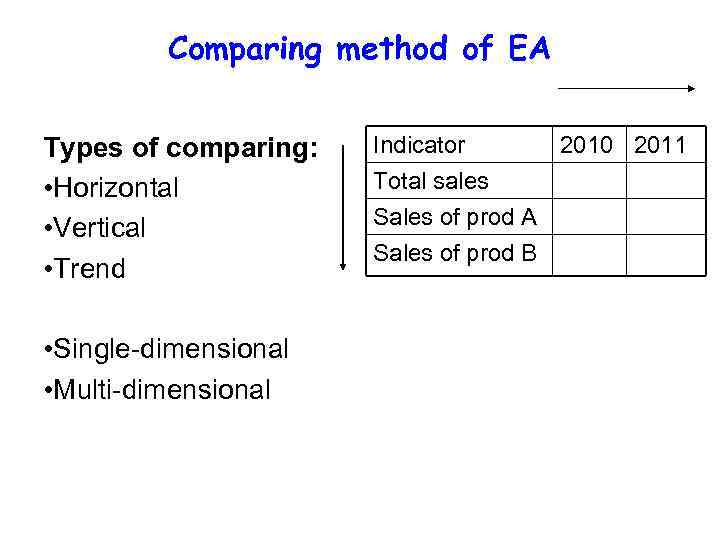 Comparing method of EA Types of comparing: • Horizontal • Vertical • Trend • Single-dimensional • Multi-dimensional Indicator Total sales Sales of prod A Sales of prod B 2010 2011
 Comparing method of EA Types of comparing: • Actual with plan • Actual with previous • Actual with normative • Actual with best practices • Actual with industry averages • Plan with actual in previous period • Actual values and dynamics among different indicators • Alternative variants of managerial decisions • Performance before and after changes in a factor
 Comparing method of EA Indicators must be comparable Incomparability can be caused by changes in: • Value (cost, price) • Quantity • Quality • Structure • Time bounds • Methods of measurement etc.
 Comparing method of EA To make indicators comparable it is necessary to eliminate influence of other factors by substituting the same meanings of indicators
 Other basic techniques of EA Grouping of information - dividing of the set of studied objects at a qualitatively homogeneous groups by relevant characteristics. Types of grouping: • Simple – by one feature • Combined – by several features
 Other basic techniques of EA Balance method Is used to reflect the relations, proportions of two groups of interrelated and balanced economic indicators, the results of which should be equal.
 Other basic techniques of EA Balance method • It is widely used in analyzing the sufficiency of the enterprise resourses (labor, financial, material, means of production) as well as in analysing of the completeness of their use. • As an supplementary method it is used to verify the source of information for the analysis and to verify analytical calculations • To create additive models for factor analysis
 Other basic techniques of EA Other methods: • Graphical method • Average and the relative numbers method • Heuristic methods
 Techniques of deterministic factor analysis Deterministic factor analysis is a method of studyng of impact of factors which are connected with resulting indicator with a functional relationship. The main objectives of the factor analysis are: 1. Selection of factors for the analysis of the result indicators. 2. The classification and systematization of the factors. 3. Determination of form and modeling of the relationship between factor and result indicators. 4. Calculation of factors impact. 5. Practical use of the factor model
 Techniques of deterministic factor analysis Factors can be: • Internal and external • Quantitative and qualitative • Of first, second level etc.
 Techniques of deterministic factor analysis Models of factor-result relations can be: • Additive (Y = A + B + C) • Multiplicative (Y = A * B * C) • Divisible (Y = A / B) • Combined (Y = (A - B) * C)
 Techniques of deterministic factor analysis Procedure of factor analysis: 1. Selecting factors 2. Creating a model: Y=A*B (quantitative factors first) 3. Substitutions 4. Calculating an impact of factors 5. Check