 Скачать презентацию Theorizing Hybridity Hybridizing Theory Creating a Hybrid Transdisciplinary
f30540775be4d5c11b2c68079af7223e.ppt
- Количество слайдов: 15



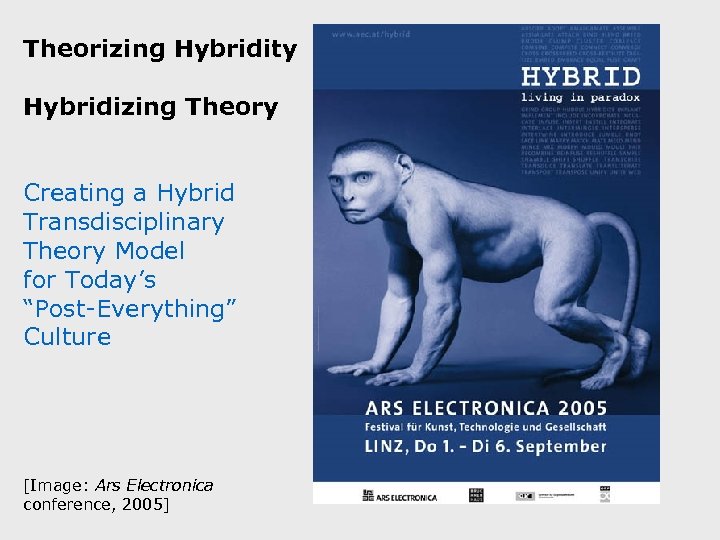
Theorizing Hybridity Hybridizing Theory Creating a Hybrid Transdisciplinary Theory Model for Today’s “Post-Everything” Culture [Image: Ars Electronica conference, 2005]
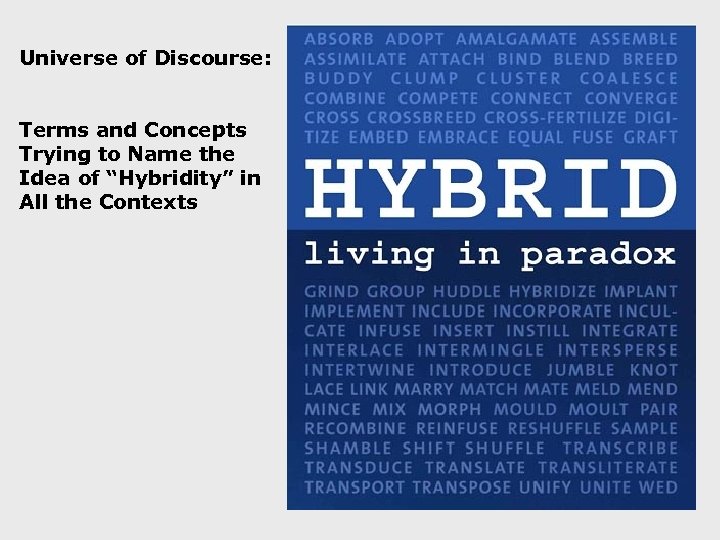
Universe of Discourse: Terms and Concepts Trying to Name the Idea of “Hybridity” in All the Contexts
Hybridity Dilemmas Understanding and interpreting today’s cultural and media complexity: ongoing mixing, appropriating, cultural interdependence without a fixed or privileged position. How can this be done? • Lessons of cultural studies, post-colonial theory, but new lessons of practice: media, art, music, photography, film. • Our own cultural and social embeddedness, positioned points of view, identities, assumptions, presuppositions. • One option: self-reflexive and heuristic theoretical ways of thinking
Hybrid Theory for Thinking about Hybridity Appropriate theory traditions that have preceded us for doing new cultural work, but don’t get stuck in any one tradition. But work with theory self-reflexively and heuristically Self-reflexive theory: question the grounds and presuppositions of theories we work with; nothing accepted as orthodoxy to be reproduced. Heuristic method in theory: theory as connected concepts to think with and through to lead to discoveries that we wouldn’t see without actively thinking with the ideas. (All artists use a heuristic method even if they don’t call it that. )
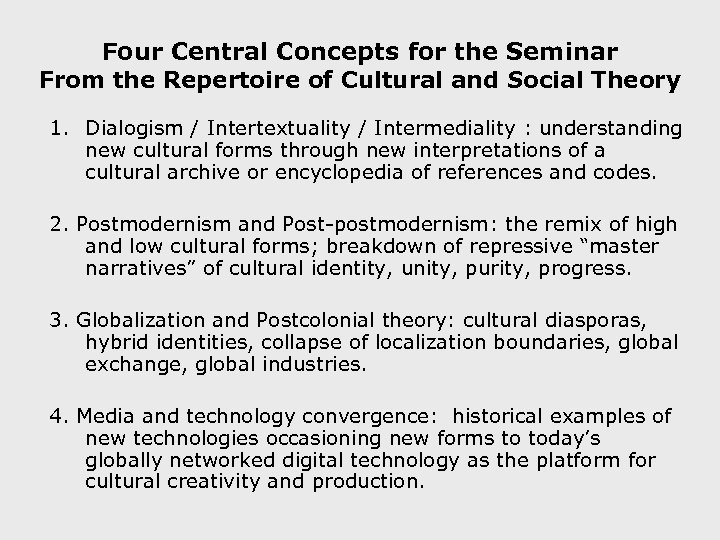
Four Central Concepts for the Seminar From the Repertoire of Cultural and Social Theory 1. Dialogism / Intertextuality / Intermediality : understanding new cultural forms through new interpretations of a cultural archive or encyclopedia of references and codes. 2. Postmodernism and Post-postmodernism: the remix of high and low cultural forms; breakdown of repressive “master narratives” of cultural identity, unity, purity, progress. 3. Globalization and Postcolonial theory: cultural diasporas, hybrid identities, collapse of localization boundaries, global exchange, global industries. 4. Media and technology convergence: historical examples of new technologies occasioning new forms to today’s globally networked digital technology as the platform for cultural creativity and production.
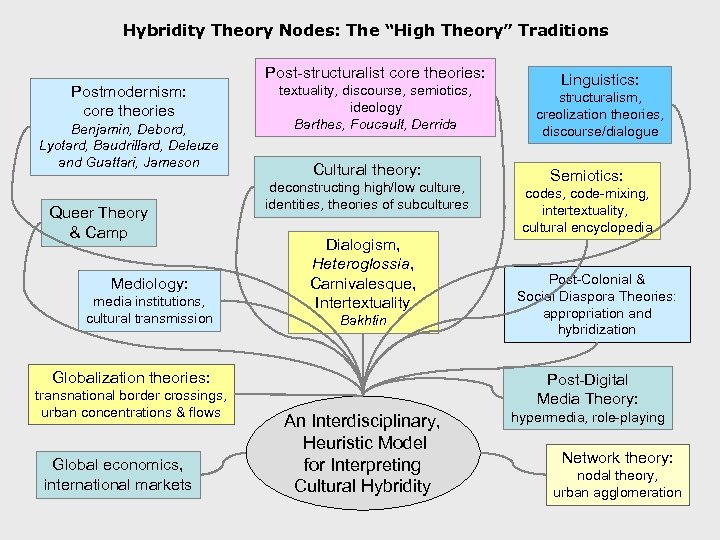
Hybridity Theory Nodes: The “High Theory” Traditions Post-structuralist core theories: Postmodernism: core theories Benjamin, Debord, Lyotard, Baudrillard, Deleuze and Guattari, Jameson Queer Theory & Camp Mediology: media institutions, cultural transmission textuality, discourse, semiotics, ideology Barthes, Foucault, Derrida Cultural theory: deconstructing high/low culture, identities, theories of subcultures Dialogism, Heteroglossia, Carnivalesque, Intertextuality Bakhtin Globalization theories: transnational border crossings, urban concentrations & flows Global economics, international markets Linguistics: structuralism, creolization theories, discourse/dialogue Semiotics: codes, code-mixing, intertextuality, cultural encyclopedia Post-Colonial & Social Diaspora Theories: appropriation and hybridization Post-Digital Media Theory: An Interdisciplinary, Heuristic Model for Interpreting Cultural Hybridity hypermedia, role-playing Network theory: nodal theory, urban agglomeration
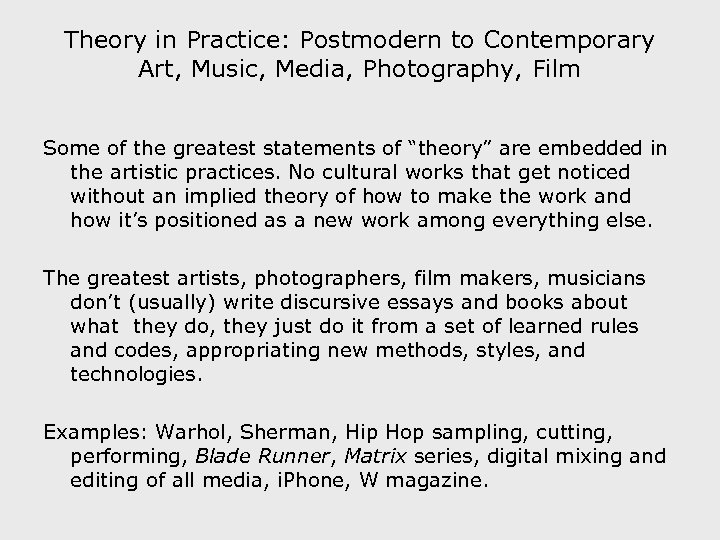
Theory in Practice: Postmodern to Contemporary Art, Music, Media, Photography, Film Some of the greatest statements of “theory” are embedded in the artistic practices. No cultural works that get noticed without an implied theory of how to make the work and how it’s positioned as a new work among everything else. The greatest artists, photographers, film makers, musicians don’t (usually) write discursive essays and books about what they do, they just do it from a set of learned rules and codes, appropriating new methods, styles, and technologies. Examples: Warhol, Sherman, Hip Hop sampling, cutting, performing, Blade Runner, Matrix series, digital mixing and editing of all media, i. Phone, W magazine.
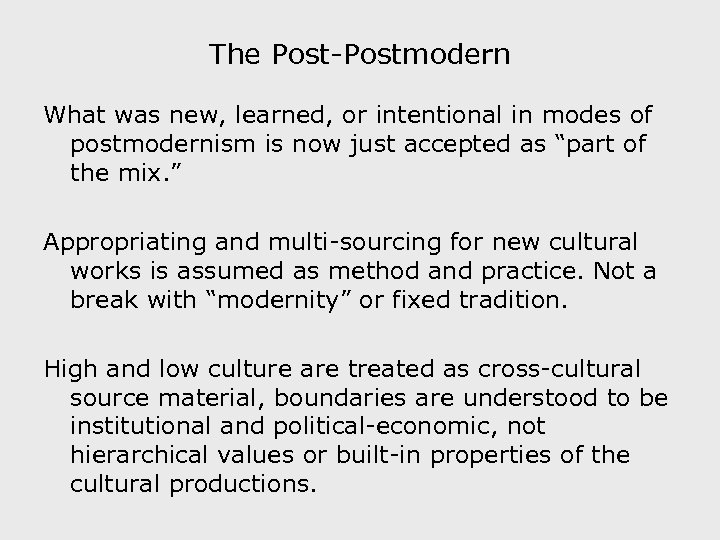
The Post-Postmodern What was new, learned, or intentional in modes of postmodernism is now just accepted as “part of the mix. ” Appropriating and multi-sourcing for new cultural works is assumed as method and practice. Not a break with “modernity” or fixed tradition. High and low culture are treated as cross-cultural source material, boundaries are understood to be institutional and political-economic, not hierarchical values or built-in properties of the cultural productions.
Jonathan Lethem’s argument in “The Ecstasy of Influence” (Harpers, 2007) Blues and jazz musicians have long been enabled by a kind of “open source” culture, in which pre-existing melodic fragments and larger musical frameworks are freely reworked. Technology has only multiplied the possibilities; musicians have gained the power to duplicate sounds literally rather than simply approximate them through allusion. In Seventies Jamaica, King Tubby and Lee “Scratch” Perry deconstructed recorded music, using astonishingly primitive pre-digital hardware, creating what they called “versions. ” The recombinant nature of their means of production quickly spread to DJs in New York and London. Today an endless, gloriously impure, and fundamentally social process generates countless hours of music. Visual, sound, and text collage—which for many centuries were relatively fugitive traditions (a cento here, a folk pastiche there)—became explosively central to a series of movements in the twentieth century: futurism, cubism, Dada, musique concrète, situationism, pop art, and appropriationism. In fact, collage, the common denominator in that list, might be called the art form of the twentieth century, never mind the twenty-first. But forget, for the moment, chronologies, schools, or even centuries. As examples accumulate—Igor Stravinsky's music and Daniel Johnston's, Francis Bacon's paintings and Henry Darger's, the novels of the Oulipo group and of Hannah Crafts (the author who pillaged Dickens's Bleak House to write The Bondwoman's Narrative), as well as cherished texts that become troubling to their admirers after the discovery of their “plagiarized” elements, like Richard Condon's novels or Martin Luther King Jr. 's sermons—it becomes apparent that appropriation, mimicry, quotation, allusion, and sublimated collaboration consist of a kind of sine qua non of the creative act, cutting across all forms and genres in the realm of cultural production. …. The world of art and culture is a vast commons, one that is salted through with zones of utter commerce yet remains gloriously immune to any overall commodification. The closest resemblance is to the commons of a language: altered by every contributor, expanded by even the most passive user. That a language is a commons doesn't mean that the community owns it; rather it belongs between people, possessed by no one, not even by society as a whole.
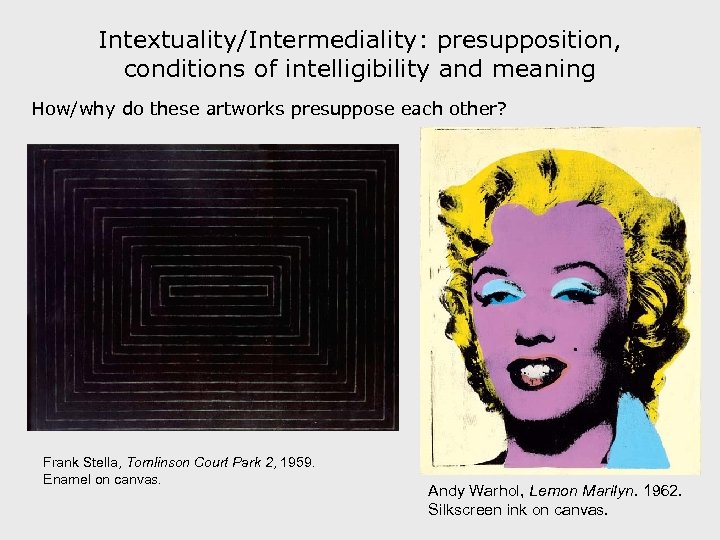
Intextuality/Intermediality: presupposition, conditions of intelligibility and meaning How/why do these artworks presuppose each other? Frank Stella, Tomlinson Court Park 2, 1959. Enamel on canvas. Andy Warhol, Lemon Marilyn. 1962. Silkscreen ink on canvas.
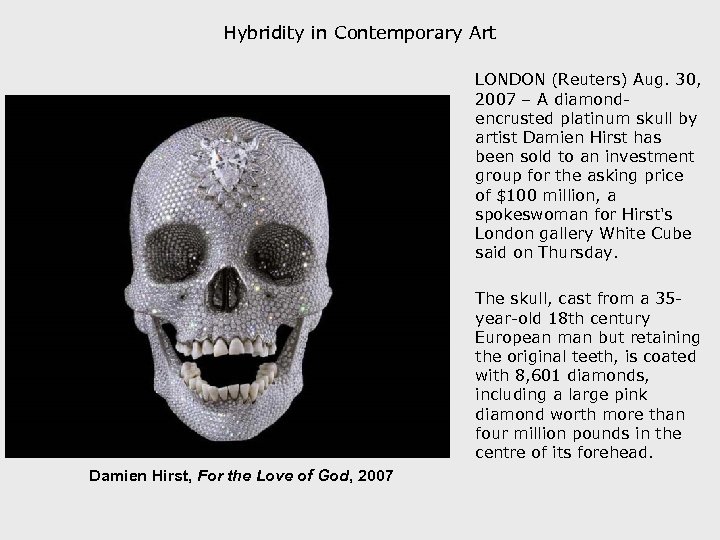
Hybridity in Contemporary Art LONDON (Reuters) Aug. 30, 2007 – A diamondencrusted platinum skull by artist Damien Hirst has been sold to an investment group for the asking price of $100 million, a spokeswoman for Hirst's London gallery White Cube said on Thursday. The skull, cast from a 35 year-old 18 th century European man but retaining the original teeth, is coated with 8, 601 diamonds, including a large pink diamond worth more than four million pounds in the centre of its forehead. Damien Hirst, For the Love of God, 2007
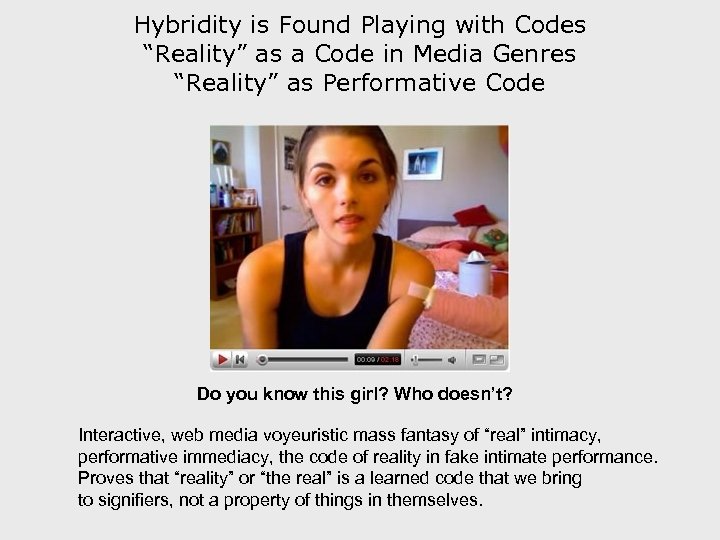
Hybridity is Found Playing with Codes “Reality” as a Code in Media Genres “Reality” as Performative Code Do you know this girl? Who doesn’t? Interactive, web media voyeuristic mass fantasy of “real” intimacy, performative immediacy, the code of reality in fake intimate performance. Proves that “reality” or “the real” is a learned code that we bring to signifiers, not a property of things in themselves.
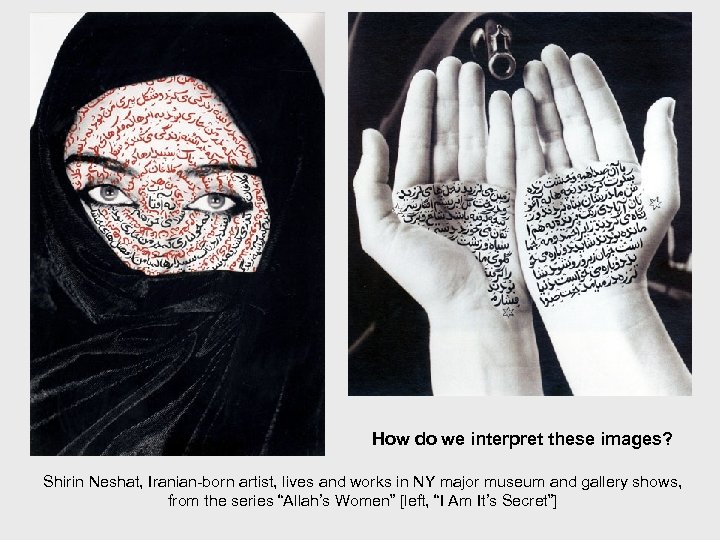
How do we interpret these images? Shirin Neshat, Iranian-born artist, lives and works in NY major museum and gallery shows, from the series “Allah’s Women” [left, “I Am It’s Secret”]
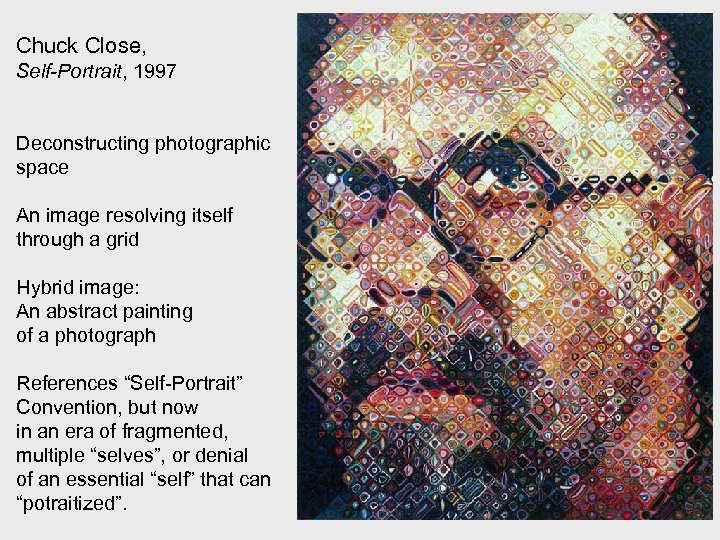
Chuck Close, Self-Portrait, 1997 Deconstructing photographic space An image resolving itself through a grid Hybrid image: An abstract painting of a photograph References “Self-Portrait” Convention, but now in an era of fragmented, multiple “selves”, or denial of an essential “self” that can “potraitized”.
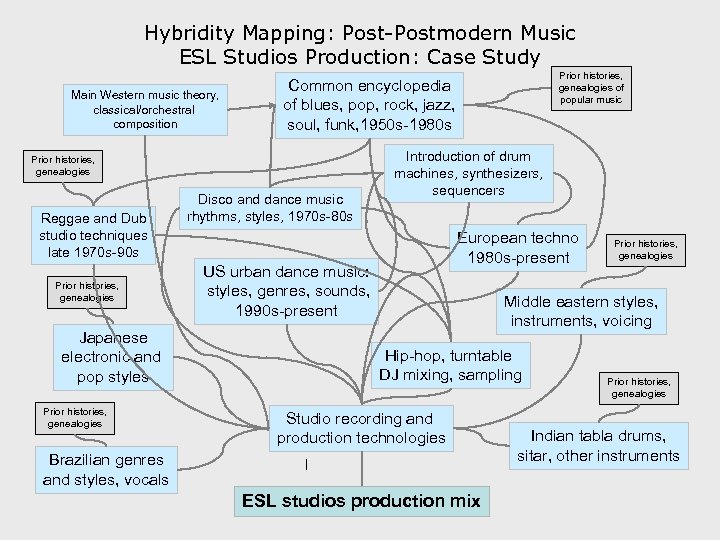
Hybridity Mapping: Post-Postmodern Music ESL Studios Production: Case Study Main Western music theory, classical/orchestral composition Prior histories, genealogies Reggae and Dub studio techniques late 1970 s-90 s Prior histories, genealogies Disco and dance music rhythms, styles, 1970 s-80 s Brazilian genres and styles, vocals Introduction of drum machines, synthesizers, sequencers European techno 1980 s-present US urban dance music: styles, genres, sounds, 1990 s-present Japanese electronic and pop styles Prior histories, genealogies of popular music Common encyclopedia of blues, pop, rock, jazz, soul, funk, 1950 s-1980 s Prior histories, genealogies Middle eastern styles, instruments, voicing Hip-hop, turntable DJ mixing, sampling Studio recording and production technologies E l ESL studios production mix Prior histories, genealogies Indian tabla drums, sitar, other instruments
Скачать презентацию Theorizing Hybridity Hybridizing Theory Creating a Hybrid Transdisciplinary
f30540775be4d5c11b2c68079af7223e.ppt