


 Скачать презентацию Theories of Class Structure Modern World
3. Class concepts & MW.ppt
- Количество слайдов: 23
 Theories of Class Structure & Modern World
 Debate on social class: Is ‘class’ irrelevant in our time? l Pahl: ‘Class as a concept is ceasing to do any useful work for sociology’. l Crompton: Capitalist industrial societies are still stratified, and theories of social class still provide us with essential insights into the manner in which inequalities in wealth and power are reproduced.
 Two tradition of studying social inequality European tradition of defining classes in relation to each other, as one group of people who benefits at the expense of others (relational approach, class analysis). l American tradition of studying of social inequality by ranking individuals on a scale (gradational approach, social stratification). l
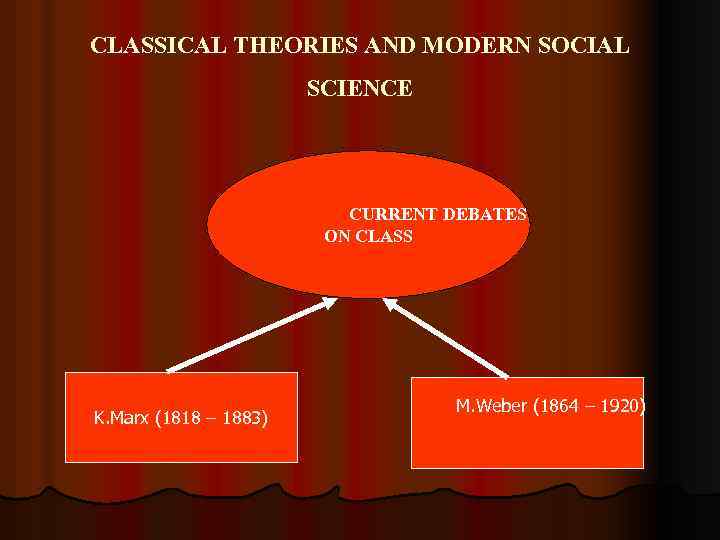 CLASSICAL THEORIES AND MODERN SOCIAL SCIENCE CURRENT DEBATES ON CLASS K. Marx (1818 – 1883) M. Weber (1864 – 1920)
 l. What constitutes a class?
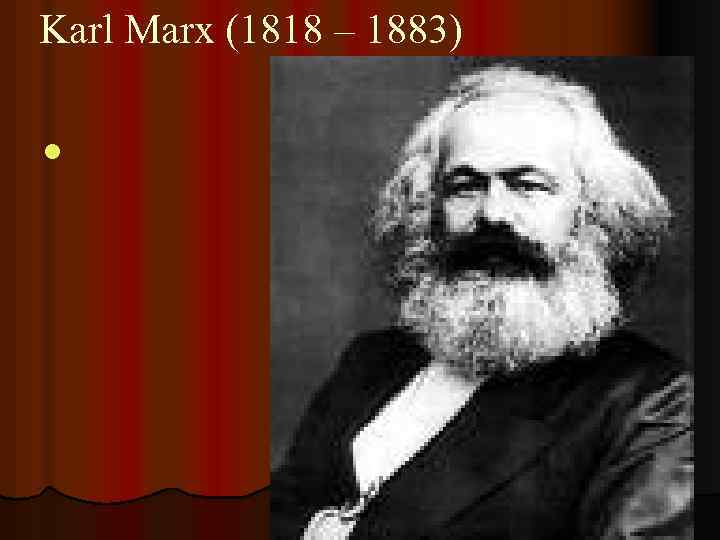 Karl Marx (1818 – 1883) l
 Karl Marx: l Class relations are embedded in production relationship, in the patterns of ownership and control. l Ownership of the material forces of production is the means to the exploitation of the proletariat by the bourgeoisie within the process of production.
 Karl Marx on Class Structure l There are only two major classes under capitalism: a class who own the means of production and a class who do not and hence have to sell their capacity to work (‘labourpower’).
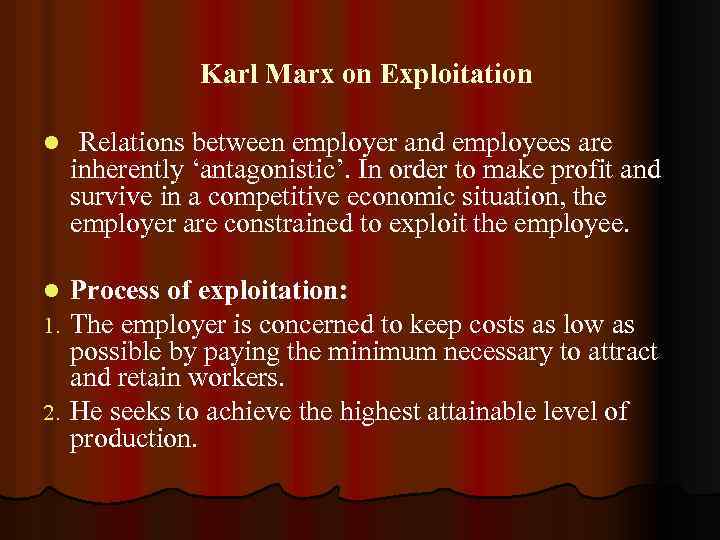 Karl Marx on Exploitation l Relations between employer and employees are inherently ‘antagonistic’. In order to make profit and survive in a competitive economic situation, the employer are constrained to exploit the employee. Process of exploitation: The employer is concerned to keep costs as low as possible by paying the minimum necessary to attract and retain workers. 2. He seeks to achieve the highest attainable level of production. l 1.
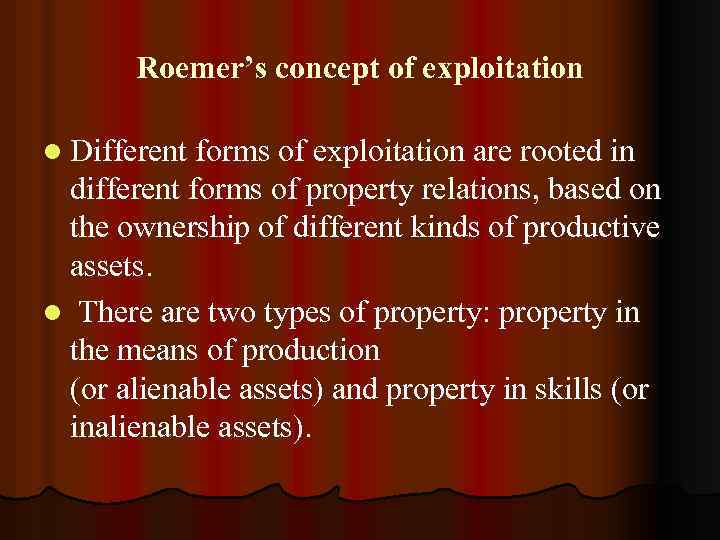 Roemer’s concept of exploitation l Different forms of exploitation are rooted in different forms of property relations, based on the ownership of different kinds of productive assets. l There are two types of property: property in the means of production (or alienable assets) and property in skills (or inalienable assets).
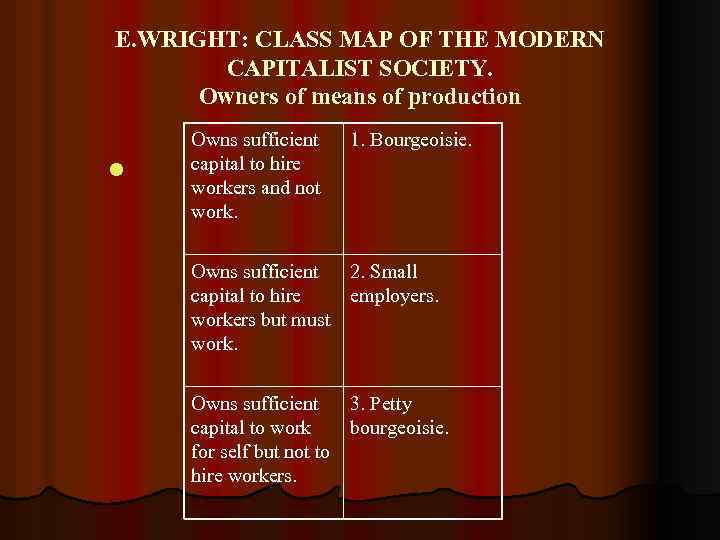 E. WRIGHT: CLASS MAP OF THE MODERN CAPITALIST SOCIETY. Owners of means of production l Owns sufficient capital to hire workers and not work. 1. Bourgeoisie. Owns sufficient 2. Small capital to hire employers. workers but must work. Owns sufficient 3. Petty capital to work bourgeoisie. for self but not to hire workers.
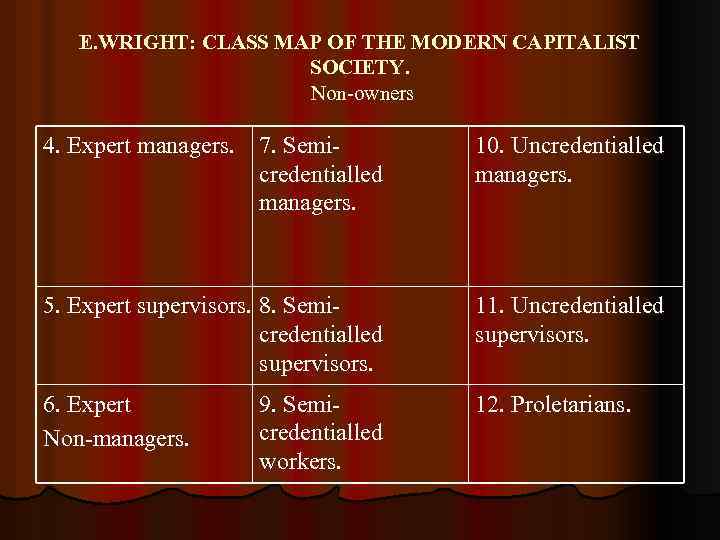 E. WRIGHT: CLASS MAP OF THE MODERN CAPITALIST SOCIETY. Non-owners 4. Expert managers. 7. Semicredentialled managers. 10. Uncredentialled managers. 5. Expert supervisors. 8. Semicredentialled supervisors. 11. Uncredentialled supervisors. 6. Expert Non-managers. 12. Proletarians. 9. Semicredentialled workers.
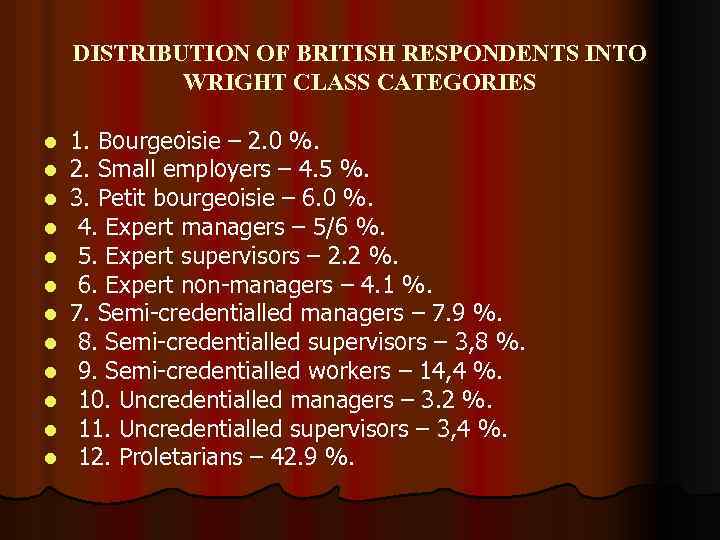 DISTRIBUTION OF BRITISH RESPONDENTS INTO WRIGHT CLASS CATEGORIES l l l 1. Bourgeoisie – 2. 0 %. 2. Small employers – 4. 5 %. 3. Petit bourgeoisie – 6. 0 %. 4. Expert managers – 5/6 %. 5. Expert supervisors – 2. 2 %. 6. Expert non-managers – 4. 1 %. 7. Semi-credentialled managers – 7. 9 %. 8. Semi-credentialled supervisors – 3, 8 %. 9. Semi-credentialled workers – 14, 4 %. 10. Uncredentialled managers – 3. 2 %. 11. Uncredentialled supervisors – 3, 4 %. 12. Proletarians – 42. 9 %.
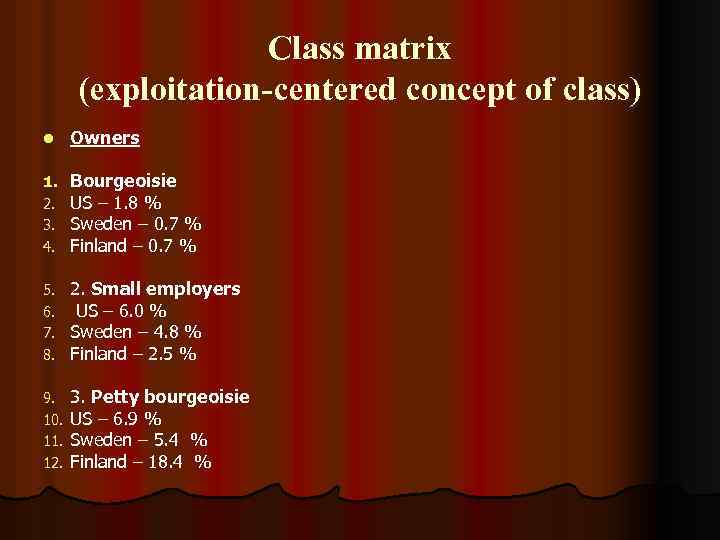 Class matrix (exploitation-centered concept of class) l Owners 1. 2. 3. 4. Bourgeoisie US – 1. 8 % Sweden – 0. 7 % Finland – 0. 7 % 5. 6. 7. 8. 2. Small employers US – 6. 0 % Sweden – 4. 8 % Finland – 2. 5 % 9. 10. 11. 12. 3. Petty bourgeoisie US – 6. 9 % Sweden – 5. 4 % Finland – 18. 4 %
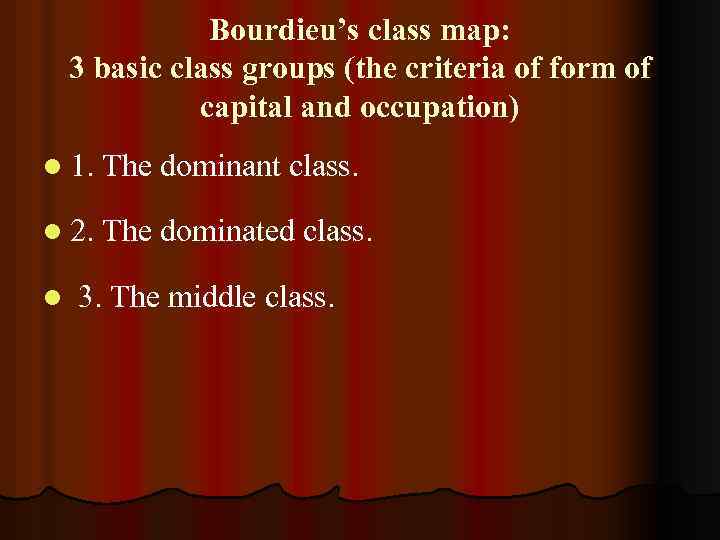 Bourdieu’s class map: 3 basic class groups (the criteria of form of capital and occupation) l 1. The dominant class. l 2. The dominated class. l 3. The middle class.
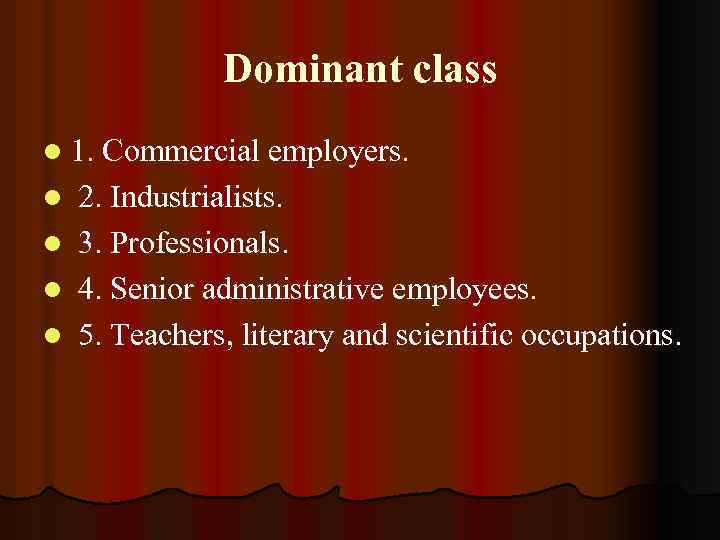 Dominant class l 1. Commercial employers. 2. Industrialists. l 3. Professionals. l 4. Senior administrative employees. l 5. Teachers, literary and scientific occupations. l
 Middle Class l l l l 1. Craftsmen. 2. Small shopkeepers. 3. Commercial employees. 5. Junior administrative employees. 6. Primary teachers. 7. Technicians. 8. Social and medical services.
 Marxist Class Matrix of Modern Societies 1. Bourgeoisie. 3. New Middle Class. 2. Old middle class. 4. Working class.
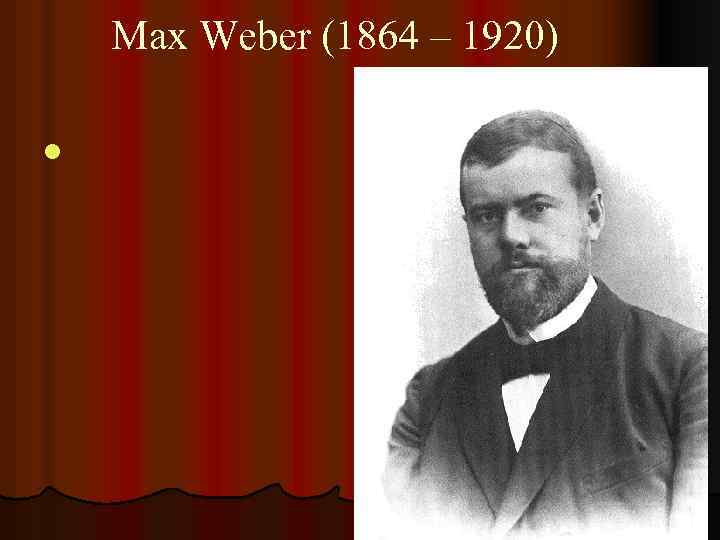 Max Weber (1864 – 1920) l
 Max Weber on Class l Class refers to any group of people who share a common class situation. l Class situation is “the typical chance for a supply of goods, external living conditions, and personal life experience, in so far as this chance is determined by the amount and kind of power, or lack of such, to dispose of goods or skills for the sake of income in a given economic order”.
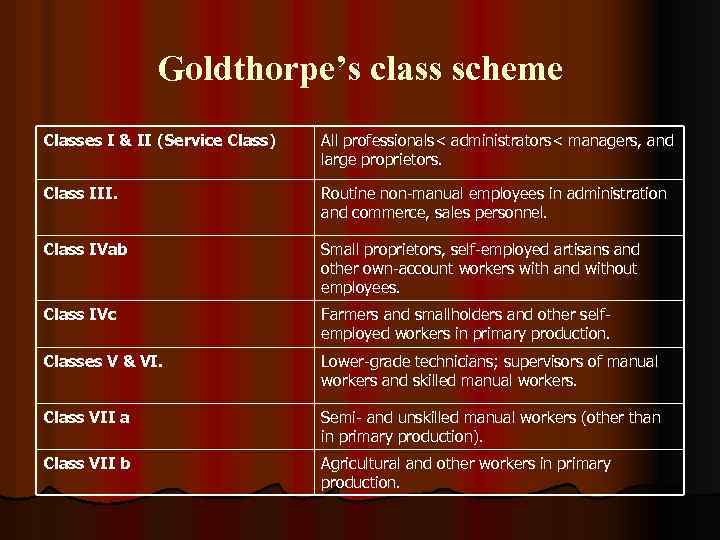 Goldthorpe’s class scheme Classes I & II (Service Class) All professionals< administrators< managers, and large proprietors. Class III. Routine non-manual employees in administration and commerce, sales personnel. Class IVab Small proprietors, self-employed artisans and other own-account workers with and without employees. Class IVc Farmers and smallholders and other selfemployed workers in primary production. Classes V & VI. Lower-grade technicians; supervisors of manual workers and skilled manual workers. Class VII a Semi- and unskilled manual workers (other than in primary production). Class VII b Agricultural and other workers in primary production.
 Was state socialism a class society?
 State socialism