


 Скачать презентацию THEORETICAL SUGGESTIONS FOR THE IMPROVEMENT OF DRY LASER
4a9c9e17465093615c14638ab6b82a2a.ppt
- Количество слайдов: 15
 THEORETICAL SUGGESTIONS FOR THE IMPROVEMENT OF DRY LASER CLEANING N. Arnold Angewandte Physik, Johannes - Kepler - Universität A-4040, Linz, Austria N. Arnold, Applied Physics, Linz
 Motivation and goals • DLC is simple but not very efficient • Theoretical understanding improved over the last years • Local damage hinders DLC • Discuss qualitative ideas that can help DLC Summary: • Optimal absorption and pulse duration for damage-free DLC • Cleaning in high RH atmosphere • Cleaning by 1 D laser-induced SAW N. Arnold, Applied Physics, Linz
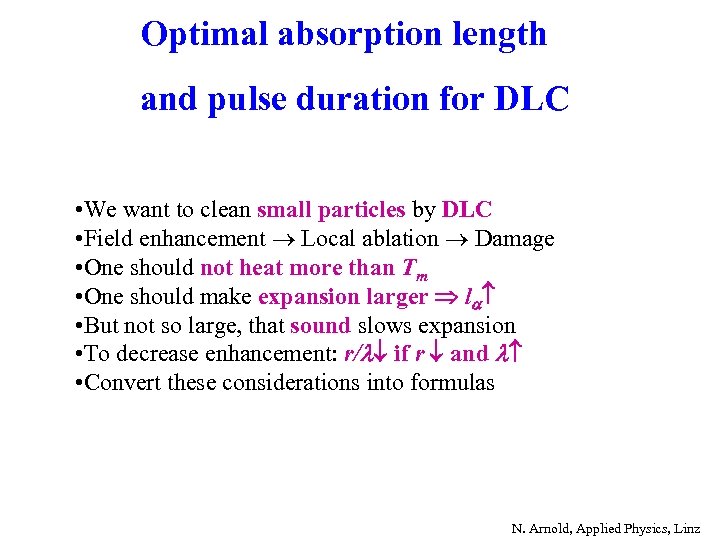 Optimal absorption length and pulse duration for DLC • We want to clean small particles by DLC • Field enhancement Local ablation Damage • One should not heat more than Tm • One should make expansion larger l • But not so large, that sound slows expansion • To decrease enhancement: r/ if r and • Convert these considerations into formulas N. Arnold, Applied Physics, Linz
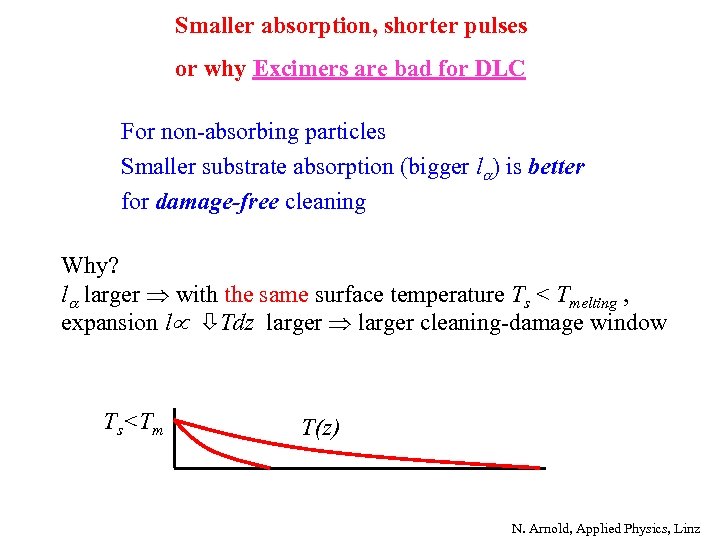 Smaller absorption, shorter pulses or why Excimers are bad for DLC For non-absorbing particles Smaller substrate absorption (bigger l ) is better for damage-free cleaning Why? l larger with the same surface temperature Ts < Tmelting , expansion l Tdz larger cleaning-damage window Ts
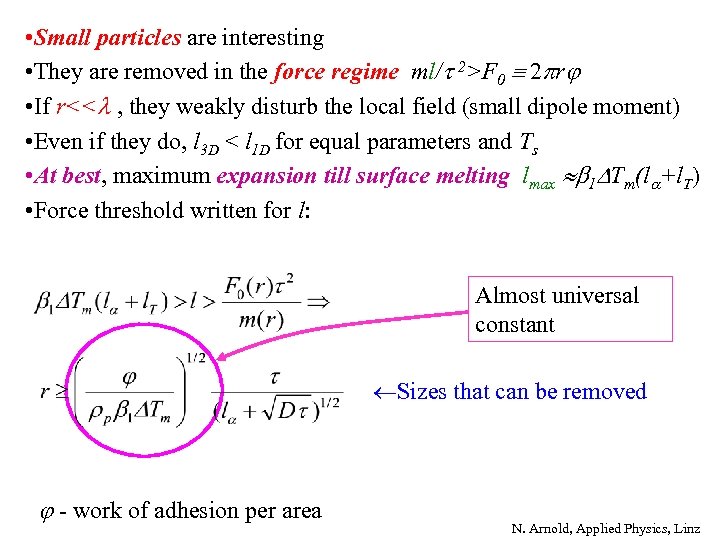 • Small particles are interesting • They are removed in the force regime ml/ 2>F 0 2 r • If r<< , they weakly disturb the local field (small dipole moment) • Even if they do, l 3 D < l 1 D for equal parameters and Ts • At best, maximum expansion till surface melting lmax 1 Tm(l +l. T) • Force threshold written for l: Almost universal constant Sizes that can be removed - work of adhesion per area N. Arnold, Applied Physics, Linz
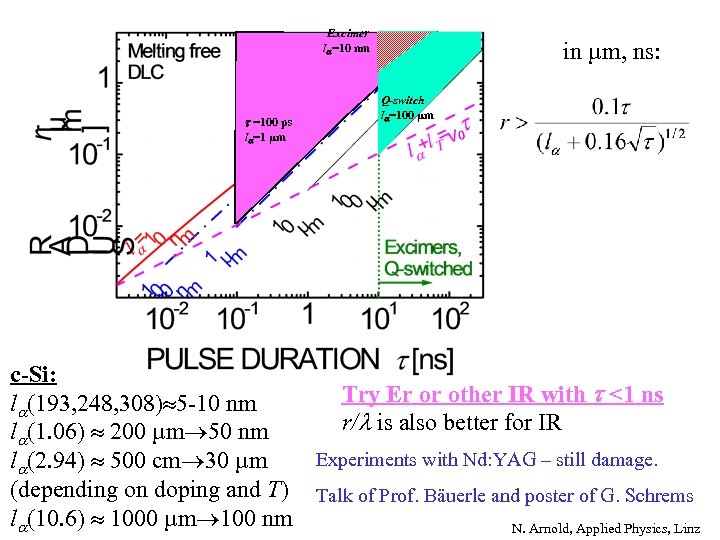 Excimer l =10 nm =100 ps in µm, ns: Q-switch l =100 µm l =1 µm c-Si: Try Er or other IR with <1 ns l (193, 248, 308) 5 -10 nm r/ is also better for IR l (1. 06) 200 µm 50 nm Experiments with Nd: YAG – still damage. l (2. 94) 500 cm 30 µm (depending on doping and T) Talk of Prof. Bäuerle and poster of G. Schrems l (10. 6) 1000 µm 100 nm N. Arnold, Applied Physics, Linz
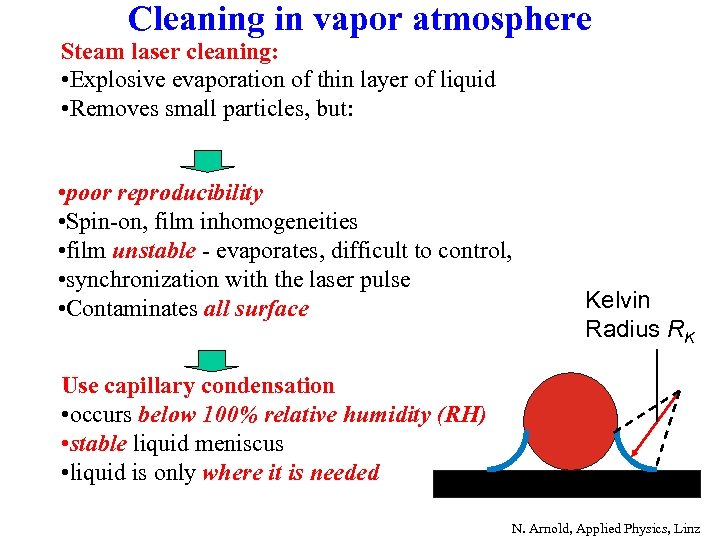 Cleaning in vapor atmosphere Steam laser cleaning: • Explosive evaporation of thin layer of liquid • Removes small particles, but: • poor reproducibility • Spin-on, film inhomogeneities • film unstable - evaporates, difficult to control, • synchronization with the laser pulse • Contaminates all surface Kelvin Radius RK Use capillary condensation • occurs below 100% relative humidity (RH) • stable liquid meniscus • liquid is only where it is needed N. Arnold, Applied Physics, Linz
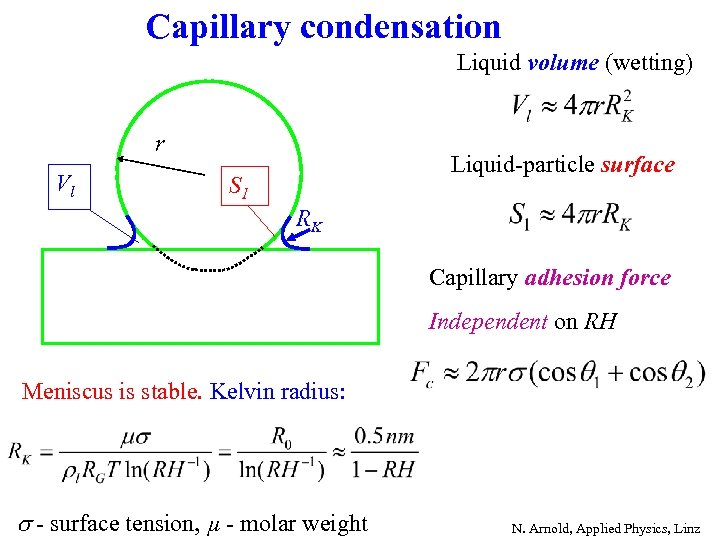 Capillary condensation Liquid volume (wetting) r Vl Liquid-particle surface S 1 RK Capillary adhesion force Independent on RH Meniscus is stable. Kelvin radius: - surface tension, µ - molar weight N. Arnold, Applied Physics, Linz
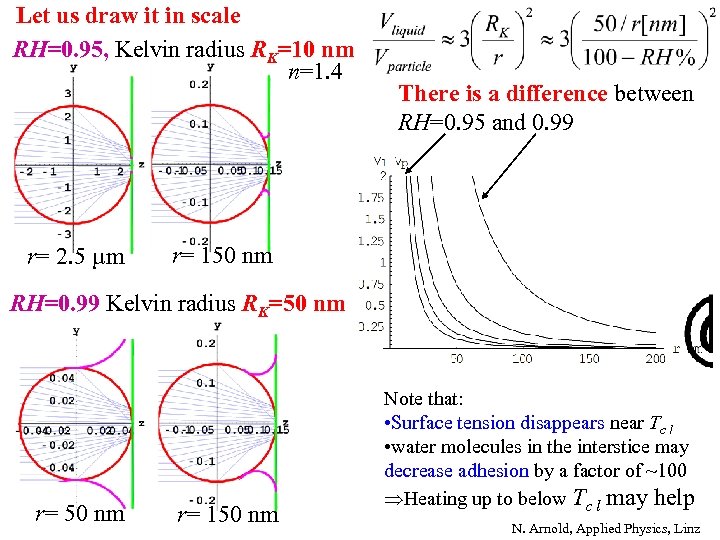 Let us draw it in scale RH=0. 95, Kelvin radius RK=10 nm n=1. 4 r= 2. 5 µm There is a difference between RH=0. 95 and 0. 99 r= 150 nm RH=0. 99 Kelvin radius RK=50 nm r= 150 nm Note that: • Surface tension disappears near Tc l • water molecules in the interstice may decrease adhesion by a factor of ~100 Heating up to below Tc l may help N. Arnold, Applied Physics, Linz
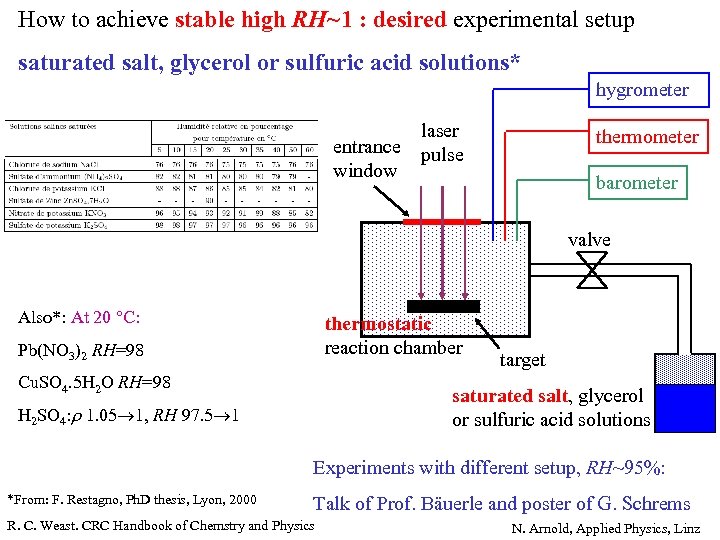 How to achieve stable high RH~1 : desired experimental setup saturated salt, glycerol or sulfuric acid solutions* hygrometer entrance window laser pulse thermometer barometer valve Also*: At 20 °C: thermostatic reaction chamber Pb(NO 3)2 RH=98 Cu. SO 4. 5 H 2 O RH=98 target saturated salt, glycerol or sulfuric acid solutions H 2 SO 4: 1. 05 1, RH 97. 5 1 Experiments with different setup, RH~95%: *From: F. Restagno, Ph. D thesis, Lyon, 2000 Talk of Prof. Bäuerle and poster of G. Schrems R. C. Weast. CRC Handbook of Chemstry and Physics N. Arnold, Applied Physics, Linz
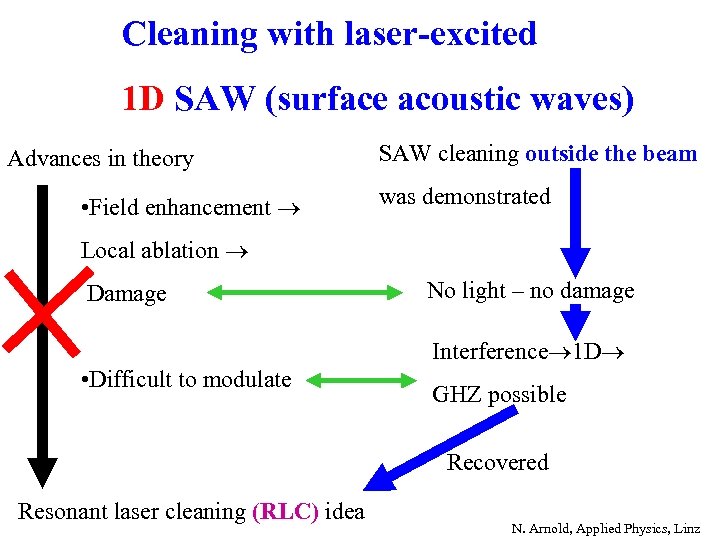 Cleaning with laser-excited 1 D SAW (surface acoustic waves) Advances in theory • Field enhancement SAW cleaning outside the beam was demonstrated Local ablation Damage No light – no damage Interference 1 D • Difficult to modulate GHZ possible Recovered Resonant laser cleaning (RLC) idea N. Arnold, Applied Physics, Linz
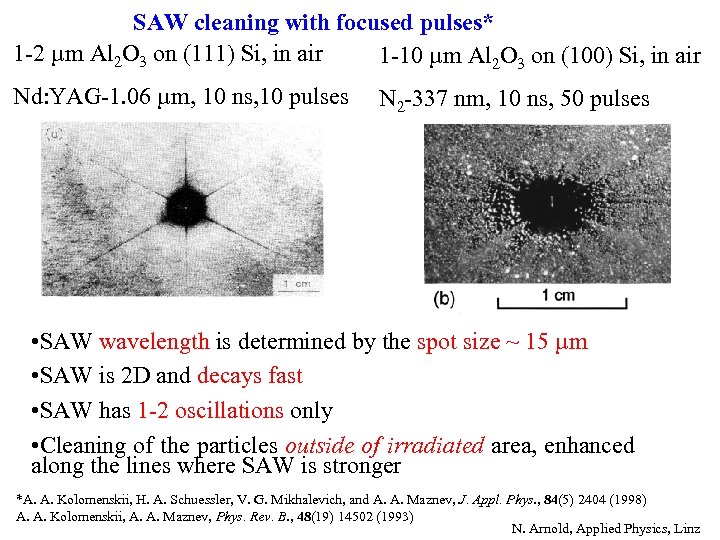 SAW cleaning with focused pulses* 1 -2 µm Al 2 O 3 on (111) Si, in air 1 -10 µm Al 2 O 3 on (100) Si, in air Nd: YAG-1. 06 µm, 10 ns, 10 pulses N 2 -337 nm, 10 ns, 50 pulses • SAW wavelength is determined by the spot size ~ 15 µm • SAW is 2 D and decays fast • SAW has 1 -2 oscillations only • Cleaning of the particles outside of irradiated area, enhanced along the lines where SAW is stronger *A. A. Kolomenskii, H. A. Schuessler, V. G. Mikhalevich, and A. A. Maznev, J. Appl. Phys. , 84(5) 2404 (1998) A. A. Kolomenskii, A. A. Maznev, Phys. Rev. B. , 48(19) 14502 (1993) N. Arnold, Applied Physics, Linz
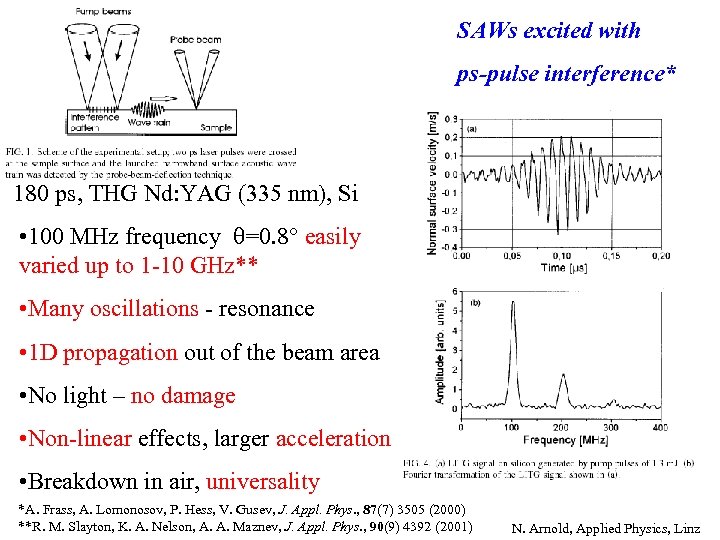 SAWs excited with ps-pulse interference* 180 ps, THG Nd: YAG (335 nm), Si • 100 MHz frequency =0. 8° easily varied up to 1 -10 GHz** • Many oscillations - resonance • 1 D propagation out of the beam area • No light – no damage • Non-linear effects, larger acceleration • Breakdown in air, universality *A. Frass, A. Lomonosov, P. Hess, V. Gusev, J. Appl. Phys. , 87(7) 3505 (2000) **R. M. Slayton, K. A. Nelson, A. A. Maznev, J. Appl. Phys. , 90(9) 4392 (2001) N. Arnold, Applied Physics, Linz
 Advantages of 1 D SAW excited by laser light interference for cleaning • SAW are 1 D. No fast decay, propagate out of the beam area. • No light is present in the majority of area covered by SAW No local field enhancement-damage. • SAW have many oscillations, suitable for testing of RLC • Frequency is determined by the periodicity of interference. v. SAW~vsound/ light~1 -10 GHz - suitable for resonant laser cleaning (RLC). • Frequency easily varied via angle of interfering beams. Indispensable for testing and application of RLC. • Smaller overall thermal load on the substrate. • Non-linearity makes fronts steeper, increase accelerations. • Can be excited via breakdown in the air. Material independent, suitable for structured substrates, (industry). N. Arnold, Applied Physics, Linz
 Acknowledgments (discussions, ideas, pictures) Linz Prof. D. Bäuerle, Dr. M. P. Delamare, DI. G. Schrems, Dr. K. Piglmayer Konstanz Prof. P. Leiderer, Dr. M. Mosbacher, Dr. H. Münzer, DI. M. Olapinski Singapore Prof. B. Luk’yanchuk, Prof. Y. F. Lu, Dr. M. Hong, Dr. Z. B. Wang Sydney Prof. D. Kane, Dr. S. Pleasants College Station, Heidelberg Prof. A. Kolomenskii, Prof. P. Hess, A. Maznev Funding: Austrian Science Fund (FWF), P 14700 -TPH EU TMR Laser Cleaning, #ERBFMRXCT 98 0188 N. Arnold, Applied Physics, Linz