


 Скачать презентацию THEORETICAL FOUNDATIONS OF ENGLISH STYLISTICS Lecture on English
LECTURE 1_STUDENTS.ppt
- Количество слайдов: 66
 THEORETICAL FOUNDATIONS OF ENGLISH STYLISTICS Lecture on English Stylistics 4 th year of study N. P. Izotova, Ph. D
 LECTURE OUTLINE q Stylistics as a linguistic discipline: its aims and subject matter. q Main schools of modern stylistics. q Links of stylistics with other branches of linguistics.
 LECTURE OUTLINE q Key ь ь ь concepts of stylistics: Style; Foregrounding; Stylistic neutrality and Stylistic coloring; Norm and its violation. Types of norms; Context. Types of context; Image and imagery.
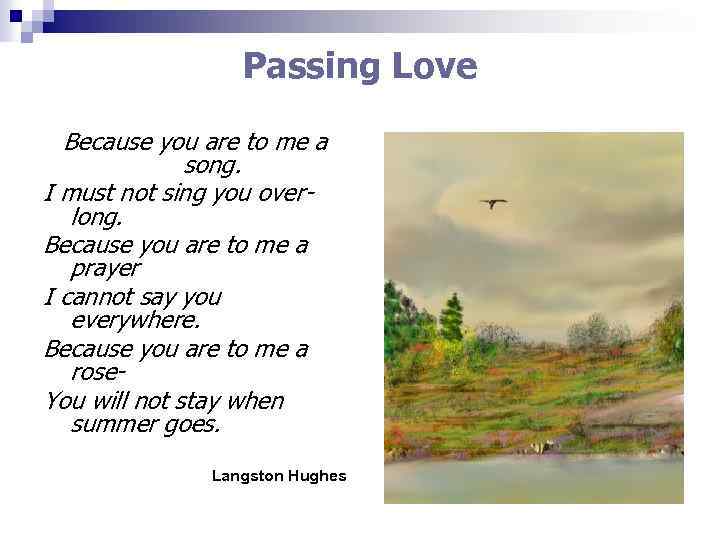 Passing Love Because you are to me a song. I must not sing you overlong. Because you are to me a prayer I cannot say you everywhere. Because you are to me a rose. You will not stay when summer goes. Langston Hughes
 Дождь был грибным. По крышам дождь названивал, И солнце протянуло руки в комнату, И, не щадя ни возраста ни звания, Весна пришла, как старая знакомая. И кажется, что солнцем всё расплавлено И что на коромысле от колодца Сама весна, покачиваясь плавно, Несёт в двух вёдрах два дрожащих солнца. Е. Евтушенко
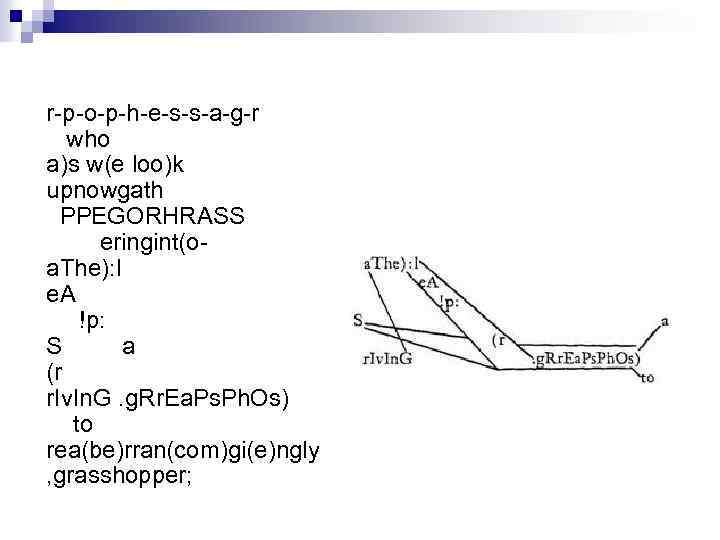 r-p-o-p-h-e-s-s-a-g-r who a)s w(e loo)k upnowgath PPEGORHRASS eringint(oa. The): l e. A !p: S a (r r. Iv. In. G. g. Rr. Ea. Ps. Ph. Os) to rea(be)rran(com)gi(e)ngly , grasshopper;
 The Myth about Contemporary Stylistics A stylistician is simply a dull old grammarian who spends rather too much time on such trivial pursuits as counting the nouns and verbs in literary texts.
 THE PURPOSE OF STYLISTICS To do stylistics is to explore the creativity in the use of language. Paul Simpson
 Why Should We Do Stylistics? q to enrich our ways of thinking about language by shedding light on the language system, as well as learning the ‘rules’ of language (stylistics often explores texts where those rules are bent); q acquire the skills of adequate comprehension and accurate interpretation of texts used in different spheres of human communication (mass media, editorials, brief news, analytical articles, scientific prose, poetry, drama, etc. )
 The Sources of Stylistics n Rhetoric – the art of creating speech; n Poetics – the process of artistic creation; n Dialectics – the study of methods of persuasion.
 n The object of a science is a certain phenomenon, or a system of objects which exists irrespective of the cognizing and transforming role of human mind. n The subject-matter of a science covers one or several aspects of the given object.
 What is Stylistics? n The word ‘stylistics’ is derived from ‘style’ which originates from the Latin ‘stylus/stilus’ – a slender pointed writing instrument (a small stick with a pointed end) used by the ancient Greeks and Romans as they scratched letters on waxcovered plates (or wax tablets).
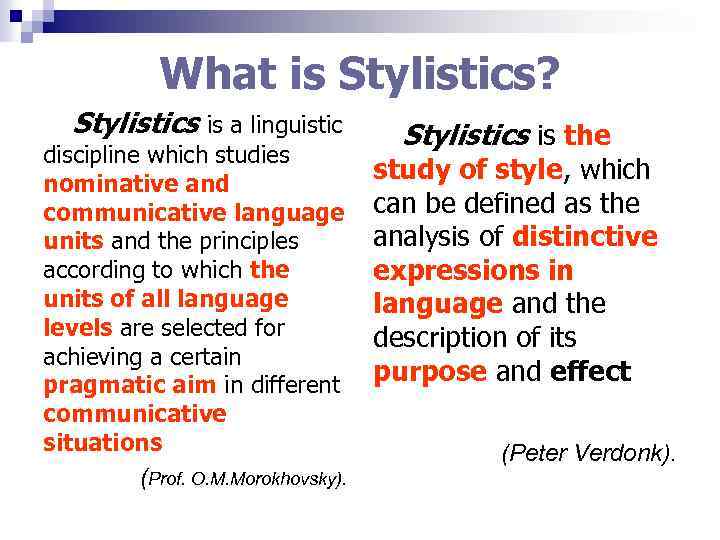 What is Stylistics? Stylistics is a linguistic discipline which studies nominative and communicative language units and the principles according to which the units of all language levels are selected for achieving a certain pragmatic aim in different communicative situations (Prof. O. M. Morokhovsky). Stylistics is the study of style, which can be defined as the analysis of distinctive expressions in language and the description of its purpose and effect (Peter Verdonk).
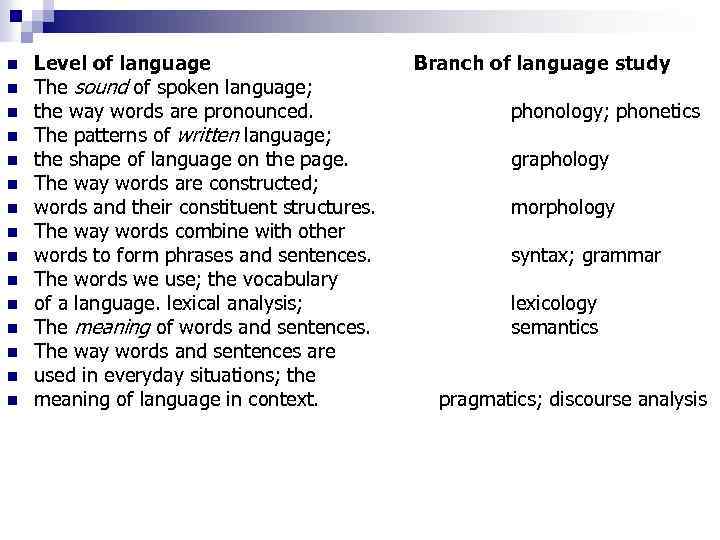 n n n n Level of language The sound of spoken language; the way words are pronounced. The patterns of written language; the shape of language on the page. The way words are constructed; words and their constituent structures. The way words combine with other words to form phrases and sentences. The words we use; the vocabulary of a language. lexical analysis; The meaning of words and sentences. The way words and sentences are used in everyday situations; the meaning of language in context. Branch of language study phonology; phonetics graphology morphology syntax; grammar lexicology semantics pragmatics; discourse analysis
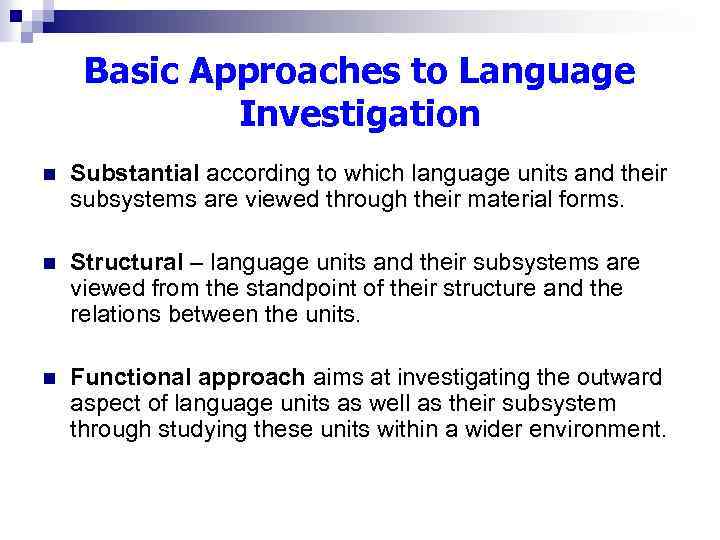 Basic Approaches to Language Investigation n Substantial according to which language units and their subsystems are viewed through their material forms. n Structural – language units and their subsystems are viewed from the standpoint of their structure and the relations between the units. n Functional approach aims at investigating the outward aspect of language units as well as their subsystem through studying these units within a wider environment.
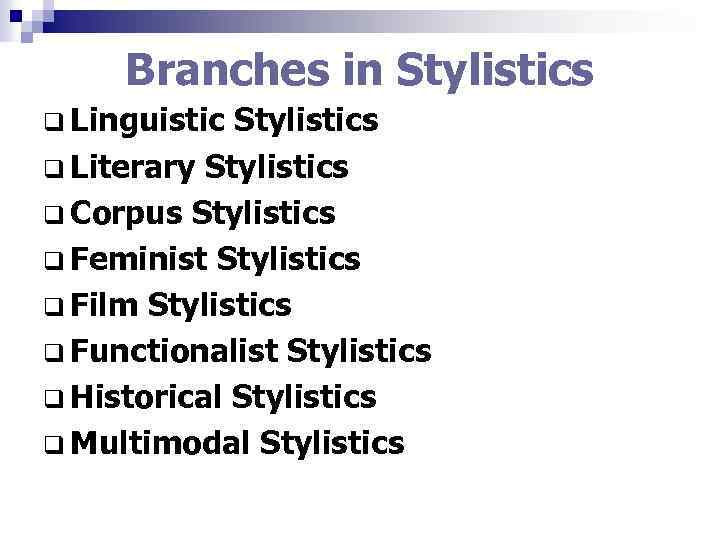 Branches in Stylistics q Linguistic Stylistics q Literary Stylistics q Corpus Stylistics q Feminist Stylistics q Film Stylistics q Functionalist Stylistics q Historical Stylistics q Multimodal Stylistics
 Literary vs. Linguistic Stylistics “. . . stylistics can sometimes look like either linguistics or literary criticism, depending upon where you are standing when looking at it. So, some of my literary critical colleagues sometimes accuse me of being an unfeelinguist, saying that my analyses of poems, say, are too analytical, being too full of linguistic jargon and leaving unsufficient room for personal preference on the part of the reader. My linguist colleagues, on the other hand, sometimes say that I‘m no linguist at all, but a critic in disguise, who cannot make his descriptions of language precise enough to count as real linguistics. They think that I leave too much to intuition and that I am not analytical enough. I think I‘ve got the mix just right, of course!” (M. Short, 1996, p. 1)
 What is Style? Style is a distinctive way of using language for some purpose and to some effect (P. Verdonk)
 What is Style? n. A variety of national language traditionally used in one of the socially identifiable spheres of life. n Generally accepted linguistic identity of oral and written units of discourse. n Individual manner of expression.
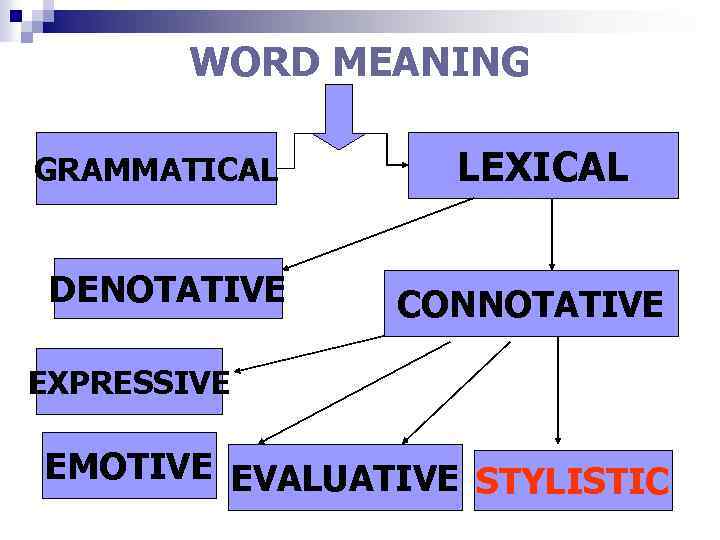 WORD MEANING GRAMMATICAL DENOTATIVE LEXICAL CONNOTATIVE EXPRESSIVE EMOTIVE EVALUATIVE STYLISTIC
 DENOTATIVE MEANING represents the most important aspect of communication because it refers to the notional basis of information conveyed by the speaker to the listener;
 DENOTATIVE MEANING q establishes correlation between the name (word) and the object, phenomenon, process or qualification of concrete reality or thought as such, which is detonated by the word; q makes the communication possible.
 CONNOTATIVE MEANING q Conveys information about the situation and the participants of communication; q Does not exist independently of denotation but simultaneously with it; q Every components represents a specific layer of cognition.
 CONNOTATIONS 1) brat = an annoying, ill-behaving child; ruffian = brutal violent lawless person; duffer = indecent person. 2) pig-headed – ‘very stubborn and obstinate’ alive and kicking – ‘healthy, in good condition’ huge is ‘large + extremely + enormous’
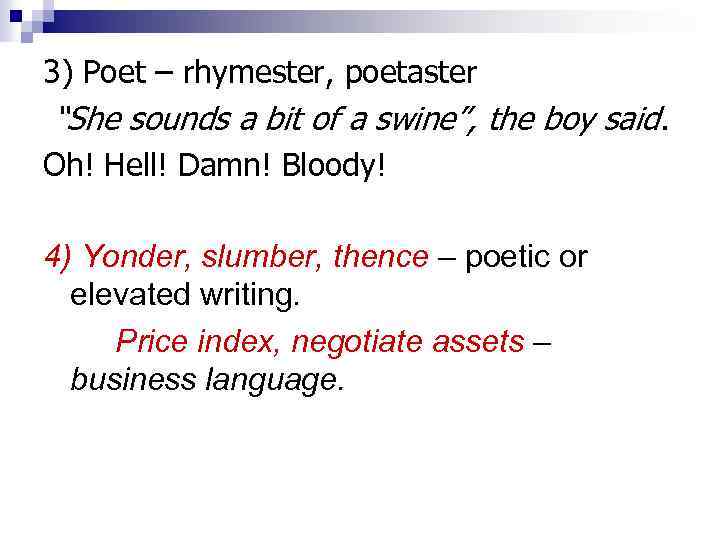 3) Poet – rhymester, poetaster “She sounds a bit of a swine”, the boy said. Oh! Hell! Damn! Bloody! 4) Yonder, slumber, thence – poetic or elevated writing. Price index, negotiate assets – business language.
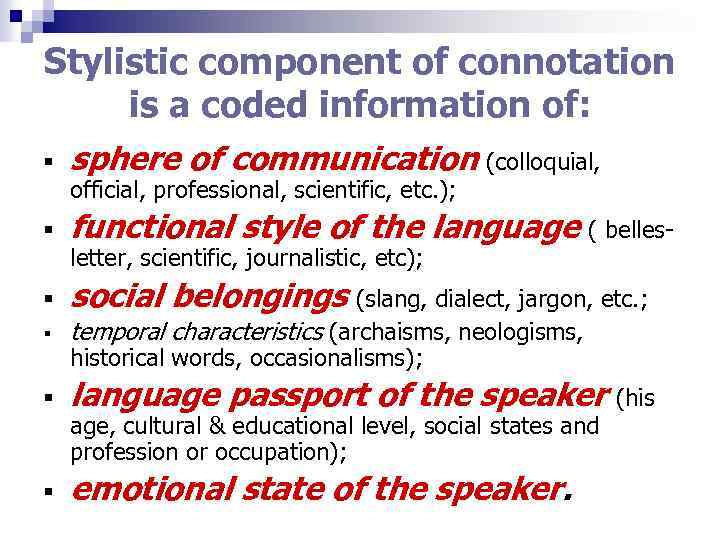 Stylistic component of connotation is a coded information of: § sphere of communication (colloquial, § functional style of the language ( belles- § social belongings (slang, dialect, jargon, etc. ; § temporal characteristics (archaisms, neologisms, § language passport of the speaker (his § emotional state of the speaker. official, professional, scientific, etc. ); letter, scientific, journalistic, etc); historical words, occasionalisms); age, cultural & educational level, social states and profession or occupation);
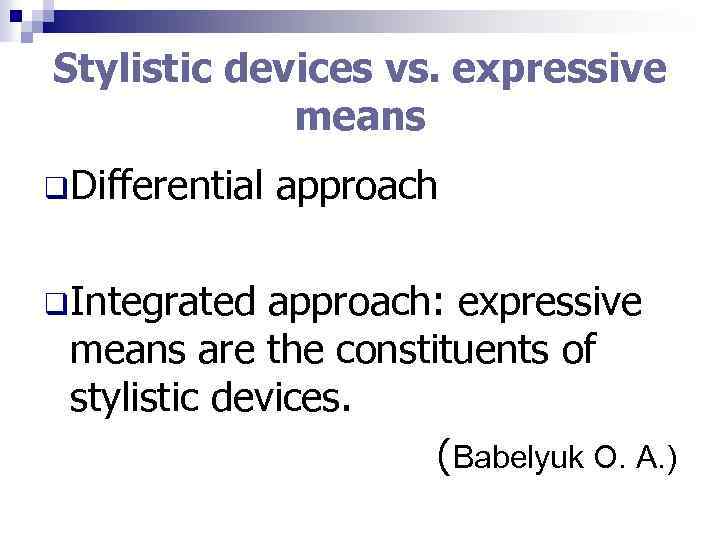 Stylistic devices vs. expressive means q. Differential q. Integrated approach: expressive means are the constituents of stylistic devices. (Babelyuk O. A. )
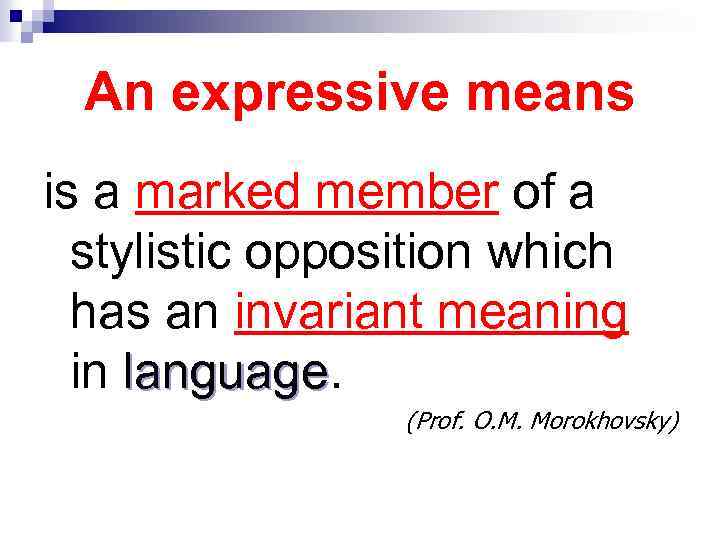 An expressive means is a marked member of a stylistic opposition which has an invariant meaning in language (Prof. O. M. Morokhovsky)
 A stylistic device is an intentional change of a fixed distribution of language units in speech. (O. M. Morokhovsky)
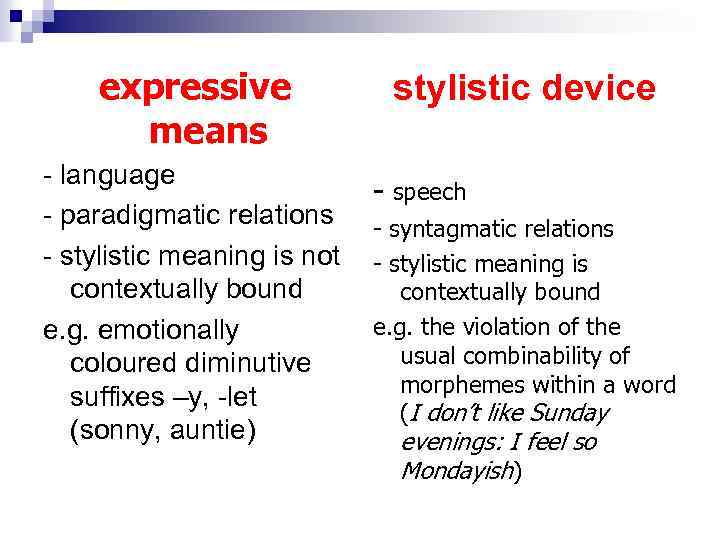 expressive means - language - paradigmatic relations - stylistic meaning is not contextually bound e. g. emotionally coloured diminutive suffixes –y, -let (sonny, auntie) stylistic device - speech - syntagmatic relations - stylistic meaning is contextually bound e. g. the violation of the usual combinability of morphemes within a word (I don’t like Sunday evenings: I feel so Mondayish)
 What is norm? The norm may be defined as a set of language rules which are considered to be the most standard and correct in a certain epoch and in a certain society.
 Types of norm: n language norm n stylistic norm n ethic/ecological norm
 n You n He look unkissable today. smelled the ever-beautiful smell of coffee, imprisoned in the can.
 What is Context? A linguistic context is the encirclement of a language unit by other language units in speech. Such an encirclement makes the meaning of the unit clear and unambiguous.
 Types of Context n Microcontext n Macrocontext n Megacontext (O. M. Morokhovsky)
 FOREGROUNDING In a literary text some elements (letters, words, expressions, etc. ) appear to be perceptually prominent, notable; in other words they get highlighted, emphasized, or foregrounded.
 FOREGROUNDING Capble of working at any language level, foregrounding comes in two main guises: n. As ‘a deviation from the norm’ n. As ‘more of the same’
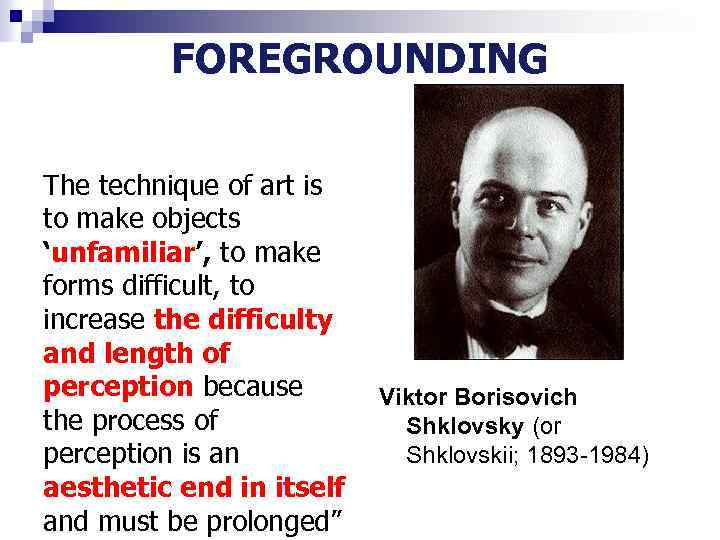 FOREGROUNDING The technique of art is to make objects ‘unfamiliar’, to make forms difficult, to increase the difficulty and length of perception because the process of perception is an aesthetic end in itself and must be prolonged” Viktor Borisovich Shklovsky (or Shklovskii; 1893 -1984)
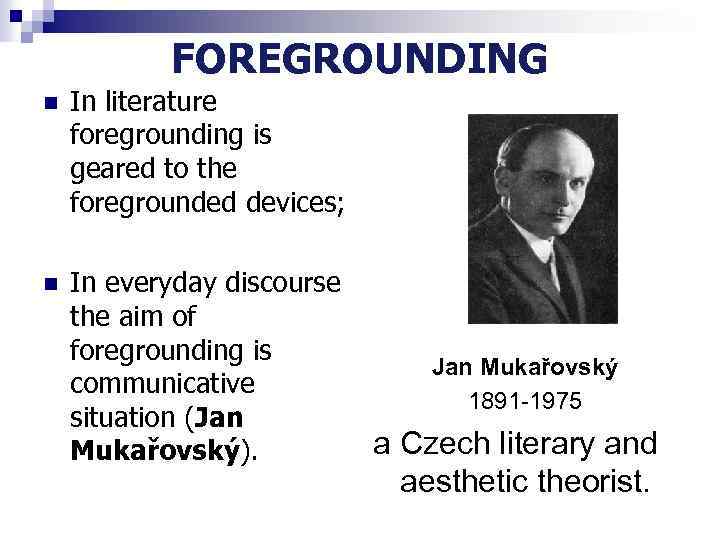 FOREGROUNDING n In literature foregrounding is geared to the foregrounded devices; n In everyday discourse the aim of foregrounding is communicative situation (Jan Mukařovský). Jan Mukařovský 1891 -1975 a Czech literary and aesthetic theorist.
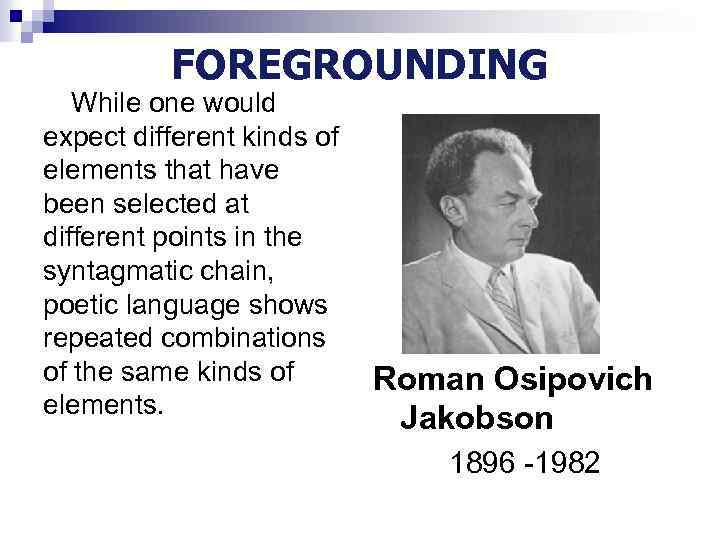 FOREGROUNDING While one would expect different kinds of elements that have been selected at different points in the syntagmatic chain, poetic language shows repeated combinations of the same kinds of Roman Osipovich elements. Jakobson 1896 -1982
 FOREGROUNDING This is the price and the promise of citizenship. This is the source of our confidence - the knowledge that God calls on us to shape an uncertain destiny. This is the meaning of our liberty and our creed.
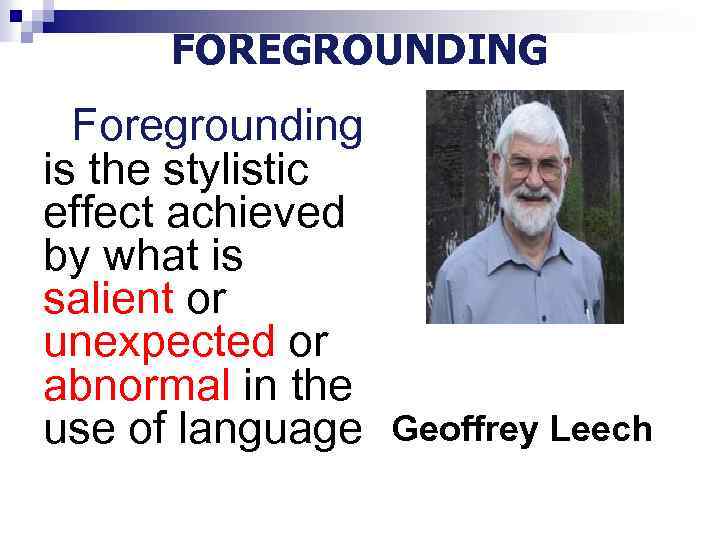 FOREGROUNDING Foregrounding is the stylistic effect achieved by what is salient or unexpected or abnormal in the use of language Geoffrey Leech
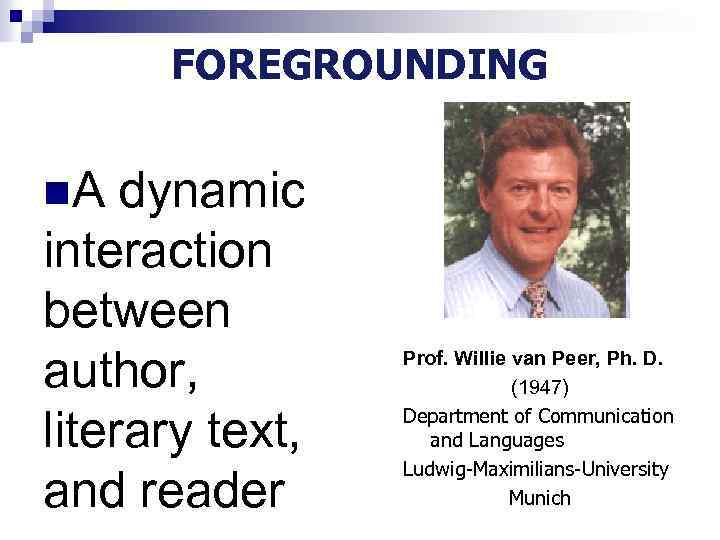 FOREGROUNDING n. A dynamic interaction between author, literary text, and reader Prof. Willie van Peer, Ph. D. (1947) Department of Communication and Languages Ludwig-Maximilians-University Munich
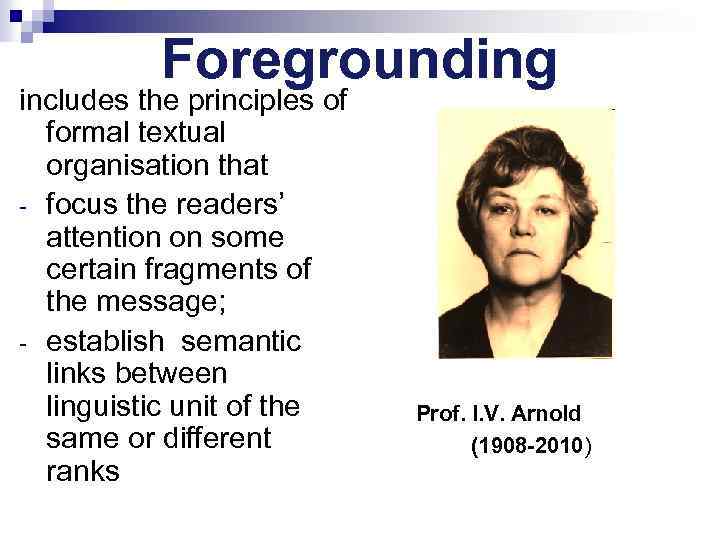 Foregrounding includes the principles of formal textual organisation that - focus the readers’ attention on some certain fragments of the message; - establish semantic links between linguistic unit of the same or different ranks Prof. I. V. Arnold (1908 -2010)
 Types of Foregrounding n Convergence n Coupling n Defeated Expectancy n Strong Positions (the title, the beginning, the end, epigraph); (Prof. I. V. Arnold)
 Convergence denotes a combination or accumulation of stylistic devices promoting the same idea, emotion or motive.
 Convergence n. The door opened and from the cushions within emerged a tall young man in a clinging dove-gray coat. After him, like the first breath of spring in the Champs-Elysee came Mrs. Beste-Chetwynde – two lizard skin feet, silk legs, chinchilla body, a tight little black hat, pinned with platinum and diamonds, and the high invariable voice that may be heard in any Pits Hotel from New York to Budapest. (E. Waugh)
 Coupling semantically relevant appearance of equivalent elements in equivalent position. Coupling is based on the affinity of elements that occupy similar positions throughout the text.
 FOREGROUNDING The affinity may be different in nature: phonetic, structural, semantic. § Phonetic affinity is provided by the phonetic stylistic devices (alliteration, assonance, paronomasia), as well as such prosodic features as rhyme, rhythm and meter.
 FOREGROUNDING § § Syntactical affinity is achieved by all kinds of parallelism and syntactical repetition – anadiplosis, anaphora, framing, chiasmus, epiphora, etc. Semantic coupling is demonstrated by the use of synonyms and antonyms, both direct and contextual, root repetition, paraphrase, sustained metaphor, semantic fields, recurrence of images, connotations or symbols.
 Coupling Lloyd Williams in Collieryville, a mining town three or four miles from 10 North Frederick, but separated from the Chapins’ home and their life by accepted differences of money and prestige; the miners’ poolroom, and the Gibbsville; sickening poverty, and four live-in-servants for a family of four, the Second Thursday, and the chicken-andwaffle suppers of the English Lutheran Church. Joe Chapin and Lloyd Williams were courthouse-corridor friends and fellow Republicans, but Joe was a Company man and Lloyd Williams was a Union man who was a Republican because to be anything else in Lantenengo County was futile and foolish. (O’Hara)
 FOREGROUNDING in defeated expectancy some element of the text receives prominence due to an interruption in the pattern of predictability.
 Defeated Expectancy Miss Fairfax, ever since I met you I have admired you more than any girl … I have met … since I met you. (O. Wilde)
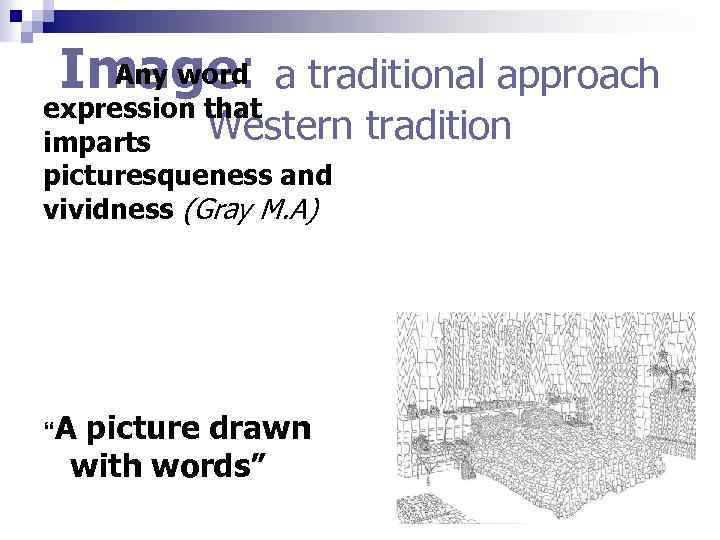 Any word Image: a traditional approach expression that Western tradition imparts picturesqueness and vividness (Gray M. A) “A picture drawn with words”
 Image: a traditional approach Russian and Ukrainian traditions qan artistic detail, metaphor or any trope; q a character (персонаж); qa means of cognition, a type of reflection of the surrounding (O. M. Morokhovsky)
 Image: a cognitive approach Image as a textual construal and a cognitive structure which has two planes n a conceptual plane n a verbal plane (L. Bieliekhova)
 IMAGE a verbal subjective description of this or another person, event, occurrence, sight made by the speaker with the help of the whole set of expressive means and stylistic devices. (L. P. Yefimov). a speech fragment that contains image -bearing information (O. M. Morokhovsky)
 Image Structure n Tenor n Vehicle n Ground n Relation between Tenor and Vehicle n Types of Comparison n Grammatical and Lexical features of Comparison (Prof. I. V. Arnold)
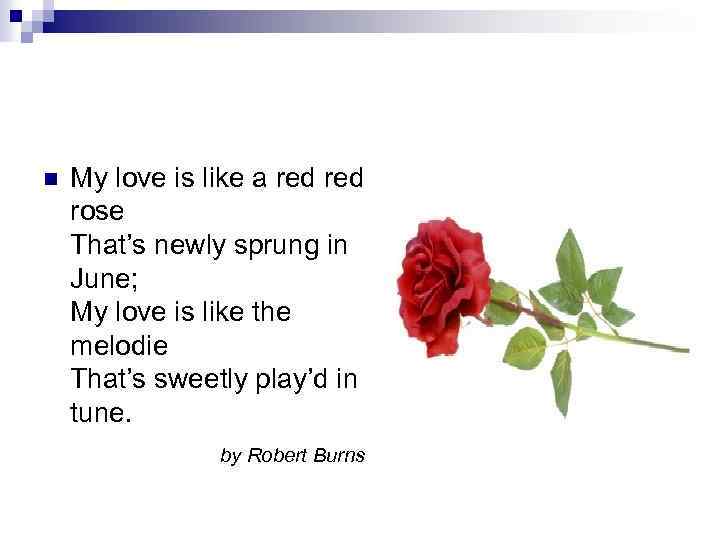 n My love is like a red rose That’s newly sprung in June; My love is like the melodie That’s sweetly play’d in tune. by Robert Burns
 What is Imagery? n Imagery in a broad sense is the property of fiction to convey not only logical (denotative), but also sensuous information (feelings, perceptions, ideas) (Prof. O. M. Morokhovsky). n The term imagery refers to combinations or clusters of images that are used to create a dominant impression.
 Figurative Description n does not refer to the object directly; n deals with the things associated with it; n usually contradicts the reality (to treat somebody with a cold shoulder, to be on the rocks); n appeals to senses, not to logical reasoning (Томашевский В. Б. )
 ‘Logical’ description n gives the information only about the subject matter of the utterance n it aims at an accurate description n it disregards impressions and emotions (Томашевский В. Б. )
 Bent Double, like old beggars under sacks, Knock-kneed, coughing like hags we cursed though sludge (From Fields of Vision)
 Physically exhausted, the soldiers marched across the wet terrain cursing their fate.
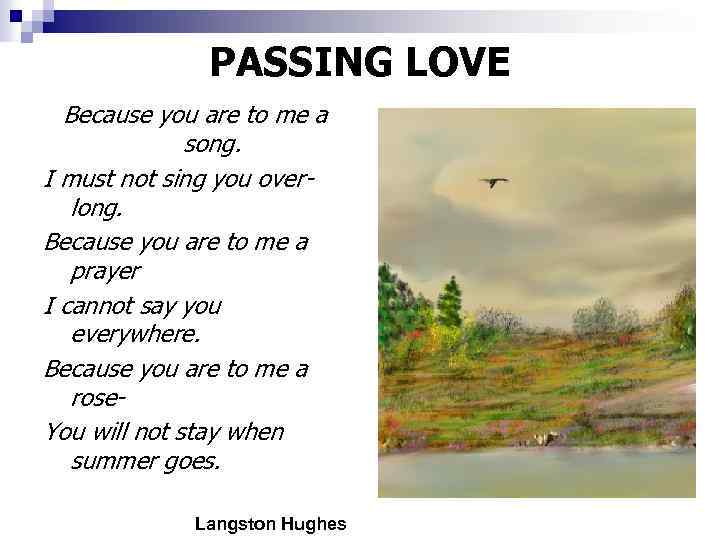 PASSING LOVE Because you are to me a song. I must not sing you overlong. Because you are to me a prayer I cannot say you everywhere. Because you are to me a rose. You will not stay when summer goes. Langston Hughes