 Скачать презентацию Theodore Roosevelt Theodore Teddy Roosevelt October 27
Theodore Roosevelt.pptx
- Количество слайдов: 15




Theodore Roosevelt

Theodore "Teddy" Roosevelt October 27, 1858 – January 6, 1919) was the 26 th President of the United States of America (1901– 1909). He is noted for his exuberant personality, range of interests and achievements, and his leadership of the Progressive Movement, as well as his "cowboy" persona and robust masculinity. He was a leader of the Republican Party and founder of the short-lived Progressive ("Bull Moose") Party of 1912. Before becoming President, he held offices at the city, state, and federal levels. Roosevelt's achievements as a naturalist, explorer, hunter, author, and soldier are as much a part of his fame as any office he held as a politician.

Childhood Theodore Roosevelt was born on October 27, 1858, in a four-story brownstone at 28 East 20 th Street, in the modern-day Gramercy section of New York City, the second of four children of Theodore Roosevelt, Sr. (1831– 1878) and Martha "Mittie" Bulloch (1835– 1884). He had an older sister, Anna, and two younger siblings: his brother Elliott (the father of future First Lady Eleanor Roosevelt) and his sister Corinne. Sickly and asthmatic as a child, Roosevelt had to sleep propped up in bed or slouching in a chair during much of his early years, and had frequent ailments. Despite his illnesses, he was hyperactive and often mischievous. [9] His lifelong interest in zoology was formed at age seven upon seeing a dead seal at a local market. After obtaining the seal's head, the young Roosevelt and two of his cousins formed what they called the "Roosevelt Museum of Natural History". Learning the rudiments of taxidermy, he filled his makeshift museum with animals that he killed or caught, studied, and prepared for display. At age nine, he codified his observation of insects with a paper titled "The Natural History of Insects". Encouraged by his father, the boy began exercising and boxing to combat his poor physical condition. Two trips abroad had a lasting impact: family tours of Europe in 1869 and 1870, and Egypt 1872 to 1873. Theodore, Sr. , had a tremendous influence on his son, who wrote of him, "My father, Theodore Roosevelt, was the best man I ever knew. He combined strength and courage with gentleness, tenderness, and great unselfishness. He would not tolerate in us children selfishness or cruelty, idleness, cowardice, or untruthfulness. "

Education Young "Teedie", as he was nicknamed as a child, was mostly home schooled by tutors and his parents. A leading biographer says: "The most obvious drawback to the home schooling Roosevelt received was uneven coverage of the various areas of human knowledge. "[13] He was solid in geography (thanks to his careful observations on all his travels) and well read in history, strong in biology, French, and German, but deficient in mathematics, Latin and Greek. He matriculated at Harvard College in 1876. His father's death in 1878 was a tremendous blow, but Roosevelt redoubled his activities. He did well in science, philosophy and rhetoric courses but fared poorly in Latin and Greek. He studied biology with considerable interest and was already an accomplished naturalist and published ornithologist. He had a photographic memory and developed a lifelong habit of devouring books, memorizing every detail. [14] He was an eloquent conversationalist who, throughout his life, sought out the company of the smartest people. He could multitask in impressive fashion, dictating letters to one secretary and memoranda to another, while browsing through a new book. While at Harvard, Roosevelt was active in rowing, boxing, the Alpha Delta Phi literary society, the Delta Kappa Epsilon fraternity, and was a member of the Porcellian Club. He also edited a student magazine. He was runner-up in the Harvard boxing championship. Upon graduating, Roosevelt underwent a physical examination, and his doctor advised him that because of serious heart problems, he should find a desk job and avoid strenuous activity. He chose to embrace strenuous life instead. [15] He graduated Phi Beta Kappa (22 nd of 177) from Harvard with an A. B. magna cum laude[16] in 1880 and entered Columbia Law School. When offered a chance to run for New York Assemblyman in 1881, he dropped out of law school to pursue his new goal of entering public life.
First marriage In 1880, Roosevelt married Alice Hathaway Lee (July 29, 1861 – February 14, 1884) of Chestnut Hill, Massachusetts. She died young of an undiagnosed case of kidney failure (in those days called Bright's disease) two days after their infant Alice was born. Her pregnancy had masked the illness. Theodore Roosevelt's mother Mittie died of typhoid fever on the same day, at 3 am, some eleven hours earlier, in the same house. After the nearly simultaneous deaths of his mother and wife, Roosevelt left his daughter in the care of his sister, Anna "Bamie/Bye" in New York City. In his diary, he wrote a large 'X' on the page and then, "The light has gone out of my life. " (See diary photo). For the rest of his life, Roosevelt never spoke of his wife Alice publicly or privately and did not write about her in his autobiography. As late as 1919, when Roosevelt was working with Joseph Bucklin Bishop on a biography that included a collection of his letters, Roosevelt did not mention either his first or second marriage, which took place in London.
Early political career The Naval War of 1812 While at Harvard, Roosevelt began a systematic study of the role played by the nascent US Navy in the War of 1812, largely completing two chapters of a book he would publish after graduation. Helped in part by his two uncles, he did his own research using original source materials and official US Navy records. Roosevelt's carefully researched book was comparable to modern doctoral dissertations, complete with drawings of individual and combined ship maneuvers, charts depicting the differences in iron throw weights of cannon shot between American and British forces, and analyses of the differences between British and American leadership down to the ship-to-ship level. Published after Roosevelt's graduation from college, The Naval War of 1812 was praised for its scholarship and style. This book established Roosevelt's reputation as a serious historian. One modern naval historian wrote: "Roosevelt’s study of the War of 1812 influenced all subsequent scholarship on the naval aspects of the War of 1812 and continues to be reprinted. More than a classic, it remains, after 120 years, a standard study of the war. "
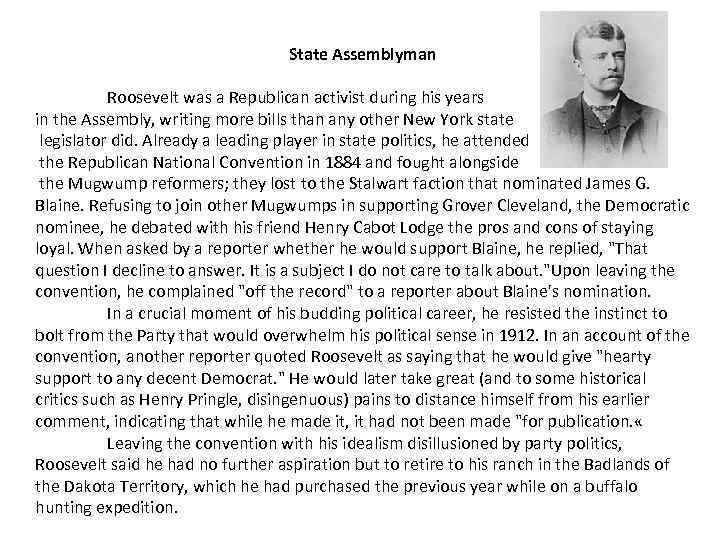
State Assemblyman Roosevelt was a Republican activist during his years in the Assembly, writing more bills than any other New York state legislator did. Already a leading player in state politics, he attended the Republican National Convention in 1884 and fought alongside the Mugwump reformers; they lost to the Stalwart faction that nominated James G. Blaine. Refusing to join other Mugwumps in supporting Grover Cleveland, the Democratic nominee, he debated with his friend Henry Cabot Lodge the pros and cons of staying loyal. When asked by a reporter whether he would support Blaine, he replied, "That question I decline to answer. It is a subject I do not care to talk about. "Upon leaving the convention, he complained "off the record" to a reporter about Blaine's nomination. In a crucial moment of his budding political career, he resisted the instinct to bolt from the Party that would overwhelm his political sense in 1912. In an account of the convention, another reporter quoted Roosevelt as saying that he would give "hearty support to any decent Democrat. " He would later take great (and to some historical critics such as Henry Pringle, disingenuous) pains to distance himself from his earlier comment, indicating that while he made it, it had not been made "for publication. « Leaving the convention with his idealism disillusioned by party politics, Roosevelt said he had no further aspiration but to retire to his ranch in the Badlands of the Dakota Territory, which he had purchased the previous year while on a buffalo hunting expedition.
Return to New York After the uniquely severe U. S. winter of 1886 -1887 wiped out his herd of cattle (together with those of his competitors) and his $60, 000 investment, Roosevelt returned to the East. In 1885, he had built Sagamore Hill in Oyster Bay, New York on Long Island, which was his home and estate until his death. In 1886, Roosevelt ran as the Republican candidate for mayor of New York City, portraying himself as "The Cowboy of the Dakotas"; he came in third. Second marriage Following the election, he went to London in 1886 and married his childhood sweetheart, Edith Kermit Carow. They honeymooned in Europe, and Roosevelt led a group to the summit of Mont Blanc, an achievement that resulted in his induction into the British Royal Society. They had five children: Theodore Jr. , Kermit, Ethel Carow, Archibald Bulloch "Archie", and Quentin.

Reentering public life Civil Service Commission In the 1888 presidential election, Roosevelt campaigned in the Midwest for Benjamin Harrison. President Harrison appointed Roosevelt to the United States Civil Service Commission, where he served until 1895. In his term, Roosevelt vigorously fought the spoilsmen and demanded enforcement of civil service laws. His close associate, friend and biographer, Joseph Bucklin Bishop, described Roosevelt's assault on the spoils system: The very citadel of spoils politics, the hitherto impregnable fortress that had existed unshaken since it was erected on the foundation laid by Andrew Jackson, was tottering to its fall under the assaults of this audacious and irrepressible young man. . Whatever may have been the feelings of the (fellow Republican party) President (Harrison) — and there is little doubt that he had no idea when he appointed Roosevelt that he would prove to be so veritable a bull in a china shop—he refused to remove him and stood by him firmly till the end of his term. During this time, the New York Sun described Roosevelt as "irrepressible, belligerent, and enthusiastic" Despite Roosevelt's support for Harrison's reelection bid in the presidential election of 1892, the eventual winner, Grover Cleveland (a Bourbon Democrat), reappointed him to the same post.
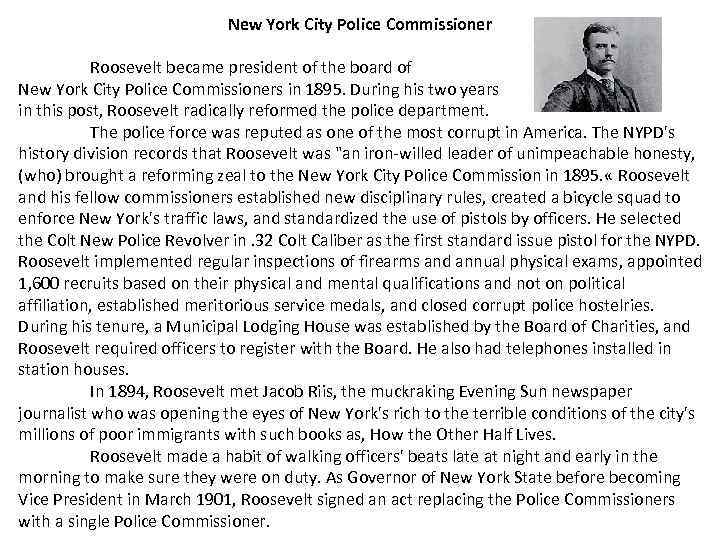
New York City Police Commissioner Roosevelt became president of the board of New York City Police Commissioners in 1895. During his two years in this post, Roosevelt radically reformed the police department. The police force was reputed as one of the most corrupt in America. The NYPD's history division records that Roosevelt was "an iron-willed leader of unimpeachable honesty, (who) brought a reforming zeal to the New York City Police Commission in 1895. « Roosevelt and his fellow commissioners established new disciplinary rules, created a bicycle squad to enforce New York's traffic laws, and standardized the use of pistols by officers. He selected the Colt New Police Revolver in. 32 Colt Caliber as the first standard issue pistol for the NYPD. Roosevelt implemented regular inspections of firearms and annual physical exams, appointed 1, 600 recruits based on their physical and mental qualifications and not on political affiliation, established meritorious service medals, and closed corrupt police hostelries. During his tenure, a Municipal Lodging House was established by the Board of Charities, and Roosevelt required officers to register with the Board. He also had telephones installed in station houses. In 1894, Roosevelt met Jacob Riis, the muckraking Evening Sun newspaper journalist who was opening the eyes of New York's rich to the terrible conditions of the city's millions of poor immigrants with such books as, How the Other Half Lives. Roosevelt made a habit of walking officers' beats late at night and early in the morning to make sure they were on duty. As Governor of New York State before becoming Vice President in March 1901, Roosevelt signed an act replacing the Police Commissioners with a single Police Commissioner.
Emergence as a national figure Assistant Secretary of the Navy Roosevelt had always been fascinated by naval history. Urged by Roosevelt's close friend, Congressman Henry Cabot Lodge, President William Mc. Kinley appointed Roosevelt to the post of Assistant Secretary of the Navy in 1897. Because of the inactivity of Secretary of the Navy John D. Long, this gave Roosevelt control over the department. Ten days after the battleship Maine exploded in the harbor of Havana, Cuba, the Secretary left for a massage, and Roosevelt became Acting Secretary for four hours. Roosevelt told the Navy worldwide to prepare for war, ordered ammunition and supplies, brought in experts, and went to Congress asking for authority to recruit as many sailors as he wanted, thus moving the nation toward war. Roosevelt was instrumental in preparing the Navy for the Spanish-American War and was an enthusiastic supporter of testing the U. S. military in combat, at one point saying, "I should welcome almost any war, for I think this country needs one".
Election of 1912 Republican primaries Despite his new doubts about Taft's leadership abilities, Roosevelt still was friendly towards him and was in favor of his re-election. On October 27, 1911, however, Roosevelt and Taft's deteriorating friendship officially came to an end when Taft's administration filed an antitrust suit against US Steel, which Roosevelt labeled as a "good trust". After he finally broke with Taft, Roosevelt saw himself as the only person who could save the Republican party from defeat in the upcoming Presidential election and announced himself as a candidate for the Republican nomination. Roosevelt, however, had delayed too long, and Taft had already won the support of most party leaders in the country. Because of La. Follette's nervous breakdown on the campaign trail before Roosevelt's entry, most of La. Follette's supporters went over to Roosevelt, the new progressive Republican candidate. Roosevelt, stepping up his attack on judges, carried nine of the states that held preferential primaries, La. Follette took two, and Taft only one. The 1912 primaries represented the first extensive use of the presidential primary, a reform achievement of the progressive movement. However, these primary elections, while demonstrating Roosevelt's continuing popularity with the electorate, were not nearly as pivotal as primaries became later in the century. There were fewer states where a common voter had an opportunity to express a recorded preference. Many more states selected convention delegates at state party conventions, or in caucuses, which were not as open as they later became. While Roosevelt was popular with the public, most Republican politicians and party leaders supported Taft, and their support proved difficult to counter in states without primaries.
Assassination attempt While Roosevelt was campaigning in Milwaukee, Wisconsin, on October 14, 1912, a saloonkeeper named John Schrank shot him, but the bullet lodged in his chest only after penetrating his steel eyeglass case and passing through a thick (50 pages) single-folded copy of the speech he was carrying in his jacket. Roosevelt, as an experienced hunter and anatomist, correctly concluded that since he was not coughing blood, the bullet had not completely penetrated the chest wall to his lung, and so declined suggestions he go to the hospital immediately. Instead, he delivered his scheduled speech with blood seeping into his shirt. He spoke for 90 minutes. His opening comments to the gathered crowd were, "Ladies and gentlemen, I don't know whether you fully understand that I have just been shot; but it takes more than that to kill a Bull Moose. " Afterwards, probes and x-ray showed that the bullet had traversed three inches (76 mm) of tissue and lodged in Roosevelt's chest muscle but did not penetrate the pleura, and it would be more dangerous to attempt to remove the bullet than to leave it in place. Roosevelt carried it with him for the rest of his life.
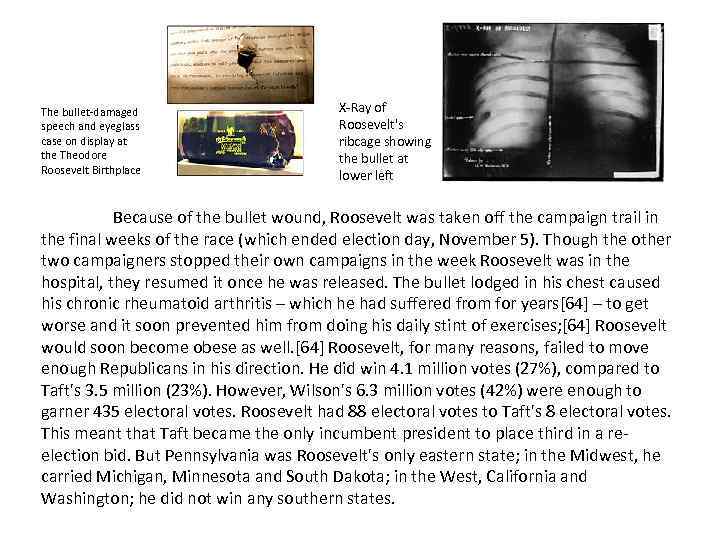
The bullet-damaged speech and eyeglass case on display at the Theodore Roosevelt Birthplace X-Ray of Roosevelt's ribcage showing the bullet at lower left Because of the bullet wound, Roosevelt was taken off the campaign trail in the final weeks of the race (which ended election day, November 5). Though the other two campaigners stopped their own campaigns in the week Roosevelt was in the hospital, they resumed it once he was released. The bullet lodged in his chest caused his chronic rheumatoid arthritis – which he had suffered from for years[64] – to get worse and it soon prevented him from doing his daily stint of exercises; [64] Roosevelt would soon become obese as well. [64] Roosevelt, for many reasons, failed to move enough Republicans in his direction. He did win 4. 1 million votes (27%), compared to Taft's 3. 5 million (23%). However, Wilson's 6. 3 million votes (42%) were enough to garner 435 electoral votes. Roosevelt had 88 electoral votes to Taft's 8 electoral votes. This meant that Taft became the only incumbent president to place third in a reelection bid. But Pennsylvania was Roosevelt's only eastern state; in the Midwest, he carried Michigan, Minnesota and South Dakota; in the West, California and Washington; he did not win any southern states.
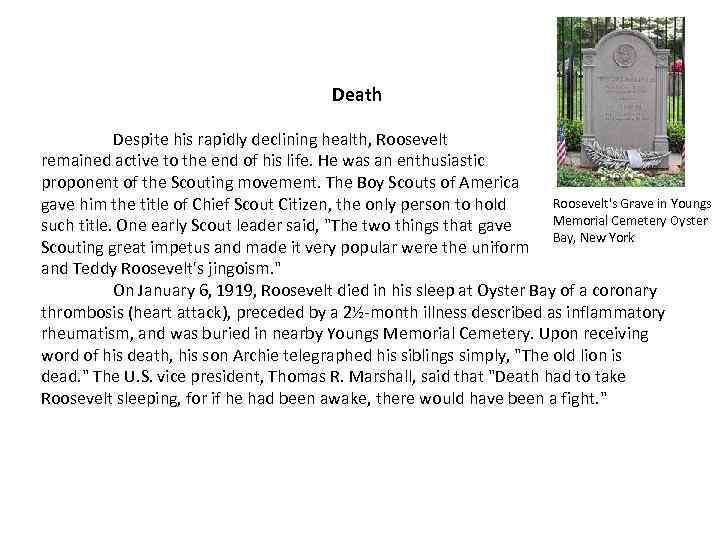
Death Despite his rapidly declining health, Roosevelt remained active to the end of his life. He was an enthusiastic proponent of the Scouting movement. The Boy Scouts of America Roosevelt's Grave in Youngs gave him the title of Chief Scout Citizen, the only person to hold Memorial Cemetery Oyster such title. One early Scout leader said, "The two things that gave Bay, New York Scouting great impetus and made it very popular were the uniform and Teddy Roosevelt's jingoism. " On January 6, 1919, Roosevelt died in his sleep at Oyster Bay of a coronary thrombosis (heart attack), preceded by a 2½-month illness described as inflammatory rheumatism, and was buried in nearby Youngs Memorial Cemetery. Upon receiving word of his death, his son Archie telegraphed his siblings simply, "The old lion is dead. " The U. S. vice president, Thomas R. Marshall, said that "Death had to take Roosevelt sleeping, for if he had been awake, there would have been a fight. "
Скачать презентацию Theodore Roosevelt Theodore Teddy Roosevelt October 27
Theodore Roosevelt.pptx