


 Скачать презентацию Theodore Roosevelt Theodore Roosevelt Jr was an
Theodore Roosevelt.pptx
- Количество слайдов: 7
 Theodore Roosevelt
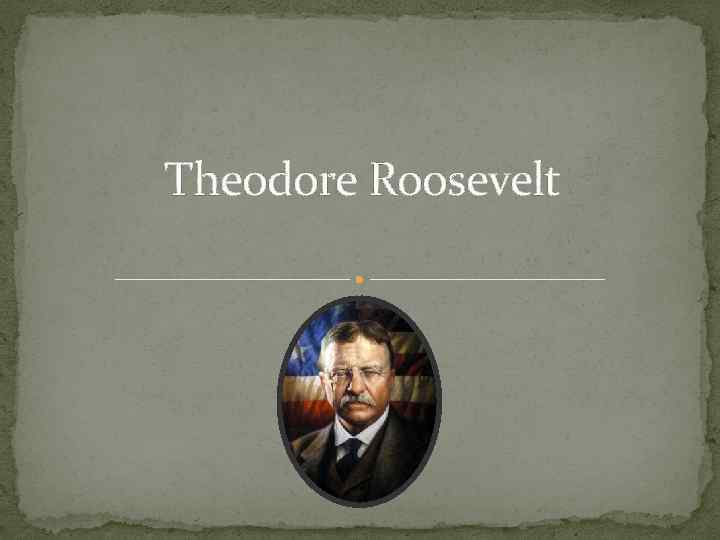
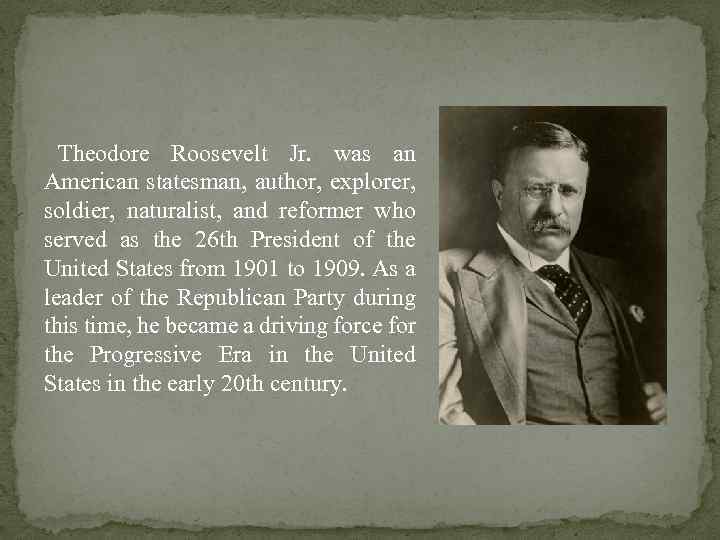 Theodore Roosevelt Jr. was an American statesman, author, explorer, soldier, naturalist, and reformer who served as the 26 th President of the United States from 1901 to 1909. As a leader of the Republican Party during this time, he became a driving force for the Progressive Era in the United States in the early 20 th century.
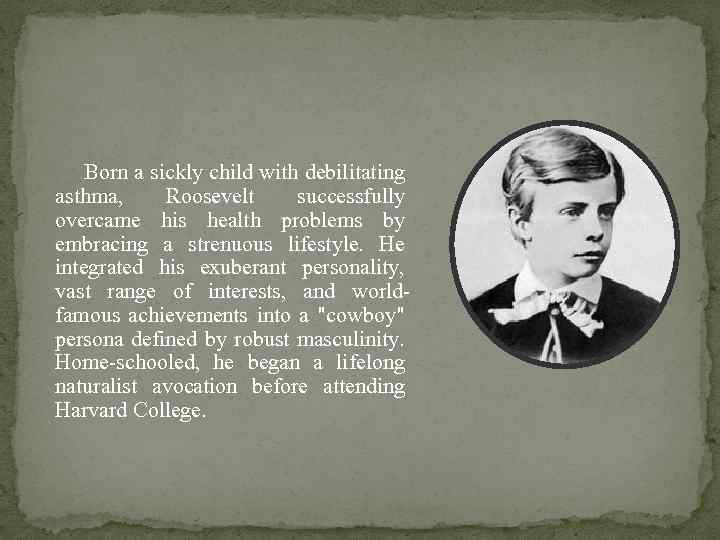 Born a sickly child with debilitating asthma, Roosevelt successfully overcame his health problems by embracing a strenuous lifestyle. He integrated his exuberant personality, vast range of interests, and worldfamous achievements into a "cowboy" persona defined by robust masculinity. Home-schooled, he began a lifelong naturalist avocation before attending Harvard College.
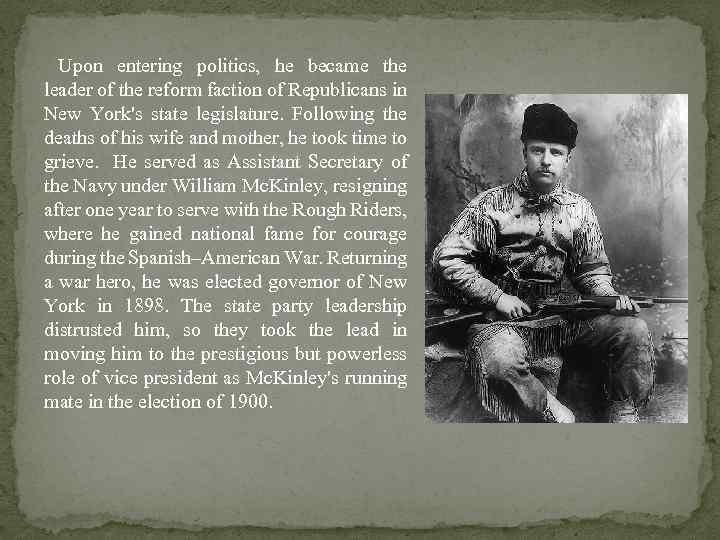 Upon entering politics, he became the leader of the reform faction of Republicans in New York's state legislature. Following the deaths of his wife and mother, he took time to grieve. He served as Assistant Secretary of the Navy under William Mc. Kinley, resigning after one year to serve with the Rough Riders, where he gained national fame for courage during the Spanish–American War. Returning a war hero, he was elected governor of New York in 1898. The state party leadership distrusted him, so they took the lead in moving him to the prestigious but powerless role of vice president as Mc. Kinley's running mate in the election of 1900.
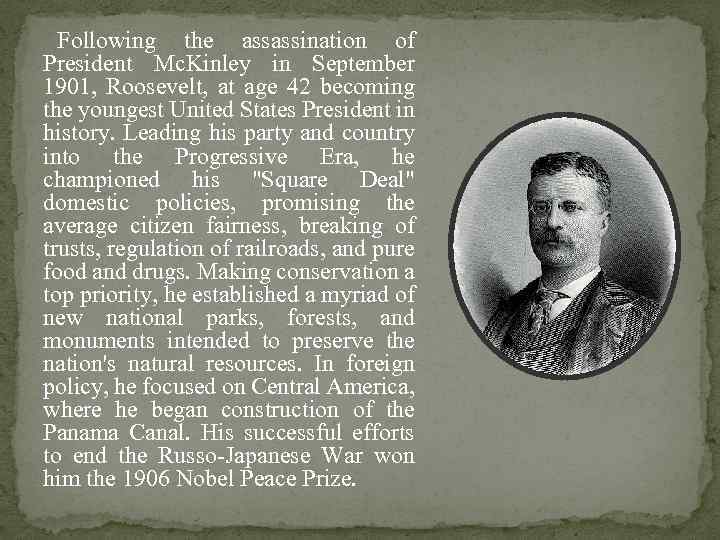 Following the assassination of President Mc. Kinley in September 1901, Roosevelt, at age 42 becoming the youngest United States President in history. Leading his party and country into the Progressive Era, he championed his "Square Deal" domestic policies, promising the average citizen fairness, breaking of trusts, regulation of railroads, and pure food and drugs. Making conservation a top priority, he established a myriad of new national parks, forests, and monuments intended to preserve the nation's natural resources. In foreign policy, he focused on Central America, where he began construction of the Panama Canal. His successful efforts to end the Russo-Japanese War won him the 1906 Nobel Peace Prize.
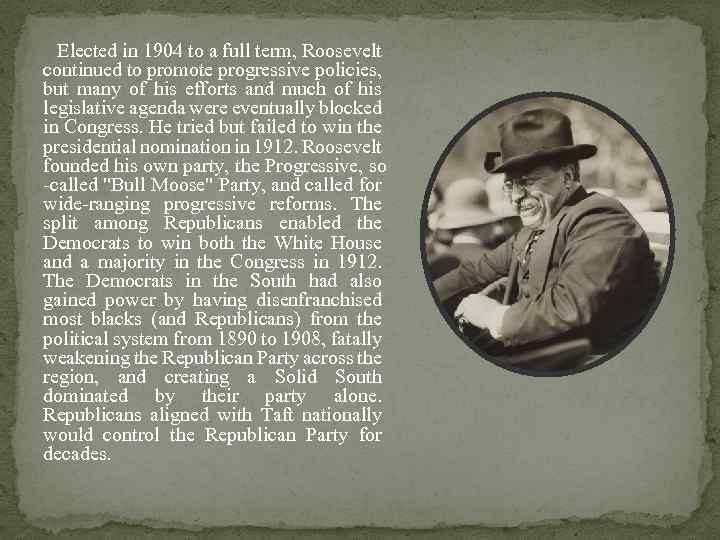 Elected in 1904 to a full term, Roosevelt continued to promote progressive policies, but many of his efforts and much of his legislative agenda were eventually blocked in Congress. He tried but failed to win the presidential nomination in 1912. Roosevelt founded his own party, the Progressive, so -called "Bull Moose" Party, and called for wide-ranging progressive reforms. The split among Republicans enabled the Democrats to win both the White House and a majority in the Congress in 1912. The Democrats in the South had also gained power by having disenfranchised most blacks (and Republicans) from the political system from 1890 to 1908, fatally weakening the Republican Party across the region, and creating a Solid South dominated by their party alone. Republicans aligned with Taft nationally would control the Republican Party for decades.
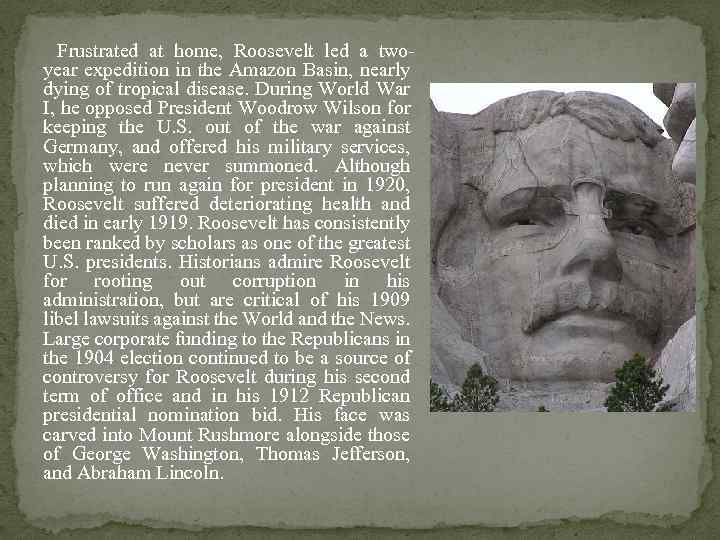 Frustrated at home, Roosevelt led a twoyear expedition in the Amazon Basin, nearly dying of tropical disease. During World War I, he opposed President Woodrow Wilson for keeping the U. S. out of the war against Germany, and offered his military services, which were never summoned. Although planning to run again for president in 1920, Roosevelt suffered deteriorating health and died in early 1919. Roosevelt has consistently been ranked by scholars as one of the greatest U. S. presidents. Historians admire Roosevelt for rooting out corruption in his administration, but are critical of his 1909 libel lawsuits against the World and the News. Large corporate funding to the Republicans in the 1904 election continued to be a source of controversy for Roosevelt during his second term of office and in his 1912 Republican presidential nomination bid. His face was carved into Mount Rushmore alongside those of George Washington, Thomas Jefferson, and Abraham Lincoln.