 Скачать презентацию Theme Spoken speech of teenagers between 15 -20
maray.pptx
- Количество слайдов: 17



Theme Spoken speech of teenagers between 15 -20 years old
We were preparing on the main issue of our work: what slang dialects are the jargon used by teenagers? ? ?
To date, youth slang can rightly become an independent discipline in the faculties of linguistics. Containing in itself a huge number of even phenomenal linguistic word-formations, the modern slang of youth surprises with its prevalence and popularity among the most diverse areas of our life activity. This phenomenon though is called "youth" slang, however it can not be limited neither by age, nor by social environment of application. Almost all categories of people on the planet speak it. But most of all youth slang occurs in the speech of adolescents
The very word "slang" comes from English "slang" - jargon and carries the concept of youth slang as a set of dialects, colloquial and everyday speech of youth.
The words of youth slang are often abbreviated variants of a common word or even a phrase. For example, a modern youth slang (dictionary): keyboard - a keyboard, a pedic - a student of the pedagogical department or a person of non-traditional orientation, IMHO - I have an opinion, I want to voice, etc. And also the slang of the borrowed vocabulary of a foreign language: av, avatars - avatar, crazy people - crazy people, aftertapati - after party, etc. , which is the most popular in modern youth slang. This is not the whole classification. There is a large number of examples from the dictionary of youth slang, the formation of which is difficult, and more often and completely impossible to find out. But they can be grouped.
We must preserve the purity of our language and guard against unnecessary words
Teenage or, in a different way, school slang can be heard in any yard where children meet, approximately, of the same age up to 15 -20 years. Slang of teenagers (examples)
Icha - from the "teacher" (teacher). Lafa, roll cotton wool - do nothing. Stole, stolen, copied. Spur - crib. The theme is excellent, I like it. Bro - from "brother" (brother). To see is to look. Knocking - mischief. Nishtyak - well, go, not bad. Pipe, cover - punishment for misconduct. In crowbar - laziness. Bummer - when the actual did not coincide with th expectation. Brake, tupac - stupid. In nature, even - conviction. Dude, chuvak - guy, kid.

Beregovskaya E. M. Allocates more than 10 ways of forming functional units of slang, thereby confirming thesis about the constant updating of the slang vocabulary. The first place in terms of productivity comes from foreign language borrowings (a dude is a guy (from the Gypsy language), mostly English-speaking, this way is organically combined with affixation, so the word comes in a Russified form at once: for example: thank you - senka; (Parents) - parents, prents, birthday (birthday) - a pit, beznik.
In the youth environment, the slang has been around for a long time (the jargon of schoolboys, seminarians). The main thing in this linguistic phenomenon is a departure from everyday life, play, irony, mask. The disciplined, laid-back youth jargon strives to escape from the boring world of adults, parents and teachers. They say: Good! And we: Cool! Fun! They: That's bad luck! We: Well, bummer! They: It's too complicated! We: Do not load me! They admire, we stick out and weep.
Language is a piece of people's lives L. B. Sherba Language is a piece of people's lives Statistics show that slang is inherent in young people 1520 when entering into an adult conscious life, young people stop actively using slang expressions
Interesting facts about jargon In the dystopia "Clockwork Orange" Anthony Burgess put into the mouth of the teenage heroes a fictional jargon called Nadsat. Most of the words nadsata had a Russian origin - for example, droog (friend), litso (person), viddy (see). The very word Nadsat is formed from the end of Russian numerals from 11 to 19, its meaning is the same as that of the word teenager ("nadtsatiletnik"). The translators of the novel in Russian are faced with the difficulty of how to adequately convey this slang. In one translation variant, such words were replaced by English words written in Cyrillic (men, face, etc. ). In another version, the words of the jargon were left in the original form in Latin letters.
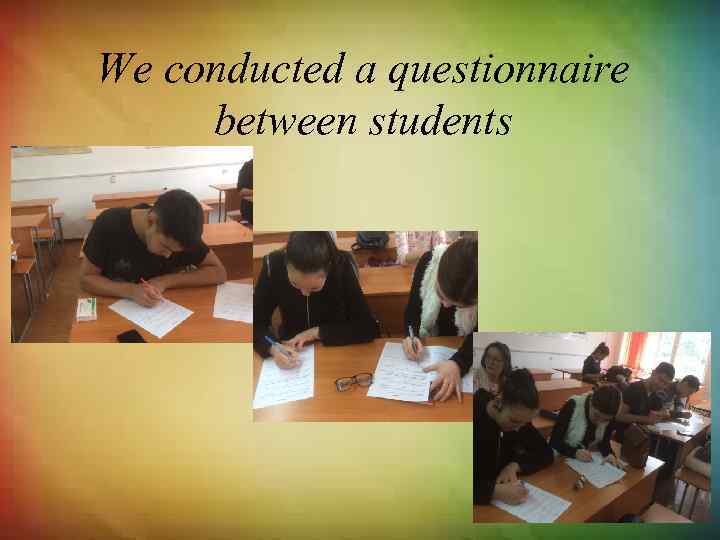
We conducted a questionnaire between students
When completing the questionnaire, we learned that most of our students use Russian words and slang. This of course did not please us. We are now afraid not to mess our tongue. All begin with us from you. Language is our life, thanks to the language we live, we breathe
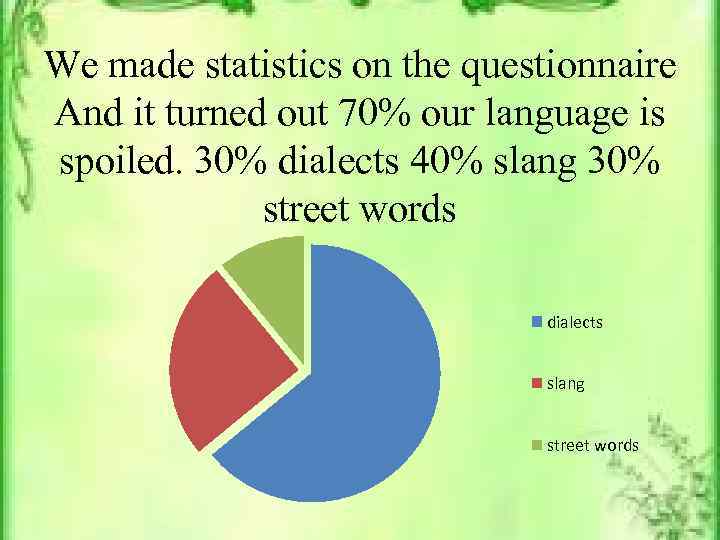
We made statistics on the questionnaire And it turned out 70% our language is spoiled. 30% dialects 40% slang 30% street words dialects slang street words
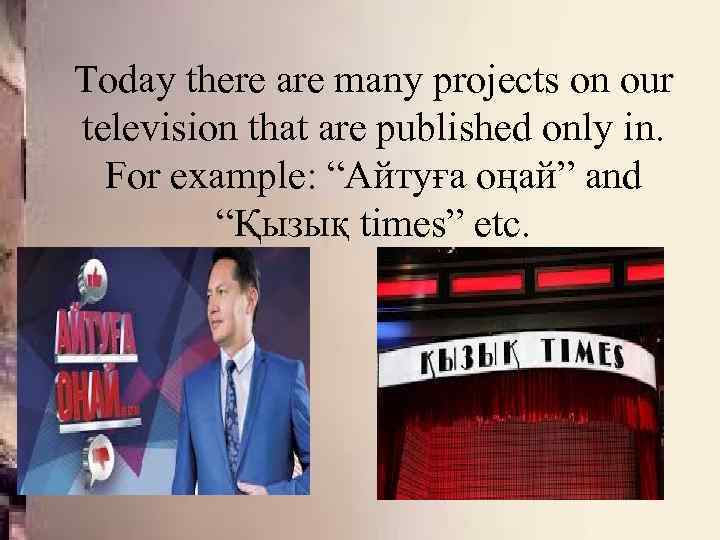
Today there are many projects on our television that are published only in. For example: “Айтуға оңай” and “Қызық times” etc.
 Скачать презентацию Theme Spoken speech of teenagers between 15 -20
maray.pptx